
The Best Garden Wagons and Folding Trolleys for Hauling Everything
Folding fabric wagons and heavyweight carts for compost, tools, firewood, pots, plants and the assorted clutter that somehow accumulates at the far end of a British garden.
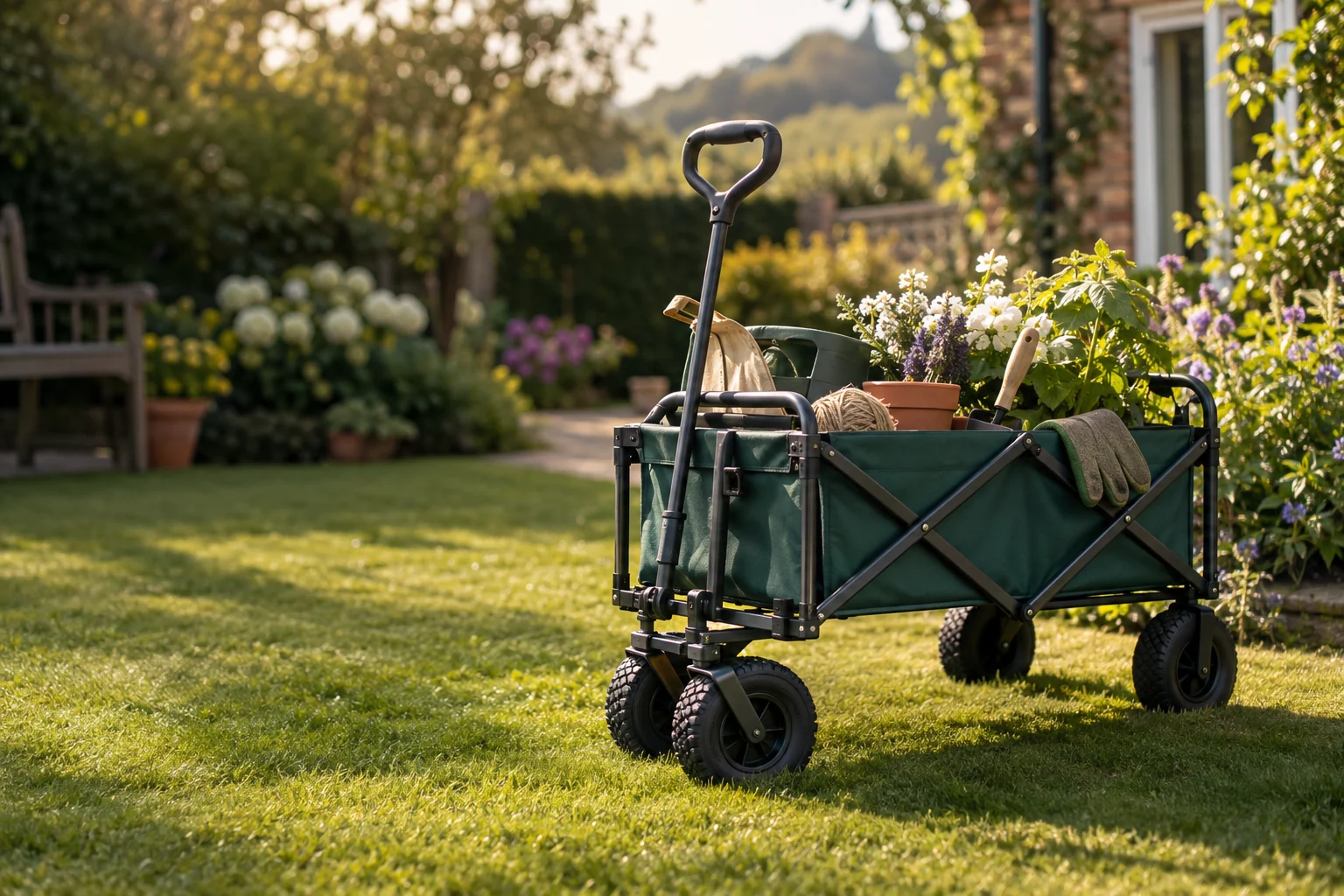
Why Your Wheelbarrow Isn't Cutting It Anymore
It is early October, which means the garden is beginning to ask for a particular sort of physical labour. There are bags of compost to move before autumn planting. There are fallen branches to clear, pots to shuffle into shelter, logs to bring in before a wet weekend, and tools to return to the shed after a job that somehow became three jobs. The wheelbarrow, faithful old thing, is usually pressed into service.
And then it tips sideways on the lawn.
A conventional wheelbarrow is brilliant at moving loose material: soil, gravel, manure, prunings and rubble. It is less brilliant at carrying a collection of awkward things that refuse to behave as one load. A bag of bark mulch slides to one side. A fork catches on the rim. Three terracotta pots roll about like they are trying to escape. On a narrow path, the single front wheel needs a surprising amount of concentration. If the tyre is soft, you have been handed a small upper-body workout before breakfast.
That is where folding fabric wagons and heavy-duty garden trolleys have become genuinely useful. They are not replacements for every wheelbarrow task, and anyone shifting a mound of topsoil will still appreciate a proper barrow. But for contained loads, several bags, garden tools, plants, firewood and family-garden miscellany, a four-wheeled wagon is often calmer, more stable and considerably less irritating.
The other advantage is domestic rather than heroic: storage. A wheelbarrow is always there, taking up room in the shed or leaning against a fence with the sad dignity of abandoned garden furniture. A collapsible wagon is designed to shrink down between jobs. That matters in smaller UK gardens, town gardens and allotment sheds where a rake, a lawnmower and a single chair already appear to occupy the same square metre.
The useful distinction
Think of a folding wagon as a movable crate on wheels. It is at its best with bagged, boxed, potted or bundled loads. Think of a wheelbarrow as a scoop. It remains the more sensible choice for loose soil, wet concrete, rubble and anything you intend to tip out.
This guide looks at seven independently made wagons and trolleys: the Mac Sports WTC-111, Coleman XL Collapsible Wagon, Originsure 48-Inch Collapsible Wagon, Vivosun Heavy-Duty Collapsible Folding Wagon, Sekey Collapsible Foldable Wagon Cart, ROSONG Collapsible Wagon Cart and Blomoba Collapsible Wagon.
There is quite a spread here. Some are light, compact carriers for occasional pots and tools. Others are serious, broad-shouldered carts intended for large wood runs and bulky garden materials. The important thing is not simply buying the wagon with the biggest number printed beside it. It is choosing one that suits your paths, your storage, your typical load and, crucially, the sort of mud your garden produces after two days of rain.
Eight Wagons, One Showdown: Meet the Contenders
Before getting into handles, wheels and collapsed frames, here is the short version. All seven wagons are aimed at the same broad problem: moving a lot of garden kit without repeatedly carrying it in your arms. Yet they approach that problem very differently.
The Mac Sports WTC-111 is the familiar all-round folding wagon. It is the one many people recognise from garden centres, markets, campsites and school sports days. Its modest 68 kg (150 lb) load rating is not the biggest here, but its proportions, steel frame, 600D polyester fabric and quick-fold format make it a sensible general garden companion.
The Coleman XL Collapsible Wagon moves into a much more muscular category. Its stated capacity is 181 kg (400 lb), with more than 189 litres of volume. The combination of a large fabric body, all-terrain wheels and one-pull folding makes it the obvious option for gardeners who routinely carry big, bulky loads rather than merely lots of small ones.
The Originsure 48-Inch Collapsible Wagon is larger again in concept: a 122 cm (48 in) wagon with 300 litres of capacity and a 254 kg (560 lb) static load rating. That word static matters. A cart can support a very large weight while stationary, but moving that same load over an uneven lawn is a different question altogether. Still, its thickened steel, triangle-frame arrangement and diagonal rear support rods put it firmly into the heavy-haul bracket.
The Vivosun Heavy-Duty Collapsible Folding Wagon takes a middle course, pairing a metal frame and canvas bed with a stated 159 kg (350 lb) capacity. Its particular point of difference is the cushioned bottom, which makes it more sympathetic to potted plants and other fragile cargo than a bare, hard cart base.
The Sekey Collapsible Foldable Wagon Cart has a 150 kg (330 lb) capacity, a responsive handle with a lock function, brakes on its wheels and a cover that zips. Those are useful practical details if the wagon will be parked on a slope, used near a driveway, or stored in a shed where dust, leaves and cobwebs are apparently running their own small country.
The ROSONG Collapsible Wagon Cart is one of the lightest models in this guide; however, its weight is listed inconsistently across sources (approximately 12 lb or 18 lb — figures conflict and could not be resolved at time of writing). Its capacity is similarly subject to conflicting data (250 lb on the product page; 350 lb on some retailer listings — the more conservative 250 lb figure should be taken as a guide until this is resolved). Its 150-litre capacity, 600D Oxford fabric, rotating front wheels and compact folded size make it appealing where lifting the wagon in and out of a car or carrying it up a few steps is part of the routine.
Finally, the Blomoba Collapsible Wagon is an 5 kg (11 lb), no-assembly option with a carbon-steel frame, 300D Oxford fabric and a stated capacity of 100 kg (220 lb). It is compact and uncomplicated: a practical answer for gardeners who want a wagon that can be opened, loaded and put away without a mechanical relationship developing between them.
| Model | Best suited to | Stated capacity | Notable detail |
|---|---|---|---|
| Mac Sports WTC-111 | Everyday mixed garden jobs | 68 kg (150 lb) | 600D polyester, 7-inch ball-bearing wheels |
| Coleman XL | Bulky, heavy garden loads | 181 kg (400 lb) | More than 189 litres; all-terrain wheels |
| Originsure 48-Inch | Maximum-volume hauling | 254 kg (560 lb) static | 300-litre body; 122 cm length |
| Vivosun Heavy-Duty | Plants, pots and heavier mixed loads | 159 kg (350 lb) | Cushioned canvas-bed base |
| Sekey Foldable Cart | Controlled parking and compact storage | 150 kg (330 lb) | Wheel brakes and handle lock |
| ROSONG Wagon Cart | Lightweight lifting and car transport | See product guidance | 5.4 kg weight; detachable wheels |
| Blomoba Wagon | Simple, lighter garden jobs | 100 kg (220 lb) | 5 kg weight; no assembly |
Capacity figures are a useful guide, not an invitation to load a wagon until the fabric strains and the wheels disappear into turf. With any trolley, terrain, slope, load shape and how much control you have over it matter as much as the headline rating.
The Mac Sports WTC-111: Still the Garden Wagon Everyone Copies
There is a reason the Mac Sports WTC-111 has become the reference point for this entire category. It has not tried to reinvent garden transport. It simply combines the things most people need: a steel frame, tough fabric body, usable wheels, a telescopic handle and a fold that does not require a degree in camping equipment.
At 10 kg (22 lb), it is not a featherweight. That is actually part of its appeal. It feels like a proper object rather than a bag with aspirations. The heavy-duty powder-coated steel frame gives the wagon its structure, whilst the fabric body is made from 600-denier polyester. In practical terms, 600D describes a relatively robust fabric construction for a folding wagon. It should not be confused with being indestructible—sharp secateur blades and jagged paving are still perfectly capable of making a bad day of it—but it is more reassuring for garden use than the thinner materials often found on very light wagons.
The bed measures 80 cm long by 44.5 cm wide by 25.4 cm deep when open. Those dimensions are especially useful for garden work because they accommodate the awkward mix of long and bulky items we all end up shifting: a broom, hand tools, a small stack of pots, bags of bulbs, gloves, watering cans and that one piece of plastic edging you have been meaning to install since April.
The 17.8 cm (7 in) wheels use a ball-bearing assembly. That is a more meaningful detail than it sounds. A wagon with decent bearings feels less reluctant when you pull it across a firm lawn or along paving. You are still dragging a load, of course; no wheel turns wet grass into a polished warehouse floor. But the movement is smoother and the handle has less of that unpleasant jerking sensation that makes a load feel heavier than it is.
Its telescopic handle swivels easily, which is useful when navigating a turn around a greenhouse corner or trying to avoid flattening the last of the autumn asters. There are also two cup holders. In a garden context, these are less important than the frame and wheels, but they are handy for a water bottle, a packet of labels or the screw fittings you will otherwise place "somewhere safe" and never see again.
The stated load capacity is 68 kg (150 lb). That is enough for a good deal of ordinary garden life, but it sets the Mac Sports apart from the bigger Coleman, Vivosun, Sekey and Originsure models. If your regular work involves repeated heavy wood runs or large-scale landscaping materials, this is not the one to stretch beyond its natural role. Its strength is versatility, not brute force.
For UK conditions, the powder-coated frame is welcome. Damp grass, muddy tyres and an unheated shed are not unusual from now through winter, and metal equipment lasts better when it is not routinely put away dripping wet. After a wet job, brush off clods of soil, wipe the frame and wheels where practical, and allow the fabric to dry before folding it into its carry case. This is unglamorous advice. It is also how you avoid opening a wagon in March to discover a smell with ambitions of its own.
What works well
- Sturdy steel-and-600D-fabric construction for mixed garden loads.
- Ball-bearing wheels are a useful upgrade for repeated pulling.
- Telescopic swivel handle is easy to steer around beds and paths.
- Folds in about five seconds and includes a carry case.
Keep in mind
- Its 68 kg capacity is lower than the heavy-haul contenders here.
- At 10 kg, it is more substantial than the ultralight options.
- Fabric-sided wagons are not intended for loose soil or rubble.
For many gardens, that balance is precisely right. You want a trolley that will carry a weekend's worth of jobs, fold away afterwards and not feel too precious to get muddy. The Mac Sports WTC-111 has remained popular because it does the ordinary things well. Garden equipment does not always need to be dramatic. It just needs to save your back on a Sunday afternoon.
Coleman XL and Originsure: When the Job Demands Serious Muscle
There is a point where the compact, all-purpose wagon stops being the obvious answer. Perhaps you heat with logs and make regular runs from wood store to house. Perhaps you have a long garden and the compost bays are inconveniently far from the borders. Perhaps autumn is when you shift a lot of pots, bark, foliage and garden furniture before winter. This is where the Coleman XL and Originsure 48-Inch models start to make more sense.
The Coleman XL has a stated capacity of 181 kg (400 lb) and more than 189 litres of volume. That is a considerable step beyond the Mac Sports' 68 kg rating. It also has all-terrain wheels and a one-pull folding mechanism, two details that tell you what sort of user it is aimed at: someone who wants a collapsible wagon, but does not want the compact design to limit the amount it can carry.
Volume is as important as weight with firewood, autumn prunings and bags of dry leaves. These loads can be light for their size, then unexpectedly heavy once they are damp. A big wagon prevents the tedious business of stacking everything precariously high, where a sharp turn results in a slow-motion avalanche of logs or plant pots. It is not merely about taking more in one trip. It is about taking a more stable load in one trip.
The Originsure is more specialised still. It is 122 cm (48 in) long, offers 300 litres of capacity and has a stated static rating of 254 kg (560 lb). The triangle structure and diagonal rear support rods are intended to keep the thickened-steel frame rigid under load. A reported test loaded it with 227 kg (500 lb) of wet soil while the frame remained rigid. That gives useful context for the cart's intended strength, although common sense remains essential: hauling a stationary test load over rutted ground is not the same thing as moving it around a garden.
Heavy capacity needs sensible loading
Put the densest items low and central, keep the load below the top edge where possible, and do not assume a high rating makes a loaded wagon easy to control downhill. If you would hesitate to wheel it towards your toes, reduce the load.
Both carts address a real annoyance with conventional steel garden trolleys: storage. A rigid trolley can be superb at moving materials, but it requires permanent floor space. The Coleman's one-pull fold gives it the practical advantage of a collapsible wagon despite its larger ambitions. The Originsure offers large capacity in a folding design, making it attractive for people whose garden work is substantial but whose shed is not.
There are trade-offs. A larger wagon needs more turning room. On a narrow side passage, a wide load of bags or logs can catch on posts, fences and greenhouse staging. It may be stronger than a basic wagon, but it cannot negotiate a route that simply is not wide enough. Measure tight gateways before choosing a large-capacity cart. It is a dull thing to do. It is much less dull than discovering your new trolley cannot reach the place it was bought to serve.
For October jobs, these are the models to consider if you are moving substantial loads of firewood, clearing a large leaf fall, bringing containers into a protected spot, or transporting materials for new planting. Come spring, they will also suit the annual rush of compost, growbags, supports, seed trays and the inexplicable number of pots acquired over winter.
The Lighter-Duty Brigade: Wakeman, ROSONG and Blomoba Reviewed
Not every wagon has to be built for an estate garden. In fact, some of the most useful choices are the ones you are happy to lift from the shed, put in the boot and use without a planning meeting. Wakeman, ROSONG and Blomoba occupy that part of the market: practical folding trolleys for gardeners whose jobs are real but not relentlessly heavy.
The Wakeman Outdoors Folding Wagon is the uncomplicated alternative in this group. Its appeal is the familiar format: fabric body, collapsible frame and the ability to take a mixed load from one part of the garden to another. If your normal haul is a few hand tools, packets of bulbs, a watering can, trugs of harvested vegetables or several small pots, simplicity has considerable value.
I would not buy any light folding wagon on the assumption that it will replace a contractor's cart. That is not a criticism. It is simply matching the tool to the work. Occasional garden use is a perfectly respectable category. There is no prize for owning the heaviest trolley if it spends eleven months of the year blocking the shed door.
The ROSONG is particularly interesting for its low stated weight and 150 litres of storage, though its weight is listed inconsistently across sources (approximately 12 lb or 18 lb — this conflict could not be resolved at time of writing and the lower figure should not be taken as settled fact). Its front wheels rotate through 360 degrees, and the wheels can be detached for cleaning. Those two details are more relevant to gardening than they initially sound. Manoeuvrability is useful around beds and narrow paved areas, whilst detachable wheels make it easier to deal with the inevitable film of mud, grass and decomposing leaf matter that collects after autumn use.
When open, the ROSONG measures 71.1 cm deep by 43.2 cm wide by 83.8 cm high. Folded, it is 55.9 cm by 24.9 cm by 19.1 cm. That compact folded form is a genuine asset for households with a small shed, a garage shelf or a need to transport the wagon by car. The 600D Oxford fabric and thick steel frame are encouraging construction details for a lightweight cart, but it remains sensible to keep sharp tools sheathed and avoid dragging the fabric body over rough surfaces.
The Blomoba is even lighter at 5 kg (11 lb). It has a carbon-steel frame, 300D Oxford fabric, rotating wheels and a 100 kg (220 lb) stated load capacity. Its open dimensions are 69 cm deep by 42 cm wide by 45.5 cm high. It requires no assembly, which sounds almost too obvious to mention until you have spent a grey Saturday morning staring at an instruction sheet and eight identical bolts.
ROSONG: compact after use
Its 55.9 × 24.9 × 19.1 cm folded size is a practical fit for gardeners who cannot spare a permanent parking bay for a trolley.
ROSONG: wheels designed for manoeuvring
360-degree rotating front wheels make it easier to change direction around beds, patio furniture and greenhouse corners.
Blomoba: ready without assembly
For a straightforward household trolley, being able to open it and get on with the job is a worthwhile advantage.
Lightweight handling
At around 5 kg (Blomoba) and a manufacturer-stated weight that remains subject to conflicting data (approximately 12 lb or 18 lb for the ROSONG — unresolved at time of writing), both are easier to lift into storage than the 10 kg Mac Sports.
The obvious compromise with ultralight designs is that they are less naturally reassuring under truly bulky loads. A wagon can have an impressive capacity figure, but practical comfort depends on wheel behaviour, path condition and whether the load is stable. For several bags of compost, consider splitting the journey rather than loading to the point where you have to wrestle it over a threshold. Your back will not send a thank-you note, but it will quietly remain on speaking terms with you.
For gardeners with small plots, patios, rented homes or allotments, these lighter models are often the most realistic purchase. They make the repeated little journeys easier: tools to the plot, harvest back to the car, pots to the tap, firewood from stack to door. Gardening is full of repeated little journeys. Removing the worst of them is not glamorous, but it is very effective.
Vivosun and Sekey: The Feature-Packed Middle Ground
If the Mac Sports is the everyday all-rounder and the Coleman and Originsure represent the heavyweight end, the Vivosun and Sekey models sit in a useful middle ground. They have considerably higher stated capacities than the classic compact wagon, but retain the folding convenience that makes this category so attractive in the first place.
The Vivosun Heavy-Duty Collapsible Folding Wagon has a stated capacity of 159 kg (350 lb), a metal frame, canvas bed and 17.8 cm (7 in) hard wheels with ball-bearing assemblies. The front axle connects to a telescopic handle that swivels, helping with steering. Its wheels are solid plastic rather than pneumatic, so there is no need to inflate them or worry about punctures. On the other hand, solid wheels do not offer the cushioning of an air-filled tyre when you are bumping over rough ground.
The feature that distinguishes the Vivosun is its cushioned bottom. That makes genuine sense in a garden, especially during the container-moving season. Terracotta pots do not enjoy repeated jolts. Neither do seed trays, ceramic planters, a newly purchased shrub with a tall, vulnerable crown, or a tray of spring bulbs that has already been watered and is now doing its best impression of a very shallow pond.
Use the cushioned base sensibly. It will soften vibration and reduce hard knocks, but it does not turn a loaded cart into a florist's delivery van. Tall plants should be secured or steadied by hand. Heavy pots should sit low. If the route is particularly rough, take fewer items and make two trips. This is dull but sound advice, which is the best sort in a garden.
The Sekey carries a stated 150 kg (330 lb), measures 91.4 cm by 55.9 cm by 96.5 cm when open, and folds down compactly. It has brakes on its wheels, a responsive lockable handle, a carry handle and a zip cover. Of those features, the brakes are the headline item for gardeners. If you work on a sloping plot, use a paved drive, or regularly stop to open a gate, wheel brakes can make the difference between a controlled pause and an undignified chase.
Match features to your route
Choose Vivosun if protecting potted plants and fragile garden items is a regular concern. Choose Sekey if controlled parking, a covered load and compact packing matter more on your particular route.
The zip cover on the Sekey is handy for keeping loose, lightweight items together during transport and for tidier storage. It will not make a wagon weatherproof, nor should it encourage you to leave wet tools sealed inside for weeks. But it does help prevent gloves, labels and small hand tools from disappearing down the side of the shed, where they join the national collection of missing dibbers.
Both models are good examples of why you should look beyond capacity alone. A high number tells you something about the frame and intended load, but features determine whether the trolley suits your actual habits. Do you carry fragile pots? Do you stop on slopes? Do you need to keep kit contained? Do you want a trolley that doubles as a temporary work seat? Vivosun's cushioned bottom and Sekey's brakes provide different answers to those questions.
Wheel Deep-Dive: Grass, Gravel and Glorious British Mud
Wheels are the most important part of a garden wagon after the basic frame. A beautiful folding mechanism is of limited comfort when the trolley refuses to move across damp grass. The UK garden presents a cheerful range of hostile surfaces: lumpy lawns, loose gravel, old paving, narrow paths, mossy patios and mud with the adhesive powers of industrial glue.
The Mac Sports and Vivosun both use 17.8 cm (7 in) hard wheels with ball-bearing assemblies. Ball bearings reduce friction in the wheel's rotation, which is helpful when pulling a loaded wagon across reasonably firm surfaces. The advantage is not magic. On deep mud, the tyre will still sink; on chunky gravel, it will still jolt. But the rolling action is generally smoother than a basic wheel-and-axle arrangement.
The Coleman XL's all-terrain wheels are the clearest fit for rougher ground in this group. "All-terrain" should be read as a practical design intention, not a promise that you can tow 181 kg across a saturated lawn in January. No folding wagon enjoys that. But if your regular route includes uneven turf, gravel or rough tracks at an allotment, this is a more appropriate starting point than a lightweight compact wagon.
ROSONG and Blomoba use rotating-wheel arrangements that prioritise steering. ROSONG has 360-degree rotating front wheels; Blomoba also has 360-degree rotating wheels. This is useful for turning in confined areas, especially around patios, raised beds and greenhouse staging. The trade-off with highly manoeuvrable wheels can be that they feel more responsive to changes in surface and load balance. Keep the load distributed evenly and avoid pulling at an awkward angle when one wheel is caught in a rut.
In October, avoid making a single loaded route repeatedly over the same wet strip of lawn. Even a good wagon can leave ruts when the ground is soft. Use paths where possible, or vary the line of travel if you must cross grass.
Wheel maintenance is modest but worthwhile. After a muddy job, remove clumps of soil from around the hubs and treads before they dry hard. Check that wheels rotate freely and that no garden twine, grass stems or netting have wound around the axle. With the ROSONG, detachable wheels make thorough cleaning easier. With a braked model such as the Sekey, clear debris around the brake mechanism so it can engage properly.
There is also a simple technique point. Pulling a wagon is generally easier than pushing it, especially when the handle is designed to swivel. Walk at a measured pace, take turns wide and slow down before uneven ground rather than accelerating into it. If a wagon starts to tip, do not try to save it with a dramatic one-handed catch. Stop, unload the top-heavy items and begin again. Your knees have enough to contend with in gardening.
Fold, Store, Repeat: How These Wagons Live in the Real World
The appeal of a folding wagon is not really the folding. It is what folding allows you to do. You can own a genuinely useful cart without sacrificing the aisle through the shed. You can take it in the car for an allotment visit. You can keep it out of sight during the months when the garden is quieter, then bring it out for spring compost, summer pots and autumn clear-ups.
The Mac Sports WTC-111 folds and unfolds in about five seconds. The process is the familiar concertina arrangement: pull the sides together and the frame collapses inward. Open it by drawing the frame out until the fabric body takes its working shape. Folded, it measures 74.9 cm by 50.8 cm by 20.3 cm and comes with a carry case. That is a manageable profile for standing against a shed wall, sliding behind a door or storing on a broad shelf.
The Coleman XL uses a one-pull folding mechanism. This is especially welcome on a larger trolley because the less wrestling involved after a tiring job, the more likely you are to actually put it away. Folding mechanisms are at their best when they become automatic: unload, shake off debris, collapse, store. The wagon does not need a ceremony. It needs to become part of the routine.
Storage does need a little care. Fabric wagons are not weatherproof sheds. Leaving one permanently outdoors exposes fabric, frame joints and wheels to rain, frost, UV light and accumulated grime. If you do not have indoor storage, a covered, dry location is much kinder than an open patio. Never fold the body away soaking wet if you can help it. Dry it first, particularly after transporting wet leaves or compost bags.
Unload before folding
Do not try to collapse a wagon around forgotten secateurs, sharp tools or a rogue log. Aside from damaging the fabric, it is an excellent way to surprise yourself later.
Dry fabric after wet work
A few minutes open in a dry spot is preferable to storing damp garden debris inside folded fabric.
Clean the rolling gear
Remove dried mud and trapped grass from wheels and axles before storage, especially after autumn clear-ups.
Measure the storage gap
Check the folded dimensions against the place you intend to store it, rather than relying on an optimistic mental measurement taken whilst standing in a cluttered shed.
For an allotment holder, portability may matter as much as fold size. A 5 kg or 5.4 kg wagon such as the Blomoba or ROSONG is easier to lift from car to plot. For a garden where the cart mostly lives nearby and performs more demanding work, the heavier Mac Sports, Vivosun, Coleman or Originsure options may be more appropriate.
Think about the entire journey, not just the gardening bit. Does the trolley need to go through a side gate? Up a small step? Into the boot? Around a washing line? Across paving slabs that have settled at different heights since 1997? Folding wagons are most satisfying when their design suits the slightly ridiculous obstacle course between your shed and the job.
How to Choose the Right Wagon for Your Garden
Choosing a wagon becomes much easier once you stop asking, "Which is best?" and start asking, "What am I carrying on an ordinary Saturday?" The answer is rarely "everything". Most of us have a pattern.
For general gardening, the Mac Sports WTC-111 is a strong starting point. It has enough capacity for typical tools, plants, bagged material and general household-garden jobs, without becoming a vast piece of kit to store. If you need the easiest wagon to lift and transport, focus on the ROSONG or Blomoba. Their low item weights make them particularly attractive for smaller gardens, car journeys and gardeners who do not want to heft a 10 kg trolley before it carries anything at all.
For larger loads, the numbers point clearly towards the Coleman XL, Vivosun, Sekey and Originsure. Coleman is the heavy-load folding choice with 181 kg capacity and all-terrain wheels. Vivosun combines 159 kg capacity with cushioning for delicate cargo. Sekey offers 150 kg capacity with brakes and a handle lock. Originsure is the maximum-capacity option, with a 254 kg static rating and 300 litres of volume.
The everyday gardener
Mac Sports WTC-111 for tools, compost bags, pots and ordinary weekly garden work.
The small-shed household
ROSONG or Blomoba for low lifting weight and straightforward compact storage.
The heavy hauler
Coleman XL or Originsure for larger, bulkier loads and serious garden clear-outs.
Do not overlook route conditions. A compact wagon with agile rotating wheels is excellent on paving and around tight corners. A larger wagon with all-terrain wheels is more suited to rougher routes. Brakes matter if you have a slope. Cushioning matters if you move pots. A large volume matters if you carry logs or bulky dry material. This is not glamorous shopping logic, but it is how you end up with a trolley you use rather than one you keep meaning to use.
For the season ahead, start with the immediate jobs: moving firewood, clearing leaves, carrying pots into a sheltered spot and transporting compost for border planting. Come next spring, the same wagon will earn its place again with seed trays, growbags, supports, watering kit and the annual migration of plants that seemed perfectly well placed until you saw them in a different pot.
Garden Wagon Questions Answered
The GardenScout Verdict
The Mac Sports WTC-111 remains the most balanced choice for everyday garden hauling: robust fabric, a steel frame, ball-bearing wheels and an easy fold in a manageable format. For serious capacity, Coleman XL and Originsure are the standout heavy-duty options. Vivosun is particularly appealing for gardeners moving pots and fragile items, whilst Sekey brings useful control features with its brakes and lockable handle. If low lifting weight and compact storage matter most, ROSONG and Blomoba make excellent sense. Whichever route you take, buy for the loads and paths you actually have—not the imaginary landscaping project you briefly considered after watching one too many garden makeover programmes.