The short answer
For most gardeners, a pressure-treated, tongue-and-groove timber shed is the best choice: it looks right, is easy to fit out and, treated every three to five years, lasts 20 to 30 years or more. For bikes and machinery, buy a purpose-built steel security shed and manage condensation. For no maintenance, choose double-wall resin, firmly anchored.

Useful for readers choosing a metal shed who are concerned about condensation, or anyone storing tools and equipment in a damp garden building. It provides a practical way to manage humid air where electricity is available.
Check price on Amazon
It adds visible monitoring around a shed, complementing the guide’s advice on locks, location and the limits of shed materials. Motion alerts, lighting and a siren can make an isolated shed less attractive to opportunist thieves.
Check price on Amazon
A practical workshop companion for clearing sawdust, leaves and water from a shed during assembly, cleaning and maintenance. The blower function is also useful for clearing loose debris before inspecting or treating timber.
Check price on AmazonWe link to the exact model on Amazon UK. Prices change often, so check the live price before you buy. As an Amazon Associate we earn from qualifying purchases.
So You Need a Shed: Why the Material You Choose Matters More Than You Think
It usually starts with the lawnmower. Or the bicycles. Or the moment you open the garage door and a rake falls on your head with the quiet malice only garden tools seem able to muster. Whatever the trigger, you decide it is time for a proper shed, and that is where the fun ends and the scrolling begins.
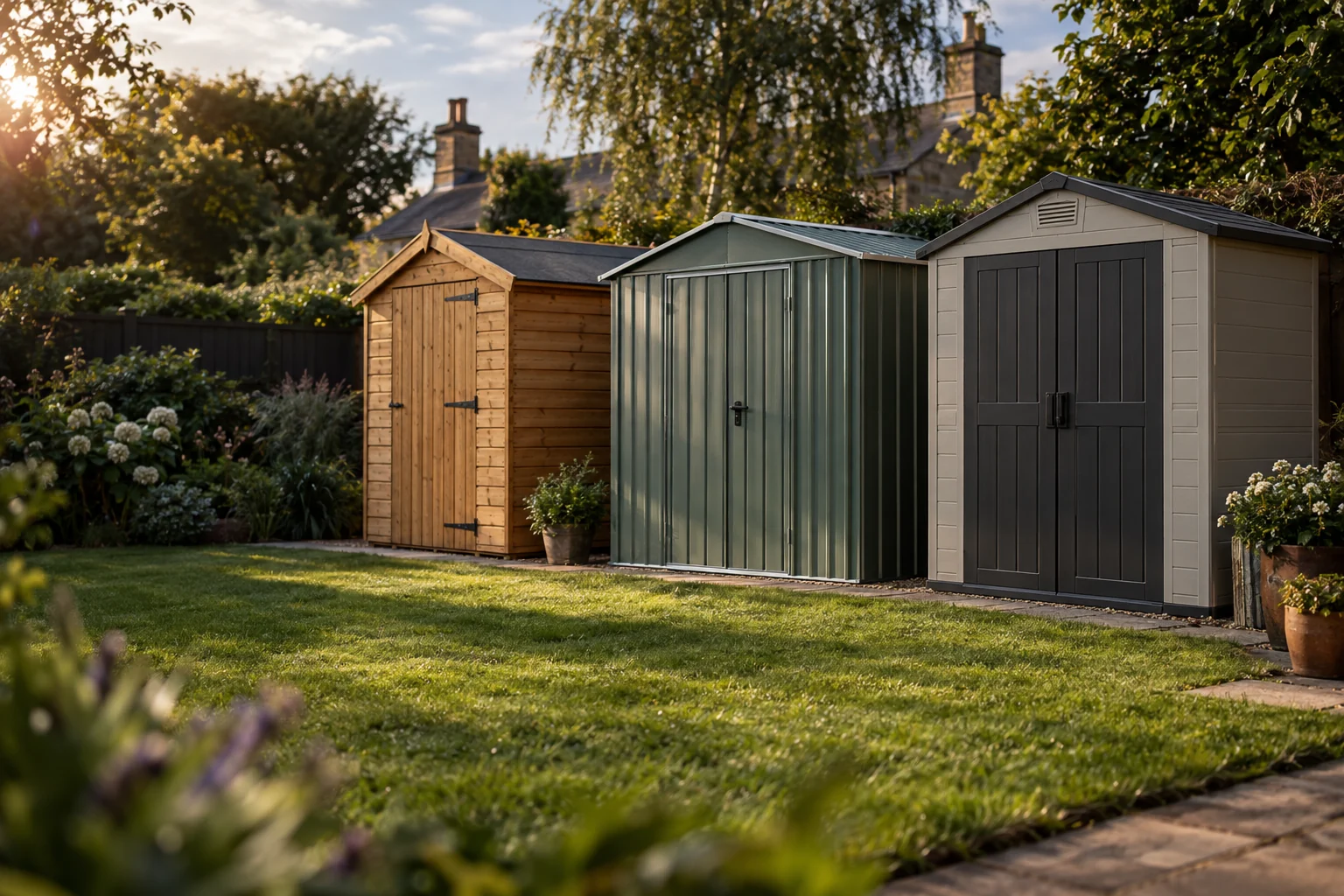
Walk into any garden centre, or open any retailer's website, and you are confronted by three distinct families of shed. There are the timber ones, looking reassuringly traditional with their felted roofs and little windows. There are the metal ones, sharp-edged and businesslike. And there are the plastic ones, moulded in greys and greens, promising that you will never have to lift a paintbrush again. Each comes in a dizzying spread of sizes, styles and price points. Each has a devoted fan club who will tell you, at length, that the other two are rubbish.
Here is the thing nobody in the photo shoot mentions. A shed is not a one-off purchase. It is a small building you will own for a decade or more, and the material it is made from decides almost everything about that ownership: how much you spend on upkeep, whether the contents stay dry, how easily someone could walk off with your mower, and whether you will be replacing the whole thing sooner than you would like.
So this guide is not about which shed looks prettiest under studio lighting. It is about total cost of ownership, the security realities of each material, and how long each one genuinely lasts in a British garden, which, let us be honest, spends a fair part of the year being rained on sideways.
A quick introduction to the contenders:
- Timber is the classic. It is the most attractive and the most versatile of the three, easy to customise, and with proper care it will outlast the alternatives. The catch is that it needs treating every few years.
- Metal, which in practice means galvanised steel, is durable and low-maintenance. It also has a well-known condensation problem and, in its standard form, rather an industrial look. The specialist security versions are in a league of their own.
- Plastic and resin, typically HDPE or polypropylene, need almost no maintenance at all. They are, however, limited in size, difficult to modify and tend to look exactly like what they are.
None of these is the "right" answer for everyone. The right answer depends on what you are storing, how much you value your weekends, how visible the shed will be from the kitchen window, and how much of a target your garden is. By the end of this guide you should know which of the three suits the way you actually garden, rather than the way the brochure imagines you do.
Start with the contents, not the shed
Before you look at a single product, write a list of what will live inside. A few hand tools and some bags of compost have very different needs from a petrol mower, two good bikes and a set of cordless power tools. The value and vulnerability of the contents should steer your choice of material far more than the colour of the roof felt.
Timber Sheds: The Classic Choice That Rewards Patient Owners
There is a reason the timber shed is a fixture of the British back garden. It looks right. It weathers into its surroundings, sits comfortably beside a hedge or a border, and can be painted sage green, slate grey or cheerful duck-egg blue depending on your mood and your neighbour's tolerance. Of the three materials, timber is the most attractive, and it works particularly well in landscaped gardens and more traditional outdoor spaces.
But "timber shed" covers a vast range of quality, and the cladding is where most of the difference lies.
Overlap, shiplap and tongue-and-groove
Overlap cladding is the entry-level option. The boards are simply laid over one another, rather like the scales on a fish, with the rough-sawn faces showing. It is cheap to produce, which is why it appears on so many budget sheds. It does the job, but the boards can move and split as they dry and swell, and small gaps can open up that let in draughts and driving rain.
Shiplap and tongue-and-groove cladding are machined so each board locks into its neighbour. Tongue-and-groove, in particular, gives a tight, smooth fit that is noticeably better at keeping weather out and keeping the structure rigid. It costs more, and in my experience it is worth every penny if the shed is going to hold anything that minds being damp. I have opened enough cheap overlap sheds in February to find a fine dusting of mildew on everything inside to have firm views on this.
Why pressure treatment changes the equation
The other big distinction is how the wood has been protected. Many budget sheds are dip-treated, which means the timber has had a surface coating that needs topping up fairly quickly. Pressure-treated timber is different: the preservative is forced deep into the grain at the factory, rather than sitting on the surface.
The practical upshot is that a good-quality pressure-treated shed is very low-maintenance in its early years. It is not maintenance-free, and anyone who tells you otherwise is selling something, but it does buy you a welcome stretch of time before the brushes come out.
How long does a timber shed last?
This is where timber earns its reputation. With proper care, which in practice means treating it every three to five years, a good timber shed will last 20 to 30 years or more. Looked after properly, it will genuinely outlast its metal or plastic equivalents. The words "looked after properly" are doing quite a lot of work in that sentence, mind. A neglected timber shed sitting in a damp corner on a soggy base will tell you all about rot well before its twentieth birthday.
Pros
- The most attractive option, suiting traditional and landscaped gardens
- Lifespan of 20–30+ years with regular care, outlasting metal and plastic
- Simple to customise with shelves, hooks and internal fittings
- Can be stained or painted any colour you like
- Low condensation risk, provided there is reasonable ventilation
- Heavier and more planted than plastic, so less likely to take flight in a storm
Cons
- Needs treating every three to five years to stay weatherproof
- Budget overlap cladding can warp, split and let in weather
- Only moderate security unless you upgrade hinges, locks and windows
- Prone to rot if left sitting on a poor base or in standing water
- Typically the most expensive of the three at equivalent size and quality
Easy to fit out
Screw a shelf bracket straight into a timber wall and it stays put. Pegboards, tool racks, potting benches and hooks all go in without special fixings, which is why timber is the natural choice if the shed will double as a potting shed or small workshop.
Breathable structure
Timber does not heat and cool as dramatically as sheet metal, so with a vent or an openable window it stays relatively free of the dripping condensation that plagues metal sheds.
Blends into planting
Paint it a muted colour, grow a climber up a trellis panel beside it, and a timber shed becomes part of the garden rather than something you try to hide behind a buddleia.
Repairable
A damaged board can be replaced, a soft corner can be cut out and patched, and the roof can be re-felted. Timber sheds can be nursed along in a way that a cracked plastic panel or a rusted-through steel sheet rarely can.
Timing your treatment
Mid-November is not the moment to be slapping preservative on a shed. Most treatments want dry timber and mild, settled weather to soak in properly. Make a note now, then plan the job for a dry spell come late spring or summer. What you can usefully do this month is check the roof felt after the autumn gales, clear leaves from gutters and the base, and make sure no soil or mulch is banked up against the bottom boards.
Metal Sheds: The Low-Maintenance Workhorse With a Condensation Problem
When people say "metal shed" in the UK, they almost always mean galvanised steel. The steel sheets are coated in zinc, which protects the metal underneath from rust. Some of the better models go a step further with a powder-coated finish on top, adding another layer of corrosion resistance and, usefully, giving you a choice of colours beyond "battleship".
On paper, metal is the sensible option. It does not rot. It is not interesting to woodworm. It does not need treating every few summers. Beyond touching up scratches before rust has a chance to take hold, maintenance is pleasingly low.
Lifespan: a material of two halves
Metal sheds have the widest quality spread of the three materials, and the lifespan figures reflect that. At the cheap end, thin-gauge sheds that are scratched during assembly and left to their own devices may manage something more like 10 to 15 years before corrosion and dents take their toll. A quality galvanised steel shed, though, typically lasts 20 to 30 years, which puts it right up alongside well-maintained timber.
One handy way to tell the two apart is the manufacturer's panel guarantee. Guarantees of 10 to 25 years on panels are common among the better brands, and I use them as a rough proxy for build quality when comparing models. A company prepared to stand behind its panels for two decades is telling you something about the thickness of its steel and the quality of its coating. A company offering a year, or nothing at all, is also telling you something.
The condensation problem, explained
This is the big one, and it is not a minor inconvenience. Metal heats up and cools down very quickly. On a cold, clear night the walls and roof of a steel shed drop in temperature fast, whilst the air inside is still holding moisture from the day. When that warmer, damp air meets the cold metal, it condenses, and you get droplets forming on the inside of the walls and, more annoyingly, on the roof, from where they drip onto whatever is underneath.
This matters because of what people tend to keep in metal sheds. Bicycles, lawnmowers, strimmers, hand tools and power tools are all exactly the sort of thing that suffers from repeated wetting. Chains rust, blades pit, electrical contacts corrode, and cardboard boxes of seed packets turn into papier-mâché. Ventilation helps, but it rarely eliminates the problem entirely.
Why this matters right now: November into March is peak condensation season. Cold nights following milder, damper days create exactly the temperature swings that make metal sheds "sweat". If you already own a steel shed, now is the time to check whether tools are sitting under the worst drip points, oil exposed blades and chains, and get anything paper- or cardboard-based off the floor and into sealed plastic boxes.
The other compromises
Condensation aside, metal sheds have a few other quirks worth knowing about. Thin panels dent if you lean a wheelbarrow against them carelessly or if a football arrives at speed. They can be remarkably noisy in heavy rain, which you will notice if you ever shelter in one during a downpour. They are harder to customise than timber, because you cannot simply screw a shelf into a thin steel wall and expect it to hold a set of paint tins. And, being frank, a standard metal shed is less attractive than timber or even plastic. It looks functional and industrial, which is fine in a side return but less charming at the end of a cottage-garden path.
Pros
- Low maintenance: no rot, no woodworm, no regular treating
- Quality galvanised steel lasts 20–30 years; budget models may last only 10–15 years
- Panel guarantees of 10–25 years are common on better models
- Purpose-built security models offer the strongest protection available
- Standard models are generally cheaper than equivalent timber sheds
Cons
- High condensation risk that ventilation rarely cures completely
- Can rust where the coating is scratched or cut
- Dents easily, especially thinner budget panels
- Noisy in heavy rain
- Harder to fit with shelves and hooks
- Industrial look that can jar in a traditional garden
Taming the drips
If you choose metal, give yourself the best chance against condensation. Fit it on a dry, raised base rather than bare soil, keep any vents clear, and avoid storing wet items such as a freshly used mower or damp coats inside overnight. Hang tools on wall racks rather than leaving them on the floor, and keep anything vulnerable in lidded boxes. None of this makes the problem disappear, but it shifts it from "ruinous" to "manageable".
Plastic and Resin Sheds: The Genuinely Zero-Maintenance Option (With Real Trade-Offs)
Plastic sheds have come a long way from the flimsy, flexing boxes of a couple of decades ago. The better ones are made from HDPE (high-density polyethylene) or polypropylene resin, and many now use a double-wall construction. Instead of a single sheet of plastic, each panel is effectively two skins joined together, which makes the structure far more rigid and adds a modest amount of insulation compared with single-skin designs. Some go further still, with steel reinforcement within the resin panels to stiffen the frame.
The maintenance headline is true
I am usually suspicious of anything marketed as maintenance-free, but plastic sheds come closer than anything else in the garden. There is no painting, no preservative, no rust to chase. Mould and green algae can build up on shaded sides, but a hose-down, perhaps with a soft brush, is essentially the whole annual care routine. For anyone who would honestly rather spend Saturday doing almost anything else, that is a real and meaningful advantage.
Lifespan: know the ceiling from the average
A typical plastic shed lasts somewhere between 10 and 20 years. High-quality resin sheds from reputable manufacturers can reach 20 years or more with minimal maintenance, but I would treat that as the ceiling rather than the average. A cheap single-skin shed in a fully exposed, sun-baked spot is unlikely to get anywhere near it.
Sunlight is the main reason. Plastic can fade noticeably over time in direct sun, and prolonged UV exposure is the slow enemy of most plastics. In a bright, south-facing position, wood and metal handle UV better than plastic does. A shed tucked into partial shade will usually look younger for longer.
Size, looks and the wind
The limitations of plastic are mostly about size and aesthetics. Plastic sheds rarely come much larger than about 2.4 x 1.8m (8 x 6ft), so if you need a workshop or space for several bikes and a ride-on mower, the choice runs out quickly. They are not easily customised either. You cannot drill a shelf into a hollow double-wall panel the way you would with timber, so you are largely reliant on the manufacturer's own accessories.
And they tend to look exactly like what they are: a plastic box. In a modern, minimalist garden that may be perfectly fine. In a traditional or cottage-style garden, a resin shed can look out of place, and they do have a slightly temporary feel compared with a timber building.
Finally, weight. Plastic sheds are notoriously lightweight, which makes them easy to get through a side gate but means they absolutely must be anchored properly. You see far fewer stories of timber sheds taking flight in heavy storms. With winter gales now arriving, this is not a theoretical point.
Pros
- Very low maintenance: a wash down is about all it needs
- No rot, no rust, no woodworm
- Double-wall HDPE designs offer good rigidity and some insulation
- Low to moderate condensation risk
- Quality resin models can last 20 years or more
- Light and straightforward to move into position
Cons
- Rarely larger than about 2.4 x 1.8m (8 x 6ft)
- Very limited scope for customisation
- Can fade noticeably in strong sun
- Lowest security potential of the three materials
- Lightweight, so thorough anchoring is essential
- Utilitarian look that can feel out of place in traditional gardens
Before the next storm: if you already have a plastic shed, take ten minutes this week to check its fixings. Ground anchors or bolts into a slab should be tight, and the shed should not rock when you push firmly on a corner. Keeping heavy items low inside helps a little, but it is no substitute for proper anchoring. A resin shed cartwheeling across three gardens is a story nobody wants to tell their insurer.
Head-to-Head: How All Three Materials Stack Up Across Every Key Metric
Having looked at each material on its own, it is worth laying them side by side. This is where the trade-offs become obvious, and where you can start crossing options off based on the things that matter most to you.
On maintenance, plastic is the clear winner: very low, and a wash down is enough. Metal follows closely behind as low maintenance, provided you treat scratches promptly before rust gets a foothold. Timber trails with a moderate commitment, needing treatment every three to five years.
On appearance, the order more or less flips. Timber is attractive and natural, and suits most garden styles. Plastic is utilitarian, with limited aesthetic appeal. Standard metal is functional and industrial, and is usually the least attractive of the three.
Condensation is metal's Achilles heel, with a high risk. Plastic sits at low to moderate. Timber is low, as long as there is some ventilation.
On customisation, timber is in a different class: highly customisable, inside and out. Metal is limited, and plastic very limited.
Lifespan is more nuanced than any single number. Timber offers 20–30+ years with care. Metal depends heavily on quality: budget models might manage 10–15 years, whilst quality galvanised steel reaches 20–30. Plastic usually falls between 10 and 20 years, with the best resin models pushing past that.
And on security, purpose-built steel security sheds are in a league of their own, timber offers moderate potential, and plastic has the lowest of all.
| Feature | Timber | Metal (galvanised steel) | Plastic / resin |
|---|---|---|---|
| Maintenance | Moderate: treat every 3–5 years | Low: treat scratches promptly | Very low: wash down |
| Appearance | Attractive, natural | Functional, industrial | Utilitarian |
| Condensation | Low with ventilation | High risk | Low–moderate |
| Customisation | Highly customisable | Limited | Very limited |
| Lifespan (with care) | 20–30+ years | 10–15 years budget; 20–30 years quality galvanised | 10–20 years; 20+ for high-quality resin |
| Security potential | Moderate | Highest (purpose-built security models) | Lowest |
| Storm stability | Good, heavier structure | Good if properly fixed down | Lightweight, needs thorough anchoring |
| Typical UK price range | £500 – £3,000 | £300 – £1,500 | £250 – £1,000 |
| Best for | Appearance, longevity, flexibility | Budget storage, no frills; high-security needs | Zero-maintenance storage |
The price row deserves a visual of its own, because the spread is so different between materials. Timber has by far the longest tail into premium territory, reflecting everything from modest overlap sheds to large tongue-and-groove garden buildings.
Reading across the table, a pattern emerges. Plastic wins if you value your free time above all else and only need modest storage. Metal wins on low upkeep and, in its specialist form, on security. Timber wins on looks, flexibility and long-term lifespan, provided you are prepared to put in a few hours every few years. There is no material that wins everything, which is precisely why the choice causes so much dithering.
What Does a Garden Shed Actually Cost? UK Pricing Reality in 2026
Shed prices in the UK cover an enormous span. At one end you have compact plastic units that cost less than a decent cordless drill. At the other, large pressure-treated timber buildings and high-spec steel security sheds that cost more than some second-hand cars. Averaged across the market, the ranges look like this:
- Wooden sheds: £500 – £3,000
- Metal sheds: £300 – £1,500
- Plastic sheds: £250 – £1,000
Those headline figures are useful, but they hide a lot. The more interesting picture appears when you look at the size most of us actually buy: something around 2.4 x 1.8m (8 x 6ft), enough for a mower, tools and a bike or two.
Timber, 2.4 x 1.8m (8 x 6ft)
A typical standard-size wooden shed. The spread reflects cladding type and treatment, from basic overlap to tongue-and-groove.
Metal, 2.1 x 1.5m (7 x 5ft)
Supply only. Fully installed, expect roughly £350 – £400. The cheapest route to a lockable shed.
Plastic, 2.4 x 1.8m (8 x 6ft)
Fully installed. A sign that larger plastic sheds are not always the budget option people assume.
That last card surprises people. Plastic is often thought of as the cheap choice, and at the smaller end it can be. But a full-size, good-quality resin shed, once installed, can cost noticeably more than a modest timber shed of the same footprint. When you compare quotes, always check whether you are looking at a supply-only price or a fully installed one. The difference between the two on the metal example above is around £100, and on bigger buildings it can be considerably more.
Thinking in total cost of ownership
The purchase price is only part of the story. Over a couple of decades, the costs that creep in afterwards can matter just as much:
- Timber carries the ongoing cost of preservative or paint every three to five years, plus occasional re-felting of the roof. In exchange, it offers the longest potential lifespan.
- Metal has minimal upkeep costs, but you may want to budget for storage boxes, racking designed for metal sheds, and ventilation to manage condensation. A budget model replaced after 10–15 years can work out dearer over time than a quality one that lasts twice as long.
- Plastic costs almost nothing to maintain, but its shorter typical lifespan and limited size mean some owners find themselves buying a second shed sooner than they planned.
Every shed, whatever the material, also needs a proper base. A level, well-drained foundation such as a concrete slab, paving or a purpose-made base kit is not an optional extra. Some resin sheds come with a built-in floor, which can save you a slab, but even then the ground beneath needs to be firm and level. Factor this into your budget from the start.
Divide the price by the years
A rough but surprisingly useful exercise: take the installed price, add a realistic allowance for upkeep, and divide by the number of years you can reasonably expect the shed to last. A pricier, well-built shed that lasts 25 years often costs less per year than a cheap one that needs replacing after 10. It also saves you the joy of dismantling and disposing of a tired old shed, which is nobody's idea of a good weekend.
Security Deep-Dive: Which Shed Material Actually Keeps Thieves Out?
Here is the uncomfortable truth. Shed break-ins are extremely common in the UK, and what we keep in sheds is exactly what thieves want: garden tools, bicycles, power equipment and lawnmowers are among the most frequently stolen items from homes. Most standard sheds, of any material, offer only modest resistance to someone with a crowbar and five quiet minutes.
Purpose-built security steel: the gold standard
If security is your overriding concern, the answer is clear. Purpose-built steel security sheds, with integrated locking systems, are in a different league to any wooden shed. These typically feature multi-point locking, anti-pick and anti-drill locks, reinforced hinges and heavy-gauge panels that are genuinely difficult to force.
The important word there is "purpose-built". These are a distinct subcategory, designed and sold specifically for security, and priced accordingly. They are the sort of thing you buy to protect a motorcycle, a collection of expensive bikes or a garage-worth of power tools.
Standard metal sheds: not as tough as they look
A standard, budget galvanised steel shed is a different animal. It may look more formidable than a timber shed, but it is not significantly more secure. Thin panels can be cut or forced, and the cheap padlock fittings often supplied are easily defeated. Do not let the word "steel" lull you into a false sense of security.
Timber and plastic
Timber offers moderate security potential, and the word "potential" matters. Out of the box, many timber sheds are secured by a flimsy hasp held on with short screws, hinges whose screws are on the outside, and a window that can be quietly popped out of its frame. The good news is that timber is easy to upgrade, precisely because you can fix things firmly to it.
Plastic has the lowest security potential of the three. Panels can be flexed or cut, and fixings for additional locks are limited. A resin shed is best suited to items you would be irritated, rather than devastated, to lose.
Upgrade the hasp and lock
Replace a basic hasp with a heavy-duty, high-security version fixed with coach bolts that pass right through the door, so it cannot simply be unscrewed. Pair it with a good-quality closed-shackle padlock.
Secure the hinges
Exposed hinge screws are an easy way in. Swap them for coach bolts or security screws, or fit hinge bolts so the door stays in place even if the hinges are attacked.
Hide the contents
A window full of shiny bikes is an advert. Fit frosted film or a blind, or choose a windowless design if the shed is purely for storage.
Lock items inside the shed
A ground anchor or wall anchor fixed into a solid base, with bikes and mowers chained to it, adds a second layer that makes theft slower and noisier.
Light it up
A motion-activated light near the shed door is a cheap, effective deterrent, especially through the long, dark evenings of November to February.
Check your home insurance: many policies have specific requirements or limits for items kept in outbuildings, and some only pay out if the shed was locked with an appropriate lock. It is worth reading the small print before you fill a new shed with expensive kit, not after something has gone missing.
Before You Buy: What to Do Now, and What Can Wait Until Spring
It is mid-November, which might seem an odd time to be shopping for sheds. In fact it is rather a good one. The garden is quietening down, you can see clearly where the space is, and the autumn storms have a habit of revealing which existing sheds have been quietly giving up.
Useful jobs for the next few weeks
- Inspect what you have. After the first proper gales, walk round any existing shed. Look for lifted roof felt, soft or blackened boards near the base, rust spots on metal panels, and plastic panels that have shifted or cracked. This tells you whether you are buying out of need or just fancy.
- Measure properly. Mark out the footprint on the ground with string or a hosepipe, then add space to walk round the shed. You need access to treat timber sides and to clear leaves, and a gap from fences and hedges helps air circulate.
- Check the drainage. Winter is the best time to spot where water sits. A spot that puddles after rain is a poor home for any shed, and a particularly bad one for timber.
- Think about orientation. If you are leaning towards plastic, consider a spot with some shade to slow UV fading. If metal, avoid places where the shed will bake by day and chill hard by night, as this worsens condensation.
- Plan the base. Laying a concrete slab or paving can be done in winter on dry, frost-free days, though you should avoid laying concrete when frost is forecast before it has cured.
What can wait
Treating or painting a new timber shed is best saved for the warmer, drier days come late spring or summer, when the wood is dry and the finish can soak in properly. If you buy a pressure-treated shed now, that is no great problem: it will be fine through winter. Equally, there is nothing wrong with installing a shed in winter, provided the base is sound and the weather is kind on the day. Assembling a shed in a howling wind, however, is the kind of experience that ends friendships, so pick a calm day.
Ventilation is not optional
Whichever material you choose, airflow is your friend. A vent, an openable window or a gap at the eaves helps moisture escape. It makes a modest difference in timber and plastic sheds and a significant one in metal sheds, where condensation is the single biggest complaint from owners.
Making the Decision: Which Shed Material Is Right for You?
By now the trade-offs should be fairly clear. What remains is matching them to your own situation. In my experience, most people fall into one of a handful of camps, and once you know which one you are in, the choice tends to make itself.
The keen gardener
You want a potting bench, shelves for pots and seed trays, and somewhere to hang tools. The shed is visible from the house. Choose timber, ideally tongue-and-groove and pressure-treated. It is the most customisable, the most attractive, and with care it will see you through 20–30 years or more.
The bike or machinery owner
You have valuable bikes, a petrol mower or power tools. Choose a purpose-built steel security shed if budget allows, and manage condensation carefully. Alternatively, a solid timber shed with upgraded locks and an internal ground anchor is a sensible middle path.
The low-effort owner
You want somewhere to put garden furniture cushions, a few tools and the hose, and you never want to pick up a paintbrush. Choose plastic or resin, ideally double-wall HDPE, in a partly shaded spot and anchored firmly.
The tight budget
You need lockable storage without frills. Choose a standard galvanised metal shed, which offers the cheapest route into a decent-sized shed. Treat scratches promptly, keep vulnerable items boxed, and accept that it will never win a beauty contest.
A few extra tie-breakers that I find useful when people are still torn:
- Size: if you need more than about 2.4 x 1.8m (8 x 6ft), plastic largely drops out of the running. Timber and metal both come in much larger sizes.
- Exposure: in a very windy or exposed garden, the lightness of plastic becomes a genuine liability. In a hot, sunny spot, plastic will also fade faster than wood or metal.
- Use as a workspace: if you plan to spend time inside, timber is far more pleasant. Metal can be loud in rain and chilly, and plastic offers only limited insulation.
- Garden style: a traditional or cottage garden almost always suits timber. A contemporary garden with clean lines can carry off plastic or a powder-coated metal shed perfectly well.
- Your honesty about maintenance: if you know, deep down, that you will not treat a timber shed every few years, buy something that does not need it. A neglected timber shed is worse than a well-chosen plastic one.
Kit that makes this easier
A few tools that help with the jobs above. We link to the exact model on Amazon UK.
MeacoDry Arete® One 10L dual Dehumidifier
Useful for readers choosing a metal shed who are concerned about condensation, or anyone storing tools and equipment in a damp garden building. It provides a practical way to manage humid air where electricity is available.

Check today's price: MeacoDry Arete® One 10L dual Dehumidifier on Amazon UK
Ring Spotlight Cam Plus
It adds visible monitoring around a shed, complementing the guide’s advice on locks, location and the limits of shed materials. Motion alerts, lighting and a siren can make an isolated shed less attractive to opportunist thieves.

Check today's price: Ring Spotlight Cam Plus on Amazon UK
KÄRCHER 16283020 Wet & Dry Vacuum
A practical workshop companion for clearing sawdust, leaves and water from a shed during assembly, cleaning and maintenance. The blower function is also useful for clearing loose debris before inspecting or treating timber.

Check today's price: KÄRCHER 16283020 Wet & Dry Vacuum on Amazon UK
Frequently Asked Questions
The GardenScout Verdict
After years of opening other people's sheds, sheltering in a few during downpours and replacing more than one of my own, I have come to think that the material question is really a question about you. How much effort will you put in? How valuable is what you are storing? How much does the view from the kitchen window matter?
Best all-rounder: timber
For most gardeners, a good-quality pressure-treated, tongue-and-groove timber shed remains the best choice. It looks the part, it is easy to fit out, it handles condensation well, and with treatment every three to five years it will last 20–30 years or more. It asks for a little patience. It rewards it handsomely.
Best for security: purpose-built steel. If you are protecting bikes, machinery or power tools, a dedicated security steel shed is in a different league. Just go in with your eyes open about condensation, and do not confuse a budget steel shed with the real thing.
Best for zero effort: double-wall resin. If you need modest storage and genuinely want to forget about maintenance, a quality HDPE shed, anchored firmly and placed out of the harshest sun, is a sensible, honest choice.
Whichever way you go, spend as much thought on the base, the ventilation and the locks as on the shed itself. Use these quiet November weeks to measure up, check where the water sits and work out what the shed really needs to hold. Then, when you finally hang that rake on a proper hook, it might even stay there.
- MeacoDry Arete® One 10L dual DehumidifierFor condensation controlView on Amazon
- Ring Spotlight Cam PlusBest for shed securityView on Amazon
- KÄRCHER 16283020 Wet & Dry VacuumHandy for shed upkeepView on Amazon
Buying for a gardener? See our gifts for gardeners, checked on Amazon every day.