Choosing a Garden Fork vs Border Fork: Which Do You Actually Need?
The difference is not just a smaller head and a nicer handle. Tine shape, spacing and shaft length decide whether digging feels productive or like an argument with the ground.
Garden Fork vs Border Fork vs Potato Fork: The Quick Answer
It is early October, which is exactly when a fork begins to earn its keep. Beds are being cleared, compost is being moved, autumn leaves are gathering in inconvenient places and the last potatoes are waiting to be lifted before wet weather makes the task rather more theatrical. If your current fork feels too big, too heavy or surprisingly poor at the job in front of it, you may not need a stronger arm. You may simply have the wrong sort of fork.
This is a common muddle in British gardens. A full-size digging fork is bought because it looks like the proper, serious option. Then it spends its life trying to squeeze between perennials in a narrow border. Or a compact border fork is pressed into service on hard clay and asked to break new ground. It is a bit like opening a tin of paint with the good kitchen knife: possible, perhaps, but nobody comes away entirely happy.
The three main categories are straightforward once you know what to look for:
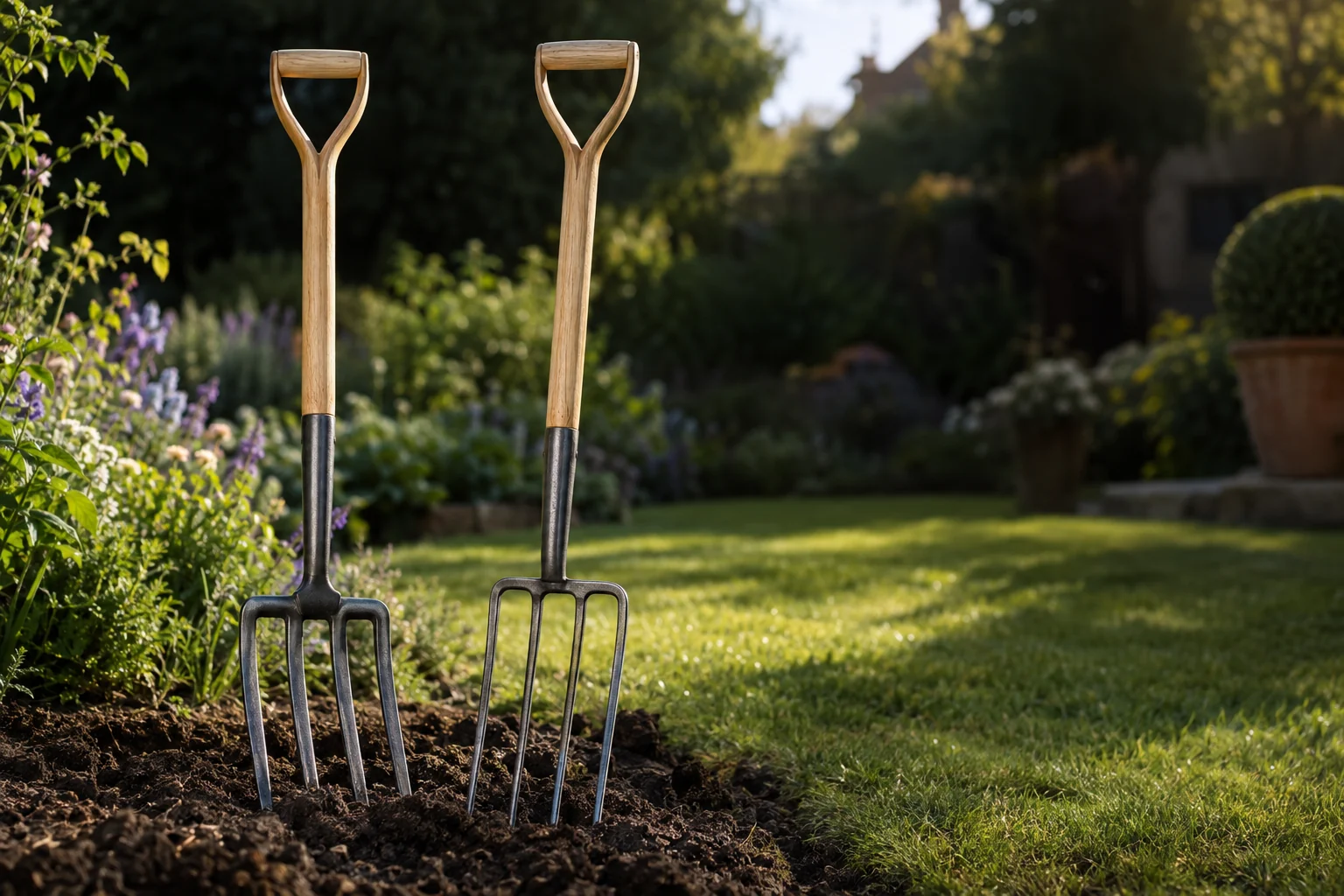
- Digging forks, often called garden or spading forks, generally have four strong square tines and a full-length shaft. They are the tools for turning ground, loosening compacted soil, working compost heaps and tackling beds that have not been cultivated for a while.
- Border forks have four tines too, but their heads are narrower and their overall build is intended for smaller spaces. They are much easier to place accurately around established plants, in raised beds and in compact urban gardens where every square centimetre has a resident.
- Potato forks use multiple blunt, rounded or ball-tipped tines. Their job is not to spear a crop but to lift it, letting soil crumble away whilst keeping tubers and other root vegetables safer from punctures.
The simple buying rule
Choose a digging fork for uncooperative soil and big jobs, a border fork for precision and confined growing spaces, and a potato fork when harvesting root crops matters enough to deserve its own tool. If you only own one fork, buy for the toughest routine task in your own garden rather than the task you do once a year.
There is no universal winner because the garden itself is the opponent. A light, sandy plot asks very little of a fork. A clay garden after a wet week can make even a handsome stainless-steel tool feel like an item of decorative furniture. Likewise, a broad vegetable plot and a neat terrace border need quite different manoeuvrability.
For most gardeners, the real choice is between a full digging fork and a border fork. The potato fork is the specialist third option: immensely useful if you grow potatoes, carrots, parsnips or other roots in quantity, but not usually the first tool to buy for a newly established garden. The useful trick is to judge the head first, the shaft second and the handle last. A comfortable grip is lovely. A head that is too wide for the bed is still too wide for the bed.
Tine Geometry 101: Why Shape Determines Everything
A fork is one of those tools that appears gloriously uncomplicated until you put three of them side by side. Then the details become obvious. Tines vary in length, thickness, spacing, tip shape and the width of the head that holds them together. All of those features alter the way a tool enters soil and what it does once it is there.
The standard digging fork uses four robust, square tines. Their broad, fairly flat profile is made to penetrate and lift soil rather than delicately thread its way between roots. This is what you want when opening a compacted vegetable patch, incorporating organic matter or breaking up ground that has spent a summer baking hard. Four tines also leave reasonably large gaps, so clods can be loosened without the head becoming a mud-coated paddle at the first sign of damp weather.
Tine length matters more than it first appears. The Spear & Jackson Neverbend Professional Digging Fork has tines measuring 28cm, whilst the Spear & Jackson Traditional Border Fork has 23cm tines. Five centimetres may not sound dramatic on paper. In dense ground, though, it changes how much soil the tool can engage before the socket and shaft have to do the hard work. A deeper tine can get beneath a compacted layer rather than merely scratching its surface.
That does not mean the longer tine is automatically better. In a crowded ornamental border, depth is not the only concern. You are trying to make a small, controlled opening for compost, lift a self-seeded plant, loosen the edge of a perennial clump or remove a persistent weed without disrupting the neighbours. A shorter, narrower border-fork head gives you a more exact entry point. It is less likely to require the awkward, apologetic shuffling of foliage that follows when a large fork has arrived at a delicate job.
Square tines for resistance
Four sturdy square tines are the familiar digging-fork arrangement. They are suited to lifting and breaking soil, especially where firmness and a deeper bite matter more than finesse.
Narrower heads for planted ground
A border fork's narrower head is easier to place around established plants. The Spear & Jackson Traditional Border Fork measures 13.8cm across, compared with 18.5cm for the Neverbend Professional Digging Fork.
Blunt ends for harvesting
Potato forks use rounded, knobbed or ball-tipped tines so that they can slide below a crop rather than behaving like a row of skewers. It is a small design decision with a very practical result.
Potato forks are the most visibly different. Instead of four pointed digging tines, they may have between four and nine tines, often positioned closely enough to act like a coarse sieve. As you lift, loose soil falls through the gaps whilst potatoes remain supported on the head. The SHW Heavy Duty Potato Fork has nine tines with rounded tips and a 25.5cm-wide head. That arrangement makes sense for a crop grown in loose ridges or a broad bed: it gathers more of the soil around the potatoes in one lift.
There is a trade-off. More tines mean more material and therefore more weight. More closely packed tines can also collect sticky soil in heavy conditions. That is not a flaw; it is simply the wrong tool for deep winter digging. A potato fork is at its best when the soil is workable, the crop is ready and you want to lift broadly but gently.
Read the ends of the tines
For digging, look for the strength and length of the tines. For harvesting, inspect the tips. Rounded or knobbed ends are purposeful: they are there to reduce the chance of piercing a potato just as you discover the best one in the row.
It is also worth resisting the temptation to treat a fork as a crowbar. Even a sturdy fork is happiest being driven in, eased back and lifted with your body weight. Twisting hard sideways against buried brick, mature woody roots or a paving edge risks bending tines and putting strain on the socket. Choose the head shape that gets you into the soil cleanly, and the fork will feel stronger than one you have to force.
Shaft Length and Handle Shape: The Ergonomics Nobody Talks About
Fork shopping has a tendency to focus on shiny steel. Shiny steel photographs well. Your back, however, is much more interested in shaft length, handle position and the overall balance of the tool. These are not glamorous specifications, but they decide whether you can work for half an hour comfortably or begin making those little involuntary noises that suggest a cup of tea is now medically necessary.
Across the examples here, overall lengths vary noticeably. The Spear & Jackson Neverbend Professional Digging Fork is 90.5cm long. The Rolson Ash Handle Digging Fork is 99.5cm long. The Spear & Jackson Traditional Border Fork measures 97cm, whilst the Kent & Stowe Stainless Steel Border Fork is 104cm overall and has a 49cm handle section. A longer fork can allow you to work with less bending, particularly when levering soil and lifting a forkful. A shorter tool can feel more controlled in close planting or when working from the side of a raised bed.
Your height matters, but so does how you work. Tall gardeners often find a longer shaft kinder during repeated digging because it helps keep the shoulders more upright. Smaller gardeners may prefer a compact tool that is easier to control and does not leave the handle hovering somewhere around the ribcage. Neither preference is a character test. It is just leverage.
Handle shape has its own quiet influence. A D-grip gives the hand a defined place to hold and can feel natural when turning soil or making a controlled twist. The Rolson uses a D-shaped grip with an ash shaft. It is a familiar, traditional arrangement and one that many gardeners find immediately intuitive.
A wishbone handle, such as the one on the Spear & Jackson Neverbend Professional, provides two points of contact and a broader area to brace against when lifting or turning soil. For a task that involves repeated, firm use of both hands, that can spread grip pressure more comfortably. It is especially useful when you are working a bed in stages rather than taking the optimistic approach of deciding to "just finish this bit" shortly before dark.
T-handles are another common arrangement, particularly on tools intended for controlled use. They can be very comfortable for a straightforward vertical push and lift, but feel different when you want to twist the fork through heavy soil. The right answer comes down to the movement you repeat most often. If you regularly turn a compost heap or dig dense soil, try the grip with gardening gloves on if you can. A handle that feels fine in a shop can become less charming once it is wet with rain and speckled with clay.
Weight is worth considering in context, not in isolation. A 1.95kg digging fork can feel reassuringly planted when breaking firm soil; the tool contributes a little useful momentum as it goes in. The 825g Rolson is far easier to lift repeatedly, which can be a real advantage for gardeners with reduced strength or for lighter soils. Yet a very light tool has less mass behind it when ground resists. Neither is a mistake. They suit different jobs.
Finally, think about the space around the work, not only the bed itself. A long handle needs room to swing. In a broad open vegetable plot, that is no problem. Between a shed wall, raised bed and shrub border, it quickly becomes an awkward piece of choreography. A border fork earns its place when there is simply less room to stand, lean and manoeuvre.
Full Specifications at a Glance: Digging, Border and Potato Forks Compared
The table below puts the key measurements together. It is not a league table, because the tools do different jobs. Instead, use it to spot the features that matter to your own plot: head width if space is tight, tine length if soil is difficult, tool weight if fatigue is a concern, and blunt multi-tine construction if harvesting is the priority.
| Model | Type | Weight | Overall length | Head / tines | Construction and handle |
|---|---|---|---|---|---|
| Spear & Jackson Neverbend Professional | Digging fork | 1.95kg | 90.5cm | 18.5cm wide; four tines; 28cm tine length | Mirror-polished stainless-steel tines; wishbone handle |
| Rolson Ash Handle | Digging fork | 825g | 99.5cm | 20cm wide; four tines | Carbon-steel head; ash shaft; D-shaped grip |
| Spear & Jackson Traditional | Border fork | 1.76kg | 97cm | 13.8cm wide; four tines; 23cm tine length | Stainless-steel tines; hardwood and polypropylene handle |
| Kent & Stowe Stainless Steel | Border fork | 1.51kg | 104cm | 49cm handle section | Stainless steel and ash construction |
| Burgon & Ball RHS Endorsed Stainless Steel | Border fork | 1.64kg | — | Rated to withstand 90kg strain | Stainless-steel tines; FSC-certified ash handle |
| Radius Garden 204 PRO | Border fork | — | 103.9cm (40.9in) | Stainless-steel blade | Polypropylene-encased carbon-steel shaft; thermoplastic elastomer grip |
| SHW Heavy Duty Potato / Gravel / Chip Fork | Potato fork | 2.5kg | 130cm | 25.5cm wide; nine 36cm tines with rounded tips | Ash handle; scoop-shaped tines |
The Burgon & Ball RHS Endorsed Stainless Steel Border Fork is rated to withstand strains of up to 90kg and carries a lifetime guarantee against manufacturer's defects. Its stated weight is 1.64kg.
Measurements are useful, but give yourself permission to handle a fork before deciding if possible. Hold it upright, put both hands where they would naturally go, and imagine pushing it into the ground. Does the grip suit your hands? Is the shaft length sensible for your height? Can you turn it in the narrowest part of the garden? A fork may last for many years, so an extra five minutes of thought at this stage is very well spent.
The Digging Fork Deep-Dive: Built for Soil That Fights Back
A digging fork is the default workhorse for gardeners with open ground to manage. It is the fork for breaking new beds, turning over neglected patches, aerating compacted ground, incorporating bulky organic matter and lifting substantial root masses. If the task involves soil that is reluctant to move, this is generally the place to start.
Forks are particularly useful where a spade would cut through earthworm channels and soil layers more aggressively than necessary. A fork lets you lift and loosen, rather than simply slice. That makes it valuable for no-dig gardeners as well: you may not be double-digging beds, but you may still need to aerate a compact patch, lift a perennial for division or tease out deep roots from an area that has become too dense.
The Spear & Jackson Neverbend Professional Digging Fork illustrates the full-size format clearly. It weighs 1.95kg, is 90.5cm long and has a 18.5cm-wide head with four 28cm tines. Those mirror-polished stainless-steel tines are intended to move through soil cleanly, and the wishbone handle gives a secure two-handed hold when a forkful needs turning or lifting.
That weight will not suit every gardener, particularly for prolonged work in a light soil where brute force is unnecessary. But for firm ground, some weight can be useful. It helps the tines settle into the surface and gives the tool a solid, grounded feel when levering soil upward. The trick is not to confuse heaviness with strength. The aim is controlled downward pressure through the foot and a smooth lift with the legs, rather than a sudden heave from the lower back.
Why choose a digging fork?
- Longer tines can reach more deeply into firm soil.
- Four strong tines suit lifting, loosening and turning ground.
- A wider head deals efficiently with open beds and compost heaps.
- Useful for breaking new ground and lifting larger root masses.
Where it is less comfortable
- A broad head is awkward among close-planted perennials.
- It can be unnecessarily bulky in small raised beds.
- Heavier models can be tiring for repeated light work.
- Pointed digging tines are not the best choice for lifting potatoes.
The Rolson Ash Handle Digging Fork offers a quite different proposition. At 825g, it is dramatically lighter than the 1.95kg Neverbend Professional. It is 99.5cm long, 20cm wide and has four tines, with a carbon-steel head, ash shaft and D-shaped handle. For a gardener who finds heavier tools tiring, or who works mainly in loam and sandy ground, that reduced weight could be the deciding feature.
The limitation is simply physics. A lighter fork brings less downward momentum to hard ground, so the gardener must supply more of it through technique and patience. In loose soil, that does not matter very much. In dry, compacted clay, it can become the difference between a pleasant afternoon and a lengthy negotiation. If your plot is heavy, do not judge a digging fork only by how easy it is to lift in the shed. Think about how often you need it to go in.
At this point in the year, a digging fork is most useful for clearing spent crops, moving well-rotted compost into vacant beds and opening up compacted areas without working sodden soil. If the ground is sticky enough to cling to your boots in thick layers, wait for a drier spell. Digging wet clay does not improve its structure; it merely creates heavy lumps and a powerful desire to abandon the whole project until spring.
The Border Fork Sweet Spot: Precision Tool for Smaller Plots and Raised Beds
The border fork is often dismissed as a smaller version of a "real" fork. That is unfair. It is a precision tool, and in many modern British gardens it may be the more useful everyday choice. Where a plot is made up of planted borders, narrow beds, containers and a modest vegetable area, the ability to work accurately matters at least as much as outright digging power.
The most obvious distinction is width. The Spear & Jackson Traditional Border Fork has a 13.8cm-wide head. The Neverbend Professional Digging Fork is 18.5cm wide, and the Rolson digging fork is 20cm wide. Those few centimetres make a remarkable difference when you are trying to work beside a clump of geraniums, a row of winter salad, or the base of a shrub that has been in place for long enough to consider the entire border its personal property.
A narrow head lets you loosen soil, introduce compost or remove weeds without creating a large trench. It is particularly useful in raised beds, where you may be reaching in from the side rather than standing on the soil. It is also more manageable in an established border where the aim is to disturb as little as possible. You can work around plants rather than trying to clear a large enough area for a full digging fork to fit.
The Spear & Jackson Traditional Border Fork weighs 1.76kg, measures 97cm overall and has four 23cm tines. That places it in a useful middle ground: substantial enough for ordinary garden soil, yet narrow enough to make close work feel deliberate rather than risky. It should not be treated as the ideal tool for prising out a deeply embedded root or attacking an untouched clay lawn. It is a border fork. Let it be excellent at that.
The Kent & Stowe Stainless Steel Border Fork is lighter at 1.51kg, with an overall length of 104cm and a 49cm handle section. That longer overall reach may appeal to taller gardeners who still want the manoeuvrability of a smaller head. Its stainless-steel and ash construction is a classic pairing, and the relatively low weight will be welcome during repetitive work such as clearing a border, loosening soil around shrubs or mixing in compost.
Raised-bed reality check
If you garden mainly in raised beds, measure the narrowest working space rather than the bed itself. Allow room for your hands, the shaft and the arc of the handle. A tool that technically fits inside the bed can still be irritatingly large to use from its edge.
Why a border fork shines
- Narrower heads are easier to position among established plants.
- Lighter models reduce fatigue during detailed maintenance.
- Well suited to raised beds, compact gardens and narrow borders.
- A sensible choice for routine lifting, loosening and composting.
Its limits
- Smaller heads move less soil with each lift.
- Not the first choice for opening a large area of hard ground.
- Shorter tines offer less depth than a full digging fork.
- It is still not a substitute for a potato fork at harvest time.
There is also a pleasing psychological advantage to a border fork. It makes small jobs feel possible. You are more likely to nip outside and loosen a patch, plant a bulb, remove a weed or lift a crowded perennial when the tool is light and close to hand. A large digging fork can make every task feel like the beginning of a building project. Sometimes you want the garden equivalent of a good paring knife, not a cleaver.
For October work, use a border fork to lift and divide overcrowded herbaceous perennials while the soil remains workable, incorporate compost around hungry plants and loosen areas that will receive spring bulbs. Work carefully around roots rather than stabbing straight down close to the crown. In an established bed, patience is generally cheaper than replacing a favourite plant.
Potato Forks: The Specialist Tool Most UK Gardeners Do Not Own But May Want
The potato fork is the specialist that tends to be appreciated only after the first time you use one. Anyone who has harvested potatoes with a standard digging fork knows the feeling: you find a promising mound, put the fork in what seems like a safe position, lift carefully, and hear the faint but unmistakable sound of a tine meeting a tuber. It is not disastrous, but it does shorten storage life and turns the harvest basket into an urgent menu plan.
A potato fork tackles that problem by changing the tine ends. Instead of pointed digging tines designed to break soil, it uses blunt, rounded, ball-tipped or knobbed ends intended to slide beneath the crop. The head is generally wider too, with more tines placed closer together. The effect is almost sieve-like: soil falls away as you lift, while the potatoes remain supported rather than slipping through wide gaps.
Rounded tips protect the harvest
Blunt or knobbed tine ends reduce the risk of puncturing tubers. They are designed for lifting crops, not for forcing a path through compacted ground.
Close tines let soil fall away
A multi-tine head supports the crop while loose soil drops through. This makes it easier to spot potatoes that may otherwise be left behind in the bed.
Useful beyond potatoes
The same gentler lifting approach can be helpful for other root crops, including carrots and parsnips, where a pointed tine is an unnecessary gamble.
The SHW Heavy Duty Potato / Gravel / Chip Fork demonstrates the more substantial end of the category. It has nine solid scoop-shaped tines with rounded tips, each measuring 36cm long. The head is 25.5cm wide, the ash handle is 130cm long and the tool weighs 2.5kg. That is a serious tool for a serious quantity of produce, rather than a small hand-fork substitute for a few plants in a growbag.
Nine tines provide a generous lifting surface, which is valuable on an allotment-scale potato patch. The tool can get beneath a broad section of ridge and hold the soil and tubers together long enough for the soil to fall clear. It is also heavy, and that needs acknowledging. A 2.5kg fork is not the casual choice for an hour of tidying in a flower border. It is a purpose-built lifter for a purpose-built job.
For autumn harvesting, wait until soil is workable rather than waterlogged. A little moisture helps soil release, but saturated ground clings to every tine and can make it difficult to see what you are lifting.
The Sneeboer three-tine digging fork is another potato-focused format, with three teeth forged in a V-shape on the back and a flat front. It is much more compact, measuring 69.9cm overall, with an 20.9cm blade length and a 15.9cm blade width. That style is suited to controlled work in a smaller crop area, where you want to slide beneath roots rather than lift a broad swathe of soil.
Do you need a potato fork? If you grow a few potatoes in containers or one small bed, probably not immediately. A careful border fork can cope if you work from the outside in and accept that a few nicked tubers are part of the bargain. If potatoes are a regular crop, however, or if you also grow carrots and parsnips, the specialist tool begins to look rather sensible. It is not an indulgence. It is a way of making a repetitive harvest cleaner, quicker and less damaging.
Which Fork Suits Your Garden? Start With the Soil and the Space
If you are still torn between fork types, stop looking at product names for a moment and look down at your garden. The answer is usually under your boots. Soil texture, bed width, planting density and the kind of work you actually do will tell you far more than an impressive label on a handle.
Heavy clay or new ground
Choose a digging fork with four strong tines and a head wide enough to make steady progress in open ground. Longer tines help when you need a deeper bite.
Small urban garden
A border fork is usually the sensible everyday choice. Its narrower head is easier to steer around plants, paths, walls and raised-bed edges.
Regular root-crop grower
Add a potato fork once potatoes and other roots become a meaningful part of the vegetable garden. Its blunt tines are made for lifting rather than puncturing.
For heavy clay: prioritise a digging fork. Clay can be excellent garden soil once improved, but it asks more of a tool, especially after dry weather. Use the fork when the soil is damp enough to work but not saturated. Push down with a foot, rock the handle gently and lift in manageable sections. Trying to overturn a huge clod in one heroic movement is how forks, wrists and good intentions all come to grief.
For sandy or light loam: you have more flexibility. A lighter digging fork, such as the 825g Rolson, may feel entirely adequate, and a border fork can cover a surprising number of jobs. The soil offers less resistance, so control and comfort may matter more than absolute strength. In this situation, choose according to bed size and the density of planting.
For a mixed ornamental garden: a border fork is often the better first purchase. Borders tend to be full of plants, and a wide digging fork can be difficult to manoeuvre without disturbing roots or knocking foliage. You can still use the border fork for light soil cultivation, lifting perennials and incorporating compost. It will just be slower if you suddenly decide to create a whole new bed.
For an allotment: owning more than one fork makes sense. A full digging fork does the broad structural work, while a potato fork earns its keep at harvest. A border fork may also be useful in tightly planted salad or herb beds, but it is unlikely to replace the full-size tool when there are larger areas to manage.
For gardeners with limited strength: do not assume that the smallest tool is always easiest. Weight matters, certainly, but so does leverage. A longer shaft can reduce bending, and a well-balanced tool can feel less tiring than a short one that forces awkward posture. The 825g Rolson is notable for being light, whilst the 1.51kg Kent & Stowe border fork is a lighter option within the border-fork category. If possible, lift each tool and mimic the movements you will actually make.
Buy for the job you repeat
Do not choose solely for the dramatic job you might do one weekend a year. If you spend most of your gardening time tending planted borders and raised beds, a border fork may deliver more value in daily use than a large digging fork that lives behind the shed.
Using Your Fork Well This Autumn — and Looking Ahead to Spring
October is a useful month for fork work because it sits between summer's dry hardness and winter's saturated soil. There is often time to clear beds, lift crops, divide perennials and add organic matter before cold, wet conditions close in. The emphasis should be on thoughtful soil care rather than turning everything over simply because the fork is available.
Where beds are empty after summer crops, use a digging fork to loosen compacted patches and remove persistent roots. Add well-rotted compost or other suitable organic matter to the surface and let worms and weather help move it through the soil. There is no need to create a perfectly turned, bare expanse. Soil structure is valuable, and autumn does not require a military parade of overturned clods.
In ornamental borders, a border fork is useful for carefully lifting overcrowded herbaceous perennials. Slide the tines into the soil a little distance from the crown, work around the clump and ease it up gradually. If you meet thick roots, do not wrench the handle sideways. Reposition, loosen a little more soil and let the plant come free in stages. Gardening rewards steady pressure more often than spectacular force.
For potatoes still in the ground, harvest on a dry-ish day where possible. Cut back old foliage if it remains, start at the outer edge of the row or mound, and lift from beneath rather than stabbing directly through the centre. A potato fork makes this easier, but the method matters whichever tool you use. Leave sound harvested potatoes to dry briefly before moving them to storage, and set aside any damaged ones to use first.
Come next spring, the fork becomes useful in a different way. A digging fork can aerate areas that have settled over winter and help prepare new vegetable beds. A border fork can loosen planting holes and work compost into smaller spaces before sowing or planting. The potato fork can wait until harvest season again; there is no prize for using every tool every month. A good tool shed is not a stage production.
Keep an eye on soil conditions. Avoid working ground that is frozen, waterlogged or smeary. Wet clay especially can be compressed into hard, smooth lumps that take a long time to recover. If a fork comes up coated in dense mud and your footprint fills immediately with water, go and do a different garden job. Pruning, cleaning pots or making tea are all honourable alternatives.
Care and Storage: Making a Fork Last for Years
A fork is a fairly simple tool, which is good news because its maintenance is equally simple. Most damage begins with leaving it dirty, wet and leaning against a wall through winter. Soil holds moisture against steel, wooden handles suffer when repeatedly soaked and dried, and a tool that falls over in a dark shed has an uncanny ability to find your ankle later.
After use, knock off loose soil before it dries. A stiff brush is usually enough; stubborn clay may need a rinse, followed by drying rather than returning the fork to storage dripping wet. Pay particular attention to the socket where the head meets the shaft. This is where damp soil tends to gather, and it is where a clean tool has the best chance of remaining sound.
Stainless steel is valued for its corrosion resistance, but it still benefits from being cleaned. Mirror-polished tines can be wiped down after wet work. Carbon steel deserves a little more attention: keep it dry and apply a light protective coating if it will be stored for a long period. Wooden ash handles are comfortable and traditional, but they prefer shelter. Store forks under cover, ideally hanging or standing securely with the tines away from walking routes.
Do not use the handle as a lever for moving paving stones, pulling out fence posts or removing the sort of root that really needs a mattock, saw or professional opinion. A fork is strong in the direction it was designed to work: down into soil and up through it. Sideways abuse is the quickest route to bent tines, loosened sockets and a distinctly sour mood.
Before putting a fork away for winter, clean the head, dry it thoroughly, inspect the handle and socket, and store it under cover. Ten quiet minutes now are much nicer than discovering a seized, muddy tool next spring.
Frequently Asked Questions
For light soil, small beds and routine border maintenance, it may be all you need. For breaking new ground, turning larger areas or working dense clay, a full digging fork remains the more suitable tool because of its wider head and longer, sturdier tines.
No. Its blunt, closely spaced tines can also be useful for lifting other root crops where reducing punctures is important. It is, however, a specialist lifting tool rather than the best general fork for soil cultivation.
Soil moisture, texture and compaction all matter. A fork enters workable loam very differently from dry clay or waterlogged ground. Tool weight and tine length also affect how easily it gains purchase beneath the surface.
A D-grip can feel natural for controlled twisting and turning. A wishbone handle gives two points of contact and can feel comfortable for sustained two-handed digging. If you can, try the grip with gloves on before choosing.
It is better to wait if soil is saturated or sticks heavily to the fork and boots. Working very wet ground, especially clay, can damage its structure and make the job much harder than it needs to be.
GardenScout verdict
A full-size digging fork is the right foundation tool for open ground, tough soil and big seasonal jobs. A border fork is the smarter everyday choice for compact gardens, raised beds and established planting. A potato fork is a worthwhile specialist for regular root-crop harvests. Start with your soil and the width of your beds, then choose the tine shape and shaft length that make the work feel controlled rather than combative.