
Garden Twine, Ties and Plant Supports That Actually Hold Up
A sensible guide to stakes, obelisks, grow-throughs, soft ties and twine for climbers, vegetables and perennials that have ideas above their station.
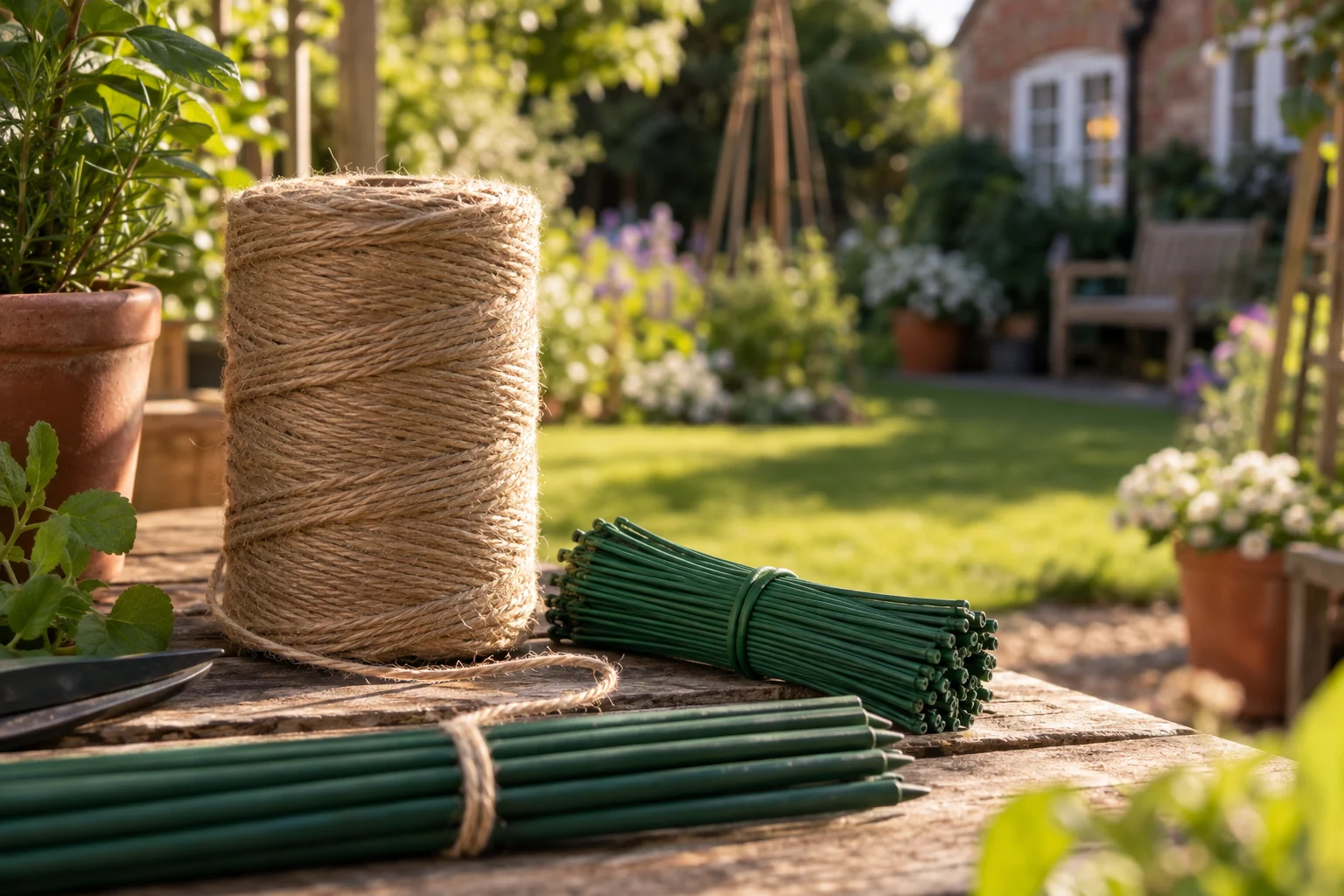
Why Your Plants Keep Flopping Over — And What to Do About It
It is late October, the borders are collapsing with all the dignity of a deckchair at a village fête, and the evidence is everywhere. A peony that looked statuesque in June is bent into the path. Sweet pea stems have worked loose from their canes. The dahlia that survived slugs, drought and your determinedly optimistic deadheading regime has been snapped by one wet, blustery afternoon.
This is not always poor growing. In fact, vigorous plants are often the ones most likely to make a mess of themselves. Rich soil, a sheltered corner that suddenly is not sheltered, a burst of rain when flowers are at their heaviest: any of these can turn a good border into a rescue operation. The trick is not to tie every stem into submission. It is to choose a support that suits the plant's habit, then install it early enough that the plant can grow naturally around it.
That final bit is where many of us go wrong. We buy a handsome obelisk for a plant that really needs a low grid. We reach for garden twine when a cushioned tie would avoid rubbing a rose cane. Or we prop a broad clump of perennial growth with one heroic bamboo cane, which is rather like holding up a marquee with a knitting needle.
A support should do three jobs. It should bear the likely weight of the plant, remain secure in the soil and avoid cutting, pinching or chafing the stems it is meant to protect. It should also, ideally, disappear into the planting or add something attractive when the garden is bare. The good news is that you do not need a shed full of specialist hardware. A modest, well-chosen collection covers most gardens.
The October tidy-up rule
Use this month's flattened stems as a note for next year. If a plant has repeatedly fallen outward, it wants a grow-through support. If a climber has slipped sideways, it needs more tie-in points. If a single stem has snapped, a sturdier stake and a looser tie are usually the answer.
There is also no prize for making supports invisible at every stage. A willow or metal structure can be a welcome piece of winter architecture; a well-made obelisk gives a rose somewhere sensible to go before it starts visiting the neighbour's fence. The aim is simply to avoid the desperate midsummer intervention, when flowers are open, stems are brittle and the whole job becomes much more fiddly than it had any right to be.
The Five Categories Explained: Stakes, Obelisks, Grow-Throughs, Ties and Twine
These items are often sold together and stored in the same untidy corner of the shed, but they solve different problems. Knowing which is which stops you buying something attractive that is wrong for the job. I have done this more than once. It is a particular sort of gardening optimism: "Surely this delicate cone of wire will hold up a full-grown climbing rose." It will not.
Stakes and canes
These give individual stems or a small group of stems a firm vertical anchor. Use them for tomatoes, young climbers, annual flowers and the tall flowering stems of plants that need guidance rather than a cage.
Obelisks and larger structures
These are upright frameworks for climbers and plants with long, reaching growth. They are part support, part permanent feature, and are at their best when positioned before the plant begins its seasonal sprint.
Grow-through supports
Low grids, hoops and rings are built for clump-forming perennials. Stems grow through the openings and are held in a natural-looking mound by the time flowers appear.
Soft ties and twist ties
These connect a stem to its support. The useful ones hold securely without acting like a tiny cheese wire when the plant thickens or moves in the wind.
Twine
Twine is flexible, cheap and exceptionally useful, particularly for making rows, tying in annual climbers and building temporary frames. It is not, however, automatically kind to every stem.
At the inexpensive end, fruit and vegetable stakes begin at £0.97. That makes them perfectly reasonable for lightweight jobs: a young pea net, a small annual climber or a temporary marker in the vegetable plot. They are not a substitute for a proper structure where a plant is top-heavy, woody or exposed to prevailing wind.
Obelisks sit at the other end of the mood board. They are there for the long haul and can be genuinely handsome in a border, particularly once the garden's summer furniture has been put away and all that remains is structure. Tall wooden examples reach £61.98. That sounds like quite a leap from a simple stake, because it is. But the two products are not doing the same work.
Think about the plant before the material. A tomato wants a direct, simple route upwards. A sweet pea wants a fine network it can grip. A peony needs broad support beneath and around its emerging stems. A climbing rose needs something solid enough to bear woody growth and enough fixing points that you can spread the stems rather than creating one congested bundle.
At a Glance: Key Details Across the Range
There is a remarkably broad market hiding behind the innocent phrase "plant support". One end is a straightforward garden stake. The other is a substantial bean frame at £228.99. Between those extremes sit jute twines in generous rolls, soft ties for careful stem work and grow-through supports that can make a border look as though it has somehow learned good posture.
(328 ft)
(656 ft)
(800 ft)
(515 ft per 1 lb)
Length on the label is useful, but it is not the whole story. For twine, a manageable thickness and a reliable knot matter more than owning an enormous roll that you dislike using. For supports, stability in the soil matters more than decorative detail.
The PGarden-EZ twist tie offers 100 metres of coated material and includes a built-in metal trimmer. Vivifying's natural jute option is 200 metres long and 2 millimetres thick. PerkHomy green jute is supplied in a 244-metre roll, whilst Lee Valley green jute is listed at approximately 157 metres per 0.45-kilogram roll.
Those are useful reference points, not instructions to buy the longest roll. If you only train a few sweet peas each summer, storing a vast spool for years is not necessarily a triumph of thrift. Natural fibres can become less pleasant to use if they are left damp or grubby in an unheated shed. Buy enough for your actual growing style, then keep it dry and easy to reach. The latter is more important than it sounds. The twine that is in a labelled tin gets used; the twine behind three bags of compost becomes archaeology.
Twine Tested in the Real World: Jute, Coated Wire and Everyday Jobs
Twine is probably the most frequently purchased item in this guide and one of the most frequently misunderstood. It is tempting to see it as interchangeable string. Sometimes it is. But the material against a tender shoot, the way a knot grips after rain and the ease with which you can untie it in autumn all change whether the job feels satisfying or mildly infuriating.
Natural jute is the traditional choice for good reason. It has a slightly rough surface, which helps knots stay put and gives young climbers something to find. It looks at home in a vegetable garden and disappears pleasantly among stems and foliage. At the end of the season, it is far less objectionable to remove than a tangle of plastic-coated offcuts that have become a permanent resident of the compost heap.
Vivifying garden twine is natural jute, supplied at 200 metres and 2 millimetres thick. That thickness is useful territory for general garden work: substantial enough for tying in sweet peas, making a simple pea support or securing the stems of climbing beans to a framework, whilst still pliable enough to knot without a wrestling match. It can also be useful for guiding clematis stems onto their first support, though clematis should not be lashed tightly. Its stems need room to move and thicken.
PerkHomy's green natural jute comes in a 244-metre roll. The camouflage colour can be a small advantage in ornamental planting, where a line of natural brown twine may be more visible than you would like. The additional length is appealing for a larger vegetable patch or anyone who makes temporary seasonal frames. What it does not tell you on its own is whether the twine suits your hand, your knots or the weight of a wet crop. Use a short length first; tug the knot, wet it, then see whether it still behaves itself.
| Option | Known format | Best gardening use | Practical consideration |
|---|---|---|---|
| Vivifying natural jute | 200 m, 2 mm | Sweet peas, beans and temporary plant ties | Natural texture makes it easy to knot and handle |
| PerkHomy green jute | 244 m | Long runs of seasonal support in beds or veg plots | Green finish is less conspicuous among foliage |
| Lee Valley green jute | About 157 m per 0.45 kg | General tying and repeated garden jobs | A weight-based roll is useful for gardeners who use plenty of twine |
| PGarden-EZ twist tie | 100 m, coated PE core | Adjustable ties around canes and supports | Built-in metal trimmer helps keep cutting tidy |
Jute does have limits. It absorbs moisture, becomes less tidy after a season outdoors and is not what I would choose to hold a thickening rose cane against a trellis for years. Nor should it be cinched hard around a stem. Use the figure-of-eight method: loop around the support, cross the twine, then loop loosely around the plant. The crossing point reduces rubbing, and the slack allows a little wind movement. A stem that can move slightly becomes stronger; a stem trapped rigidly can rub and weaken.
Make twine work harder
For a row of annual climbers, run twine in horizontal lines between sturdy uprights instead of tying every stem individually. It is faster, looks neater and gives the plants several places to catch hold as they grow.
Coated twist tie occupies a different niche. The PGarden-EZ option has a rustproof PE core with flexible green coating, so it can be twisted, untwisted and adjusted more readily than knotted jute. It is useful where a growing stem will need several checks during the season: tomatoes, young shrubs being trained, or a climber that is still deciding which way is up. The important word is adjusted. A twist tie is only plant-friendly if you revisit it. A tie that fit in May may be far too snug by July.
Soft Ties and Twist Ties: Small Products, Big Difference
The humblest bit of the support kit is often the one that decides whether a plant comes through the season unmarked. A stake can be perfectly solid, but if the tie is too tight, abrasive or left forgotten, the plant may still be damaged. This is particularly important with roses, young fruit trees, dahlias and any stem that moves in the wind.
A soft tie is designed to spread pressure more gently than bare wire or a narrow piece of string. In practical terms, it should feel forgiving between finger and thumb and should be easy to remove or reposition. Haxnicks soft ties are priced at £5.99–£6.49, placing them in a useful middle ground: a modest purchase for gardeners who want a dedicated, reusable tying material rather than relying on whatever is to hand.
That "whatever is to hand" is usually where trouble begins. Ordinary twist ties can be useful, but narrow wire ties may bite into softer stems if pulled tight. Thin plastic string can also rub in wind. Old tights have long been a gardener's favourite improvisation and can be gentle, but they are not always the tidiest solution and can be oddly visible in a carefully planted border. There is no shame in using them. There is also no shame in buying a purpose-made tie when you want the job to stay neat.
Where soft ties shine
- Securing woody rose growth without concentrating pressure on one small point.
- Holding dahlia stems to a stake where wind movement is likely.
- Training young shrubs while allowing room for stems to thicken.
- Jobs that need revisiting and adjusting through the growing season.
Where they are not the answer
- Making broad support grids for peas or sweet peas; twine is simpler.
- Holding an inadequate support upright in loose soil.
- Repairing a snapped stem that needs a splint and careful protection.
- Any job where the tie will be put on once and then ignored forever.
For roses, use ties to guide canes outward across a support rather than gathering everything into a narrow upright column. Spreading growth encourages a more balanced display and makes the whole plant less likely to become a top-heavy lump. With dahlias, tie the main stems as they extend, not only when they begin to lean. By the time a flower-laden stem is hanging at an alarming angle, you are trying to correct weight that has already found its direction.
Whatever tie you choose, check it while you deadhead, harvest or weed. It takes moments. Look for stems pressing against the tie, rubbing in the breeze or beginning to swell around it. Loosen, move or replace it immediately. This is the sort of small maintenance task that prevents a surprisingly large amount of damage.
Stakes and Canes: The Foundation of Every Border
Bamboo canes are the default garden stake because they are light, unobtrusive and adaptable. You can use one as a simple plant prop, several as a wigwam, or a whole row as the bones of a netted climbing support. Their charm is that they do not demand much fuss. Push them in, tie the plant, get on with your day.
But not all canes are equal, and the visible thickness is only part of it. A cane that feels firm in your hand may split if it is thin-walled, dried out or asked to support a wet, flowering perennial in exposed ground. For a lightweight annual or small vegetable crop, that may not matter. For a dahlia or a delphinium in a windy site, it certainly does.
The budget starting point for fruit and vegetable stakes is £0.97. This is sensible money for a temporary, low-risk support. Use such stakes where failure would be mildly annoying rather than heartbreaking: marking rows, supporting a light annual climber or providing a little direction for young growth. Do not ask a bargain stake to carry a large, rain-soaked plant and then feel personally betrayed when it leans. Gardening has enough drama already.
Entry fruit or veg stake
Best treated as a simple support for light seasonal work.
Grow-through support example
A more specialist solution for clump-forming perennial plants.
Tall wooden obelisk
A structural feature as well as a climbing support.
For an ornamental border, metal stakes can be less visually distracting and easier to reuse. A finish that suits the planting tends to recede better than pale bamboo once leaves begin to thin. The key is to choose a stake that is sturdy enough to be inserted deeply and tall enough that you are not tying the plant above the top of its support. That is an arrangement with a very short career.
Position is just as important as material. Put a stake close enough to steady the stem but not so close that you spear the crown or main root area. Drive it in before growth gets large, ideally at planting time for a new perennial. If you are adding one now, in autumn, work carefully around the root zone and do not force it through a dense clump. It may be kinder to mark the plant's location and plan a proper support installation next spring.
Obelisks and Structures: When You Need Something That Looks the Part
An obelisk earns its place differently from a cane. It is expected to be useful, yes, but it is also there when the garden is bare in January, when the border is little more than soil, labels and optimism. A well-proportioned structure creates a focal point and gives climbing plants a clear route upwards rather than letting them make a bid for the nearest shrub.
Wooden obelisks have an easy relationship with cottage gardens, vegetable plots and more formal borders alike. They soften as they weather, especially once a climber has threaded its way through them. If you prefer wood, look for responsibly sourced timber and give it periodic care appropriate to its finish. Keeping the base out of permanently wet soil, where possible, is particularly helpful. The lower section does the hardest work and tends to show it first.
Metal structures bring a cleaner line. They can look smart in a contemporary scheme, where a strong dark frame among grasses or pale flowers creates a deliberate contrast. Their narrow members also allow more air and light around the plant than a bulky arrangement of canes. Do remember that metal in a bright, exposed spot can become hot to the touch. Tie young stems so they are not pressed hard against sun-warmed surfaces.
| Structure type | Where it works well | What it asks of you | What to avoid |
|---|---|---|---|
| Wooden obelisk | Cottage-style borders, roses and climbers with a softer look | Occasional inspection and sensible placement away from persistent wetness | Using it as an afterthought once a mature climber is already sprawling |
| Metal obelisk | Permanent framework in ornamental or contemporary planting | Careful tie placement and a solid footing | Forcing stems tightly against metal in a very sunny position |
| Bean frame | A productive plot with climbing crops needing a substantial framework | Seasonal planning and enough space around it for access | Putting it where harvesting becomes an obstacle course |
The Haxnicks Big Ben Bean Frame is listed at £228.99, a reminder that purpose-built structures can be a serious piece of garden equipment rather than an impulse purchase. It makes most sense where growing climbing crops is a regular part of the garden, and where the structure can be given room to work. The cheap alternative is not always a cheap substitute: a temporary cane wigwam can be excellent, but only if it is properly anchored and the crop is not expected to outgrow it.
For climbers such as sweet peas, an obelisk can be more decorative than necessary unless it also carries a net or twine lattice for the tendrils to grip. For a woody climber, give stems multiple loose ties as they develop. Do not wrap every shoot round and round in a tight spiral. Air circulation and access for pruning matter, and a tangled plant is not easier to manage merely because it has reached the top.
Grow-Through Supports: The Set-and-Forget Answer for Perennials
Grow-through supports are quietly brilliant. They are not exciting to shop for, and they are rarely the thing visitors admire first. Yet they solve one of the most persistent border problems: the big, beautiful perennial that starts the year as a promising mound, flowers gloriously, then opens from the centre and collapses onto everything nearby.
The principle is simple. A ring, hoop or grid is placed over the emerging plant in early spring. As stems grow, they rise through the openings and spread naturally across the support. By flowering time, the framework is mostly hidden. Instead of a plant tied into little bundles, you get a full shape that appears to be holding itself together. Which, to be fair, is exactly the illusion we are after.
Peonies are the classic candidate, but any clump-forming perennial with long flower stems can benefit where it has a tendency to splay after rain. The support needs to be wide enough for the mature clump and low enough that foliage disguises it. If it is too small, stems will be pushed outward at the edge. If it is added too late, you will spend a frustrating afternoon threading stems through squares and wondering why you did not do this when the plant was only a small tuft.
Why gardeners come to love them
- They support a whole plant rather than one stem at a time.
- They are largely hidden once leaves and flowers fill out.
- They preserve a loose, natural form rather than a tied-up appearance.
- They are especially useful where summer rain flattens flower-heavy growth.
The catches
- They need to go in early, before stems become difficult to thread.
- One size does not suit every perennial clump.
- They need anchoring properly in soil that may be soft after winter.
- They do not replace sensible spacing between plants.
Install before the weather makes the decision
A grow-through support at £25.95 can feel like an indulgence when a plant is still small. It feels far more practical after the first summer storm has flattened a peony or snapped a flowering dahlia stem you had been looking forward to for weeks.
Now, in late October, you can identify where grow-throughs will be needed next year. Take photographs of any flattened clumps before cutting back. Mark their location with a discreet label if you tend to forget where everything is once the border is bare. Come early spring, put the support in while there is space around the crown and before new stems are long enough to object.
Build a Support Kit That Suits Your Garden
You do not need every kind of support. A small city courtyard with pots and one climbing rose has different needs from a windy rural border or a serious bean-growing operation. Buy for the plants you actually grow, then add to the kit when a recurring problem appears. That approach is kinder to your wallet, your shed and your patience.
The flower-border gardener
Prioritise grow-through supports, a few sturdy individual stakes and soft ties for dahlias, roses and other plants with heavy flowering stems.
The vegetable grower
Keep bamboo or simple stakes, jute twine and a dependable method for making rows or temporary frames close at hand.
The climber collector
Choose a permanent obelisk or framework where needed, then use soft, adjustable ties to train growth without constriction.
For a mixed garden, I would begin with practical basics: a few decent stakes, natural jute for seasonal jobs and a roll of soft tie for plants that need gentler handling. Add grow-through supports for individual perennial offenders. Only then consider larger structures, once you know where a climber will earn one.
Storage matters more than it gets credit for. Keep twine dry. Coil soft ties rather than stuffing them in a pocket full of soil and labels. Clean mud from metal supports before putting them away if they are not staying in the border. Discard damaged canes before they fail at the exact moment a plant needs them. None of this is glamorous, but neither is lifting a fallen delphinium out of the path after rain.
Finally, match your support to the wind in your own garden, not the sheltered display garden in your imagination. A site that catches weather needs stronger stakes, more tie points and structures with a reliable footing. A protected wall may need only light guidance. The best support is not necessarily the heaviest or most expensive one. It is the one that makes sense where you are standing.
Common Support Mistakes That Are Easy to Avoid
Most support failures are not product failures. They are timing failures. The support is installed too late, pushed too shallowly into soil, tied too tightly, or asked to carry more growth than it was ever intended to bear. The fix is usually simple and rarely involves buying something grander.
- Adding support after flowering has begun: do it earlier next season, while you can work around the plant without breaking stems.
- Tying stems straight to a stake: use a loose figure-of-eight, which reduces rubbing and leaves room for natural movement.
- Using one tie for a whole bundle: this encourages congestion and can trap damp growth. Separate stems where possible.
- Forgetting to check ties: plants thicken. What was loose in spring may be restrictive in summer.
- Choosing a pretty structure with nowhere to grip: add twine or a suitable framework for climbers that need fine support.
- Leaving damaged twine and ties in the border: remove them during autumn clearing, particularly where they may entangle wildlife or get caught in tools.
At this time of year, do not rush to prop up every plant that has finished flowering. Some floppy seedheads are useful shelter for wildlife and add welcome shape in winter. Support the plants that are at risk of damage, clear away ties that are constricting stems, and make a quiet plan for the rest. Gardening is full of jobs that are easier when you give yourself permission to do them next season.
Frequently Asked Questions
Yes, wherever possible. Early support lets stems grow into a natural position and avoids the risk of breaking or forcing established growth later. Grow-through supports are especially effective when fitted before a perennial has made much growth.
Jute is excellent for seasonal jobs, annual climbers and temporary frames. For woody stems or plants that need ongoing adjustment, a soft reusable tie is usually a kinder and more practical choice.
Loosely enough for the stem to move slightly and thicken. A figure-of-eight tie is a good habit: one loop sits around the support and the other around the stem, with the crossing between them reducing friction.
Remove ties that may rub through winter, clear away worn twine, inspect stakes and take photographs of plants that flopped. Those photos are surprisingly useful next spring, when every bare patch in the border looks alike.
The GardenScout verdict
There is no single "best" plant support, because a peony, a sweet pea, a climbing rose and a tomato are not asking the same question. Stakes provide direction. Grow-throughs hold up broad perennial clumps. Obelisks add long-term structure. Jute makes temporary jobs easy, whilst soft ties protect the stems that deserve a little more care.
Start with the plant and the problem, not the prettiest support on the shelf. Put it in early, tie loosely and check it occasionally. Do that, and next summer's border is far more likely to look lush and abundant rather than as though it has just lost an argument with the weather.