
Best Gazebos and Garden Shelters for Sun and Sudden Showers
Pop-up, pergola and hardtop options for turning a fair-weather patio into a space you can actually use through summer.
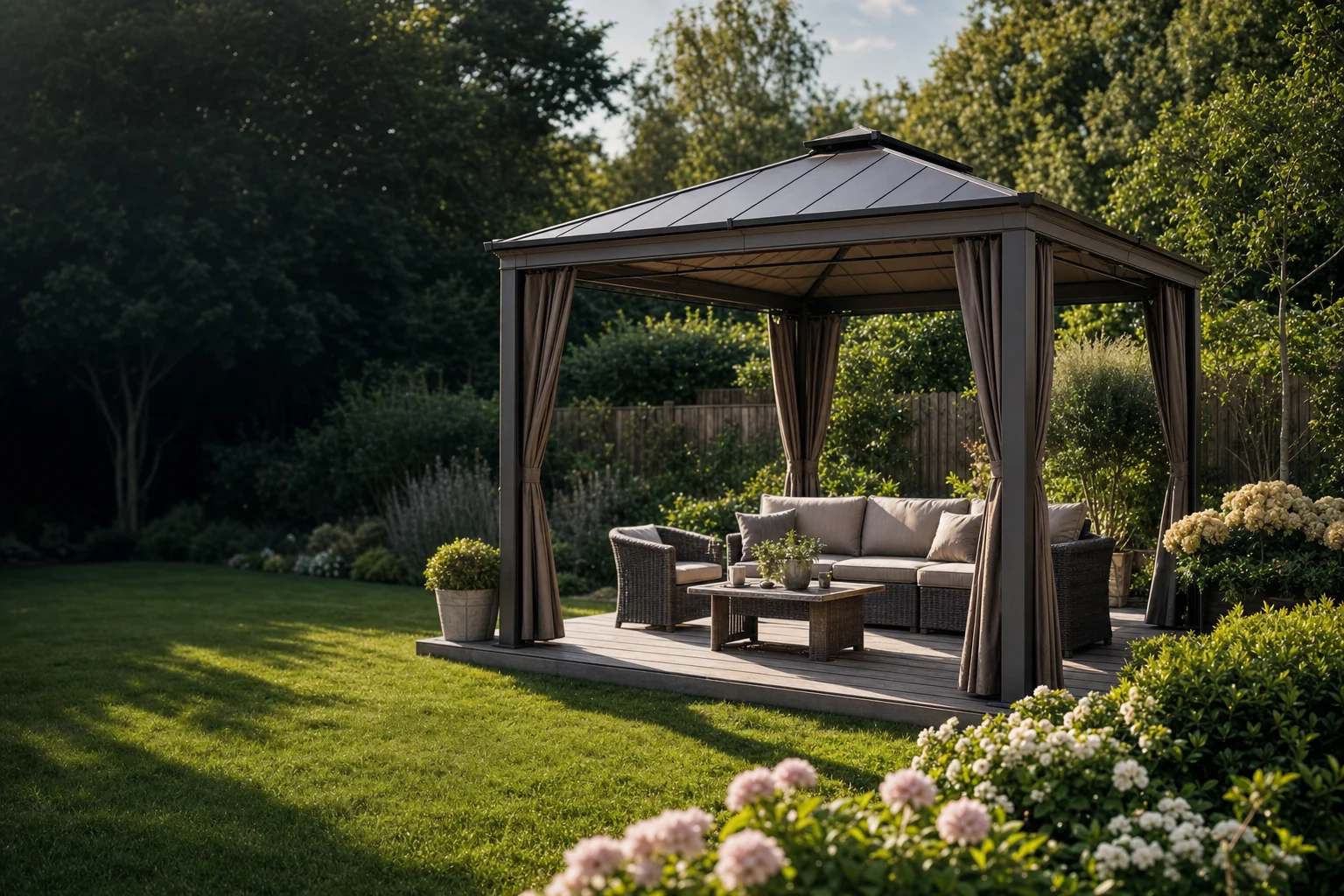
Shade, Shelter and Summer Style: What to Expect From This Guide
British summer entertaining has a familiar rhythm. At noon, the patio is too hot for anyone sensible to sit on. By mid-afternoon, somebody is moving plates, cushions and a hopeful jug of something cold indoors because a dark cloud has appeared over the neighbour's roof. Ten minutes later, the sun is back out as though none of it happened. Our weather does enjoy a little theatre.
That is why a garden shelter is less of a luxury than it once was. The right one creates a usable outdoor room: somewhere to eat lunch without squinting, take the heat out of a south-facing patio, protect a dining table from a sudden shower, or simply make a garden feel more finished. It can also spare you the classic scramble to drag everything under cover at the first sound of rain on the fence.
The trick is not to treat every gazebo, canopy and pergola as the same thing. They are not. The three main families do very different jobs, and choosing the wrong category is how you end up trying to use a lightweight event canopy as a permanent roof. It rarely ends happily.
Hardtop gazebos are the most substantial option. Their aluminium frames and galvanised steel roofs are intended to stay in place, creating a semi-permanent covered area for patios and larger garden seating zones. The Kozyard Alexander, Sojag Genova, Erommy 13' x 10' and Sojag Mykonos II belong here. They suit households that want reliable cover rather than something to unfold for the occasional barbecue.
Pop-up gazebos trade permanence for flexibility. They are sensible for renters, smaller gardens, occasional parties and trips away from home. The Quick Set Pavilion, MASTERCANOPY Durable EZ Pop-Up, Alvantor Screen House and Suntime Outdoor Pop-Up Gazebo show how broad this category can be: from very light screen houses to more substantial portable shelters.
Pergolas sit between the two. Some have soft fabric roofs; some are open-beam structures designed chiefly for shade and style; the premium end uses adjustable louvres. The Sojag Malta brings a water-resistant polyester canopy to a clean-lined framework, whilst Harbour Lifestyle's aluminium pergolas focus on a material that does not rust and is suited to UK rain and coastal air. Motorised louvred pergolas are the most adaptable roof concept of all, but they are unmistakably a premium proposition.
The short version: buy a hardtop gazebo when the patio needs a permanent roof, a pop-up when portability is the priority, and a pergola when the visual openness of the structure matters as much as the shelter it provides. Start with how you live outside, rather than the product photo that caught your eye.
How We Scored Them: Our Testing Criteria Explained
A garden shelter can look marvellous in a product photograph and still be completely unsuited to the spot behind your house. A practical review needs to look beyond a handsome roofline. I have assessed the options in this guide through six lenses: weather resistance, UV protection, assembly, structural stability, aesthetic finish and overall usefulness for the kind of garden job each structure is designed to do.
First comes weather resistance. Rain performance is about more than whether a roof has a waterproof-looking surface. Where does water go once it lands? A hardtop gazebo with an integrated gutter system, such as the Kozyard Alexander, has a clear advantage on a patio because it channels water away from the roof edges and down the poles. That means fewer unexpected drips at the corner of the dining table. It is a small detail until you have sat beneath a roof that deposits an entire puddle on one shoulder.
Wind and snow capability matter most with permanent structures. The Alexander is stated to withstand wind speeds of up to 40 MPH, with a stated figure of up to 60 MPH when properly anchored into concrete or pavers. Its stated snow-load capacity is 2,500 pounds when properly anchored. Those are useful figures because they connect a gazebo's appearance to the far more important question of whether its frame and roof have been designed for a garden that experiences more than a perfectly calm August evening.
UV protection deserves equal attention, particularly with fabric canopies. Shade is helpful, but certified protection is more meaningful than a vague promise of shelter. MASTERCANOPY's UPF50+ canopy is stated to shield the covered space from 98% of UV rays. That is an unusually clear benchmark in the portable category. Many pop-up shelters do not carry an equivalent stated UPF figure, so it is worth treating the absence of one as a reason to ask more questions before assuming a canopy offers the same level of protection.
Then there is assembly. A pop-up should justify itself by being genuinely easy to deploy and store. A hardtop should not pretend to be a casual afternoon project if it is destined to become a permanent garden structure. The Sojag Genova has detailed pictures and step-by-step instructions, which is the sort of feature that sounds dull until you are surrounded by beams, fixings and one increasingly optimistic helper.
Structural stability covers the relationship between the frame, roof and anchoring method. Aesthetic finish considers whether the shelter works with the garden rather than appearing dropped there from a garden-centre car park. Finally, usefulness asks the blunt question: does this model suit the task? A 15-pound Alvantor Screen House is appealing for a walk from the car to a picnic spot. A 192-square-foot Sojag Mykonos II is appealing for a large garden entertaining area. Neither is automatically "better". They simply have very different careers.
The bars show the stated benchmarks as a visual comparison, rather than treating different types of performance as like-for-like measurements.
Built to Last: Hardtop Gazebos for Year-Round Cover
For homeowners who want a proper outdoor room rather than a temporary patch of shade, hardtop gazebos are the benchmark. They are substantial structures with metal frames and metal roofs, designed to remain on the patio through the changing seasons rather than being folded into a bag when September arrives. If your priority is dependable cover for a dining set, outdoor sofa or cooking area, this is where the conversation should begin.
The attraction is straightforward. Fabric roofs can be very useful, but a galvanised steel roof does not need you to dash out and remove it every time the forecast turns moody. A hardtop is better suited to the long, slow rain we know so well, to strong sun, and to a garden that needs visual structure all year. It turns an exposed paving area into somewhere with a ceiling, edges and a sense of purpose.
The Kozyard Alexander is the most rounded option in this group. It combines an aluminium frame with a 29-gauge galvanised steel roof, described as thicker and stronger than the panels used in most gazebos. Its 4.7" x 4.7" triangular poles and 5" x 4" beams create the sort of visibly robust framework that inspires more confidence than a collection of thin tubular uprights. It also includes mosquito netting and privacy curtains, using a dual-track system so the two can be used together.
That last point matters more than it might appear. A roof alone deals with the weather coming from above, but a late-afternoon sun can still cut directly under it. Netting helps keep insects out whilst allowing air to pass through; curtains add privacy and a more enclosed feeling when you want it. With double-sided zips, the Alexander gives you scope to treat the gazebo as a sheltered room rather than just a roof on four legs.
Size is another Alexander strength. It is offered in 10' x 12', 12' x 12', 12' x 14', 12' x 16', 12' x 18' and 12' x 20' formats. That is a serious spread. A 10' x 12' model can make sense on a compact patio where the goal is to cover a small dining arrangement, whilst the larger sizes are clearly aimed at substantial entertainment spaces. It is much easier to select a gazebo that fits a patio properly when the family has not been reduced to "small, medium or rather enormous".
Sojag's Genova is the other major hardtop contender. Its 12' x 16' version covers 192 square feet, making it a natural fit for a generous patio or an outdoor dining area that needs more than token cover. The frame is extruded aluminium and finished in a powder coating using AkzoNobel's Interpon coating, intended to resist scratches and corrosion. Its roof uses galvanised steel panels, and it also has mosquito netting around every wall plus a double-track system for using netting and curtains at the same time.
The Genova's proposition is slightly different in character from the Alexander's. It leans into a polished, permanent appearance, with a frame designed to resist rust and a roof intended to cope with harsh weather. It can be left up year-round. For many buyers, that alone narrows the choice dramatically: you are buying a lasting garden feature, not a seasonal compromise.
The Erommy 13' x 10' deserves mention for a more specific reason. Its rectangular footprint makes it particularly suitable for covering a long outdoor dining table. Square gazebos are often the default, but they can waste space at the ends of a rectangular table whilst leaving chairs awkwardly close to the posts. A 13' x 10' format makes practical sense where dining, rather than lounging, is the main objective.
At the larger end, the Sojag Mykonos II in 12' x 16' form provides 192 square feet of protected area. That is the kind of footprint that changes the feel of a bigger garden. It can bring a large seating arrangement, substantial dining table or mixed entertainment setup under a single roofline. It needs a garden and patio proportionate to it, obviously. A big gazebo in a small plot has all the subtlety of a gazebo in a small plot.
| Feature | Kozyard Alexander 10' x 12' | Sojag Genova 12' x 16' | Sojag Mykonos II 12' x 16' |
|---|---|---|---|
| Covered area | 120 sq ft | 192 sq ft | 192 sq ft |
| Frame material | Aluminium | Extruded aluminium | Aluminum |
| Roof material | 29-gauge galvanised steel | Galvanised steel panels | Polycarbonate panels |
| Screening and curtains | Netting and privacy curtains on a dual-track system | Mosquito netting and double track for curtains | No screening or curtains |
| Best suited to | Patios needing a robust, adaptable hardtop | Large permanent dining or seating areas | Large-scale garden coverage |
The Kozyard Alexander Up Close: Our Top Hardtop Pick
The Kozyard Alexander is the hardtop gazebo I would begin with if the brief is simple: "I want cover that feels properly built, looks finished and does not turn every shower into a leak-finding expedition." It makes a convincing case because the structural details are not merely decorative flourishes. They are directly connected to how the gazebo behaves when the weather becomes less cooperative.
Start with the poles. The 4.7" x 4.7" triangular design is a notable departure from the slimmer square-section uprights often seen on more basic structures. The shape is intended to distribute load evenly, while the substantial dimensions give the gazebo visual and physical presence. Pair those poles with 5" x 4" beams and the result is a frame that is clearly designed as a permanent garden structure rather than a temporary event tent in a smarter outfit.
The 29-gauge galvanised steel roof is equally important. This is the portion doing the hard work when rain is rattling overhead or sun is bearing down on the patio. It is described as thicker and stronger than panels used in most gazebos, and it sits above a double-top design that promotes ventilation and air circulation. That elevated roof profile does two useful things in real garden life: it helps the gazebo avoid feeling completely closed-in on hot days, and it gives the structure the kind of substantial silhouette that makes it look at home next to a house.
Then there is drainage. The integrated water-gutter system directs rainwater away from the roof edges and down the poles. This is a practical feature I would actively prioritise. Without planned drainage, rainwater finds its own route — usually one that involves the edge of a chair, the back of your neck, or the one paving slab that has already started to dip.
The Alexander's stated wind performance is especially persuasive. It is capable of withstanding wind speeds up to 40 MPH, and the stated figure rises to 60 MPH when the gazebo is properly anchored into concrete or pavers. That difference is not a footnote. It is a reminder that anchoring is part of the structure, not an optional finishing touch. If you are planning a permanent gazebo, the base and fixings deserve just as much thought as the roof colour or curtain arrangement.
The stated 2,500-pound snow-load capacity when anchored reinforces that point. UK gardens may not face months of deep snow, but winter weather still brings wet snow, prolonged rain, frost and gusty conditions. A structure intended to remain in place should be selected and installed with those months in mind, not just with the first garden party in mind.
The 10' x 12' model provides 120 square feet of coverage, and the broader size range gives the Alexander unusual flexibility. You can choose 10' x 12', 12' x 12', 12' x 14', 12' x 16', 12' x 18' or 12' x 20' according to the patio's proportions and how you want to use it. That avoids one of the most common gazebo errors: choosing a structure large enough to cover the furniture but not large enough to leave sensible circulation space around it.
The included mosquito netting and privacy curtains lift it above a bare-bones roof. The netting gives you an option on still evenings when insects begin taking a professional interest in your dinner. The curtains can reduce low-angle sun and add privacy. Crucially, the double-sided zips and dual-track system mean you can use these layers in combination rather than having to choose between one or the other.
What stands out
- Substantial 4.7" x 4.7" triangular poles and 5" x 4" beams.
- 29-gauge galvanised steel roof with a ventilating double-top design.
- Integrated gutters direct rainwater down the poles.
- Stated wind capability rises from 40 MPH to 60 MPH with correct anchoring.
- Six size options cover compact patios through to large entertainment areas.
- Netting and privacy curtains are included.
Consider before choosing
- Its permanent character means the base and anchoring plan need proper attention.
- The more generous sizes need a patio that can accommodate posts, furniture and walkways comfortably.
- A hardtop gazebo is not the quick, occasional-use solution that a pop-up can be.
GardenScout tip
Measure the usable furniture zone, then add room for chairs to move and people to walk around the perimeter. A gazebo that only just covers a table can still leave everybody sitting half in, half out whenever the rain comes in at an angle.
Pack It Up, Set It Up: The Best Pop-Up Gazebos Reviewed
Pop-up gazebos appeal because they are gloriously non-committal. They can come out for a birthday lunch, a school sports day, an afternoon in a rented garden or an impromptu gathering where the forecast has offered three weather symbols and no useful conclusion. When the season changes, they store away. For many gardens, that flexibility is not a compromise; it is exactly the point.
The main rule is to buy a pop-up for what it is. It is a portable, seasonal shelter. It is not a miniature permanent building. The best examples make that portability worthwhile with meaningful sun protection, adaptable height, sensible carrying weight or useful screened enclosure. The less successful ones are simply big pieces of fabric that ask you to develop surprising faith in the forecast.
The MASTERCANOPY Durable EZ Pop-Up is the strongest all-rounder here. It is offered in 2.5 x 2.5m, 3 x 3m and larger formats, with a UPF50+ fabric canopy stated to shield the space beneath from 98% of UV rays. It has adjustable legs with three height settings: 260cm, 270cm and 280cm. Its stated shade capacity is 8 to 12 people. Those are unusually practical details for a portable canopy, and together they explain why it is the model I would favour for regular garden use.
The 3 x 3m size is the particularly useful middle ground. It gives a defined shelter zone without taking over an ordinary patio. For a standing garden party, the stated eight-to-12-person capacity is plausible as long as people are not all trying to hold a plate, a glass and an umbrella. For seated use, it is more comfortable to think in terms of a dining arrangement for six to eight people. That is not a criticism; it is simply how furniture behaves once chairs need to move backwards.
The Quick Set Pavilion takes a different route. At 41 pounds, it sits in the middle of this portable group: considerably lighter than the Suntime Outdoor Pop-Up Gazebo at approximately 63 pounds, but more substantial than the 15-pound Alvantor Screen House. That makes it a very useful all-round garden choice where the shelter may move occasionally but is not being carried far on foot. It is portable without being featherweight, which is often a sensible trade-off for backyard use.
Certified sun protection
MASTERCANOPY's UPF50+ canopy is stated to block 98% of UV rays, giving its shade claim a clear, useful benchmark.
Three adjustable heights
MASTERCANOPY offers 260cm, 270cm and 280cm leg settings, useful for matching the shelter to a site and lowering it when conditions call for a more conservative setup.
Portability has a spectrum
The Alvantor Screen House weighs 15 pounds, the Quick Set Pavilion 41 pounds, and the Suntime Outdoor Pop-Up Gazebo approximately 63 pounds.
Useful party-scale shade
MASTERCANOPY states capacity for eight to 12 people, making it particularly appealing for casual garden gatherings.
The Alvantor Screen House is the outlier for portability. At just 15 pounds, it is light enough to be carried on a half-mile hike. That tells you a great deal about its purpose. It is ideal when the shelter itself needs to travel — to a picnic spot, campsite or a garden where storage and lifting capacity are limited. It is less about creating a fixed patio room and more about giving you a lightweight screened place to sit.
The Suntime Outdoor Pop-Up Gazebo, at approximately 63 pounds, sits at the opposite end of the convenience scale. It may still be moved, but "portable" becomes a more generous word once a shelter starts to feel cumbersome between the shed and the lawn. That does not make it unsuitable. It just means this is the sort of model to consider when it will be relocated occasionally, rather than loaded in and out of the car every weekend.
One caution with all pop-ups: wind changes the equation quickly. Adjustable legs can be helpful, and a smaller footprint can be easier to place, but no portable canopy should be treated casually when gusts are picking up. The appeal of a pop-up is speed and flexibility, so use those qualities intelligently. If conditions deteriorate, pack it down rather than expecting it to prove a point.
| Feature | MASTERCANOPY Durable EZ Pop-Up | Quick Set Pavilion | Alvantor Screen House |
|---|---|---|---|
| Available size information | 2.5 x 2.5m, 3 x 3m and larger formats | 10' x 10' | 10' x 10', 12' x 12' |
| UV information | UPF50+, stated to block 98% of UV rays | UV protected | UV blocking fabric |
| Weight | — | 41 lb | 15 lb |
| Height settings | 260cm, 270cm and 280cm | — | — |
| Best fit | Regular garden shade and casual entertaining | Garden use with occasional relocation | Very lightweight, carryable shelter |
MASTERCANOPY EZ Pop-Up: The Portable Shelter That Punches Above Its Weight
The MASTERCANOPY Durable EZ Pop-Up makes the most convincing case for a portable shelter because it focuses on the things a garden canopy should do well: provide dependable shade, adapt to the site, and cover enough people to make it useful for more than one deckchair and a mildly disappointed lemonade.
Its headline specification is the UPF50+ canopy. The fabric is stated to block 98% of UV rays, which gives it a level of sun-protection clarity that many budget canopies lack. This matters because a sunny patio can be uncomfortable long before it looks dramatically hot. The issue is not merely avoiding a sunburn; it is being able to eat, read, supervise children or work at an outdoor table without feeling as though you are slowly being grilled.
For households with a south- or west-facing garden, that stated UV performance is a major practical advantage. The canopy is not pretending to be a hard roof, and it should not be judged as one. But as a shade-making tool that can be stored away, it offers a genuinely useful level of protection.
The adjustable leg system is the other feature that deserves more credit than it normally receives. There are three settings: 260cm, 270cm and 280cm. On paper, a 10cm adjustment may not sound transformative. In a real garden it can make a difference. Ground is rarely as level as the catalogue picture suggests, and lowering the canopy can be a sensible move when you want a more compact profile. A roof that can adapt to the space is often easier to use well than one locked into a single height.
The 3 x 3m version has a stated shade capacity for eight to 12 people. As ever, capacity claims need translating into real life. For a standing event, a group of eight to 12 can gather beneath it comfortably enough for short spells, particularly when people are moving in and out of the shelter. For a seated meal, six to eight is a more relaxed expectation. It is a versatile size because it can serve both uses without looking absurdly large over a conventional patio.
Why it works
- UPF50+ canopy with a stated 98% UV-blocking figure.
- Available in 2.5 x 2.5m, 3 x 3m and larger formats.
- Three adjustable leg heights: 260cm, 270cm and 280cm.
- Stated shade capacity of eight to 12 people.
- A practical choice when a permanent hardtop would be excessive.
Keep expectations sensible
- It is a seasonal portable canopy, not a replacement for a steel-roof gazebo.
- Seated capacity is naturally lower than standing party capacity.
- Like every pop-up shelter, it needs sensible judgment in windy conditions.
Best use case
Choose the MASTERCANOPY when the patio needs reliable shade for summer lunches and gatherings, but you still want the freedom to reclaim the entire space in winter. It is a particularly sensible answer for renters and for gardens where a permanent structure would dominate the view.
Open Skies to Covered Comfort: Pergolas for the Modern British Garden
Pergolas are often confused with gazebos, which is understandable because both can involve posts, beams and a roof-shaped idea. The distinction matters, though. A gazebo is usually designed as a more enclosed standalone shelter. A pergola is typically freestanding or wall-attached with an open or semi-open roof. It is often chosen as much for its architectural effect as for its rain protection.
That openness can be a virtue. A pergola frames a patio without making it feel shut off from the rest of the garden. It gives climbing plants, outdoor lighting and furniture a structure to work around. It can make a plain terrace look intentional. And when it uses a retractable fabric canopy or adjustable louvres, it can offer genuinely useful shade too.
There are three broad types worth separating. First are soft-top pergolas, represented here by the Sojag Malta. These have a fabric canopy that softens the look and can offer seasonal flexibility. Second are aluminium open-beam pergolas, such as Harbour Lifestyle models, where the frame itself provides the visual statement and can be paired with the shading approach that suits the garden. Third are motorised louvred pergolas, where adjustable roof blades allow the roof to respond to changing sun and weather conditions.
The Sojag Grey Malta Gazebo is the soft-top option to consider if you like a clean, contemporary frame but do not want a permanent solid roof. Its grey polyester cover is water-resistant and wrinkle-resistant, which is a useful combination for a shelter that needs to look composed after more than one afternoon outdoors. The clean lines give it a refined look, whilst the fabric roof stops the structure feeling too heavy against planting or a smaller patio.
The real appeal of a soft-top pergola is seasonal flexibility. A canopy can be removed in winter, reducing the wind load on the frame and allowing the garden to return to a more open appearance. That is not the same as a hardtop gazebo's year-round protection, but it is a very good middle route for people who want summer shade without committing to a solid roof as a permanent visual feature.
Harbour Lifestyle's aluminium pergolas suit gardeners looking for a long-lived frame material. Aluminium does not rust, and it is well suited to UK rain and salty coastal air. That makes it a sensible choice where steel may demand more vigilance over time, particularly in exposed locations. A pergola frame is a prominent part of the garden, so selecting a material that can cope with the local environment is not just a maintenance issue; it is about retaining the finished look.
Motorised louvred pergolas sit at the top end of the category. Their adjustable louvers can provide an open-sky feel when the weather is kind, then shift the roof configuration when shade is needed. Integrated lighting and privacy walls are common features in this premium category. They are for homeowners who want a patio structure to behave more like an extension of the house — a proper outdoor room with controllable light, shade and enclosure.
Pergola reality check: an open-beam pergola provides form and filtered shade, not automatic rain cover. If sudden showers are the core problem, choose a soft-top or louvred roof design rather than assuming every pergola will provide the same level of shelter.
| Pergola type | Roof approach | Strength | Best garden role |
|---|---|---|---|
| Sojag Malta | Water-resistant, wrinkle-resistant grey polyester cover | Clean lines and seasonal flexibility | Summer patio shade with a softer visual finish |
| Harbour Lifestyle aluminium pergola | Open-beam pergola format | Aluminium does not rust and suits rain and coastal air | Long-lasting architectural garden structure |
| Motorised louvred pergola | Adjustable motorised louvers | Controllable roof, often with lighting and privacy-wall options | Premium outdoor-room design |
Choosing the Right Shelter for Your Patio
The easiest way to narrow this whole category is to decide what the shelter must do on a bad-weather day, not merely how it should look on a perfect one. If the answer is "keep a dining table dry through a passing shower", you are looking at a hardtop or a roofed pergola. If the answer is "make the lawn usable for a birthday party twice a year", a pop-up is probably the honest and economical choice in terms of space and effort. If the answer is "make this bare patio feel like a garden room", a pergola may be exactly right.
Patio shape should influence the shortlist too. Rectangular dining areas often suit rectangular shelters, which is why the Erommy 13' x 10' is worth considering for a long outdoor table. Broad square patios are more forgiving and can accommodate square or near-square models. Large gardens can make the most of the Sojag Mykonos II's 192 square feet of protected space, but that scale needs enough surrounding room that the shelter does not visually swallow the planting.
Also think about whether you need sides. If insects are a regular nuisance, the Alexander and Genova both have mosquito-netting arrangements. If low sun is the problem, curtains and canopies matter. If privacy is the issue, curtains or the privacy-wall options associated with louvred pergolas are more relevant than simply buying the largest possible roof.
Permanent patio hosts
Choose a hardtop such as the Kozyard Alexander or Sojag Genova if outdoor dining is a regular part of life and the shelter can remain in place.
Flexible entertainers
Choose a pop-up such as MASTERCANOPY or the Quick Set Pavilion if the shelter needs to appear for events, then disappear again.
Style-led gardeners
Choose a pergola if framing the patio, retaining openness and improving the garden's overall structure are central priorities.
Finally, consider anchoring before you choose. The Kozyard Alexander's stated jump from up to 40 MPH to up to 60 MPH when anchored into concrete or pavers is a useful lesson for every garden structure. A shelter's performance depends on installation. A good frame on a poor base is still a poor arrangement.
Setup, Positioning and Summer-Saving Practicalities
Once you have chosen the category, positioning determines whether the shelter becomes a favourite part of the garden or a handsome obstacle. Begin with the sun. Watch where the strongest afternoon light falls, particularly if your main aim is to shade a dining table. A gazebo positioned for noon may be less effective at five o'clock, when lower sun comes in beneath the roofline. Curtains, netting and a pergola's flexible canopy can help, but the basic location still matters.
Think about rain run-off as well. The Alexander's integrated gutter system is valuable because it sends water down the poles rather than allowing it to drip from all sides. Even so, place a hardtop where that drainage route will not direct water towards a doorway, a neighbour's boundary or the one place you are trying to keep dry. It is not glamorous planning. It is the sort that prevents a lot of muttering later.
Ventilation is another small detail with a large effect. The Alexander's double-top roof is designed to support breathability and air circulation. That is a feature worth valuing in a sheltered patio space, especially when the roof is covering several people, a hot barbecue nearby, or a table full of food. Shade that traps heat is not quite the victory it first appears to be.
With pop-up gazebos, make storage part of the decision. The Alvantor Screen House's 15-pound weight makes carrying straightforward; the Quick Set Pavilion's 41 pounds makes it more of a purposeful garden item; the Suntime's approximate 63-pound weight means it is better suited to less frequent relocation. There is no virtue in buying a shelter that technically folds away if it is so awkward to move that it ends up living permanently in the corner of the lawn.
For soft-top pergolas, use their seasonal nature to your advantage. The Sojag Malta's removable canopy allows the frame to remain as a clean garden feature whilst the fabric can be taken down when winter conditions make an open patio more practical. That is one of the quiet pleasures of this category: you can change the feel of the garden rather than committing to a single look all year.
The sensible sequence
Measure the patio, map the afternoon sun, decide where water should go, then choose the shelter. Buying first and trying to force a structure into an unsuitable space is how garden projects acquire their own vocabulary of sighs.
Gazebo and Garden Shelter FAQs
A hardtop gazebo is the strongest fit when dependable rain cover is the priority. The Kozyard Alexander has a galvanised steel roof and integrated gutter system, whilst the Sojag Genova uses galvanised steel roof panels and is designed to remain in place year-round. A soft-top pergola can help with lighter summer conditions, but an open-beam pergola should not be treated as full rain shelter.
Yes, provided you want seasonal, flexible cover rather than a permanent outdoor room. The MASTERCANOPY Durable EZ Pop-Up is especially compelling for regular summer use because its canopy is UPF50+ and stated to block 98% of UV rays. It should still be treated as a portable shelter and packed away when conditions are unsuitable.
Choose around the furniture rather than simply matching the tabletop dimensions. Chairs need room to slide out, and people need a path around the perimeter. The Erommy 13' x 10' is a sensible rectangular format for a long dining table; the Kozyard Alexander's wide size range lets you scale up from 10' x 12' to 12' x 20' depending on the patio.
Anchoring is part of the shelter's structural performance. For the Kozyard Alexander, the stated wind figure is up to 40 MPH, rising to up to 60 MPH when properly anchored into concrete or pavers. Permanent gazebos should be approached as installed garden structures, not freestanding furniture.
Aluminium is a sensible material in wet and coastal settings because it does not rust. Harbour Lifestyle uses aluminium for pergolas specifically because it can cope with UK rain and salty coastal air.
Final Verdict: The Best Garden Shelter for Every Kind of Summer
There is no single "best gazebo" for every garden because the category covers everything from a 15-pound screen house to a 192-square-foot permanent hardtop. What matters is matching the structure to your weather exposure, patio footprint, storage reality and appetite for a lasting installation.
For the most complete permanent solution, the Kozyard Alexander is the standout. The aluminium frame, 4.7" x 4.7" triangular poles, 5" x 4" beams, 29-gauge galvanised steel roof, double-top ventilation, integrated gutters and stated anchored wind capability of up to 60 MPH make it the most compelling hardtop choice in this guide. The inclusion of netting and curtains is the finishing touch: it gives you a shelter that can adapt from bright afternoon shade to a more enclosed evening setting.
The Sojag Genova is the strong alternative for buyers who want a large, polished, year-round hardtop with a 12' x 16' footprint, galvanised steel roof panels, extruded aluminium frame and a well-considered netting-and-curtain system. The Sojag Mykonos II is the natural choice when 192 square feet of covered area is what the garden genuinely requires. Meanwhile, the Erommy 13' x 10' earns its place for its dining-table-friendly rectangular shape.
For portable shade, the MASTERCANOPY Durable EZ Pop-Up is the clearest recommendation. UPF50+ protection, a stated 98% UV-blocking figure, adjustable 260cm, 270cm and 280cm leg positions, and a stated capacity of eight to 12 people make it unusually practical. The Quick Set Pavilion is a sensible portable all-rounder at 41 pounds, whilst the Alvantor Screen House is the standout when carrying weight matters most.
And for those who want the patio to look more designed than covered, pergolas offer a different kind of reward. The Sojag Malta delivers a clean soft-top option with water-resistant, wrinkle-resistant polyester; Harbour Lifestyle's aluminium pergolas bring corrosion-resistant practicality; and motorised louvred pergolas provide the most adaptable premium roof concept.
GardenScout's bottom line
Choose the Kozyard Alexander if you want a substantial, all-season patio shelter. Choose MASTERCANOPY if flexibility and serious sun protection matter more than permanence. Choose a pergola when you want to shape the garden as much as shelter it. The British summer will still do whatever it likes, of course. At least you will have somewhere rather pleasant to sit whilst it does.