
The Best Garden Dining Sets for Family Meals Outdoors
A practical comparison of six- and eight-seat dining sets, with the things that matter in a British garden: materials, weather resistance and the annual question of where on earth it will all go in winter.
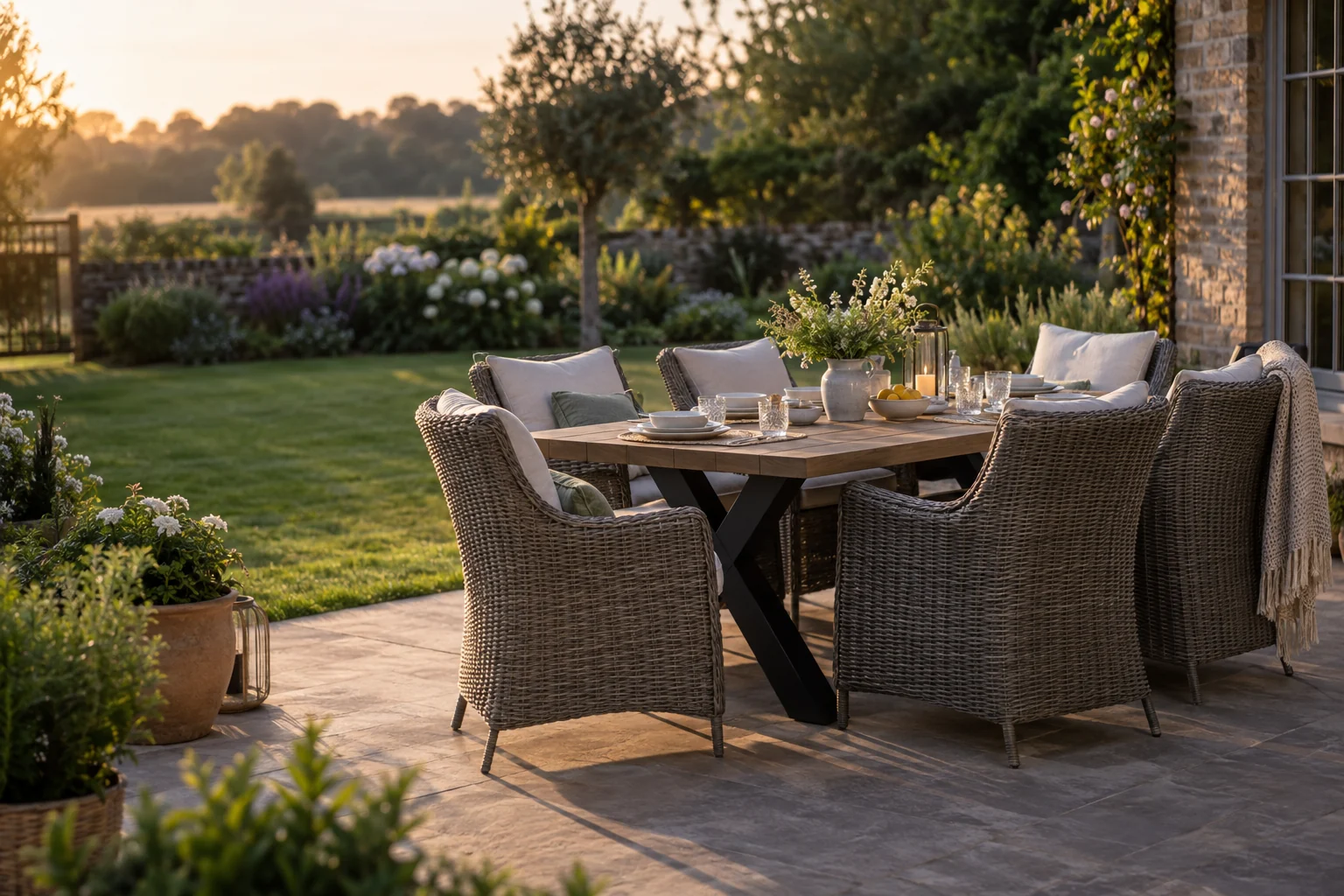
Eating Alfresco With the Whole Family: What This Review Covers
It is early October, which means the garden dining season has become a rather optimistic affair. There may still be a sunny lunch or two ahead, especially if you have a sheltered patio and a willingness to wear a jumper, but most of us are now looking at outdoor furniture with a more practical eye. Does it need covering? Will the cushions fit in the loft? Can two people move the table without developing a lasting grudge?
That makes this a surprisingly good time to choose a family dining set. The summer's use has revealed what matters. Four chairs may have felt perfectly adequate in April. By August, with children, grandparents, neighbours who "just popped in", and a roasting tin that needs somewhere to land, it can feel like a game of garden furniture musical chairs. Six- and eight-seat sets occupy a useful middle ground: enough room for a proper family meal, without automatically turning the whole patio into an outdoor restaurant.
For a typical British garden, six seats tend to suit day-to-day family life particularly well. A six-seat table can accommodate parents, children and a guest or two without every place setting being positioned at an alarming angle. Eight-seat sets make more sense for larger families, regular entertaining, or households where Sunday lunch routinely migrates outside once the weather improves. They need more breathing room, naturally, but they can remove the need to borrow folding chairs from the shed whenever friends appear.
The three things to decide first: choose the material you are willing to care for, be realistic about how exposed your garden is, and work out now—not in the first cold snap—where cushions and furniture will spend the winter.
I have approached this guide around those three everyday questions. First, material: the warmth of acacia wood, the exceptionally low-maintenance appeal of recycled HDPE plastic lumber, and the more architectural acacia-and-iron combinations. Second, weatherproofing: not vague promises of "outdoor use", but how the construction should cope with rain, sun, frost and, for some gardens, salt-laden coastal air. Finally, storage: whether chairs tuck in, stack, require covers, or become a complicated game of shed Tetris.
The shortlisted six-seat options are the POLYWOOD Lakeside 7-Piece Farmhouse Dining Set; the GDFStudio Outdoor 6-Seater Acacia Wood Dining Set with Bench; the GDFStudio Outdoor 6 Seater Expandable Acacia Wood Dining Set in Dark Gray; the Melissa Outdoor 6-Seater Rectangular Acacia Wood and Iron Dining Set; and the Best Choice Products 6-Person Indoor Outdoor Acacia Wood Dining Table. The eight-seat group includes the POLYWOOD Vineyard 9-Piece Farmhouse Trestle Dining Set, the POLYWOOD Oxford 9-Piece Farmhouse Dining Set with Trestle Legs, two expandable GDFStudio acacia options, and the NH390013 acacia-and-iron set with a teak finish.
There is no universal winner. That would be far too convenient. A family who wants to leave furniture out all year will arrive at a different answer from one with a dry garage and a strong preference for natural timber. The good news is that once you understand the compromises, the choice becomes much less mysterious.
Material Matters: Wood, Recycled Plastic and Mixed Builds Explained
Material is the decision that keeps making itself long after delivery day. It influences how the set feels, what it needs from you in spring, how it reacts to a wet February, and whether it looks quietly handsome after several seasons or starts requesting attention like a needy houseplant.
Acacia is the dominant material in this comparison. It appears across the GDFStudio family dining sets, the Melissa set and the NH390013 model, whilst the Best Choice Products table also uses acacia with an alloy steel frame. This is not accidental. Acacia is a dense hardwood, valued for outdoor furniture because its natural oil content helps it stand up better to the elements than softer, cheaper timbers. Its Janka hardness is around 7,560 N (1,700 lbf), which gives some useful context for its robust feel.
That does not mean acacia is a magic wood that can be ignored indefinitely. No timber really is. Rain, sunshine and fluctuating temperatures will gradually alter the surface. The familiar silvery-grey weathered look is not necessarily a structural failure; it is simply what exposed timber does when left to its own devices. Some people like it. Others prefer to preserve the richer colour using an appropriate outdoor wood treatment. Neither camp needs to start a committee.
Acacia: natural warmth for a sociable patio
Acacia brings grain, colour variation and a softer visual presence than plastic or metal. Several of the sets pair it with water-resistant polyester cushions, which is much more forgiving for a long meal than an entirely hard seat.
Recycled HDPE: designed for the weather
POLYWOOD's Genuine POLYWOOD® Lumber is recycled HDPE plastic lumber. It is made from recycled plastic items such as milk jugs and detergent bottles, and is engineered to resist splintering, cracking, chipping, peeling and rotting.
Acacia and iron: a more structured look
The Melissa and NH390013 designs combine timber with iron legs. The metal adds rigidity and a more contemporary outline, but it also means keeping an eye on joints and protective coatings over time.
POLYWOOD's recycled HDPE takes a fundamentally different approach. It is not trying to look or behave like freshly oiled hardwood. It is a substantial, weather-resistant plastic lumber intended to live outdoors in a wide range of climates. The manufacturer states that it resists splintering, cracking, chipping, peeling and rot, and does not require painting or waterproofing. For anyone who already has a list of garden jobs long enough to require a clipboard, that is a significant advantage.
HDPE is particularly attractive for homes where the dining set will remain outside through the British winter. Wet leaves, frost, a patchy cover and the occasional sideways downpour are all less alarming when the furniture itself does not absorb moisture in the way timber can. It is also an excellent fit for coastal gardens, where wind and salt can make life harder for many outdoor materials.
There is, however, a trade-off in feel and handling. The POLYWOOD sets are sturdy and weighty. That heft is reassuring in an exposed garden, but it is less convenient if you expect to move a full dining arrangement often. The Lakeside set weighs approximately 112 kg (247.5 lb) in total. This is not a set to casually drag across the lawn because the shade has moved. It is furniture with opinions.
Wood care is not a failure of the furniture
Choosing acacia means choosing a little maintenance. That can be part of the pleasure if you enjoy keeping timber looking its best. If your ideal garden furniture routine is soap, water and getting on with your Saturday, recycled HDPE has a clearer advantage.
The mixed acacia-and-iron construction deserves a small note of caution. Iron legs can be excellent structurally, and they often make a large table feel less visually bulky. But any damaged coating at a joint or scratch can become an entry point for moisture. In a dry, sheltered courtyard that may remain largely cosmetic for a long time. In a wind-driven rain garden, it needs earlier attention. This does not rule out the style; it simply means buying with eyes open.
Six-Seat Contenders: Full Specifications at a Glance
A six-seat dining set is often the easiest place to begin. It offers enough capacity for an ordinary family meal with room for a guest, but it does not necessarily dominate a modest patio. It is also the size at which table shape, chair design and the possibility of a bench make a surprisingly big difference to how the space works.
The most fully specified option here is the POLYWOOD Lakeside 7-Piece Farmhouse Dining Set. It includes one table, two arm chairs and four side chairs, seating six in total. The table has a 4.1 cm (1.625 in) umbrella hole and narrow gaps designed to drain water. Its chairs arrive fully assembled, whilst the table and bench require assembly. Although the set's overall arrangement occupies a generous amount of room when chairs are pulled out, the individual seats can tuck beneath the table when not in use.
(247.5 lb)
With the chairs pulled out, the Lakeside needs approximately 391 cm wide by 305 cm deep by 84 cm high (154 × 120 × 33 in). That footprint is worth measuring honestly before ordering. A table can fit on a patio and still be miserable to use if everybody has to turn sideways to reach their seat or cannot walk around it with a plate in hand. Marking the footprint with string or spare plant pots is a low-effort trick that can save a great deal of regret.
The GDFStudio Outdoor 6-Seater Acacia Wood Dining Set with Bench is an appealing alternative for households that want more flexibility and a more relaxed dining layout. It combines one bench with four dining chairs, all around an expandable acacia table. The table measures approximately 175 cm wide by 90 cm deep by 75 cm high (69 × 35.5 × 29.5 in), and has a stated load capacity of approximately 136 kg (300 lb). The chairs use acacia frames with water-resistant polyester cushions.
A bench can be very practical with children because it is less precious about exactly where everyone sits. It can also be tucked under the table when the meal is over, depending on the layout, making the dining area look calmer. There is a small practical point here: bench seating asks people to share space. For relaxed summer lunches, that is usually part of the charm. For a formal meal involving elbows, serving dishes and one particularly enthusiastic relative, individual chairs can feel easier.
| Six-seat option | Primary construction | Dining format | Cushion approach | Notable practical point |
|---|---|---|---|---|
| POLYWOOD Lakeside 7-Piece Farmhouse | Recycled HDPE lumber | Table, two arm chairs and four side chairs | No cushions | Seats tuck beneath the table |
| GDFStudio Acacia Wood Dining Set with Bench | Acacia wood | Expandable table, four chairs and bench | Water-resistant polyester cushions | Bench creates flexible family seating |
| GDFStudio Expandable Acacia, Dark Gray | Acacia wood | Expandable dining table | Not a confirmed feature | Modern expandable format |
| Melissa Acacia and Iron | Acacia with iron legs | Rectangular dining set | Water-resistant cushions | Timber-and-metal silhouette |
| Best Choice Products Acacia Table | Acacia with alloy steel frame | Table-only foundation | Not applicable | Lets you choose separate seating |
The Dark Gray GDFStudio expandable acacia option will suit buyers who prefer a more contemporary look than the bench-led arrangement. The Melissa set goes further into mixed materials, pairing acacia with iron legs and water-resistant cushions. It is a strong visual formula for a paved terrace, particularly beside rendered walls, dark fencing or more architectural planting. Just remember that metal legs shift a little more of the winter-care burden towards inspecting coating and joints.
The Best Choice Products acacia table is slightly different from the finished-set options because it is a table rather than a complete dining package. That can be useful if you already own suitable chairs, want to match seats to a particular style, or need a more tailored arrangement. It has an acacia top and alloy steel frame, giving you the opportunity to build a six-place setting around the table rather than accepting a predetermined chair design.
Eight-Seat Contenders: Full Specifications at a Glance
Eight-seat dining furniture changes the scale of outdoor entertaining. It is for the family that genuinely uses the garden as another room, not merely somewhere to carry a coffee on the two warmest afternoons of the year. It gives you capacity for birthdays, barbecue lunches and those long summer evenings that begin with crisps and somehow end with somebody looking for a torch.
The important thing is not to assume that eight seats simply means "two extra chairs". The room around the table matters more, because eight people need space to sit, stand, serve food and move around one another. Trestle bases can help create generous knee room along a long table, but they also create a broad, stable structure that is not designed to be folded away at the end of each meal.
The POLYWOOD Vineyard 9-Piece Farmhouse Trestle Dining Set is the most clearly defined eight-seat option in this group. It comprises one dining table and eight chairs, all made from recycled HDPE POLYWOOD® lumber. The set includes a 4.1 cm (1.625 in) centre umbrella hole with a cover, and uses marine-grade quality hardware. Each chair has a stated capacity of approximately 159 kg (350 lb). There are no cushions to dry, replace or store.
The POLYWOOD Oxford 9-Piece Farmhouse Dining Set with Trestle Legs shares the same broad material proposition: recycled HDPE lumber, seating for eight, a farmhouse influence and POLYWOOD's long warranty credentials. Where the two differ is primarily the design language. The Vineyard has a recognisably relaxed farmhouse feel, whilst the Oxford is the more refined, traditional-looking choice. Both are sensible candidates for families that want furniture to remain outside rather than become a winter storage project.
The GDFStudio eight-seat sets take the timber route. One uses expandable acacia construction with synthetic rattan; another offers expandable acacia in a Brown Patina finish with water-resistant cushions. There is also an Outdoor 8 Seater Acacia Wood Dining Set, NH390013, with iron legs and a teak finish. These are all potentially appealing where the intention is to create a softer, more natural dining area, rather than the deliberately robust, all-weather presence of recycled plastic lumber.
Trestle legs are sturdy, but plan the footprint
A trestle base is excellent for stability and gives a long table its farmhouse character. For winter storage, though, it is not a compact folding arrangement. If the set stays outside, that is less of a concern. If it must go indoors, measure doorways, shed access and the route between them before the first frosty forecast arrives.
| Eight-seat option | Material | Construction style | Cushions | Expandable table |
|---|---|---|---|---|
| POLYWOOD Vineyard 9-Piece | Recycled HDPE lumber | Farmhouse trestle dining set | No cushions | Not a confirmed feature |
| POLYWOOD Oxford 9-Piece | Recycled HDPE lumber | Refined traditional farmhouse trestle design | No cushions | Not a confirmed feature |
| GDFStudio 8-Seater Expandable | Acacia with synthetic rattan | Expandable dining set | Not a confirmed feature | Yes |
| GDFStudio Brown Patina | Acacia wood | Expandable dining set | Water-resistant cushions | Yes |
| NH390013 | Acacia with iron legs | Teak-finish dining set | Not a confirmed feature | Not a confirmed feature |
For a large family, an expandable table is arguably the cleverest version of eight-seat furniture. It allows the set to serve a smaller everyday meal without permanently occupying its full entertaining footprint. The practical caveat is that expansion mechanisms need keeping clear of leaves and debris, and timber tables still benefit from sensible seasonal care. Expandable does not mean maintenance-free. Nothing outdoors really does, apart from perhaps a very determined paving slab.
For those who prioritise the least fussy ownership experience, the two POLYWOOD options remain compelling. Their chairs do not stack, so they are not compact in the conventional sense. Yet the lack of cushions and the material's weather resistance can make "storage" largely a question of whether you cover them, rather than whether you dismantle family dining for several months.
Battling the British Weather: Weatherproofing Compared
"Weatherproof" is one of those outdoor-living words that benefits from a raised eyebrow. It can mean a product is made for outdoor use. It does not always mean it can be ignored through every month of a British year with no change in appearance, no maintenance and no cover. The distinction matters most now, as the garden enters the damp, leaf-strewn stretch of the calendar.
For this comparison, I have considered five useful markers: the material's inherent resistance to rot, cracking and corrosion; the maker's weather claims; how exposed finishes may be to sun and rain; the cushion fabric where cushions are included; and the likely effect of repeated frost-and-thaw cycles. These are practical criteria rather than a promise that one set will remain cosmetically identical forever.
POLYWOOD comes out strongest on the inherent-material question. Its recycled HDPE lumber is designed to resist splintering, cracking, chipping, peeling and rotting, and requires neither painting nor waterproofing. The manufacturer states that the Lakeside is built to withstand a range of climates including hot sun, snowy winters and strong coastal winds. The Vineyard uses marine-grade quality hardware and is described as weather-resistant, making it a strong all-weather proposition, though the specific coastal-wind claim is made explicitly for the Lakeside.
Those figures should be read as a relative buying guide, not laboratory test results. The high score for recycled HDPE reflects its resistance to moisture-related problems, its low upkeep requirements and the explicit climate claims. Acacia scores well because it is a durable hardwood suited to outdoor use, but its appearance and long-term condition rely more heavily on timely care and sensible protection.
The GDFStudio acacia sets, including the six-seat bench arrangement, the Dark Gray expandable version, the Brown Patina eight-seat model and the eight-seat expandable set, are best treated as capable outdoor furniture rather than furniture you forget about. The timber itself is a good choice for a garden dining set. In the UK, however, a cover during prolonged wet weather and a yearly inspection are sensible rather than fussy.
Cushions deserve their own paragraph because "water-resistant" is commonly misunderstood. Water-resistant polyester fabric will cope better with a brief shower or spilled drink than untreated fabric. It is not the same as waterproof, and it is not an invitation to leave cushions outside through repeated rain, frost and winter condensation. Once the filling remains damp, you have created precisely the sort of indoor-storage problem you hoped to avoid.
Rain and standing moisture
HDPE has the clearest advantage where rain is concerned. Acacia can cope outdoors, but should not spend long periods sitting wet beneath an impermeable cover with no airflow.
Frost and winter movement
Repeated freezing and thawing make drainage and cover fit important. Water must be able to run away rather than collect on a tabletop or remain trapped around furniture legs.
Sunlight and colour change
Sun can gradually alter exposed timber. If retaining the original wood tone matters to you, regular care is part of the deal. A naturally weathered finish is the lower-effort alternative.
The acacia-and-iron combinations need one additional check: inspect iron legs and joints at the end of the season. A tiny scratch in a coated metal surface is usually easy to address early. Left through several wet months, it can develop into surface rust that is more annoying than serious, but still not the look anybody was hoping for beside their carefully swept patio.
The Great Winter Put-Away: Storage Practicality Scored
For much of the country, garden dining furniture becomes occasional furniture between November and March. That does not mean it cannot be used—there is plenty to be said for a brisk breakfast outside on a bright winter morning—but long, comfortable family meals are less likely. Furniture will spend more time waiting than hosting. This is why storage practicality is not a dull footnote; it is one of the main buying decisions.
There are two broad strategies. The first is to leave the set in place, positioned on a firm surface, with a breathable and well-fitted cover where appropriate. The second is to move at least part of it under cover, usually cushions first, then chairs if space allows. Your best choice depends less on the furniture catalogue and more on what you actually have: an accessible shed, a dry garage, a side passage that is wide enough, or perhaps no useful storage at all.
The POLYWOOD Lakeside is a useful case study. At approximately 112 kg (247.5 lb) for the complete set, it is decidedly substantial. Two people should move it if it needs relocating. The weight is not a disadvantage when it is sitting in an exposed garden; reviewers have noted that comparable POLYWOOD furniture feels sturdy and heavy enough to withstand strong winds. But it does mean that treating the whole arrangement as portable winter furniture would be optimistic.
Its storage advantage lies in the seating arrangement. The chairs tuck neatly under the table when not in use. That reduces visual clutter and means a single large cover can protect the group more easily than separate covers for each chair. It also makes the patio look more orderly through winter, which is a small psychological victory at a time of year when everything else is busy shedding leaves.
| Storage question | POLYWOOD Lakeside | POLYWOOD Vineyard and Oxford | Acacia and cushion-led sets |
|---|---|---|---|
| Can the seating stack? | No stacking feature stated | Chairs do not stack | Depends on the individual design |
| Can seating tuck under the table? | Yes | Not a confirmed feature | Depends on table and chair shape |
| Do cushions need indoor storage? | No cushions included | No cushions included | Yes, where cushions are supplied |
| Best winter approach | Leave in place and cover if desired | Leave in place and cover if desired | Store cushions dry; protect timber and metal |
| Handling consideration | Heavy complete set | Large eight-seat arrangement | More pieces, but often easier to move separately |
Acacia sets are often easier to manage piece by piece because the furniture is divided into chairs, benches and tables rather than one massive all-weather solution. The flip side is that there are more things to move. A six-seat set with cushions can mean six places to store fabric, several chair frames to arrange and a table that still needs protecting. It is perfectly manageable if you have a garage or large shed. It is less idyllic if your storage consists of one damp plastic box and hope.
Bench seating adds another small storage consideration. A bench is often a simple shape and can slide against a wall or beneath a table, but it is also long. Before choosing a bench set, check the route from patio to shed as well as the shed floor itself. Turning a long bench around a narrow side return is a task best avoided on a rainy Sunday afternoon.
Do the storage walk now
Before buying, walk the route from dining area to storage with a tape measure. Check gate widths, tight corners, steps and the shed doorway. It sounds excessively sensible. It is also the difference between a winter routine and an annual furniture-related obstacle course.
For the coming winter, the immediate priority is cushion care. Brush off leaves, allow cushions to dry completely, then store them indoors or in a dry, ventilated space. Do not seal damp cushions into plastic. With timber furniture, clear debris from joints and tabletop gaps, and make sure legs are not standing in persistent puddles. With HDPE, a clean with soap, water and a soft-bristle brush is generally all that is needed before the quieter months.
Head-to-Head: POLYWOOD vs Acacia — The Defining Choice
Once capacity has been decided, most buyers will find themselves choosing between two very different ideas of outdoor furniture. POLYWOOD is the practical, long-warranty, leave-it-outside route. Acacia is the natural, tactile, more traditionally garden-like route. Both can work beautifully. They simply ask different things of you.
POLYWOOD's biggest appeal is predictability. The material does not need painting or waterproofing, and the manufacturer supports it with a 20-year residential warranty and a three-year commercial warranty. There are no cushions included with the Lakeside, Vineyard or Oxford sets, so there is no annual round of finding a home for bulky fabric pads. For an exposed garden, a busy household, a holiday let, or anyone who has already spent enough weekends maintaining outdoor timber, it is an unusually calm ownership experience.
Acacia offers something HDPE cannot quite reproduce: the grain, warmth and slight individuality of real wood. It sits more gently among planting, terracotta, brick and mature garden boundaries. Acacia designs also make it easier to find sets with cushioned seating and expandable tables, both of which make a real difference to long family meals. If the garden is part dining terrace and part planted retreat, that visual softness may matter greatly.
Why choose POLYWOOD?
- Recycled HDPE lumber resists splintering, cracking, chipping, peeling and rot.
- No seasonal painting or waterproofing is required.
- The Lakeside is stated by the manufacturer to withstand conditions including hot sun, snowy winters and strong coastal winds; all three sets use weather-resistant recycled HDPE.
- 20-year residential warranty on the featured POLYWOOD sets.
- No cushions included, so there is no fabric storage burden.
- The Lakeside seating tucks under its table.
POLYWOOD limitations
- The Lakeside complete set is approximately 112 kg (247.5 lb), so it is not casually portable.
- Hard seating has a different feel from cushioned dining chairs.
- The farmhouse look will not suit every contemporary garden.
- Vineyard chairs do not stack.
Why choose acacia?
- Natural timber grain brings warmth and character to the dining area.
- Several options include water-resistant cushions for more comfortable longer meals.
- Expandable configurations are available in both six- and eight-seat formats.
- Bench seating can work especially well for children and flexible guest numbers.
- Acacia-and-metal choices offer a more modern, structured look.
Acacia limitations
- Timber benefits from seasonal care if you wish to retain its colour and finish.
- Water-resistant cushions should still be stored dry over winter.
- Untreated timber can weather to a grey tone.
- Iron-leg variants need occasional checks for coating damage and rust.
My own rule of thumb is straightforward. If your furniture will live in a very exposed place, or you know that annual timber maintenance will fall to the bottom of the list behind pruning, school events, work and life generally, choose recycled HDPE. The initial visual impact may be more substantial, but the long-term routine is easier.
If your garden is reasonably sheltered, you enjoy the appearance of timber, and you have somewhere dry for cushions, acacia can make outdoor meals feel distinctly more inviting. The right acacia set does not need to look pristine forever to look good. A gently weathered table beneath climbing planting and strings of lights can have considerably more charm than a dining room pretending it has been moved outside.
Which Type of Family Garden Suits Each Set?
Furniture shopping becomes easier once you stop looking for "the best" in the abstract and begin matching a set to the life it will lead. A large suburban patio, a coastal deck, a compact paved yard and a country garden beside a lawn all make different demands.
For an exposed or coastal garden
Look first at POLYWOOD Lakeside, Vineyard or Oxford. Their recycled HDPE construction is designed for a broad range of outdoor conditions; the Lakeside is specifically stated by the manufacturer to withstand strong coastal winds, hot sun and snowy winters.
For natural planting-led spaces
An acacia set will usually sit more softly among borders, brickwork and timber fencing. The bench-led GDFStudio option is especially relaxed in character.
For regular entertaining
Choose an eight-seat set, ideally an expandable acacia model if you want a smaller everyday footprint and capacity when friends or family visit.
For low winter effort
Prioritise no-cushion, all-weather seating. A set that can stay in place is far more useful than one that creates an annual storage crisis.
Families with younger children may find a bench more forgiving than a line of individual chairs. Children do not always approach a meal with the spatial precision of a cabinet maker, and a bench gives a little wriggle room. On the other hand, grandparents and guests who prefer a firm, defined seat may appreciate individual dining chairs, especially for longer lunches.
For households that entertain often but do not have a huge patio, an expandable acacia table deserves serious consideration. It lets you keep the garden more open for ordinary days, then expand when required. This is one of those features that can sound gimmicky until the first time six people arrive carrying drinks, salads and a dog that has decided it too deserves a chair.
In a small garden, the essential calculation is circulation space. Do not measure only the table. Include pulled-out chairs, walking routes to the house, access to the barbecue, and enough room for someone to leave their seat without requiring the entire table to stand up. A dining set should invite people outside, not establish a one-way system.
Autumn and Winter Care: What to Do Now
Right now, in October, is the sensible window for a modest garden-furniture reset. The furniture is still accessible, the weather is not yet relentlessly cold, and you can deal with any small issues before they become spring surprises. Nothing here needs to take all day. A calm hour with a cloth, brush and somewhere dry for cushions is usually enough.
Start by clearing fallen leaves from table gaps, chair joints and beneath furniture legs. Leaves hold moisture surprisingly well, especially once they have turned into that damp brown layer that appears to have been applied with glue. On the POLYWOOD Lakeside, the tabletop gaps are designed for drainage, but they still benefit from being clear of garden debris.
For recycled HDPE, wash the furniture with soap, water and a soft-bristle brush. The appeal is its simplicity: no painting and no waterproofing are required. Allow it to dry, then decide whether a cover makes sense for your garden. A cover is useful for keeping the set cleaner, but it should not trap moisture against the furniture or sit flat enough to form rain pools.
For acacia, brush away debris, wash gently and allow the wood to dry thoroughly. Inspect the surface and legs for signs that the finish needs attention. If you prefer to maintain the original depth of colour, plan any suitable timber treatment for a dry spell, following the treatment manufacturer's instructions. Do not rush it during damp weather simply because the calendar says winter is coming. Timber and moisture have enough going on already.
Bring water-resistant cushions inside once the weather turns consistently wet. A dry garage, utility room, loft space or well-ventilated cupboard is better than a sealed outdoor box if there is any possibility the cushions are damp. They should be completely dry before storage. This one small habit can save you from mustiness, staining and the annual discovery that a cushion has developed its own ecosystem.
Come next spring: inspect fixings, clean away any winter debris, check metal legs for coating damage, and bring cushions out only when they are fully dry and the weather is settling. A few small checks make the first proper outdoor meal feel far less like a repair project.
If your furniture remains outside, lift it slightly from any area that regularly holds water where practical. The goal is simple: keep the base dry, allow airflow, and avoid creating a damp pocket underneath a cover. For all furniture types, avoid storing it directly beneath heavy overhanging branches where drips, leaf litter and bird mess become a constant issue. Gardens are generous, but they can be surprisingly judgmental about poor positioning.
Frequently Asked Questions
The GardenScout Verdict
For the easiest all-year ownership, the POLYWOOD Lakeside, Vineyard and Oxford sets make the strongest case. Recycled HDPE is built for weather, needs no painting or waterproofing, and avoids the winter cushion-storage problem altogether. The Lakeside is especially practical where a six-seat arrangement is enough, thanks to seating that tucks under the table. It is worth noting that the Vineyard chairs do not tuck under the table and do not stack, so the storage compactness that applies to the Lakeside does not extend equally to the Vineyard.
For families who value timber warmth, softer cushioned seating and expandable dining flexibility, the acacia-led GDFStudio sets deserve close attention. They ask for more seasonal care, but they can create a gentler, more natural-looking dining area. The decisive question is not which material is objectively better. It is whether you would rather spend a little time caring for wood, or spend that time sitting outside with a cup of tea whilst the furniture quietly looks after itself.