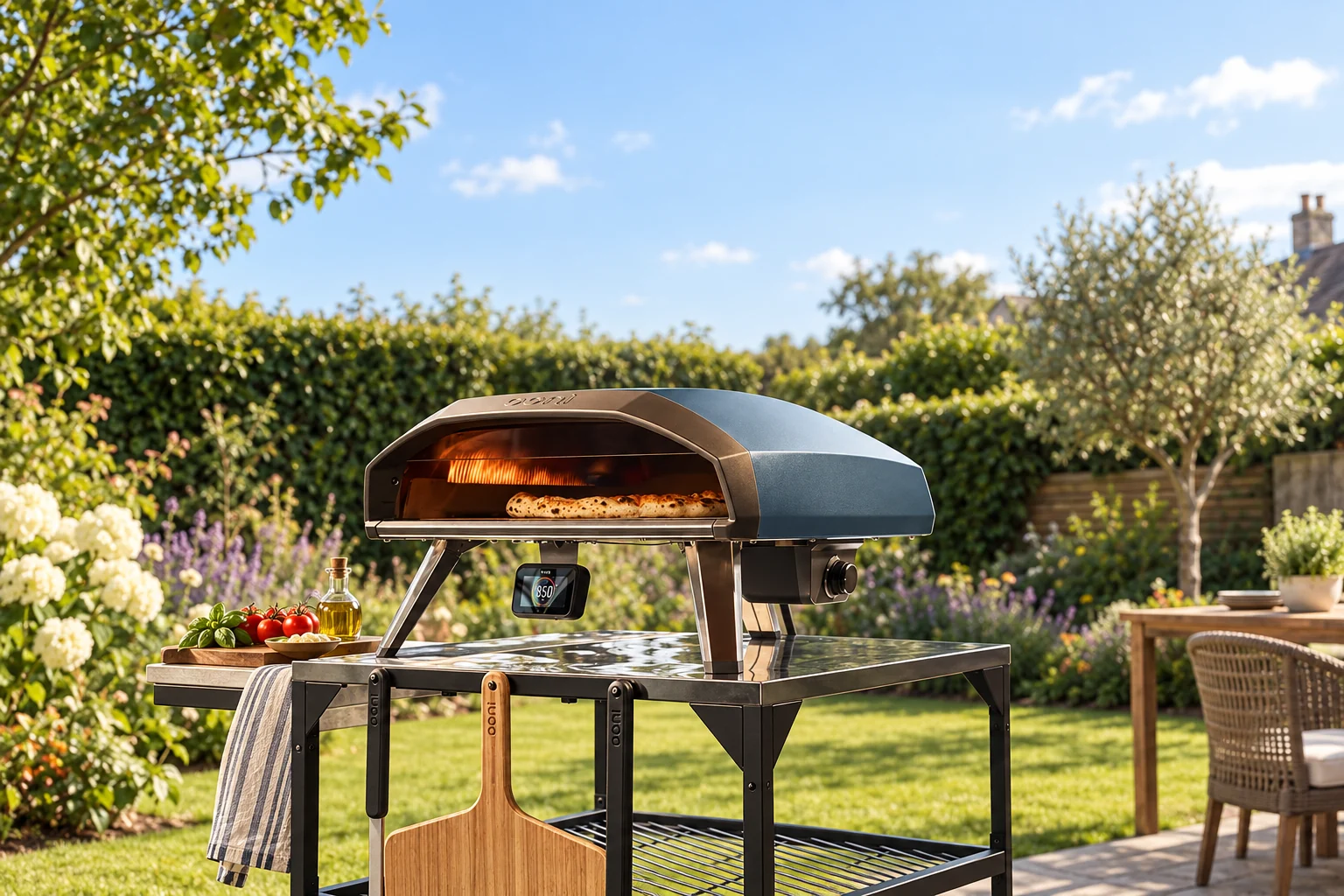
The short answer
The Ooni Koda 2 Pro is worth buying if you regularly cook for groups and want to roast and bake as well as make pizza. It takes pizzas up to 45.7 cm, but weighs 30 kg, so give it a permanent sturdy table. Run it on propane outdoors only, and allow longer than 20 minutes to preheat in winter.

An 18-inch cooking area, 160–500°C range and included Connect temperature hub make it ideal for regular hosts cooking outdoors.
Check price on AmazonWe link to the exact model on Amazon UK. Prices change often, so check the live price before you buy. As an Amazon Associate we earn from qualifying purchases.
Introduction: Why Gas Pizza Ovens Suit a UK Winter Garden
Late November is not traditionally when anyone thinks about cooking outside. The dahlias have been lifted or mulched, the last leaves are being raked into bags for leafmould, and the barbecue is usually sulking under a cover with a puddle on top. The garden goes quiet, and so do we.
Except that a dark, cold evening is one of the best times to stand next to something very hot. In my experience a short, sharp cooking session outdoors in winter is far more pleasant than a long summer barbecue: you are out there for half an hour or so, you are warm whilst you are near the oven, and the food goes straight inside to a table where nobody is being bothered by wasps. A pizza oven suits that rhythm well. It is fast, it is a bit of an event, and it gets the family into the garden in a month when they otherwise wouldn't look at it.
The fuel is what makes or breaks winter use. Wood-fired ovens are lovely, but they need dry, well-seasoned wood, and keeping a fire at the right temperature is a job in itself. Charcoal is slow to come up to heat and messy to clear away in the dark. Gas does away with most of that. You connect a cylinder, turn a dial, press an igniter and wait. There are no embers to tend whilst you're stretching dough, and when you've finished you turn it off. On a damp Tuesday in December, that difference decides whether the oven gets used at all.
The Ooni Koda 2 Pro is Ooni's second-generation large gas oven, with a cooking area that takes pizzas up to 45.7 cm (18 in) across. It launched in the UK on 1 May 2025 with an RRP of £599, and it comes in Slate Blue or Foundry Black. It is not the same thing as the smaller Koda 2, the older Koda 16 or the even larger Koda 2 Max, so it is worth keeping the names straight when you shop. The Pro sits in the middle of the new range: big enough for family-sized pizzas and roasting trays, and still (just about) a countertop appliance rather than a piece of garden architecture.
That size comes at a cost: in money, in weight and in space on the patio. So the question running through this guide is a simple one. Is the larger cooking area, the smarter temperature kit and the convenience of gas worth paying for, compared with a smaller and cheaper oven? For some gardens the answer is a clear yes. For others, the Koda 2 Pro will be a large blue lump that you wish you'd sized down.
The short answer
The Koda 2 Pro makes most sense if you cook for groups, want to use the oven for steaks, vegetables and trays as well as pizza, and have somewhere sturdy to leave it set up. If you mostly make one modest pizza at a time, or you need to lift the oven in and out of a shed every time you use it, a smaller oven will suit you better and cost less.
At a Glance: Ooni Koda 2 Pro Key Specifications
Before getting into how it cooks, here are the numbers that matter when you are deciding whether this oven fits your garden, your table and your gas supply. These are Ooni's official figures for the UK version.
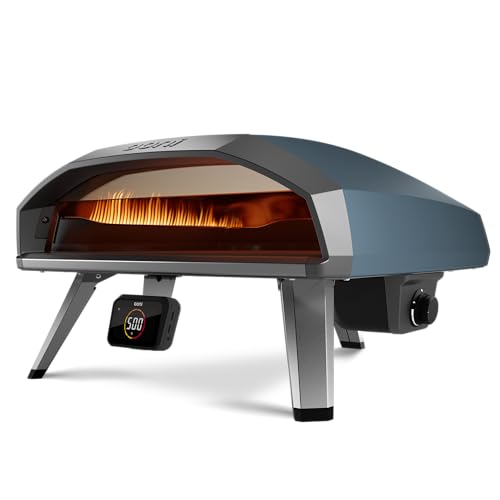
Check today's price: Ooni Koda 2 Pro on Amazon UK
Reading the spec sheet
Ooni gives the dimensions as width × depth × height, so the oven needs a surface at least 68.2 cm wide and 65.2 cm deep, and it stands 39.3 cm tall. That is before you have found room for the gas cylinder, a spot to rest the peel and somewhere to put the finished pizza. The 30 kg weight is the figure I would pay most attention to. It is not unmanageable, but it is a two-person lift, and it rules out a flimsy folding table or a wobbly old potting bench.
The burners are rated at 9.8 kW of heat input and run on propane at 37 mbar, which is the supply pressure Ooni specifies for its GB models. The orifice for that version is 1.62 mm. You don't need to remember either of those details, but they explain why the UK oven and its regulator belong together: other European pressure variants exist, and their parts are not interchangeable with the UK kit.
Two smaller features earn a mention. There is a removable 6 mm glass visor across the mouth, which helps to hold heat in and lets you see what is going on without stooping to peer into the flames. Take it out and taller pans and dishes will fit. Below the opening sits a 7.6 cm (3 in) stainless-steel ledge, which is handy for resting a peel or a pan for a moment.
Colour is a matter of taste. Slate Blue is softer and sits nicely against weathered timber, gravel and grey paving. Foundry Black is the more understated choice if you'd rather the oven blended into a dark-stained fence or a modern outdoor kitchen. Both are the same oven underneath.
The warranty is worth noting too. The standard cover is one year, rising to five years if you register the oven with Ooni within 60 days of purchase. That is a generous extension for what amounts to filling in a short form, and on an appliance at this price I would do it the day it arrives.
Gas type matters. This UK kit is built for propane at 37 mbar and is supplied with a matching regulator and hose. It is not set up for mains natural gas, and you should never swap in a regulator from another appliance simply because the connector seems to fit. Use the parts designed for this oven.
Size Matters: The 45.7 cm (18-inch) Cooking Area in Practice
The headline figure is "18 inches", but the shape of the stone tells you more than the number. The cooking floor is tapered: about 53.3 cm (21 in) wide at the front, narrowing to around 45.7 cm (18 in) at the rear. It's made of 20 mm cordierite, a stone that copes well with the very high, fast-changing temperatures of a pizza oven.
Why the stone tapers
Ooni pairs that tapered stone with two burners, one down each side, using what it calls G2 Gas Technology. The flames themselves are tapered, and Ooni's stated aim is to spread heat more evenly across the stone and cut down the hot and cold patches that older gas ovens were known for. Earlier Koda models used a single L-shaped burner running along the back and one side, so you had a very hot rear corner and a cooler front. Pala Pizza, which cooked on the Pro extensively, preferred the new dual-side arrangement and reported more even browning across the pizza.
For you at the peel, the practical consequence of the taper is that the widest part of the oven is where you actually work. You launch at the front, you turn at the front, and you pull the pizza out from the front. That is where a bit of extra elbow room matters most.
Which pizzas it takes
Ooni describes the oven as accommodating pizzas from 12 inches through to 18 inches:
- 30.5 cm (12 in): the classic individual Neapolitan size. In the Pro this has room all round, which makes turning easy.
- 35.6 cm (14 in): a good sharing size for two, still comfortable to manoeuvre.
- 40.6 cm (16 in): a large pizza to slice for the table. This is where a big oven starts to pay off over a compact one.
- 45.7 cm (18 in): the maximum. A New York-style party pizza with more than twice the surface area of a 30.5 cm pie.
Now a dose of realism. GadgetRadar measured the front opening at about 49 cm wide, the internal depth at roughly 47 cm and the rear width at around 45 cm. Those are one reviewer's observations rather than Ooni's specification, but they show that a full 45.7 cm pizza doesn't leave much spare room. It can be done (Pala Pizza cooked a proper 18-inch New York-style pizza), but notably the reviewer used a large pizza screen to get it in and out rather than a standard peel. Launching a floppy 45.7 cm round of raw dough onto a hot stone through a 49 cm gap is a skill, not a given.
So I'd look at it this way. The Koda 2 Pro's real advantage for most households isn't that it can cook an 18-inch pizza. It's that a 30.5 cm or 35.6 cm pizza has plenty of space around it. You can launch it without clipping the side, turn it without nudging it into the flames, and slide it away from a burner if one edge is charring faster than the other. Anyone who has cooked on a cramped 30 cm-class oven knows how much easier that makes things.
Sharing-sized pizzas
A 40.6 cm or 45.7 cm pizza cut into slices feeds a table in one go, rather than everybody waiting for their turn whilst the first pizzas go cold.
Room to turn and reposition
With smaller pizzas there is space to rotate and shuffle the base around the stone, which helps when the heat is very intense.
Trays, skillets and roasting dishes
Gardeners' World praised the oven's ability to take larger trays and dishes, not just pizzas. Remove the visor and taller cookware fits too.
A ledge to work from
The 7.6 cm stainless-steel front ledge gives you somewhere to rest the peel edge or a pan handle mid-turn.
Size your peel to the pizza you'll actually make
It is tempting to buy the biggest peel going because the oven is big. Resist it unless you really plan to make 45.7 cm pizzas often. A huge peel is awkward to handle in a small garden and harder to store. Most people get on best with a peel suited to the 30.5–40.6 cm pizzas they make every week, and save the monster pie for parties.
Gas Convenience: Propane, the 37 mbar Regulator and Garden-Ready Operation
If the size is the Koda 2 Pro's headline, gas is the reason it gets used on a weeknight. No firewood store, no kindling and no clearing out cold ash with a torch in your teeth.
Propane at 37 mbar
The UK version runs on propane at a supply pressure of 37 mbar, which is the specification Ooni gives for its GB model codes. That makes it a natural fit for a standard UK propane cylinder of the sort used for patio heaters and gas barbecues. Propane is also the better gas for winter. Butane struggles to vaporise properly in freezing weather, whereas propane keeps working in the kind of frosty conditions you can expect in a British December. If you already run a barbecue on butane, that cylinder isn't the right one for this oven.
This kit comes with the 37 mbar regulator and gas hose, so with a filled propane cylinder you have what you need to connect up. NationalWorld's reviewer found the gas connection straightforward and had the oven set up in under ten minutes, which matches what I'd expect from Ooni's gas ovens generally: the work is unboxing and fitting the hub, not wrestling with plumbing.
Spark ignition and a single dial
Lighting is by battery-powered electric spark ignition, and the AA batteries are in the box. You turn the dial and press the igniter, and there is no need to wave a match at a gas jet whilst crouching in the wind. On a breezy, drizzly evening that is not a small thing. Ooni packs a matchstick lighter in the box as well.
One side-mounted dial controls both burners together. Some keen cooks would like independent control of each side, and if that's important to you this isn't the oven for it. For everyone else, one dial is simpler: you have one thing to adjust, and the oven is designed to spread the heat evenly rather than asking you to balance two zones.
Safety first, especially in winter
Gas is convenient, but it still needs care. Before each use, check that the hose is securely attached and isn't cracked, kinked or perished, and replace damaged parts rather than taping over them. Northern Gas Networks advises checking LPG equipment before use and changing cylinders only in a well-ventilated, open area. Stand the cylinder upright and stable, and keep it somewhere you can reach the valve quickly.
Outdoors only, always. Ooni designs the Koda 2 Pro solely for outdoor use. Never be tempted to run it in a shed, garage, greenhouse, tent or enclosed gazebo, however cold or wet it is. Outdoor cooking appliances can produce carbon monoxide, and they can go on doing so after the flame has gone out. If you smell gas, turn off the cylinder, let the area air and don't relight until the problem is fixed.
Winter gas tips
Keep the cylinder outside, upright and out of standing water. Never bring it into the house to "warm it up". Keep a spare set of AA batteries indoors, because cold weather is hard on batteries and a dead igniter on a frosty evening is a small tragedy. And position the oven so its mouth isn't facing the prevailing wind, which will otherwise pull heat out of the front of the oven as fast as the burners can put it in.
Smart Heat: What the Ooni Connect Hub Actually Tells You
The Ooni Connect Digital Temperature Hub comes in the box with the Pro. It is a small digital unit that mounts on the oven and connects by Bluetooth to the Ooni app on your phone. T3 singled it out as one of the Pro's key features, and I can see why: knowing what is happening inside the oven saves a lot of guesswork.
What it measures (and what it doesn't)
The hub gives you two readings. An ambient-temperature cable reports the air temperature inside the oven, and a food probe reports the internal temperature of whatever you've pushed it into, such as a joint of meat, a thick steak or a whole chicken in a pan. You can watch both on the hub's display or on your phone.
What it doesn't do is read the stone. The probe is for food, and air temperature is not the same as stone temperature, especially early in the preheat, when the air heats far faster than 20 mm of cordierite. For pizza, the stone is what cooks the base. That is why a separate infrared thermometer, pointed at the middle of the stone, is still a useful thing to own.
Nor does the hub control the oven. It's a monitor, not a thermostat. You still set the heat with the gas dial, and the hub tells you what has happened as a result.
Ambient temperature
The cable reports the air temperature in the oven, useful when you've turned the dial down for roasting and want to know it has settled.
Food probe
Track the internal temperature of meat or a large dish without opening up and prodding it, which is handy when it's dark and cold outside and you're inside with the guests.
App connection
Readings go to your phone over Bluetooth, so you can keep an eye on a slow roast from the kitchen rather than standing on the patio in the drizzle.
Fitted on the oven
The mounting bracket, fixings and Torx key are all supplied, so the hub attaches neatly to the oven body and stays there.
The temperature range in context
Ooni quotes a working range of 160°C to 500°C. The bottom end is for slower roasting, the top end is for Neapolitan pizza, and there is a lot of useful cooking in between. The bars below set Ooni's figures alongside independent measurements from Pala Pizza, so you can see where real cooking actually happens.
Two things stand out. First, the oven really does reach the temperatures Ooni says it does: Pala Pizza measured the stone at about 504°C. Second, getting the stone fully saturated took around 35 minutes, and that was on a warm summer day. Ooni's "about 20 minutes to 400°C" is a reasonable target for getting cooking, but a thick stone in a cold garden will take longer to soak up heat, and you should plan for that in winter.
Equally interesting is that New York-style pizza was cooked at a stone temperature of around 343°C, well below the maximum. Bigger, more heavily topped pizzas want a cooler stone and a longer bake so that the middle cooks before the crust burns. Being able to dial the oven down for those and back up for Neapolitan is where a wide temperature range pays off.
Recovery between pizzas
Every pizza you cook pulls heat out of the stone, and the next one cooks badly if you launch too soon. Ooni claims that the G2 system reduces stone-temperature fluctuations from 180°C to 45°C and reheats the stone 25% faster than the Koda 16. Those are the manufacturer's comparisons, not independent tests, and wind and air temperature will affect them in your garden. NationalWorld's reviewer did report rapid recovery between pizzas. Ooni's general guidance is to turn pizzas every 20–30 seconds and to let the stone get back to roughly 380–450°C before launching the next one. That is where an infrared thermometer, rather than the ambient reading, earns a place in the kit bag.
Ooni Koda 2 Pro: Full In-Depth Review and Performance Analysis
Pulling all of that together, how does the Koda 2 Pro stack up as a whole? I haven't had this particular oven on my own patio, so this assessment draws on Ooni's specification and the independent reviewers who have cooked on it at length. I've judged it against what I know from years of cooking outdoors on gas pizza ovens and barbecues in all sorts of British weather.
Pizza performance
This is where the Pro is strongest. Ooni states a Neapolitan pizza cooks in around 60 seconds once the oven is properly heated — a manufacturer claim, not an independently verified result. It's worth keeping in mind that this figure does not include the preheat. This isn't a 60-second appliance from a cold start. It's a 60–90-second oven once you've given it half an hour or so.
The dual side burners produce intense heat, and that has a practical consequence. Pala Pizza recommended a long-handled turner and peel, found that the side-on heat took some adjustment to cooking technique, and still rotated pizzas and kept Neapolitan pies nearer the front of the stone. The G2 system makes the oven more even than older Kodas, but it doesn't make it hands-off. Any 500°C oven expects you to stand there and turn the pizza.
Beyond pizza
The range down to 160°C and the big, flat floor make the Pro more of a general outdoor oven than smaller pizza ovens. T3 highlighted its suitability for steaks, vegetables and roast dishes, and Gardeners' World praised its capacity for larger trays. In winter that matters more than in summer. A tray of roast roots or a cast-iron pan of something bubbling makes a better case for a cold evening outdoors than a fifth pizza does. With the food probe in a joint and the readings on your phone, you can do slow-ish cooking without hovering.
It isn't a barbecue or a smoker, though, as Gardeners' World points out. There are no grill bars, no lid to close over food and no separate hot and cool zones in the way a two-zone barbecue set-up has. It is an enclosed gas oven that happens to be good at more than pizza.
Build quality and design
Gardeners' World described it as a powerful, well-built oven, and NationalWorld praised its solid construction and its looks. It rated the Pro 4.2 out of 5 overall. The Slate Blue finish is attractive, and the low, wide body sits well on a timber outdoor table or a masonry worktop. It reads as a proper bit of kitchen equipment rather than a gadget.
The flip side of that solidity is mass. At 30 kg and 68.2 × 65.2 cm, this is not a grab-and-go oven. Gardeners' World found it heavy and awkward to move or store, and that is the criticism I'd weigh most carefully. It's portable in the sense that two adults can carry it to another part of the garden; it's not something you'll want to pack for a camping weekend or lug up to a balcony. The happiest Koda 2 Pro owners will be those with a permanent spot for it, a sturdy table and a decent cover.
Gas convenience in daily use
Supplied with regulator and hose, using one dial and lighting with a button press, it is about as straightforward as a high-temperature oven gets. The under-ten-minute set-up NationalWorld reported is a fair indication that you won't need a free weekend to get started.
Pros
- Cooks pizzas from 30.5 cm up to 45.7 cm, with plenty of room around everyday sizes
- Dual side burners are designed to give more even browning than the older single-burner design
- Neapolitan pizza in around 60 seconds once properly heated (Ooni's stated figure)
- Wide 160–500°C range suits roasts, steaks, vegetables and trays as well as pizza
- Ooni Connect hub, food probe and ambient cable included
- Comes with the 37 mbar regulator and hose; quick, simple set-up
- Battery spark ignition and single control dial
- Removable glass visor for viewing food and fitting taller cookware
- Five-year warranty when registered within 60 days
Cons
- 30 kg and a large footprint make it awkward to move and store
- Full preheat takes longer than the 60-second headline suggests
- Intense heat calls for long-handled tools and careful turning
- No peel, cover or cleaning brush in the box
- The hub monitors air and food, not the stone itself
- A 45.7 cm pizza leaves little spare room to launch and retrieve
- Not a barbecue or smoker, and no independent burner control
What's in the Box, and What You'll Need to Buy Separately
The Koda 2 Pro arrives as a fairly complete package on the gas and electronics side, and a fairly bare one on the cooking-tools side. Knowing which is which saves a disappointing first evening.
Included
- The oven body, with its removable glass visor
- Two cordierite pizza stones, as listed in Ooni's manual, forming the 20 mm cooking floor
- 37 mbar propane regulator and gas hose for the UK supply
- Ooni Connect Digital Temperature Hub
- Food probe and ambient-temperature cable
- Mounting bracket and fixings for the hub
- AA batteries for the ignition and the hub
- Matchstick lighter
- Torx key for assembly
Not included
Gardeners' World specifically criticised the lack of a cover and of cleaning tools, and those gaps are real. Ooni sells peels and covers separately, so a buyer starting from scratch will need to budget for:
- A pizza peel. This is essential. You can't launch or retrieve a pizza safely without one. Given the intense heat, choose one with a long handle, and consider a smaller turning peel for rotating pizzas in the oven.
- A cover. For a UK garden this is close to essential too. Ooni recommends a dedicated cover for longer-term protection outdoors, and over a British winter an uncovered oven collects rain, leaves and whatever the pigeons have been eating.
- A cleaning brush. You need a brush made for hot pizza stones to clear burnt flour and debris between sessions.
- An infrared thermometer. This isn't strictly essential, but as the Connect hub reads air and food rather than the stone, it is the most useful way to know when the stone is ready for the next pizza.
- A propane cylinder. The regulator and hose are supplied, but the gas is not.
Ooni also sells the Pro in bundles, including an Essentials Bundle and a Rotating Stone Bundle. These aren't the same as the basic oven kit, so if you want the extras bundled in, buy one of those specifically rather than assuming the standard box contains them.
Register it straight away. The standard warranty is one year, extended to five years if you register the oven with Ooni within 60 days. Do it whilst the box is still in the hallway, before the paperwork vanishes into the drawer of mysterious instruction leaflets.
A sensible starter kit
If I were setting up a Koda 2 Pro from nothing this winter, the order of priority would be a peel, a cover and a brush on day one. Add an infrared thermometer soon after, once you start cooking several pizzas in a row and want to know when the stone has recovered. A turning peel and a good cast-iron pan can come later, once you know how you like to use the oven. Some kind of heatproof board next to the oven, so you have somewhere to land a 45.7 cm pizza, is easy to forget and very welcome when you need it.
How It Stacks Up: The Koda 2 Pro Versus Other Types of Pizza Oven
The Koda 2 Pro is the oven this guide recommends, but it helps to see where it sits among the alternatives you might be weighing up. Rather than pitting it against a list of specific rivals, the table below compares it with the two broad options most gardeners consider: a compact gas oven for smaller pizzas, and a wood- or charcoal-fired oven.
| Feature | Ooni Koda 2 Pro | Compact gas oven | Wood- or charcoal-fired oven |
|---|---|---|---|
| Fuel and lighting | Propane, spark ignition, single dial | Usually gas with push-button or dial ignition | Wood or charcoal, lit and built up by hand |
| Tending during cooking | Turn pizzas; no fire to feed | Turn pizzas; no fire to feed | Feed and manage the fire as well as the pizza |
| Pizza size | 30.5–45.7 cm (12–18 in) | Smaller pizzas, less room to turn | Varies widely by model |
| Trays and pans | Larger trays and dishes fit; visor removes for taller cookware | Limited by the smaller mouth and floor | Varies by model |
| Temperature monitoring | Connect hub, food probe and ambient cable included | Varies by model | Varies by model |
| Smoke and ash | None to clear | None to clear | Smoke while lighting; ash to clear afterwards |
| Weight and storage | 30 kg; best left set up on a sturdy table | Lighter and easier to put away | Varies by model |
| Winter practicality | Strong: quick to start and stop | Strong, for small batches | Weaker: needs dry fuel and longer sessions |
Gas versus wood, for winter
I love the smell of a wood-fired oven, and I'll admit that on a still summer evening it is part of the fun. In winter the balance tips firmly toward gas. Dry wood needs storing somewhere dry, which in a wet British November is easier said than done, and a fire takes time both to establish and to die down before you can go in. Gas lets you decide at six o'clock that it's a pizza night and be eating by seven. For a garden that mostly sees use at weekends and in odd weeknight bursts, that matters far more than flavour nuances most guests won't spot.
The Pro versus Ooni's smaller Koda 2
The sensible alternative to the Pro is its smaller sibling, the Koda 2, and I want to be clear that it is mentioned here for context, not as a recommendation. What the step up to the Pro gets you is the larger tapered stone that takes pizzas up to 45.7 cm and roasting trays, the Connect temperature hub, food probe and ambient cable included in the box, and the two-burner G2 arrangement that Pala Pizza found browned more evenly than the older single-burner layout. What it costs you, apart from money, is weight and footprint.
When the bigger oven is worth the bigger spend
Choose the Pro if at least two of these apply to you: you regularly cook for four or more people; you want to roast, sear and bake in the oven as well as make pizza; you've struggled with the cramped feel of a small oven before; and you have a permanent, sturdy spot for it in the garden.
If none of those ring true, a smaller oven will turn out pizza just as well for one or two people, and you'll be glad of the space and weight saved every time you put it away.
Winter Cooking: Getting the Best From the Koda 2 Pro This Season
It's late November, the evenings are drawing in early and there's a run of festive gatherings ahead. Here is how I'd approach using a large gas oven in the garden over the next few months, from first set-up to putting it to bed in a hard frost.
1. Choose the spot before the oven arrives
Put the oven on a rigid, level, heat-resistant table or stand that comfortably takes 30 kg, ideally with room either side. Keep the hot mouth well away from fences, hedges, garden furniture and anything flammable, including dry leaves that have blown into a corner. Find a stable, upright position for the cylinder where you can reach the valve without leaning over the oven. Then allow for you: the practical footprint includes the person working the peel and somewhere to rest a finished pizza. A narrow patio corner may technically take the oven and still be miserable to cook in.
Think about light too. A pizza oven is a night-time appliance from now until March. An outdoor wall light or a decent head torch makes launching and turning far safer than working by the glow of the flames alone.
2. Shield it from the wind
Wind is the main enemy of a gas oven in winter. Face the mouth away from the prevailing wind, which in much of Britain blows from the south-west, and use the house wall or a solid fence as a windbreak where you can do so with safe clearance. The glass visor helps to keep heat in, so leave it in place for pizza nights unless you're cooking something tall.
3. Preheat longer than you think
Ooni's figure is around 20 minutes to 400°C, and Pala Pizza took about 35 minutes to fully heat the stone in summer. In a cold British garden, give it longer rather than less. Light it before you start shaping dough, not when you're ready to cook. If you have an infrared thermometer, check the middle of the stone before the first launch.
4. Keep the dough moving
Flour or semolina your peel and work surface, shape the dough, and transfer it to the peel only shortly before launching. Give the peel a shake to make sure the base still slides; a pizza that sticks to the peel is very hard to rescue. Keep toppings light, especially at first, as an overloaded centre drags and tears. Cold dough straight from the fridge will also cook unevenly, so let it come up to room temperature indoors first.
5. Turn, watch and let it recover
Launch towards the centre of the stone, then turn regularly as the side nearest the flame colours. Ooni's general guidance is every 20–30 seconds at Neapolitan temperatures. Use the room the Pro gives you: if one edge is darkening too fast, shift the pizza away from the burner. Between pizzas, wait for the stone to come back to temperature. A bit of patience here is the difference between the first pizza being the best and every pizza being good.
6. Cook something other than pizza
Winter is when the Pro's versatility comes into its own. Turn the dial down and use the oven for trays of roast vegetables, a spatchcocked chicken or a cast-iron pan of something hearty, with the food probe in place and the readings on your phone. You can have something cooking outside whilst the oven in the kitchen deals with everything else, which is extremely useful on Christmas Eve.
7. Shut down and store properly
Turn off the gas at the cylinder as well as at the dial, then let the oven cool completely before covering it. Brush loose debris from the stone once it is cold. Never douse a hot stone with water, as cordierite doesn't take kindly to sudden temperature shocks. Keep the cover on between uses. In prolonged freezing, very wet weather, if you have a sheltered spot such as an open-sided car port where it can sit safely, it'll appreciate that. Disconnect the cylinder and keep it outdoors and upright.
Come spring, once the worst of the weather has passed, give the oven a once-over: check the hose for perishing, replace the AA batteries, clear any spiders that have taken up residence in the burner area and give the stone a thorough hot burn to clean it off. It'll then be ready for the long evenings, when it can share the patio with the pots of tomatoes and herbs that end up on the pizzas.
Verdict: Is the Ooni Koda 2 Pro Worth It?
The Koda 2 Pro is a confident, well-made gas oven that does what it sets out to do. It gets hot (independently measured at about 504°C on the stone), it cooks a Neapolitan pizza in around 60 seconds once properly preheated (Ooni's own claim), and its larger tapered floor makes everyday pizzas easier to handle as well as making big ones possible. The Connect hub, food probe and wide 160–500°C range give it a role beyond pizza night, which is exactly what makes it worth considering for winter.
Its weaknesses are just as clear. It is heavy and bulky, it needs a proper preheat, it demands attention at full heat, and the box leaves you to buy a peel, a cover and a brush yourself. None of those is a deal-breaker, but together they mean this oven works best for people who'll use it often and give it a permanent home.
Buy it if you…
- Cook for family or friends regularly and want sharing-sized pizzas
- Have a medium-to-large patio or terrace with a sturdy table
- Want to roast, sear and bake outdoors as well as make pizza
- Prefer the convenience of gas to managing a wood or charcoal fire
- Like to monitor temperatures rather than guessing
Skip it if you…
- Have little storage space or need to move the oven often
- Want a portable oven for camping or a balcony
- Mostly cook one or two small pizzas at a time
- Want a barbecue, smoker or multi-fuel cooker
- Expect a complete set of accessories in the box
The GardenScout verdict
For households that will actually fill it, the Ooni Koda 2 Pro justifies its £599 RRP. The bigger stone, the dual burners and the included temperature hub make it a better all-round outdoor oven than a compact model, and gas makes it practical to use right through a British winter. Just make sure you have the space, a strong table, a friend to help lift it, and some budget left for a peel and a cover.
Score: 8.2/10. The best choice here for regular hosts who want one gas oven for pizza and much more besides.
Frequently asked questions
- Ooni Koda 2 ProBest large gas ovenView on Amazon
Buying for a gardener? See our gifts for outdoor cooks, checked on Amazon every day.