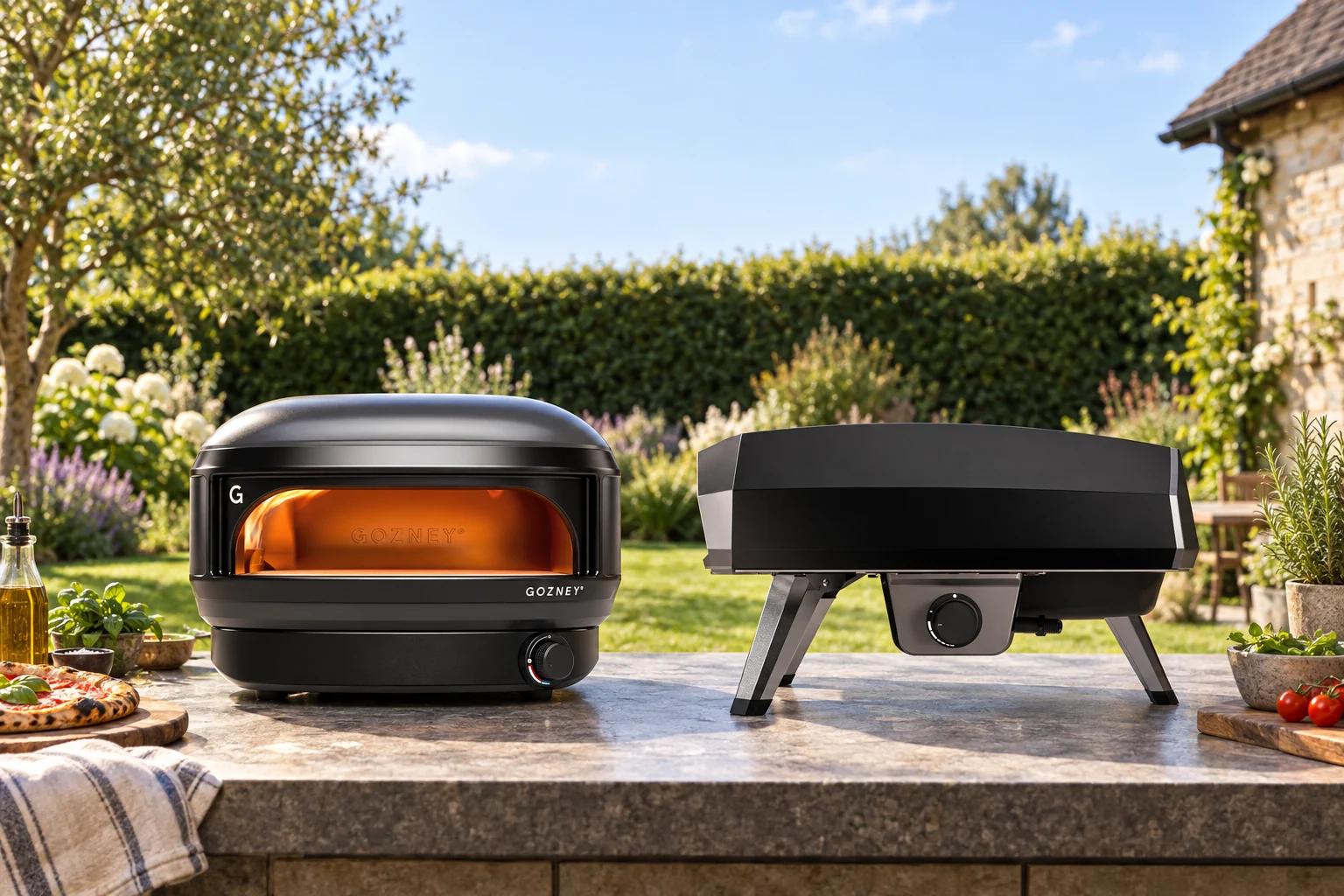
The short answer
For a small patio, choose the Gozney Arc Lite: it is 4kg lighter, more compact and heats to 500°C in around 20 minutes, though it takes pizzas only up to 12 inches. If you feed a family of four or more or want 14-inch pizzas, spark ignition and folding legs, the Ooni Koda 2 is worth the extra.

Lighter at 12kg, more compact and £49 cheaper, with precise flame control and quick heat-up for one-pizza-at-a-time cooking.
Check price on AmazonWe link to the exact model on Amazon UK. Prices change often, so check the live price before you buy. As an Amazon Associate we earn from qualifying purchases.
Gozney Arc Lite vs Ooni Koda 2: Which Compact Pizza Oven Wins Outdoors?
Not so long ago, a pizza oven in a British garden was a bit of a statement piece. Somebody's brother-in-law had built a brick dome at the end of the lawn, it took an afternoon to light, and everyone stood around it in fleeces pretending they weren't cold. Lovely, but not exactly a Tuesday-evening proposition.

Check today's price: Ooni Koda 2 on Amazon UK
Check today's price: Gozney Arc Lite on Amazon UK
The compact gas oven changed all that. Plug in a propane cylinder, turn a dial, wait twenty-odd minutes, and you are slinging out pizzas with blistered, leopard-spotted crusts that would make most takeaways blush. They have quietly become as common on UK patios as the kettle barbecue, and the two brands most people end up shortlisting are Gozney and Ooni.
This year the choice has become rather more interesting. The Gozney Arc Lite arrived in the UK in early 2026, a deliberately smaller, lighter and cheaper take on Gozney's popular Arc design. It promises a 12-inch (30.5cm) pizza in around 60 seconds, from a lateral rolling flame that Gozney rates to 500°C (932°F — you will occasionally see it rounded up to a punchier 950°F). Its rival is the Ooni Koda 2, launched in spring 2025, which offers a larger stone for pizzas up to 14 inches (35.6cm), a 190–500°C working range and a redesigned burner that Ooni says spreads heat far more evenly than the Koda models that went before it.
On paper they look like near-identical twins. In practice, they are aimed at slightly different households, and the differences matter most precisely where space is tight: on the small terrace, the courtyard garden, the rented patio with a fence two steps from the back door.
So rather than drowning in features, I have judged them on the five things that actually decide whether a pizza oven earns its keep on a smaller UK patio:
- Heat-up time — how long before you can launch a pizza, especially on a chilly evening.
- Cooking space — what that 12-inch versus 14-inch difference really means for your household.
- Flame control — how easy each one is to tame, and how much turning you will be doing.
- Weather and storage — how each one copes with being lifted, stashed and protected through a British winter.
- Value — what your money buys, and what you will need to buy on top.
The short answer, for the impatient
If your outdoor space is small and you mostly cook for one to three people, the Gozney Arc Lite is the better fit: it is 4kg lighter, noticeably smaller and £49 cheaper at RRP. If you feed a hungry family, want bigger pizzas or value conveniences like folding legs and spark ignition, the Ooni Koda 2 earns its extra cost. Read on for the reasoning — and the caveats.
Side-by-Side Specs: The Numbers That Matter Most
Before we get into how these ovens feel to use, it helps to lay the numbers next to each other. Specifications never tell the whole story, but with pizza ovens a few figures are genuinely decisive: the size of the box on your table, the weight you have to carry, the diameter of pizza you can launch and the temperature you can reach.
Start with the footprint. The Arc Lite measures 43.0cm wide, 48.1cm deep and 29.7cm high (430 × 481 × 297mm). The Koda 2 comes in at 54.5 × 47.2 × 33.3cm. That extra width is the giveaway — the Ooni is the bigger oven in every sense that matters on a bistro table, and it weighs 16kg against the Gozney's 12kg.
Then the cooking surface. The Arc Lite takes one pizza up to 12 inches (30.5cm); the Koda 2 takes one up to 14 inches (35.6cm). Two inches sounds trivial. It is not. A 35.6cm pizza has roughly 995cm² of surface compared with about 730cm² for a 30.5cm pizza — around 36 per cent more pizza per launch. We will come back to what that means at teatime.
On temperature, the two are level pegging. Gozney specifies a maximum of 500°C for the Arc Lite; Ooni quotes a range of 190°C to 500°C for the Koda 2. Neither has an onboard temperature display, so for both you will either cook by feel and timing or invest in an infrared thermometer. Ooni does offer optional temperature accessories, sold separately.
Koda 2: 500°C
Koda 2: 35.6cm (14in)
Koda 2: 16kg
Koda 2: 54.5 × 47.2 × 33.3cm
Koda 2: £399
| Feature | Gozney Arc Lite | Ooni Koda 2 |
|---|---|---|
| External dimensions | 43.0 × 48.1 × 29.7cm | 54.5 × 47.2 × 33.3cm |
| Oven weight | 12kg | 16kg |
| Boxed weight | 14.8kg | 21.3kg |
| Max pizza size | 30.5cm (12in) | 35.6cm (14in) |
| Stone | 12mm removable cordierite, repositionable | Cordierite pizza stone |
| Temperature | Dial-controlled up to 500°C | 190–500°C |
| Burner design | Side-mounted lateral rolling flame | Tapered-flame burner (G2 Gas Technology) |
| Built-in temperature display | No | No |
| Legs | Sits on a stable, non-combustible platform | Folding legs |
| Finish | Off Black | Foundry Black or Slate Blue |
| UK availability | From March 2026 | Announced April 2025 |
| UK RRP | £349.99 | £399 |
Read across that table and a pattern emerges. The Gozney is the more compact, lighter, cheaper machine. The Ooni gives you more stone, a thicker stone and some thoughtful conveniences, at the cost of extra bulk. Neither is objectively "better" — it depends almost entirely on the space you have and the number of mouths you are feeding.
Gozney Arc Lite: Precision in a Compact Shell
The Gozney Arc Lite is Gozney's answer to a question plenty of us have been asking: can I have the Arc's looks and cooking without the size and price? It is a propane-only oven in an Off Black finish, sized for one pizza up to 12 inches, and it has been on sale in the UK since early March 2026 at an RRP of £349.99.
The first thing you notice is that it does not look like a budget model. Gozney's designs have always had a certain sculpted, slightly architectural quality, and the Arc Lite keeps that. Stuff's reviewer made exactly this point — it retains the brand's distinctive styling rather than looking like a stripped-back afterthought. On a small patio, where the oven is going to be in full view, that matters more than you might think.
What's in the box (and what isn't)
The standard Arc Lite arrives with:
- The Arc Lite oven itself
- A removable cordierite stone floor
- A stone adjustment tool
- An attached gas hose and regulator
- A Torx tool
- A quick-start guide
What you will not find is a pizza peel, a turning peel, a cover, a stand, an infrared thermometer or a gas cylinder. That is fairly standard for this class of oven, but it is worth knowing before you plan a Saturday-night pizza party on the day the box arrives. A launching peel and a smaller turning peel are not optional extras in any meaningful sense — you cannot cook without something to get the pizza in and out.
Setting up is refreshingly quick. Gozney describes it as needing no significant assembly: you place it on a suitable, non-combustible platform and connect the propane. Stuff timed unboxing to first ignition at no more than 10 minutes, including fitting the stone and burner guard. Woman & Home found it perfectly stable on a small bistro table, which is encouraging for anyone without an outdoor kitchen.
The lateral flame, explained
The clever bit is the burner. Rather than a flame at the back of the oven, the Arc Lite has a propane burner at the side of the cooking chamber. The flame rolls laterally across the roof of the dome, so heat sweeps over the top of the pizza whilst the stone beneath soaks up warmth and cooks the base. You adjust it all with a single gas-control dial on the front.
This is how it hits that headline 60-second Neapolitan. BBC Good Food's testing produced Neapolitan pizzas in about 60 seconds once the oven was at temperature — but, crucially, that is cook time, not warm-up time. The oven itself needs around 20 minutes to get there, which we will dig into shortly.
Lateral rolling flame
A side-mounted burner throws flame across the dome roof, giving top heat for charred crusts and bubbling cheese. Woman & Home's infrared readings found the stone heating evenly from side to side.
Front gas-control dial
Reviewers praised the precise flame control, letting you drop from full blast for Neapolitan bases to gentler heat for thicker, slower bakes.
Removable 12mm cordierite stone
The stone is not fixed, and the supplied adjustment tool lets you reposition it — handy for fine-tuning and for cleaning.
12kg, 43cm wide
Light enough to lift on your own and small enough to sit on a garden table, a shed shelf or the back seat of the car for a camping weekend.
How it cooks
The reviews are consistently warm. Woman & Home's benchmark margherita took around two and a half minutes and came out with an evenly cooked base, a well-developed crust and proper caramelisation. T3 praised the leopard spotting and found it handy for searing meat too. Tom's Guide went off-piste with nduja prawns in cast iron, which is exactly the sort of thing that makes a pizza oven earn its space through the summer rather than gathering dust after the novelty wears off.
There are honest limits. The single side burner means you must turn pizzas as they cook — the Daily Mail found it manageable but noted that it takes practice and a turning peel. The lighter build also gives up heat sooner than chunkier premium ovens: the same reviewer managed three or four pizzas back to back before the stone needed a few minutes to recover. And Woman & Home pointed out that the low 8.5cm mouth leaves less room to manoeuvre, so complete beginners should expect a few wonky launches.
Pros
- Compact 43.0 × 48.1cm footprint suits small patios and balconies
- 12kg — genuinely one-person portable
- Precise front dial and even side-to-side stone heat
- Around 60-second Neapolitans once fully hot
- Lower RRP at £349.99, with a five-year warranty on registration
- Looks premium on show
Cons
- 12-inch maximum pizza
- No built-in temperature display
- Pizzas need turning during cooking
- Stone needs a breather after three or four pizzas
- Peels, cover and cylinder all extra
Arc Lite tip: budget for an infrared thermometer
Every serious reviewer who used the Arc Lite reached for an infrared thermometer, and with good reason: without an onboard display, it is the only reliable way to know whether the stone has recovered between pizzas. It is a small purchase that saves a lot of pale, soggy-bottomed disappointment.
Ooni Koda 2: The Bigger-Stone Challenger
The Ooni Koda 2 is the second generation of one of the best-selling gas pizza ovens around, announced in the UK in April 2025 alongside its larger sibling, the Koda 2 Pro. This is the 14-inch model, sold here in Foundry Black (a Slate Blue version also exists), with a UK 37 mbar regulator and gas hose in the box. Ooni quotes a working range of 190°C to 500°C, and the RRP is £399.
Where the Gozney aims to be small and elegant, the Ooni aims to be capable and practical. It is wider, heavier and, frankly, a bit more of a lump — but it gives you more pizza per launch and a handful of small, sensible design touches that you come to appreciate on the third or fourth cook.
What's in the box (and what isn't)
The standard Koda 2 includes:
- The Ooni Koda 2 oven
- A 15mm cordierite pizza stone
- A UK 37 mbar regulator and gas hose
- A matchstick lighter
- A battery for the electric ignition (an AA, according to Ooni's manual)
- A Torx key
As with the Gozney, there is no peel, no infrared thermometer, no cover and no gas cylinder. The motorised rotating stone and the Ooni Connect digital temperature hub are separate accessories, available either on their own or as part of Ooni's bundles, so do not assume they come with the standard oven. The good news is that the regulator is designed for the clip-on style of patio-gas cylinder, which you can pick up from most garden centres and builders' merchants.
That battery is worth a quick explanation, because it causes confusion. It is not a cordless oven — the battery simply powers the spark ignition on the side. If it gives up, there is a matchstick holder so you can still light the burner manually. There is nothing to charge.
Why the 190°C floor matters
Ooni's stated 190–500°C range is a quiet strength. Most people buy a pizza oven for scorching-hot Neapolitan pizza, but plenty end up cooking thicker New York-style bases, roasted vegetables, flatbreads or a cast-iron pan of something slow. A clearly defined lower working range makes those cooks feel less like guesswork.
To be fair to the Gozney, both ovens top out at 500°C and the Arc Lite's dial also turns down — Tom's Guide found 215°C after 15 minutes perfectly good for thicker sourdough bases. The difference is more about the Ooni explicitly supporting gentler cooking. There is a practical catch, though. The Guardian's Rachel Ogden found that once the Koda 2 had been run at full heat, it took a relatively long time to cool down far enough for lower-temperature cooking. So if you plan a mixed menu, do the gentle bakes first and crank it up for the Neapolitans afterwards.
Ogden's testing illustrates the range nicely: a cheese-and-tomato pizza at about 430°C, a salami pizza at around 400°C and a vegetable pizza nearer 350°C. Rachael Penn at The Independent had pizzas cooking in just under two minutes.
G2 Gas Technology
A redesigned tapered-flame burner. Ooni claims it cuts stone-temperature fluctuation from 175°C to 85°C compared with earlier Koda models — a manufacturer figure rather than an independent test.
Cordierite stone
A cordierite pizza stone sized for pizzas up to 35.6cm.
Pros
- Takes pizzas up to 14 inches — around 36% more surface than 12 inches
- Defined 190–500°C working range
- Defined 190–500°C working range
Cons
- 16kg and 54.5cm wide — bulkier to lift and store
- Pizzas still need regular turning
- Slow to cool after a full-heat session
- No built-in temperature display
Check your gas setup. The UK Koda 2 comes with a 37 mbar regulator for clip-on patio-gas cylinders, and Ooni optimises it for propane. Whichever oven you choose, use the regulator supplied for your region and check the label and manual rather than swapping in a spare from an old barbecue.
Race to Temperature: Heat-Up Times Under the UK Sky
Heat-up time sounds like a minor spec until you live with a pizza oven in Britain. Our weather windows are short. You glance out at six o'clock, the rain has stopped, the kids are starving and you have perhaps an hour before the next band rolls in. An oven that needs 30 minutes to get properly hot can feel like a very different proposition from one that is ready in 20.
It gets more pronounced at this time of year. Here in mid-November, evening temperatures are low and the wind is rarely shy, and every compact oven takes longer to saturate its stone when the air around it is cold. If you are planning a cosy winter pizza night — and they are genuinely lovely, with a hot oven glowing in the dark — add a few minutes to every figure below and shelter the oven from the wind.
Gozney Arc Lite
Reviewers broadly agreed that the Arc Lite heats quickly, but how quickly depends on what you count as "ready". T3 had it at cooking temperature in about 10–15 minutes. BBC Good Food and Stuff both reported roughly 20 minutes to reach 500°C on high. The Daily Mail measured 20–30 minutes for a full heat-up to 500°C, depending on the outdoor temperature. Woman & Home recorded more than 320°C after about 20 minutes, and Tom's Guide read 215°C after 15 minutes.
My reading of all that: count on around 20 minutes in decent conditions, closer to half an hour on a cold evening if you want the stone fully saturated for a 60-second Neapolitan. And remember, that 60 seconds is the cook, not the warm-up.
Ooni Koda 2
The Guardian's Rachel Ogden measured the Koda 2 reaching around 430°C in 27 minutes. That is a respectable figure and plenty hot enough for proper pizza — her cheese-and-tomato bake was done at around that temperature — though it suggests the bigger, heavier oven with its thicker stone takes a little longer to come up to full heat than the Arc Lite's best results.
Winter heat-up tips for both ovens
- Light the oven before you stretch your dough — the preheat is the perfect window for prep.
- Turn the oven's back to the prevailing wind, or tuck it beside a wall (with sensible clearance from anything combustible).
- Judge readiness by stone temperature, not flame. An infrared thermometer is worth its weight in mozzarella.
- Give the stone a few minutes between pizzas on cold nights; it recovers more slowly when the air is chilly.
Cooking Space & Pizza Size: Inches Matter on a Patio
This is the section where the two ovens genuinely diverge, and it is the one I would encourage you to think hardest about.
The Arc Lite's cooking chamber measures 32.5cm wide, 35.5cm deep and 15.0cm high, with a mouth 32.5cm wide and 8.5cm high. In practice that means one 12-inch (30.5cm) pizza at a time — a standard Neapolitan-sized round, comfortably enough for one hungry adult or two moderately restrained ones. The removable stone can be repositioned with the supplied tool, which helps you fine-tune things if you find one area cooking faster.
The Koda 2's stone takes one pizza up to 14 inches (35.6cm). That two-inch jump means around 36 per cent more pizza each time you launch. For a family, that is the difference between three pizzas and four, which over an evening of cooking adds up to a fair bit of time standing at the oven whilst everyone else eats.
Let me be clear about one thing, because it comes up often: neither oven is designed to cook two pizzas side by side. The Koda 2 is specified for a single pizza up to 14 inches, and that is how I would use it. If you need to cook for a crowd simultaneously, you are looking at a larger oven altogether.
| Your household | Gozney Arc Lite (12in) | Ooni Koda 2 (14in) |
|---|---|---|
| Couple | Ideal — one pizza each, cooked in quick succession | Works well, but more oven than you strictly need |
| Family of four | Fine if you are happy to run a pizza queue | Better — bigger pizzas mean fewer rounds |
| Occasional party of six to eight | Doable, but expect stone recovery breaks after three or four pizzas | Easier, though you will still cook one at a time |
| Balcony or tiny courtyard | Strong fit at 43cm wide | Check your table first at 54.5cm wide |
| Skillet cooking and sides | Capable — reviewers used cast iron successfully | Capable, with a defined lower range from 190°C |
If you are cooking for four on the Arc Lite, think about the rhythm. A pizza that takes a couple of minutes, plus launching, turning, slicing and topping the next one, puts you at roughly one pizza every few minutes — and the Daily Mail's experience suggests a short pause after the third or fourth to let the stone recover. That is perfectly fine for a relaxed evening where people graze. It is less fine if everyone wants to sit down to eat together.
The Koda 2's larger rounds make sharing easier: two 14-inch pizzas can comfortably feed a family of four with younger children. On the other hand, larger pizzas are harder to launch and turn, especially through a gas oven's relatively low mouth. If you are new to this, practise with smaller bases first.
Peel sizing matters. Buy a launching peel that matches your oven: a 12-inch peel for the Arc Lite, a 14-inch peel if you want to use the Koda 2's full stone. A smaller round turning peel is worth having for both, since each oven needs pizzas turning as they cook.
Flame Control & Cooking Versatility: Dialling In Your Perfect Pizza
Gas ovens are popular precisely because they are controllable. No feeding logs, no fussing with pellets — just a dial. But the way each oven delivers its flame shapes how you cook.
The Arc Lite's rolling flame
Think of the Arc Lite like a grill and a hotplate in one box. The side-mounted burner sends a flame curling across the underside of the dome, and that radiant heat bears down on the toppings: cheese bubbles, crust edges char and puff. Meanwhile, the stone — preheated by all that flame above it — cooks the base by direct contact. Get the balance right and the top and bottom finish at the same moment, which is the whole art of pizza.
The front dial is the Arc Lite's best feature in daily use. Woman & Home praised its precision and the even heat pattern, and T3 called the flame controllable. On full, it will produce a 60-second Neapolitan. Turn it down and BBC Good Food managed New York-style pizzas in around four minutes and calzones in about five. Tom's Guide's cast-iron prawns show it is not a one-trick oven.
Because the flame comes from one side, the side nearest the burner will always cook faster. You turn the pizza to compensate, as the Daily Mail noted. It becomes second nature quickly enough, though your first few may have one beautifully charred side and one slightly bashful one.
The Koda 2's tapered flame
Ooni's redesign centres on what it calls G2 Gas Technology, built around a tapered-flame burner. The aim is to spread heat more evenly across a larger stone. Ooni claims stone-temperature fluctuation drops from 175°C on earlier Koda models to 85°C, and describes it as 200 per cent better heat distribution than the Koda 12. These are Ooni's own figures, not independent measurements, but they point to a real improvement on a design that previously had a reputation for fierce hotspots.
Independent testing shows it is still a gas oven with a dominant heat source, though. Rachael Penn at The Independent found she needed to turn pizzas at roughly 30-second intervals to stop one side overcooking. That is a fair bit of attention for a pizza that is done in under two minutes — expect to be stood at the oven, peel in hand, rather than chatting by the table.
Hot and fast (around 430–500°C)
Neapolitan-style bases. Arc Lite: around 60 seconds per BBC Good Food. Koda 2: under two minutes per The Independent. Turn frequently on both.
Medium (roughly 350–400°C)
Loaded pizzas with plenty of toppings. The Guardian cooked salami and vegetable pizzas on the Koda 2 in this zone.
Gentle (around 190–250°C)
Thicker sourdough, New York-style bases and cast-iron dishes. Do these first in the session, as the Koda 2 is slow to cool after running flat out.
The turn-down trick
On both ovens, a useful technique for toppings-heavy pizzas is to launch onto a fully heated stone, then drop the flame a touch for the remainder of the cook. The stone keeps the base cooking whilst the gentler top heat gives the toppings time to catch up. Arc Lite owners will appreciate how finely the dial responds here.
Patio Storage & Weather Resistance: Surviving the British Climate
Here is the unglamorous truth about compact pizza ovens: they spend more time being stored than cooking. Most of us use ours most heavily from late spring to early autumn, with the odd crisp winter session, and the rest of the time the oven needs somewhere to live. On a small patio, "somewhere to live" can be the deciding factor.
Size and weight in real life
The Arc Lite, at 43.0 × 48.1 × 29.7cm and 12kg, is a manageable package. It will slot onto a sturdy shed shelf, sit under a potting bench or tuck into a garage corner without much negotiation. Twelve kilos is roughly a large bag of compost — awkward but perfectly liftable for most adults. BBC Good Food liked its portability enough to suggest taking it to a campsite or the beach.
The Koda 2 is a step up in effort: 16kg and 54.5cm across. It is still portable in the sense that you can carry it from patio to shed, but it is the kind of lift you want to plan rather than do absent-mindedly. In its favour, the legs fold away underneath, which tidies up its shape for storage and transport.
If you are lifting either oven onto a table every time you cook, that 4kg difference becomes very real by September.
Materials and weather
Ooni builds the Koda 2 from powder-coated carbon steel with stainless-steel internal base and legs, an aluminium nose and rear plate, and rubber feet. It is designed for outdoor life. That does not mean it is designed to be left out unprotected in a British winter, and the same is true of the Arc Lite. Gozney is clear that its oven is for outdoor use on a secure, level, non-combustible surface, but nobody would recommend leaving it permanently exposed. The Daily Mail also noted that the Arc Lite's thinner, lighter construction loses heat faster than heavier premium ovens — great for carrying, less great in a stiff breeze.
Safety first, whatever the size. Both ovens are outdoor-only appliances. Place them on a stable, level, non-combustible surface, and keep clear of timber fences, trellis, parasols and fabric. Check clearance distances in your manual. Never move either oven indoors to use it, however tempting on a wet evening.
What to do right now, in November
If you already own one of these, or you are buying one for Christmas, this is the moment to think about winter care. Our patios are cold, damp and, frankly, a bit grim through to March, which is hard on steel and stone alike.
Your November oven checklist
- Burn it clean: after your last cook of the season, run the oven for a while to burn off food residue on the stone, then let it cool completely.
- Keep the stone dry: cordierite tolerates heat brilliantly but dislikes being soaked. Store the oven where it stays dry, and never wash the stone with soapy water.
- Disconnect the gas: unclip the regulator and store the propane cylinder upright, outdoors in a well-ventilated spot — never in the house or a cellar.
- Cover or bring in: if the oven stays on the patio, use a proper fitted cover. Better still, move it to a dry shed or garage.
- Check the hose: come next spring, inspect the hose for cracks or perishing before you light up again.
Winter cooking is absolutely possible, and rather wonderful — but expect slower heat-ups and slower stone recovery between pizzas. The lighter Arc Lite is easier to carry out of the shed for a one-off December pizza night; the Koda 2's folding legs make it easier to stash neatly when you are done.
Value Verdict: What Does Your £350 Actually Buy?
At RRP, the Gozney Arc Lite costs £349.99 and the Ooni Koda 2 costs £399. That is a gap of just under £50, which is not nothing — it is about the price of a decent peel, or a fair few balls of buffalo mozzarella.
So what does each pound buy you?
With the Arc Lite, you get the oven, a removable 12mm cordierite stone, a stone adjustment tool, an attached hose and regulator, a Torx tool and a quick-start guide. That is a sensible base kit, built around a compact, good-looking oven with excellent flame control. Gozney also offers two bundles if you would rather buy accessories in one go: the Arc Lite Basic Bundle at £384.98 and the Essentials Bundle at £484.96.
With the Koda 2, you get the oven, a thicker 15mm stone, a UK 37 mbar regulator and hose, battery spark ignition with a matchstick lighter as backup, and a Torx key — plus folding legs and that useful front ledge built in. Ooni also sells Essentials and Rotating Stone bundles for those who want to kit out in one purchase.
Gozney Arc Lite
Standard oven, 12in capacity, Off Black
Arc Lite Basic Bundle
Gozney's entry accessory bundle
Arc Lite Essentials Bundle
Gozney's fuller accessory bundle
Ooni Koda 2
Standard oven, 14in capacity, 37 mbar regulator
The hidden extras
Neither oven is ready to cook straight out of the box. To make your first pizza safely, you will need, at minimum:
- A propane cylinder — neither oven includes gas, and both are propane appliances.
- A launching peel — sized for 12-inch pizzas on the Arc Lite or up to 14 inches on the Koda 2.
- A suitable surface — a stable, level, non-combustible table or stand. If you already own a sturdy garden table that meets the bill, you may not need anything new.
For regular use, I would add:
- A turning peel — both ovens need pizzas turned during cooking, and doing it with tongs is a recipe for torn crusts and burnt knuckles.
- An infrared thermometer — especially for the Arc Lite, given the lack of a display. Koda 2 owners have the option of Ooni's Connect hub instead.
- A fitted cover — non-negotiable if the oven lives outside between cooks.
Here's the important point: those extras are broadly the same for both ovens, so the RRP gap of around £49 is a fair reflection of the real difference in total outlay. The Koda 2's larger size may nudge you towards a larger peel, but that is about it.
Is the Koda 2 worth the extra? If you need the larger pizza, yes, comfortably — 36 per cent more pizza per launch, a thicker stone, spark ignition and folding legs is solid value for under £50 more. If you do not need the larger pizza, the Arc Lite simply gives you more of what a small patio needs for less: smaller, lighter and cheaper, with flame control that reviewers genuinely raved about. Tom's Guide and the Daily Mail both called its price competitive for a branded gas oven, and I agree.
The Verdict: Which Oven Should Live on Your Patio?
After all the numbers, it comes down to a simple question: what does your outdoor space look like, and who are you cooking for?
For the brief at hand — smaller UK patios — the Gozney Arc Lite is my pick. It wins on footprint, weight, price and day-to-day storage, it heats quickly, and its front dial and lateral flame make it a genuinely enjoyable oven to cook on. Its compromises — a 12-inch limit, the lack of a temperature display, and the need for a short stone recovery after a few pizzas — are real, but for couples and small families they are easy to live with.
The Ooni Koda 2 is the better buy if your household is bigger or your appetite larger. Those extra two inches of pizza make a noticeable difference across an evening, and the thicker stone, spark ignition, folding legs and defined low-temperature range make it a slightly more versatile, convenience-led machine. Just be honest with yourself about where it will live and who will be lifting it.
Choose the Gozney Arc Lite if…
- Your patio, courtyard or balcony is tight on space
- You mostly cook for one to three people
- You want to lift and store it on your own easily
- Precise flame control appeals to you
- You would rather keep the outlay under £350
Choose the Ooni Koda 2 if…
- You regularly feed a family of four or more
- You want pizzas bigger than 12 inches
- Spark ignition and folding legs matter to you
- You like gentler bakes in the 190°C-plus range
- You have a sturdy table with room for a 54.5cm-wide oven
GardenScout verdict
Best for small patios: Gozney Arc Lite. Lighter, more compact and cheaper, and a delight to control. On a compact British patio, it simply fits better — on your table and in your shed.
Best for bigger pizzas: Ooni Koda 2. More stone, more pizza and more creature comforts. If your space allows and your household is hungry, it is well worth the step up.
Quick questions answered
Whichever you choose, the real secret of great pizza is less about the oven and more about patience: a properly hot stone, well-rested dough and a willingness to turn, turn and turn again. Get those right, and even a damp November evening on a modest British patio can taste a little like Naples.
- Gozney Arc LiteBest for small patiosView on Amazon
Buying for a gardener? See our gifts for outdoor cooks, checked on Amazon every day.