The short answer
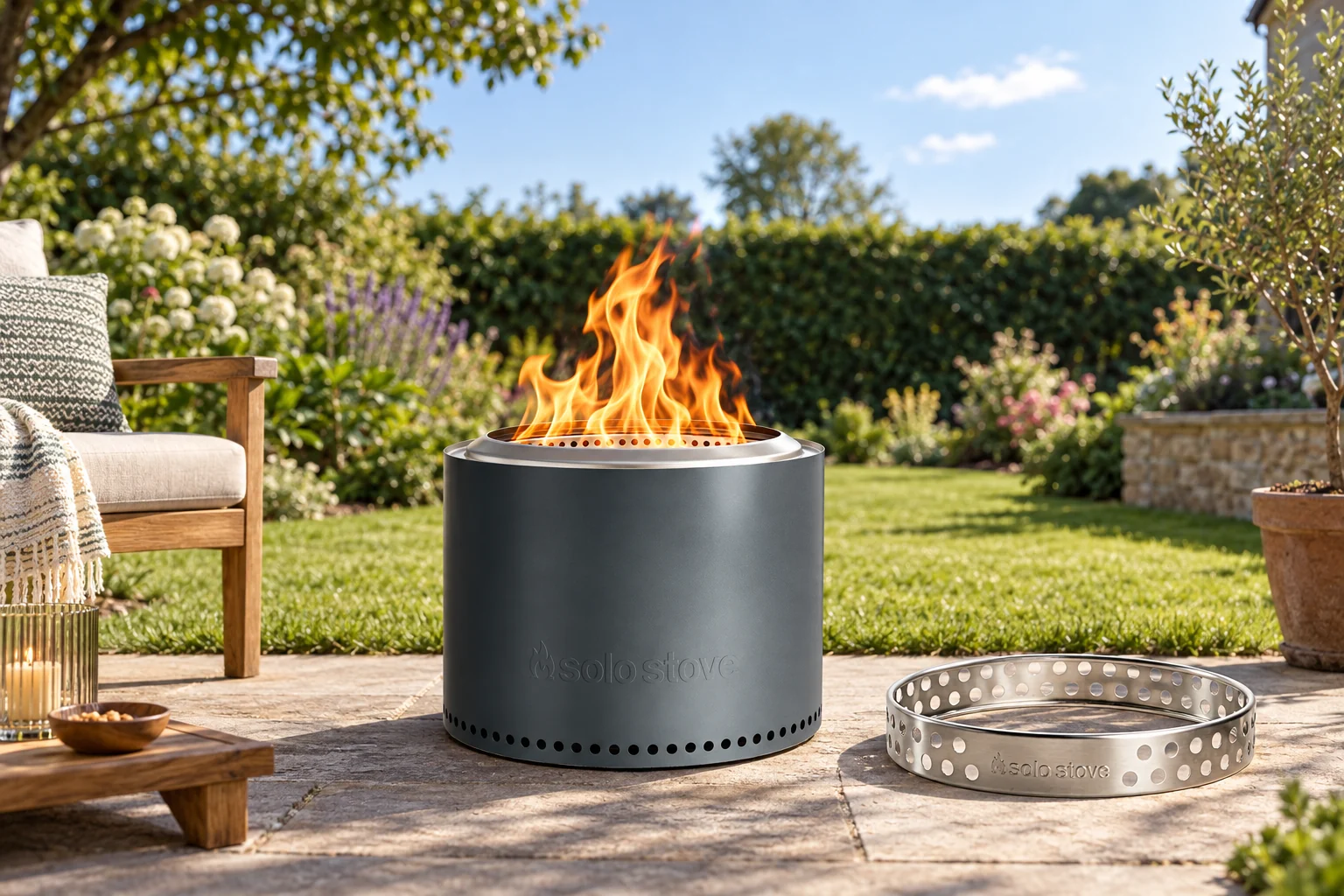
Worth buying if you light fires regularly through autumn, winter and early spring. The Solo Stove Bonfire 2.0 suits four to six people, greatly reduces smoke once properly hot and has a removable ash pan for easier cleaning. Expect some smoke when lighting or adding logs, and burn only dry, untreated wood, starting with three to four logs.
Solo Stove Bonfire 2.0: Can a Smokeless Fire Pit Really Deliver on a Damp British Evening?
There is a very particular sort of garden disappointment that arrives just as everyone has settled down with a drink. The fire is lit. The fairy lights are doing their bit. Somebody has brought out a blanket. Then the wind turns, the smoke follows, and the whole group begins the familiar awkward shuffle around the chairs.
Check today's price: Solo Stove Bonfire 2.0 on Amazon UK
It is not that a wood fire is incapable of charm. Far from it. A proper flame gives a garden an instant centre of gravity, particularly now, in early November, when the pots are looking rather tired and the patio needs all the help it can get. But ordinary open fire bowls have a habit of sending smoke into jumpers, hair, eyes and, if you are unlucky, the neighbour's washing. Wood smoke has a stubbornness about it. It will find you.
The Solo Stove Bonfire 2.0 is designed to make that experience less theatrical. This is a double-wall stainless-steel, wood-burning fire pit that uses Solo Stove's Signature 360° Airflow system to encourage a secondary burn. In plain English, it attempts to burn off more of the smoky gases before they drift out into the garden.
The exact version considered here is the Solo Stove Bonfire 2.0 with StandIt is the mid-sized Bonfire, not the compact Ranger 2.0 or the much larger Yukon 2.0. It is also the straightforward fire-pit-and-stand configuration, rather than a more elaborate package with a lid, spark shield, heat deflector, grill or griddle attachment.
The important expectation-setting bit: "smokeless" does not mean smoke-free. The Bonfire's design can substantially reduce visible smoke once a hot fire is properly established, but you should still expect some at lighting time, when adding fresh logs and whenever the fire loses heat.
That distinction matters more in Britain than it might initially seem. A dry evening can quickly become a damp one. Logs stored under a less-than-perfect cover can take on moisture. A garden that feels sheltered at tea time can develop a swirling breeze by eight. The Bonfire cannot repeal weather, nor can it make wet wood behave itself. What it can do is create a much cleaner-burning fire when given suitable fuel and enough time to get going.
It is also, plainly, a premium fire pit. You are paying for a carefully engineered airflow system, 304 stainless-steel construction and the practical 2.0 ash-pan update. Whether that makes sense depends less on whether you like a nice-looking thing in the garden — most of us do — and more on how often you will actually use it. Light fires regularly through autumn, winter and early spring, and a cleaner, easier fire becomes a meaningful quality-of-life improvement. Light one twice every August, and the argument becomes rather less convincing.
Solo Stove Bonfire 2.0: What Exactly Is This Model and What Comes with It?
Solo Stove's fire-pit family can be mildly confusing because the overall design language is consistent. They are all cylindrical, all use the brand's double-wall airflow idea, and all look as though a very sleek washing-machine drum has wandered into the garden. The differences are principally in scale and configuration.
The Ranger 2.0 sits at the smaller end, the Bonfire 2.0 occupies the middle ground, and the Yukon 2.0 is intended for a much larger fire. The Bonfire is the useful compromise for many British gardens: substantial enough to feel like a real gathering-point rather than a camping accessory, but still small enough to store rather than leave as a permanent monument on the patio.
The name "2.0" matters. Solo Stove announced its Fire Pit 2.0 range on 3 August 2022, and the central practical change was not a dramatic redesign of the flames. It was the addition of a removable base plate and ash pan. That sounds less glamorous than a roaring secondary burn, admittedly, but it addresses the job that happens after everyone has gone indoors: dealing with ash without having to tip the whole fire pit upside down.
Mid-sized social fire
The Bonfire is intended for approximately four to six people, making it a sensible scale for family evenings, a small group of friends or a compact patio seating area.
Double-wall airflow design
Air enters through the lower vents and the wall cavity, then returns near the top of the fire to support secondary combustion once the fuel bed is hot enough.
Removable ash system
The 2.0 base plate and ash pan are designed to collect ash underneath the fire, making post-fire cleaning less awkward than on the original Bonfire.
Wood-burning, not gas-powered
This is very much a real wood fire. It needs dry, untreated fuel, sensible loading and a little patience at the start — which will suit some gardeners far more than others.
Check the bundle, not only the model name
The Gunmetal Bonfire 2.0 covered here includes the fire pit and matching Stand. It should not be assumed to include a lid, spark shield, heat deflector, grill, griddle, pellet adapter or cooking equipment. Some Bonfire packages include a carry bag, but that should be checked in the listing's "What's in the box" details for the exact kit.
That may sound like cautious shopping advice, but it is useful caution. Fire pits increasingly appear in photographs surrounded by accessories: shields, covers, cooking rings, tables and protective enclosures. They can make a very appealing scene. They can also make it easy to overlook what is actually included. This particular configuration is a wood-burning fire pit and stand. That is enough to enjoy a good fire, but it is not a ready-made outdoor kitchen or a fully enclosed child-and-pet-proof system.
The included Stand is important rather than ornamental. It raises the fire pit away from the surface beneath it and is the intended support for burning. Even so, hot metal is still hot metal. A stand is not a universal permission slip for timber decking, artificial grass, delicate stone or composite boards. If the surface is at all heat-sensitive, additional protection and a conservative approach are sensible.
Solo Stove Bonfire 2.0: Dimensions, Weight and What They Mean in a Real Garden
Fire pits are one of those products that look deceptively small in a staged photograph. Put a 49.5 cm-wide metal cylinder beside a modest bistro set and it suddenly becomes a proper piece of garden equipment. The Bonfire is not huge, but it is substantial enough to deserve a measured look at the available space before it arrives.
The Amazon title's 49.5 × 44.5 cm dimensions and 11.4 kg figure refer to the Bonfire with its Stand in place. That is the number to use when you are assessing storage in the shed, deciding whether it can live beneath a covered side passage, or considering where it will sit relative to chairs and garden furniture. The fire-pit body itself is lower at 35.5 cm and lighter at 10.6 kg.
The roughly 50 cm diameter gives it a medium-to-large footprint. On a typical UK patio, it should feel purposeful rather than overwhelming, provided the fire sits with enough clear space around it. It works particularly well where chairs can form a loose circle rather than line up in a row against a wall. The warmth is better enjoyed face-on, and the whole point of a fire is slightly undermined if everybody is parked two metres away because the layout is too tight.
At 11.4 kg with the Stand, "portable" needs interpreting sensibly. It is portable in the useful garden sense: from shed to patio, from patio to lawn, or into the car for a campsite with vehicle access. It is not the sort of thing most people will relish carrying a long distance across fields. The circular body has no conventional handle, and reviewers have found it manageable rather than effortless over distance.
That is not a criticism so much as an antidote to optimistic product photography. The Bonfire is portable compared with a built-in fireplace, masonry pit or hefty cast-iron bowl. It is not a lightweight picnic accessory. If you will need to move it frequently, choose a dry storage position that is relatively close to where you intend to use it. Your back will approve.
Solo Stove Bonfire 2.0: How the Smokeless Airflow System Works
The cleverness of the Bonfire is hidden in the walls. From the outside, it appears to be a neat stainless-steel cylinder with holes around the base and inner rim. Inside, though, there are two layers of metal with a gap between them. That gap is the route through which the stove manages its airflow.
When the fire is burning, cooler air is drawn in through vents near the base of the outer wall. Some of that oxygen feeds the burning logs from below. The rest travels upward through the hollow space between the inner and outer walls. As it rises, heat from the fire warms it. By the time this air reaches the upper vent holes, it is hot and oxygen-rich.
That preheated air re-enters the fire near the top of the combustion chamber. It meets smoke particles and unburned gases that would otherwise drift straight up and away. Under the right conditions, it helps ignite and burn more of that material. This is secondary combustion: a second burn taking place above the main burning wood.
The visual sign, when it is working properly, is often a ring of small flames around the upper interior holes. It can look rather dramatic after dark. More importantly, it can reduce the visible smoke leaving the fire. The result is a flame that tends to look cleaner and more vigorous than that of a simple open bowl.
What "smokeless" means in practice
Think "low-smoke once hot", not "magically smoke-free". A newly lit fire produces smoke while it warms up. Fresh logs can produce a smoky spell as their surfaces heat and moisture burns away. Let the fire tick over too low, or use damp fuel, and the secondary burn has far less chance to do its job.
That final point is the one worth dwelling on. The Bonfire does not remove the need for good fire-making habits. Quite the opposite: its design rewards them. Dry, untreated logs are essential. Build the fire loosely enough for air to circulate. Start with kindling and smaller pieces before adding larger logs. Resist the temptation to fill the chamber to the brim at the outset. A packed, smouldering load is exactly what you do not want.
Solo Stove recommends beginning a Bonfire fire with around three to four logs. That is a useful guide because it gives the airflow system space to work. The aim is a steady, hot burn rather than a congested pile of fuel. Once the logs are burning cleanly, the Bonfire's signature effect becomes far more apparent.
Reviewers have consistently found that this is where the product earns its reputation. T3 reported very little noticeable smoke from a properly blazing fire, whilst also noting that smoke returned during cooler or less vigorous burning. Advnture and Ideal Home reached a similar conclusion: noticeably reduced smoke once established, but not the elimination of smoke under every condition.
There is no independent published percentage for smoke reduction, and it would be unwise to pretend otherwise. What matters more in a garden is the lived effect. If you have ever spent an evening migrating round an open fire bowl, changing seats every few minutes as the plume finds you again, a well-established Bonfire can feel markedly more civilised. You can sit, talk and toast a marshmallow without constantly planning an escape route.
It is also worth remembering that less visible smoke does not turn a fire into a trivial neighbourly matter. Smoke, smell and sparks are still possible. Wind direction still matters. Garden boundaries still exist. Being a considerate fire-pit owner remains part of the equipment list, alongside logs and matches.
Solo Stove Bonfire 2.0: Is It Warm Enough for Chilly UK Evenings?
For many gardeners, this is the deciding question. Low smoke is lovely, but nobody is spending an evening outside in November merely to admire the engineering. The point is to take the edge off the cold — perhaps after a family meal, perhaps when friends are lingering, perhaps because you have convinced yourself the garden can still be used despite the thermometer suggesting otherwise.
The Bonfire can certainly add useful warmth to a small group sitting close by. Solo Stove gives a heat radius of around 1.2 to 1.8 metres, and reviewers found that a family of four could stay comfortable on an early-March evening while wearing coats. That is a realistic way to think about it: this is an outdoor fire, not central heating with flames.
On autumn and early-spring evenings in the region of 5°C to 12°C, it can extend the amount of time you can comfortably spend outside, especially if the seating is arranged thoughtfully and everyone has a layer to hand. The fire is most convincing as an atmosphere-and-warmth combination. It gives you flame, light, a focal point and enough local heat to make a chilly evening feel worth attempting.
It does not, however, throw heat sideways in quite the same broad, enveloping way as a wider, shallower fire bowl or a large heavy masonry fireplace. The Bonfire's powerful airflow and tall burn chamber encourage heat upward. People sitting nearest get the best of it. Those further back, or sitting at an angle in a breezy garden, will feel less benefit.
That characteristic is part of the compromise. The comparatively cool outer wall and controlled combustion are helpful for the stove's style of burning, but some reviewers found the Bonfire less radiant than a traditional heavy steel, stone or masonry fire pit. If your sole priority is maximum heat across a broad seating area, that limitation matters.
There is no fixed wattage or BTU figure to rely on here, because wood fires do not behave like a gas appliance with a set burner output. Heat varies with the species and dryness of the wood, the size and number of logs, the way the fire is built, the wind and even the seating arrangement. A fire made from dry, well-split fuel will feel a very different proposition from one trying to burn damp logs rescued from behind the shed.
Best expectation: use the Bonfire to warm a close, sociable circle, not a whole garden. Keep chairs reasonably near, have blankets available, and regard the fire as an extension of outdoor time rather than a substitute for a covered heated terrace.
There is another small practical point. A flame can look intensely hot whilst the person seated opposite still has cold knees. With any fire pit, test the seating before committing to a full evening outdoors. A little reshuffling at the start is better than dragging furniture around later whilst holding a glass and trying not to kick a log basket.
The absence of a heat deflector in this exact configuration also matters. Such accessories are intended to push more heat outward and downward, but they are separate additions rather than part of the supplied Bonfire-and-Stand kit. As it stands, assess the Bonfire for what it is: a well-designed, low-smoke wood fire for people willing to sit close enough to enjoy it.
Solo Stove Bonfire 2.0: Why the Ash Pan Is the Upgrade That Matters Most
There is a rule of garden purchasing that deserves wider recognition: the useful improvement is not always the glamorous one. Nobody puts "easy ash removal" at the top of a dream-board. Yet the ash pan is probably the single most important difference between the Bonfire 2.0 and the original version.
The first Bonfire's cleaning routine was awkward. Once the stove was fully cold, users had to lift and invert the entire body to empty accumulated ash. It was not impossible — plenty of people managed perfectly well — but it was clumsy, particularly for a steel fire pit that weighs more than 10 kg before you begin considering the stand. Ash also has a knack for finding the one part of your jumper you had hoped to keep clean.
The 2.0 approach is simpler. The fire sits above a removable base plate. Ash falls through and collects in a removable ash pan underneath. When the unit is completely cold, the base plate and pan can be lifted out, the ash can be emptied safely, and the parts can be replaced. You are not required to turn the whole thing upside down like a reluctant oversized pudding basin.
What the 2.0 system improves
- Main ash collection happens beneath the fire rather than across the bottom of the body.
- Cleaning can be done without inverting the entire 10.6 kg fire-pit body.
- The routine is quicker and less likely to spread ash across the patio.
- The change makes frequent use more appealing, particularly through the colder months.
What it does not solve
- The unit must still be completely cool before the ash pan is handled.
- Fine ash and small charcoal pieces can remain around the pan lip and beneath it.
- An occasional more thorough clean may still be needed.
- Hot or warm ash must never go into a plastic bin or garden-waste bag.
It is a small distinction, but it changes the ownership experience. Fire pits are at their best when you can decide, on a dry evening, to light one without thinking ahead to a tiresome cleanup job. A removable pan does not make ash disappear, naturally. It simply makes the inevitable bit less annoying.
A sensible routine is to stop adding logs well before you want to come indoors, allowing the fuel to burn down naturally. Leave the fire pit until it is completely cold. Solo Stove advises waiting at least an hour before touching the unit with bare hands after flames have died, though it can remain hot for longer depending on the size of the fire and the conditions. In practice, overnight is often the least stressful option.
Once cold, remove the base plate and ash pan, empty the ash into a non-combustible container and keep that container away from combustible materials until there is no possibility of hidden embers. Ash can look entirely harmless whilst retaining heat. That is not a thrilling fact, but it is a useful one.
For ordinary maintenance, a dry cloth is generally enough for the exterior. Avoid treating a fire pit as though it needs constant polishing; it is an outdoor object designed to hold a wood fire, not a piece of cutlery. A little marking and colour change is part of the story.
Solo Stove Bonfire 2.0: Build Quality and Durability in a British Garden
The Bonfire body is made from 304 stainless steel, a sensible material choice for a garden product that has to deal with heat, damp air, mud-spattered patios and the occasional frantic attempt to bring everything under cover before a downpour. It gives the fire pit a much more refined look than thin painted steel, and avoids the peeling finish that can make cheaper fire bowls look tired rather quickly.
Stainless steel is not a promise that an outdoor product will look factory-fresh forever. It is simply a more resilient starting point. Repeated high heat will change the appearance of the metal over time, often bringing blue, gold or straw-coloured tones. That heat discolouration is normal. It is not a defect, and it does not mean the Bonfire is failing.
The Gunmetal version brings a darker, more contemporary finish to the familiar Solo Stove form. It will suit modern patios, rendered walls, crisp paving and gardens where black furniture and warm timber are already doing the visual work. If your outdoor space leans toward cottagey, weathered and rustic, the cylindrical industrial look may feel less naturally at home. That is a matter of taste, not quality.
Well suited to changeable weather — with sensible storage
304 stainless steel has good corrosion resistance, but a fire pit will last best when it is allowed to dry and is stored under cover when not in use for long periods.
Heat marks are part of ownership
High temperatures alter the appearance of stainless steel. Expect a used Bonfire to develop character rather than remain identical to the day it came out of the box.
Use the matching Stand
The Stand lifts the fire pit away from the surface beneath it, but additional protection remains sensible on decking, artificial grass, delicate paving and other heat-sensitive areas.
The most sensible longevity strategy is wonderfully unglamorous: do not leave wet ash in the unit, empty it after it is cold, keep the fire pit dry where practical, and do not use it as a bin for half-burnt rubbish. Burn only appropriate untreated wood. Painted, treated or manufactured timber can release unpleasant fumes and make a mess of both the burn and the stove.
Storage is worth considering before purchase. At 49.5 cm across, the Bonfire does not vanish behind a pot of geraniums. A dry shed, garage or covered storage area will keep it looking better and make it easier to reach when a calm winter evening appears. The more friction involved in retrieving it, the less likely it is to become part of your regular garden life.
Solo Stove Bonfire 2.0: Who It Suits — and Who Should Give It a Miss
The Bonfire 2.0 makes the most sense when it solves a problem you genuinely have. If smoky open fires have put you off using the garden after dark, the airflow system is a practical benefit rather than a novelty. If you enjoy a wood fire but resent the cleanup, the ash pan is a meaningful improvement. If you want something that can come out for company and disappear back into the shed afterwards, the size is well judged.
Small-group hosts
Its scale works well for roughly four to six people gathered fairly close together, rather than a large party spread across a lawn.
Smoke-averse gardeners
It is a strong fit if smoke in clothes, hair and eyes is the thing that has stopped you enjoying ordinary fire pits.
Regular fire-lighters
The ash pan pays back most clearly when you use the fire pit often enough to appreciate easier cleaning.
It is especially suitable for a small-to-medium garden, courtyard or patio where a permanent masonry fireplace would be excessive. It can work for occasional camping too, provided you have vehicle access and are happy moving 11.4 kg of equipment rather than carrying it across a site one-handed.
It also suits people who like to keep options open. The Bonfire can remain a straightforward fire pit, or you can explore cooking and heat-management accessories later. The important thing is not to buy it expecting those extras to be included in this particular kit.
There are equally clear reasons to skip it. If you want the lowest-cost route to a few decorative summer flames, the Bonfire's engineering may be more than you need. If you want a ready-to-use barbecue, this configuration is not that. If your priority is broad, powerful radiant heat across a large seating area, a tall, contained fire pit is not the obvious answer.
It is also not a suitable choice for anyone who interprets "smokeless" as "safe to light anywhere, in any weather, with any wood". No wood-burning appliance earns that description. You need space, sensible wind conditions, dry fuel, supervision and consideration for nearby homes. Young children and pets deserve particular thought: the fire pit and Stand become hot, and a spark shield or protective surround is not included here.
A November buying test
Ask yourself whether you can picture using it between now and spring. If the answer is yes — for weekend fires, winter gatherings and early-season evenings — the Bonfire's lower-smoke performance and easier ash removal become much easier to justify. If it will spend eleven months in a shed, a simpler option may suit your habits better.
Solo Stove Bonfire 2.0: Safe Setup, Lighting and Use in the Garden
Autumn and winter are exactly when a fire pit is most tempting, but they are also when outdoor conditions become less predictable. Fallen leaves collect in corners. Wind gets lively. Wood stores get damp. Before lighting anything, take a slower look at the setup than you might on a still July evening.
Place the Bonfire on a stable, level surface with generous clearance from fences, sheds, trees, garden buildings and overhanging branches. Keep garden furniture, cushions, stored logs and anything combustible well away. Check the wind direction before lighting; it is not merely smoke that travels downwind. Keep water, sand or a hose close at hand, and never leave the fire unattended.
The Stand helps keep the hot fire pit raised above its surface, but it does not make every surface equally suitable. Wood and composite decking remain higher-risk locations, even with the Stand. A heatproof mat or additional ground protection is a sensible precaution on vulnerable paving, artificial grass and other heat-sensitive materials. When in doubt, use a clear section of non-combustible ground.
Lighting for the cleanest burn
- Start with dry kindling and a firelighter suitable for wood fires.
- Arrange the kindling loosely so air can circulate rather than compressing it into a dense nest.
- Add smaller dry logs, then build up to larger pieces as the fire takes hold.
- Begin with approximately three to four logs rather than overloading the chamber.
- Give the fire time to establish before judging the smoke performance.
- Add logs gradually, allowing the flames to recover between additions.
Use only clean, dry, untreated wood. Wet or unseasoned logs are the quickest way to undermine a low-smoke fire pit, because the fire must spend energy driving off moisture before it can burn efficiently. Treated, painted or contaminated timber should not be burned at all. It can release unpleasant fumes and is not something you want drifting through the garden — or into your neighbour's open bedroom window.
Once the fire is established, avoid endless poking. The Bonfire needs airflow, not constant interference. If you have ever camped with somebody who treats every fire as a competitive excavation project, you will understand the value of leaving a good flame alone.
When you are ready to finish, stop adding fuel and let the fire burn down naturally. Do not pour water into a hot stainless-steel fire pit unless an emergency requires it; sudden cooling is unkind to hot metal and creates a messy slurry of ash. Wait until everything is fully cold before emptying the pan or moving the stove.
Solo Stove Bonfire 2.0: Frequently Asked Questions
No wood fire is entirely smoke-free in every condition. The Bonfire's double-wall airflow can greatly reduce smoke once the fire is hot and burning dry wood well, but smoke is normal during lighting, after adding fresh fuel and when the fire is running too cool.
It can provide useful local warmth for people seated close by, especially in a small group. Think of it as a way to extend an outdoor evening with coats and blankets, rather than a method for heating a whole patio in midwinter.
The included Stand raises the Bonfire away from the surface, but wood and composite decking remain potentially vulnerable to heat. Use a cautious setup, consider extra heat protection and follow Solo Stove's safety guidance for your specific surface.
Not in the fire-pit-and-stand configuration covered here. The Bonfire can be used with separate cooking accessories, but a grill, griddle or cooking attachment should not be assumed to be included.
Yes. It is the central functional upgrade over the original Bonfire. It makes it much easier to remove ash after the pit is completely cool, without having to invert the entire fire-pit body.
Solo Stove Bonfire 2.0: Final Verdict — Is It Worth Paying For?
The Solo Stove Bonfire 2.0 is worth paying for if the things it improves are the things that stop you using a standard fire pit: smoke, messy ash disposal, awkward storage and the sense that lighting a fire is more fuss than pleasure.
Its best quality is not that it abolishes smoke. It does not. Its best quality is that, with dry wood and a properly established fire, it makes a wood fire much more pleasant to sit beside. That difference is real. Reviewers consistently report noticeably reduced smoke once the Bonfire is blazing, and that can make the difference between a short novelty fire and an evening outdoors that people actually enjoy.
The other winning detail is the removable ash pan. It is the sort of engineering update that sounds boring in a sales description and proves genuinely useful after the second or third fire. The original Bonfire asked you to invert a large, cold metal cylinder to get rid of ash. The 2.0 version does not. Progress sometimes arrives in a small tray.
There are caveats. It is not the hottest choice for a large patio. It is not especially light for long-distance carrying. It is not a complete barbecue kit. Its modern cylindrical styling will not appeal to every garden. And it asks you to use dry fuel, site it safely and accept that a wood fire still brings some smoke, ash and responsibility.
For the right household, though, it is a very good fit: a four-to-six-person fire pit that can live in the shed, come out when the air turns cold, create an attractive flame with less smoke once hot, and clear up without a wrestling match the next day. On a calm, crisp evening, that is more useful than it might sound on paper.
GardenScout verdict: a premium fire pit that is easier to live with
The Solo Stove Bonfire 2.0 earns its place for regular users who value lower-smoke fires, a sociable mid-sized format and the genuinely practical removable ash pan. Buy it for cleaner, closer garden gatherings — not because you expect a smoke-free fire or patio-heater levels of warmth.
Buying for a gardener? See our gifts for outdoor cooks, checked on Amazon every day.