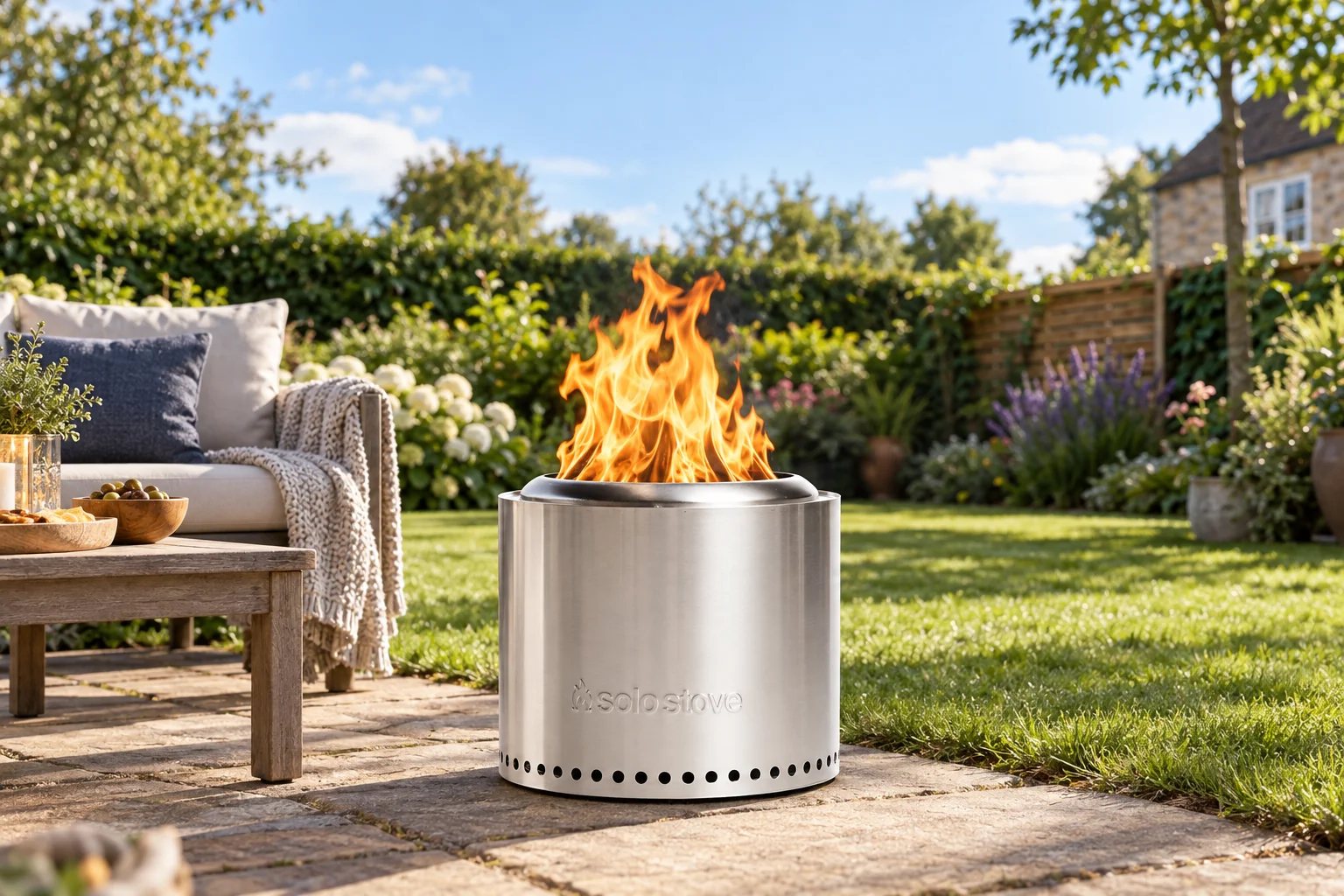
The short answer
The Solo Stove Ranger 2.0 with Stand suits an open, paved patio or small garden and gatherings of two to four people. Burn only dry, seasoned logs, expect some smoke while lighting, and add a spark shield. It warms a close circle, roughly 60–90 cm, and is not suitable for balconies or under overhangs.

Compact 38 cm stainless fire pit with stand, removable ash pan and low-smoke secondary burn, ideal for two to four people.
Check price on AmazonWe link to the exact model on Amazon UK. Prices change often, so check the live price before you buy. As an Amazon Associate we earn from qualifying purchases.
Introduction: Small Fire Pit, Big Ambitions for Compact Outdoor Spaces
Bonfire Night has been and gone, the clocks have gone back, and the garden has entered that peculiar phase where it is technically still there but you only see it in the dark. It is the middle of November. The patio is damp, the last of the dahlias have been lifted or mulched, and the furniture has that faintly sad, beaded-with-drizzle look. And yet there is still something rather lovely about stepping outside on a cold, clear evening with a hot drink and the smell of woodsmoke in the air.
The trouble is that many of us are trying to do this in very little space. A new-build garden might be a patch of lawn and a strip of slabs. A terraced house might have a courtyard roughly the size of a generous tablecloth. Large fire bowls, chimeneas with a bulging belly and full-sized outdoor heaters do not always fit, either physically or socially — nobody wants to be the household whose Saturday night fire fills next door's washing with smoke.
That is the gap the Solo Stove Ranger 2.0 with Stand is trying to fill. It is the smallest of Solo Stove's full-size fire pits: a 38 cm stainless-steel cylinder that burns wood, uses a double-wall design to reduce smoke once it is properly hot, and comes in this version with a low stand that lifts it off the surface beneath. It has a removable ash pan, a carry case, and it weighs about 7.3 kg with the stand. On paper, it reads like the ideal fire pit for small gardens and occasional autumn entertaining.
On paper is the key phrase. This is not a claim that I have had one sitting on my own patio all autumn. It is a detailed, research-led assessment: I have gone through the manufacturer's specifications and guidance, the published UK reviews from people who did light one in cold and windy conditions, and the fire-service and government advice on outdoor burning. Then I have tried to answer the questions a UK gardener with a small space would actually ask. Will it keep four people warm? Is "smokeless" true? Can it go on decking? Can it go on a balcony? And is it worth the outlay for a handful of evenings a year?
Some of the answers are reassuringly positive. One is a clear no. Let's take them in order.
The short answer
For an open, paved patio or small garden and gatherings of two to four people, the Ranger 2.0 with Stand makes a lot of sense: compact, well built, low-smoke once established and easier to clean than older designs. It is not smoke-free, it will not warm a big party, and it is not suitable for balcony use. Buy it for atmosphere and close-up warmth, not as a patio heater.
What Exactly Is the Solo Stove Ranger 2.0 with Stand? Kit Contents and First Impressions
Solo Stove sells the Ranger in several guises, and the names are similar enough to cause genuine confusion at the checkout. So let's be precise. The version covered here is the Ranger 2.0 with Stand, model number SSRAN-SD-2.0. That is the Ranger 2.0 fire pit body bundled with its matching stand.
It is worth knowing about the neighbours on the shelf:
- Ranger 2.0 (standalone): the fire pit on its own, with removable ash pan and carry case. Roughly 38 cm across and about 32 cm high, at around 6.8 kg. The stand is sold separately.
- Ranger 2.0 with Stand: the subject of this review. Same fire pit, plus stand, giving an overall height of 41.5 cm and a weight of about 7.3 kg.
- Ranger Essential Bundle 2.0 and Ranger Backyard Bundle 2.0: larger bundles built around the same fire pit with extra accessories. Different kits, different contents — don't assume one when buying the other.
The "2.0" matters too. The defining change from the earlier Ranger is the removable ash pan. Previously, emptying a Solo Stove often meant turning the whole thing upside down, which is the sort of job you remember doing badly at least once. The 2.0 design lets you lift out a base plate and ash pan once everything is completely cold.
What comes in the box
Ranger 2.0 fire pit body
A double-walled cylinder in 304-grade stainless steel, with vent holes around the base and around the top of the inner wall. This is where all the low-smoke cleverness happens.
Flame ring
A removable ring that sits on top of the drum and helps centralise the flame. It is part of the normal Ranger assembly rather than an optional extra.
Removable base plate
The perforated floor the fire sits on. It lifts out to give access to the ash pan beneath.
Removable ash pan
Catches the ash that falls through the base plate so it can be lifted out and emptied once the fire is fully cold.
Ranger stand
A low stand (33 cm across and 7.1 cm high, according to Solo Stove) that raises the fire pit off the ground, improving clearance and airflow underneath.
Nylon carry case
For transport and storage. Reviewers note the smaller parts can be nested inside the drum, which keeps the whole kit tidy in a shed or a car boot.
Not in the box: a spark shield, lid, heat deflector, shelter (weather) cover, pellet adapter or any cooking grate or griddle. These are all part of Solo Stove's accessory range and are bought separately. If you have seen photos of a Ranger with a mesh dome on top, that is an extra — and, for many UK patios, it is an extra I would seriously consider. More on that later.
First impressions, judging by the published reviews, are consistently good. Both Ideal Home and Outdoors Magic praised the stainless-steel construction, the clean cylindrical shape and the premium feel; Outdoors Magic called it durable and contemporary, whilst Ideal Home found the fire pit and its accessories solidly made. It is, frankly, a handsome object — more design-shop than builders' merchant — which matters more than you might think when it is going to sit on a small patio in full view of the kitchen window for months at a time.
It is also refreshingly simple. There is no battery, no charger, no fan, no motor and nothing to plug in. You assemble the parts, put it on its stand and light some wood. In a world of app-connected barbecues, that has a certain appeal.
Anatomy of Low Smoke: How the Double-Wall Airflow System Actually Works
The word "smokeless" appears on a great many fire pits these days, and it is worth understanding what the Ranger is doing differently before deciding how much weight to put on it. The short version is that the design tries to burn the smoke rather than release it. The longer version is genuinely rather neat.
Step by step through Solo Stove's 360-degree airflow
- Air comes in low. Cool air is drawn in through the vent holes around the base of the outer wall. Some of it rises up through the base plate to feed the fire from below — this is the primary burn, the ordinary business of wood catching and flaming.
- Air travels between the walls. The rest of the incoming air is channelled upwards through the gap between the inner and outer walls of the drum.
- That air is preheated. The inner wall is, quite obviously, very hot once a fire is going. Air moving up the cavity picks up that heat on its way.
- Hot air is introduced near the top. The preheated air emerges through the ring of smaller vent holes near the top of the burn chamber, right where the smoke and unburned gases from the primary fire are rising.
- The secondary burn. Those gases and fine particles — which in an ordinary fire simply drift off as smoke — meet a supply of hot, oxygen-rich air and are burned off instead. That is the secondary combustion you will often see as a ring of flame licking from the upper vents.
The result, when everything is hot and the fuel is dry, is a fire that burns more completely. Solo Stove says this can nearly eliminate smoke once the fire is established. Reviewers broadly agree with the direction of travel if not the absolute claim, and Joey Holmes at Raw Earth Wild noted how little ash was left behind when dry wood was used — which is what you would expect from more efficient combustion.
No fan, no plug, no fuss
What I particularly like is that it is entirely passive. There is no fan pushing air through the system and nothing electrical to fail in a damp shed over winter. The airflow is driven purely by the heat of the fire itself: hot gases rise out of the top, which draws fresh air in at the bottom, which feeds the fire, which makes more heat. It is physics doing the work for free.
That also means there is very little to maintain. Keep the vents clear, keep the ash pan emptied, don't let debris clog the base, and the system should keep doing its job.
Why it still smokes sometimes
The secondary burn only works when the fire is hot enough. During lighting, the walls are cold and the incoming air is barely preheated, so there is little or no secondary combustion. Solo Stove itself says a little smoke at start-up is normal. Equally, if the fire is overfilled so that wood sits above the upper vents, or if those vents are blocked, the clever bit is bypassed.
The wood matters more than the steel
No airflow design can turn wet logs into clean fuel. Damp wood spends a great deal of its energy boiling off water, which keeps the fire cooler and produces more smoke — Raw Earth Wild found that damp logs still smoked in the Ranger. If you take one practical lesson from this section, make it this: buy properly seasoned or kiln-dried logs, keep them under cover, and the "smokeless" claim gets a lot closer to the truth.
So read "smokeless" as "noticeably less smoky once hot". That is still a meaningful improvement for a small garden where every wisp counts. It is not an invisible fire.
Full Technical Specifications at a Glance
Here are the numbers that matter for planning where it will go and how you will move it. Figures differ very slightly between retailers and the manufacturer — Solo Stove itself quotes 38.1 cm across, for instance — but the differences are a matter of a centimetre or a few hundred grams, not anything that changes the buying decision.
On fuel: this is a wood-burning fire pit, first and foremost. Some documentation also mentions wood pellets, but they need care, because loose pellets can drop through the base plate into the ash pan and restrict the airflow that makes the whole thing work. Solo Stove sells a pellet adapter separately for that reason. If you simply want a nice log fire on a cold evening, stick to wood and you will not need to think about it.
On the warranty: Solo Stove and its UK stockists describe a lifetime warranty, but at least one major UK retailer notes that registration is required. It takes five minutes. Do it the day it arrives, before the box goes in the recycling.
Solo Stove Ranger 2.0 with Stand Smokeless Fire Pit: In-Depth Performance and Usability Assessment
Specifications only get you so far. What matters on a raw November evening is whether people actually feel warm, whether the smoke chases anyone round the circle, how much faff is involved, and what the patio looks like the next morning. Here is how the Ranger 2.0 with Stand shapes up on each of those counts, drawing on the published UK testing and the manufacturer's own guidance.

Check today's price: Solo Stove Ranger 2.0 with Stand Smokeless Fire Pit on Amazon UK
Heat: a circle of warmth, not a patio heater
The Ranger's burn chamber is small, and it is honest to say so. Solo Stove's own comparison information gives it a heat radius of roughly 60–90 cm and positions it for two to four people. Amy Lockwood, testing the Ranger with its stand in a Shropshire garden in cool and windy weather for Ideal Home, could feel the heat when sitting about a metre away and judged it enough for four people to sit around comfortably.
Translate that to a real patio and you get a picture of four chairs pulled in fairly close, knees pointing at the fire. That is perfectly pleasant — cosy, even — but it is a different experience from the broad, room-like warmth of a gas patio heater. If your idea of a November gathering is eight people standing about with mulled wine, the Ranger will be the pleasant glowing thing in the middle that only some of them can feel.
Lighting and getting it going
This is one of the Ranger's quiet strengths. Joey Holmes at Raw Earth Wild lit hers quickly with newspaper, kindling and a cotton-wool firelighter, adding larger sticks after a minute or two, and found that once it was established it needed little attention. Solo Stove recommends starting with two to three logs in the Ranger rather than packing it full. The strong draw created by the airflow system helps here: once the fire takes, it tends to take with some enthusiasm.
What you won't get is a precise run time. That depends entirely on the wood — its species, its dryness, the size of the logs and how often you feed it. Plan to top up with a log or two at intervals, and keep them below the upper vent holes.
Smoke: less, not none
Ideal Home's verdict is the one I'd pin on the fridge: "less smoke" is a more accurate description than "smokeless". There were no big black clouds in Amy Lockwood's test, and after about 30 minutes round the fire she reported only a faint smell of smoke on her clothes, rather than the full bonfire treatment. Smoke was more likely during lighting, before the fire was properly hot, or when conditions and fuel were less favourable. For a small garden with neighbours close by, that improvement is genuinely worth having.
The stand: small part, big job
The stand raises the fire pit off the surface and improves clearance and airflow beneath it. Solo Stove says this allows the Ranger to be used on more surfaces, including wooden decking. That is a real practical benefit on patios — radiant heat directly beneath a fire can mark or damage paving and decking — but it is not a blanket guarantee for every material. Composite decking in particular can be sensitive to heat and to falling embers. If you are placing it on anything other than solid stone or slabs, I would add a fire-resistant mat underneath and check the decking manufacturer's own advice. The stand reduces heat transfer; it doesn't stop a spark landing beside it.
Cleaning and portability
Both reviewers who used the 2.0 design found cleaning relatively neat. Most of the ash collects in the pan, but Ideal Home still had to tip the main body over to remove a last small amount. Think "much tidier" rather than "mess-free".
Portability is similar: real, but with limits. Ideal Home called the fire pit portable without wanting to carry it any great distance, and Raw Earth Wild found about 100 metres manageable but wished for a shoulder strap beyond that because the drum does not collapse. For moving it from shed to patio, or from car to campsite pitch, it is fine. For a hike to a beach, it is not.
Pros
- Compact 38 cm footprint suits small patios and courtyard gardens
- Noticeably less smoke than a conventional fire pit once properly hot
- Lights easily; needs little attention once established
- Stand included, improving clearance and airflow beneath the fire
- Removable ash pan makes clearing up far tidier than older designs
- Robust, handsome 304-grade stainless-steel construction
- Passive airflow — no electrics, no fan, very little to go wrong
- Carry case included; parts nest inside the drum for storage
- Lifetime warranty, subject to registration
Cons
- Not smoke-free: expect smoke at lighting and with poor fuel
- Warmth reaches roughly a metre, so best for two to four people
- Very fussy about dry wood
- Portable, but awkward to carry far and does not collapse
- A little ash still remains in the body after removing the pan
- Spark shield, lid and cooking accessories cost extra
- A premium purchase rather than a budget fire pit
- Not suitable for balconies or anywhere with an overhang
Getting the best from a small fire
Because the warmth radius is modest, the seating plan does a lot of the work. Use low chairs, sit in a close ring, and position the group so the prevailing breeze blows from behind you rather than across the fire towards you. A blanket over the knees does more than another log ever will.
Patio and Balcony Suitability: Is the Ranger 2.0 Right for Smaller UK Outdoor Spaces?
This is the heart of the matter, so let's be straightforward. The Ranger's compact dimensions — 38 cm across, 41.5 cm tall on its stand — make it look tailor-made for small outdoor spaces. For some of them, it is. For others, compactness is beside the point.
Small patios: yes, if the space is genuinely open
At 38 cm across, the fire pit itself takes up about as much floor as a large terracotta pot. It doesn't dominate. What actually decides whether your patio is suitable is not the footprint of the fire pit but the space around and above it. Solo Stove says it must be used on a stable, non-flammable surface and away from overhangs, patio ceilings and other flammable materials. Government outdoor fire-safety guidance adds the familiar list: keep it away from sheds, fences, trees, shrubs and garden waste; keep children and pets away; and have water, sand or a hose to hand.
A small patio is a good candidate if it ticks these boxes:
- a level, stable, non-flammable surface such as stone or concrete slabs;
- open sky above — no pergola, awning, gazebo, washing line or low tree canopy;
- generous clear space to fences, sheds, dry planting, cushions and stacked logs;
- room to arrange seats without anyone's chair sitting right against the drum;
- a way to keep children and dogs from wandering into it;
- a hose, bucket of water or extinguisher within arm's reach, not in the garage.
Use the manufacturer's instructions for exact clearances, and err on the side of more space rather than less. In a narrow courtyard, remember that the walls themselves may be close, and that a fence panel in late autumn is a dry wooden board with a lot of surface area.
Balconies: no
I know this is the answer many flat-dwellers were hoping would be different, but I would not recommend the Ranger — or any wood-burning fire pit — for a balcony.
The London Fire Brigade's guidance is clear that barbecues should not be used on balconies, because flames, sparks and hot embers can start a fire that spreads rapidly through or between buildings, and wind can carry ash towards neighbouring properties. An open wood fire carries the same risks; Solo Stove itself warns that sparks and embers may escape depending on the wood and the surroundings. Balconies add their own problems on top:
- decking, artificial grass or furniture that may be combustible;
- windows and neighbouring flats directly above, below and beside you;
- turbulent wind around railings and building corners, which can throw embers unpredictably;
- limited escape routes if something goes wrong;
- nowhere sensible to store logs or deal with hot ash;
- tenancy agreements, leases and building fire-risk policies that commonly prohibit open flames.
The stand does not change the balcony answer. It reduces heat transfer to the surface beneath, which is useful on a patio, but it does nothing about sparks, embers, smoke drifting into a neighbour's open window or the rules of your building. A low-smoke fire is still an open fire. If you rent or own leasehold, check your agreement and building rules before buying any fire pit — a product being on sale in the UK does not mean it is permitted in every outdoor space.
Rooftop terraces and communal gardens
These sit in a grey area that, in practice, usually resolves to "ask first". Communal gardens are typically governed by the managing agent or freeholder, and many building policies prohibit open fires outright. Even where they don't, the neighbours who share the space will have opinions — and quite reasonably so.
The neighbour question
Small gardens mean close neighbours, and that is perhaps where the Ranger's lower smoke is most valuable. But "low smoke" is not "no smell". Councils can investigate smoke as a statutory nuisance, and smoke drifting across a road can create a traffic hazard that leads to a fine. A considerate approach goes a long way: light it when the wind is blowing away from houses, avoid evenings when people have washing out or windows open, burn only dry wood, and perhaps mention it over the fence beforehand. It is surprising how much goodwill a quick word buys.
Quick suitability check
- Open paved patio with sky above: good fit.
- Timber or composite decking: possible with the stand, but add a fire-resistant mat and check the decking maker's guidance.
- Under a pergola, awning or veranda: no.
- Balcony or flat roof: no.
- Communal garden: only with clear permission.
A November Evening With the Ranger: Fuel, Lighting and Safety in Practice
Since it is mid-November, let's walk through how an evening with the Ranger should actually go — from the bit most people skip (the wood) to the bit most people rush (putting it to bed).
1. Sort the wood this week, not on the night
If there is one job worth doing now, it is getting properly dry fuel under cover. Defra's outdoor-burning advice is to burn dry materials such as dry wood, because wet wood creates more air pollution. With this fire pit, dry wood also decides whether the secondary burn works at all. Kiln-dried or well-seasoned logs, small enough to sit comfortably inside a 38 cm drum, are the thing to buy. Store them in a log store or shed, off the ground — a November week of drizzle on an uncovered net bag will undo all your good intentions.
2. Don't treat it as a garden incinerator
This is a gardening site, so let me say it plainly. Autumn produces a lot of tempting material: fallen leaves, prunings, dead stems from the border. None of it belongs in the Ranger. Garden waste is usually damp and smoky, and Defra recommends composting it or using your council's garden-waste collection instead. Equally, never burn treated or painted timber, household rubbish, plastic, rubber or synthetic materials. The leaves will make far better leafmould in a bin bag behind the shed by next autumn than they ever will smoke.
3. Set up before dark
Place the stand on your chosen spot, check it is level, then sit the fire pit securely on top with the base plate, ash pan and flame ring in place. Put your water, sand or extinguisher next to it — not inside, not "somewhere handy". Arrange the chairs at a sensible distance, and move cushions and throws well back.
4. Light small, then build
Start with newspaper or a natural firelighter and plenty of dry kindling, then add larger sticks after a minute or two, as Raw Earth Wild did. Solo Stove suggests beginning with two to three logs. Expect a little smoke while the walls warm up; that is normal. Once the upper vents are drawing and you can see flame around the top, the smoke should drop away noticeably.
5. Feed it modestly
Overfilling is the most common way to make a Solo Stove smoky. Keep logs below the upper vent holes so the secondary air can do its job, and add one or two at a time rather than an armful. A smaller, hotter fire is both cleaner and warmer than a heaped one smouldering at the top.
6. Supervise it, always
Never leave it unattended, even "just to put the kettle on". Keep children and pets back, and remember that the stainless steel will be extremely hot. If the wind picks up and starts carrying sparks, stop feeding the fire and let it die down.
7. Let it burn out, then wait
Plan the last log well before bedtime and let the fire burn down completely. Only empty the ash pan once everything is completely cold — which, with a well-insulated double-walled drum, may well mean the following morning. Wood ash from clean, untreated logs can go on the compost heap in small quantities; anything else goes in the general waste once cold.
Over-winter care
Between uses, keep the Ranger and its parts dry — in a shed or garage, or under a cover if it must stay out. Empty the ash pan rather than leaving damp ash sitting in it through the winter. Come next spring, give it a once-over, check the vents are clear, and it will be ready for the first mild evening of April.
Ranger 2.0 vs the Field: How Does It Stack Up Against Comparable Garden Fire Pits?
To be clear about what this section is: market context. The Solo Stove Ranger 2.0 with Stand is the only product reviewed and recommended in this article. To help you judge whether its particular strengths matter to you, it is useful to compare it with the two broad types of fire pit most people consider alongside it: the traditional cast-iron fire bowl, and the simple single-wall steel fire pit or brazier. These are generic categories, not specific products, and individual models vary a great deal.
| Feature | Solo Stove Ranger 2.0 with Stand | Typical cast-iron fire bowl | Typical single-wall steel fire pit |
|---|---|---|---|
| Price | Premium; listed at £229.99 RRP by UK specialist retailers | Varies widely by size and make | Often cheaper, varies widely |
| Weight | 7.3 kg with stand | Generally heavy; rarely moved once placed | Varies; often light but flimsier |
| Size | 38 cm diameter, 41.5 cm tall with stand | Usually wider, shallow bowl shape | Many sizes available |
| Smoke reduction | Double-wall secondary burn once hot | None built in; smoke depends on fuel | None built in; smoke depends on fuel |
| Ash management | Removable base plate and ash pan | Usually scooped or tipped out | Usually scooped or tipped out |
| Rust resistance | 304-grade stainless steel | Cast iron rusts; patina expected | Depends on coating and steel |
| Portability | Carry case included; car-portable | Rarely designed to travel | Sometimes folding or portable |
| Stand included | Yes | Often has integral legs | Sometimes |
| Heat spread | Close-up; roughly 60–90 cm radius quoted | Wider bowls can spread heat further | Varies with size and design |
| Accessory range | Extensive dedicated Solo Stove range | Often limited to grill grates | Usually limited |
Where the Ranger pulls ahead
The two features that genuinely set the Ranger apart are the secondary burn and the ash pan. On a large rural plot, a bit of smoke from a cast-iron bowl drifts away and nobody notices. In a terrace or a new-build estate with gardens back to back, it lands on someone's washing. If you've ever had to apologise over a fence, the Ranger's lower smoke output is not a marketing nicety; it is the main reason to buy one.
The stainless construction also matters in a British winter. Cast iron has real charm, and many people enjoy the rusty patina, but it will mark paving if left standing on it through a wet season. A stainless drum on its own stand is a tidier proposition for a patio you look at every day.
Portability is the third advantage. The upright drum fits into a car boot more easily than a broad bowl, it comes with a case, and the smaller parts nest inside. If you fancy the occasional campsite fire — where fires are permitted — the Ranger doubles up nicely.
Where it falls behind
Heat spread is the obvious one. A wide, open bowl exposes more fire to the people around it, and a larger fire pit simply burns more fuel at once. Solo Stove itself steers buyers with bigger groups towards the larger Bonfire and Yukon models, and for six or more people that is sensible advice — or consider a non-flame outdoor heater instead.
Price is the other. The Ranger is a premium product, and both Ideal Home and Outdoors Magic treated it as such. A basic steel fire pit can be had for considerably less. Whether the Ranger is worth the difference depends almost entirely on how much you care about smoke, tidiness and longevity. For occasional use in a small garden with close neighbours, I think there is a reasonable case. For a big garden with nobody nearby, the argument weakens.
Cooking is a minor point but worth noting. Outdoors Magic described the Ranger as mainly for sitting around and enjoying rather than a dedicated cooking fire pit. Marshmallows are fine; a family barbecue needs accessories, or a barbecue.
Accessories, Upgrades and the Solo Stove Ecosystem
One of Solo Stove's selling points is its large range of matched accessories. One of its drawbacks, as Ideal Home gently warned, is that those accessories can add up. It is worth being clear-eyed about what you get in the Ranger 2.0 with Stand, and which extras are worth considering for UK patio use.
To recap, the kit includes the fire pit body, flame ring, removable base plate, removable ash pan, stand and carry case. It does not include a spark shield, lid, heat deflector, shelter cover, pellet adapter or any cooking hub, grate or griddle.
Spark shield — my near-essential add-on
A mesh screen that sits over the top of the fire pit to contain sparks and embers whilst still letting you see the flames. Solo Stove itself warns that sparks may escape depending on the wood and conditions. On a small patio with fences close by, on any kind of decking, or on a breezy night, that mesh is cheap peace of mind compared with a scorched fence panel. If you buy one accessory, make it this.
Lid
Covers the top of the fire pit between uses, keeping rain, leaves and the odd curious snail out of the burn chamber and ash pan. Useful if the Ranger lives on the patio rather than in the shed. Follow the manufacturer's guidance on when and how it should be fitted relative to a fire.
Shelter cover
A weather cover for the whole unit. Stainless steel is resilient, but a UK winter is persistent; a cover keeps the ash pan dry and the steel looking tidier for longer.
Heat deflector
Designed to redirect more of the fire's heat outwards towards the people sitting around it. Given the Ranger's modest warmth radius, this is the accessory most likely to appeal if you find yourself wishing it reached a little further.
Pellet adapter
Lets you burn wood pellets without them falling through the base plate into the ash pan and choking the airflow. Only worth considering if you specifically want to use pellets; for most garden users, logs are simpler.
Cooking accessories
Solo Stove offers cooking add-ons for its fire pits. They broaden what the Ranger can do, but remember it is primarily a fire to sit around; if cooking is the main point, a barbecue may serve you better.
How to prioritise
My suggestion for a small-garden owner would be to buy the Ranger with Stand first, add a spark shield straight away, and then live with it for a few evenings before deciding on anything else. You will quickly find out whether you wish it were warmer (heat deflector), whether it is living outdoors (cover or lid), or whether you are entirely happy as it is. Many people will be.
Count the full cost. Because the Ranger is already a premium purchase and accessories are sold separately, anyone on a tight budget should consider the total — fire pit plus spark shield plus any cover — before committing. It is better to budget for the one extra you genuinely need than to discover it after the first windy evening.
One more practical note on the ecosystem: buy accessories designed for the Ranger specifically. Solo Stove's fire pits come in several sizes, and a spark shield or lid for a larger model will not fit a 38 cm drum.
Verdict: Who Should Buy the Solo Stove Ranger 2.0 with Stand?
After working through the specifications, the published testing and the safety guidance, my view is fairly settled. The Ranger 2.0 with Stand is a well-made, thoughtfully designed small fire pit that does what it promises — provided you read its promises carefully. It is compact, it burns noticeably cleaner than a basic fire pit once hot, it lights easily, and the ash pan makes the morning after much less of a chore. What it is not is a patio heater, a smoke-free miracle, a cooking station or a balcony accessory.
A good fit if you…
- have a small or medium open patio or garden;
- usually gather in twos, threes or fours;
- have neighbours close by and want to minimise smoke;
- value tidy cleaning and durable stainless steel;
- might take it car camping where fires are permitted;
- will commit to buying properly dry wood.
Look elsewhere if you…
- want to use it on a balcony or under any overhang;
- regularly host six or more people outdoors;
- expect zero smoke in all conditions;
- want a long, unattended burn;
- need something light enough to carry long distances;
- mainly want to cook, or are on a tight budget.
GardenScout verdict
The Solo Stove Ranger 2.0 with Stand is one of the more sensible ways to bring a real wood fire to a small UK patio. Its 38 cm footprint, included stand, removable ash pan and low-smoke secondary burn all address the genuine frustrations of using a fire pit in a compact garden with close neighbours.
Buy it with realistic expectations: warmth for a close circle of two to four, some smoke at lighting, a firm requirement for dry logs and a spark shield as a sensible extra. Keep it firmly off balconies and away from overhangs. Used in the right place, it turns a damp November patio into somewhere you actually want to sit.
Frequently asked questions
If you have a small, open patio, a few friends who don't mind pulling their chairs in close and a dry stack of logs in the shed, the Ranger 2.0 with Stand is a lovely way to stretch the garden season into the dark half of the year. Light it early, feed it gently, and keep the kettle on.
- Solo Stove Ranger 2.0 with Stand Smokeless Fire PitBest for small patiosView on Amazon
Buying for a gardener? See our gifts for outdoor cooks, checked on Amazon every day.