
Kettle and Ceramic BBQs vs Flat-Top Griddles: Which Suits You?
Three very different ways to cook outdoors, from the familiar charcoal circle to the heat-hoarding kamado and the sociable sizzle of a plancha.
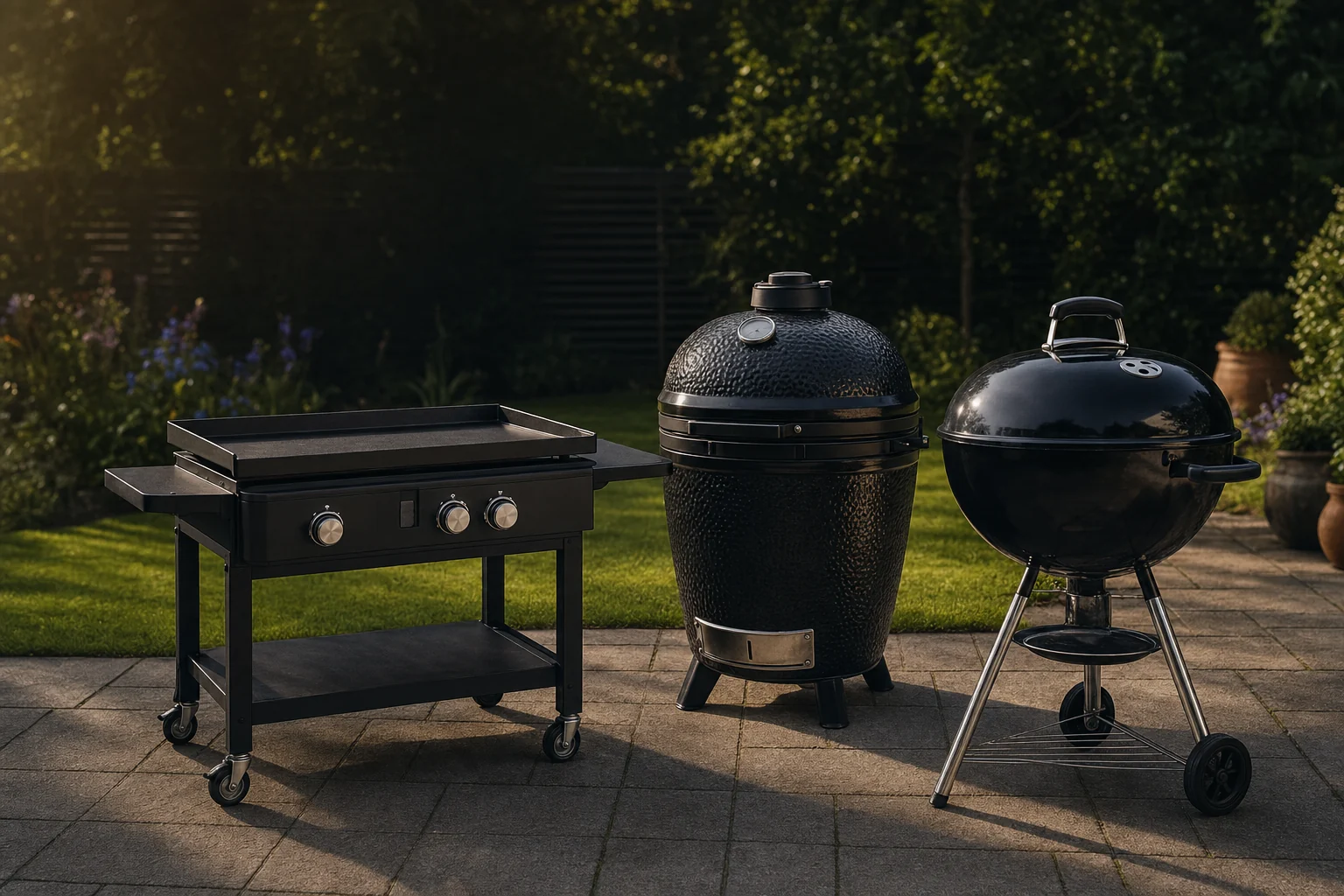
Fire Up the Debate: Kettle, Kamado, or Flat-Top Griddle?
Buying a barbecue ought to be simple. Fire goes in one end, dinner comes out of the other, everyone applauds politely and somebody starts looking for the ketchup. In practice, it is one of those garden purchases that becomes oddly philosophical. Do you want smoke or speed? A lid or a crowd? One glorious steak, or twenty smashed burgers in a noisy procession? And how much patience do you have when a thermometer is being stubborn?
There are three distinct families in this comparison. The kettle barbecue is the classic charcoal all-rounder: a rounded metal bowl, domed lid, cooking grate and vents. It is the familiar silhouette that has occupied patios since the middle of the twentieth century, and with good reason. Kettles can grill directly over coals, cook indirectly beneath a closed lid, roast a chicken and, with a little care, smoke food slowly. They ask you to get involved. Some people call that effort. Others call it the point.
Then comes the ceramic kamado. This is the egg-shaped heavyweight, made around thick, heat-resistant ceramic walls and controlled through upper and lower vents. A kamado is still charcoal cooking, but it behaves quite differently from a thin steel kettle. Its insulation is the headline act. Once heated, it is designed to hold onto warmth with remarkable determination, which makes it particularly appealing for long cooks and for people who enjoy treating a Saturday brisket as a modest engineering project.
Finally, flat-top griddles and planchas take a more open approach. Instead of cooking through a grate over charcoal, food sits directly on a broad, flat surface heated from below. They are often gas-fired and usually have no dome to close over the top. The format is brilliant for cooking lots of smaller things quickly: burgers, breakfast, seafood, vegetables, fried rice, pancakes and those onions that somehow taste better outdoors. Everybody can see what is happening. Everybody will offer advice. That is part of the package.
This is a compatibility guide, not a league table. The most capable cooker is not automatically the most suitable one. Garden space, how often you cook, the number of people you feed and whether you enjoy managing live charcoal all matter more than a shiny badge on a lid.
A modest kettle can be the perfect answer for a couple who want proper charcoal flavour without filling the shed. A ceramic kamado can make complete sense for a keen cook who wants to smoke, roast and bake as much as grill. A flat-top can be the garden hero for a family that hosts often and would rather cook a whole meal in view of their guests than disappear behind a closed lid.
So, rather than asking which type is "best", start with a better question: what do you actually want to cook on a normal Wednesday, a sunny Sunday, and the one ambitious bank-holiday afternoon when you decide that twelve people definitely need lunch? Your answer is probably sitting in one of the three camps below.
The Contenders at a Glance: Specs, Sizes, and What You're Actually Getting
Category comparisons can get woolly very quickly. "Versatile", "premium" and "perfect for entertaining" are all pleasant words, but they do not tell you whether a barbecue will fit by the back door or whether you can move it without recruiting a neighbour. Physical details are where the personality of each format starts to show.
Among full-size kettles, the Weber Original Kettle Premium 57cm gives a useful reference point. Its 57cm diameter cooking grate provides 2,342cm² of cooking area. With the lid closed, it measures 107cm high, 57cm wide and 75cm deep, and weighs 18kg. It has two all-weather wheels, a built-in lid thermometer, a rust-resistant aluminium damper, two tool hooks and a Gourmet BBQ System plated-steel hinged cooking grate. That is a substantial but still movable garden barbecue.
The Weber Compact Kettle 57cm follows the same essential shape with a noticeably lighter 12.46kg weight. It measures 98cm high, 56cm wide and 63cm deep with the lid closed, has two all-weather wheels, a plated steel cooking grate and two rust-resistant aluminium dampers. It is the less elaborate version of the familiar formula. Nothing wrong with that. A kettle does not require a control panel and a postgraduate qualification to make a very good sausage.
Kamados use their space differently. The Kamado Joe Classic II has a 46cm-diameter cooking surface listed at 1,646cm². Its thick-walled ceramic body is a key part of the design rather than a cosmetic flourish. This is not a cooker you casually drag across the lawn because the wind changed direction. A ceramic barbecue rewards thoughtful placement: a stable spot, sensible access and enough clearance to work around it comfortably.
Flat-top griddles are less easily summarised by one standard measurement because the format comes in many shapes, from compact tabletop plates to freestanding carts. What is consistent is the cooking geometry. The surface is broad, flat and uninterrupted. There are no gaps between bars, no food dropping through to the coals and no need to juggle delicate ingredients in a grill basket simply because they are too small for a grate.
Material is equally important. Kettles generally use metal bodies, often with porcelain-coated or enamelled surfaces. The Weber Original Kettle Premium uses a plated steel cooking grate, whilst the ProQ Rodeo combines high-grade porcelain-coated steel with a stainless steel grill and aluminium parts. Ceramic kamados centre their design around a heat-resistant ceramic shell. Flat-tops normally rely on steel or cast-iron cooking plates, which need a different sort of care: keeping the surface clean, dry and maintained rather than expecting it to behave like a grate.
Assembly is also worth considering before the delivery arrives and your hallway becomes an obstacle course. A kettle is typically the least intimidating option. It has a bowl, lid, legs or wheeled frame, grates and a few fittings. A large ceramic cooker has more parts and much more mass. A freestanding griddle may involve a frame, cooking plate and gas connections. None is inherently difficult, but they are not equally convenient at half past seven on a Friday evening.
Think beyond the cooking surface
Cooking area matters, but usable workflow matters too. A kettle asks you to work through a grate and lid. A kamado asks you to plan fire management. A flat-top gives you a large visible stage, but expects you to organise ingredients, oil and serving trays around that stage. The better fit is usually the one whose routine sounds enjoyable rather than laborious.
Kettle BBQs Unpacked: The Classic Charcoal Circle That Started It All
The kettle barbecue is one of those designs that seems almost too obvious to improve. A round bowl holds charcoal below a cooking grate. A domed lid turns it from an exposed grill into an oven-like chamber. Dampers regulate airflow. Wheels make it possible to shift the whole affair when the smoke is heading directly for the washing. The formula has been around for decades because it works.
Its strength is flexibility without excessive ceremony. Arrange coals beneath the centre and you have direct heat for steaks, burgers, skewers and anything else that benefits from a quick blast. Move the charcoal to either side, or create an indirect zone, and the area under the closed lid becomes useful for larger joints, whole poultry or slower cooking. It is not as insulated as a ceramic cooker, but it is far more versatile than a simple open brazier.
That versatility does come with a trade-off. A kettle's metal body has more moderate heat retention than ceramic, so you need to pay attention to the charcoal bed and airflow. It will heat up comparatively quickly for straightforward grilling, which is excellent when dinner needs to happen rather than become a weekend project. But during a longer cook, you cannot simply assume the temperature will look after itself. You need to watch the vents, notice the weather and develop the faintly magical skill of knowing when not to fiddle with anything.
The Weber kettle ladder
Within Weber's 57cm kettle family, the Original Kettle Premium is the most feature-rich of the three models here. Its 2,342cm² cooking area is generous for a domestic charcoal barbecue, and the hinged Gourmet BBQ System plated steel grate makes adding charcoal during a cook less awkward. The built-in lid thermometer is useful as a guide to the environment under the lid, whilst the two tool hooks and two all-weather wheels are small, practical details that tend to matter once you are actually cooking.
The Bar-B-Kettle 57cm sits between the Premium and Compact in weight at 15.81kg. With the lid closed, it measures 100cm high, 57.1cm wide and 64cm deep. It uses a plated steel cooking grate, two all-weather wheels and two charcoal rails, but its distinctive detail is four rust-resistant aluminium dampers. More damping points give a little more scope for adjusting airflow. That does not transform charcoal cooking into an automatic process, but it can be appealing if you enjoy a little extra control.
The Compact Kettle is the stripped-back choice. At 12.46kg, it is considerably lighter than the 18kg Original Kettle Premium, and its closed-lid dimensions of 98cm by 56cm by 63cm make it easier to accommodate in a tighter outdoor corner. It retains the practical essentials: charcoal fuel, two dampers, a plated steel cooking grate and wheels. What it loses is some of the Premium's convenience equipment rather than the fundamental kettle experience.
There is a useful lesson in that. The cooking principle is not confined to the top-spec version. You can make good food on a plain kettle if you learn where the hot zones are and stop lifting the lid every ninety seconds. The fancier model may make the process more comfortable. It does not replace technique.
Alternatives that broaden the format
The VonHaus Kettle Charcoal BBQ shows how much storage and serving convenience can be built around the familiar bowl-and-lid arrangement. It weighs 11.5kg and measures 93.5cm high, 71cm wide and 59cm deep. Its 53.5cm-diameter enamel-coated steel grill sits alongside a temperature gauge, warming rack, side shelf and lower shelf. The warming rack measures 42cm by 23cm, and the lower shelf measures 44cm by 48cm. For someone who dislikes balancing a plate on one knee whilst handling tongs, those additions are not frivolous.
CosmoGrill's kettle is another larger-format metal option. Its powder-coated steel body and chrome-plated steel grate are arranged around a 54cm cooking diameter. It weighs 17kg, measures 66cm by 61cm by 96cm with the hood closed, and is around 141cm high when open. Its 3kg coal capacity is worth noting for cooks that need a reasonably substantial charcoal bed. Again, it is recognisably a kettle. The variations are mostly about frame, storage, grate material and the level of convenience around the core fire.
The ProQ Rodeo sits at 15.2kg and measures 107cm high, 61cm wide and 65cm deep when assembled. It uses high-grade porcelain-coated steel, a stainless steel grill, aluminium parts, heat-proof silicone on the lid and bowl, a heavy-gauge charcoal grate, three legs, two rubberised wheels and a storage rack. That specification underlines the enduring appeal of the type: plenty of manufacturers can add their own priorities, but the round charcoal cooker remains remarkably adaptable.
Kettle strengths
- Charcoal flavour and direct grilling in a familiar, uncomplicated format.
- Closed-lid cooking makes roasting and indirect heat possible.
- Generally lighter and easier to move than a full ceramic kamado.
- Many models offer wheels, useful when a permanent cooking position is not possible.
- Quick to heat for ordinary grilling sessions.
Kettle limitations
- Temperature management needs regular attention during longer cooks.
- Metal construction does not retain heat like a ceramic shell.
- Food can fall through a traditional grate unless you use suitable accessories.
- Opening the lid repeatedly disrupts heat and extends cooking time.
- Charcoal ash and grate cleaning are part of ownership. No way around it.
The kettle sweet spot
Choose a kettle if you want proper charcoal cooking but do not want your barbecue to become a fixed garden monument. It is the sensible middle ground: more flexible than an open grill, less physically demanding than a ceramic egg, and capable of far more than burgers if you learn to use direct and indirect zones.
For many households, that middle ground is exactly right. A kettle feels approachable. You can use it casually, then become more adventurous as confidence grows. It is also forgiving in a social sense. If your guests are hungry and you simply need to cook some chops, you can do that. If you wake up wanting to experiment with slower indirect cooking, the lid is waiting. No one needs to know you watched three videos about vent settings first.
Ceramic Kamado BBQs: The Heat-Retaining Heavyweights Worth the Investment
A kamado is a charcoal barbecue with a very different temperament. The egg-shaped silhouette is instantly recognisable, but it is the heavy ceramic shell that changes the cooking experience. Instead of a relatively thin metal bowl losing heat to the surrounding air, thick ceramic walls are designed to absorb and retain it. The cooker becomes stable once it is properly warmed through. This can make it particularly rewarding for cooks that demand consistency rather than speed.
The basic mechanism is still pleasingly analogue. Air enters through a lower vent, passes over charcoal and exits through an upper vent. Restrict the airflow and the fire calms down. Open it and the fire gets more oxygen. The difference is that the ceramic body helps keep the internal environment steady. In practical terms, that can make a kamado suited to both hot cooking and long, low-temperature charcoal sessions.
It also explains why kamado owners tend to become enthusiasts. A ceramic cooker does not feel like a barbecue that happens to have a lid. It feels closer to an outdoor oven that happens to run on charcoal. You can grill, roast, smoke and bake in the same substantial vessel. There is a satisfying sense of control once you understand it, although the learning curve is real. Ceramic may be clever, but it cannot read your mind.
The Kamado Joe Classic II illustrates the compact-but-serious end of the format. Its cooking surface is 46cm in diameter and listed at 1,646cm². The design uses a thick-walled, heat-resistant ceramic shell, and an additional grill expander is listed at 1,031.24cm². Even before discussing culinary ambition, that tells you something important: the cooking surface is not necessarily the whole story. Kamado systems often aim to make vertical space and multi-level cooking useful, not merely make one enormous flat grate.
Heat-retaining ceramic body
Thick ceramic construction is the defining feature. It is designed to hold heat efficiently, making the cooker a strong fit for people who value stable charcoal cooking over quick pack-away convenience.
Top and bottom vent control
Kamados use airflow to regulate the charcoal fire. That means precision is possible, but it also means you need to learn how changes to either vent affect the cooker over time.
Built for patient cooking
Once settled, a ceramic cooker is naturally suited to low-and-slow styles as well as higher-heat grilling. It rewards preparation and a less frantic approach around the fire.
A fixed-garden mindset
These are substantial appliances. Choose the spot carefully, make sure the base is stable and think of the kamado as a long-term feature of the garden rather than a barbecue you will routinely carry around.
There is a misconception that a kamado is only for smoking. It is certainly excellent for cooks where time and controlled heat are the main ingredients, but that is not all it does. The insulated body can support high-heat grilling too. The point is not that every meal must become an all-day ceremony. The point is that the cooker has the range to make a rapid supper or a slow weekend project feel equally plausible.
That said, the format is not universally convenient. Ceramic is heavy. It needs a stable location and a little more care when being moved or assembled. Unlike a lighter kettle, it is not the obvious choice for someone who needs to wheel the barbecue into a narrow storage gap after every use. If your garden is accessed via steps, or if the cooking spot changes according to the prevailing wind and who has put washing out, the practicality calculation changes sharply.
It is also worth being honest about the relationship between insulation and spontaneity. A kamado is not necessarily the appliance you choose when you decide at 6pm that you would like dinner at 6:25pm. The ceramic body needs to warm through before it delivers the stable performance that makes the design special. Once it is there, wonderful. Before it is there, you are simply waiting beside an expensive egg, trying not to look at the clock.
Those bars are not laboratory scores. They are a simple way to visualise the different priorities. A kettle is naturally good at getting a charcoal grill going without too much ceremony. A ceramic cooker's defining advantage is heat retention and control once established. A flat-top is designed around access and volume. The useful comparison is not which bar is longest. It is which one matches your cooking habits.
Kamado ownership suits a particular sort of person very well: someone who enjoys the process, wants to explore different cooking styles and has a sensible permanent location for a heavy cooker. It can be a serious investment in outdoor cooking rather than an occasional-use garden accessory. If that description makes you grin rather than sigh, you may already know where you stand.
Flat-Top Griddles and Planchas: The Show-Stopping Surface for Social Cooking
A flat-top griddle has almost the opposite social energy to a kamado. Where the ceramic cooker encourages you to close the lid, watch the vents and let the food quietly get on with its business, the plancha puts the entire process on display. There is no grate separating the food from the cooking surface. There is usually no lid to hide behind. You stand in front of a wide hot plate and cook in full view of everyone nearby.
That open format is intentional. Flat-top grills, also described in different contexts as griddles, planchas, teppanyaki grills or hibachis, make a meal feel communal. You can move food around in zones, cook several ingredients at once and keep an eye on everything without repeatedly lifting a lid. If you enjoy being part of the conversation whilst cooking, rather than becoming the mysterious smoke-covered figure at the far end of the patio, it is an extremely persuasive design.
The cooking physics are different too. On a conventional grate, rendered fat and juices fall away. That is useful for certain foods and creates the familiar char-grilled pattern, but it is not always what you want. On a flat plate, cooking juices and fats remain on the surface until you move or drain them. This helps create a self-basting effect, especially with burgers, seafood and vegetables. It also makes the surface ideal for ingredients that would be hopeless on an open grate: eggs, sliced mushrooms, diced onions, pancakes, small prawns and loose stir-fry ingredients.
Smash burgers are the obvious example. A flat-top provides the contact surface required to press a burger down, build a browned crust and cook multiple patties in sequence. But it would be a mistake to treat the format as a burger-only machine. Breakfast is another obvious fit. Eggs, bacon, sausages, tomatoes and mushrooms can all cook in adjacent areas, with a level of control that is awkward on a gridded barbecue. The same goes for fajitas, fried rice, vegetables, fish and a very effective outdoor brunch.
The theatre is a feature, not a distraction
Flat-tops suit cooks who want to face their guests. The broad, open surface lets you cook, talk and serve at the same time. That makes it especially useful for family meals and informal gatherings, where the food arrives in waves rather than in one carefully timed reveal from under a lid.
There are limitations, naturally. The lack of a lid means the flat-top is not trying to duplicate the enclosed roasting and smoking environment of a kettle or kamado. It is strongest when the food benefits from direct contact with the plate and quick, visible management. You are cooking more like a diner chef than a pitmaster. Both are valid life choices. They simply produce different dinners.
Cleaning also has a different rhythm. A grate has bars, undersides and spaces where residue can hide. A flat-top has one large surface to scrape and wipe down. That can be wonderfully straightforward after a quick cook, but the plate needs attention. Leaving grease, food residue or moisture sitting there is not a great long-term maintenance plan. A little routine goes a long way.
The surface encourages organisation. Before lighting up, it helps to have ingredients chopped, bowls nearby and somewhere ready for cooked food. On a kettle, you can close the lid and buy yourself a moment. On a flat-top, everything is in motion and visible. This is exhilarating if you like cooking in a lively, hands-on way. It can feel slightly like hosting a game show if you do not.
One more distinction matters: flavour. A charcoal kettle or kamado has the obvious appeal of live coals and smoke. A gas-heated flat-top has a different character, built around browning, caramelisation and cooking in the food's own juices. That is not lesser flavour; it is just a different route to it. If the phrase "smoky charcoal crust" makes your heart sing, charcoal should stay in the conversation. If "crisp-edged burger with fried onions and a fried egg" sounds more compelling, the griddle is making a strong case.
Head-to-Head: How the Three Styles Stack Up When It Counts
Trying to make these cookers compete on one number would be silly. A 57cm kettle, a ceramic kamado and a flat-top griddle are tools for overlapping but not identical jobs. Still, putting the core differences side by side makes the decision clearer. The Weber Original Kettle Premium 57cm and Kamado Joe Classic II provide firm reference points for the charcoal categories; the flat-top column describes the defining design characteristics of that category rather than pretending every plancha is identical.
| Feature | Weber Original Kettle Premium 57cm | Kamado Joe Classic II | Flat-top griddle / plancha |
|---|---|---|---|
| Primary cooking format | Charcoal cooking grate beneath a domed lid | Charcoal cooking within a ceramic, egg-shaped body | Flat cooking plate heated from below |
| Cooking area | 2,342cm² | 1,646cm² cooking surface; grill expander listed at 1,031.24cm² | Varies by model; broad, uninterrupted surface is the defining feature |
| Cooking diameter | 57cm | 46cm | Varies by model and plate shape |
| Weight | 18kg | Substantial ceramic construction | Varies by tabletop or freestanding format |
| Main strength | Flexible charcoal grilling, roasting and indirect cooking | Heat retention and controlled charcoal cooking | Social, high-access cooking of small or delicate foods |
| Best food types | Steaks, burgers, poultry, roasts and indirect cooks | Grilling, roasting, baking and long charcoal cooks | Burgers, eggs, pancakes, seafood, vegetables and stir-fries |
| Lid or dome | Yes | Yes | Usually no enclosed dome |
| Fire management | Charcoal and damper adjustment | Charcoal with top and bottom airflow control | Heat is delivered beneath the cooking plate |
| Social cooking style | Cook, check and close the lid | More planned, enclosed cooking process | Open and visible throughout |
Do not confuse capacity with convenience. A large apparent cooking area is only useful if it suits what you cook. A flat-top makes dozens of small items easy to manage. A kamado uses its enclosed heat for slower, controlled cooking. A kettle brings broad versatility without demanding a permanent ceramic installation.
The kettle sits in the middle of this comparison particularly well. Its 2,342cm² cooking area is roomy, its 18kg weight remains manageable compared with a ceramic cooker, and the lid gives you options beyond direct grilling. It cannot hold heat like a thick ceramic shell, nor can it handle loose ingredients as naturally as a flat plate. But it can turn its hand to a surprising number of jobs without asking you to redesign the garden around it.
The Kamado Joe Classic II's 46cm cooking diameter looks more compact beside a 57cm kettle, but the kamado's appeal is not simply footprint. It is cooking environment. The ceramic shell, airflow control and optional expanded cooking arrangement are for people who value temperature stability and are happy to let a charcoal cooker become part of their routine. It is a more deliberate tool.
The flat-top refuses to play the same game. It does not win by being a better smoker or a more traditional grill. It wins when food needs a flat surface, when you want to cook in batches without losing ingredients through bars, and when the person cooking would like to remain socially visible. If your ideal barbecue is an outdoor feast of smashed burgers, grilled vegetables, fried onions and quick side dishes, the plancha is not a compromise. It is probably the specialist you wanted all along.
Match the Cooker to Your Favourite Kind of Food
The fastest route to a good decision is to think backwards from dinner. Not an aspirational dinner from a cookbook photo, either. Think about the food you genuinely cook when people arrive hungry and the weather is nice. The answer often exposes the right barbecue format immediately.
If steak, chicken thighs, sausages, burgers and skewers make up the majority of your outdoor menu, a kettle is hard to fault. Direct charcoal heat and a traditional grate are exactly what those foods expect. The lid provides useful flexibility when thicker pieces need more gentle finishing. You can sear something over the coals, move it to indirect heat and stop pretending that every steak must be cooked entirely over a flare-up. Civilisation advances in small steps.
If your favourite cooks involve whole chickens, larger joints, slow smoking sessions or baking outdoors, ceramic deserves serious consideration. The kamado's heat-retaining construction is designed for controlled enclosed cooking. It is the sort of barbecue that encourages you to make plans. You begin thinking in terms of temperature, airflow and timing, which sounds alarming until you realise that it is also quite relaxing. Once the cooker is settled, the food can quietly get on with becoming excellent.
If breakfast, seafood, vegetables, sliced meat, pancakes and burger nights dominate, the flat-top is difficult to beat. Eggs do not belong on an ordinary grate unless you are enjoying a small domestic tragedy. Prawns, diced vegetables and thinly sliced onions are simply easier on a solid plate. The same is true when a meal needs several components cooked close together. One section can handle burgers, another can soften onions, another can toast buns in their residual fat. Nobody is suggesting that is health food. Nobody is complaining either.
The charcoal traditionalist
Choose a kettle if you want live-fire flavour, a lid for indirect cooking and a format that can stay flexible as your confidence grows.
The weekend project cook
Choose a ceramic kamado if you enjoy controlled charcoal cooking, want to explore roasting and smoking, and can give a heavy cooker a stable home.
The sociable host
Choose a flat-top if you want to cook in front of guests, serve food in waves and make burgers, breakfast and vegetables easy to manage.
The smaller-garden owner
A lighter kettle is often the most practical choice where the barbecue must be wheeled away, stored carefully or moved around a compact patio.
There is room for crossover, of course. A kettle can cook vegetables beautifully. A kamado can grill a burger. A flat-top can make a spectacular meal for a crowd. But choosing the tool that naturally favours your usual menu makes outdoor cooking less fussy. You will use it more, clean it more willingly and feel less guilty when it has not been lit for a fortnight.
Garden Space, Storage and the Reality of Living With It
Barbecues are often judged in the showroom as if they will live in a vast, sunlit courtyard with unlimited storage and an assistant carrying trays. Real gardens are less accommodating. There may be a narrow side passage, a patio shared with bikes, a washing line positioned by someone with no interest in smoke, or a shed already full of things that were supposedly "just for the summer". Placement matters.
The kettle is usually the easiest fit. The Weber Compact Kettle's 12.46kg weight and 98cm by 56cm by 63cm closed-lid dimensions make it particularly approachable where movement matters. The Original Kettle Premium is larger and heavier at 18kg, but two all-weather wheels still make it a practical garden appliance rather than a fixed installation. The 57cm cooking diameter gives useful capacity without requiring an enormous footprint.
Models with shelves alter the equation. The VonHaus kettle's side shelf, lower shelf and warming rack make it more self-contained during a cook. That is useful when outdoor worktop space is scarce. The trade-off is simply that the barbecue occupies more visual and physical room than a plain bowl on legs. There is no universal winner; it depends whether you would rather have storage built in or preserve clear patio space around the cooker.
A kamado should be treated more like a permanent garden feature. Ceramic construction brings real cooking benefits, but it is not especially compatible with casual relocation. Choose the spot before you commit. Consider access, a stable surface, room to lift the lid safely and enough working space for tools and food. If you only have a balcony-sized patch of paving or need to put the barbecue away after each use, the lifestyle fit may be less convincing than the cooking performance suggests.
Flat-tops need their own kind of space. The plate is open, so the cook needs room around it for ingredients, utensils and serving dishes. You are not simply opening a lid, placing food down and stepping back. You are actively managing several elements at once. For a sociable garden, that can be magnificent. For a narrow corner where you barely have elbow room, it may feel rather like attempting a restaurant service in a phone box.
Weather also changes the practical picture. Kettle models with porcelain-coated or enamel-coated elements, such as the Weber and ProQ styles described here, are designed for outdoor use, but any barbecue benefits from sensible care and protection. Ceramic does not remove the need for maintenance. Flat cooking plates demand their own attention after use. The boring truth is that the best barbecue is generally the one you can keep clean, dry and accessible enough to use regularly.
Questions to Ask Before You Commit
It is very easy to be seduced by the idea of a barbecue that can do everything. The more useful approach is to work through a few unglamorous questions before choosing. They do not sound exciting, but neither does discovering that your dream cooker cannot make it through the side gate.
How do you feed people?
For a plated meal of grilled meat and sides, a kettle or kamado works naturally. For food served continuously to a gathering, the open surface of a flat-top can be more comfortable.
Are you spontaneous or methodical?
Kettles heat quickly for direct grilling. Kamados reward a more patient approach to warming, airflow and stable cooking. A flat-top favours mise en place and active cooking.
Must it move after every cook?
If the barbecue needs to be stored away, a wheeled metal kettle is the practical favourite. Ceramic cookers make more sense where a permanent spot is available.
What falls through your current grill?
If the answer is vegetables, seafood, eggs or anything chopped small, a flat-top solves a genuine cooking problem rather than merely adding another appliance.
Also consider how much you enjoy fire management. This is not a test of character. Some people love adjusting vents, arranging charcoal and checking temperatures. Others want to cook dinner with the minimum number of moving parts. A kettle sits in the accessible middle. It offers charcoal involvement without the physical commitment of ceramic. A kamado is for people happy to make heat control part of the experience. A flat-top shifts the focus away from charcoal management and towards the food itself.
There is a slightly romantic idea that charcoal is automatically more authentic. It certainly has its own flavour and ritual, and that matters to many cooks. But there is nothing inauthentic about choosing the appliance that lets you cook food you enjoy, for people you like, without becoming frazzled. A griddle full of sizzling vegetables and burgers can be every bit as joyous as a smoked joint emerging from a ceramic dome. The garden police will not call.
Frequently Asked Questions
No. The domed lid and adjustable airflow make a kettle more versatile than an open charcoal grill. By arranging charcoal for indirect cooking, it can be used for roasting and slower cooking as well as direct grilling.
The main reason is heat retention. A ceramic kamado's thick shell is designed to hold heat efficiently and support stable, controlled charcoal cooking. The trade-off is a heavier, more permanent style of barbecue ownership.
It can replace it for many meals, particularly burgers, breakfasts, seafood, vegetables and stir-fries. It does not replicate the enclosed, lid-on roasting and smoking environment offered by kettles and kamados.
A lighter wheeled kettle is often the most practical answer because it can be moved and stored more easily. The Weber Compact Kettle 57cm weighs 12.46kg, whilst the Weber Original Kettle Premium 57cm weighs 18kg.
Not at all. Burgers suit the format brilliantly, but so do eggs, pancakes, vegetables, fish, seafood and chopped ingredients that would be awkward on a conventional grate.
No. A larger surface helps only when it suits your cooking style. The layout of the surface, whether it is open or enclosed, and how easily you can manage food all matter as much as the headline number.
The GardenScout Verdict: Choose the Cooking Experience You'll Use
There is no awkward loser here. Kettles, ceramic kamados and flat-top griddles are all excellent at what they are designed to do. The mistake is assuming they are interchangeable because they all live outdoors and involve food. A bicycle, an estate car and a wheelbarrow all have wheels too. That does not make them direct rivals.
The kettle remains the broadest all-round recommendation for most people. The Weber Original Kettle Premium 57cm demonstrates why: a 57cm diameter grate, 2,342cm² of cooking space, charcoal versatility, lid thermometer, wheels and a manageable 18kg weight. It can be a straightforward grill one evening and an indirect cooker the next. The lighter Weber Compact Kettle 57cm shows that you do not need every extra feature to enjoy the same fundamental style.
A ceramic kamado is the choice for the cook who wants the barbecue itself to become a hobby. The heat-retaining ceramic body, airflow control and enclosed cooking environment make it compelling for slow cooks, roasting and serious charcoal experimentation. It asks more of your garden and a little more of your patience. In return, it offers a distinctive kind of control that a lighter metal barbecue cannot quite imitate.
A flat-top griddle is the best answer when cooking is part of the entertainment. It is open, fast-moving and brilliantly suited to foods that benefit from a solid plate rather than a grate. Choose it if you want to talk whilst you cook, feed a group in batches and make outdoor breakfasts, burgers and vegetable-heavy meals feel easy rather than fiddly.
Final call
Choose a kettle for flexible charcoal cooking, a moveable garden-friendly format and the widest blend of grilling and lid-on cooking. Choose a ceramic kamado for heat retention, controlled long cooks and a permanent outdoor cooking centrepiece. Choose a flat-top griddle for sociable, visible meals and foods that need a broad solid surface.
In the end, buy for your real habits. The barbecue that suits your favourite food, available space and tolerance for faffing will make more memorable meals than the one that merely looks impressive beside the patio doors.