
Greenhouse Glass vs Polycarbonate: Which Should You Choose?
The glazing decision that shapes your light levels, winter warmth, safety and future maintenance — long after the frame has been assembled and the instruction manual has disappeared behind a potting bench.
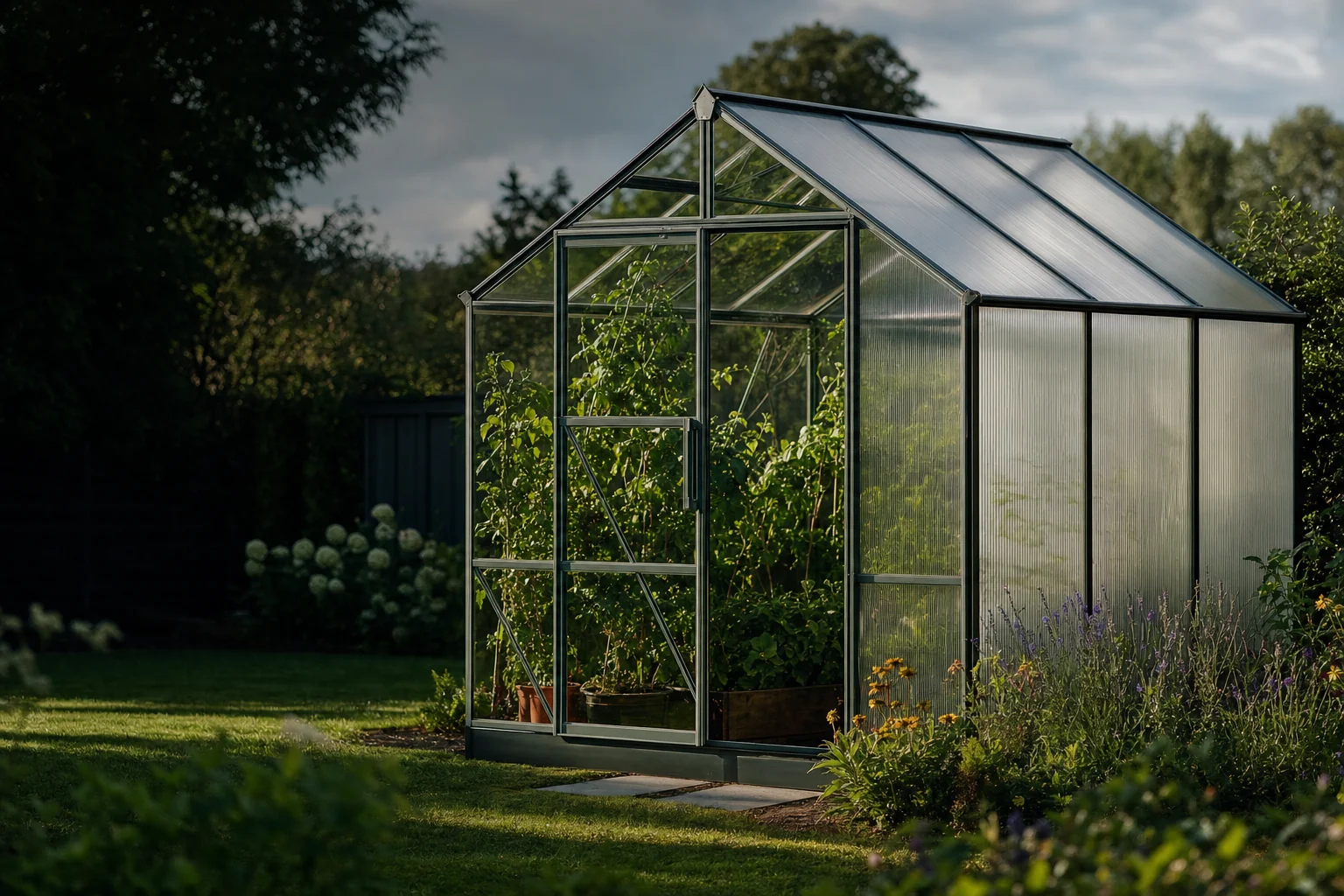
Glass vs Polycarbonate Greenhouses: The Verdict at a Glance
A greenhouse frame is important, obviously. It keeps the thing upright, which is a reasonable starting point. But the material filling that frame is what determines how the greenhouse behaves every day: how much useful light reaches the plants, how quickly warmth escapes at dusk, whether hail is a disaster or merely noisy, and how long you can expect the panels to remain clear.
If you are choosing a new greenhouse in September, this question becomes especially useful. The late-summer abundance is beginning to fade, nights are cooler, and anyone hoping to overwinter tender plants, raise hardy salads or keep a few cuttings ticking along will soon discover whether their greenhouse is a sunroom with shelves or a genuinely useful protected growing space.
The simple version is this. Glass is the traditional light-maximiser. Standard horticultural glass transmits around 90–92% of visible light, looks crisp and lasts for decades when it is not physically damaged. It is the obvious choice for gardeners who want maximum brightness, a classic appearance and a structure intended to stay put for a very long time.
Polycarbonate is the practical all-rounder. Twin-wall panels typically transmit about 80–83% of light, but their internal structure traps air and improves insulation considerably. They diffuse sunlight too, spreading it more evenly around the greenhouse instead of firing a hard beam at whichever tray happens to be nearest the glass. A useful quality for seedlings, and for the gardener who would rather not spend July playing musical chairs with every tomato plant.
The quick recommendation
Choose twin-wall polycarbonate for a family garden, an exposed site, year-round use or regular propagation. Choose glass if maximum natural light and a long-lived traditional greenhouse are your priorities, particularly in a sheltered garden where breakage is unlikely. Step up to multi-wall polycarbonate if winter heat retention matters more than ultimate clarity.
There is no universal winner because greenhouses are asked to do different jobs. A bright, unheated summer greenhouse for tomatoes has rather different needs from a winter nursery full of pelargonium cuttings, citrus and an electric propagator trying its best in January. The trick is to buy the glazing for the job you will actually do, not for the imaginary life in which every weekend is calm, sunny and devoted entirely to pricking out seedlings.
Know Your Glazing: A Field Guide to Every Material Type
"Glass greenhouse" and "polycarbonate greenhouse" sound like two neat categories. In reality, there are useful variations within both. It pays to understand them before comparing one kit with another, because a thin twin-wall panel and a thick multi-wall panel may both be called polycarbonate yet behave very differently once the weather turns.
Horticultural glass
This is the familiar greenhouse glazing most of us picture first: clear, single-pane glass held in an aluminium or timber frame. It delivers excellent visibility and high light transmission. If your greenhouse sits in a bright but sheltered corner and is primarily a spring-to-autumn growing space, those qualities remain compelling.
The drawback is that a single pane creates very little thermal resistance. On a sunny October morning it may feel wonderfully warm inside. A few hours later, once the sun has gone behind the house, that stored warmth can leave with impressive enthusiasm. Standard horticultural glass is also brittle. It can be replaced panel by panel, which is helpful, but the panel still has to survive the football, branch, ladder, wheelbarrow handle or overconfident strimmer before replacement becomes relevant.
Tempered or toughened safety glass
Tempered glass retains the clear, bright character of standard glass whilst offering much better impact performance. Its important safety advantage is how it fails: rather than breaking into long, sharp shards, it fractures into many smaller and less dangerous pieces. It is not unbreakable, nor should anyone test that theory for recreational purposes, but it is a far more sensible specification where children play nearby or where access around the greenhouse is busy.
Double-glazed and low-e glass
Double-glazed glass is the premium glass route. Insulated glass transmits around 78% of light, so you trade some brightness for improved thermal performance. Some units use low-emissivity coatings that let visible light through whilst reflecting infrared heat back. That is a useful bit of physics for a greenhouse used through colder months, though it naturally moves the project away from the simple, repairable pane-by-pane greenhouse tradition.
Polycarbonate: twin-wall and multi-wall
Twin-wall polycarbonate
Usually 4–6 mm thick, with two outer faces and an air gap between. It typically transmits around 80–83% of light and has an R-value of roughly 1.7.
Four-wall polycarbonate
A more insulated option, commonly around 10 mm thick, with an R-value of about 2.1. It suits gardeners who want meaningful cold-weather improvement.
Five-wall and higher
At around 16 mm, multi-wall panels can reach an R-value of approximately 2.8. Light transmission falls to roughly 65%, but the incoming light is fully diffused.
UV-resistant outer layer
Modern panels use a co-extruded UV-resistant layer to slow degradation. Fit panels with that protected face facing outwards; it is not a decorative suggestion.
Polycarbonate's internal walls do two useful things. They create air spaces, which slow heat loss, and they scatter incoming sunlight. The first is plainly valuable in winter. The second can be just as helpful in summer because plants receive a broader wash of light instead of pronounced bright and shaded strips.
The compromise is visual. You can see through clear glass in the way you see through a window. Twin-wall polycarbonate has a softened, slightly opaque appearance, and thicker multi-wall products become progressively less transparent. If watching the garden through the greenhouse is part of the pleasure for you, glass has a charm that numbers do not completely capture.
A fitting detail that matters
Polycarbonate needs its UV-protected face on the outside. That coating is what helps the panel resist yellowing and weathering. Reversing it undermines the material's expected working life before you have even filled the first seed tray.
Let There Be Light: Transmission Figures That Actually Matter to Your Plants
Light is the argument glass wins most cleanly. Standard single-pane horticultural glass transmits around 90–92% of visible light. Twin-wall polycarbonate generally sits around 80–83%, with figures ranging from roughly 75–85% according to thickness and panel construction. Thick five-wall polycarbonate falls to around 65%.
It is tempting to stop there and declare glass the winner. In some situations, it absolutely is. British winter light is not extravagant, and a greenhouse used for light-hungry crops benefits from every useful photon it can get. If you are growing through the gloomy months without supplementary lighting, a clear glass structure gives you the strongest starting point.
But raw transmission is only half the story. The other half is light quality: how the light lands on leaves, trays and benches. Glass lets light pass through in a directional way. That creates familiar patterns of high intensity near sun-facing panes and lower intensity elsewhere. It can produce hot spots in summer, especially where plants are close to the glazing or where the sun catches a particular corner for several hours.
Polycarbonate diffuses light. Its slightly milky internal structure spreads rays in multiple directions, helping more of the plant receive light rather than concentrating it on the uppermost leaves. Seedlings on a bench tend to benefit from that more even distribution. So do densely arranged plants, where the aim is not simply to illuminate the top leaf but to get useful light further into the canopy.
Come late September, light levels are already dropping. This is when the practical difference becomes easier to understand. A glass greenhouse offers excellent brightness for overwintering plants placed close to the glazing. A twin-wall polycarbonate greenhouse is a little dimmer, but it gives plants a more even environment and loses less heat overnight. Neither property cancels the other out. It simply means you need to decide which limitation matters more in your garden.
For summer crops, shading remains part of the routine whichever glazing you choose. Glass may need more active attention because direct sunlight can be fierce and sharply focused. Shading paint, blinds or suitable fabric can reduce that risk. Polycarbonate's diffusion softens extremes, but it does not make ventilation optional. A greenhouse on a still July afternoon can become uncomfortable for plants with remarkable speed, whatever the panels are made from.
Do not confuse a clear view with the best growing light. Glass gives a clearer view outside; diffused polycarbonate can give a more even spread of light across the plants inside. For propagation benches and tightly planted seedlings, that distinction can matter more than it first appears.
Keeping the Heat In: R-Values, Insulation and Your Winter Heating Bill
R-value is simply a measure of resistance to heat flow. Higher is better. A material with a higher R-value slows the rate at which warmth moves from the greenhouse interior to the colder outdoors. It is not a magic force field, sadly. Doors, roof vents, gaps around the frame and cold ground all still play their part. But glazing covers a large proportion of a greenhouse, so its thermal performance matters enormously.
For working comparison purposes, single-pane glass R-values vary significantly depending on the calculation method and glass construction. A commonly cited figure is around R 0.9, though more precise thermal measurements for a standard 6 mm pane give approximately R 0.16. The useful gardening conclusion remains uncomplicated: single glazing is a poor insulator compared with a multi-layer polycarbonate panel.
Twin-wall polycarbonate has an R-value of roughly 1.7. Four-wall polycarbonate rises to approximately R 2.1. Five-wall and higher multi-wall construction can reach around R 2.8. Even using the higher of the commonly cited single-pane glass figures (~R 0.9), polycarbonate offers substantially better insulation; using the more precise thermal measurement for a 6 mm pane (~R 0.16), the difference is even more marked. Each internal air channel adds another barrier to heat loss.
| Glazing type | Approximate R-value | What that means in practice |
|---|---|---|
| Single-pane glass | R c. 0.16 (precise thermal measurement for 6 mm pane; some sources cite up to ~0.9 using different calculation methods) | Fast heat loss once the sun goes down; best suited to mainly seasonal use or a greenhouse where heating demand is modest. |
| Twin-wall polycarbonate | R c. 1.7 | Roughly double the thermal resistance of single-pane glass, making it a strong all-round choice for propagation and overwintering. |
| Four-wall polycarbonate | R c. 2.1 | A worthwhile step up where colder-season growing is important and a bright but more protected space is wanted. |
| Five-wall multi-wall polycarbonate | R c. 2.8 | The best insulation of these options, particularly useful for consistent cool-weather use, although it admits less total light. |
Imagine two otherwise similar small greenhouses held at a minimum of 5°C through a cold British winter night: one single-glazed, one with twin-wall polycarbonate. Because twin-wall polycarbonate has roughly twice the R-value, conducted heat loss through the glazing can be roughly halved compared with single-pane glass. Real-world results will vary with draughts, ventilation, location, heater output and how often somebody opens the door to admire a tray of lettuce. Even so, the direction of travel is clear.
For heavier multi-wall systems, heating costs can be reduced by around 30–50% compared with single-pane glass. That is the figure that catches the attention of gardeners using a greenhouse continuously rather than merely extending the tomato season. When you are paying to maintain a frost-free environment for months, insulation stops being a technical specification and starts becoming part of the gardening budget.
Think in nights, not sunny afternoons
Most greenhouses can feel warm in direct sun. The meaningful test is what happens after sunset. If you want to keep tender plants or a propagator going from autumn into spring, choose glazing for overnight heat retention rather than for the temperature at 2 pm on a bright day.
This does not mean glass is unsuitable for winter. Plenty of gardeners successfully overwinter plants in glasshouses. It means that a glasshouse usually demands more from the heater, and more from you. Bubble insulation, careful draught-proofing and sensible plant grouping can improve matters, but starting with a more insulating panel is the easier route if year-round growing is the ambition.
Safety First: What Happens When Something Goes Wrong
Garden greenhouses live surprisingly adventurous lives. There are footballs, of course. There are falling twigs after a windy night, an overhanging branch you meant to prune in June, a ladder slipped against the side panel and hail that arrives with no respect whatsoever for the day you chose to leave the roof vent open.
Standard horticultural glass has baseline impact resistance and is brittle by nature. When it breaks, it can form large sharp shards. That is the central safety issue. It matters most in gardens used by children, in narrow side passages, near patios and paths, or anywhere a broken pane could be handled in a hurry by somebody wearing sandals. A traditional glass greenhouse can be perfectly sensible, but its placement and surroundings deserve honest thought.
Tempered or toughened safety glass is much safer when breakage does happen. Instead of producing dangerous long shards, it breaks into smaller pieces with blunter edges. It remains glass — a sufficiently determined impact can still defeat it — but the likely consequences are less severe. Where you want the clarity and longevity of glass without accepting the same level of breakage risk, toughened glass is the logical upgrade.
Polycarbonate is in another league for impact resistance. It is described as around 200 times stronger than standard annealed glass and 30 times stronger than acrylic. Note that comparisons against safety (toughened) glass yield a different figure — polycarbonate is cited as approximately 250 times more impact-resistant than safety glass by some sources, reflecting the higher baseline of tempered glass. Four-wall polycarbonate can be rated at roughly 300 times the impact resistance of standard annealed glass. It also resists hail impacts up to around 3.8 cm (1.5 inches). For an exposed garden, that is not a minor detail.
Why glass still appeals
- Very high visible light transmission, at around 90–92% for single-pane glass.
- A clear, traditional finish that makes the greenhouse feel open and bright.
- A long potential lifespan of 40–50 years when panes avoid mechanical damage.
- Tempered safety glass improves the breakage behaviour considerably.
Where glass needs caution
- Standard horticultural panes can shatter into sharp pieces.
- Single glazing loses heat rapidly in cold conditions.
- Condensation is more likely to accumulate on the cold inner surface.
- It is the less forgiving option around balls, branches and energetic garden activity.
If the greenhouse will sit beside a family seating area, play space or frequently used route, safety deserves more weight than it sometimes gets in showroom comparisons. A slightly lower light figure is easier to live with than a broken panel and a painful clean-up.
There is a quieter safety benefit to polycarbonate too: panels are generally easier to handle during assembly and maintenance because they are much less prone to sudden shattering. That does not make installation effortless, particularly in wind, but it does remove one rather stressful part of handling traditional glazing.
The Long Game: Lifespan, UV Degradation and Replacement Planning
Glass has one enormous advantage that tends to be underestimated when everyone is busy comparing initial specifications: it can last for 40–50 years. In a good frame, with sensible maintenance and no unfortunate collision, it is a genuinely long-lived material. The greenhouse may become part of the garden rather than an item you expect to refresh every decade or so.
That longevity is not just sentimental. A glasshouse acquired for a permanent site can outlast changes in planting style, patios, sheds and perhaps several attempts at deciding where the compost bins should go. Individual damaged panes may need replacing, but the glazing itself does not gradually become opaque through normal sun exposure in the way unprotected plastics can.
Polycarbonate has a different long-term story. Modern greenhouse panels use co-extruded UV-resistant layers, and these generally remain effective for around 10–15 years with proper care. Once that protective layer has degraded, yellowing, reduced light transmission and brittleness become more likely. In very sunny, hot conditions, unprotected polycarbonate can begin yellowing within one to two years, which underlines why the UV-resistant layer and correct orientation matter so much. Always install panels with the UV-protected face on the outside; fitting the unprotected face outward will cause premature yellowing and significantly shorten the panel's effective lifespan.
This is not an argument against polycarbonate. It is an argument for treating it as a component with a replacement cycle. The panel may remain physically in place for longer, but a greenhouse is there to grow plants, not merely to continue existing. If the panels have become noticeably less clear or are deteriorating, their job is no longer being done properly.
Over a 40-year period, a polycarbonate greenhouse may therefore involve one or more full panel replacement cycles, whereas undamaged glass may require none. On the other hand, glass is more vulnerable to isolated accidental breakage, and one bad storm can make a decades-long lifespan feel rather theoretical. The sensible comparison is not "which material lasts forever?" because neither does. It is "which kind of maintenance would I rather deal with?"
Glass maintenance is mostly cleaning and occasional breakage management. It is prone to smudges, streaks and watermarks, so it rewards regular washing if maximum light is the goal. Polycarbonate is generally easier-going to clean and more forgiving of the odd missed patch, but the channels, panel orientation and UV layer require care from day one.
Condensation is worth including here because it influences long-term plant health. Glass is more susceptible to condensation accumulation. Cold panes encourage moisture to settle, and persistent dampness can help create conditions favoured by mould and some pest problems. Polycarbonate's construction minimises condensation accumulation, although good ventilation remains essential with either material. A greenhouse with no air movement is an excellent place to grow problems. Plants are merely the guests.
Maintenance is a growing condition
Clean glazing lets in more light, dry surfaces reduce disease pressure, and a sound frame keeps the climate controllable. Whichever material you choose, put a spring clean and an autumn inspection in the diary. Future you will be smug. Present you may grumble a little, but that is gardening.
Which Glazing Suits Your Garden and Growing Style?
The best choice becomes clearer once you stop treating every greenhouse as if it will do the same job. Think about where it will stand, who uses the garden, how much winter growing you genuinely intend to do and whether your greenhouse will be a neat seasonal workspace or a working nursery twelve months of the year.
Choose single-pane glass if…
You prioritise maximum light, love the classic clear-glass look and have a sheltered site where accidental impact is unlikely. It is especially appealing for a mainly spring-to-autumn greenhouse.
Choose twin-wall polycarbonate if…
You want the broadest practical compromise: good light, much stronger impact resistance and roughly twice the insulation of single-pane glass.
Choose multi-wall polycarbonate if…
You plan to overwinter plants, propagate regularly or heat the greenhouse through cold weather. Its higher R-value is the point, not the view through the panels.
Choose toughened glass if…
You want glass clarity but need a safer breakage pattern in a busy garden. It is the sensible route where the glasshouse will be close to everyday family life.
For the typical British back garden, twin-wall polycarbonate is often the easiest recommendation. It is safer, forgiving and usefully insulated without becoming too dark. The light reduction compared with glass is real, but so is the practical advantage of a greenhouse that will not be defeated by a wayward football or an abrupt hailstorm.
For the committed gardener with a sheltered plot and a love of a traditional greenhouse, glass remains deeply attractive. There is a particular pleasure in a clear glasshouse on a cold morning: you can see every bench, every label and every neglected watering can from the garden. It also brings maximum natural brightness at a time of year when it is in short supply.
By contrast, if your plan this autumn is to keep tender plants growing steadily, nurse cuttings and perhaps maintain a modest frost-free temperature, do not be seduced by looks alone. The extra insulation of twin-wall or multi-wall polycarbonate is likely to be more useful to you than the clearest possible view of the rain.
Head-to-Head: The Full Greenhouse Glazing Comparison
Here is the practical comparison without the showroom fog. The figures make the trade-offs easier to see, but remember that a greenhouse is a system. A well-sited, ventilated and carefully maintained structure will outperform a theoretically superior one that is poorly assembled, filthy or allowed to become a sauna every sunny afternoon.
| Feature | Horticultural glass | Toughened glass | Double-glazed glass | Twin-wall polycarbonate | Five-wall polycarbonate |
|---|---|---|---|---|---|
| Visible light transmission | 90–92% | c. 90% | c. 78% | c. 80–83% | c. 65% |
| Insulation | R c. 0.16 (6 mm pane; see note above on variable sources) | Similar single-pane performance (see horticultural glass note) | Improved insulated construction | R c. 1.7 | R c. 2.8 |
| Impact behaviour | Brittle; sharp shards possible | Breaks into smaller pieces | Glass remains breakable | Very high resistance | Very high resistance |
| Light character | Clear and directional | Clear and directional | Clear and directional | Diffused | Fully diffused |
| UV behaviour | Blocks most UV-B and significant UV-A | Comparable glass behaviour | May include low-e heat-reflecting coating | UV-resistant outer layer | UV-resistant outer layer |
| Expected lifespan | 40–50 years | Long-lived if undamaged | Long-lived construction | UV layer effective for 10–15 years | UV layer effective for 10–15 years |
| Condensation tendency | Higher | Higher | Reduced by insulated construction | Lower accumulation tendency | Lower accumulation tendency |
| Best fit | Maximum light and traditional appearance | Safer clear-glass greenhouse | Premium insulated glasshouse | All-round family garden choice | Cold-weather growing priority |
The important pattern is straightforward. Glass leads on clarity and long-term longevity. Polycarbonate leads on safety and insulation. The thicker the polycarbonate becomes, the more it turns the greenhouse into a protected, temperature-moderated growing environment — but the more you give up the bright, transparent quality that makes a glasshouse feel so inviting.
Frequently Asked Questions
The Final Verdict: Glass or Polycarbonate?
If your heart says glass, it is probably responding to something real. A proper glass greenhouse is bright, elegant and capable of lasting 40–50 years. For a sheltered garden and a gardener who values maximum natural light above all else, it remains a superb choice. It is not old-fashioned. It is simply specialised.
If your head says polycarbonate, it is also making a strong case. Twin-wall polycarbonate offers a very persuasive mix of light transmission, insulation and safety. It will not match glass for sheer clarity, but it is far more resistant to impact and has roughly double the insulating value of single-pane glass. For most family gardens, it is the lower-stress option.
And if your greenhouse is going to work hard through winter — keeping plants frost-free, supporting propagation or extending the productive season properly — thicker multi-wall polycarbonate is the material to look at. It gives up more light, yes, but its R-value of around 2.8 makes it a far better barrier against cold than single-pane glass.
GardenScout's glazing verdict
Choose glass for maximum light, traditional looks and exceptional potential longevity in a sheltered setting. Choose toughened glass where you want those benefits with a safer break pattern. Choose twin-wall polycarbonate for the best all-round balance of usable light, warmth and impact resistance. Choose thicker multi-wall polycarbonate when winter growing and heat retention are the priority.
In other words: buy glass for the view and the light; buy polycarbonate for resilience and warmth. Neither is wrong. The wrong choice is the one that does not match the life your greenhouse is actually going to lead.