
Garden Shredders and Chippers: Turn Prunings Into Mulch
Electric or petrol? I've spent years feeding hedge trimmings and tree branches into both, and here's how to choose the machine that ends those endless trips to the tip.
If you've ever stood at the back of your garden staring at a teetering heap of hedge clippings, snapped branches and the spoils of a serious autumn prune, you'll know the feeling. There's the green-bin overflow. The car boot you'll have to line with old sheets. The queue at the recycling centre on a Saturday morning, surrounded by everyone else who had the same idea. And then, weeks later, you're buying bagged mulch from the garden centre — paying money for what you literally drove away.
A garden shredder breaks that absurd cycle. Feed it your prunings and it hands you back a pile of chipped, shredded material you can spread on borders, pile onto the compost heap, or use to suppress weeds along a path. It's one of the few bits of garden kit that genuinely pays you back in both convenience and saved money on mulch and tip runs.
But there's a fork in the road the moment you start shopping: electric or petrol? The honest answer is that it depends entirely on what you're cutting, how much of it there is, and how far your nearest power socket reaches. I've used quiet electric turbine models that purr through a hedge, and brutish petrol chippers that swallow whole branches without flinching. Both have their place — and both have genuine drawbacks the marketing tends to gloss over. Let's get into it.
The Two Camps: How Electric and Petrol Actually Differ
Before we name names, it helps to understand why these two types of machine feel so different in use. It isn't just the engine — it's the entire mechanism of how they grab and process your waste.
Electric shredders typically use one of two mechanisms. The first is an impact system, where fast-spinning flails or blades smash material apart at high speed — quick, but loud and prone to throwing chips around. The second, and increasingly popular, is the turbine or roller system, where a slow-turning cutter draws the branch in gradually and crushes rather than chops it. The Bosch AXT 25 TC is the poster child for this approach: its turbine mechanism pulls material in at a measured pace, producing a quieter operation and a finer output that's genuinely well suited to composting.
Petrol chippers, by contrast, are usually built around heavy flywheel-mounted blades or hammer systems driven directly by a four-stroke engine. There's no extension lead, no socket to find, and crucially far more raw torque on tap. That's why a petrol machine like the Forest Master FM6DD can shrug off a 50mm branch that would have an electric shredder grumbling and stalling.
Noise & Neighbours
Quiet electric turbine units run at conversation-level volume; petrol chippers demand ear defenders and a friendly relationship with the people next door.
Power & Tether
Electric models need a socket and trail a cable — fine near the house, frustrating at the bottom of a long plot. Petrol roams free.
Branch Capacity
Electric tops out around 38–45mm in practice; petrol machines climb to 60mm, 100mm and beyond depending on engine size.
Maintenance
Electric is largely plug-and-go. Petrol needs fuel, oil changes and the occasional reluctant pull-start ritual — though direct-drive designs cut the fuss.
Quick-Reference Specs Across the Field
Here's a snapshot of the headline figures that matter most when you're weighing up a machine. I've pulled the most telling numbers from across both camps so you can see at a glance where the lines are drawn.
A quick word on branch diameter claims: manufacturers quote the maximum a machine can take, usually with a single straight, dry, freshly cut branch. In the real world — with forks, knots and green wood — you'll comfortably handle material a little under the rated figure. Treat the headline number as a ceiling, not a daily working limit.
The Quiet Electric Champion: Bosch AXT 25 TC
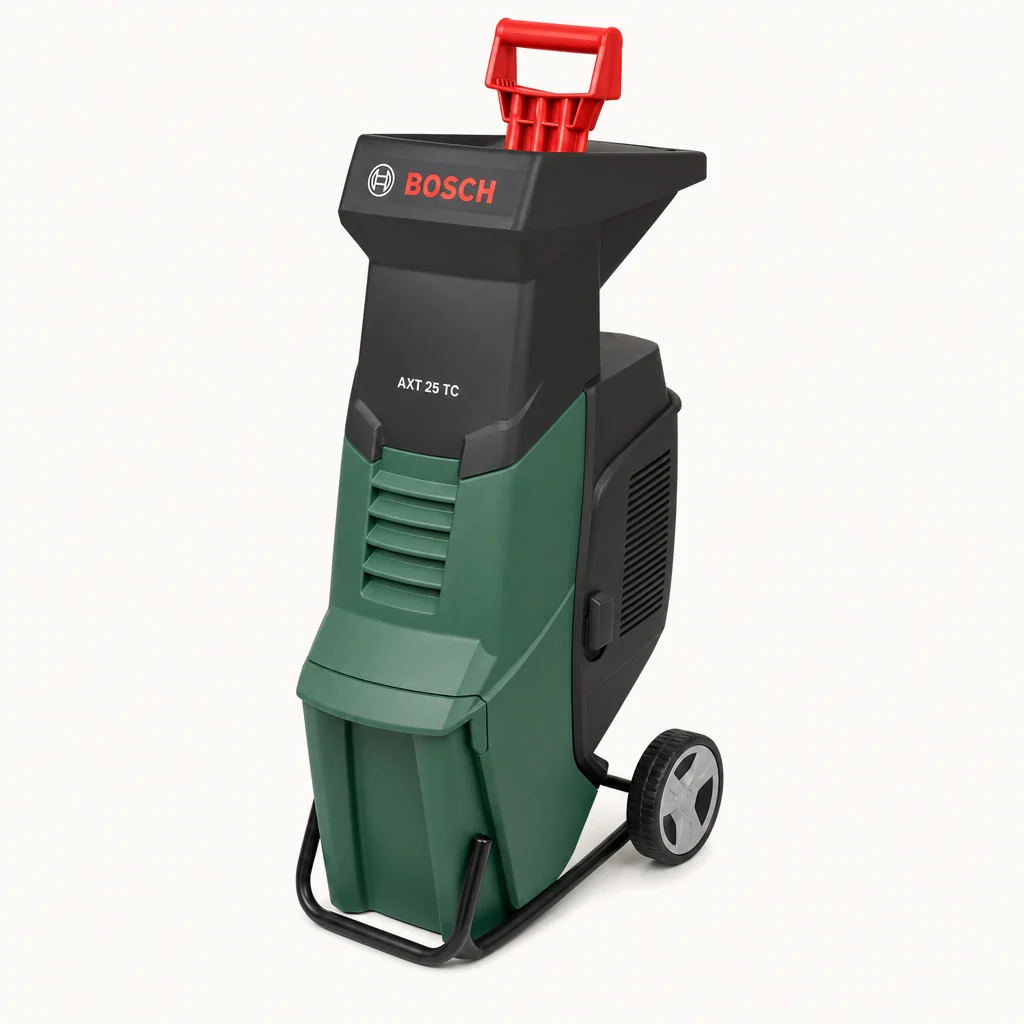
If there's one electric shredder that reviewers keep circling back to, it's the Bosch AXT 25 TC. It's been described as the best electric garden shredder for many years running, and having used the turbine design, I understand why it holds that reputation.
The headline trick is noise — or the lack of it. This is genuinely the quietest of all the electric shredders I'm aware of. You can run major branches through it without it sounding loud, and you can hold a conversation alongside it. For anyone with close neighbours, a terraced garden, or a simple aversion to wearing ear defenders for an afternoon, that's not a minor perk. It changes when and how often you'll actually reach for the thing.
The turbine mechanism draws material in gradually rather than snatching it, and the result is a finer output that drops neatly into the 53-litre collection box (which, neatly, stores inside the hopper for storage). On paper it'll process up to 230kg per hour, and it's strong, well made and excellent at chipping woody material.
Pros
- Conversation-level noise — runs major branches through without sounding loud
- Strong and well made, with a reputation built over many years
- Excellent at chipping woody prunings into fine mulch
- 53L collection box stores neatly inside the hopper
- Quoted throughput of up to 230kg per hour
Cons
- That 230kg/hour figure is theoretical — the feed slot is smaller than an average letterbox flap
- Handling of soft, green material was disappointing
- Not recommended if most of your waste is soft and green rather than woody
- At 31kg it's no featherweight to wheel about
That last point is the crucial caveat. The AXT 25 TC is a chipper at heart — it loves dry, woody stems and turns them into something lovely. Feed it a barrowload of leafy, sappy hedge trimmings, though, and you'll find yourself poking and prodding to keep things moving. The feed slot is the bottleneck: you're passing waste through an opening smaller than an average post flap, so that big throughput number assumes a steady stream of well-sized branches rather than fistfuls of greenery. Know your garden's diet before you buy.
Pro Tip: Match the Machine to Your Waste Mix
Take an honest look at what your garden actually produces. Mostly woody prunings from shrubs, fruit trees and established hedges? A turbine shredder like the Bosch will reward you with beautiful mulch. Mostly soft, leafy growth and bedding-plant clear-outs? You may be better off with a different mechanism — or simply composting the soft stuff and saving the shredder for the woody bits.
The Value Surprise: Hyundai HYCH2800ES Quiet Electric Shredder
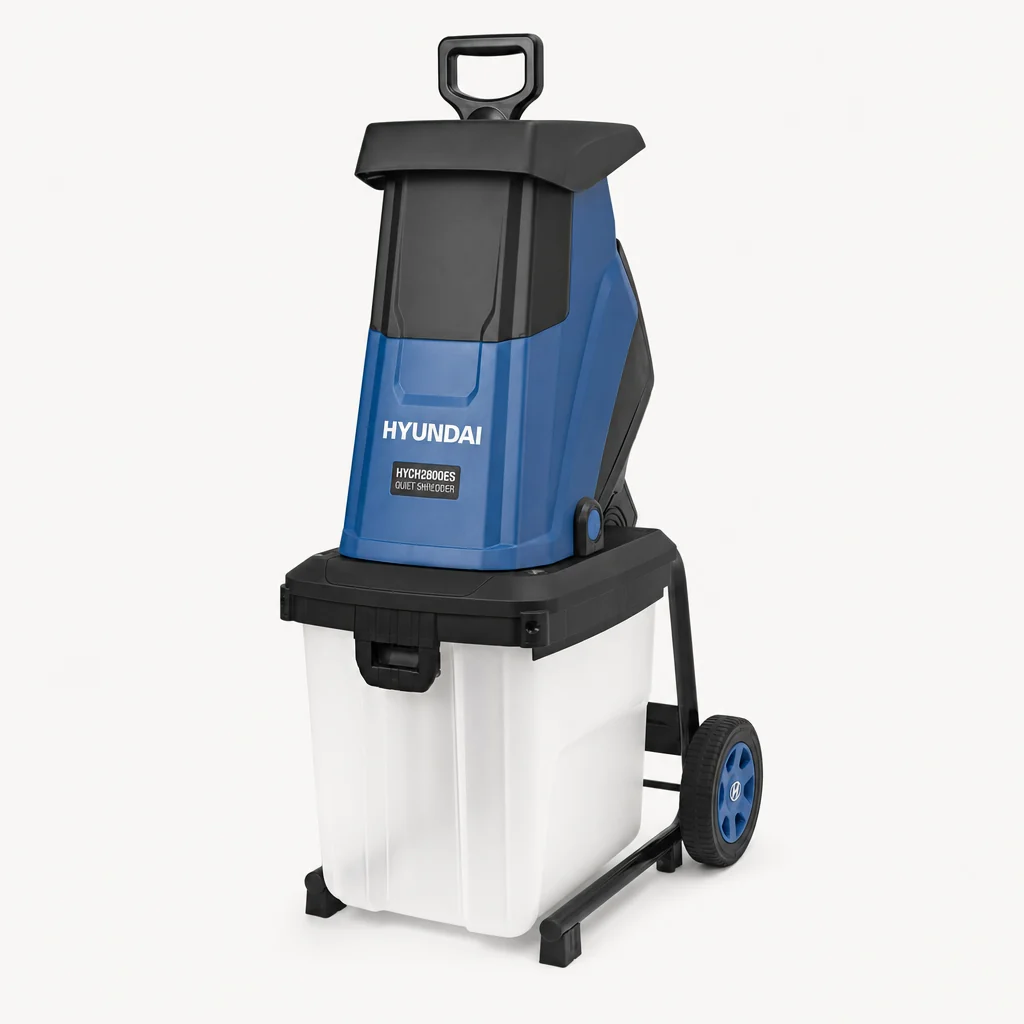
If the Bosch is the established favourite, the Hyundai HYCH2800ES is the model making people do a double take. It's a 2800W (2.8kW) quiet electric shredder built around a slow-turning roller mechanism, and the spec sheet reads almost suspiciously well for the money.
That motor turns at just 60 rpm, which is the secret behind its "super quiet" billing — slow rotation means crushing rather than violent chopping, and far less of that ear-splitting impact whine. There's a generous 10-metre power cable, which spares you the immediate hunt for an extension lead, and a 60-litre collector that's actually larger than the Bosch's box. Maximum branch diameter is a healthy 4.4cm (44mm), right at the top of what electric machines manage.
What impressed me most, though, were the real-world reports. This is a machine people have run for eight hours a day without problems — powerful, efficient, and coping well with thicker branches with no jamming. That's a serious endorsement of durability for an electric shredder at this price point, and it puts the Hyundai squarely in "best value" territory rather than merely "cheap".
60 rpm Roller
The slow-turning crush mechanism is the source of its quiet running and reduces the chance of jamming on awkward stems.
10-Metre Cable
A long built-in lead means you can often reach the working area without scrabbling for an extension reel.
60-Litre Collector
Fewer trips to empty the box and a tidier work area while you shred.
Long-Run Stamina
Owner reports of eight-hour days without issues suggest it can handle a serious garden clear-out, not just a quick tidy.
Stepping Up to Petrol: When Electric Just Isn't Enough
There comes a point — usually defined by branch thickness, plot size or sheer volume — where electric simply runs out of road. If you're managing an orchard, a large rural garden, mature trees, or hedges measured in tens of metres rather than a few panels, petrol is where the serious work gets done.
The first thing to understand is that "petrol chipper" covers an enormous range, from compact 6HP machines you can wheel through a side gate to 14HP brutes that demand respect. The right one depends entirely on the diameter of wood you need to process and how much grunt you're prepared to manhandle.
Forest Master FM6DD — The Compact 6HP Workhorse
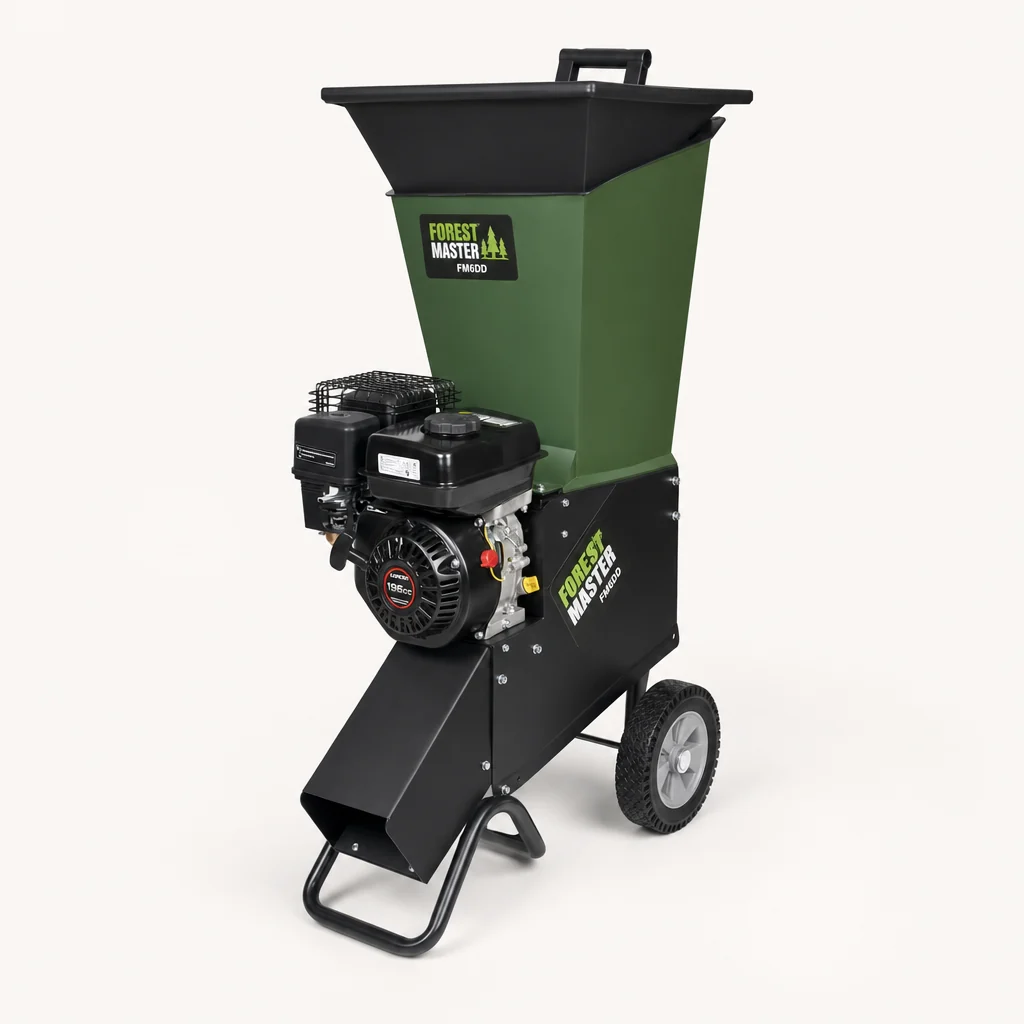
The FM6DD is, for many domestic gardens, the sweet spot where petrol power meets a manageable footprint. It's built around a four-stroke LCT Maxx petrol engine capable of 3600rpm, producing 6HP from its 208cc displacement, and at 38kg it's heavy enough to feel planted while you work but light enough to move about a typical garden.
It handles branches up to 50mm in diameter — and importantly, owners confirm it actually manages that figure rather than choking on it. The clever bit is the direct-drive design: there are no belts to slip, snap or replace, which simplifies maintenance and improves reliability. Dual reversible blades double the cutting life before you need to think about sharpening or replacing, and a rotatable hopper helps you position the feed conveniently.
What Owners Say
One customer writing in November 2025 summed up the appeal nicely: "this is our third make... won't need to buy another. It works and does what it says." They use it mainly on holly hedges, and report it works happily with privet, hawthorn and beech too — exactly the mixed woody diet a petrol chipper is built for.
On noise, it's not as bad as you might fear from a petrol engine — owners describe it as not as noisy as expected — but ear defenders are still firmly recommended. This is not a machine you run at 8am on a Sunday without ringing the neighbours first.
STIHL GH 460 — The Versatile Twin-Chamber Specialist
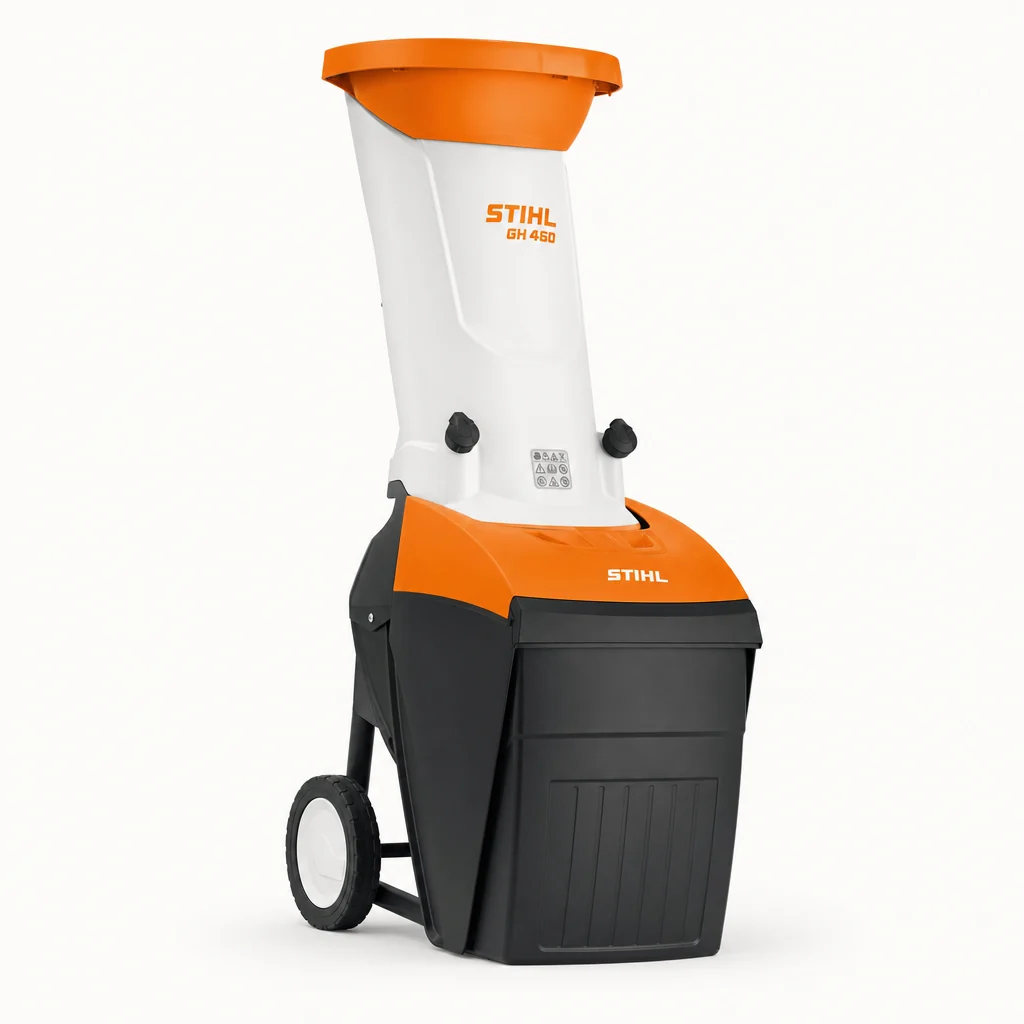
STIHL's GH 460 is a more sophisticated beast, and it solves the single biggest weakness of most shredders: the awkward mix of soft green waste and tough woody material that a typical machine handles only one of well.
It does this with a twin-chamber system. There are separate inlets, each optimised for a different job — one for soft green waste, one for woody material up to 60mm in diameter. That means you're not constantly stopping to swap your approach; you simply feed the right stuff into the right chute. At its heart is a Briggs & Stratton Series 850 EXi OHV RS engine driving a sandwich-type Multi-Cut 450 blade unit, and the whole thing rides on a wide chassis with pneumatic tyres so it'll trundle across a lawn or rough ground without sinking.
STIHL has also paid attention to the experience of using it: the feed chute is sound-insulated and wide, which both tames the racket a touch and makes loading easier. In practice, the throughput and versatility here are simply beyond what smaller electric units can match — it chews through mixed garden waste quickly, which is exactly what you want when the alternative is a long afternoon. It's backed by a 1-year professional or 2-year domestic warranty depending on use.
Forest Master FM14DDES — Going Properly Heavy-Duty
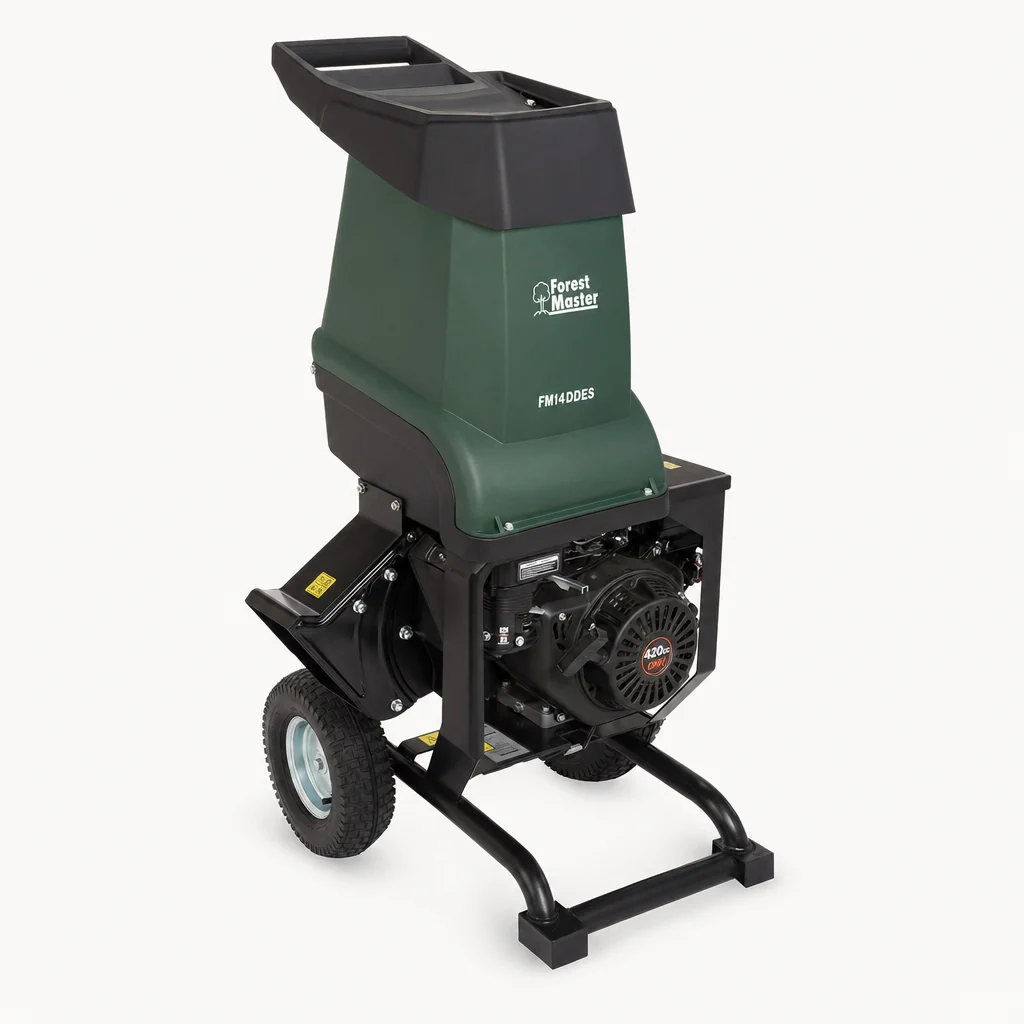
At the top of the domestic-to-light-professional ladder sits the FM14DDES. This is built around an LCT Maxx 460cc four-stroke engine producing 14HP, and it'll take branches up to a genuine 100mm — that's a full 4 inches of solid wood. We're well into "small fallen tree" territory now.
Sensibly for a machine of this calibre, it offers both electric and pull-start options, so you're not wrestling a recoil cord on a cold morning if you don't want to. Like its smaller sibling it uses direct drive — no belts to replace — which keeps maintenance time down and, the manufacturer notes, increases the machine's lifespan. If you've got mature trees coming down, large hedges to maintain, or you simply never want to be limited by branch size again, this is the kind of machine that turns a skip-hire job into an afternoon's mulching.
How They Stack Up Side by Side
Numbers tell the clearest story when they're lined up next to each other. Here's how a leading quiet electric model, a value electric pick and a compact petrol chipper compare across the figures that matter day to day.
| Feature | Bosch AXT 25 TC (Electric) | Hyundai HYCH2800ES (Electric) | Forest Master FM6DD (Petrol) |
|---|---|---|---|
| Power Source | Mains electric (turbine) | Mains electric (60 rpm roller) | 208cc petrol, 6HP |
| Max Branch Diameter | 38–45mm | 44mm | 50mm |
| Quoted Throughput | 230 kg/hr | Up to 2800 watts | — |
| Collection / Box | 53 L (stores in hopper) | 60 L collector | Rotatable hopper |
| Weight | 31 kg | 24 kg | 38 kg |
| Cable / Mobility | Mains-tethered | 10 m cable | Cordless — roams free |
| Noise Level | Quietest electric available | Super quiet (60 rpm) | Ear defenders advised |
| Drive Type | Turbine/roller | Roller | Direct drive (no belts) |
| Best For | Woody prunings, quiet operation | Long sessions, value | Thicker branches, no socket nearby |
Notice how close the electric models sit on branch diameter (44–45mm) and how the petrol FM6DD only pulls modestly ahead at 50mm. The real petrol advantage isn't a few extra millimetres on a compact machine — it's freedom from the cable and the ability to step up to 60mm, 100mm models when your trees demand it.
Real-World Performance: What the Numbers Feel Like
Specs on a page only get you so far. What actually separates these machines is how they behave under load — and there are three performance dimensions worth visualising: branch capacity, ease of feeding, and how quietly they let you work.
Here's how the field compares on maximum branch diameter, scaled against the heavy-duty 100mm benchmark of the FM14DDES so you can see just how much headroom each machine has:
That visual makes the hierarchy obvious. The three lighter machines cluster tightly between 44mm and 50mm — practically interchangeable on the thickest stem they'll accept. The STIHL stretches that to 60mm, and the FM14DDES exists in a different league entirely. If your reality is hedge clippings and the odd thick stem, the cluster of smaller machines covers you. If it's genuine tree work, you need to be reaching for the right-hand end of that chart.
The other thing the bars can't show is feel. The Bosch's turbine and the Hyundai's 60 rpm roller draw material in slowly and deliberately — you load a branch, let go, and the machine does the pulling. That's relaxing and safe, but it sets a pace; you can't rush it. The petrol machines, with their spinning flywheels and direct-drive torque, work faster but demand more attention and more respect. Neither is "better" — they're suited to different temperaments and different sized jobs.
Noise: The Factor That Decides How Often You'll Actually Use It
I want to dwell on noise for a moment, because it's the spec people under-weight at the point of purchase and then obsess over for the rest of the machine's life. A shredder you dread switching on because of the racket is a shredder that stays in the shed while your prunings pile up.
This is precisely where the quiet electric models earn their keep. The Bosch AXT 25 TC's reputation as the quietest of all the electric shredders, running at conversation-level volume even with major branches going through, transforms it from a "weekend only, warn the neighbours" tool into something you can pick up on a quiet weekday evening. The Hyundai's 60 rpm roller delivers similar "super quiet" running for the same reason — slow rotation simply doesn't generate the violent impact noise of fast-spinning blades.
Petrol is the trade-off. Even the relatively restrained FM6DD, described by owners as not as noisy as expected, still warrants ear defenders, and the STIHL's sound-insulated chute is a deliberate acknowledgement that noise is the price of petrol throughput. If you live cheek by jowl with neighbours, that's a genuine consideration — not just for your eardrums but for your relationships.
Pro Tip: Think About When You'll Shred
If your only realistic window for garden jobs is early mornings or evenings — around work, around children's bedtimes, around neighbours' patios in summer — a quiet electric model isn't a luxury, it's the difference between a machine you use and a machine that gathers dust. Buy for the time slot you actually have, not the one you wish you had.
Pricing the Petrol Options
Petrol machines sit at a higher price tier than their electric counterparts, reflecting their engines and capacity. Here's how the Forest Master petrol range positions itself for UK buyers, so you can see where the compact-to-heavy-duty steps land.
FM4DDE (Electric Version)
Inc VAT — the electric entry point to the range
FM6DD (6HP Petrol)
Promotional price (£432 RRP) — compact petrol sweet spot
FM6DD-MUL (Mulcher)
Inc VAT — the mulcher version, new to the range in 2021
On the electric side, value is the headline story: the Hyundai HYCH2800ES has been seen at £139.99, a remarkably low entry price for a quiet 2800W roller shredder with the durability owners report. That gulf between the electric and petrol tiers is itself a useful decision tool — if a sub-£150 electric machine genuinely covers your garden's needs, the petrol premium only makes sense once branch diameter or plot size forces the issue.
Promotional prices come and go, so treat these as a guide to the relative steps between models rather than a guaranteed checkout figure. The pattern that holds is the one worth remembering: compact petrol roughly matches mid-range electric on price, with heavier petrol machines climbing steeply from there.
Who Should Buy What
Cutting through all the specs, most gardeners fall into one of a handful of clear camps. Find yours below.
The Suburban Gardener
Modest plot, close neighbours, mostly woody hedge and shrub prunings. The quiet Bosch AXT 25 TC is made for you — beautiful mulch, conversation-level noise.
The Value Hunter
You want capability without overspending. The Hyundai HYCH2800ES delivers quiet 2800W power, a 10m cable and proven long-run stamina at a standout price.
The Rural Property Owner
Long plot, no socket nearby, thicker branches. The cordless Forest Master FM6DD roams free and handles 50mm wood with belt-free reliability.
The Mixed-Waste Maximiser
You generate both soft green growth and tough woody stems. The STIHL GH 460's twin-chamber system handles both without compromise.
The Smallholder
Mature trees, large hedges, serious volume. The 14HP FM14DDES eats 100mm branches and turns skip-hire jobs into afternoon mulching.
The Compost Obsessive
If feeding the heap is the whole point, prioritise a fine output — the Bosch turbine's crushed mulch breaks down beautifully on a compost pile.
Getting the Best From Your Shredder
Whichever machine you land on, a few habits make the difference between joyful mulching and a frustrating, jam-prone afternoon. These apply across both electric and petrol.
Shred Fresh, Not Stockpiled
Green wood feeds and cuts more easily than wood that's dried hard. Shred prunings soon after cutting rather than letting them seize up in a heap for months.
Alternate Woody and Soft
On single-chamber machines, feeding a leafy handful followed by a stick helps clear the chamber and reduces sappy clogging.
Use Both Blade Edges
On machines with reversible blades like the FM6DD, flip them when cutting dulls — you effectively double your blade life before sharpening or replacing.
Protect Yourself
Ear defenders for petrol, sturdy gloves and eye protection for everything. Never reach into a feed chute — use a branch to push material through.
Keep Petrol Engines Happy
Direct-drive designs spare you belt changes, but four-stroke engines still need clean fuel and regular oil checks. A few minutes of care prevents most starting woes.
Overall Rating
Garden shredders as a category are one of the most genuinely useful investments a gardener can make — but the right choice is so dependent on your circumstances that no single machine scores a perfect ten for everyone. Here's how the category rates across the factors that matter, weighing the strengths of the best electric and petrol options together.
Frequently Asked Questions
The Verdict
There's no single winner here, and anyone who tells you otherwise hasn't thought about your garden. The decision splits cleanly along two questions: how thick is your wood, and how far is your nearest socket?
For the majority of suburban gardeners dealing with hedge and shrub prunings near the house, a quiet electric shredder is the smart buy. The Bosch AXT 25 TC remains the benchmark for woody material and whisper-quiet running — just don't ask it to swallow soft green waste. If value is your watchword, the Hyundai HYCH2800ES is the standout: quiet 2800W power, a long 10-metre cable, a roomy 60-litre collector and the kind of long-run durability owners genuinely vouch for, all at a price that's hard to argue with.
Once branch diameter or plot size forces your hand, petrol takes over. The cordless Forest Master FM6DD is the compact sweet spot for thicker wood and far-flung corners; the twin-chamber STIHL GH 460 is the answer when you've got a relentless mix of green and woody waste; and the FM14DDES exists for those rare, glorious days when you simply refuse to be beaten by a branch.
Buy the machine that matches your waste, your acreage and your tolerance for noise — and you'll wonder how you ever put up with those endless trips to the tip.