
Choosing a Garden Vacuum for Leaves, Gravel and Gutters
Dedicated garden vacs and mulching models for the jobs a blower simply can't do well — leaf-strewn borders, gravel drives and clogged gutters included.
There comes a point every autumn where the leaf blower on the shed wall stops being the hero and starts being the problem. You've herded the leaves into a tidy pile, a gust arrives, and suddenly you're chasing them across next door's lawn like a man possessed. That's the moment a proper garden vacuum starts to make sense — because collecting, shredding and bagging debris is a fundamentally different job to shoving it around, and the tools that do it well are built around suction and a mulching impeller rather than raw air speed.
I've spent a good deal of time with the current crop of blower-vac-mulchers, from cheap-and-cheerful corded units through to serious 40V cordless machines and gas-powered handhelds that'll happily run all afternoon. In this guide I want to cut through the marketing and talk about what actually matters when you're picking one: mulch ratios, CFM, bag capacity, weight on your shoulder, and — crucially — which of these jobs (leaves, gravel, gutters) each machine is genuinely suited to. Because they are not all the same, and buying the wrong type is an expensive way to learn that lesson.
Why a Garden Vacuum, Not Just a Blower?
Let's be honest about the elephant in the utility room: most people already own a blower, and many of them do a "vacuum mode" too. So why bother reading a whole article about garden vacs? Because the collect-and-mulch side of the job is where the real value hides, and it's the part cheaper multi-function tools tend to skimp on.
A blower moves air. That's its entire personality. It's brilliant for clearing a patio, blasting debris off a driveway, or corralling leaves into a heap. But the moment you want those leaves gone rather than merely relocated, you need suction and an impeller — the spinning blade that draws material in, chops it up, and reduces its volume dramatically before it lands in the bag. This is the "mulching ratio" you'll see quoted everywhere, and it's the single most useful headline spec on any of these machines.
What "mulching ratio" actually means
A 16:1 mulch ratio means the machine grinds roughly 16 bags of loose leaves down into a single bag of shredded material. A higher ratio (18:1 on the WORX WG509, for example) means fewer trips to empty the bag and a finer mulch that composts faster or spreads neatly onto borders. It's the number I'd weigh most heavily if your main enemy is leaves.
The knock-on benefit is that shredded leaves are genuinely useful. Run them through a decent impeller and you've got instant leaf mould for the compost heap, or a fine mulch to tuck around your shrubs over winter. A blower gives you a soggy pile to bin; a vacuum-mulcher gives you free garden material. Once you've experienced that, it's hard to go back.
The Key Specifications, Decoded
Before we get into individual machines, here's a quick tour of the numbers on the box — and how much you should actually care about each one.
The most common mistake I see is buyers fixating on MPH — miles per hour of air speed — because it sounds impressive. For blowing, air speed helps punch through wet, matted leaves. But for vacuuming, it's air volume (CFM, cubic feet per minute) that draws material up the tube and keeps it moving. A machine with 470 CFM will hoover up a dense pile far more happily than one with a screaming 250 MPH figure and modest volume.
CFM: the suction league table
Across the machines I'd steer you towards, the airflow figures tell a clear story. The gas-powered Husqvarna 125BVX pushes 470 CFM — the strongest of the traditional handhelds. The BLACK+DECKER BV6000 delivers a solid 400 CFM, on par with other capable electric handhelds. The WORX WG509 TRIVAC sits at 350 CFM, and the cordless WORX WG583 manages 410 CFM in blow mode. But the standout on paper is the AIVOLT 40V cordless, quoting a genuinely professional-grade 600 CFM of suction.
These CFM figures come from each manufacturer's own quoted specifications. In real-world use, factors like tube design, how wet the debris is, and how full the bag is will all shave off effective performance — so treat them as a ranking guide rather than gospel.
Corded Electric: The Sensible Starting Point
For a lot of gardens — anything up to a modest suburban plot with a power socket in reach — a corded electric blower-vac is the pragmatic choice. No fuel, no battery to charge or degrade, no petrol engine to service, and generally the lowest running cost of the lot. The cord is the obvious limitation, but if your leaf-fall is concentrated near the house, it rarely bites.
WORX WG509 TRIVAC
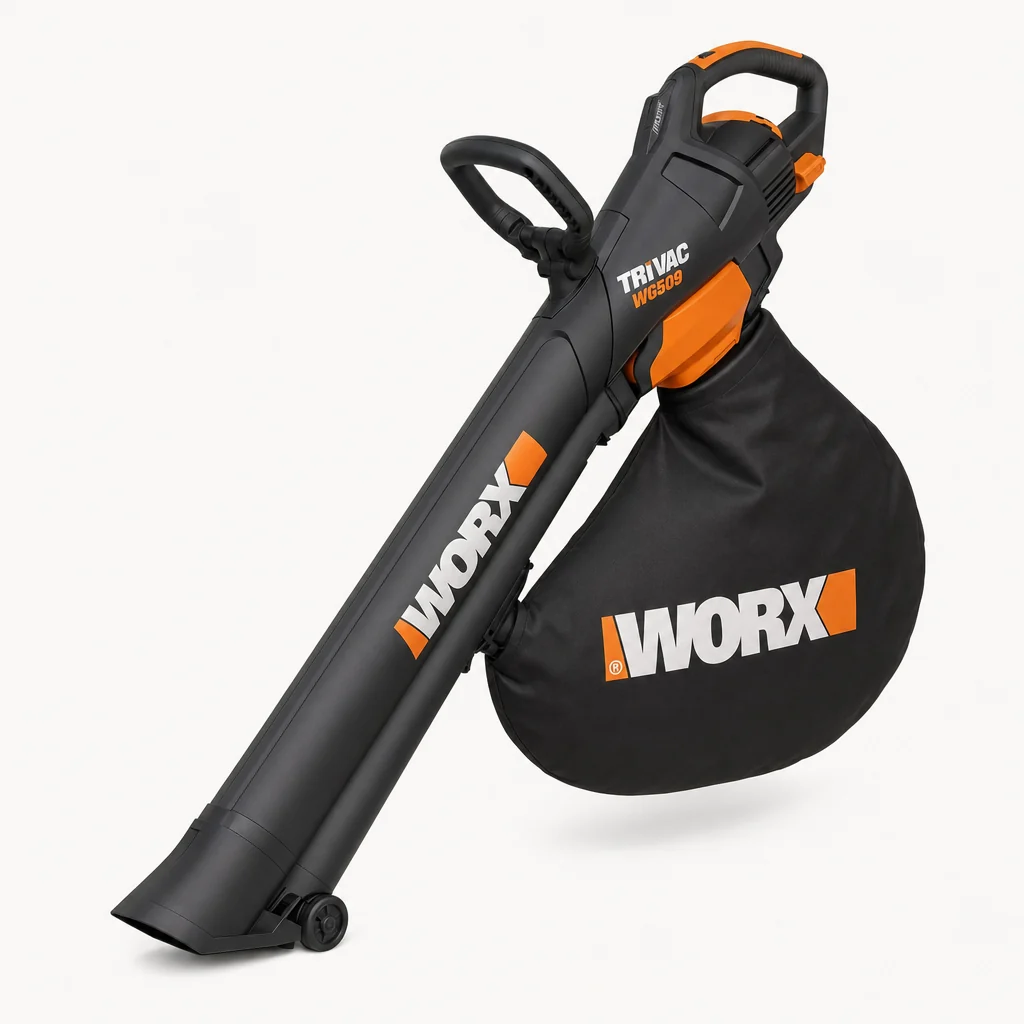
The WG509 is the machine I most often recommend to first-timers who want proper mulching without spending a fortune. Its 12A motor spins up to a brisk 15,000 RPM no-load, and the headline here is that dual-stage metal impeller delivering an 18:1 mulch ratio — the highest in this entire round-up. That means finer mulch and fewer emptying trips, which genuinely changes how a big leaf clearance feels.
What I like about the TRIVAC is the variable speed dial on the left of the handle. Being able to dial the power down means you can vacuum around delicate planting or lift lighter debris without flinging gravel everywhere, then wind it back up for a dense pile of wet leaves. The three-year warranty and 30-day money-back guarantee are also reassuringly generous for a tool at this level.
Pros
- Best-in-class 18:1 mulch ratio for finer mulch and fewer bag trips
- Durable dual-stage metal impeller rather than plastic
- Variable speed control adds real everyday versatility
- Excellent 3-year warranty plus money-back guarantee
Cons
- Lowest CFM of the group at 350 — tackles piles more slowly
- Corded, so range is limited to your extension lead
- 1.2-bushel bag is on the smaller side for big gardens
BLACK+DECKER BV6000
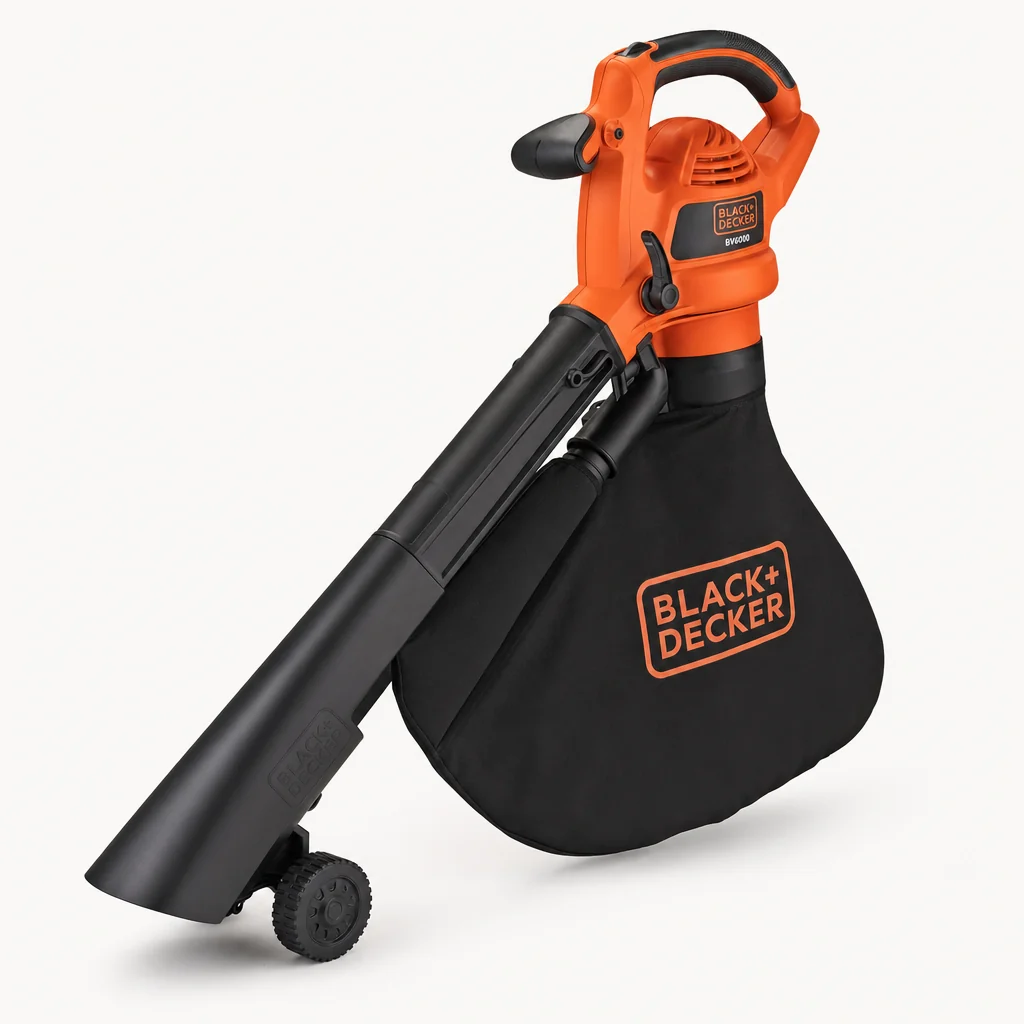
If the WORX is the mulching specialist, the BV6000 is the all-rounder. Its 12 Amp motor produces 400 CFM at a punchy 250 MPH — the fastest air speed here, which helps enormously when you're switching to blow mode to shift stubborn wet leaves before vacuuming. The metal fan grinds at a 16:1 mulching ratio, taking up to 16 bags of debris down to one.
Two things stand out in day-to-day use. First, at 8.1 lbs it's the lightest machine in this comparison, which your shoulder will thank you for after twenty minutes. Second, that quoted 68 dBA noise level makes it one of the more neighbour-friendly options — meaningfully quieter than any petrol machine, and enough to stay on the right side of a Sunday-morning grumble. The 1.5-bushel, 14-gallon bag is also the largest of the corded pair here, and the two-speed selector covers both gentle and full-power work.
Pro tip for corded machines
Always loop your extension lead through the cord-retention hook (or tie a simple loose knot at the plug junction) before you start. It stops the connector yanking apart mid-job when you stretch to the far border — a small habit that saves a lot of muttering.
Terratek Corded Blower & Garden Vacuum
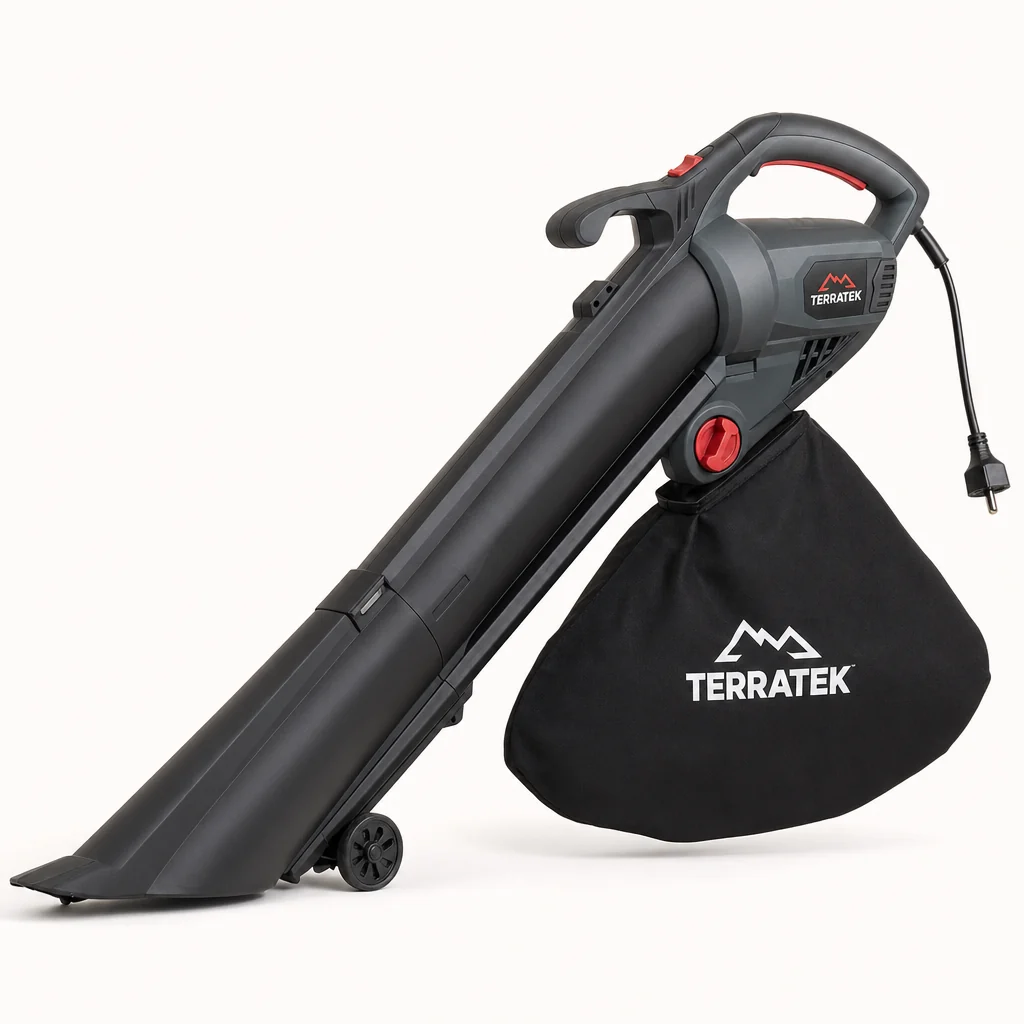
At the budget end sits the Terratek, and it's a genuinely tempting entry point at £39.99. It won't out-mulch the WORX or out-blow the BLACK+DECKER, but it covers the fundamentals sensibly: a large switch lets you flip between blower and vacuum modes in seconds, there's a 35-litre collection bag, and it ships with rolling wheels and a shoulder strap to take the weight off. A thermal cut-out safety feature guards the motor against overload, and it's backed by a 2-year guarantee.
Quick mode switching
A single large switch flips between blowing and vacuuming in seconds — no tool changes or fiddly conversions.
Thermal cut-out
Automatic overload protection shuts the motor down before it cooks itself if you jam the tube.
Wheels and strap included
Rolling wheels and a shoulder strap come in the box to reduce fatigue over longer sessions.
For someone with a small garden and a modest annual leaf problem, the Terratek is a lot of function for very little money. Just go in with realistic expectations: this is a light-duty tool, and I wouldn't ask it to swallow heavy gravel or spend all day on a large plot.
Cordless 40V: Freedom, at a Price
Cutting the cord is liberating. There's no lead to snag on a rose bush, no socket to find, and modern brushless motors have narrowed the power gap dramatically. The trade-off is runtime and battery cost — and on some of these machines, that trade-off is sharper than the marketing suggests.
WORX WG583 40V Cordless Blower Vac Mulcher
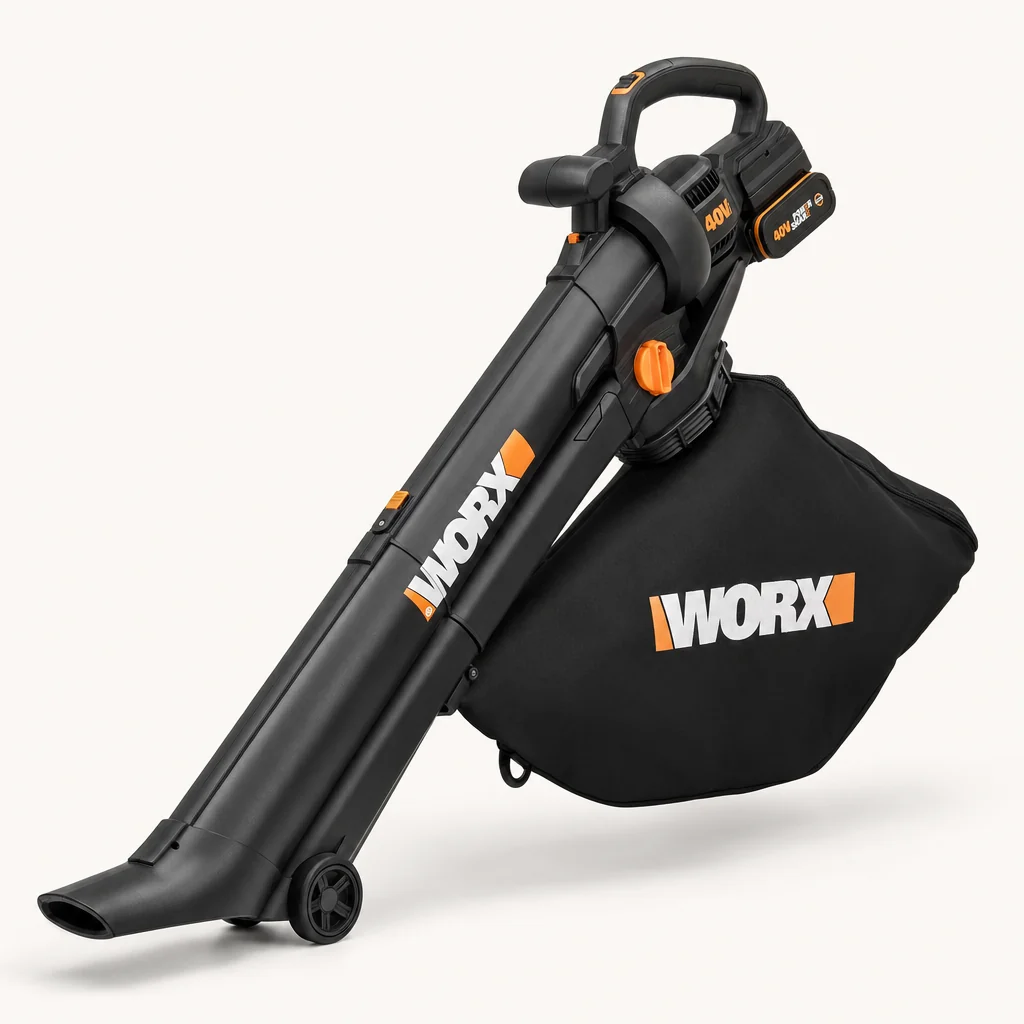
The WG583 runs a high-efficiency brushless motor fed by two 4.0Ah Power Share batteries, pushing up to 410 CFM of max air volume. Its 2-stage impeller delivers a 12:1 mulch ratio into a 35-litre collection bag, and there's a two-speed control to balance power against battery drain.
Here's where I have to be straight with you. The WG583's headline weakness is runtime: you'll get around 15 minutes of work before the batteries need recharging. That's fine for a quick tidy of a small garden, but it isn't going to clear a leaf-heavy plot in one go. The saving grace is that the 4A dual-charger tops up both 4.0Ah batteries in just 2 hours — so if you buy a second pair, you can realistically rotate and keep working. The Power Share ecosystem is also a genuine plus if you already own other WORX 20V/40V tools, since the batteries interchange.
Pros
- Brushless motor with a healthy 410 CFM output
- Completely cordless — no lead to manage
- Fast dual-charging: both batteries in ~2 hours
- Power Share batteries work across the wider WORX range
Cons
- Only ~15 minutes runtime before a recharge is needed
- Lower 12:1 mulch ratio than the WORX corded model
- Real all-day use effectively requires spare batteries
AIVOLT 40V Cordless Leaf Vacuum
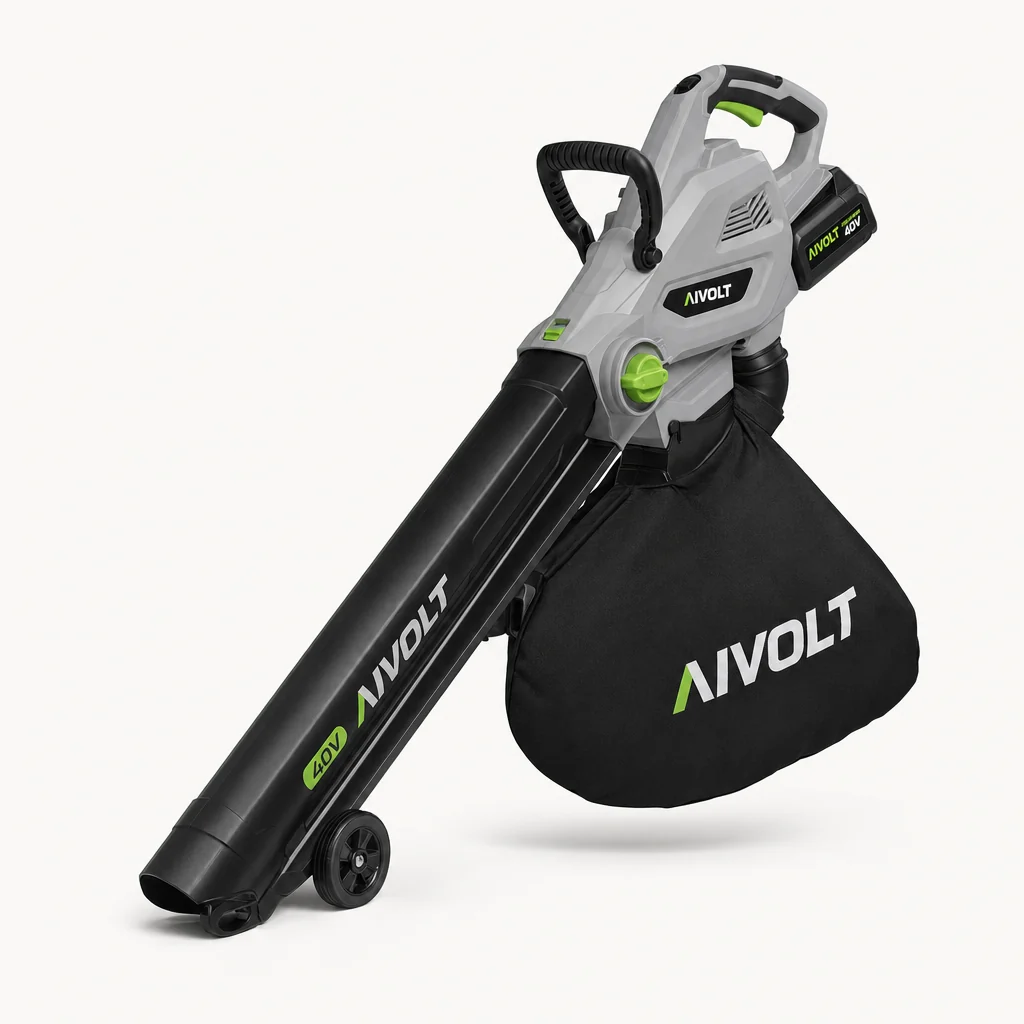
If the WG583 shows the limits of cordless, the AIVOLT shows the potential. This is the machine that genuinely surprised me. A brushless motor drives a claimed 600 CFM of suction — professional-grade, and the highest figure in this entire guide — with a 15:1 mulching ratio feeding a large 40-litre collection bag that has a bottom zip for quick dumping. Powered by dual 4.0Ah batteries, it delivers over 45 minutes of continuous vacuuming on a single charge.
The combination of that 600 CFM suction and a 45-minute-plus runtime is what sets it apart — it handled dense leaf piles and even damp debris with ease, outperforming a number of corded models I've used. That damp-debris capability is the real tell. Wet leaves are where cheaper vacuums choke, and a machine that swallows them without complaint is worth its weight. The bottom-zip bag is a small touch that makes a big difference too: no wrestling a heavy full bag off the tube, just unzip the base over your compost heap and let it fall out.
The AIVOLT is designed to be flexible — it's light enough to carry behind a zero-turn mower or to use entirely independently on foot, and the shoulder strap adds real comfort during extended clearing sessions.
Gas-Powered: The Long-Haul Workhorses
When you've got a large plot, a lot of trees, and no interest in babysitting battery levels, petrol still makes sense. There's no runtime anxiety — refuel and keep going — and the raw grunt is reassuring. The costs are noise, weight, emissions, fuel mixing, and the ongoing maintenance a two-stroke engine demands. For some gardens, that's a fair trade; for most suburban plots, it's overkill.
Husqvarna 125BVX
The 125BVX is the classic handheld petrol blower-vac, and it's a properly capable machine. Its 2-stroke 28-cc engine produces 1.1 HP running on a 50:1 fuel-to-oil mixture, and it moves the most air of any handheld here at 470 CFM, with 170 MPH air speed and 12.5 N of blowing force. The 16:1 mulching ratio matches the best of the electric field, and it comes with both a flare nozzle and a Vac-Kit for switching to vacuuming and mulching duty.
The features that make it pleasant to live with are the Smart Start system — a stop switch that automatically resets to the "on" position so you don't fluff the next start — and the variable-speed throttle with cruise control, which lets you lock in a comfortable power level so you're not squeezing a trigger for an hour. At 9.6 lbs dry it's the heaviest handheld here, but that heft comes with the reassurance of a machine you'll rarely, if ever, have to worry about outrunning.
Craftsman BV245
The Craftsman BV245 is cut from similar cloth: a 27cc, 2-cycle gas engine producing 450 CFM at 205 MPH — so it trades a little air volume for noticeably higher air speed compared to the Husqvarna, which helps when blowing wet, stuck-down leaves. Debris collects in a generous 1.5-bushel bag, and there's a variable-speed throttle control for fine-tuning power.
Easy Start technology
A simple 3-step starting routine — prime, choke, pull — takes the frustration out of firing up a two-stroke on a cold morning.
Variable-speed throttle
Dial the power up for dense piles or down for delicate work around planting and gravel edges.
1.5-bushel bag
A large collection bag means fewer interruptions to empty during a big autumn clearance.
Both petrol machines carry practical warranties — the Craftsman with a 2-year limited warranty — and both will comfortably outlast a cordless machine's battery pack over the years. If your priority is uninterrupted running on a big plot, either is a sound choice; the Husqvarna edges ahead on air volume and refinement, the Craftsman on outright air speed and its foolproof starting drill.
Head-to-Head Comparison
Here's the whole field laid out side by side, so you can weigh the trade-offs at a glance. I've grouped by the spec that most people end up deciding on.
| Model | Type | Airflow | Mulch Ratio | Bag | Notable |
|---|---|---|---|---|---|
| WORX WG509 TRIVAC | Corded | 350 CFM / 210 MPH | 18:1 | 1.2 bushels | Best mulch ratio; 3-yr warranty |
| BLACK+DECKER BV6000 | Corded | 400 CFM / 250 MPH | 16:1 | 1.5 bushels | Lightest (8.1 lbs); 68 dBA |
| Terratek Corded | Corded | — | — | 35 L | Budget; wheels + strap included |
| WORX WG583 40V | Cordless | 410 CFM | 12:1 | 35 L | ~15 min runtime; 2-hr charge |
| AIVOLT 40V | Cordless | 600 CFM | 15:1 | 40 L | 45+ min runtime; damp-debris capable |
| Husqvarna 125BVX | Gas | 470 CFM / 170 MPH | 16:1 | — | Most air volume; cruise control |
| Craftsman BV245 | Gas | 450 CFM / 205 MPH | — | 1.5 bushels | Easy 3-step start; 2-yr warranty |
Reading that table, a few patterns jump out. The AIVOLT's 600 CFM is genuinely exceptional for a cordless machine. The WORX WG509's 18:1 mulch ratio is the leaf-hoarder's dream. The BLACK+DECKER wins on the combination of light weight and low noise. And the two petrol machines sit where you'd expect — high, sustained output, at the cost of weight and refinement.
Matching the Machine to the Job
This is where the editorial rubber meets the road, because "leaves, gravel and gutters" are three very different challenges — and no single machine is best at all three.
Leaves
This is what these machines are born to do, and almost any of them will handle dry leaves well. Where they separate is on volume and wet leaves. For big, dry falls, prioritise a high mulch ratio (the WORX WG509's 18:1) and a large bag. For soggy, matted autumn leaves, you want raw suction — the AIVOLT's 600 CFM or the Husqvarna's 470 CFM — plus a healthy air speed to help lift the mat before it clogs the tube.
Gravel
A crucial word of caution: garden vacuums are designed for light organic debris — leaves, grass clippings, twigs. Deliberately vacuuming gravel is asking for trouble, because stones can chip or crack an impeller (particularly plastic ones) and clog the tube. Where a vacuum earns its keep on a gravel drive is in removing the leaves that settle amongst the gravel without scattering the stones everywhere.
For that job, variable speed is your best friend. Dial the power down — as you can on the WORX WG509, the Craftsman BV245 or the Husqvarna's cruise control — so the suction lifts the leaves whilst leaving the heavier gravel in place. A metal impeller (as fitted to the WG509 and the BV6000) also gives you a little more peace of mind against the odd small stone that inevitably finds its way in. On a gravel drive, I'd honestly reach for blow mode first to clear the loose leaves off the surface, then vacuum only what's stubbornly lodged.
Gutters
Gutters are the awkward third job. The debris — decomposing leaves, moss, grit — is exactly what these mulchers are designed to swallow, but reaching it safely is the challenge. This is where the lightest machines shine: the 8.1 lb BLACK+DECKER BV6000 is far more manageable at height on a ladder than a 9.6 lb petrol unit. Air speed also helps here — the BV6000's 250 MPH in blow mode can dislodge packed gutter debris, which you then collect below.
Safety first on gutters
Never overreach from a ladder whilst holding a running blower-vac — the reactive force and weight combined are a genuine fall risk. Move the ladder often, keep three points of contact, and consider a cordless machine (no cord to snag on the way down) with the lightest weight you can find. If your gutters are high or your roof steep, a dedicated gutter-cleaning attachment or a professional is the wiser call.
How I'd Rate the Field Overall
Weighing versatility, mulching performance, real-world runtime, weight, and how well each machine copes with the trickier jobs, here's my summary scorecard for the category as a whole. Bear in mind these are relative to one another within this specific group.
The reason the category scores well overall is that, unlike a plain blower, these machines genuinely reduce your workload — turning bags of leaves into a fraction of the volume, and giving you usable mulch as a byproduct. The points come off for the runtime compromises on the cheaper cordless models and the noise-and-maintenance burden of petrol.
Who Should Buy What
Rather than crown a single winner, let me match machines to the kind of gardener you are — because the "best" garden vacuum is entirely a function of your plot, your leaf load and your tolerance for cords, batteries and two-stroke fuel.
The small-garden tidier
Modest plot, socket nearby, occasional leaf clearance. The Terratek at £39.99 covers the basics, or step up to the BLACK+DECKER BV6000 for lighter weight, lower noise and a bigger bag.
The leaf-mould maker
You compost and want fine mulch. The WORX WG509 TRIVAC's 18:1 ratio and metal impeller produce the finest shred here, straight into the heap.
The cord-hater
You want freedom without petrol. The AIVOLT 40V's 600 CFM and 45+ minute runtime make it the standout cordless machine for serious clearing.
The big-plot workhorse
Lots of trees, no time for recharging. The Husqvarna 125BVX (470 CFM) or Craftsman BV245 keep going all afternoon on a tank of fuel.
Frequently Asked Questions
The Verdict
Final Thoughts
A dedicated garden vacuum-mulcher is one of those tools that quietly changes how you feel about autumn. Instead of dreading the leaf-fall, you find yourself almost looking forward to reducing a whole lawn's worth of leaves into a couple of bags of useful mulch. That's the magic a plain blower can't replicate — and it's why these machines deserve a spot on the shed wall, not just an existing blower's "vac mode".
If I had to pick standouts: the WORX WG509 TRIVAC is my choice for anyone who mulches and composts, thanks to that class-leading 18:1 ratio, metal impeller and three-year warranty. The AIVOLT 40V is the cordless machine to beat, with a properly serious 600 CFM and 45-plus minutes of runtime that shrugs off even damp debris. The BLACK+DECKER BV6000 is the most well-rounded corded all-rounder — light at 8.1 lbs, quiet at 68 dBA, with a big 1.5-bushel bag. And for big plots that won't sit still, the Husqvarna 125BVX and Craftsman BV245 keep grinding as long as there's fuel in the tank.
Match the machine to your leaves, your plot size and your patience with cords or fuel, and you won't go far wrong. Just remember: leaves are the natural quarry, gutters demand caution and light weight, and gravel is best left mostly where it lies. Get that right, and your garden vacuum will earn its keep every single autumn.