
Choosing a Garden Hose and Reel That Won't Kink or Crack
Hose materials, fittings and wall-mounted reels built to last more than one summer — a hands-on guide to getting it right the first time.
There are few garden frustrations more reliably infuriating than wrestling a kinked hose. You've got the watering can mentally retired, the sprinkler set up, the borders gasping in July heat — and then, just as the flow gets going, the hose folds itself into a stubborn crimp twenty feet away and the water dribbles to nothing. You stomp back, flick the kink loose, and by the time you're back at the nozzle it's done exactly the same thing somewhere else. Sound familiar?
I've spent more summers than I care to admit replacing cheap hoses that cracked at the fittings, split along their seams after a single frost, or developed a "memory" so aggressive they coiled themselves back into a tangle the moment you let go. So this guide is the one I wish I'd had years ago. It's about choosing a hose and a reel that genuinely solve the kinking and cracking problem rather than just claiming to — and about understanding why some products survive a decade outdoors whilst others are landfill by August.
We'll cover hose materials in proper detail, the fittings that quietly make or break longevity, and — crucially — the wall-mounted reels that keep everything tidy, supported and out of the UV firing line. I'll be honest about the compromises too, because every option here has them.
Why Hoses Kink and Crack in the First Place
Before we get to recommendations, it's worth understanding the enemy. A hose kinks when its wall can't support its own bend radius — the tube collapses inward, pinches the bore shut, and water stops. Cheap hoses kink because their walls are thin, uneven, or made from a plastic with high "memory", meaning the material wants to hold whatever shape it was last forced into (usually a tight coil from the packaging).
Cracking is a separate failure mode, and it's almost always about material chemistry and UV exposure. Standard PVC garden hoses go brittle over time as plasticisers leach out and sunlight degrades the polymer chains. Add a British winter — water freezing inside a hose expands and stresses the wall — and you've got a recipe for splits, particularly near the brass or plastic fittings where the hose is clamped under tension.
The good news is that both problems are solvable. The materials that resist kinking (polyurethane, modern hybrids, woven-jacket designs) also tend to resist cracking, and a decent reel removes the storage abuse that finishes off the survivors. Get the trio right — material, fittings, storage — and a hose that "won't kink or crack" stops being a marketing slogan and becomes your actual reality.
Kink memory
The tendency of a hose to spring back into its coiled shape. Low-memory materials like polyurethane stay relaxed and lie flat, dramatically reducing mid-bend collapses.
Wall uniformity
A consistent, reinforced wall thickness means there are no weak points to flatten or split. Uneven extrusion is where most budget hoses fail.
UV stability
Sunlight is the silent killer. UV-stabilised housings and jackets resist fading and embrittlement, which is what keeps a hose flexible season after season.
Temperature tolerance
A wide working temperature range tells you the material won't go stiff in cold mornings or soften and balloon under summer heat and high pressure.
Hose Materials Compared: What Actually Survives
Let's get into the materials themselves, because this is where your money goes furthest or vanishes fastest. I've grouped the realistic options into four families, and they behave very differently.
Polyurethane — the kink-resistance champion
Polyurethane (PU) is the material I keep coming back to when someone asks for a hose that simply won't fold over. The ELEY Polyurethane Garden Hose is the clearest example of what good PU does: it's engineered with low kink memory and a reinforced, uniform wall thickness that prevents the flattening and weak points that doom cheaper hoses. In practical terms, it lies relaxed on the lawn rather than fighting you, and it stays kink-resistant even when bent or looped during normal use.
The numbers back up the feel. The ELEY PU hose carries a maximum working pressure of 150 PSI (10 bar) and an enormous temperature range of -40°F to 165°F (-40°C to 74°C). That cold-end figure is the bit that matters in Britain — a material rated to -40°C isn't going to go brittle on a frosty March morning. It uses a true 5/8-inch internal bore (0.625 in / 16 mm) with a 7/8-inch outside diameter (0.875 in / 22 mm), and standard ¾-inch Garden Hose Thread (GHT) fittings so it plays nicely with everything else in the shed.
One genuinely useful thing about the ELEY range is how cleanly the weights scale, which helps you match a length to your reel and your strength. A 25 ft length is 4 lb dry (7 lb full of water); 50 ft is 7 lb (14 lb filled); 75 ft is 11 lb (21 lb filled); 100 ft is 14 lb (27 lb filled); and at the top end the 200 ft length is 28 lb dry, ballooning to 54 lb once it's full of water. That last figure is a quiet reminder that very long hoses are heavy when charged — something your reel's mounting absolutely has to account for.
Hybrid hoses — the flexible all-rounder
Hybrid hoses blend polymers to get much of polyurethane's flexibility at a friendlier weight and price. The Giraffe Tools hybrid hose used in their retractable reels is a strong example: it's described as all-weather, flexible, abrasion-resistant and pressure-tested to 116 PSI working pressure with a 600 PSI burst rating. That burst-to-working ratio is healthy and tells you there's real safety margin in the wall — the kind of headroom that stops a hose ballooning and eventually splitting after years of pressure cycling.
Woven-jacket and semi-collapsible designs
The Teknor Apex Zero-G represents a different philosophy entirely: a semi-collapsible hose with a watertight inner tube wrapped in a tightly woven casing. Instead of a thick rubber wall, you get a tough fabric jacket that resists abrasion and lets the hose collapse flat when empty, making it light to carry and easy to store. The trade-off is that woven designs feel different in the hand and behave differently on a reel, but for sheer carry-weight they're hard to beat.
Expandable hoses — convenient, but know the limits
Expandable hoses like the Pocket Hose Silver Bullet (50+ feet extended) and the Flexi Hose (with its soft outer sheath and integrated valve) are the featherweight darlings of the category. They shrink to a fraction of their length when empty, which is wonderful for storage. They genuinely don't kink in the conventional sense because there's no rigid wall to fold. But I'll be candid: the inner latex tube is the weak point, expandables generally have shorter lifespans than PU or rubber, and they don't pair naturally with a crank reel. They're a niche delight, not a do-everything answer.
Heavy-duty rubber — the traditional workhorse
Don't write off rubber. The Briggs & Stratton Heavy-Duty Rubber hose (75 feet) is exactly what it says — durable rubber construction that shrugs off hot water, abrasion and rough handling. Rubber is heavy and it can take a set if stored badly, but a quality rubber hose on a good reel is arguably the most bombproof combination in the garden. It's the hose equivalent of a cast-iron pan.
| Material | Kink resistance | Crack/UV resistance | Weight | Best for |
|---|---|---|---|---|
| Polyurethane (ELEY) | Excellent — low memory | Excellent (-40°C rated) | Moderate | Everyday all-rounder, reel use |
| Hybrid (Giraffe) | Very good | Very good | Light–moderate | Retractable reels, general watering |
| Woven (Zero-G) | Good | Good | Very light | Carrying long distances |
| Expandable | Doesn't kink | Moderate | Featherweight | Balconies, small plots, easy storage |
| Rubber (Briggs & Stratton) | Good | Excellent | Heavy | Heavy-duty, hot water, longevity |
Pro Tip
If you're buying a hose to live on a reel, weight matters more than you think. A 200 ft hose can weigh 54 lb when filled with water — match the length to your actual reach, not to a "more is better" instinct. A 50 ft hose at 14 lb filled handles far more pleasantly day to day.
The Fittings: Where Cheap Hoses Quietly Die
Here's the part nobody puts on the front of the packaging. You can buy a beautifully engineered hose and still end up with a leaky, failing setup if the fittings are an afterthought. The connection between hose and tap, and hose and nozzle, is the highest-stress point in the entire system — it's clamped, it's bent, it's tightened and loosened constantly, and it's where corrosion starts.
This is where I'd steer you firmly towards brass over moulded plastic. The ELEY reel system uses lead-free brass components throughout, which is exactly what you want: brass threads don't cross-thread as easily as plastic, they seal better, and lead-free brass is the responsible choice for anything that might touch drinking-grade water. Cheap plastic fittings, by contrast, crack at the first hard frost or strip their threads after a season of being over-tightened.
Look for a "full-flow" swivel where the hose meets the reel. The ELEY 1041 uses a 5/8-inch inlet hose and a full-flow ¾-inch swivel, which keeps water volume up and lets the hose rotate freely instead of twisting itself into kinks at the connection point.
The other detail worth obsessing over is hardware corrosion. On the ELEY reels, every screw, nut and mounting fastener is high-grade stainless steel — the manufacturer's claim is that nothing on the reel will rust or corrode. That sounds like marketing until you've watched a budget reel's mounting bolts weep orange streaks down a rendered wall after one wet winter. Stainless hardware is the difference between a fixture you mount once and forget, and one you're re-drilling in three years.
Wall-Mounted Reels: The Storage That Saves Your Hose
A reel isn't just tidiness for tidiness' sake. Proper storage is genuinely a longevity feature. A hose left coiled on the ground sits in standing water, gets trodden on, bakes in UV, and takes a permanent "set" from being looped tightly. A wall-mounted reel lifts it off the ground, supports its bend radius, keeps it out of the worst sun, and — with the better designs — guides it on evenly so it never develops the tight crimps that become kinks.
There are two broad camps: manual crank reels and auto-retract reels. Both have a place, and the right choice depends on how much hose you're managing and how much faff you'll tolerate.
The manual crank champion: ELEY Wall Mount 1041
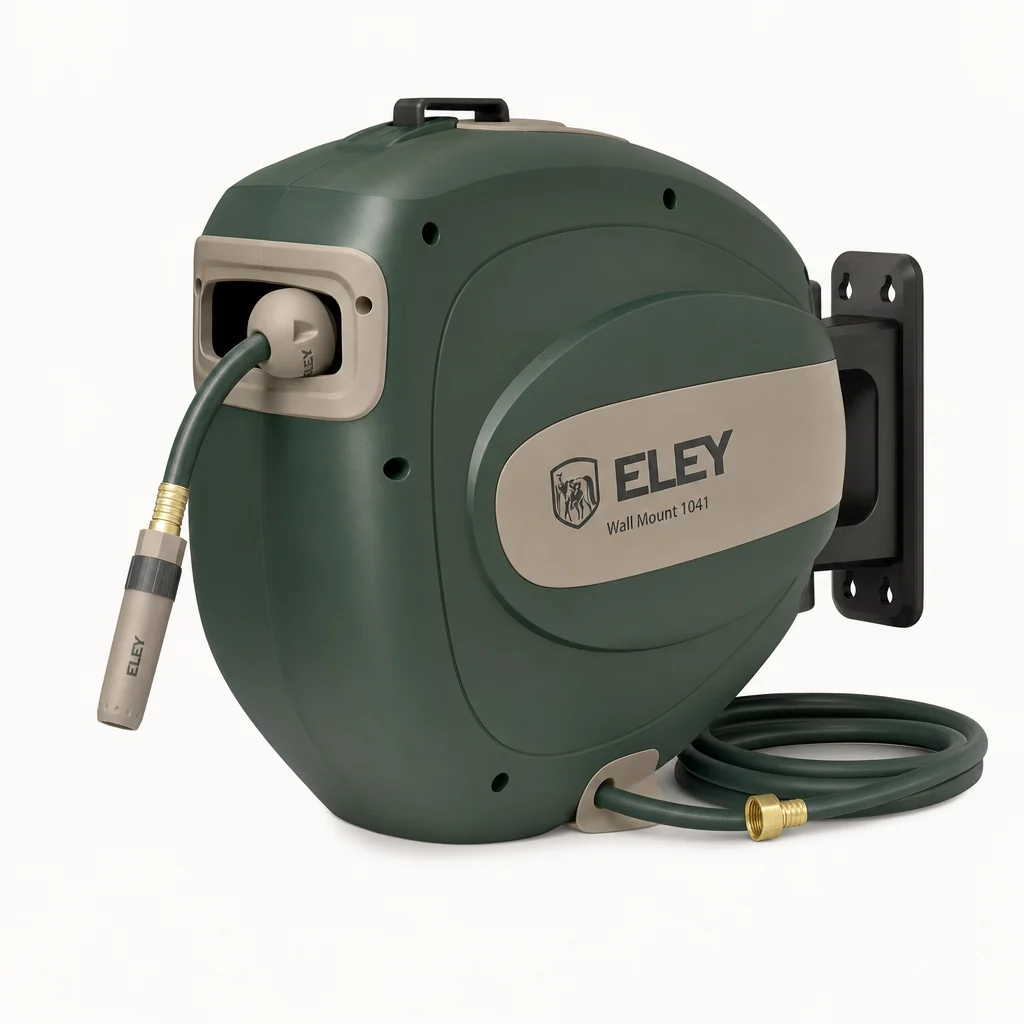
If I had to nail my colours to one mast for sheer build quality and longevity, it's the ELEY 1041. It's built from durable aluminium-alloy, and the headline figure is the warranty: ELEY positions itself as the only reel brand to guarantee a full decade of rugged, reliable, no-leak, no-fail performance. A ten-year guarantee on an outdoor product tells you a lot about how the maker expects it to age.
Capacity is generous and flexible. As standard the 1041 holds up to 125 feet of 5/8-inch hose. Fit the Extra-Capacity Kit — which widens the drum by 4 inches — and that jumps to 200 feet of 5/8-inch hose (this is also sold as the 1041X variant). That's a serious amount of reach for larger plots.
The clever bit is the configurability. The 1041 can be set up in either a parallel or perpendicular orientation: parallel pulls the hose out alongside the wall, perpendicular pulls it straight out away from the wall. On top of that, every ELEY reel can be configured for left- or right-hand rewinding thanks to its hose attachment method. That sounds like a minor thing until you're trying to position a reel near a corner or a doorway and realise most reels only work one way round.
The auto-retract convenience pick: Giraffe Tools Retractable
For anyone who genuinely won't bother cranking a handle, an auto-retract reel removes the only real chore. The Giraffe Tools Retractable Garden Hose Reel comes in several configurations — a 5/8-inch by 90 ft version and a 1/2-inch by 130 ft version among them — and the engineering touches are sensible. There's an auto-rewind system with a hose locker (so you can stop the hose at any length rather than only fully out or fully in), a 9-mode nozzle included, and a 6 ft leader hose to reach your tap.
The features that matter most for kink-and-crack avoidance are two. First, the self-layering system guides the hose back into the unit smoothly and without kinking — which is exactly the storage-induced damage we're trying to prevent. Second, the housing is UV-resistant and claimed to withstand sun, rain and time without fading, cracking or weakening, which the maker says doubles the lifespan of traditional reels. The 180° swivel bracket lets you water every corner of the yard without moving the reel, which is a genuinely lovely convenience.
Other reels worth knowing
The category is broader than two brands, and a few others deserve a mention depending on your priorities. The Liberty Garden Navigator Series (models 707, 712 and 714) offers manual wall-mounting with an aluminium body and a rotating arm — handy for directing the hose where you need it. The GARDENA 115-foot wall-mount reel is a retractable, fabric-reinforced and UV-stabilised option from a brand with a strong reputation for considered design. For pure industrial toughness, the Giraffe Tools Stainless Steel Wall Mounted Reel uses 304 stainless steel with a manual crank, and the Yard Butler ISRWM-180 is an all-steel swivel reel with 100 ft capacity rated for up to a ⅝-inch flow. The VEVOR Retractable Wall Mount (1/2-inch by 84 ft) adds a slow-rewind system, a 180° swivel and a 9-pattern nozzle at the more affordable end.
| Reel | Type | Material | Capacity | Standout feature |
|---|---|---|---|---|
| ELEY 1041 / 1041X | Manual crank | Aluminium-alloy | 125–200 ft (5/8") | 10-year warranty, parallel/perpendicular config |
| Giraffe Tools Retractable | Auto-retract | UV-resistant housing | 90 ft (5/8") / 130 ft (1/2") | Self-layering, hose locker, 9-mode nozzle |
| Giraffe Tools Stainless | Manual crank | 304 stainless steel | 100 feet | Industrial-grade corrosion resistance |
| Liberty Garden Navigator | Manual | Aluminium | 66 feet | Rotating arm for hose direction |
| GARDENA 115 ft | Retractable | UV-stabilised, fabric-reinforced | 115 ft | Refined, considered design |
| Yard Butler ISRWM-180 | Manual swivel | All-steel | 100 ft | Swivel mount, robust steel build |
| VEVOR Retractable | Auto (slow-rewind) | — | 84 ft (1/2") | Slow-rewind, 180° swivel, 9-pattern nozzle |
Manual vs Auto-Retract: An Honest Comparison
I get asked this constantly, so let's lay it out plainly. Neither type is objectively superior — they suit different temperaments and different gardens.
Manual crank reels
- Far higher capacity — up to 200 ft on the ELEY 1041X versus typically 84–130 ft on auto reels
- Fewer moving parts to fail; no spring mechanism to wear out
- Configurable orientation and handedness (ELEY)
- Often the longest warranties — ten years on the ELEY
- You control exactly how the hose layers on
The trade-offs
- You have to physically crank the handle to rewind
- Sloppy winding can still create a few loose loops
- Less "grab and go" than a self-retracting unit
- A full 200 ft of charged hose is genuinely heavy to manage
Auto-retract reels
- Effortless rewind — the self-layering system does the tidying
- Hose locker lets you stop at any length
- UV-resistant housing claimed to double traditional reel lifespan
- 9-mode nozzle and leader hose usually included
- Self-layering actively prevents kinks during storage
The trade-offs
- Lower maximum capacity than big crank reels
- The retract mechanism is a wear point over many years
- Less flexibility to swap in a hose of your own choosing
- The retract spring can pull the hose back faster than you'd like if mishandled
My rule of thumb
If your garden is large, you value maximum reach, and you don't mind cranking, go manual — the ELEY 1041 is the longevity benchmark. If you have a small-to-medium plot, hate faff, and want the tidiest possible result with zero effort, an auto-retract Giraffe Tools reel is the smarter buy. Match the tool to your patience, not to a spec sheet.
Mounting Done Properly: The Bit People Rush
A reel is only as good as the wall it's bolted to, and this is where I see the most regret. A 200 ft hose can hold 54 lb of water — add the weight of the reel and the leverage of the hose pulling outward, and you've got real load on those fixings. Skimp here and you'll pull the whole assembly off a render finish in a soggy February.
Find solid substrate
Mount into brick or solid masonry, not just render or a single course of soft block. Use the appropriate wall plugs rated for the load, and don't rely on the screws supplied if your wall is unusual.
Plan your configuration first
With a configurable reel like the ELEY 1041, decide parallel vs perpendicular and left- vs right-hand rewind before you drill. Walk the hose's path to the furthest bed and make sure nothing fouls.
Mind the sun and frost line
Where you can, choose a spot with some afternoon shade to spare the hose from peak UV. And always drain and disconnect before hard frosts — frozen water inside a hose is a leading cause of splits.
Set a comfortable height
Mount the reel at a height where cranking (or pulling) doesn't mean stooping or reaching. Your back will thank you across a season of daily watering.
Putting a Rating on It
Across the category, the strongest combination I keep coming back to is a polyurethane hose paired with a well-built wall-mounted reel — specifically the ELEY hose-and-reel ecosystem, with the Giraffe Tools auto-retract as the convenience-first alternative. Here's how I'd score the kink-and-crack-resistant approach as a whole.
The slight marks off are honest ones: the very best gear costs more upfront, and managing long, heavy hoses is never going to be completely effortless. But measured over the lifespan — where a ten-year warranty replaces an annual landfill habit — the value calculation is overwhelming.
Who Should Buy What
The large-garden owner
You need reach and longevity. Go for the ELEY 1041 (or 1041X with the extra-capacity kit) loaded with ELEY PU hose. Up to 200 ft of reach and a ten-year warranty.
The convenience seeker
You won't crank a handle. The Giraffe Tools Retractable with its self-layering rewind, hose locker and 9-mode nozzle keeps everything tidy with zero effort.
The balcony gardener
Space is tight and reach is short. An expandable hose like the Flexi Hose or Pocket Hose Silver Bullet stores tiny and won't kink — accept the shorter lifespan as the trade.
The heavy-duty user
You want bombproof. A Briggs & Stratton heavy-duty rubber hose on a 304 stainless Giraffe Tools or all-steel Yard Butler reel will outlast almost anything.
Frequently Asked Questions
The Verdict
A hose that "won't kink or crack" isn't wishful thinking — it's the predictable result of three good decisions. Choose a low-memory, uniform-walled material (polyurethane leads, with hybrids and quality rubber close behind). Insist on lead-free brass fittings and stainless hardware so the connections don't become the failure point. And store the whole lot on a wall-mounted reel that supports the hose, guides it on cleanly and keeps it out of the UV.
For most gardeners chasing genuine longevity, the ELEY 1041 reel paired with ELEY polyurethane hose is the benchmark — a true ten-year proposition with configurable mounting, a full-flow ¾-inch swivel and a temperature range that laughs at British winters. If you'd rather never touch a crank handle, the self-layering Giraffe Tools retractable, with its UV-resistant housing and 600 PSI burst-rated hybrid hose, is the convenience-first choice that still takes kink prevention seriously.
Spend a little more once, mount it properly, drain it before the frosts — and you'll have bought yourself out of the annual hose-replacement cycle for good. That, more than any single spec, is what "won't kink or crack" really means in practice.