
Wheelbarrows and Garden Carts That Save Your Back
Traditional barrows, two-wheel balance carts and folding trolleys compared — which design suits your soil, your paths and your spine?
If there's one tool that quietly defines how much you enjoy your garden, it's the thing you use to move everything else around it. Soil, compost, gravel, paving slabs, hedge trimmings, the wet sludge of last autumn's leaves — none of it walks itself to the heap. And whilst most of us spend ages agonising over secateurs and spades, we tend to grab whatever barrow is leaning against the shed wall and just get on with it. Then, three hours later, our lower back has a few choice words to say.
I've spent more seasons than I care to admit hauling material around sloping plots, narrow allotment paths and gravel drives, and I've reached a firm conclusion: there is no single "best" wheelbarrow. There's only the best design for the job in front of you. A traditional single-wheel barrow that's brilliant between raised beds can be a sideways-tipping menace on a rutted field. A four-wheel garden cart that glides across a lawn with 250kg of topsoil can be hopeless squeezing past a water butt.
So in this guide I'm going to walk you through the three big back-saving families — traditional single-wheel barrows, two-wheel balance carts, and four-wheel and folding trolleys — with honest notes on where each shines and where each will let you down. I'll point to specific models worth knowing, including the clever Worx Aerocart and the workhorse Gorilla Carts range, and I'll help you match a design to your particular patch of ground. The goal isn't to sell you the most expensive option. It's to stop you reaching for the ibuprofen.
Why Your Barrow Is Probably Hurting Your Back
Before we get into specific kit, it's worth understanding why moving things around the garden is so hard on the body — because once you grasp the mechanics, the differences between barrow designs suddenly make a lot more sense.
The strain comes from three places. First, lifting: to get a traditional barrow moving, you bend, grip the handles and heave the back end up off its legs. With a dense load — wet soil, gravel, a couple of paving slabs — that initial lift puts a real shear force through your lumbar spine. Second, balancing: a single-wheel barrow asks your arms, shoulders and core to keep the load upright the entire journey, and every wobble is a small correction you pay for in fatigue. Third, steering and stopping: a heavy load wants to keep going, and arresting it on a slope or steering it round a corner recruits exactly the muscles that ache the next morning.
Good back-saving design tackles all three. It reduces or eliminates the lift (clever geometry, pivot points, or simply more wheels taking the weight). It removes the constant balancing act (two or four wheels do the standing-up for you). And it makes steering predictable so you're not fighting the load. Keep those three jobs in mind as we go — lift, balance, steer — and you'll be able to judge any barrow on the shelf in seconds.
Pro Tip
Before you buy anything, walk your most common route with a tape measure. Note the narrowest gap, the steepest slope and the roughest surface. Those three numbers decide more about the right barrow than any feature list — a cart that can't fit through your side gate is useless no matter how clever it is.
The Three Families At A Glance
Let's set the scene with a quick lay of the land. Each of the three designs solves the lift-balance-steer problem differently, and each trades something away to do it. There's genuinely no free lunch here — the question is which compromise suits you.
| Trait | Single-Wheel Barrow | Two-Wheel Balance Cart | Four-Wheel Garden Cart |
|---|---|---|---|
| Manoeuvrability | Excellent — tightest turns | Good | Fair — wide turning circle |
| Stability | Poor — needs balancing | Very good | Excellent |
| Rough terrain | Good — tilt around obstacles | Fair | Variable |
| Lifting effort | High | Low to none | None — wheels carry all |
| Tipping load out | Easy and precise | Easy | Dump-style on many models |
| Storage footprint | Medium | Compact (some fold) | Large (unless folding) |
| Best for | Narrow beds, precision | Mixed jobs, all-rounder | Big bulk hauls, towing |
If you scan that table and one column already jumps out as "that's my garden," you can probably skip ahead. But for most people the honest answer is that they'd benefit from owning two of these — and I'll come back to that pairing strategy at the end, because it's the single best bit of advice in this whole article.
Traditional Single-Wheel Wheelbarrows
The classic for a reason. The traditional wheelbarrow design has a single wheel at the front and two steel legs at the rear to balance the tool when it's parked. That deceptively simple layout has survived centuries of garden labour because, for certain jobs, nothing beats it.
Where the single-wheel barrow earns its keep is manoeuvrability and precision. The single front wheel lets you navigate narrow garden paths, squeeze between raised beds, and tip the load precisely where you want it — pivot on that one wheel and you can practically turn on the spot. They also cope surprisingly well with uneven terrain, because you can tilt and balance around obstacles rather than having to roll straight over them. On a lumpy allotment plot with a rut down the middle, an experienced hand with a single-wheeler will often get further than someone wrestling a wide-bodied cart.
The trade-off is exactly the one we discussed earlier. A loaded single-wheel wheelbarrow requires constant balancing, and a heavy load on uneven ground can tip sideways without much warning. That balancing act gets genuinely tiring over long distances, especially with dense materials like wet soil or gravel where the weight is concentrated low and forward. And of course, every trip starts with that lift to get the legs off the ground.
Unbeatable in tight spaces
One wheel means one contact point to steer around. Side gates, gaps between beds and crowded patios are no obstacle.
Precision tipping
You can dribble a load out exactly where it's needed — invaluable when top-dressing borders or filling a planter.
Demands core strength
The balancing and lifting both lean on your arms, shoulders and lower back, which is where the back-strain reputation comes from.
Sideways tip risk
On a slope or rutted ground, a heavy off-centre load can roll the whole barrow over before you can correct it.
Pros
- The most manoeuvrable design by a clear margin
- Precise, controllable tipping for finishing work
- Handles obstacles by tilting around them
- Compact and familiar — everyone knows how to use one
- Generally the most affordable entry point
Cons
- Constant balancing is tiring over distance
- Heavy loads can tip sideways on uneven ground
- Every journey begins with a lift off the legs
- Dense loads concentrate strain on the back
- Poor choice for long hauls across rough fields
A pneumatic (inflatable) front tyre makes a bigger difference to comfort than almost any other feature on a single-wheel barrow. It absorbs jolts that would otherwise travel straight up the handles into your wrists and shoulders. The downside is punctures — which is precisely the problem the next category sets out to solve.
Two-Wheel Balance Carts: The All-Rounder
For many gardeners this is the sweet spot, and it's where some of the cleverest engineering in the category lives. Two-wheelers are far easier to balance, so you don't have to worry nearly as much about tipping — the load stands up by itself. The trade-off is honest and predictable: these wheelbarrows don't manoeuvre quite as well over rough terrain as one-wheelers, because you can't tilt around an obstacle the way you can with a single front wheel.
But what you gain is enormous for your back. With the load balanced across two points, you're no longer fighting to keep it upright every step of the way, and your effort goes purely into moving forward. For anyone who finds a traditional barrow exhausting — and that's a lot of us — this is often the moment gardening stops being a chore.
The Worx Aerocart WG050 — The Clever One
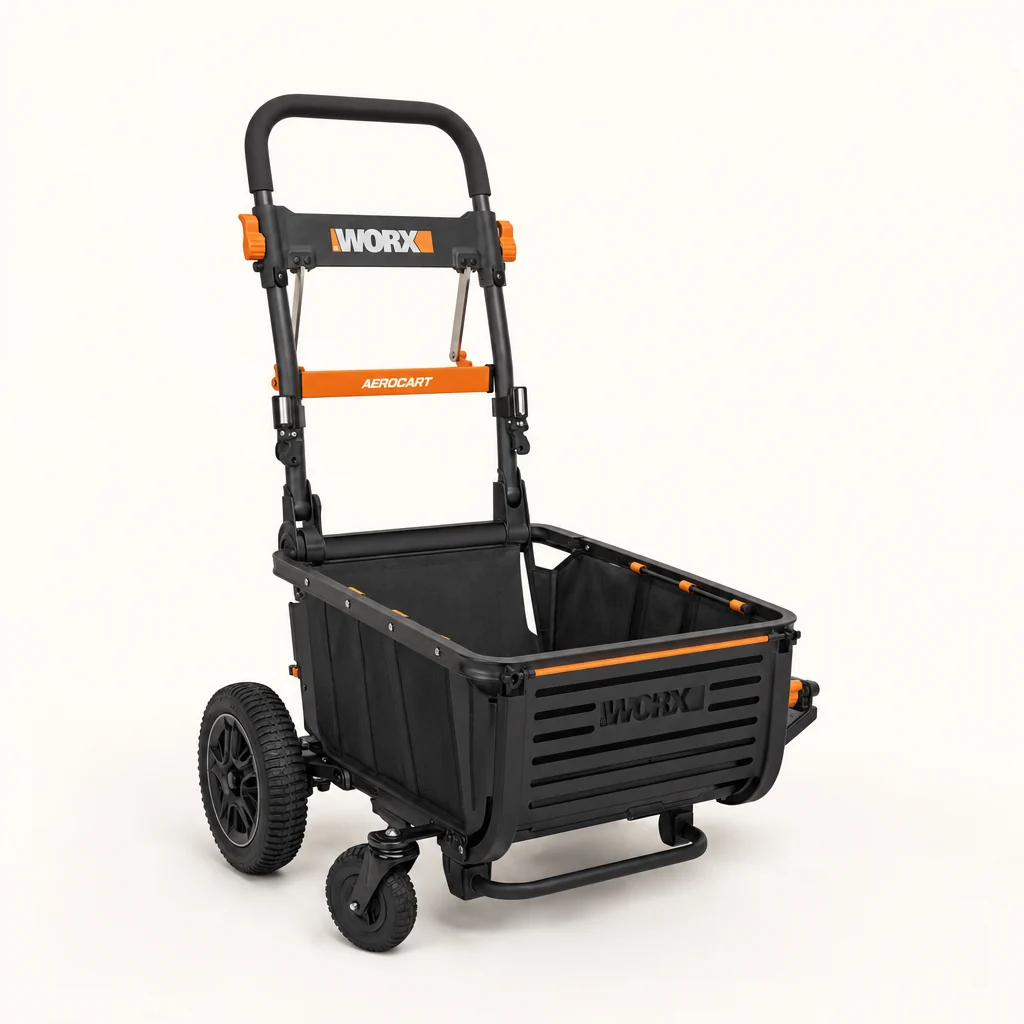
If you only look at one two-wheel design, make it this. The Worx Aerocart WG050 is an 8-in-1 multi-function machine, and its party piece is genuinely impressive. Thanks to the innovative Turbo Lift design, a 200-pound wheelbarrow load feels like only 17 pounds in your hands. That's not marketing fluff about "feeling lighter" — it's the result of clever weight distribution that shifts the load over the wheels, so your arms barely register it. The first time you move a full barrow of soil and feel almost nothing in your back, it's a small revelation.
The numbers stack up nicely too. The maximum weight capacity of the Aerocart is 300 pounds, so it's no lightweight when it comes to actual hauling. The wheels feature flat-free tyres that never need inflating and deliver a consistently smooth ride — no more discovering a punctured barrow on the morning you've got three tonnes of bark to move. And despite all that capability, the tool itself is light to handle, with compact dimensions of roughly 36 inches tall, 25 inches wide and 20 inches long, so it tucks away without dominating the shed.
It's not just my enthusiasm, either. The Aerocart has been named the best two-wheel wheelbarrow by Better Homes & Gardens, and has been featured for its "multifunction genius" in Popular Science, Country Life and Popular Mechanics. The multifunction part matters: it converts between a barrow, a dolly, a rock and plant mover, a trailer tote and more, so for a small garden it can genuinely replace a whole rack of separate tools.
Pro Tip
The Turbo Lift effect depends on loading the Aerocart correctly — keep heavy material toward the front of the tray, over the wheels, rather than letting it slide back toward the handles. Load it wrong and you give away exactly the leverage advantage you bought it for.
Best Choice Products Dual-Wheel Wheelbarrow — The Capacity King
If your priority is sheer volume on a budget-friendly two-wheeler, the Best Choice Products dual-wheel barrow is worth a look. Its deep basin holds up to 5 cubic feet of materials — soil, bricks, gravel, whatever the job demands — and it's equipped with two 14-inch inflatable rubber wheels that deliver stability and smooth navigation across uneven terrain.
The standout figure is capacity: it's designed to support up to 500 pounds. That's a serious amount of material for a two-wheel design, and the twin inflatable tyres spread that weight nicely. The compromise versus the Aerocart is the inflatable tyres themselves — more cushioning, but vulnerable to punctures — and you don't get the Turbo Lift leverage trick or the multi-function versatility. For pure "move a lot of stuff, stay balanced, don't break the bank," though, it's a sensible workhorse.
| Feature | Worx Aerocart WG050 | Best Choice Dual-Wheel | Marathon Yard Rover |
|---|---|---|---|
| Wheels | Twin, flat-free | Twin 14-in inflatable | Dual-wheel |
| Max capacity | 300 lb | 500 lb | 600 lbs |
| Basin volume | 15 cubic feet | 5 cu ft | 10 cubic feet |
| Lift assistance | Turbo Lift (200 lb → 17 lb) | Standard balance | Standard balance |
| Versatility | 8-in-1 multifunction | Single function | Single function |
| Puncture risk | None (flat-free) | Yes (inflatable) | — |
Pros
- Far less balancing effort than a single-wheel barrow
- The Aerocart's Turbo Lift dramatically cuts felt weight
- Flat-free tyre options remove the puncture worry entirely
- High capacities available — up to 500 lb on some models
- Multifunction designs can replace several separate tools
Cons
- Less nimble over rough ground than a single-wheeler
- Can't tilt around obstacles the same way
- Inflatable-tyre models reintroduce puncture risk
- Cleverest designs are pricier than a basic barrow
- Wider footprint may not fit the very tightest gaps
Four-Wheel Garden Carts: Brute Force Without The Lift
Four-wheel wheelbarrows are more commonly known as garden carts, and they take the back-saving philosophy to its logical conclusion: with four wheels carrying the load, there's no lift at all. You don't heave anything off the ground — you simply pull or push a load that's already fully supported. Unlike traditional wheelbarrows, these trolleys feature four wheels and ergonomic handles, which together slash the strain on your back and make heavy hauls genuinely manageable.
The honest caveat is manoeuvrability. Garden carts can sometimes be awkward to steer — that wider, four-point footprint gives them a larger turning circle, and they don't thread through pinch points the way a single-wheeler does. But the benefit of four wheels is the sturdy, balanced platform they create. Set a couple of heavy plant pots, a bag of compost and your tools on top and the whole lot sits there serenely while you walk it across the garden.
Gorilla Carts — The Benchmark Workhorse
When people talk about garden carts that genuinely save your back, the conversation tends to land on Gorilla Carts, and with good reason. The 4 cu. ft. Poly Yard Cart was rated favourably in testing thanks to its flat basin, level surface and single-handed operation — the sort of practical details that matter once you're actually out there working rather than reading a spec sheet.
In use, it was not too heavy to control even with a full load of mulch, helped by a well-balanced pivot point, and the spring-loaded bed latch worked smoothly — you simply lift up on the handle to release it. The durable, impact-resistant poly tub is easy to clean and won't rust, which is a quiet but real advantage over steel barrows that flake and corrode after a few damp winters. And despite the modest 4 cubic foot tray, this little cart packs 600 pounds of hauling power.
The wider Gorilla range carries the features that make these carts such favourites. The patented 2-in-1 handle lets you tow the cart behind a lawn tractor or ATV, or pull it easily by hand — a brilliant touch if you've got a big plot and a ride-on mower. The extra-wide base with balanced wheels provides additional stability, so the cart doesn't lurch when you load it unevenly. And the quick-release dumping system means no more wrestling to unload — you tip the bed and the contents fall out, which is its own little gift to your lower back at the end of a long task.
2-in-1 towing handle
Pull by hand for small jobs, or hitch behind a lawn tractor or ATV for big hauls across a large plot.
Quick-release dump system
Tip the bed to empty it instead of shovelling out — a genuine back-saver at the unloading stage.
Rust-proof poly tub
Impact-resistant, easy to rinse clean and immune to the corrosion that plagues steel barrows.
Serious capacity
600 pounds of hauling power from the 4 cu. ft. model, with higher-capacity carts available across the range.
That last bar deserves a moment's reflection. The Aerocart's felt-weight of 17 pounds from a 200-pound load is a different kind of figure entirely — it's not about raw capacity but about what your body experiences. A garden cart wins on sheer tonnage, but for the actual job of moving a barrow-sized load with minimum strain, the leverage trick is hard to beat. Which design "wins" depends entirely on whether your enemy is volume or effort.
Gorilla Carts and similar four-wheel trolleys are widely stocked at general hardware and garden retailers including Lowe's, Home Depot and Ace Hardware, so they're easy to inspect in person before buying. Always check the bed latch and dump action yourself in store — a smooth release is the feature you'll appreciate most often.
Other Four-Wheel Carts Worth Knowing
The Gorilla range alone spans plenty of choices, from the 4 cu. ft. dump cart up through 7 cu. ft. yard carts and heavier models rated from 600 right up to 1,200 lb for the most demanding hauls. Beyond Gorilla, the Kobalt utility carts come in several capacity levels, the Evolution Poly Yard Cart is a solid alternative, and the Polar Trailer 10 cu. ft. utility cart caters to those moving genuinely large volumes. If your gardening involves regular bulk deliveries — a few tonnes of topsoil or bark dropped on the drive each spring — stepping up the capacity ladder here is money well spent.
Folding And Collapsible Trolleys: The Storage Saviours
The newest member of the family answers a problem the others ignore entirely: where on earth do you keep the thing? Foldable carts are a godsend for anyone who only needs to haul occasionally, or who simply doesn't have the shed space for a full-size barrow standing permanently in the corner.
Like other quality garden carts, the best foldable models are built from tough, durable materials — these aren't flimsy toys. But it's worth being clear-eyed about the trade-off: most folding wagons sit in the light-duty category, with lower load capacities than their rigid cousins. The collapsing mechanism that lets them fold flat against a wall or slot into a car boot inevitably caps how much weight they can bear. So they're brilliant for ferrying potted plants, bags of compost, garden centre hauls and tidy-up loads — and less suited to shifting half a tonne of gravel.
For flat lawns, patios and the trips between car and garden, a folding trolley is an unsung hero. The fact that it vanishes into a cupboard when you're done makes it the one back-saver that earns its place even in the smallest of spaces.
Pros
- Folds flat for storage in tight spaces or a car boot
- Quality models still use tough, durable materials
- Four wheels mean no lifting on the move
- Perfect for occasional and light-duty hauling
- Ideal for garden-centre runs and patio tidy-ups
Cons
- Lower load capacities than rigid carts
- Not suited to heavy bulk materials like gravel
- Folding mechanism is a potential weak point over time
- Small wheels can struggle on rough or soft ground
- Less stable than a wide, fixed four-wheel base
Pro Tip
If you choose a folding trolley as your only hauler, resist the temptation to overload it "just this once." Exceeding the rated capacity is what eventually kills the folding mechanism. Keep a single bag of compost per trip rather than three, and the trolley will outlast several seasons of heavier abuse.
Matching The Design To Your Garden
Here's where it all comes together. Rather than ask "which is best?", ask "which is best for me?" — and that depends almost entirely on your terrain, your typical loads and your storage. Let me lay out the most common scenarios.
The raised-bed gardener
Tight paths and gaps between beds? A traditional single-wheel barrow's nimbleness and precise tipping are exactly what you need. Choose a pneumatic front tyre for comfort.
The do-everything homeowner
One tool, mixed jobs, a bad back to protect? The Worx Aerocart's Turbo Lift and 8-in-1 versatility make it the standout all-rounder.
The big-plot smallholder
Moving serious tonnage across open ground, maybe with a ride-on mower? A Gorilla Cart with its 2-in-1 towing handle and dump system is built for you.
The space-starved gardener
No shed, small yard, occasional hauls? A folding trolley that vanishes into a cupboard is the only practical answer.
Notice how rarely the answer is "the most expensive option." A modest single-wheel barrow is the right call for a great many gardeners, and the Aerocart only really justifies itself if you value its leverage and versatility. Buy for your garden, not for the spec sheet.
The Two-Barrow Strategy (My Honest Recommendation)
I promised I'd come back to this, because it's the single best piece of advice I can give. If your budget and storage allow it, own two complementary haulers rather than one compromise machine.
The most effective pairing I've found is a two-wheel balance cart for the bulk of jobs — the soil, the compost, the heavier material where you want low effort and good stability — partnered with either a single-wheel barrow for the fiddly precision work between beds, or a folding trolley for the light, occasional runs. Each tool does what it's genuinely best at, and you never find yourself fighting the wrong design for the job in hand. The result is that you stop dreading the heavy parts of gardening, which is rather the whole point.
If you can only have one, the two-wheel balance cart — and specifically something like the Worx Aerocart — is the most forgiving all-rounder for the broadest range of gardens and bodies. It won't be perfect for the very tightest spaces, but it'll never actively hurt you, and that consistency counts for a lot.
How These Designs Score On The Things That Matter
Pulling the threads together, here's how I'd rate each family across the criteria that actually affect your back and your enjoyment. These are broad judgements about the design types rather than any single product — but they should help you weigh up which compromise you're happiest to live with.
The two-wheel cart edges ahead overall because it balances the back-saving you came here for with enough manoeuvrability to remain practical. The four-wheel cart matches it for kindness to your spine but loses ground in tight spaces. And the trusty single-wheeler, for all its strain, remains unbeaten on agility and precision — which is exactly why it refuses to disappear.
Frequently Asked Questions
The Verdict
There is no single barrow that wins every contest, and anyone who tells you otherwise is selling something. What there is, is a clear logic for matching design to garden — and once you've got it, the right choice almost picks itself.
For the broadest range of gardeners, the two-wheel balance cart is the most forgiving all-rounder, and the Worx Aerocart WG050 is the standout: its Turbo Lift makes a 200-pound load feel like 17, its flat-free tyres never puncture, and its 8-in-1 versatility means it earns its shed space many times over. For heavy bulk hauling with zero lifting, the Gorilla Carts range — with 600 lb of capacity on the 4 cu. ft. model, a quick-release dump system and a 2-in-1 towing handle — is the workhorse to beat. For tight, precise work between raised beds, the humble single-wheel barrow remains unmatched on agility. And for the storage-starved, a folding trolley is the only sensible answer.
My genuine recommendation, if you can manage it, is to own two complementary tools rather than one compromise. Pair a balance cart for the heavy lifting with a single-wheeler or folding trolley for the fiddly bits, and you'll never fight the wrong barrow again. Your back, after a long Saturday in the garden, will quietly thank you.