
How to Kill Weeds in Block Paving and Gravel
A complete, hands-on guide to chemical-free and treated weed control — plus the tools that make the job genuinely quick.
If you've got a block-paved driveway or a gravel path, you already know the score. You spend an afternoon making everything look pristine, and within a few weeks a stubborn fringe of grass, moss and dandelions has muscled its way back up between the joints. It's one of the most relentless jobs in the garden, and the reason is simple: those gaps between pavers and the loose grit of gravel are practically purpose-built nurseries for weed seeds. They collect windblown dust, organic debris and moisture, giving roots everything they need to take hold.
I've spent a great many weekends battling weeds across paving and gravel, and over the years I've come round to a particular view: there's no single magic bullet. The people who keep their surfaces clean year after year tend to combine a couple of approaches — a chemical-free method for the bulk of the work, a decent tool to make the physical side bearable, and the occasional targeted treatment for the really entrenched offenders. This guide walks through all of it, honestly, including where each method falls short.
Whether you're firmly in the no-chemicals camp (and I understand entirely why so many gardeners are these days) or you simply want the fastest route to a tidy drive, there's something here for you. Let's get into it.
Why Block Paving and Gravel Are Such Weed Magnets
Before we reach for anything, it's worth understanding the enemy. Weeds in paving and gravel rarely grow from the foundation up. Instead, seeds land on the surface, settle into the joints or the gaps between stones, and germinate in the thin layer of organic matter that accumulates there. This is actually good news, because it means most of the root system is shallow — you're not usually dealing with something anchored deep into the sub-base.
Gravel behaves slightly differently to block paving. With gravel, the loose stones shift and create pockets where dust and leaf litter collect, forming a surprisingly fertile micro-bed. Block paving, by contrast, concentrates everything into the narrow jointing sand between blocks. That sand is the battleground. Keep it clean and tightly packed and you've won half the war; let it become a soft, debris-filled seedbed and you'll be weeding constantly.
The practical takeaway is this: removal of the visible weed matters less than disrupting the conditions that let weeds re-establish. That's why the best long-term strategy almost always pairs killing or pulling the weeds with keeping the joints and gravel clean and compacted afterwards.
Pro Tip
Tackle weeds when they're young and small, before they flower and set seed. A single dandelion left to go to seed can scatter hundreds of new colonisers across your drive. Ten minutes of regular maintenance beats a marathon weeding session every time.
Chemical-Free Methods That Actually Work
Let's start where I think most people should: chemical-free control. There's a growing reluctance to spray weedkiller across surfaces that drain straight into our soil and watercourses, and that reluctance is well-founded. Notably, the Royal Horticultural Society does not support the use of weedkillers, instead encouraging gardeners to lean on physical and cultural methods. That's a meaningful position from the country's leading gardening authority, and it shapes how I'd approach a domestic drive or path.
The good news is that chemical-free doesn't mean ineffective. It does, however, mean a bit more elbow grease — which is precisely why the right tool matters so much. Here are the methods I rate.
Manual Weeding and Scraping
The classic. Physically removing weeds and the debris they grow in is the single most reliable method, full stop. For block paving, this means dragging a blade down the joints to slice through roots and lift out the weed along with the soft, contaminated sand. For gravel, it's often a matter of hoeing or raking through to dislodge seedlings before they establish.
The downside is obvious — it's physical, and on a large drive it can be backbreaking if you're crouched on your knees with a hand tool. This is exactly where long-handled and telescopic tools earn their keep, and we'll get to specific recommendations shortly.
Boiling Water
Wonderfully simple and completely free if you've already boiled the kettle. Pouring boiling water directly onto weeds in joints scalds the foliage and can kill smaller plants outright. It works best on young, shallow-rooted weeds and in the tight confines of paving joints where the heat is concentrated. On established perennials with deep taproots it tends to knock back the top growth without killing the plant, so you'll be repeating it. Take care, obviously — boiling water and bare feet don't mix.
Mechanical Brushing
Stiff wire brushing is brilliant for paving and is my preferred routine method. A wire brush scrapes the weed, moss and accumulated debris out of the joints in one motion, which both removes the current growth and disrupts the seedbed for next time. Done a couple of times a season, brushing alone keeps a lot of drives respectably clean without a drop of anything chemical.
Manual Pulling & Scraping
Most reliable for root removal; best paired with a long-handled tool to save your back on larger areas.
Boiling Water
Free and effective on young weeds in joints; needs repeating on deep-rooted perennials.
Wire Brushing
Excellent routine maintenance for paving — clears weed, moss and the debris that feeds future growth.
Powered Brushing
An electric weed remover speeds up brushing dramatically across larger paved areas.
A common mistake is reaching for the pressure washer first. It blasts weeds and moss away impressively, but it also strips out the jointing sand between blocks — and that loose, hollow joint becomes the perfect new seedbed. If you do jet wash, plan to re-sand the joints afterwards.
Treated Options: When and How to Use Them
I'll be straightforward here. Given the RHS position against weedkillers, and the environmental case for keeping chemicals off free-draining surfaces, my honest recommendation is to treat chemical control as a last resort rather than a first move. The vast majority of domestic paving and gravel weed problems can be handled by the physical and thermal methods above, especially if you stay on top of them.
That said, I appreciate not everyone has the time or the inclination for regular manual maintenance, and some people will choose a treated route for a heavily infested area. If you go that way, the responsible approach is targeted spot-treatment of individual stubborn weeds rather than blanket spraying across the whole surface. Apply only to the weeds themselves, on a still, dry day so nothing drifts onto borders or runs off into drains, and always follow the product label to the letter. Less is genuinely more.
My Honest Take
If you're on the fence, start chemical-free for a full season. Combine routine wire brushing with the occasional pour of boiling water and targeted hand-weeding. I'd wager you won't feel the need to reach for anything stronger — and your soil, pets and local wildlife will thank you.
The Tools That Make It Quick: Hand Weeders
For chemical-free control, the tool is everything. A good weeder turns a miserable chore into a quick, almost satisfying job. Let's run through the hand tools I rate, starting with the workhorses you'll use on your knees or bent over the joints.
Spear & Jackson Select Stainless Steel Weeder
This is a proper, professional-grade hand weeder and the sort of tool that lasts decades. It's a 12-inch hand tool built around a mirror-polished stainless steel head, which matters more than it sounds — stainless slides through soil and debris with far less drag than coated carbon steel and won't rust on you. The design includes an integrated fulcrum so you can lever weeds out with the root intact, which is exactly what you want for taproot offenders like dandelions sitting in your gravel.
It also has a tanged design for knuckle clearance, so you're not grazing your hand against the ground every time you dig in, and a bi-material comfort grip handle that takes the sting out of repetitive use. Spear & Jackson, for context, have been making tools in Sheffield since 1760, and that steel heritage shows in the quality. At £13.95 it's an easy recommendation as a first proper weeder.
Spear & Jackson Elements Dandelion Weeder
If your nemesis is the dandelion — and across gravel especially, it usually is — this is the specialist for the job. It uses a heat-treated hardened carbon steel head that's hammer finished and epoxy coated to resist rust, paired with a weatherproofed clear-lacquered ash wood handle that feels lovely in the hand. At just 0.18 kilograms it's light and nimble, ideal for the targeted in-and-twist motion that levers a whole taproot out of gravel in one go. The forked tip is designed precisely to grip and extract deep roots rather than snapping them off below the surface, which is where so many weeds simply regrow from.
Draper Carbon Steel Hand Patio Weed Remover (Model 24935)
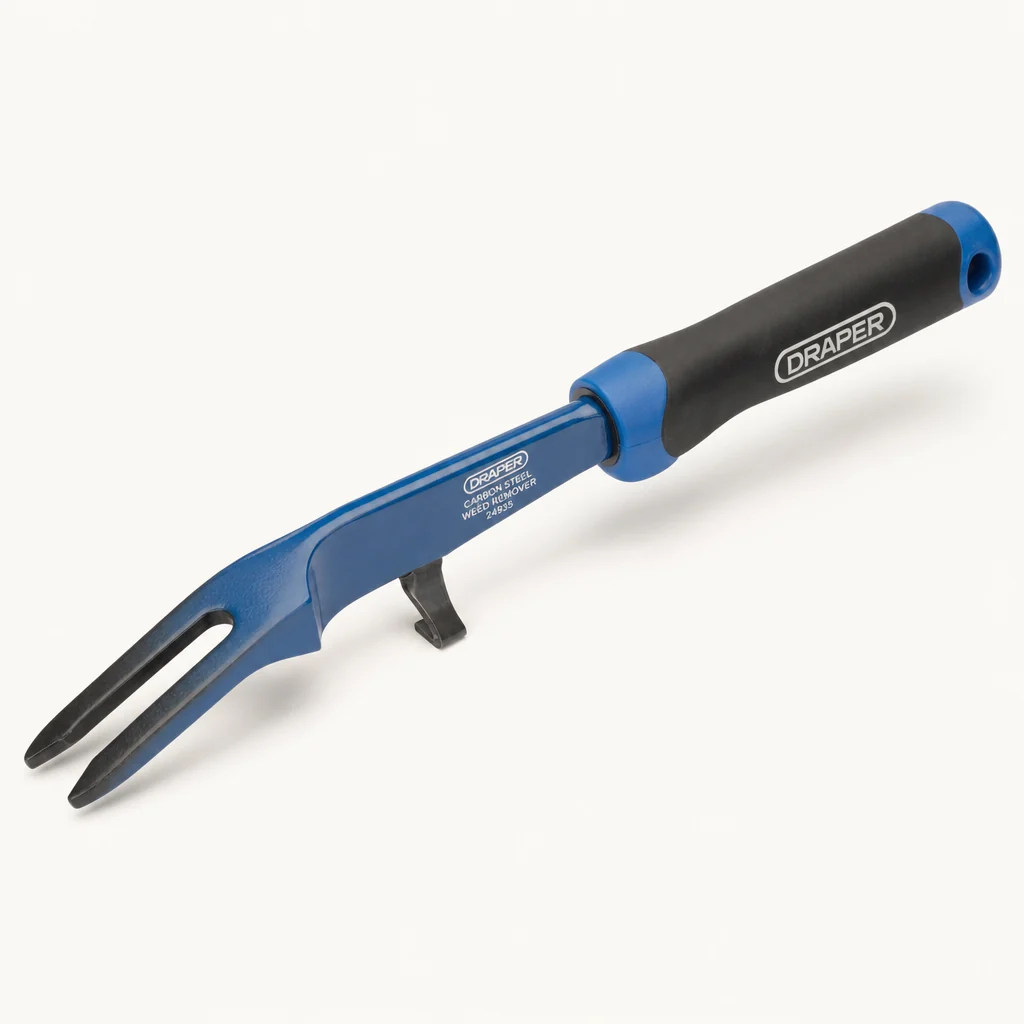
This one is squarely aimed at block paving and flagstones. It's a hand-held weeder with a carbon steel blade and a heavy-duty ash handle, and the angled blade is shaped to run down the gaps between paving slabs to drag out weeds and debris. Users consistently describe it as sturdy, good quality and genuinely effective at pulling weeds from between flagstones and paving slabs — which is exactly the job it's built for. If your problem is paving joints rather than open gravel, this is the more relevant hand tool of the two carbon-steel options.
| Feature | S&J Select Weeder | S&J Elements Dandelion | Draper Patio Remover (24935) |
|---|---|---|---|
| Best For | General weeding, gravel | Deep taproots, gravel | Paving & flagstone joints |
| Head Material | Mirror-polished stainless steel | Heat-treated carbon steel | Carbon steel |
| Handle | Bi-material comfort grip | Lacquered ash wood | Heavy-duty ash |
| Length / Weight | 12 inches | 0.18 kg | Hand-held |
| Standout Feature | Integrated fulcrum leverage | Forked taproot extraction | Angled joint-clearing blade |
| Price | £13.95 | — | — |
Stainless steel versus carbon steel is the eternal garden-tool debate. Stainless resists rust and glides more easily; hardened carbon steel takes and holds a sharper edge for slicing roots. Honestly, for most people the deciding factor is which surface you're tackling — joints versus open gravel — more than the metal itself.
Telescopic and Long-Handled Tools: Saving Your Back
Here's where the job stops being a chore. Kneeling on cold paving for an hour is the part everyone dreads, and it's the single biggest reason people give up and let the weeds win. Long-handled and telescopic tools let you work standing up, which transforms both the comfort and the speed of the task.
Spear & Jackson Razorsharp Telescopic Patio Knife/Weeder
This is my standout pick for block paving and the tool I'd point most people towards first. It's a patio knife on a telescopic handle that extends to a full 1.5 metres (1525mm, or 60 inches), so you can stand comfortably upright and run the blade down the joints between blocks. The blade is stainless steel and double riveted for extra strength — riveting being the joint that usually fails first on cheaper tools — and there's a non-slip safety grip on the handle. It carries a generous 10-year guarantee, which tells you something about how it's built to last.
Reviewers have rated it an impressive 5 out of 5, and that matches my experience: the long reach means you cover a whole drive far faster than crawling along on your knees, and the stainless blade keeps slicing cleanly through the joints. At £33.54 including VAT (£27.95 ex VAT, as of April 2026) it's not the cheapest hand-weeding tool, but the comfort and longevity make it superb value for anyone with a sizeable paved area.
Generic Telescopic Weed Brush Tool for Block Paving
If brushing is more your style — and as I mentioned, it's my preferred routine method — this telescopic brush set is a clever bit of kit. The metal handle adjusts from 80cm to 140cm and twists to lock at your chosen height, so you can dial in the right reach for your build. Crucially it ships with two interchangeable wire brush heads: an angled wire weed brush sized for joints and gaps, and a wider wire broom head for sweeping larger areas. Both use hard-wearing steel wire bristles that bite into the debris in the joints.
The flexibility is what makes it. The angled brush gets into the joints to scrape out weed and moss, then you swap to the broom head to clear the loosened debris off the surface — a complete maintenance cycle from one handle, all done standing up.
Wolf Garten Joint Brush Weeder
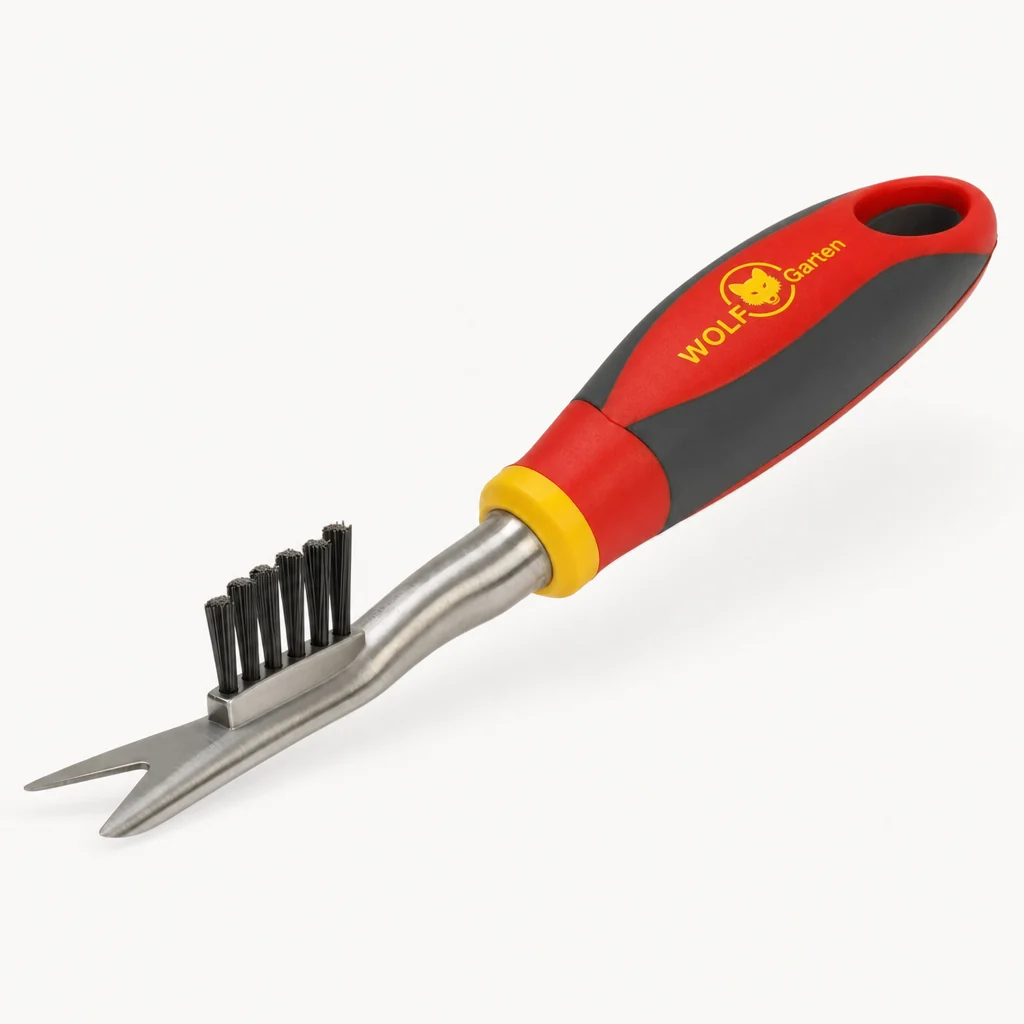
Wolf Garten's joint brush is a quality option for anyone already invested in their modular system. It's a dedicated joint brush with stiff, heavy-duty bristles designed specifically to scrape weed, moss and debris out of cracks and joints, and it's made in Germany with a 10-year warranty behind it. The one thing to know is that it's a head-only tool — it clips onto Wolf Garten's separate long handles, which you buy once and share across their whole range of attachments. If you don't already own a Wolf Garten handle, factor that into your decision; if you do, this is a brilliant, durable addition.
Telescopic Tools: Pros
- Work standing upright — far kinder on knees and back
- Dramatically faster across large drives and paths
- Adjustable reach suits users of different heights
- Long warranties (10 years on the S&J and Wolf Garten)
Telescopic Tools: Cons
- Less precise than a hand tool for fiddly individual roots
- Modular brushes (Wolf Garten) need a separate handle
- Higher upfront cost than a basic hand weeder
- Brush heads wear and eventually need replacing
The Powered Option: Electric Weed Removers
For larger paved areas, or if manual brushing simply isn't realistic for you, an electric weed remover steps things up another gear. These motorised tools spin a brush head to scrape out weeds and moss far faster than you could by hand.
Draper Electric Patio Sweeper and Weed Remover (Model 84746)
This is the powered tool I've seen win over the most sceptics. It's an electric sweeper and weed remover designed to clear weeds from block paving quickly and easily, and the results genuinely do leave the area looking close to new. It comes with a metal wheel attachment, and the headline claim — borne out in real-world use — is that it performs better than a jet wash for weed removal whilst maintaining the sand between the blocks. That's the key advantage over pressure washing: you get clean joints without hollowing them out.
In practice, users report being able to cover around 20 square metres on a session, and it lifts moss up easily. It's also very light to handle, which makes a real difference over an extended job. It's not flawless — it doesn't shift deep-grounded grass as effectively as it does moss and surface weeds, so grass-rooted offenders may need multiple passes, and the build feels a little flimsy in the hand, though how that translates to long-term durability isn't something I can claim with certainty. For routine moss and weed clearance across a moderate drive, though, it's a genuine time-saver.
Electric Remover: Pros
- Clears weeds and moss far faster than hand brushing
- Outperforms a jet wash whilst keeping joint sand intact
- Very light and easy to manoeuvre
- Covers around 20 square metres in a session
Electric Remover: Cons
- Struggles with deep-rooted grass; needs multiple passes
- Build feels somewhat flimsy in hand
- Powered tool means a cable or power source to manage
- Overkill for small paths or light maintenance
Putting It Together: A Year-Round Routine
Tools and methods are only as good as the routine you build around them. After much trial and error, here's the rhythm I'd recommend for keeping block paving and gravel genuinely weed-free without resorting to chemicals.
Late Winter / Early Spring
Do your big clear-out before the growing season kicks off. Brush or power-sweep the whole area to remove overwintered moss and debris, and re-sand any joints that have gone soft. Starting clean makes the whole year easier.
Spring Through Summer
This is prime weed season. Spend ten minutes every week or two with a telescopic weeder or hand tool catching seedlings whilst they're small. Boiling water deals with anything in tight joints. Never let weeds flower.
Autumn
Clear fallen leaves promptly — they rot down into exactly the kind of organic matter weeds love. A quick brush-through keeps the joints from turning into a seedbed over winter.
Ongoing
Keep jointing sand topped up and compacted. A tight, full joint simply has nowhere for seeds to settle. This single habit prevents more weeds than any treatment ever will.
The Ten-Minute Rule
The gardeners with the cleanest drives aren't the ones doing epic weekend battles — they're the ones doing ten minutes regularly. Frequent, light maintenance with a good standing-height tool keeps things under control with a fraction of the effort. It's far more about consistency than intensity.
Which Approach Is Right for You?
There's no universally correct answer here — it genuinely depends on your surface, the size of your area, your budget and how you feel about chemicals. Here's how I'd steer different people.
The Small-Path Owner
A single quality hand weeder is all you need. The Spear & Jackson Select at £13.95 covers gravel and joints brilliantly for occasional use.
The Big-Drive Owner
Invest in the telescopic Razorsharp patio knife (£33.54 inc VAT) to save your back, and consider the Draper electric remover for the heavy seasonal clear-outs.
The Eco-Conscious Gardener
Skip chemicals entirely. Pair regular wire brushing with boiling water and targeted hand-weeding — in line with RHS guidance against weedkillers.
The Time-Poor Homeowner
An electric weed remover does the bulk fast, and a telescopic brush handles the touch-ups standing up. Minimal kneeling, maximum efficiency.
Frequently Asked Questions
Overall Assessment
Taking the whole topic together — the methods and the tools that serve them — here's how I'd score the chemical-free-first approach to weed control on paving and gravel.
The only thing that holds the score back from a perfect ten is the simple fact that chemical-free control asks for a little more of your time than spraying does. But with a telescopic tool and a sensible routine, that time cost shrinks to almost nothing — and the trade-off in environmental peace of mind is well worth it.
The Verdict
Killing weeds in block paving and gravel isn't about finding one miracle product — it's about combining the right method with a tool that makes the job quick enough that you'll actually keep on top of it. My strong recommendation is to go chemical-free first, in line with RHS guidance, and let the tools do the heavy lifting.
For most people, the winning combination is a Spear & Jackson Razorsharp telescopic patio knife (£33.54 inc VAT, 5 out of 5 from reviewers and a 10-year guarantee) for standing-height joint weeding, backed up by a good hand weeder like the Spear & Jackson Select at £13.95 for precision work. If you've a large drive and limited time, add the Draper electric remover to fly through the seasonal clear-outs without blasting out your jointing sand.
Get the routine right — frequent, light maintenance rather than occasional marathons — and you'll have clean paving and tidy gravel without a single drop of weedkiller. That's a result worth the elbow grease.