
The Best Garden Rollers and When to Use One
A garden roller can settle seed, bed in turf and tidy frost-heaved ground. Used as a weekly lawn ritual, however, it can do rather more harm than good.
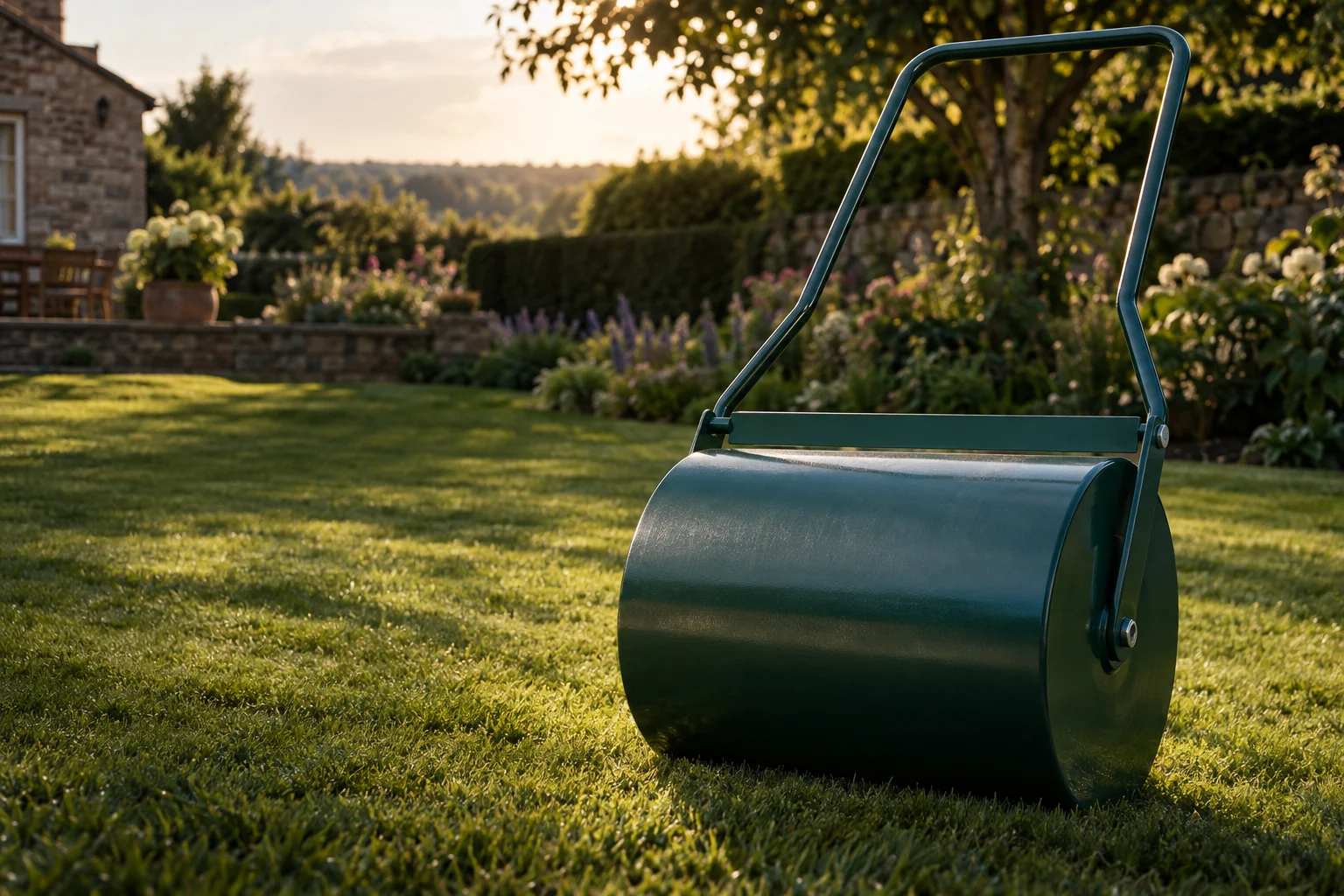
Do You Actually Need a Garden Roller? The Honest Answer
Garden rollers are among the most misunderstood bits of lawn kit. One gardener will tell you they are indispensable for a smart, level lawn. Another will insist that so much as looking at one will compact your soil into something resembling a municipal car park. As usual, the sensible answer lives somewhere in the middle.
A roller is simply a heavy cylinder that you push or tow across turf. Some are filled with water or sand when needed and emptied afterwards; others have a fixed working weight. Its job is to press the surface down. That can be genuinely useful when you are trying to bring grass seed into contact with soil, settle freshly laid turf or gently re-seat grass after winter frost has lifted it. It is not, despite the hopeful advertisements of years gone by, a magic wand for every bumpy lawn.
At the beginning of October, most UK gardeners do not need to rush out and roll an established lawn. In fact, this is often the point in the year to leave it alone. Autumn rain can quickly make soil too soft, and a roller on wet ground is a remarkably efficient way of squeezing out the air that grass roots need. If you have recently overseeded during a mild, workable spell, a very light pass may still be useful. Otherwise, concentrate on keeping leaves cleared and avoiding unnecessary traffic while the ground is damp.
The three situations in which a roller earns its shed space are straightforward:
- Establishing a new lawn from seed or overseeding: it firms seed into prepared soil.
- Settling newly laid turf: it removes small air gaps between turf and the soil beneath.
- Correcting shallow frost heave in spring: it can press lifted roots gently back into contact with the soil.
The useful rule of thumb
Buy a roller for a particular job, not because you feel a lawn ought to be rolled every year. For many gardens, one careful use after seeding, turfing or light surface work is more valuable than a lifetime of routine rolling.
There is a fourth, smaller role too. Following topdressing or very light grading, a roller can help settle a freshly worked surface and smooth minor undulations. The important word there is minor. A roller presses down; it does not move enough soil to fill a hollow, remove a tree root or correct a rut. Those jobs require the unglamorous but effective combination of soil, a rake and a little patience.
So, do you need one? If you sow or repair lawn regularly, lay turf, or have a lawn that suffers from winter lifting, a compact water- or sand-fill roller is useful. If your lawn is healthy, reasonably level and already established, you may be better off spending the money and effort on aeration, topdressing, sharp mower blades and a decent cup of tea afterwards.
When Rolling Your Lawn Actually Makes Sense: The Four Genuine Use Cases
Rolling makes sense when it improves contact between things that should already be touching: seed and soil, turf and soil, or grass roots and the ground after winter movement. It is a finishing tool. Think of it as the gentle press at the end of a job, rather than the main event.
1. New lawn seed and overseeding
Grass seed needs close contact with the soil in order to take up moisture and begin rooting. A light roller pass after sowing presses seed into a prepared, raked surface without burying it deeply.
2. Fresh turf installation
Once turf is laid, a roller can settle it against the soil below and remove small pockets of air that would otherwise dry the roots and lead to patchy establishment.
3. Frost heave in early spring
Repeated freezing and thawing can lift the surface slightly, taking grass roots with it. Gentle rolling once conditions improve helps re-seat those roots before mowing begins in earnest.
4. Settling a lightly dressed surface
After a light topdressing or fine surface preparation, a modest roller can settle loose material and reduce very shallow bumps. It will not cure a genuinely uneven lawn.
New seed: firm contact, not burial
This is the strongest case for owning a roller. Grass seed is small, and most types should sit in the top 3–6 mm of soil. If seed rests loosely on a fluffy surface, it can dry out, wash into clumps or become an easy snack for birds. Raking it in lightly is the first step; rolling is the second. The drum presses the seed into the soil surface, improving seed-to-soil contact while keeping it close enough to light and warmth to germinate properly.
You are not trying to create a billiard-table crust. One calm, even pass is enough. Walk at a sensible pace, overlap slightly, and avoid turning sharply with a heavy roller sitting on one spot. If the surface is dry and dusty, lightly water first. If it is sticky enough to cling to boots, wait. The lawn can survive your impatience; it is usually the soil structure that pays for it.
New turf: a little pressure goes a long way
Turf is often laid with good intentions and a surprising number of tiny air gaps. Those gaps matter because roots need contact with moist soil beneath the turf. A roller helps press the turf down evenly after it has been laid and watered, particularly where the ground was carefully prepared but remains a little soft or uneven at the surface.
Use a modestly filled roller rather than the heaviest possible one. The aim is to encourage contact, not flatten every crumb of life out of the root zone. Roll in different directions only if needed, and stop once the turf looks settled. Then water appropriately and keep foot traffic off whilst roots establish.
Frost heave: the traditional spring job
Frost heave sounds rather grand for something that can look like a slightly lumpy lawn, but the mechanism is simple. Water in the soil freezes, expands and pushes the soil surface up. As it thaws and freezes again, shallow grass roots may be lifted away from firm contact with the soil. In a British winter, especially in colder inland areas, that can leave turf looking slightly raised or vulnerable to scalping when you resume mowing.
Come next spring, wait until the ground has thawed and drained but remains gently moist. A light roller pass can press roots back down and help the lawn recover. Do not attempt it whilst the soil is frozen, saturated or visibly soft underfoot. That is not corrective lawn care; that is merely making ruts with confidence.
Before you roll
Walk the lawn first. If you can see drainage dips, animal tunnels, tyre ruts, raised roots or holes deeper than roughly 3 cm, deal with the cause before reaching for a roller. Those are repair jobs, not rolling jobs.
The Compaction Myth Explained: Why Over-Rolling Kills Lawns
The myth is not that rollers can compact soil. They absolutely can. The myth is the old idea that a lawn benefits from heavy annual rolling as a piece of routine maintenance. It does not. A lawn is not a cricket pitch, and even a cricket pitch is managed by people who understand exactly what they are doing and why.
Healthy soil contains solid particles, water and air. Grass roots need the air spaces. Worms, soil organisms and water movement depend on them too. When a heavy roller repeatedly passes over already firm ground, those spaces become smaller. Roots find it harder to travel through the soil, water may sit on the surface rather than soaking in, and the lawn becomes less resilient in dry weather. In short: it can look flatter for a while whilst becoming less healthy underneath.
The risk is greatest with heavy clay soil. Clay particles are small and pack tightly together, particularly when wet. Rolling a clay lawn can produce a sealed, smeared surface that holds water at the top and excludes air below. Once that happens, grass has very little reason to thank you for your efforts.
Moist is right; wet is wrong. The ideal rolling window is when soil and grass are damp after a light shower or modest watering, but not waterlogged. If water glistens on the surface, boots sink in, or soil sticks thickly to the drum, put the roller away.
The "sealed lawn" problem
When wet soil is compressed, especially clay, it can smear into a dense surface layer. Gardeners sometimes describe this as sealing the lawn, and it is a useful description. Water struggles to penetrate, oxygen movement at the roots is reduced, and shallow rooting becomes more likely. The result can be thin, stressed grass that suffers more during dry spells and is slower to recover from ordinary wear.
That is why the timing advice matters more than the make of roller. A beautifully made roller used on saturated ground remains a beautifully made way to cause trouble. Conversely, a basic compact roller used once, lightly, on a properly prepared seedbed can be exactly the right tool.
What rolling cannot repair
Rollers are often bought in the hope that they will sort out a bumpy lawn. They may disguise tiny surface irregularities after topdressing, but they do not solve structural problems. A hollow deeper than about 3 cm needs filling and reseeding or patching. A raised tree root needs a different mowing strategy or careful local work. A mole tunnel needs pest management and repair once activity has stopped. A drainage dip needs drainage thinking, which is admittedly less exciting than buying a new tool but much more likely to work.
Tyre ruts should be repaired with soil correction and reseeding. Repeatedly rolling them merely firms the compacted track further. Likewise, if the lawn feels hard already, the corrective action is usually aeration, followed by suitable topdressing, rather than more weight on top.
A better annual habit
For an established lawn, make aeration the regular task and rolling the exception. Use the roller after a major job such as seeding, turfing or light regrading, then let roots, worms and weather do the quieter work of maintaining a healthy soil structure.
As a broad limit, do not roll an established lawn more than once in a year, and do not feel obliged to do even that. Most domestic lawns will need rolling only occasionally. The tool should earn its outing.
When and How to Use a Garden Roller Properly
There is a pleasantly uncomplicated technique to rolling, but it rewards restraint. The work should begin long before the roller moves: level the area as well as you can, rake away stones and debris, repair genuine hollows, and decide whether rolling is actually the final step that the job needs.
For seed, rake the ground to a fine, reasonably level tilth, sow evenly, rake the seed in lightly, and then roll once. For turf, prepare and level the soil first, lay the turf neatly, water it, and then use the roller lightly enough to settle it rather than squash it. For frost heave, wait for early spring conditions when the surface is thawed, damp and stable.
The right weather window
Most rollers work best when the soil is damp. That might be after a short rain shower, or after using a sprinkler lightly on a dry seedbed. Damp soil yields just enough for seed or turf to settle into contact. Bone-dry ground resists the roller, meaning you accomplish very little beyond a decent upper-body workout. Saturated ground yields too much and is prone to compaction.
In practical terms, look for soil that feels cool and moist but does not ooze, smear or stick heavily to your boots. If a wheelbarrow would leave deep tracks, postpone the job. The same goes for very stressed turf during dry weather. A roller cannot restore a lawn that is thirsty and struggling; it can only add pressure at an unhelpful moment.
Fill gradually and use the least weight that works
With a fillable roller, it is tempting to treat maximum capacity as an instruction. It is not. Start with water or a partial fill if the purpose is seed or new turf. You can add more only if a specific, appropriate task calls for it. The gentlest effective weight is almost always the sensible choice on domestic turf.
Sand delivers more weight for the same drum volume than water, which can be useful for a larger area or firmer surface work. It also makes the roller far less convenient to empty and move, so it is not the default choice for every garden. Water-filled rollers have a practical advantage: drain them after use, and they become much easier to store and manoeuvre. In winter, emptying water is especially important so freezing does not create a nasty surprise inside the drum.
Rolling pattern and turns
Make straight passes with a small overlap. Avoid spinning or pivoting a filled roller sharply in one place, particularly on soft turf. If your roller has rounded ends, it will be kinder to the lawn during turns, but gentler movement still wins. Push rollers are usually easier to control in small sections; tow rollers make sense only where there is ample room and an appropriate machine to pull them.
Once you have finished, inspect the lawn rather than immediately doing another pass because it feels satisfying. It is astonishing how often the urge to "just do it once more" is gardening's route to overdoing a perfectly adequate job.
How to Choose the Right Roller: Width, Weight, Fill and Drum Material
The best roller is not necessarily the widest or heaviest one. It is the one you can store, fill, manoeuvre and use lightly enough for the lawn in question. Width, working weight, drum material and whether it pushes or tows are the four useful buying questions.
Choose width to suit the lawn, not your ambition
Compact push rollers in the 40–50 cm range make the most sense for small residential lawns, narrow side sections and gardens where you need to turn around beds, paths and trees. They take longer on an open area, but they are manageable and less likely to turn a simple lawn job into a logistical exercise.
A 61 cm roller is a useful middle ground. It covers noticeably more ground while remaining sensible for many medium gardens, and push/tow models offer flexibility if you have a suitable ride-on machine but do not wish to rely on it for every job. Once you move to 91 cm, 122 cm or 152 cm widths, you are firmly in tow-only territory. These models are for extensive lawns, smallholdings, sports turf preparation or paddock-type work, where a tractor or ride-on can pull a substantial load safely.
Water or sand?
Water is the convenient fill. A garden hose usually makes filling straightforward, and draining the roller afterwards reduces the effort of storage. It is particularly appropriate where the aim is to settle seed or turf rather than apply serious ground pressure.
Sand produces more weight within the same drum. The Brinly PRC-24BH, for example, can reach 122 kg when filled with sand. That can be useful when a bit more mass is genuinely warranted, but it comes with responsibility: more weight means more potential to compact soil, especially if you repeat the job or work on clay. Sand is also not something you casually drain away after an afternoon's gardening. Choose it because you have a clear reason, not because heavier sounds better.
Polyethylene or steel drum?
Polyethylene drums are well suited to most domestic gardens. They do not rust or dent in the way steel can, and they tend to be easier to live with if the roller spends much of its time in a shed. The Brinly PRC-24BH uses a heavy-duty polyethylene drum, as do Agri-Fab's poly models. For the normal duties of seeding, turf settling and occasional spring correction, this is a sensible material choice.
Steel becomes more attractive where very high working weights and repeated heavy-duty use are expected. The Agri-Fab 45-0216C has welded seam steel construction and reaches 413 kg when filled with water. That is a very different proposition from a small push roller. Ohio Steel's 60T Pro has a capacity of 522 kg. Neither is a casual suburban-lawn purchase; both underline why material and working weight should be selected together.
Buy for your narrowest awkward bit
A roller that covers a large open lawn quickly is no use if it cannot turn through the gate, negotiate the path beside the patio or be stored without becoming permanent shed furniture. Measure access before deciding that wider is wiser.
Budget Picks: The Best Rollers for Small UK Gardens
Small gardens need a roller that is practical rather than heroic. A narrow push model is easier to steer around borders, paths and washing lines, simpler to store and much less likely to tempt you into applying excessive weight. For patch repairs, autumn overseeding and modest turf work, this is generally all you need.
Cobra LR40: the strongest compact all-rounder
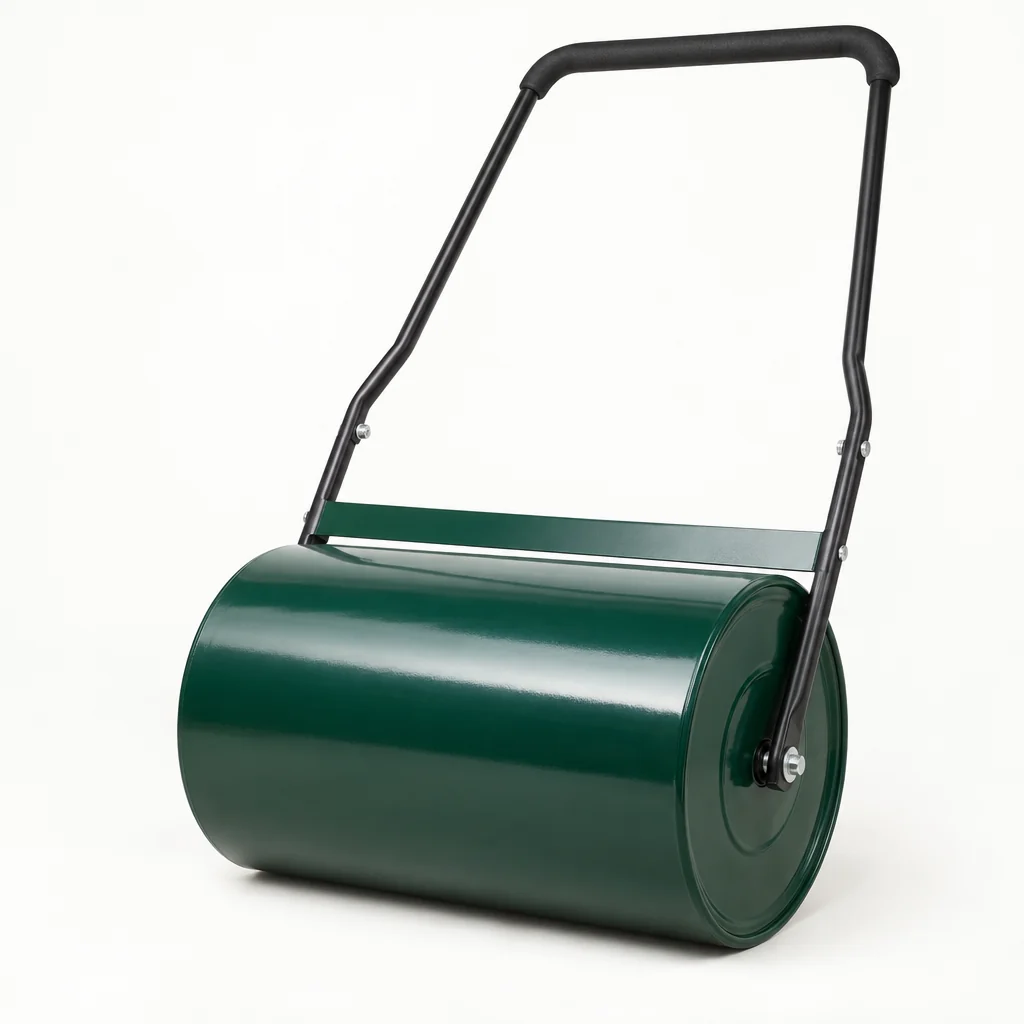
The Cobra LR40 is the most substantial-looking compact option here. Its one-piece steel drum is 50 cm wide and 42 cm in diameter, putting it at the upper end of the small-garden push category. Empty, it weighs 13 kg. It can be filled with water to 72 kg or sand to 120 kg, giving useful flexibility depending on whether you are bedding in seed, settling turf or working on a firmer prepared surface.
That 50 cm rolling width makes it a practical choice for lawns around 100–150 square metres, provided the layout is reasonably open. Folding handles help with storage, whilst the scraper bar prevents debris building up on the rolling surface. That scraper is more useful than it may sound: clods and wet debris stuck to a drum can leave an uneven result precisely when you are trying to create an even finish. The fitted drain plug also makes water filling and emptying straightforward.
For a typical UK garden, the Cobra's sensible appeal is its balance. It has enough potential weight for real lawn-establishment jobs, but it remains a push roller that you can control closely. Fill it only as much as the task requires. With 120 kg of sand on board, it deserves the same cautious handling as any heavy roller.
The Handy THSGR: compact for tight spaces
The Handy THSGR has a 42 cm rolling width. That makes it especially suited to narrow lawns, patio-adjacent strips and smaller sections where a broad roller would spend half its time clipping border edges or requiring an elaborate three-point turn. The Handy is a familiar name in UK garden machinery, and this sort of compact roller fits the practical end of its range well.
A narrower roller does mean more passes over a larger lawn, but that is not necessarily a drawback. For local overseeding or a small new lawn, the extra control can be welcome. It is also the more realistic choice where storage is at a premium. Many garden tools sound manageable until you try to fit them around bicycles, compost bags and the collection of pots that one day may definitely be used.
KCT Standard: simple capacity for modest jobs
The KCT Standard has a 30-litre capacity, making it another option aimed at modest domestic work rather than large-scale rolling. It is the kind of roller to consider if your jobs are limited to small seed areas, occasional patch repairs and careful settling rather than whole-lawn treatment.
Small push rollers suit
- Overseeding and patch repairs.
- New lawns with gates, beds and tight turns.
- Fresh turf in manageable sections.
- Gardeners who need straightforward storage.
They are less suitable for
- Large, open grounds where many passes become tedious.
- Heavy-duty towing or sports-turf preparation.
- Deep hollows, ruts and drainage faults.
- Routine rolling of clay lawns.
For most smaller lawns, I would favour the Cobra LR40 if you want a wider working path and flexible fill options, or the Handy THSGR if compact handling is the priority. Neither needs to be used often. That is a compliment, not a criticism. A garden roller is at its best when it is quietly useful for a few specific jobs and otherwise stays out of the way.
Mid-Range Masters: Push/Tow Combos That Handle Most Gardens
If you have a medium lawn, occasionally lay turf or want the option of towing as well as pushing, the Brinly PRC-24BH is the most balanced model in this guide. Its 61 cm drum width is wide enough to make progress across an open lawn but not so broad that it becomes unwieldy in an ordinary garden. More importantly, it is designed to work as either a push roller or a tow roller.
That flexibility matters. You may want close control when rolling a newly seeded section near beds, then use a suitable tractor or ride-on for an open area later. The PRC-24BH has a universal hitch intended to attach to any brand of tractor, and its rounded ends help avoid damaging turf during turns.
The drum is heavy-duty polyethylene, so it will not dent or rust. That is useful for a tool that may spend much of the year stored, occasionally damp and waiting for its moment. The large-diameter opening is designed to speed filling and emptying, which is a practical advantage whether you use water or sand. A roller that is difficult to drain or refill tends to become a roller that is used at the wrong weight because nobody fancies the faff.
Why this weight is sensible for many residential lawns
At up to 122 kg when filled, the Brinly PRC-24BH has enough mass to settle new turf and carry out serious surface work after proper preparation. It is a meaningful step up from a tiny hand roller, without straying into the territory of the much heavier tow-only machines designed for broad, open ground.
That does not mean 122 kg is automatically appropriate. On clay, wet ground or stressed turf, it can still be too much. But as a maximum available working weight for a versatile 61 cm roller, it gives you options. Fill with water for lighter jobs, use sand only when there is a clear need, and remember that the lawn generally wants one careful pass rather than a demonstration of machinery.
| Feature | Brinly PRC-24BH | Agri-Fab 45-0268 | Cobra LR40 |
|---|---|---|---|
| Working style | Push or tow | Tow only | Push |
| Drum width | 61 cm | 91 cm | 50 cm |
| Filled weight or capacity | 122 kg with sand | 181 kg with water | 72 kg with water; 120 kg with sand |
| Empty weight | 16.8 kg | 20.4 kg | 13 kg |
| Drum material | Heavy-duty polyethylene | Poly construction | One-piece steel |
| Notable detail | Universal hitch and rounded ends | Scraper bar and hose-fill plug | Folding handles and scraper bar |
Compared with the Cobra LR40, the Brinly offers more coverage per pass and towing flexibility. Compared with the 91 cm Agri-Fab 45-0268, it is more adaptable in a mixed-use domestic garden because it can be pushed. That is the point of the PRC-24BH: it bridges the gap between a small hand roller and a tractor-only implement without pretending that every lawn needs commercial weight.
Heavy-Duty Rollers: When You Need Serious Weight and a Tractor to Pull It
Heavy-duty rollers belong to a different category. They are for large gardens of 500 square metres or more, smallholdings, extensive open grounds, sports-turf preparation and similar work where a ride-on or tractor is already part of the setup. They are not the answer to a bumpy suburban lawn, and they are definitely not the right tool for a damp clay garden simply because it has a large patch of grass.
The practical difference is obvious once you look at the dimensions and working weights. These are broad drums carrying several hundred kilograms when filled. They cover ground quickly, but they apply substantial pressure. That can be useful on suitable ground with a clear purpose. It can also cause expensive soil problems if used casually.
Agri-Fab 45-0268: broad, rust-proof and tow-only
The Agri-Fab 45-0268 has a 91 cm-wide, 46 cm-diameter poly drum. It weighs 20.4 kg empty and reaches 181 kg when filled with water. Its poly construction offers rust-proof durability, while a scraper bar prevents soil clumps being compacted onto the drum. The fill plug can be used with a standard garden hose, which is a genuinely practical feature on a roller of this size.
Crucially, it is tow-only. That makes it appropriate for an open site with enough turning room and a suitable machine to pull it. It cannot be converted into a push roller for a fiddly repair beside the patio. If your lawn has lots of obstacles, curved borders or narrow access points, its width becomes a disadvantage rather than a triumph.
Brinly PRC-36BH: a substantial step up
The Brinly PRC-36BH has a 91 cm tow drum and has a larger drum than the PRC-24BH. Its filled weight is not confirmed in available specifications. It is a much more forceful tool intended for larger work. It is not merely a wider version of the mid-range roller; it is a much more forceful tool intended for larger work.
On a broad, well-drained, non-clay lawn where serious rolling is genuinely required after suitable preparation, that weight may have a place. On a normal family lawn, it is excessive. The potential for compaction rises sharply as the load increases, and a towing machine makes it all too easy to make repeated passes because the work feels effortless from the seat. The soil still notices.
Agri-Fab 45-0216C and Ohio Steel 60T Pro: specialist territory
The Agri-Fab 45-0216C is a welded-seam steel roller with a 122 cm-wide, 61 cm-diameter drum and a filled water weight of 413 kg. It has heavy-duty hitch tubes, a scraper bar and dual drain plugs. This is equipment for genuinely extensive ground and an operator who understands the soil beneath it.
Ohio Steel's 60T Pro goes further still: its 61 × 152 cm drum has a capacity of 522 kg. Again, this is not domestic lawn grooming. It is serious tow equipment. If you are considering something of this scale, factor in not only the tractor or ride-on required to pull it, but also turning space, storage, ground condition and whether your underlying problem would actually be better solved with grading, drainage or aeration.
Heavy is not automatically better. A roller carrying 181 kg, 287 kg or more can be appropriate for a large, open, well-drained site. It is not a cure for uneven ground, and it should not be used on clay-rich or saturated soil.
Garden Roller FAQ: The Questions Worth Asking Before You Buy
No. Routine annual rolling of an established lawn can compact soil and weaken grass. Roll only after a job that benefits from it, such as sowing seed, laying turf, light surface work or correcting frost heave.
Only very shallow surface irregularities. Holes deeper than around 3 cm, tree roots, drainage dips, tunnels and tyre ruts need the underlying cause addressed. A roller cannot add soil to hollows or remove the reason they formed.
Water is easier to fill and drain, making it the practical choice for most domestic use. Sand gives higher working weight, but should be reserved for suitable tasks and suitable soils because it increases compaction risk.
No. Wait until it is damp but not waterlogged. Rolling saturated soil can seal the surface, reduce root-zone air circulation and create compaction, particularly on clay.
Drain a water-filled roller before storing it. This makes it easier to move and avoids water freezing inside the drum. Clean off soil and debris, especially around the scraper bar and plug.
The GardenScout Verdict: Use a Roller Sparingly, But Use the Right One
A garden roller is not an essential purchase for every lawn, but it is a genuinely useful specialist tool when you sow grass, lay turf or deal with spring frost heave. The trick is to think of it as a finishing tool, used briefly and deliberately, rather than a lawn-care ritual.
For small UK gardens, a compact push roller makes the most sense. The Cobra LR40 stands out for its 50 cm width, 72 kg water capacity, 120 kg sand capacity and practical details including folding handles, drain plug and scraper bar. The Handy THSGR is a neat alternative for narrower lawns and tight spaces, whilst the KCT Standard's 30-litre capacity suits modest patching and seed work.
For a medium-sized lawn where push and tow flexibility are both useful, the Brinly PRC-24BH is the strongest all-round proposition. Its 61 cm polyethylene drum, 106-litre capacity, rounded ends and universal hitch provide the versatility that most domestic users actually need. It has enough available weight for meaningful work, but it does not immediately force you into the heavy-duty territory where compaction becomes a much larger concern.
Wide tow-only rollers such as the Agri-Fab 45-0268, Brinly PRC-36BH, Agri-Fab 45-0216C and Ohio Steel 60T Pro have their place. That place is large, open, well-managed ground with a suitable towing machine and a very clear reason to roll. For the average lawn, they are more tool than task.
- Roll only for seed, turf, frost heave or very light surface settling.
- Choose a dry-ish, damp day rather than wet ground.
- Avoid rolling clay-heavy soil.
- Use the lightest fill that achieves the job.
- Repair hollows, ruts and drainage issues properly first.
- Drain water-filled rollers before storage.
Final thought
If you remember just one thing, make it this: a roller is for improving contact, not flattening problems into submission. Use it lightly, use it rarely, and your lawn will be far more likely to reward you than retaliate.