
How to Create a Wildlife Garden That Actually Attracts Hedgehogs, Bees and Butterflies
Forget decorative insect hotels and one lonely lavender plant. This is the practical UK blueprint for turning an ordinary garden into somewhere wildlife can eat, travel, drink, shelter and return to.
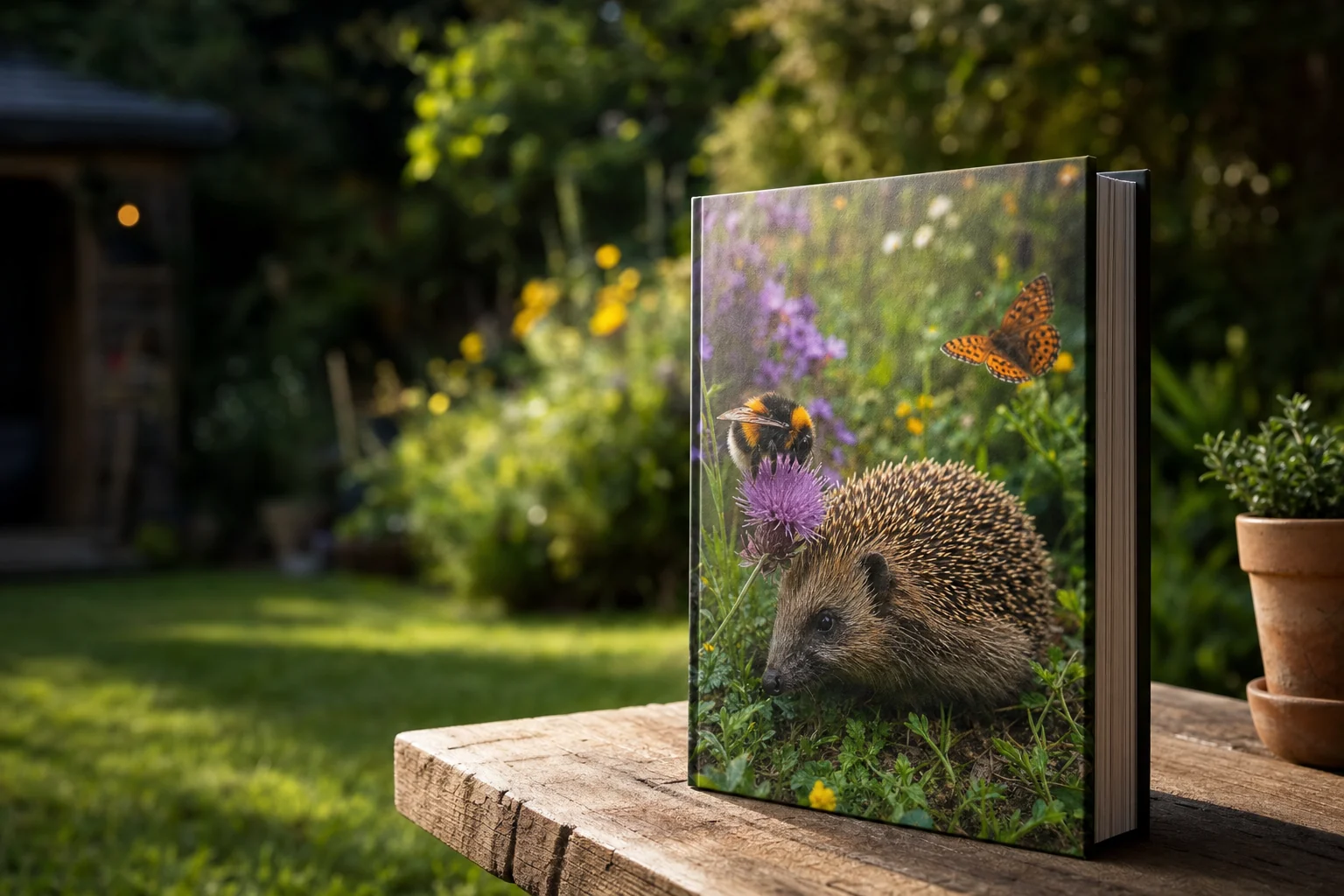
Why Most Wildlife Gardens Fail (And What UK Gardeners Get Wrong)
Wildlife gardening has a marketing problem. It is often presented as a quick shopping list: buy a bee hotel, put up a bird feeder, scatter wildflower seed, stand back and wait for David Attenborough to arrive on the patio. Lovely idea. Slightly optimistic.
A garden becomes useful to wildlife when it solves the unglamorous practical problems: where to find food in lean months, where to get out of a pond, how to move between neighbouring gardens, and where to hide when the weather turns beastly. A little wooden house screwed to a fence can be part of that picture, but it is not the picture.
The need is not abstract. The British Hedgehog Preservation Society reports that UK hedgehog numbers have fallen from roughly 36 million in the 1950s to under one million by 2023: a loss of 97%. Buglife records that the UK has lost 13 bumblebee species since 1900, with two now extinct on mainland Britain. The UK Butterfly Monitoring Scheme shows that 80% of species have declined over the last 40 years. Those are sobering figures, even before you notice that your own garden seems rather quieter than it did a decade ago.
The central mistake: treating wildlife as a visitor
Hedgehogs, bees and butterflies do not need a photogenic stopover. They need a connected patchwork of food, cover and safe routes. Make your garden useful at more than one point in the year and it stops being a stage set for wildlife. It becomes habitat.
The second common mistake is tidiness. British gardeners are very good at clearing leaves, edging lawns, lifting dead stems and making every border look as though it has just had an important meeting. Unfortunately, beetles, caterpillars, earthworms and other invertebrates tend not to thrive in a garden with the atmosphere of a particularly strict hotel lobby.
This is not an argument for abandoning all standards. A wildlife garden can still have paths, clipped hedges, smart pots and a table you would happily sit at. The trick is to be deliberately untidy in selected places. Leave leaf litter under shrubs. Let a corner of grass grow. Build a log pile where it will not annoy you. Plant flowers that overlap through the season rather than all bursting into action for a few glorious weeks in June.
Think in systems, not ornaments. A bee hotel without nearby flowers is a bedroom with no kitchen. A hedgehog house behind a solid fence is a house with no road. A pond with vertical sides is, rather alarmingly, a bath with no exit.
There is also the scale issue. A tiny courtyard cannot support a full meadow or a large pond, and a suburban garden cannot replace a landscape. It can, however, form one useful link in a chain. That matters particularly for hedgehogs, which need connected gardens rather than isolated pockets of goodwill.
My advice is to begin with the least glamorous improvements first: access, water, organic matter and an honest look at what flowers between late winter and autumn. Once those foundations are in place, all the enjoyable planting and building becomes far more likely to earn its keep.
Know Your Wildlife: Habits, Needs and Seasonal Timelines for All Three Species
You do not need to become the neighbourhood naturalist with a clipboard and a torch. Although, to be fair, it is a surprisingly good way to spend an evening. You do need to understand that a hedgehog, a bumblebee and a butterfly are asking very different things of the same garden.
Hedgehogs are nocturnal, largely solitary and surprisingly mobile. They can travel up to 2km in a night, which immediately explains why a lovely sheltered corner in one sealed-off garden is not enough. They hibernate from roughly October to April, depending on conditions, and their active months revolve around finding food, navigating cover and avoiding hazards.
More than 70% of a hedgehog's diet comes from invertebrates, including beetles, earthworms and caterpillars. In practical garden terms, that means leaf litter, rough grass, compost heaps, log piles and dense planting are not decorative extras. They support the food web. If you remove every damp, decaying, slightly scruffy place, you also remove the larder.
Bees are more diverse than most of us casually assume. The UK has more than 270 bee species, and only one of them is the honey bee. There are 24 bumblebee species and more than 240 solitary bee species. They differ in size, behaviour, nesting preferences and the flowers they can use. That is why a planting scheme based on one fashionable flower can look generous to us whilst being narrow in reality.
Some bees will use holes in dead wood or bare ground. Others work among long grass, walls, banks and plant stems. Bumblebees need continuity of forage; solitary bees may need particular nest sites close to those flowers. The important takeaway is simple: "bee-friendly" is not a single setting you switch on. Variety is the setting.
Butterflies have an equally awkward habit of being selective. Adult butterflies need accessible nectar, but their caterpillars need suitable food plants too. A garden that provides nectar but nowhere for larvae to develop may attract an adult briefly without supporting the next stage of its life. This is why allowing a few wilder edges and accepting the occasional nibbled leaf is part of the bargain.
For hedgehogs: connected, covered ground
Build a route through the garden and into neighbouring spaces, then provide sheltered margins where invertebrates can live. The house comes after the route and food supply, not before it.
For bees: flowers with a long season
Prioritise overlapping bloom from February through November, with open flower forms that make pollen and nectar easier to reach.
For butterflies: nectar plus rough edges
Keep feeding opportunities available, but also preserve some less-managed grass, stems and host-plant space. It is not all about the pretty bit.
For all three: safe water
Water must be reachable and escapable. A shallow drinking point helps insects; a pond needs a route out for anything that falls in.
Seasonality is the bit that turns a pleasant wildlife garden into a reliable one. In February, when a bee emerges and there is very little about, a flowering shrub can matter more than a whole summer border. In autumn, ivy and late flowers can be the final refuelling stop before conditions become harder. Meanwhile, hedgehogs need sheltered foraging ground and hibernation potential when most gardens are being "put to bed".
That phrase, by the way, is a little misleading. Wildlife gardens should not be put to bed. They should be allowed to keep a slightly chaotic night shift going.
The Hedgehog Highway: Connectivity, Access Points and Boundary Design
If you do one thing for hedgehogs this year, make it a route. The Hedgehog Street campaign identifies solid garden boundaries as the single biggest cause of suburban hedgehog decline. It makes complete sense once you picture a hedgehog trying to cover a large nightly range while every fence panel behaves like the wall of a small fortress.
The practical answer is a hedgehog highway: a 13cm by 13cm gap at the base of a boundary. This is the standard recommended by Hedgehog Street. It is small enough to exclude foxes and cats, whilst allowing hedgehogs to travel between gardens. One gap is useful; a chain of neighbours creating gaps is transformational.
The neighbour conversation is the real tool
A single garden can offer food and shelter, but hedgehogs need a network. Ask the people either side if they will make or retain one 13cm by 13cm opening. It is a wonderfully low-drama community project, especially compared with discussing fences in general.
How to make a hedgehog hole without creating a boundary headache
Before cutting anything, check where the gap will lead. Choose a quiet section away from busy paths, gates, bonfires, ponds with no escape route and places likely to flood. If the garden next door contains a dog, talk first. A gap works best where it remains open and is not immediately blocked by stored pots, gravel boards or enthusiastic landscaping.
Wooden fence panels
Mark a 13cm by 13cm square at ground level in a lower section of the panel. Cut carefully, smooth any sharp edges and make sure the opening remains clear after soil, mulch or leaves shift around it.
Brick walls
Where the construction allows, remove or adapt a low-level brick-sized section to create the required clear opening. The important thing is the finished internal space, not whether it looks Instagram-ready.
Concrete gravel boards
A purpose-made opening or a careful adaptation at ground level can work. Keep the route free from rubble and avoid leaving snagging points that might injure an animal passing through at night.
Keep the route boring. A hedgehog highway does not need bait, lights, decoration or a tiny "welcome" sign. It needs to remain clear, low, safe and open in every season.
Connectivity also changes how you arrange the garden itself. A hedgehog is more likely to use a route with cover nearby than an exposed dash across a bright patio. Planting along boundaries, low gaps under shrubs and a discreet corridor beside a border all make movement feel safer. You are not building a maze. You are reducing the number of dead ends.
Be cautious with netting, deep holes and ponds. A connected garden is only helpful if it is navigable. Check netting before nightfall, cover hazards where possible and fit an escape route to any water feature. The wildlife garden ideal is not simply "more nature". It is fewer avoidable traps.
Planting for Pollinators: Building a Bloom Calendar That Feeds Bees and Butterflies from February to November
Most ornamental gardens have a spectacular but brief confidence peak. June and July arrive, everything flowers at once, and for a few weeks the place looks as though it has won a prize. Then the gaps appear. For pollinators, those gaps matter more than the peak.
Bees need forage from February to November. The RHS Perfect for Pollinators list has assessed more than 400 plants, but you do not need to cram hundreds into a border. You need a deliberate sequence: early flowers before spring has properly started, reliable summer resources, and late flowers when the rest of the garden is fading.
Use UK-native and near-native plants where you can, particularly those with open, accessible flower structures. Doubled blooms may look impressively frilly, but they can make access to pollen and nectar more difficult. A simple flower is often more useful than a show-off.
| Planting approach | Flowering pattern | Value for pollinators | What it needs from you |
|---|---|---|---|
| Peak-summer ornamental border | Strong June–July display | Can be useful in peak season, but leaves early and late gaps | Regular deadheading and a plan for the quiet months |
| Single "bee-friendly" feature plant | Short, plant-specific flowering window | Helpful as one food source, limited as a complete strategy | Works best as part of a larger mix |
| Bloom-calendar planting | Overlapping flowers from February to November | Supports a wider range of bees and butterflies over more of the year | Some planning, then sensible maintenance |
Early season: February to April
This is where many gardens quietly fail. There may be plenty of flowers in summer, but early forage can be thin just when emerging bees need it. Start with Crocus tommasinianus, Pulmonaria and Helleborus niger in borders or containers. For larger gardens, blackthorn (Prunus spinosa) and goat willow (Salix caprea) bring useful early blossom and structure.
Crocuses work particularly well threaded through grass or under deciduous shrubs, where they catch early light before the canopy develops. Pulmonaria is excellent in shadier conditions and earns its place without needing to look theatrical. Hellebores offer a more composed border look, which is handy if your wildlife ambitions are being judged by someone who believes a garden should still look "done".
Mid-season: build density, not a monoculture
Through late spring and summer, aim for groups of plants rather than isolated singles. A pollinator should not have to tour the entire garden for each sip of nectar. Repeating a few suitable plants in drifts makes feeding more efficient, whilst using several different types prevents the whole garden from depending on one flowering moment.
Keep flower forms simple and accessible. Think of each border as a buffet with several opening hours, not a single wedding cake wheeled in for July.
Late season: the bit everybody forgets
By autumn, many borders are fading precisely when pollinators still need food. Ivy and Mahonia extend the season into November, filling the nectar gap that conventional planting often leaves behind. They may not always be the plants people get most excited about in a garden centre, but wildlife gardening rewards the dependable types. The ones who turn up late, do the washing-up and bring snacks.
February–April: start early
Use Crocus tommasinianus, Pulmonaria, Helleborus niger, blackthorn and goat willow to offer forage before the main growing season has gathered pace.
Spring–summer: overlap flowering
Choose groups of open flowers and arrange them so one group comes into bloom before another finishes. Continuity matters more than a one-off blaze of colour.
Autumn–November: leave a final fuel stop
Include ivy and Mahonia so the garden is not effectively closed for business once September arrives.
Design trick: repeat, then vary
Repeat a few good pollinator plants in several parts of the garden, then vary their flowering periods. It looks coherent to human eyes and creates a more dependable sequence for insects. This is one of those unusually pleasing moments when good design and good habitat agree.
Containers count too. If you rent, garden on a balcony or have a small paved space, several pots with different flowering times can make a meaningful forage stop. Put them where they receive the conditions the plants need, keep them watered, and avoid treating them as disposable seasonal décor. A pot can be habitat. It just has to be more than a pot with one cheerful thing in it for a fortnight.
Lawn Alternatives and the 'No Mow May' Debate: What the Science Actually Says
No Mow May is one of those ideas that sounds almost suspiciously easy. Do less mowing. Get more flowers. Help wildlife. It is hard not to like the pitch, especially when the alternative is spending a Saturday pushing a noisy machine round in circles.
Plantlife's 2021 survey of 250,000 front lawns found that unmown lawns produced 23 times more nectar sugar than mown equivalents. That is a serious difference, and it explains why letting some grass grow can be far more useful than merely adding a token flowerpot to an otherwise tightly managed plot.
But the phrase "No Mow May" can make the approach sound all-or-nothing. It does not have to be. A long lawn may not suit every garden, every family or every neighbourly relationship. The RHS mini-meadow approach offers the sensible middle ground: retain a mown path through longer grass. The path makes the choice look intentional, gives you access and prevents the space from feeling as though you have simply misplaced the lawnmower.
The useful lawn plants are not exotic rarities. White clover (Trifolium repens), bird's-foot trefoil (Lotus corniculatus), selfheal (Prunella vulgaris) and dandelions all deserve a little more respect than they receive in the average mowing schedule. These flowers create nectar opportunities, and the longer structure provides more variety than a uniform clipped surface.
Do not confuse "long" with "ignored". A mini-meadow works best when you decide where it belongs, keep a path clear and avoid cutting every inch on the same day. Wildlife benefits from unevenness and continuity.
For hedgehogs, longer grass and rougher margins can contribute to the invertebrate-rich ground they need. For butterflies and bees, flowering lawn plants provide forage. For you, it may mean fewer mowing sessions. A rare three-way agreement.
There are limits. A lawn that has been closely mown for years may not instantly turn into a flower-rich meadow just because you stop cutting it for a month. What appears depends on what is already present in the soil and around the garden. Still, allowing existing flowers to bloom is worthwhile, and it gives you information. You may discover clover, selfheal or dandelions that your old mowing pattern had never allowed to introduce themselves.
Start with a test strip
If a whole lawn feels like a leap, leave one edge or one broad island unmown and cut a route around it. Watch what appears. You can expand next year without turning the garden into an experiment conducted by a very optimistic hay bale.
The best compromise is usually a mosaic: short grass where you sit or play, longer grass at the margins, and a few flowers allowed to bloom between. Gardens need not choose between bowling green and wilderness. Most of the interesting options sit somewhere in the middle.
Hedgehog Houses, Bee Hotels and Butterfly Boxes: What Works, What Doesn't and What's a Waste of Money
Wildlife homes are where good intentions most often meet questionable design. There are plenty of products that look charming in a photograph, especially when mounted on a rustic fence beside a perfectly styled trowel. Their usefulness depends on details that are much less glamorous: dimensions, placement, airflow, access and whether the surrounding garden actually provides food.
A hedgehog house can be useful, especially where the garden already has cover, invertebrates and a connected route. The key design features are a minimum internal space of 30cm by 30cm, a 13cm by 13cm entrance tunnel, a weatherproof roof and untreated timber. Position it facing north or east to reduce overheating, partly buried into leaf litter, away from flood risk and at least 2m from a fence boundary.
That last point can feel counterintuitive when the fence is the obvious place to hide something. But hedgehogs need a calm, protected site rather than a busy edge where disturbance is likely. The house should feel like a tucked-away refuge, not a garden accessory placed for maximum visibility.
| Shelter option | What makes it useful | Where it goes wrong | Best role in the garden |
|---|---|---|---|
| DIY hedgehog house | Can meet the required 30cm by 30cm internal size, 13cm by 13cm tunnel and untreated-timber approach | Placed on exposed ground, in flood-prone spots or without food and access nearby | Quiet refuge within a wider hedgehog-friendly system |
| Commercial hedgehog house | Convenient if it provides the correct entrance, weatherproofing and suitable internal space | Buying the look rather than checking the practical details | A ready-made alternative where placement is carefully considered |
| Bee hotel | Can complement flowers and varied nesting habitat for some solitary bees | Used as a substitute for planting, bare ground, stems and natural habitat | One small part of a varied pollinator garden |
| Butterfly box | May add visual interest to a wildlife area | Assumed to replace nectar, caterpillar food plants or sheltered rough vegetation | Strictly secondary to planting and habitat structure |
A simple DIY hedgehog house is endorsed by both the RHS and the British Hedgehog Preservation Society. Using timber offcuts, this can cost roughly £5–£15. Commercial options are commonly in the £20–£60 range. The DIY route is not automatically better, but it has one considerable advantage: you can make the dimensions and tunnel arrangement do the actual job rather than hoping the decorative version happens to be suitable.
What is worth doing
- Use untreated timber and a weatherproof roof for a hedgehog shelter.
- Check for a minimum 30cm by 30cm internal area and a 13cm by 13cm tunnel entrance.
- Set the house north or east facing, partly into leaf litter and away from flooding.
- Pair any shelter with a hedgehog highway, cover and invertebrate habitat.
- Treat bee hotels as an optional addition to flowers and natural nesting opportunities.
What wastes effort
- Buying a wildlife house before solving food, water and connectivity.
- Placing a hedgehog house beside a busy boundary or exposed patio.
- Using treated timber where wildlife may shelter.
- Assuming a bee hotel can compensate for a garden with few flowers.
- Expecting butterfly boxes to do the work of nectar plants and rough habitat.
Bee hotels are not useless, but their reputation has run ahead of their role. Some solitary bees may use them, yet a genuinely bee-friendly garden also needs flowering plants, undisturbed areas and different nest opportunities. Bare patches of soil, stems, dead wood and long grass all contribute to that broader picture.
Butterfly boxes are even more easily overestimated. If you enjoy one as part of a wildlife-themed garden, fine. Just do not let it become the entire plan. Nectar, caterpillar food plants, sheltered vegetation and a pesticide-free approach are the heavy lifters. The little box is the supporting cast.
Buy details, not sentiment. For hedgehog houses, dimensions and placement matter. For pollinator shelters, habitat around the shelter matters more than the object itself. A charming roofline has never fed a caterpillar.
Water Features That Work: From Hedgehog-Safe Ponds to Bee Drinking Stations
Water is one of the quickest ways to make a garden feel alive. It catches light, adds movement and, on a warm day, gathers insects with almost suspicious efficiency. It can also become a hazard if designed only for human eyes.
RHS research shows that a garden pond can increase wildlife diversity by up to eight times compared with gardens without water features. That does not mean every garden needs a large formal pond with a bridge, a fountain and an alarming maintenance schedule. It means that water, when safely designed, creates opportunities that dry gardens simply do not offer.
The Wildlife Trusts' minimum effective pond recommendation is 1m by 1m and 45cm deep. Smaller ponds can still be attractive, but they experience greater temperature fluctuation and tend to support less biodiversity. If you have space for the recommended size, it is a very strong starting point.
For hedgehogs, gradual sloping sides are critical. Keep banks no steeper than 30 degrees and include an exit ramp. Vertical-sided ponds are dangerous because a hedgehog that falls in may be unable to climb out. A mesh ramp is a practical option, provided it reaches securely from the water to dry ground and remains clear.
Build a shallow margin
A gradual edge makes water accessible for insects and gives animals a natural route in and out. It also looks softer than a hard-sided hole in the ground, which is not nothing.
Add an escape ramp
Use a secure mesh ramp or another reliably textured exit route. Check that it still reaches the water as levels change.
Offer drinking points for insects
For bees, shallow water with safe landing places is more useful than a deep open container. The aim is refreshment, not an obstacle course.
Keep the pond part of the habitat network
Put cover and planting nearby, but do not create a hidden hazard. Wildlife should be able to approach, drink, leave and continue through the garden safely.
Every pond needs an exit strategy
Before you fill the pond, stand back and ask one very simple question: if a hedgehog falls in at night, how does it get out? If the answer involves you noticing in the morning, redesign it.
A small bee drinking station can be much simpler: a shallow container with stones or other stable landing points so insects can drink without slipping into deeper water. Keep it topped up during dry spells and position it near flowers, but not so close that the whole area becomes congested. Bees do not need a spa complex. They need a dependable sip.
Whatever your scale, avoid viewing water as a purely ornamental centrepiece. A safe pond is a living part of the garden. It should have edges, exits and nearby cover, not just reflections.
Composting, Log Piles and Leaf Litter: The Unglamorous Backbone of a Wildlife Garden
This is the section where wildlife gardening becomes less about buying attractive things and more about leaving useful things alone. Compost heaps, decaying logs and leaf litter are not the glamorous bits you show off first. They are the bits doing much of the work.
Hedgehogs obtain more than 70% of their diet from invertebrates, and many of those invertebrates live among damp, decaying organic matter. A log pile is not merely a rustic feature. Leaf litter is not just an unfinished job. Compost is not a guilty corner behind the shed. Together, they create the conditions in which food can live.
An open-bottomed compost heap allows hedgehog access. Wire mesh sides support airflow, and a minimum size of 1m by 1m by 60cm is recommended for viable hibernation use. Do not treat that as a guarantee that a hedgehog will move in; wildlife is not taking bookings. Think of it as creating the kind of sheltered, warm, living structure that may become useful.
Check before you disturb. Compost heaps and log piles can provide cover, particularly in cooler months. Before turning, moving or dismantling them, inspect carefully and work slowly. The best habitat is not much help if it is repeatedly demolished without warning.
How to make a log pile that does more than look vaguely woodland-ish
Use native hardwoods such as oak, ash and hazel. Start with base logs at least 15cm in diameter, partially burying them to retain moisture. Place the pile in semi-shade, where it is less likely to bake dry and more likely to hold the damp conditions many invertebrates favour.
Stack further branches loosely above and around the base rather than making a perfectly neat tower. Voids and crevices are useful. So are leaf litter and small twigs tucked around the edges. You are creating a small, slowly changing habitat rather than assembling garden furniture.
Compost heap: keep the base open
An open-bottomed heap lets wildlife access the ground beneath, whilst wire mesh sides help the heap breathe. Aim for at least 1m by 1m by 60cm if hibernation use is a possibility.
Log pile: use substantial base logs
Choose oak, ash or hazel logs with a minimum 15cm diameter. Partly bury the base pieces and position them in semi-shade for better moisture retention.
Leaf litter: leave it where it helps
Gather fallen leaves beneath shrubs, around the log pile or near a sheltered corner rather than bagging every last one. It provides cover and supports the tiny life that feeds larger animals.
Tidy paths, messy margins
The easiest way to keep a wildlife garden looking intentional is to maintain the parts you use and relax around the edges. Sweep the path. Weed the patio if you wish. Then let the hedge base, log corner and back border get on with being useful.
Leaf litter is especially valuable beneath shrubs and hedges, where it does not look out of place and is less likely to blow around the whole garden. It supports invertebrates, holds moisture and creates cover. If you must clear leaves from lawn or paving, relocate them rather than treating them as waste.
This is also where pesticides and a wildlife-garden mindset sit rather awkwardly together. If your aim is to encourage insects, caterpillars and the creatures that eat them, wiping out every insect that appears is not an especially coherent strategy. A little damage is part of a living system. The occasional nibbled leaf is not a personal insult from nature.
A Realistic Wildlife Garden Plan for Different Kinds of Gardeners
The best wildlife garden is not necessarily the largest, most expensive or most elaborate. It is the one you can maintain without resenting it by August. Start with the changes that fit your space and routine, then add layers over time.
Small garden or courtyard
Focus on pots with overlapping flowers, a shallow bee drinking point, leaf litter under shrubs and a 13cm by 13cm hedgehog route if boundaries allow.
Busy family garden
Keep lawn for use, but create one mini-meadow strip with a mown path. Add safe pond exits and explain why the "messy" corner is not available for football.
Established suburban garden
Prioritise neighbourhood connectivity, a proper pond, layered planting and a compost or log area. This is where small improvements can join up into real habitat.
If you are starting from a conventional garden, do not try to change everything at once. Make a hedgehog hole. Stop clearing one sheltered leaf-litter area. Add early and late flowers. Leave one lawn edge longer. Add a safe exit to existing water. Those are modest jobs, but they address the actual bottlenecks wildlife faces.
Then observe. Which flowers are busy? Does the long grass develop clover or selfheal? Is leaf litter staying damp beneath the hedge? Do you see evidence of hedgehog movement? A good wildlife garden is not installed once. It is adjusted as you learn what the space can support.
The GardenScout Verdict
A wildlife garden that actually attracts hedgehogs, bees and butterflies is not built around novelty products. It is built around continuity. Continuous access for hedgehogs. Continuous flowers for pollinators. Continuous pockets of cover, water and decaying organic matter for the creatures lower down the food chain.
Start with a 13cm by 13cm hedgehog highway, plan bloom from February to November, leave selected areas a little rougher, and make every water feature escapable. Add a log pile, compost heap and a mini-meadow strip when you can. It will not all look immaculate. That is rather the point. It will look alive.