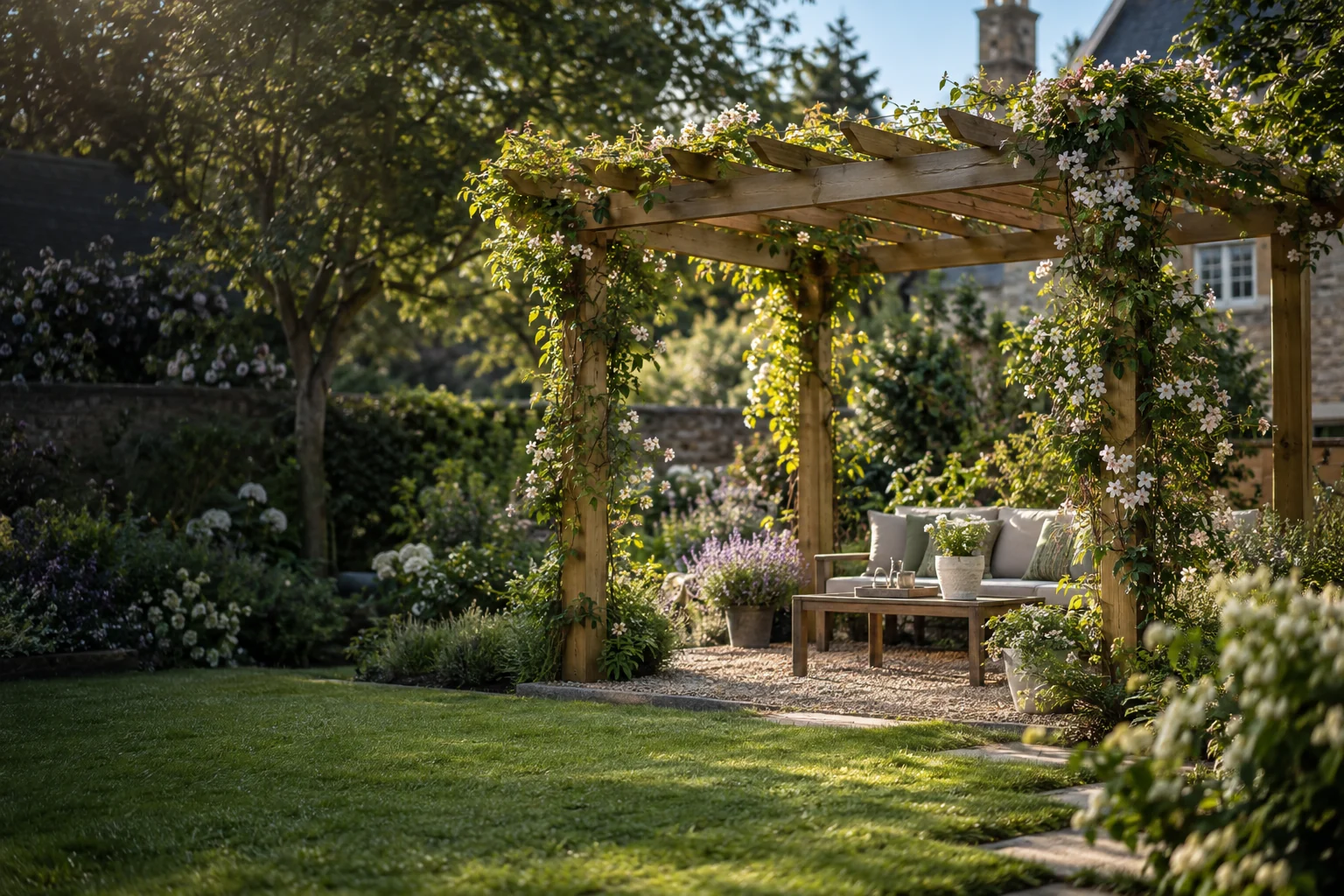
The short answer
Choose an arbour to mark a path, bench or view, and a pergola to create an outdoor room such as a dining area. Allow around 2.7m of height for climbers and use 8 × 8cm uprights. Keep a pergola under a third of your garden, space rafters 30–40cm apart for real shade, and build for the climber's mature weight.

Use it to check the available width, depth and headroom before ordering an arbour or pergola, and to compare the structure’s footprint with nearby paths, seating and boundaries.
Check price on AmazonWe link to the exact model on Amazon UK. Prices change often, so check the live price before you buy. As an Amazon Associate we earn from qualifying purchases.
Late October is a surprisingly good time to make this decision. The garden is beginning to show its bones, leaves are thinning, and that cheerful climber which looked perfectly manageable in June is now revealing precisely where it intends to go next year. It is also easier to see winter shade, overlooked corners and the routes you actually take through the garden. All very useful information before you commit to several substantial posts and a structure which will, ideally, be there for many years.
An arbour or pergola can be a simple purchase on paper: choose a shape, build it, plant something romantic beside it, admire results. In real gardens, however, the best ones come from getting a few unglamorous decisions right first. Is the purpose to make a path feel like an entrance? Create shade over a table? Hide the view of next door's bins without making your own garden gloomy? Give a greedy rose somewhere appropriate to go? Those questions matter more than whether the roof ends have a particularly jaunty curve.
Here is how I would approach it: begin with the job, measure the space honestly, consider sunlight through the whole year, then select a material and planting scheme that fit both your garden and your appetite for maintenance. The finished structure should feel inevitable, rather than like a gazebo that accidentally wandered into a flower border.
Arbours vs Pergolas: Understanding the Difference Before You Buy
The terms are often used rather loosely, which is understandable because both involve posts, overhead timbers or metalwork, and plants eventually doing their best to obscure the lot. They do different jobs, though.
An arbour is generally a smaller, more intimate structure. It is often an arch or short tunnel over a gateway, path or bench, with open sides designed to support climbers. Its main purpose is decorative and directional. It says "something is happening here", even if what is happening is simply that you have reached the compost bin. A well-positioned arbour makes a threshold feel deliberate: the entrance to a vegetable plot, the beginning of a winding path, or a little sitting spot tucked into planting.
A pergola is usually larger and more architectural. It defines an outdoor room or route whilst leaving the sky substantially open. Posts support beams and rafters overhead, creating partial shelter, a measure of enclosure and, once planted, dappled shade. Put one over a terrace and the seating area gains a ceiling of sorts. Run one along a path and the journey through the garden becomes more interesting. It is not a roof in the conventional sense. That is rather the point.
Think of the frame and planting as one design
A bare pergola may look purposeful, but it is only half finished. Equally, a magnificent climber on a flimsy frame is a future repair job in waiting. Buy and plant as a pair: the structure must suit the mature weight and habit of what will grow over it.
Choose an arbour for a pause or transition
Arbours work brilliantly in smaller gardens where one well-made focal point earns its keep. Use one to frame a view, mark a path entrance, shelter a bench a little, or create the sense that there is another garden beyond it.
Choose a pergola to make an outdoor room
A pergola is more useful where you want a dining area, terrace, deck, broad walkway or sitting area to feel contained without becoming a dark, fully enclosed structure.
Use both as living architecture
Climbers soften hard lines, bring scent and seasonal colour close to eye level, and alter the quality of shade. Deciduous climbers can make a structure leafy in summer and bright again in winter. Very civilised.
The distinction is especially helpful when space is tight. A large pergola can dominate a modest plot rather quickly, particularly before plants have grown in. An arbour, by contrast, can create drama on a far smaller footprint. If you only need to frame a narrow path or give a rose somewhere to climb, a full pergola may be the garden equivalent of bringing a grand piano to a picnic.
For medium and larger gardens, pergolas earn their space because they organise it. They can connect the house to the garden, divide a lawn from a terrace, make an exposed seating area feel more comfortable, or pull your gaze towards a distant border. A long pergola over a route also makes a garden feel longer and more layered, which is useful if your plot is broad but lacks a sense of journey.
Getting the Size Right: Dimensions, Headroom and Garden Proportions
Measure twice, then measure with the chairs, table, barbecue, doors, borders and the person carrying a tray of tea in mind. It is amazing how roomy an empty rectangle appears until furniture arrives. A pergola intended for dining should cover the dining area, not simply hover decoratively over the middle of the table like a slightly confused hat.
For a compact seating zone, standard pergola footprints often begin at around 2.4 × 2.4m (8 × 8ft). That can make a useful destination at the end of a small garden or a sheltered spot for a compact table and chairs. Larger patio pergolas commonly extend to around 4.9 × 4.9m (16 × 16ft) and beyond. At that scale, the structure is defining a genuine outdoor room rather than making a visual gesture.
Most pergolas are between 2.1m and 2.7m (7–9ft) high. For a structure intended to carry climbers across the roof, around 2.7m (9ft) from ground level to the uprights is a helpful guide. It provides decent headroom, leaves room for climbers to drape down a little, and avoids that unfortunate feeling of ducking beneath a very expensive collection of stems.
(8 × 8ft)
(16 × 16ft) or more
(7–9ft)
(9ft)
(2 × 2in)
(3½ × 3½in)
Post size matters both structurally and visually. Uprights should be at least 5 × 5cm (2 × 2in), but 8 × 8cm (3½ × 3½in) is a better target for a structure expected to carry established climbers. Larger pergolas may use posts with diameters from 95mm to 150mm. Besides their practical role, these chunky uprights have more visual weight. That can look wonderful beside a substantial house or broad terrace, but overwhelm a delicate cottage border.
There is a proportion question here which is easy to overlook. A pergola should not usually occupy more than a third of your total outdoor space. It is a rule of thumb, not a planning law, but it is a useful brake on enthusiasm. A structure that consumes most of a garden makes everything else seem secondary: the lawn becomes a narrow strip, borders become awkward margins, and the view from indoors becomes "posts".
For an arbour, start by measuring the route through it. Can two people pass comfortably? Can you move a wheelbarrow or garden furniture through if needed? Does the path already have a pinch point? If the arbour contains a seat, allow enough space in front of it that someone can sit down without stepping immediately into a bed. These are very ordinary considerations, but ordinary is generally where good design lives.
Mock up the bulk before buying
Use canes, string, cardboard or even a few old sheets held between poles to mark the footprint and height. Stand at the kitchen window, sit where you expect to sit, and walk the routes around it. Do this now, while autumn reveals the garden's true shape, and again on a sunny day if possible.
Do not forget the planting zone. A climber planted directly against a post still needs a decent patch of open soil, not a narrow crack between paving slabs. If your pergola sits on a patio, plan border openings or generous containers from the beginning. Trying to provide roots with a home after construction usually involves lifting paving, regretting things, and discovering that every project has one buried cable somewhere.
Choosing Your Material: Wood, Metal, Vinyl and Beyond
Material changes nearly everything: the look of the frame, the maintenance it will demand, the thickness of the members, how easy it is to attach plants, and whether it will settle into the garden or remain a deliberate contrast. There is no universally best choice. There is only the choice that suits your garden, budget, building confidence and tolerance for annual jobs.
Timber: the natural default
Timber remains the obvious choice for many British gardens because it belongs comfortably beside brick, gravel, lawns and planting. It is easy to adapt, easy to repair, and generally kind to climbers. You can screw in vine eyes, staple wires, attach trellis and make small adjustments without feeling as though you need an engineering qualification.
Cedar and redwood are valued for their natural resistance to rot and their ability to take stain well. They offer a refined finish for gardens where the pergola will be seen close up from the house. Pressure-treated pine is the practical workhorse: widely used, more accessible, and well suited to many off-the-shelf timber kits. It does need periodic retreatment if you want it looking good and performing well for the long haul.
Oak is the handsome option. It is extremely durable, wonderfully solid and well suited to traditional gardens, old brick, gravel paths and places where a slightly more permanent feel is wanted. Left to weather, it develops that attractive silver-grey tone which makes a new structure look as though it has always been there. Oak is not the option for somebody seeking lightweight, speedy assembly. But then neither is a stone wall, and we still like those.
Rustic frames made from un-milled sweet chestnut logs have a looser, more informal character. They are particularly lovely in wildlife gardens, cottage gardens and woodland-style planting, where straight, polished timber might feel too neat. Sweet chestnut has good natural rot resistance. The irregularity is part of the charm, but it does mean you should inspect joints and stability carefully: rustic should mean characterful, not wobbly.
Metal: slim, modern and sometimes deceptively light
Steel and aluminium offer a different mood altogether. A powder-coated aluminium pergola can be crisp and contemporary, with slimmer lines than a timber equivalent. It suits modern patios, rendered walls and gardens where furniture is similarly clean-lined. Aluminium is also useful where you want less routine maintenance than timber requires.
Steel can be elegant, strong and well suited to a more ornate garden arch or arbour. Hardened steel models are often found at the accessible end of the market. The main caveat is planting: a vigorous rose or wisteria does not care that a frame looked delicate in the catalogue. It will simply continue climbing until something gives. Check the quality of welds, the protective finish and how securely the structure can be anchored before giving a light metal arch a permanent woody climber.
Metal also gets hot in strong sun, which is rarely the central issue in Britain but can matter on a south-facing wall or patio. Keep tender young stems tied clear where possible, and remember that metalwork can become much less discreet after a few years if scratched coating exposes it to weather.
Vinyl and composite: tidy, low-maintenance alternatives
Vinyl and composite structures appeal if you want a clean appearance with resistance to rot and insect damage. They can be a sensible answer for a low-maintenance garden, particularly where painting, staining and annual inspections are not your idea of a restorative Sunday. Their look is more controlled and less organic than timber, however. In a very naturalistic garden, they can feel a little too pristine until planting has had time to soften them.
Whatever the material, consider how it will look in February. Summer planting is generous and forgiving. Winter is not. A good frame should still sit comfortably in the garden when it is bare, wet and being inspected by a blackbird with very high standards.
| Material | Best character | Maintenance outlook | Good match for |
|---|---|---|---|
| Pressure-treated pine | Traditional and adaptable | Benefits from periodic retreatment | Everyday garden pergolas and timber kits |
| Cedar or redwood | Refined natural timber finish | Naturally rot-resistant; takes stain well | Close-to-house structures and detailed joinery |
| Oak | Substantial, classic and long-lived | Weathers naturally to silver-grey | Traditional gardens and permanent focal points |
| Sweet chestnut logs | Rustic and informal | Good natural rot resistance | Cottage, wildlife and woodland-style schemes |
| Aluminium or steel | Slim, modern or ornate | Protective finish should be kept in good order | Contemporary patios and lightweight arches |
| Vinyl or composite | Consistent, tidy appearance | Resists rot and insects | Low-maintenance gardens |
Timber's strengths
- Looks at home in most planting styles and ages gracefully.
- Easy to customise with wires, trellis, hooks and repairs.
- Chunkier posts can give a pergola reassuring presence.
- Particularly forgiving when training roses and clematis.
Timber's trade-offs
- Requires attention if you want to preserve its finish.
- Softwood can look tired if water is allowed to sit in joints.
- Heavy climbers can conceal areas that need inspection.
- Large hardwood sections are weighty and less forgiving to install.
Siting for Sun, Shade and Shelter: Getting the Position Perfect
Before you decide where the pergola ought to go, spend time noticing where you already go. The obvious central patio is not always the nicest place to sit in July. The sheltered spot behind the shed might catch beautiful evening light. The gap beside the house may be useless for chairs but perfect for a rose-covered passage. Gardens are full of these small revelations, provided you stop treating them as a collection of rectangles.
In the UK, a south-facing pergola or arbour receives the most sun across the day. That makes it a good choice if your aim is a sun-trap seating area, a scented rose overhead, or a place where seasonal colour can really perform. It also means a dense evergreen climber or an overly solid roof treatment may turn a welcome sunny space into a rather dim one. Shade is lovely until it is all you have.
If shade is the priority, a north- or east-facing position can be much more forgiving, particularly for a sitting area used during hot afternoons. This is increasingly relevant in the south-east of England, where exposed patios can become surprisingly fierce in summer. Existing trees, a house wall and boundary planting can also help. A pergola does not need to create every bit of shade itself; sometimes it simply needs to complete a comfortable patch of it.
In October, take particular notice of long shadows. From October to March, the sun is far lower in the UK sky, so structures and neighbouring buildings cast shadows much further than they do in midsummer. A pergola which feels airy in June may shade a border for much of the shorter winter day. This is not necessarily a problem, but it should be a conscious choice — especially if you are growing vegetables or sun-loving perennials nearby.
Do a sun check before ordering. Observe the intended site in the morning, around midday and later in the afternoon. Repeat across seasons where you can. Make a note of where shade comes from, whether it moves quickly, and whether the site is breezy enough to make a fabric canopy or leafy roof less enjoyable.
South-facing: colour, warmth and more active growth
Good for sun-lovers and seating areas where warmth is the point. Pair with deciduous climbers if you want foliage overhead in summer but more winter light once leaves fall.
North- or east-facing: softer light and cooler afternoons
Useful for shade-focused sitting areas, though it can be slower for plants that expect full sun. Consider carefully what will actually thrive there before filling every post with climbers.
Near a wall: shelter with a dry-side warning
A wall can provide warmth and protection, but it can also create a rain shadow. Planting at the base may need more careful watering, especially during the establishment period.
Shelter matters almost as much as sunlight. A tall pergola can catch wind, and a canopy or dense climber adds surface area. Avoid forcing a substantial structure into the windiest exposed corner unless it is designed and secured for that job. If your garden funnels wind between the house and a boundary fence, even a small arbour can become an enthusiastic wind instrument. Charming for about four minutes.
Think about sightlines too. An arbour is particularly effective when it frames something worth looking at: a clipped evergreen, a specimen tree, a bench, a distant border or simply the next section of garden. A pergola can conceal less attractive views, but do not block a good one just because you have found a flat bit of paving. Stand inside the house and look out. The view from the kitchen is often where the structure will be judged most often.
The UK Market at a Glance: What to Expect at Each Price Point
There is a vast difference between a lightweight garden arch intended for seasonal annuals and a permanent pergola designed to take decades of woody growth. Price alone does not tell the whole story, but it does give a fair indication of material section, construction, fixing quality and the level of confidence you should have before unleashing a rambler rose.
At the entry level, expect compact metal arbours and lighter timber kits. The Shire Ivy Pergola Kit 8 × 8, made from pressure-treated timber, is listed at £129.99. The Rowlinson Wrenbury, in hardened steel, is listed at £199. The Zest Ascot Pergola, with 90mm square legs, is listed at £229. These can make an appealing start for a path marker, a smaller sitting point or lighter planting, but it is worth being realistic about what you ask them to carry.
A vigorous perennial climber becomes considerably heavier as it matures, especially after rain. At this level, examine how the structure is anchored, whether its uprights are substantial enough for the intended job, and how easily you can inspect or tighten fixings after a winter of wind. A light arch can be delightful with sweet peas, nasturtiums or an annual display. It is a different proposition with an old rose and three years of growth.
In the middle ground, better-quality pressure-treated timber pergola kits begin to make more sense for patios and dining spaces. The Large Ultima Pergola Garden Arch is listed at £315, while the Mercia Traditional Wooden Pergola, measuring 3.05 × 3.05m (10 × 10ft), is listed at £499.99. Here you are generally looking for more useful beam and rafter proportions, more robust post sections and a frame that can form the basis of a real planted feature.
Further up the scale, hardwoods and powder-coated aluminium structures bring a more finished appearance and often cater for more specialised uses. The Savannah BBQ Pergola, measuring 1.5 × 3m, has an aluminium structure with a wood-effect finish and is listed at £1,599. In this territory, the question becomes less "can I have a pergola?" and more "what kind of outdoor room do I want it to become?"
Shire Ivy Pergola Kit
Pressure-treated timber; 8 × 8ft footprint.
Rowlinson Wrenbury
Hardened steel structure.
Zest Ascot Pergola
Wooden construction with 90mm square legs.
Mercia Traditional Pergola
Pressure-treated timber; 3.05 × 3.05m (10 × 10ft).
Savannah BBQ Pergola
Aluminium with wood-effect finish; 1.5 × 3m.
It is tempting to choose the largest structure the budget can stretch to, but it is usually wiser to choose the strongest appropriate structure for the space. A smaller, well-sited pergola with substantial posts and excellent planting will feel more convincing than an oversized, flimsy one. The same principle applies to arbours: a modest arch positioned exactly where a path changes direction can be more memorable than an elaborate structure stranded in the middle of a lawn.
Shade by Design: Rafters, Roof Styles and Add-On Canopies
"Pergola shade" means different things to different people. For one gardener, it means a little relief from midday sun and a changing pattern of light on the table. For another, it means somewhere to eat outside when the sun is blazing and a passing shower appears. Those are not the same brief, so do not expect one arrangement of rafters to solve both.
Rafter spacing is fundamental. Rafters placed at around 30–40cm intervals create much more meaningful shade than those set at 60–90cm intervals, which produce a lighter, dappled effect. Designer Melissa Morton's advice is sound: decide how much shading and privacy you need before choosing the spacing. It sounds obvious. It is still astonishingly easy to choose the look first, then spend every sunny afternoon wondering why it does not feel cooler.
Closely spaced rafters can be excellent over a dining table or a hot south-facing terrace, especially once a deciduous climber has filled in. Wider spacing preserves a sense of openness and is useful where the structure is more about framing than shelter. Bear in mind that climbers alter the equation. A bare pergola with wide rafter spacing can become rather shady after a vigorous clematis montana or rambling rose has spread across it.
Build for the shade you will have in five years
Young climbers are not a reliable guide. Imagine the structure in full leaf, after rain, with a mature plant draped through the rafters. If that sounds too dark or too heavy, start with a lighter climber, wider spacing, or a removable shade solution.
Flat-topped pergolas
The classic choice: simple horizontal beams and rafters, ideal for climbing plants and for creating the familiar pattern of filtered light. It suits most garden styles because it is visually quiet.
Pitched or apex roofs
These have a stronger architectural presence and can encourage rain to run away more readily. They are useful where an arbour needs to feel like a destination rather than a simple gateway.
Curved and ogee arbours
Curves bring a more traditional, romantic effect and work particularly well with roses and honeysuckle. They can look fussy in a very modern garden, but delightful in the right setting.
Sails, canopies and lean-to forms
Tensioned fabric provides flexible contemporary shade, whilst a lean-to pergola against a wall can be practical where rain shelter and easy access from the house matter most.
A polycarbonate or toughened-glass roof panel changes a pergola's job completely. It becomes closer to a rain-sheltered outdoor room, which can be extremely useful in a British summer. UV-filtering options can moderate glare, but a solid roof introduces condensation, water run-off and extra load. Posts and beams need to be specified for that load rather than assumed capable because they happen to look sturdy. That is one area where a professional check is sensible.
Also consider whether a solid roof makes sense for the plants beneath it. The soil beside a house wall is often dry enough already. A roof may reduce rain reaching your climbers further, so watering becomes part of the design rather than an occasional rescue operation. If your aim is simply flexible shade, a removable fabric sail may be easier to live with and kinder to a planting scheme.
Best Climbers for Arbours and Pergolas: A Grower's Shortlist
Choosing a climber is the enjoyable bit, but it is also where a great many otherwise sensible structures meet their nemesis. The first question is not "what flower do I like?" It is "what will this plant become?" A climber's mature size, weight, method of climbing, pruning routine and seasonal habit all need to fit the frame.
For shade, deciduous climbers are often the cleverest option. They provide leafy cover through summer, then lose their foliage in winter when every scrap of daylight feels like a national treasure. Evergreen planting has its place for privacy, but it can make a small garden feel permanently enclosed and may hold dampness against a structure. Use it with intention rather than simply because you are impatient for coverage.
Clematis montana: big impact, early on
Clematis montana is a vigorous deciduous climber that can reach around 6–9m. It is excellent for a larger pergola where summer shade and spring flower are both wanted. It belongs to pruning Group 1, so it needs little pruning beyond tidying and shaping after flowering. That is pleasantly low-fuss.
The warning is in the word vigorous. On a small arch, Clematis montana can quickly become more plant than structure. It is best given room to roam over a substantial pergola, old tree or long boundary. Once established, it produces a generous canopy and then drops its leaves for winter light. For the right situation, it is hard to beat.
Rambling roses: made for travelling overhead
Any strongly growing climbing rose can work on a pergola, but rambling roses are particularly suited to the job. Their long, flexible stems are easier to train up posts and across rafters than the stiffer growth of many climbers. They create that glorious, slightly reckless overhead abundance that makes people stop beneath a pergola and look up.
'Rambling Rector', 'Veilchenblau' and 'Paul's Himalayan Musk' are popular choices for this role. They need annual tying-in, and pruning is generally done after flowering. The job is not difficult, but it is physical: gloves, long sleeves and a willingness to negotiate with a plant that has opinions. Do not plant a rambling rose beside a lightweight arch and then act surprised when it begins to dictate structural policy.
Honeysuckle, clematis and other scrambling partners
Summer-flowering honeysuckles bring fragrance, wildlife value and a more relaxed feel. They suit arbours particularly well because scent is best appreciated where you pass close by or sit beneath it. Clematis that require little or no pruning are also helpful for reducing maintenance. They can be planted with a rose or honeysuckle, using the sturdier climber as additional support once it is established.
On larger pergolas, two climbers close to each pillar can work beautifully: for example, a robust climbing or rambling rose paired with a less vigorous clematis or honeysuckle. The rose provides more structure, whilst the companion plant can add another flowering season, colour or scent. The trick is not to combine two thugs and hope for botanical diplomacy. Give each plant a clear start, train them separately at first, and choose one as the dominant grower.
| Climber | Best use | Seasonal character | Maintenance note |
|---|---|---|---|
| Clematis montana | Large pergolas and generous structures | Deciduous; leafy summer cover and winter light | Group 1; little pruning beyond tidying after flowering |
| Rambling rose | Overhead training across posts and rafters | Seasonal flowers and substantial growth | Annual tying-in and pruning after flowering |
| Summer-flowering honeysuckle | Arbours, paths and sitting areas | Fragrance and flowers close to where you sit | Train stems regularly to keep routes clear |
| Wisteria | Only very robust structures | Strong presence and dramatic flowering | Needs a structure capable of carrying woody growth |
| Grapevine | Sunny pergolas with room to train | Leafy seasonal cover | Requires a clear pruning and training routine |
| Annual nasturtiums | Lightweight arches and temporary summer display | Fast seasonal colour | Replace each year; useful while permanent climbers establish |
Wisteria can be magnificent on a pergola, but it is not a casual choice. It becomes woody and powerful, and therefore needs a seriously robust frame. The same general caution applies to vigorous grapes. Both can provide excellent cover, but they require a gardener who is prepared to prune, train and keep the structure visible enough to inspect. A pergola hidden entirely under old wood may look romantic from a distance. Up close, it can be an awkward maintenance puzzle.
Jasmine, ivy and passion flower are also possible choices, depending on the site and the effect you want. Ivy provides evergreen cover but must be monitored so it does not overwhelm the structure or smother other plants. Passion flower needs a suitable warm position to thrive. Jasmine is valued for scent, which makes it especially appealing near doors, seating and paths. Put scented climbers where you will actually brush past them. There is little point perfuming the bottom of the garden for the benefit of the hedge.
Training and pruning are part of the purchase
Install wires or plant ties when the frame is still easy to reach. Guide young shoots horizontally and across the roof rather than allowing every stem to race straight upwards. Come next spring and summer, regular small adjustments are much easier than wrestling a mature tangle into submission.
Planting, Training and Looking After the Structure
Once you have chosen the structure and climber, the first year is about establishment rather than instant coverage. Newly planted climbers can look rather sparse beside a handsome pergola. Resist the urge to cram in too many plants just to make it look finished. Overplanting solves the visual problem for roughly one season, then creates a competition for light, water and air circulation for years afterwards.
Prepare the planting area well. Loosen the soil, incorporate suitable organic matter where needed, and make sure water can reach the roots. This is particularly important close to walls, under wide eaves or beneath roofed sections, where rain may not reach the ground evenly. Keep the first few growing seasons watered during dry periods. A climber is being asked to make a considerable journey; it needs a reliable start.
Train stems from the beginning. Secure them loosely with soft ties, allowing room for thickening. Direct growth onto posts and along horizontal beams rather than letting it curl endlessly around itself at the base. A little early intervention produces a far better-covered roof and keeps the doorway, bench or route beneath the arbour usable.
Autumn is an excellent time to inspect an established structure. As foliage falls, look for loose fixings, rubbing stems, water traps, cracks in timber, scratched metal finishes and growth that has invaded joints. Cut away anything that is preventing inspection. It can feel mildly brutal when the plant is looking glorious, but your future self will appreciate being able to see whether the frame is still sound.
Small-garden gardeners
Choose an arbour or compact pergola with a clear purpose: frame a path, shelter a bench or make a destination at the end of the plot. Keep the planting one-climber simple.
Patio diners
Prioritise footprint, headroom and the amount of shade required. Decide whether filtered summer shade is enough or whether a canopy or more substantial roof treatment is genuinely needed.
Rose and clematis enthusiasts
Invest in substantial posts and accessible rafters. Your plants will get bigger, heavier and more wonderful than you currently think. They always do.
Low-maintenance gardeners
Consider aluminium, vinyl or composite, and choose a climber with a manageable pruning routine. Beautiful does not have to mean spending every July on a ladder.
Kit that makes this easier
A few tools that help with the jobs above. We link to the exact model on Amazon UK.
Bosch Laser Measure UniversalDistance 50C
Use it to check the available width, depth and headroom before ordering an arbour or pergola, and to compare the structure’s footprint with nearby paths, seating and boundaries.

Check today's price: Bosch Laser Measure UniversalDistance 50C on Amazon UK
Frequently Asked Questions
An arbour is often the better fit where space is limited. It can mark a path, frame a view or create a compact seat without dominating the whole plot. A pergola can still work, but keep the footprint modest and make sure it serves a clear purpose.
Most pergolas are between 2.1m and 2.7m (7–9ft) tall. Around 2.7m (9ft) from ground level is a useful guide where climbers will trail overhead, because it leaves comfortable passage beneath them.
A vigorous deciduous climber such as Clematis montana is a strong choice for a larger pergola. It produces leafy summer cover, then drops its foliage in winter. Rambling roses can offer a similar seasonal effect.
Be cautious. Rambling roses become substantial and need annual training and pruning. A lightweight arch can be suitable for annual climbers or lighter planting, but a mature rambler needs a strong, securely anchored frame.
It depends on the job. A solid polycarbonate or toughened-glass roof creates more reliable rain shelter, but it adds structural load and can reduce rainfall reaching plants below. A removable sail or canopy may be more flexible if shade is the main aim.
The GardenScout verdict
Choose an arbour when you want to make a moment: a gateway, a bench, a view or a pause on a path. Choose a pergola when you want to make a place: a dining area, a shaded terrace, a walkway or a proper outdoor room. Then build for the climber you hope to have in several years, not the small plant in its first pot.
At this time of year, take advantage of the bare branches and long shadows. Measure the proposed footprint, watch the winter light, inspect where water falls and imagine the frame with a mature rose or clematis above it. Get those foundations right and the rest is the pleasurable part: planting, training, waiting — and eventually sitting beneath something that feels as though it grew there naturally.
- Bosch Laser Measure UniversalDistance 50CBest for accurate planningView on Amazon
Buying for a gardener? See our gifts for gardeners, checked on Amazon every day.