
Trellis, Arches and Obelisks: Choosing Garden Structures for Climbers
How to choose a structure that suits your rose, clematis or sweet peas — and stays upright once the wind, rain and enthusiastic growth arrive.
What Are We Actually Choosing?
By mid-October, the garden starts revealing its skeleton. Dahlias are beginning to look tired, herbaceous perennials are sinking gently into themselves, and the foliage that made a rather wobbly support disappear in July is no longer being quite so diplomatic. It is an excellent time to assess trellis, arches and obelisks. You can see where a wall needs softening, where a path wants a destination, and which structure has been leaning at an angle usually associated with a very small local pub.
This is not one branded collection with a single specification sheet. Garden structures are a broad, slightly unruly category. You will find them from specialists such as Agriframes, Harrod Horticultural and H Potter, alongside ranges from Gardman, Rowlinson, Zest 4 Leisure and garden-centre own labels. They are made from timber, steel, metal wire, resin and plastic; they may be assembled with bolts, pushed into soil, fixed to a wall or set permanently into the ground.
That choice can feel more complicated than it ought to be. An obelisk looks like an obelisk until you put a well-fed clematis on it. An arch seems romantic until a climbing rose turns it into a sail. A trellis panel can be a neat green backdrop or a repeated annual repair job, depending on the wall, the plant and the way it is fixed.
For most gardens, the decision begins with the plant rather than the structure. Roses are long-term, woody and surprisingly heavy once wet. Their stems are thorny, so tying them in is an annual job you want to make as painless as possible. Clematis are generally lighter, but their leaf stalks need something narrow enough to grasp and enough crosswise support to prevent all the growth collecting in one rather sulky bundle at the top. Sweet peas are lightweight annuals, but tall forms need a generous run of support and very fine material for their tendrils to hold.
The first rule: buy for the mature plant, not the tidy specimen in its pot. A structure that feels overbuilt on planting day often looks entirely sensible by the third summer.
There are three basic forms to get to know. Trellis is a flat plane: it is usually fixed against a wall or fence, though freestanding screens exist. It is the sensible choice for training plants sideways, covering boundaries and bringing flowers up close to a seating area. Arches create a doorway or tunnel and naturally invite you through the garden. Obelisks rise from a single point in a bed, border or large container, turning vertical growth into a focal point.
None is inherently "best". The best one is the structure that gives the plant a realistic route, is strong enough for its eventual load, and can be anchored properly where you intend to put it. It should also be a shape you will still like in January, when there is no foliage to flatter it. That last point is not trivial. Garden structures are furniture for outdoors, only with more rain and fewer cushions.
A useful way to narrow the choice
Use trellis when you need a plant to spread across a surface, an obelisk when you need height from one planting position, and an arch when you want to frame a route, gate or view. Then check that the structure is suitable for the weight and reach of the climber you plan to grow.
Spec Snapshot: What to Check Before You Buy
Garden-structure listings can be oddly vague. A handsome photograph may show a rose-covered arch in perfect evening light, but omit the part that matters: how it is fixed into the ground. Before falling for the image, read the dimensions, inspect the construction and picture the plant at full size after a proper downpour.
Height is the first useful filter. Obelisks are commonly available in roughly the 1.8–3 m range, whilst trellis panels are often shorter and broader. An arch needs enough headroom for people to walk beneath without ducking, but it also needs enough height to carry the plant without placing all its growth permanently beyond reach. A tall rambler may make a modest arch look wonderful for a season or two, then rather overwhelmed. Plants have no respect for product photography.
Look next at the gaps between bars, slats or wires. Clematis leaf stalks are not lasso artists. They work best when there are frequent, slim supports within easy reach. Roses do not cling for themselves, so they need places where you can secure stems. For a wall-trained rose, horizontal support at intervals no greater than 45 cm is a sound practical guide: it gives you regular points for tying in and reduces the wind-rock that can work stems loose.
Width deserves equal attention. An obelisk can be tall yet too narrow at its base to look balanced once planted, especially with a vigorous climber. An arch can technically span a path but leave little room for shoulders, coats, wheelbarrows or a pair of people attempting to pass one another with a tray of tea. Measure the route in use, not merely the clear gap on a quiet day.
Finally, investigate the fixing method. Pointed legs are convenient, but a few centimetres in loose soil are not the same thing as a properly anchored structure. Wall trellis needs spacers or battens so air can circulate behind it and stems have room to be tied. A structure on paving needs a suitable plate and secure bolts. These are not glamorous details. They are, however, the details that stop you collecting an arch from the neighbour's hedge after the first autumn gale.
Timber, Steel or Plastic? The Material Choice That Sets the Tone
Material changes almost everything: the look of the structure, how much work it asks of you, whether it suits a traditional or contemporary garden, and how confidently it can carry a mature climber. There is no universal winner. There is only the right compromise for a particular place.
FSC-certified softwood: warm, adaptable and not immortal
Softwood trellis and arches remain popular because timber belongs easily in almost any British garden. It softens fences, complements brick and stone, and starts looking at home very quickly. FSC-certified timber is a worthwhile choice where available, because it indicates that the wood has come from responsibly managed sources. It is also simple to customise. You can stain it, paint it, let it weather naturally or repaint it when the garden changes direction. We have all repainted a garden feature to "refresh the space" when what we really mean is "I saw a colour on a pot and now everything must coordinate".
The trade-off is maintenance. Untreated softwood is vulnerable outdoors and should not be expected to remain sound indefinitely. Moisture enters at cut ends, around screw holes and wherever timber touches soil. Re-treatment every two or three years can help preserve a painted or stained finish, and it is wise to inspect joints as part of the spring tidy-up. If a screw has started to work loose, deal with it while the structure is still bare. Waiting until it is carrying an energetic rose makes the job considerably more prickly.
For light annual climbers and modest clematis, timber can be entirely suitable. For a vigorous rose climbing beyond 3 m, it needs serious consideration: extra anchoring, substantial uprights and a realistic plan for annual maintenance are sensible. A thin decorative timber obelisk may look persuasive in a catalogue, but heavy woody stems and wet foliage are remarkably effective at finding its weak point.
Pressure-treated timber: the practical middle ground
Pressure-treated timber is the more robust version of the timber proposition. Treatment is driven into the wood to improve its resistance to decay, making it a sensible choice for permanent trellis, arches and larger obelisks. A well-made pressure-treated structure can have an expected lifespan of around 10–15 years, although position and care still matter. A sheltered structure on free-draining ground has a far easier life than one that sits in wet shade with its feet permanently in soil.
It is a particularly good material for gardeners who want a natural look without committing to regular repainting. It is also often substantial enough to feel reassuring once assembled. That said, no piece of timber is entirely beyond movement. Repeated wetting, drying and frost can eventually encourage splitting, and joints still need checking. Keep planting holes and mulch from banking permanently against timber legs. A little air around the base is a small kindness with a long-term payoff.
Powder-coated steel: slim, durable and usually the better climber frame
Powder-coated tubular steel dominates the middle and upper end of the market for good reason. It can be made into slimmer shapes than timber, which means an arch or obelisk occupies less visual space before the plant fills out. It suits traditional gardens especially well in muted heritage shades, but dark finishes can also work brilliantly in contemporary planting, where they appear to recede behind foliage.
When the coating remains intact, powder-coated steel can offer a long service life. It is also a stronger option for roses, particularly where the tube diameter and joining system are substantial. For a rose arch, a tube around 16 mm in diameter is a sensible minimum; lighter obelisks can work with finer material, though that depends on the plant and anchoring. Smooth tubes do create one small complication: sweet pea tendrils do not always grip them well. The answer is simple. Add twine, netting or a few horizontal strings. The plant does not mind; it merely wants something narrow to hold.
Check the coating after assembly and after an accidental meeting with a lawnmower, wheelbarrow or enthusiastic child's bicycle. Chips should be dealt with promptly, because exposed metal is where corrosion begins. This is less romantic than choosing a finish colour, but much more useful.
Galvanised steel, wrought iron and plastic
Galvanised steel is often selected for its excellent resistance to rust and a more utilitarian appearance. It can be a strong choice for productive gardens, allotment-style sweet pea frames and structures that need to work hard without becoming the main visual event. Wrought iron has a weighty, decorative charm and can be immensely durable, but its mass means fixing and handling deserve proper thought.
Plastic and resin structures are light, affordable and low-maintenance. They can be helpful for short-term seasonal planting or a lightweight screen in a sheltered spot. They are generally less convincing for a mature rose or a large clematis, not because every plastic support will fail, but because plants become heavier, windier and less cooperative over time. The larger and woodier the climber, the more I prefer metal or substantial timber.
| Material | Best suited to | Main strengths | Watch for |
|---|---|---|---|
| FSC-certified softwood | Light climbers, cottage-garden trellis, decorative use | Natural appearance; easy to paint or stain | Regular protection and joint checks |
| Pressure-treated timber | Permanent trellis, arches and larger border features | More durable natural material; substantial presence | Movement, splits and damp around ground contact |
| Powder-coated steel | Roses, clematis, long-term arches and obelisks | Slim profile; strong support; durable finish when intact | Chipped coating; smooth bars for tendrils |
| Galvanised steel | Productive gardens and hard-working supports | Strong weather resistance; practical finish | More functional than decorative in some settings |
| Plastic or resin | Seasonal planting and sheltered lightweight use | Light to move; little maintenance | Limited confidence with heavy, long-lived climbers |
Choose steel if...
- You are training a climbing rose or vigorous clematis.
- You want a visually slim structure that remains useful in winter.
- Your site is exposed and you can anchor it properly.
- You would rather inspect a finish occasionally than repaint timber.
Choose timber cautiously if...
- The structure will carry a large, woody rose without extra support.
- Its legs will sit in persistently wet soil.
- You do not have time for periodic maintenance.
- It is very lightweight for its size and will stand in an exposed position.
Height Matters: Match the Structure to the Climber
It is tempting to choose the structure first because that is the attractive, visible object. But climbers have very different ambitions. A compact rose, a rampant rambler, a large-flowered clematis and a tall sweet pea may all be sold near one another, yet asking them to share the same support is like expecting a bicycle, a family car and a bus to use the same parking bay.
Climbing and rambling roses
Roses are the plant group most likely to expose an undersized structure. Vigorous ramblers such as 'Kiftsgate' and 'Rambling Rector' can reach 6–9 m. They are magnificent plants, but a standard domestic arch is not their natural destination. They suit large trees, substantial pergolas and big, robust boundaries where their scale can be enjoyed rather than managed as an annual argument.
Repeat-flowering modern climbers such as 'Climbing Iceberg' and 'Generous Gardener' reach around 3–4 m. They are better candidates for a generous arch or a tall obelisk, provided you are prepared to tie in fresh growth each year. The important word is tie. Rose stems do not cling. Their thorns may catch as they scramble, but that is not a support system. Train young stems as close to horizontal as you reasonably can, because this encourages more flowering shoots along their length.
Compact patio climbers such as 'Little Rambler', which stays below 2 m, are far easier to accommodate on an obelisk or modest trellis. These smaller roses are useful in courtyards and containers where a full-scale arch would feel like a formal entrance to a garden that is, in fact, three paving slabs and a rosemary bush.
Clematis groups and their different needs
Clematis reward matching the pruning group to the structure. Group 1 clematis, including montana types, can reach 6–9 m and grow with huge spring energy. They need a pergola, a large wall system or another substantial support. A small obelisk may be covered briefly, then engulfed, which is not quite the same as being successfully displayed.
Group 2 large-flowered clematis such as 'Nelly Moser' generally reach around 2.5–4 m. They are excellent partners for a tall obelisk, arch or wall trellis, especially where you want flowers at eye level. They benefit from frequent crossbars, netting or twine because their leaf stalks need something they can curl around.
Group 3 clematis, including viticella and herbaceous types, commonly grow around 2–3 m and are particularly forgiving on obelisks. They are cut hard back to around 20–30 cm above the lowest pair of healthy buds each spring, so the structure is effectively reset every year. That makes them ideal if you enjoy a neat winter outline and do not want to wrestle a permanent tangle of old stems from the top of a support.
Sweet peas: tall plants with fine tendrils
Tall Spencer sweet peas can reach approximately 1.8–2.4 m (figures are approximate and vary by variety). They look splendid on a purpose-made obelisk, a wigwam of canes or netting stretched between supports. Their key requirement is not brute strength but grip. Sweet pea tendrils prefer thin bamboo, twiggy hazel, narrow netting or wire around 3–4 mm. A large smooth metal tube may be structurally excellent and botanically useless until you add twine.
By contrast, bush and dwarf sweet peas stay around 0.6–1 m. They do not need a towering support, and giving them one simply creates a lot of empty framework. This is a common small mistake, easily avoided by reading the label before planting rather than during the moment of optimistic seed sowing.
The reach test
Before buying, write down the climber's likely height and add the space needed for tying, pruning and growth beyond the top. If the plant will outgrow the support in one season, choose a larger structure or a more compact variety. Do not rely on severe pruning to turn a naturally huge plant into a small one.
Fixing and Anchoring: The Ground Matters as Much as the Frame
A garden structure is only as reliable as the point where it meets the ground, wall or paving. This becomes obvious in autumn and winter, when rain adds weight to foliage, soil softens and wind catches every leaf. The frame may be beautifully made. If it is sitting loosely in shallow soil, it is still one gust away from becoming a garden problem with a postcode.
Spikes and pointed legs
Many obelisks use pointed legs that are pushed directly into the soil. This is convenient and often adequate for sweet peas or a modest clematis in a sheltered bed. The important question is how deeply those legs can be set in firm ground. Do not simply press them into a freshly dug planting hole full of loose compost. Firm the surrounding soil, push each leg in evenly and check that the structure is upright from more than one angle.
Clay soil deserves particular caution. It holds a structure securely when dry, but repeated winter freezing and thawing can cause soil movement. Shallow legs may gradually rise or loosen over successive seasons. Sandy and chalky ground can be equally troublesome in a different way: it drains freely, but may not grip a tall frame well enough. In both cases, deeper anchoring or a separate ground anchor makes sense for anything heavier than a seasonal support.
Ground sockets and removable systems
Ground sockets are one of the most useful solutions for a serious arch or tall obelisk. A socket is set deep in the soil, then the upright drops into it. This makes the structure more stable and can allow it to be removed if necessary for maintenance, painting or a major redesign. It is especially helpful where you want a metal arch to remain secure but dislike the idea of permanently burying its lower sections.
For arches, treat the two sides as a single installation. Set one side accurately, measure across, check the frame is square and only then secure the other. If you install it by eye from one direction, you may discover later that the arch is beautifully upright from the kitchen window and distinctly slanted from everywhere else.
Bolting to paving, decking or concrete
Where the structure stands on a hard surface, it needs proper base plates and appropriate fixings. An arch on paving should be securely bolted rather than balanced with pots or squeezed against a fence. For an arch, four M8 bolts as a minimum is a sound practical standard where the design uses base plates. Use fixings suited to the surface beneath; paving slabs, timber decking and concrete each behave differently.
Think about drainage too. A base plate sitting where water regularly pools will need more attention than one on a dry, open surface. A climbing rose in a nearby container may be lovely, but remember that a container can blow over long before the bolted arch does. The whole arrangement has to work together.
Measure the structure's footprint
Check the space required by legs, base plates and planting areas, not just the arch opening or trellis face.
Allow for saturated growth
Wet foliage and wet soil both change the forces acting on a structure. Anchor for a stormy November day, not a calm June afternoon.
Keep maintenance access open
Leave enough room to reach ties, inspect joints and prune without having to climb through a thorny thicket.
Plant after the support is secure
Install and test the structure first. It is much easier than trying to straighten it around a newly planted clematis.
October job: inspect existing supports now, while growth is thinning. Tighten loose fixings, remove ties that are cutting into stems and check whether the base has shifted. It is kinder to both plant and gardener than discovering the issue in a winter gale.
Trellis: The Best Structure for Walls, Fences and Sideways Growth
Trellis is sometimes treated as the ordinary sibling of arches and obelisks. It is not as theatrical, perhaps, but it is frequently the most useful structure in a small garden. A well-positioned panel can turn a blank wall into a flowering backdrop, make use of a narrow side return, screen an awkward view or carry a climbing rose at a height where you can actually enjoy its flowers.
The crucial point is to fit trellis away from the surface behind it. Whether you use a wall batten or purpose-made stand-off fixings, leave an air gap. This helps air circulation, creates room for stems and ties, and prevents the plant being pressed hard against damp masonry or fencing. It also makes the whole effect look more deliberate. A climber needs a little breathing space, like the rest of us.
For roses, add horizontal wires or choose a panel with suitably regular crosspieces. The aim is to guide long stems sideways and secure them at frequent intervals. Vertical-only support encourages a rose to race for the top, flower mostly there and leave bare lower stems. Training some canes outwards and across the panel spreads the plant's energy and keeps flowers within reach.
Clematis can use trellis directly, but fine mesh, garden twine or a discreet extra layer of wire may be useful if the slats are too broad. This is especially true on large, open latticework. It may look ideal to us, but leaf stalks do not always agree. Add a few horizontal twine lines and the clematis will usually find its way.
Sweet peas can be grown against a short temporary trellis, although they are often happier on netting or canes. In a small garden, however, a seasonal sheet of pea netting fixed in front of permanent trellis can give you cut flowers without needing a separate frame. Remove the annual growth in autumn, tidy the netting away and the underlying structure is ready for a rose or clematis to take the stage again.
| Situation | Best structure | Good climber direction | Key practical detail |
|---|---|---|---|
| Sunny wall beside a sitting area | Wall-mounted trellis | Rose trained horizontally, with clematis if desired | Use regular tie points and an air gap behind the panel |
| Narrow border needing height | Obelisk | Group 3 clematis or compact climbing rose | Choose a broad enough base and anchor before planting |
| Path, gate or transition between spaces | Arch | Two climbers, one on each side | Protect the walking width and use secure footing |
| Vegetable plot or cut-flower area | Canes, netting or galvanised frame | Tall sweet peas | Provide fine supports for tendrils to grip |
Arches and Obelisks: Choosing the Right Garden Landmark
An arch and an obelisk both create height, but they do different jobs in the design of a garden. An arch connects two spaces. It marks a threshold, focuses the eye and gives a sense of arrival, even in a modest plot. An obelisk is more like punctuation within a border: it draws the eye upwards, gives a climber presence and can stop a large bed becoming one long, low, leafy sentence.
Arches are at their best when they lead somewhere. This does not need to be grand. They can signal the entrance to a vegetable garden, frame the route to a shed, separate a patio from a lawn or simply give a path a sense of direction. If an arch lands you directly in a shrub, it will still be attractive, but the visual promise is a little misleading. Like a door painted on a wall in an old cartoon.
Planting an arch can be as simple as one climber on each side. A rose and clematis combination is a classic, but do check their vigour is compatible. A rampant clematis can smother a modest rose; a powerful rose can leave a delicate clematis short of light. Choose plants with similar eventual scale and give each a separate starting point. They can mingle later, once they have earned your trust.
Obelisks are especially useful where there is no wall or fence to exploit. Place one towards the middle or back of a border rather than automatically at the edge. It can give structure among softer planting, offer a vertical counterpoint to rounded shrubs and keep a clematis from flopping across its neighbours. In a large pot, an obelisk creates a self-contained feature, although the container must be large and stable enough for both plant and frame.
There is a tendency to put obelisks in the exact centre of a bed. Sometimes that works. More often, moving one slightly off-centre looks better, particularly in a naturalistic border. The plant will soften the geometry, but it is still worth standing back before committing. Take a photograph from the house. The camera is wonderfully rude about things that look "probably fine" in person.
An arch is ideal when...
- You want to frame a route or make a transition feel intentional.
- You have room for planting on both sides and access for pruning.
- You can anchor each upright securely.
- You are growing climbers that can be trained outward and across.
An obelisk is usually better when...
- You need height in a bed rather than a gateway between spaces.
- The garden is too narrow for a comfortable arch.
- You are growing a single clematis or compact rose from one root area.
- You want a feature that can be repeated through a long border.
Planting, Training and Looking After the Partnership
Buying a good structure is only half the job. The plant needs help to use it well. This is especially true during its first two seasons, when stems are still choosing a direction and roots are settling in. A little attention early on creates a much better shape later, and prevents the common situation where all the flowers are stranded at the top like guests at a very exclusive party.
Plant climbers at a sensible distance from the base rather than right against it. This gives roots room and prevents the plant being crowded by the uprights. For clematis, guide the first shoots gently towards the framework using soft ties. For roses, select several strong stems and fan them out. Do not tie tightly. Stems thicken, and ties that seem harmless in May can become restrictive by late summer.
Use soft, adjustable garden ties for permanent plants. Check them at least once a year, preferably in late winter or early spring before growth accelerates. Old string can rot; wire can rub; plastic ties can girdle stems if forgotten. This is one of those small jobs that takes minutes until it does not. Set a reminder if you are someone who means well in February and then wakes up in June surrounded by foliage.
Sweet peas need more regular guidance whilst they are racing upwards. Start them on their support early, before stems become long and floppy. If your obelisk has smooth metal uprights, run twine in horizontal rings or add vertical lines between the legs. Once tendrils have a thin target, they usually get on with the job enthusiastically.
Come next spring, inspect the support before the new season starts. Clear away dead stems, wash off accumulated debris if practical, tighten fittings and renew any twine. For timber, this is the moment to assess its finish and treat it where required. For steel, look for scratches or chips. For wall trellis, make sure the fixings remain firm and the gap behind the panel is not packed with leaves or nesting material.
In autumn, when you are cutting sweet peas down and tidying faded clematis growth, avoid stripping every last stem from a mature rose in a rush. Remove loose material and anything diseased or damaged, but save major rose pruning for its appropriate season. The structure should support the plant through winter, not invite a complete overhaul on a cold, damp Sunday afternoon when the gloves have already gone missing.
Common Mistakes That Make Climbers Harder Work
The most frustrating garden-structure problems are predictable. They happen because the plant is bought in spring at its smallest, the support is bought for its prettiest photograph, and the anchoring is left until after everything has been planted. None of this is a disaster. It is simply how gardens teach us to think ahead.
Choosing a structure that is too short
A short support does not make a tall climber stay short. It merely gives the plant a launching pad. Once growth reaches the top, it spills, tangles or starts exploring nearby gutters, trees and washing lines. Choose a climber that suits the structure or choose a larger structure. Trying to force the relationship afterwards is rarely relaxing.
Using a decorative frame for a heavy rose
Roses gain weight gradually, which makes them deceptive. A young plant may barely trouble a light arch. After several seasons, wet foliage, old wood and long flowering stems can exert considerable pressure on joints and legs. If you want a rose-covered arch, begin with a robust frame and secure it well. The support should feel slightly excessive when bare. This is reassuring, not wasteful.
Giving clematis nothing fine enough to hold
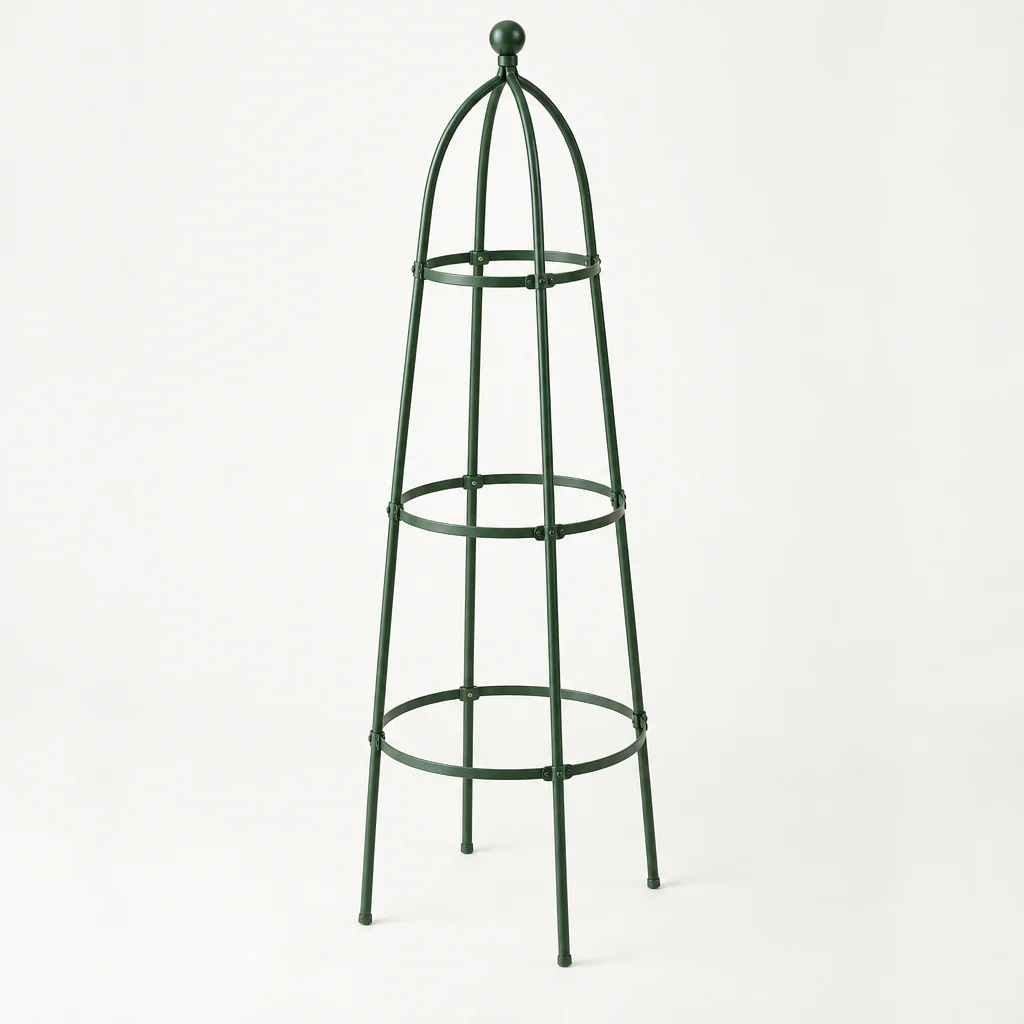
Large, widely spaced bars can look beautifully clean, but clematis leaf stalks may not reach them. Add a network of twine, wire or plant netting. It need not be obvious once foliage grows. The point is to provide a ladder between the main structural elements, rather than expecting the plant to leap the gaps.
Planting before installing the support
This is easy to do and annoyingly difficult to undo. Digging in legs, sockets or bolts after planting risks damaging roots and makes it harder to get the frame level. Assemble, position and secure the support first. Then plant, mulch and train. Your future self will be grateful, even if your current self would rather get straight to the exciting part.
Ignoring winter exposure
A sheltered summer border can become a wind tunnel when leaves fall from surrounding trees and shrubs. Look at the site now, in October. Notice where gusts come through, where soil stays wet and where frost lingers. Those observations are more useful than a sunny product image taken in June.
Do not use thorny stems as ties
Rose thorns catch, but they do not reliably hold a plant in the direction you want. Use soft ties and proper support points.
Do not let mulch bury timber bases
Mulch is valuable around plants, but constant damp contact against timber encourages decay. Keep a little clearance around structural legs.
Do not rely on one annual inspection
Check after major storms as well as during the spring tidy. A small wobble is much easier to correct before a climber is in full growth.
Questions Gardeners Ask About Climbing Supports
Yes, provided their vigour is reasonably well matched and the arch is strong enough for both plants. Give each climber its own planting position and initial route. A large, vigorous clematis with a modest rose can become a crowding problem, so choose carefully and be prepared to prune and tie regularly.
Match it to the variety. Tall Spencer sweet peas reach approximately 1.8–2.4 m and need a tall frame, canes or netting. Bush and dwarf types reach approximately 0.6–1 m (both figures are approximate and vary by variety) and are better on a smaller support. The fine texture of the support is as important as its height.
It depends on the metal and finish. Powder-coated steel is designed for outdoor use, but chips in the coating should be addressed promptly. Galvanised steel is chosen for strong corrosion resistance. Whatever the material, inspect it periodically, particularly after winter and after accidental knocks.
Usually not. Group 3 clematis are cut back hard to around 20–30 cm above the lowest pair of healthy buds in spring, which makes them straightforward on an obelisk or trellis. Other groups are pruned differently, so identify the pruning group before cutting. The right structure makes this easier by leaving accessible gaps and crossbars.
Yes, especially for a compact climbing rose or clematis, but use a substantial container and make sure the obelisk is secure. The combination of plant, compost and framework can become top-heavy, particularly in wind. Containers also dry out faster, so watering and feeding need attention in the growing season.
Which Structure Is Right for Your Garden?
If you are deciding now, in the quieter part of the gardening year, keep the choice simple. Start with the place. Is it a wall, a path, an open bed or a productive patch? Then choose the plant according to the scale you can support, rather than trying to shrink a naturally ambitious climber into a decorative frame.
Small-garden grower
Choose wall trellis or a compact obelisk. Both add vertical interest without consuming valuable floor space, and both are easier to reach for tying and pruning.
Rose enthusiast
Choose substantial steel or well-anchored pressure-treated timber. Prioritise accessible tie points, a realistic height and secure installation over decorative detail.
Sweet pea devotee
Choose canes, netting or a structure adapted with fine twine. Your priority is a tall enough run and narrow material that tendrils can grip.
For a mixed garden, a useful arrangement is often one strong arch where a route needs defining, a run of trellis where a wall needs softening, and one or two obelisks in the border to carry clematis or compact roses. Repeating a material or finish helps the garden feel coherent. It does not need to be identical throughout, but an accidental collection of three entirely different styles can make a border look as though the garden centre had a clear-out and you were feeling generous.
As autumn progresses, there is no urgency to plant every climber immediately. This is, however, a very good time to measure, inspect existing structures and plan anchor points while the ground is workable. Come next spring, you can install the support first, choose the right climber and begin training it from the start. That sequence makes an enormous difference.
The GardenScout verdict
Choose trellis for walls and sideways training, an arch for routes and garden transitions, and an obelisk for vertical drama in a border or container. For roses, favour strength and secure anchoring. For clematis, provide plenty of close, fine support. For sweet peas, make sure tendrils have something narrow to grip. Buy for the plant at maturity, install the structure before planting, and check it every autumn. A good support should quietly do its job for years — which is exactly the sort of gardening companion worth having.