
The Best Garden Parasols and Cantilever Umbrellas for Real Shade
A practical guide to crank, tilting and cantilever parasols — and the bases, fabrics and wind precautions that separate proper garden shade from a decorative afterthought.
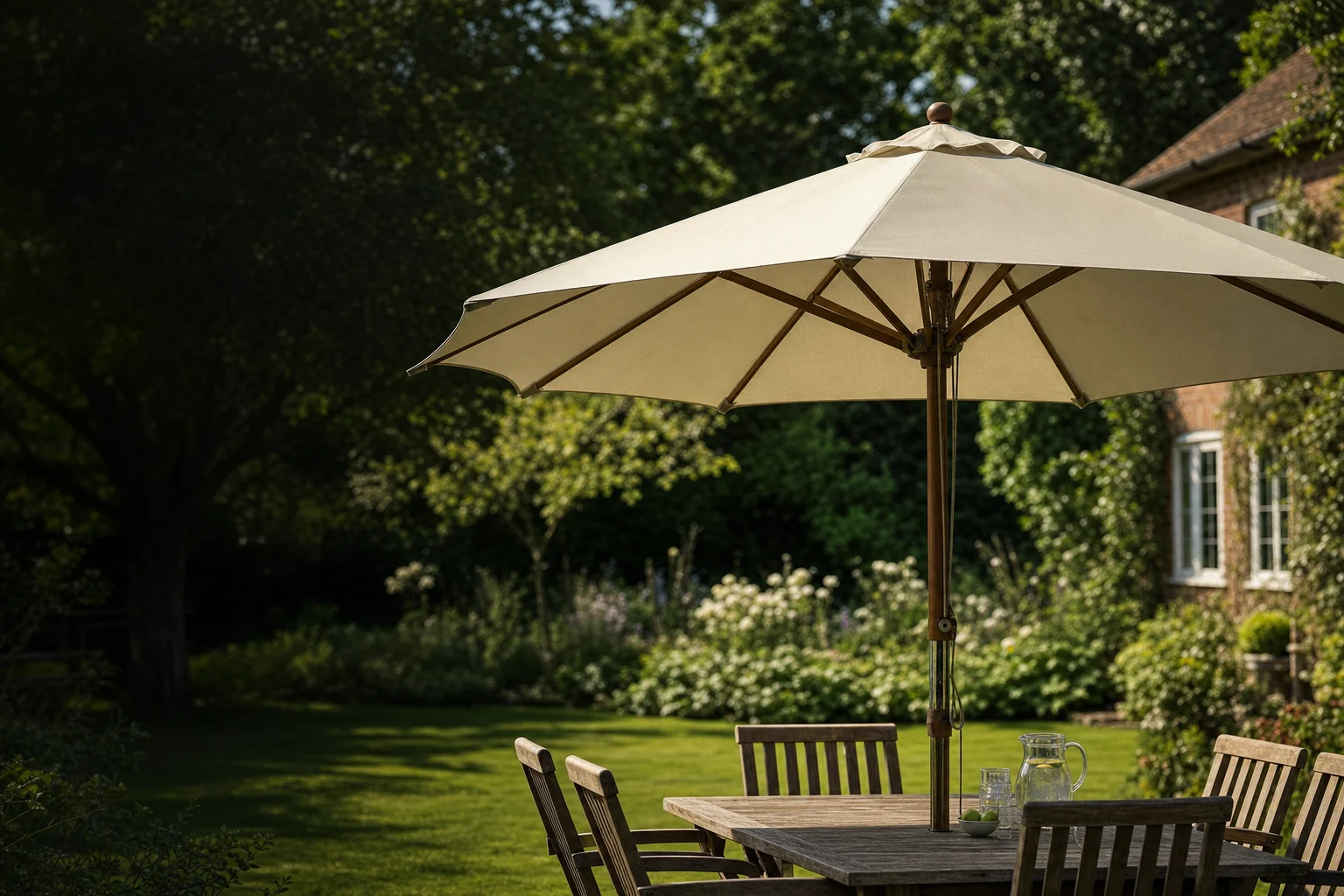
Why Most Garden Parasols Fail the Real-Shade Test
There is a particular sort of disappointment reserved for a garden parasol. You open it on the first properly bright afternoon, arrange the chairs beneath it, carry out drinks with the satisfaction of someone who has briefly got their life in order — and discover that the shade has landed two feet away from everybody.
Or the canopy is so thin that the paving beneath it still feels like a griddle. Or it offers lovely shade at lunchtime, then becomes completely redundant as the sun drops behind the house. Or a light breeze turns the whole arrangement into an alarming piece of garden theatre. None of this is unusual. A parasol is often bought as a finishing touch, when it ought to be chosen as a working bit of outdoor equipment.
Real shade is not simply a patch of darkness. It is coverage in the right place, at the right time, from fabric dense enough to screen direct sun, held on a frame that can be adjusted without an argument. The prettiest canopy in the world is not much use if it cannot reach the end of the table where you are actually sitting.
This matters particularly now, in early September. The sun is lower than it was in midsummer, so a canopy held directly overhead may leave faces and shoulders exposed by mid-afternoon. It is also the point in the year when a good parasol earns its keep for lunches, reading corners and those surprisingly warm late-season evenings. A tilting or rotating model can still be useful well into autumn. An upright, fixed canopy has rather less to say for itself.
The real-shade rule
Buy the mechanism before you buy the colour. A canopy must be able to move with the sun, cover the shape of your seating area and sit on a base suited to its design. Everything else comes second.
There are three main families worth understanding. First, central-pole crank parasols: traditional umbrellas with a pole in the middle and a winding handle to open the canopy. Second, central-pole tilt parasols: similar, but with a joint that lets the canopy angle into low sun. Third, cantilever or banana parasols: larger offset designs with the pole and base to one side, leaving the space below clear.
Each solves a different garden problem. A central-pole parasol is neat, familiar and often happiest through the hole in a sturdy dining table. A tilt model adds useful late-afternoon flexibility, although its angled canopy can catch wind more readily. A cantilever gives you the clearest, most furniture-friendly area of shade, but it asks more of its frame, its mechanism and — very importantly — its base.
Think about where the sun sits at the time you most use the garden. The answer is often more useful than measuring the table alone. A parasol bought only for noon will be a poor companion at 5pm.
Crank, Tilt or Cantilever? A Plain-English Mechanism Guide
The words used to describe parasols can make them sound more complicated than they are. In practice, you are choosing where the pole sits, how the canopy opens and how far you can move it once it is up. Get those three things right and the rest of the decision becomes pleasantly straightforward.
Crank parasols: the familiar all-rounder
A crank parasol is the classic central-pole design with a handle on the pole. Turn the handle and the canopy lifts open; turn it back and it closes. It is a simple arrangement, and for a table positioned in one reliable sunny spot it remains a very sensible one.
The benefit is usability. A good crank should feel smooth and controlled, so opening the parasol is a small task rather than a shoulder workout. That sounds obvious, but it is surprisingly important. If a parasol is awkward to put up, people leave it down. Then the garden furniture becomes hot, the cushions fade, and the carefully chosen parasol spends more time folded than working. Not ideal.
Central-pole crank parasols also make sense where the table already has a central hole. The pole occupies the space intended for it, the canopy radiates evenly around it, and there is no large side arm intruding into a narrow patio. For smaller eating areas, that simplicity can be a virtue.
Its limitation is equally simple: the pole must live in the middle of the shaded area. That is perfectly fine for a central dining table. It is less helpful for a corner sofa, two loungers, a children's paddling pool or a bench pushed against a wall. A central pole can become an obstacle just where you want legroom.
Tilt-neck parasols: better at chasing low sun
A tilt parasol begins with that same central-pole layout but adds an articulated joint near the neck. Once open, the canopy can angle towards the sun. This is extremely useful when the sun is low, which is exactly when a standard parasol has a habit of shading your knees whilst leaving your head in full glare.
The practical benefit is clear in September. As afternoon light slides sideways across a patio, a tilted canopy can create shade where you are sitting rather than where the sun happened to be at midday. It can make a modest dining setup more adaptable without introducing a large cantilever arm.
There is a trade-off. Tilt models are usually more complex than fixed upright parasols, and an angled canopy presents a different shape to the wind. It is therefore not a mechanism to set and forget. If the breeze picks up, close the canopy rather than hoping the garden will be polite about it. British weather has never been especially interested in our plans.
Cantilever parasols: maximum clear space beneath
A cantilever parasol puts the pole and base to one side. The canopy hangs from an extension arm, like an umbrella that has taken a very firm decision not to sit in the middle of the table. This is why they are also called banana parasols: the support arm curves or extends over the shaded area.
It is the most flexible layout for larger furniture. With no centre pole under the canopy, you can shade a dining table without threading anything through it, cover a pair of loungers, or let the canopy hover over an outdoor sofa. You can position the support where it is least inconvenient and put the shade where it is most useful. That is the central appeal.
It is also why a cantilever needs more consideration. The canopy is held away from the base, so wind has more leverage to work with. The base needs to be substantial and compatible with the frame. Rotation, tilt and height adjustment are desirable features, but every moving part is a reason to inspect the mechanism carefully and use it properly.
Choose a crank parasol for simple table shade
It is the tidy choice when a dining table has a central parasol hole and the sun reaches the area from broadly the same direction.
Choose a tilt-neck design for a changing afternoon
The adjustable canopy earns its keep when low sunlight arrives from the side rather than directly above.
Choose cantilever for uninterrupted living space
It is especially persuasive beside seating, loungers and dining furniture where a central pole would be in the way.
| Type | Where the pole sits | Best use | What to watch |
|---|---|---|---|
| Crank central-pole | In the middle of the canopy | Tables with a parasol hole and straightforward overhead shade | Canopy position is limited once the sun moves sideways |
| Tilt-neck central-pole | In the middle of the canopy | Dining tables needing extra protection from low sun | An angled canopy requires more care in breezy conditions |
| Cantilever / banana | To one side of the canopy | Loungers, sofas and dining sets needing clear floor space | The offset arm demands a suitably heavy, secure base |
There is no universal winner. A well-chosen central-pole parasol is better than an oversized cantilever squeezed awkwardly onto a small terrace. Equally, a fixed parasol through a table is no substitute for a properly adjustable cantilever beside a wide corner sofa. Start with your layout. The mechanism follows.
Schneider Rhodos Twist 3m Square Cantilever — German Engineering Reviewed
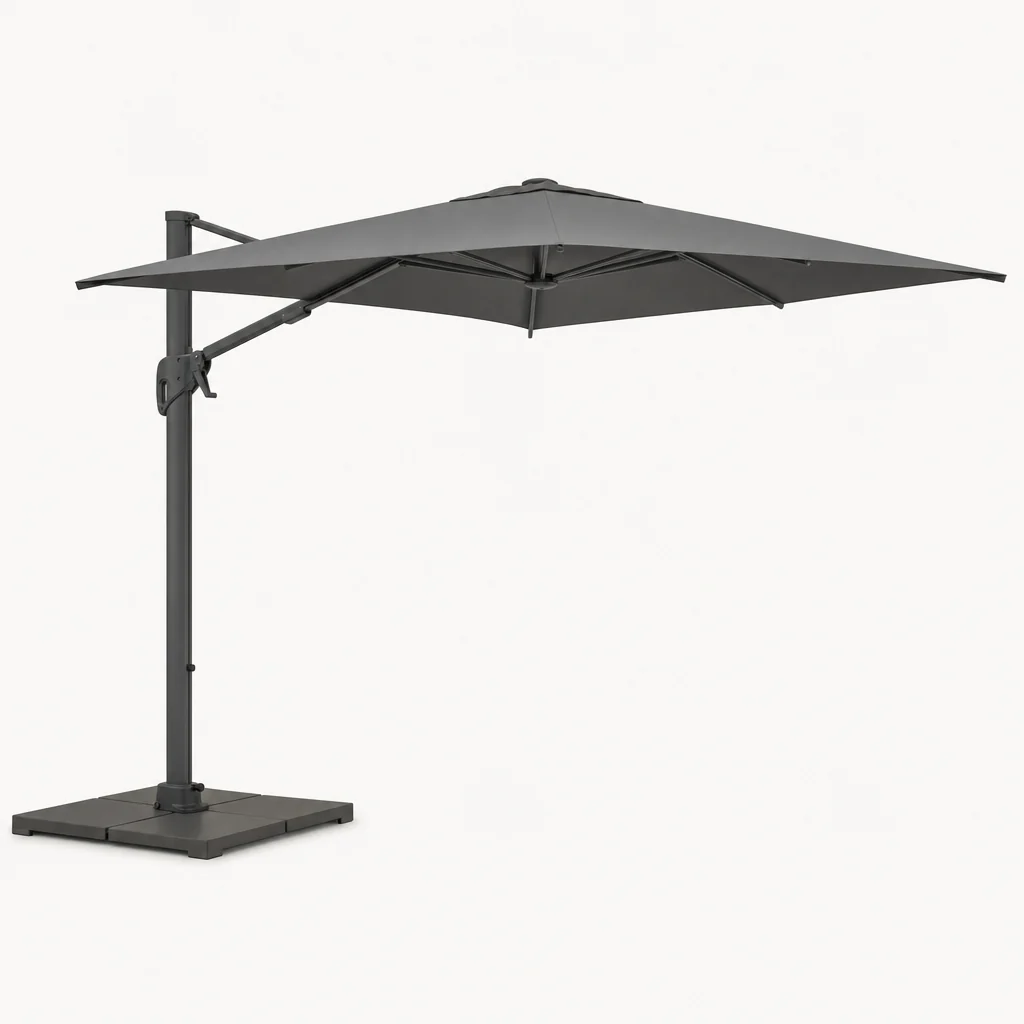
The Schneider Rhodos Twist is the sort of cantilever parasol that makes a strong case for buying fewer things, but choosing them more carefully. Schneider Schirme is a German parasol specialist, and the Rhodos Twist is built around the things that make a large offset umbrella genuinely useful: a substantial square canopy, a crank opening system, lateral tilt and full rotation.
The canopy measures 3 metres square. That is a generous, versatile shape for a seating zone because it gives equal reach in both directions. It suits a square or round dining arrangement particularly well, but it also works over a compact lounge area where people are gathered rather than arranged in a line. Square coverage can be easier to place than a long rectangle when the furniture moves around from one weekend to the next.
Its polyester canopy is approximately 200g/m² and includes an air vent. The density matters. A parasol canopy should not merely soften the sun; it should feel like a proper overhead barrier. A fabric around this weight has more substance than the flimsy, translucent material that can turn an umbrella into an expensive way of creating a faintly darker patch of patio.
The Rhodos Twist is rated UV50+. In plain English, a UPF 50 fabric allows less than 2% of ultraviolet radiation to pass through it. That is the sort of rating to look for if genuine sun protection is part of the reason for buying, rather than simply wanting a flattering bit of dappled shade in photographs.
The adjustment system is where the Rhodos Twist becomes more than a large static umbrella. The integrated crank is intended to make opening comfortable, while the extension arm allows lateral tilting up to 45°. A solid swivel joint, controlled by a foot pedal, rotates the umbrella through 360°. Together, those controls let you reposition shade without dragging the base or rearranging furniture.
That sounds like a luxury until you use a garden through a whole day. At breakfast, you may want shade cast one way. By late afternoon, the same seating area may need a canopy swung around entirely. Rotation handles the broad movement; lateral tilt lets you fine-tune the angle. It is a sensible pairing for gardens where the sun moves across more than one side of the patio.
What stands out
- The 3m square canopy provides broad, even coverage for a social seating area.
- UV50+ protection and approximately 200g/m² polyester put shade performance at the centre of the design.
- 360° rotation and 45° lateral tilt offer useful control as the sun drops.
- The powder-coated aluminium frame is a sensible material choice for an outdoor structure.
Consider before choosing
- A square canopy is not always the most efficient shape for a long rectangular table.
- Like any cantilever, it depends on a properly specified base and attentive use in wind.
- The side-arm layout needs room beside, rather than through the middle of, the furniture.
Best for a moving sun
The Rhodos Twist makes particular sense where shade needs to travel around a patio. Rotation and lateral tilt are not decorative extras here; they are the difference between a canopy that works for an hour and one that remains useful through the afternoon.
Schneider Bermuda Cantilever — When You Need Rectangle, Not Square
Square parasols are wonderfully adaptable, but they are not always the efficient answer. A long dining table, a row of loungers or an elongated terrace has a different footprint. Cover it with a square canopy and you may shade empty paving at each side whilst leaving the ends of the seating area exposed. The Schneider Bermuda is the rectangular alternative.
Its canopy measures 260cm by 350cm. That longer side changes how the parasol works in a garden. Instead of creating a central square of shade, it can follow the length of a dining table or a more linear seating arrangement. For a garden that is long and narrow — a very British garden shape, frankly — that can feel far more natural than trying to make a square do a rectangular job.
It is a useful consideration for larger dining. A rectangular canopy can be aligned with an elongated table so the shade follows the people rather than the paving. The exact result will depend on chair positions and the path of the sun, but the principle is sound: match the geometry of the canopy to the geometry of the furniture.
The Bermuda uses 100% polyester at approximately 200g/m². It is described as rot-resistant, which is reassuring for the British garden reality: damp fabric, dew, showers that arrive just as you have put the cushions out, and the general inability of a patio to remain dry for very long in a normal season.
There is serious UV protection here too, with level 80 protection according to the Hohenstein UV Standard 801. It is not directly labelled in the same way as a UPF 50+ canopy, but it belongs in the same conversation: both are high-level fabric protection claims intended for direct sunlight. The important point is that the Bermuda is designed around more than visual shade.
The frame combines aluminium and steel with a silver-grey powder-coated finish. Its one-piece pole measures 55mm by 86mm, and it uses a solid swivel joint with a foot pedal. A single-piece support is worth noting on an offset structure. Cantilevers place considerable demands on the junctions between parts, so fewer interruptions in the main pole are a welcome design decision.
Before committing to a rectangle, mark the canopy footprint on the patio with string or a hose. Check not only the furniture beneath it, but the clear space needed beside the parasol for the offset arm, base and rotation.
The Bermuda will appeal most to gardeners who already know that their shade problem is a long one. If your furniture is spread across a broad square courtyard, the Rhodos Twist's equal-sided coverage may be easier to live with. If you have a rectangular dining run, however, the Bermuda's shape is the point. It wastes less canopy where you do not need it and puts more shade along the line where people sit.
So'Home Challenger T2 3m Rectangular Cantilever — UK Brand, Serious Kit
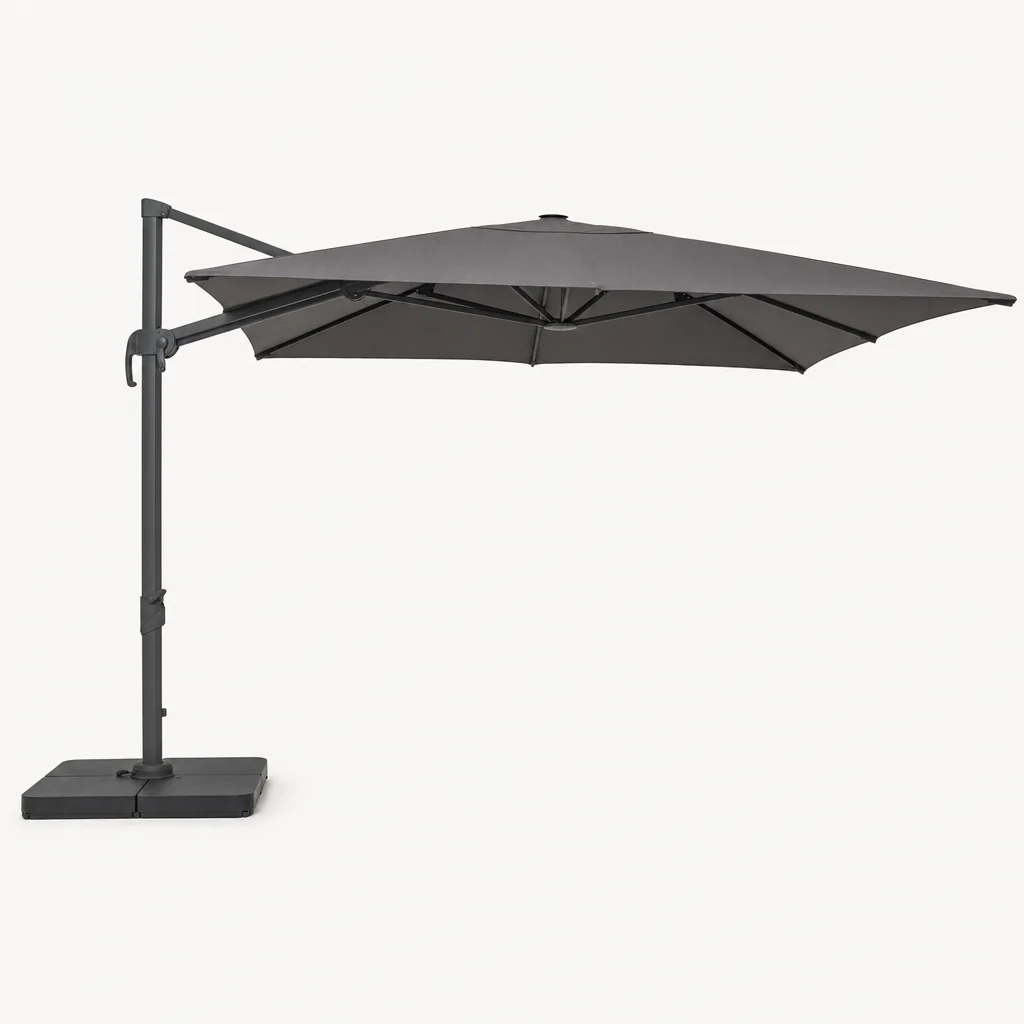
The So'Home Challenger T2 takes the cantilever idea and pushes hard on adjustability. It is a 3m rectangular cantilever parasol designed for gardens where the sun does not behave in a conveniently single-direction manner. Which is most of them.
Its headline feature is a double tilt system. The canopy can angle side to side, and backwards and forwards. That distinction matters more than it first appears. Many parasols tilt on a single axis, which is useful until the sun approaches from the wrong direction. The Challenger T2 is designed to offer movement across both planes, so you can direct coverage more precisely around changing light.
It also has a smooth rotating mechanism allowing a full 360-degree turn. Rotation moves the canopy around the garden; double tilt adjusts its attitude towards the sun. Used together, those features offer something close to practical sun-tracking without shifting furniture, carrying the base or repeatedly moving your chair by a few inches. The latter is a surprisingly common gardening activity. It is not one anybody has chosen as a hobby.
The rectangular canopy is generously proportioned for a dining area or paired loungers. The exact furniture arrangement matters, but that long-sided format is particularly useful where the shaded zone is not square. It can sit beside rather than through a table, giving the whole dining surface a clearer, more relaxed feel.
Its frame combines durable stainless steel with powder-coated aluminium housing intended to resist rust and corrosion. The canopy fabric is anthracite grey and has water-resistant, dirt-repellent properties. For a parasol likely to spend much of its life outdoors between spring and early autumn, those are practical rather than flashy advantages. Cleanliness and corrosion resistance are rather unglamorous subjects, but they are exactly what decide whether a parasol still feels good to use after several seasons.
Why it is compelling
- Double tilt lets the canopy move side-to-side and backwards-and-forwards.
- 360° rotation gives wide positioning freedom around a seating area.
- The rectangular layout is useful for linear furniture arrangements.
- Water-resistant, dirt-repellent canopy fabric suits routine garden use.
Important limitations
- The parasol is compatible only with So'Home parasol bases.
- A highly adjustable cantilever is still not a substitute for closing it in wind.
- The side-mounted base and arm need planned space on the patio.
| Feature | Schneider Rhodos Twist | Schneider Bermuda | So'Home Challenger T2 |
|---|---|---|---|
| Canopy format | 3m square | 260cm × 350cm rectangle | 3m rectangle |
| Rotation | 360° with foot pedal | Foot-pedal swivel joint | 360° rotating mechanism |
| Tilt provision | 45° lateral tilt | Not the defining feature | Side-to-side and backwards-and-forwards double tilt |
| Standout strength | Square coverage with controlled rotation and tilt | Long rectangular shade footprint | Multi-direction canopy adjustment |
The only caveat is a meaningful one: the Challenger T2 is compatible only with So'Home parasol bases. That is not necessarily a drawback, provided you treat base selection as part of the purchase rather than an afterthought. It does mean you should decide on the complete setup from the start. A cantilever and its base are a system. They should be treated as one.
So'Home Challenger with LED Lighting — Does the Smart Feature Stack Up?
The illuminated Challenger takes a familiar question — "do we need a parasol?" — and adds another: "would we actually use it after sunset?" For households that eat outdoors, linger over a drink or make the most of warm September evenings, that is not a frivolous extra. A canopy with integrated lighting can turn one piece of garden kit into day-and-evening infrastructure.
This version has a square canopy with wireless lighting integrated into the ribs. That placement is important. Central hub lighting tends to create one bright point beneath the parasol, a little like an indoor ceiling light that has been moved outdoors. Lighting along the ribs is different. It spreads illumination across the canopy structure and gives a softer, more ambient downward effect across the table or seating below.
It is not intended to turn the patio into a floodlit sports ground. Nor should it. The useful role of rib lighting is gentle orientation: enough light to see your glass, find the snack bowl and avoid treading on the dog's favourite toy. It keeps a seating area usable without the hard glare of a separate outdoor light aimed directly at everyone's faces.
Wireless lighting in the ribs
The lighting follows the canopy structure, providing a wider and more atmospheric spread than a single point at the centre.
360° rotation
The canopy can be rotated around the base to reposition shade and the evening shelter over the seating area.
Multi-direction tilt
The canopy can tilt forwards, backwards and sideways, making it more adaptable to low sun before the lights are needed.
Cast aluminium crank
A crank mechanism provides the practical opening control expected of a substantial cantilever design.
The model can rotate through 360° and tilt forwards, backwards and sideways. That makes it a serious shade structure first, rather than a lighting gadget bolted to an ordinary umbrella. The cast aluminium crank adds to that sense of purpose. If the shade function were compromised for the sake of a few novelty lights, it would be difficult to recommend. Here, the useful cantilever fundamentals are still present.
Lighting is a bonus, not a reason to ignore the base
The integrated lights may make evening use more enjoyable, but they do not change the fundamental rule of cantilever parasols: secure the correct compatible base, close the canopy in windy weather and never assume a pleasant dinner forecast will remain pleasant.
So'Home recommends a 90kg base for this Challenger model. That is not a casual suggestion. A large offset canopy is a lever, and the base is what prevents the entire structure from acting like one. If your patio cannot accommodate a properly weighted base, a central-pole model may be the safer and more sensible choice.
The Shade Numbers That Actually Matter — UV, GSM and Canopy Angles Explained
Parasol specifications can be a thicket of abbreviations, marketing terms and very enthusiastic adjectives. A few numbers genuinely matter. Others are merely decoration. If you remember only three things, make them UV protection, canopy fabric weight and range of adjustment.
UV ratings: shade is not automatically sun protection
A darker patch beneath a canopy does not automatically tell you how much ultraviolet radiation is being screened. This is why a stated rating is helpful. The Schneider Rhodos Twist carries UV50+ protection. UPF 50 allows less than 2% UV transmission through the fabric, which is a meaningful benchmark for a garden parasol intended to offer protection as well as comfort.
The Schneider Bermuda uses level 80 protection in accordance with Hohenstein UV Standard 801. It is a different testing standard and label, but the takeaway is similar: this is high-level UV protection, not a vague claim that the canopy creates shade. When comparing parasols, a clearly stated recognised protection rating is much more useful than relying on canopy colour or thickness by eye.
GSM: why fabric density changes the experience underneath
GSM means grams per square metre. It is a measure of fabric weight, and it gives a useful clue about substance. Both Schneider models discussed here use canopy material of approximately 200g/m². That is the sort of figure worth noticing because the canopy has enough presence to do the job expected of it.
Very light canopies can look fine when folded and can make a parasol easy to carry, but they may become translucent in strong sun. That undermines the whole purchase. A real shade structure should create a calmer, cooler-feeling space beneath it, not simply turn direct sunlight into a slightly muted version of itself.
Canopy angles: the overlooked specification
Angle is the number people rarely think about until the first low-sun afternoon. An upright canopy is at its best when the sun is high. As the sun lowers, direct light arrives from the side. Tilting the canopy towards it makes the shade useful for longer.
The Rhodos Twist offers 45° of lateral tilt, while the So'Home Challenger T2 can move side-to-side and backwards-and-forwards. Neither system makes a parasol invincible against every sun position, but both give you far more control than a static canopy. Rotation is equally important on a cantilever. It allows you to swing the shaded area around the base, then adjust the angle to suit.
For September use, prioritise tilt and rotation over sheer canopy size if your patio receives low afternoon or evening sun. The ability to aim shade often matters more than adding a little extra fabric overhead.
Bases That Won't Betray You — The Overlooked Half of the Buying Decision
A cantilever parasol on an inadequate base is not a bargain. It is not a compromise. It is a large sail waiting for a gust, and it can become a safety problem remarkably quickly. The base deserves at least as much thought as the canopy because it is doing the unglamorous job that makes everything else possible.
Central-pole parasols and cantilevers ask different things of a base. With a central-pole design, the pole sits roughly beneath the centre of the canopy. The load is comparatively direct. With a cantilever, the canopy is held to one side by an extension arm. That offset creates leverage. Wind pushing on the canopy is working at a distance from the base, trying to rotate the whole structure.
This is why a base that seemed perfectly respectable under a small central parasol may be wholly unsuitable beneath a large cantilever. It is not just a question of total weight. It is about the compatibility of the base, the geometry of the frame and the manufacturer's intended arrangement.
The So'Home Challenger Dual Tilt with LED lighting has a recommended 90kg base. The So'Home Voyager T2, with its 2.7m by 2.7m square canopy, also recommends a 90kg base. Treat those figures as a clear signal of what serious offset shade requires. A base is not the optional accessory at the bottom of the product page. It is part of the parasol.
Never improvise with a base
Use the compatible base specified for the parasol and follow its fitting instructions. Do not assume that a stack of paving slabs, a decorative planter or a lighter base from an old centre-pole umbrella will provide equivalent stability.
Many cantilever systems use multiple weights or base plates. This makes practical sense because heavy components are easier to move individually and can lock around the support frame. It also means the parasol should be set up on a level, firm surface where the entire base can sit evenly. A wobbly base on uneven paving is not a minor irritation; it reduces stability from the first day.
A base checklist before you buy
Check compatibility first
Some parasols, including the So'Home Challenger T2 and Voyager T2, are intended to work only with their specific So'Home bases.
Measure the base zone, not just the canopy
The base needs its own clear area beside the furniture. Account for doors, paths, raised beds and the route you use to carry food outdoors.
Choose solid, level ground
A parasol base belongs on firm paving or another stable surface, not on a slope or loose ground that shifts under load.
Close before conditions deteriorate
No base removes the need for common sense. Closing the canopy is the sensible response when wind begins to build.
It is tempting to see a base as something that can be sorted later, after the exciting bit has arrived. Resist that. Decide where it will go, how it will be weighted and how you will move around it before ordering a large cantilever. The garden will feel much more usable for it. Your shins may also send a note of thanks.
Wind, Rain and the British Reality — Durability Testing Context
Garden parasols live a difficult life. From April through to September they may face bright direct sun, sudden showers, regular dampness and gusts that arrive with very little ceremony. In an exposed garden — coastal, elevated, open to a field, or simply positioned in a wind tunnel between two houses — conditions can be considerably more demanding than a calm product photograph suggests.
The first rule is not complicated: a parasol is shade equipment, not a permanent roof. If the weather turns windy, close it. If you are leaving the garden, close it. If the forecast looks unsettled, close it. This is not over-cautiousness. It is basic care for a tall structure carrying a broad sheet of fabric.
Cantilevers need particular attention because of the offset arm. The canopy is not directly above the base, so wind loading tries to twist the assembly from the side. A heavy, compatible base helps, but it does not mean the canopy can safely stay open in conditions where a sensible person would not hold an ordinary umbrella.
Ventilation helps. The Rhodos Twist has an air vent, and the Purple Leaf Sunbrella Collection uses a double-top canopy with double-top vents designed to aid air circulation and heat dissipation. Vents can reduce the pressure that builds beneath a canopy, but they are not a licence to ignore gusts. Their job is to improve airflow, not to repeal weather.
Purple Leaf states that its outdoor patio umbrellas use 240g/m² polyester across the relevant range, with all-aluminium frames and eight reinforcing ribs. Its cantilever designs offer 360° rotation and six height tilt settings. The premium Sunbrella Collection uses 100% Sunbrella fabric described as UV-resistant, water-repellent and colourfast for eight years, alongside the double-top vent design. Those are worthwhile features for gardeners who want a more technical canopy specification alongside a substantial cantilever frame.
Even then, sensible seasonal care matters. In September, make a habit of brushing off leaves and checking the fabric for trapped moisture after rain. Wipe down the frame, particularly moving joints and crank areas, and ensure the canopy is fully dry before closing it for a prolonged period. When the weather becomes persistently autumnal, store the parasol or protect it according to its care guidance rather than leaving it to collect wet leaves until spring.
Habits that help a parasol last
- Close the canopy whenever wind becomes a possibility, not merely after it has become obvious.
- Allow damp fabric to dry before long-term storage.
- Keep the crank, swivel and tilt controls clean and free-moving.
- Use the parasol with its intended compatible base on level ground.
Habits that shorten its working life
- Leaving a canopy open whilst away from home.
- Using a light or improvised base under an offset-arm parasol.
- Forcing a crank or tilt mechanism when fabric or frame parts are snagged.
- Folding away wet fabric for extended periods.
Which Parasol Makes Sense for Your Garden?
By this point, the best option should feel less like a brand decision and more like a layout decision. That is exactly as it should be. A parasol is at its best when it disappears into the way you use the garden: easy to open, easy to angle and reliably where you need it.
For a traditional dining table
A central-pole crank or tilt parasol is the neatest choice when the table has a central hole and the pole will not interrupt seating.
For a sofa or loungers
A cantilever gives you shade without a pole through the middle of the relaxation zone. Plan carefully for the base and arm.
For long furniture layouts
A rectangular canopy such as the Schneider Bermuda or So'Home Challenger T2 makes more sense than a square when coverage needs to follow a line.
For low afternoon sun
Prioritise rotation and multi-direction tilt. The ability to aim the canopy is what keeps shade useful after lunchtime.
For evening garden use
The illuminated So'Home Challenger is worth considering when ambient rib lighting would genuinely extend how long you use the seating area.
For exposed gardens
Choose carefully, secure the correct base and be ready to close the canopy promptly. A smaller, simpler setup may be the wiser choice.
No. A cantilever gives clearer space beneath the canopy and more placement flexibility, but it needs room beside the furniture and a properly specified heavy base. A centre-pole parasol can be the better solution for a compact table setting.
At this time of year the sun sits lower, particularly later in the day. A canopy that can tilt towards the light is much more effective than one held permanently overhead.
No. An air vent can improve airflow through the canopy, but it does not remove wind risk. Close a parasol when conditions become breezy or when you are not there to supervise it.
Measure the full working footprint: canopy, support arm, base and rotation space. Then confirm the correct compatible base. A parasol that fits only when stationary is not going to be much fun to use.
The GardenScout Verdict
The best garden parasol is not necessarily the largest one. It is the model whose canopy shape matches your furniture, whose adjustment system follows the sun and whose base makes the whole structure feel secure rather than faintly theatrical.
For broad square coverage with serious UV protection and useful movement, the Schneider Rhodos Twist is an excellent example of what a capable cantilever should offer. For long dining tables and linear seating, the Schneider Bermuda's 260cm by 350cm canopy is the more logical shape. For gardeners who want especially flexible canopy positioning, the So'Home Challenger T2's double tilt and 360° rotation are the standout features. And for those late-season evenings when nobody is ready to go indoors, the illuminated Challenger adds a genuinely useful second life after sunset.
Whichever route you take, give the base equal billing. Choose proper shade, set it up carefully, close it when the wind arrives, and your patio becomes an outdoor room rather than a place everybody abandons at precisely the moment the sun appears.