
Patio Heaters and Chimineas: Keeping the Garden Usable After Dark
Electric, gas and chiminea options compared on cost, warmth and cosiness — so your garden doesn't go to waste the moment the sun dips below the fence.
There's a particular sort of heartbreak that arrives at around 8pm on a clear British evening. The food's been eaten, the conversation's flowing, and then somebody shivers, somebody else fetches a jumper, and within twenty minutes everyone's drifted indoors. The garden — that lovely outdoor room you've poured money and weekends into — sits empty under the stars.
Outdoor heating is the fix, and it's a category that has quietly exploded. In the UK in 2026, electric infrared heaters dominate the market, but they're not automatically the right answer for every garden. Gas pyramids still pump out enormous warmth, and chimineas — both traditional clay and modern pellet-burning — offer something the others simply can't: an actual flame to gather around. Over the years I've stood shivering in front of underwhelming heaters and basked in front of brilliant ones, and the truth is that "best" depends entirely on what you're trying to do.
This guide pulls apart all three technologies — electric, gas and chiminea — and looks honestly at running cost, real-world warmth and that intangible quality I keep coming back to: cosiness. Let's work out what actually belongs on your patio.
The Three Technologies at a Glance
Before we get into specific models, it helps to understand what each type is fundamentally doing, because they heat in completely different ways.
Electric infrared heaters work like the sun — they emit radiant heat that warms objects and people directly rather than warming the air around them. That's why they feel effective outdoors where a fan heater would be useless: the breeze can't blow your warmth away because it's landing straight on your skin. They switch on instantly, make no noise, and most run up to maximum temperature in around ten minutes, taking roughly thirty to cool down.
Gas heaters — the familiar mushroom and pyramid silhouettes — burn propane or natural gas to produce serious raw heat output, with quality pyramid units pushing 48,000 to 50,000 BTU. They warm a wide radius and don't need a power socket nearby, but they're noisier than electric and you're forever wrangling gas bottles.
Chimineas are the romantics' choice. A proper wood-burning clay or cast iron chiminea gives you a contained, crackling fire — heat plus spectacle. Newer pellet-fired models bring efficiency to the format, but the appeal has always been the flame itself.
Electric Infrared: The Modern Default
If you've got an outdoor socket and you want fuss-free warmth at the flick of a switch, electric is hard to argue with. There's a model for every budget here, and the gap between the cheap and the premium options is mostly about coverage, smart features and build quality rather than the basic ability to make you warm.
The budget end
You don't need to spend much to get something usable. The Outdoor Revolution Electric Heater sits under £40 and holds a respectable 4.3-star rating across 176 reviews — it's the sort of thing that gets you through a chilly evening without ceremony. A step up, the Devola 2.4kW (DVPH2400B) lands at just under £120 and brings features genuinely comparable to premium names like Burda and Veito, which is impressive at the price.
The Devola 2.4kW in detail
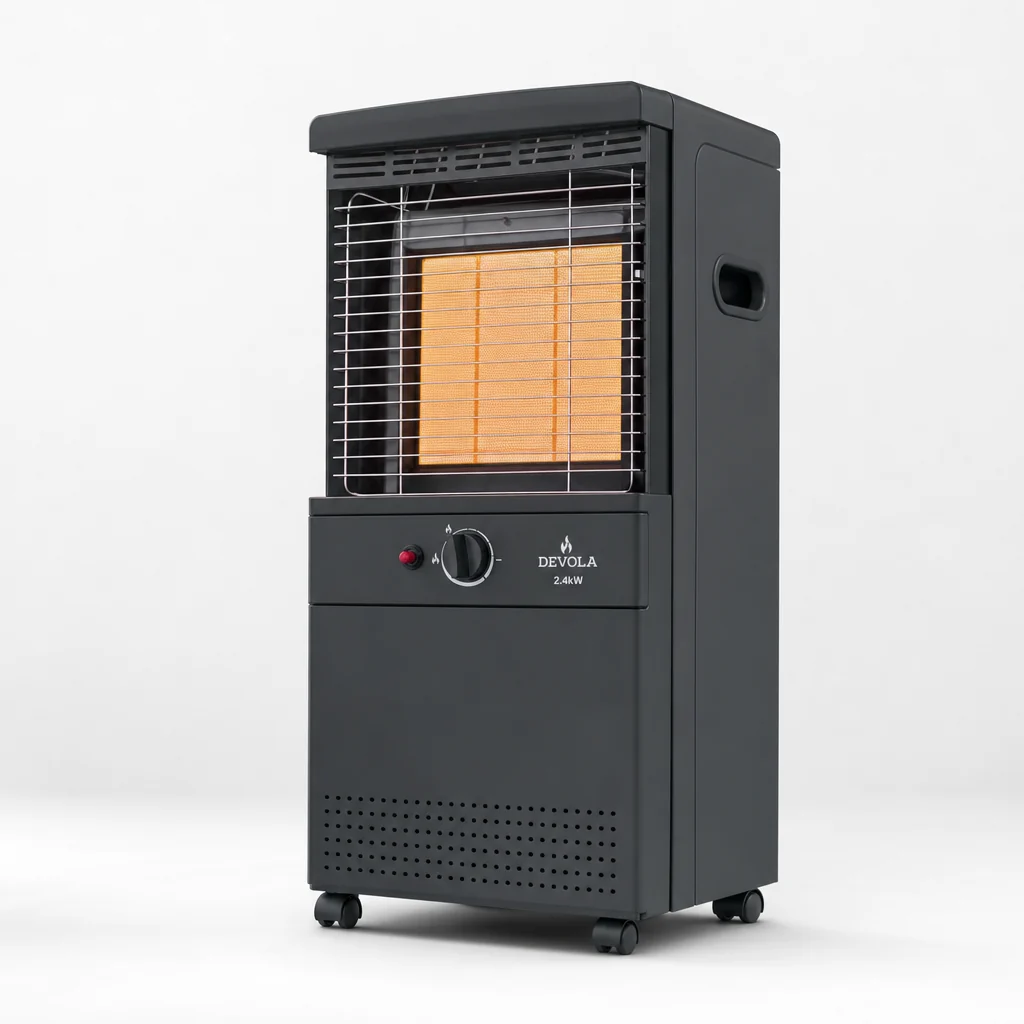
This one deserves a closer look because it punches above its weight. The 2.4kW output (roughly 8,188 BTU) covers up to 25m², and it's properly specified for the British climate.
The high-level mirror aluminium reflector hits 90% reflectivity, which means more of the heat generated actually reaches you rather than being wasted. You get four power settings, an LED display, a remote, a 24-hour timer and thermostatic control between 5 and 45°C. There's also a PIR body sensor and child lock — thoughtful touches you'd usually expect to pay more for. At 97cm × 16cm × 8cm it's a slim wall-mountable bar; for reference it's 10cm wider than the 2kW model and 20cm wider than the 1.2kW.
Pro Tip
The IP65 rating on the Devola 2.4kW means it's protected against water jets from any direction — so you can genuinely leave it mounted outside through a British autumn without panicking every time it drizzles. Always check the IP figure before committing; an IP54 unit handles splashes, but IP65 handles proper rain.
The mid-range and premium tier
The Kettler Kalos Bergamo (£249–£299) is a lovely thing — a 2kW infrared heater with a stainless steel body, IP54 rating that lets it stay outside year-round, a built-in tilt stand and remote control. It delivers instant heat and, realistically, warms about 4m² well: think two people at a bistro table rather than a whole dining set. There's also a wall-mounted Devola 2000W at £89.99 with an IP65 rating and WiFi.
At the top sit the architectural options. The Heatstrip Max Electric 3200W (€450–€550) is a wall or ceiling-mounted infrared unit heating a 3–4 metre radius, rated IP55 with a remote included. The Bromic Tungsten Electric Smart (€500–€650) adds WiFi smart control via an app for those who want to fire up the patio from the sofa.
Genuinely silent
Electric infrared heaters like the eRAD Designer Series run with no noise whatsoever — a real advantage if you want to actually hear the conversation rather than a roaring burner.
No glare
The better units produce zero glow and no harsh light, so they warm you without lighting up the garden like a floodlight or ruining the evening atmosphere.
Quick on, quick off
Roughly 10 minutes to reach maximum temperature and around 30 minutes to cool down — no lingering fire to babysit when you head indoors.
Electric Pros
- Instant, controllable heat with thermostats and timers
- Completely silent operation
- No fuel to buy, store or swap
- Weatherproof models up to IP65 stay out year-round
- Wall and ceiling mounting saves floor space
Electric Cons
- Needs a nearby outdoor socket
- Directional — you must be in the beam to feel it
- No flame, so less of the campfire atmosphere
- Coverage is modest; 2kW realistically warms ~4m²
Gas Heaters: Raw Power and No Cables
When you need to warm a bigger group, or you simply don't have a socket within reach, gas remains a heavyweight. The familiar pyramid and mushroom heaters generate far more raw heat than any domestic electric unit, and that wide radius makes them the natural choice for a busy patio full of people.
The mainstream pyramid models
The Westinghouse Outdoor Pyramid puts out 48,000 BTU and is sensibly engineered: electric pulse ignition, a variable gas control valve, an automatic shut-off device and an anti-tilt switch, all CSA approved. It rides on wheels for portability, sits on high-quality aluminium legs, and uses tall quartz glass built to resist thermal shock. The East Oak Patio Heater matches that 48,000 BTU figure and claims an 18-foot radius with double-layer stainless steel mesh, whilst the East Oak 50,000 BTU pushes that to a claimed 20-foot radius.
The Outback Signature Pyramid
This one's a UK favourite for good reason. At £329–£399 it gives 13kW of output, enough to warm a 4-metre radius in still conditions, and stands a commanding 2.2m tall. The build quality genuinely impresses — excellent welding and powder coating — but the showpiece is that satisfying blue-flame tube running up the middle, visible from inside and providing exactly the visual warmth that flameless electric heaters lack. For those wanting a more architectural fixture, the Sunglo Natural Gas Hanging Heater offers 50,000 BTU with 24-volt semi-automatic ignition and a stainless steel build.
That phrase "in still conditions" is doing a lot of heavy lifting. Gas heaters lose effectiveness quickly in a breeze, so an exposed patio will get noticeably less benefit than a sheltered courtyard. Position matters enormously.
The truth about coverage claims
Here's where I have to be honest, because gas manufacturers tend to oversell. Real-world temperature testing on quality propane units tells a sobering story. At 1 foot from the heater you'll see an average temperature increase of around 12.73°F. By 4 feet that's dropped to roughly 3.48°F above ambient. And at 8 feet? Barely 0.5°F warmer than the surrounding air — which is to say, essentially nothing.
The practical takeaway: quality propane units provide good warmth within about a 7-foot radius, not the 12–15 feet often advertised. Plan your seating with that 7-foot figure in mind and you'll never be disappointed. Cluster your chairs close, and a single pyramid does a fine job.
One more practical point: propane heaters are noticeably noisier than electric ones. That low roar of the burner is part of the gas experience, and whether it bothers you depends on how much you value quiet conversation.
Gas Pros
- Enormous heat output — up to 50,000 BTU
- No electrical socket required; fully portable on wheels
- A visible flame adds atmosphere (especially the Outback's blue-flame tube)
- Strong safety kit: anti-tilt, auto shut-off, CSA approval
Gas Cons
- Coverage claims are inflated — plan for ~7 feet, not 12–15
- Noisier than electric heaters
- Performance drops sharply in any breeze
- Ongoing cost and hassle of propane bottle refills
Chimineas: For the Love of the Flame
Now we come to my sentimental favourite. No infrared bar or gas burner gives you what a chiminea does — a real, contained fire to gather around, the crackle of wood, the dance of flame. If "cosiness" is top of your wish list, this is the category to start in.
Traditional wood-burning
The entry point is gloriously affordable. The La Hacienda Leon sits under £70, stands 110cm tall with a handsome bronze-effect finish, and has earned 4.1 stars across 422 ratings — a deserved bestseller. Clay models step up in size and price: a 49-inch-tall clay chiminea such as the Harward runs £250–£500. If you want something that'll outlive you, cast iron is the durable choice — a 55-inch-tall cast iron model weighs around 170 pounds, which is as much a feature as a drawback, since that mass radiates heat beautifully once it's up to temperature.
The modern pellet chiminea
If the romance of wood appeals but the faff of logs doesn't, the Even Embers Pellet Chiminea is a clever middle path. It burns hardwood pellets from a 25 lb hopper and produces 70,000 total BTU, heating 100+ square feet — that's roughly twice the heat of a traditional propane heater. Because it heats from the ground up and burns efficiently, it saves up to 75% on fuel cost compared to propane. There's an adjustable pellet flow system running low to high, and a genuinely welcome easy two-step ash cleanout system. For a flame-loving heater that won't bleed your wallet dry every evening, it's a strong shout.
There's also the Uniflame Steel Chiminea, a black iron wood-burner measuring 20"L × 20"W × 63"H and weighing 27.1 lb — far lighter than cast iron and easier to reposition, though steel won't retain heat the way that hefty cast iron does.
Cosiness Tip
A chiminea's warmth is radiant and localised — you feel it most when you're facing the mouth of the fire. Arrange seating in a loose arc around the opening rather than a full circle, and everyone gets the benefit of the flame both for heat and for that hypnotic glow that keeps people outside long after they'd otherwise have retreated indoors.
Chiminea Pros
- Unbeatable atmosphere — a real, contained flame
- Clay entry models start under £70
- Pellet versions cut fuel cost by up to 75% vs propane
- No electricity or gas bottle required
- Cast iron radiates heat long after the fire dies down
Chiminea Cons
- Wood and ash mean ongoing mess and cleanup
- Heat is localised to whoever faces the opening
- Cast iron models are extremely heavy (~170 lb)
- Smoke can be an issue for close neighbours
- No instant on/off — you must build and tend a fire
Head to Head: Electric vs Gas vs Chiminea
Here's how the three technologies stack up across the things that actually matter when you're standing in your garden at dusk deciding what to buy.
| Feature | Electric Infrared | Gas Pyramid | Chiminea |
|---|---|---|---|
| Typical heat output | 2–3.2kW (~8,188 BTU at 2.4kW) | 48,000–50,000 BTU | Up to 70,000 BTU (pellet) |
| Effective coverage | ~4m² (2kW) up to 25m² (2.4kW) | ~7-foot radius (real-world) | 100+ sq ft (pellet) |
| Warm-up time | ~10 minutes | Near-instant ignition | Build & light a fire |
| Noise | Silent | Audible burner roar | Gentle crackle |
| Atmosphere / flame | None (no glow) | Visible blue-flame tube | Full real flame |
| Weatherproofing | Up to IP65 | Quartz glass, weather-resistant | Clay, cast iron or steel |
| Fuel / power | Mains electricity | Propane / natural gas | Wood or hardwood pellets |
| Mounting | Wall / ceiling / stand | Freestanding, on wheels | Freestanding |
Running Cost and Efficiency
This is where the decision often gets made, and the honest answer is that each technology wins on a different metric. Electric infrared is the most controllable — you only pay for the minutes you run it, with no wasted fuel warming an empty garden, and thermostats plus timers help keep that tight. The downside is that electricity isn't cheap, and a 2.4kW unit running all evening adds up.
Gas gives you the most heat for the money in raw terms, but you're buying and swapping propane bottles, and a chunk of that heat sails past your guests if your seating is more than seven feet from the unit. The pellet chiminea is the efficiency surprise here: heating from the ground up and burning hardwood pellets, the Even Embers saves up to 75% on fuel cost versus a traditional propane heater whilst producing roughly twice the heat. If you're going to use your outdoor heater frequently and want flame, that's a compelling running-cost argument.
Traditional wood chimineas have the lowest barrier to entry — under £70 for the La Hacienda Leon — but factor in the ongoing cost and storage of seasoned firewood. Pellets are tidier and more efficient; logs are cheaper per evening if you have a free source.
Which Should You Buy?
Rather than crown one universal winner, let me match each technology to the people it actually suits, because that's how this decision really works.
The convenience seeker
Go electric. If you've an outdoor socket and want silent, instant, controllable heat with zero mess, the Devola 2.4kW or Kettler Kalos Bergamo are spot-on. Perfect for balconies, covered patios and small terraces.
The big-group host
Go gas. When you're warming a crowd with no socket nearby, the Outback Signature Pyramid (13kW) or a 50,000 BTU East Oak delivers the raw output — just keep everyone within seven feet.
The atmosphere lover
Go chiminea. If the whole point is the flame, start with the La Hacienda Leon under £70, or step up to the efficient Even Embers pellet model for serious, fuel-saving warmth.
The all-rounder
Consider a wall-mounted electric heater for everyday use, plus a small chiminea for special evenings. Many gardens are happiest with one of each.
Our Ratings
Scoring three different technologies on a single scale is inherently imperfect, but here's how each performs against the criteria that matter for keeping the garden usable after dark.
Frequently Asked Questions
The Verdict
Keeping the Garden Alive After Dark
There isn't a single best outdoor heater — there's a best one for you, and it hinges on whether you prioritise convenience, raw warmth or atmosphere.
For most gardens, electric infrared is the sensible modern default: silent, instant, controllable and weatherproof up to IP65, with the Devola 2.4kW offering genuinely premium features for under £120 and the Kettler Kalos Bergamo bringing real polish in the mid-range. It's the heater you'll actually use on a random Tuesday because it's so effortless.
If you're regularly hosting groups without a socket to hand, gas delivers the heaviest output — just respect that real-world 7-foot radius and shelter it from the wind. And if your heart's set on a flame to gather around, a chiminea gives you something the others never can, whether that's the bargain charm of the La Hacienda Leon or the efficient, fuel-saving punch of the Even Embers pellet model.
Get the match right and you reclaim your garden for months of the year you'd otherwise lose. That's the whole point — and on that measure, every option here earns its place on the patio.