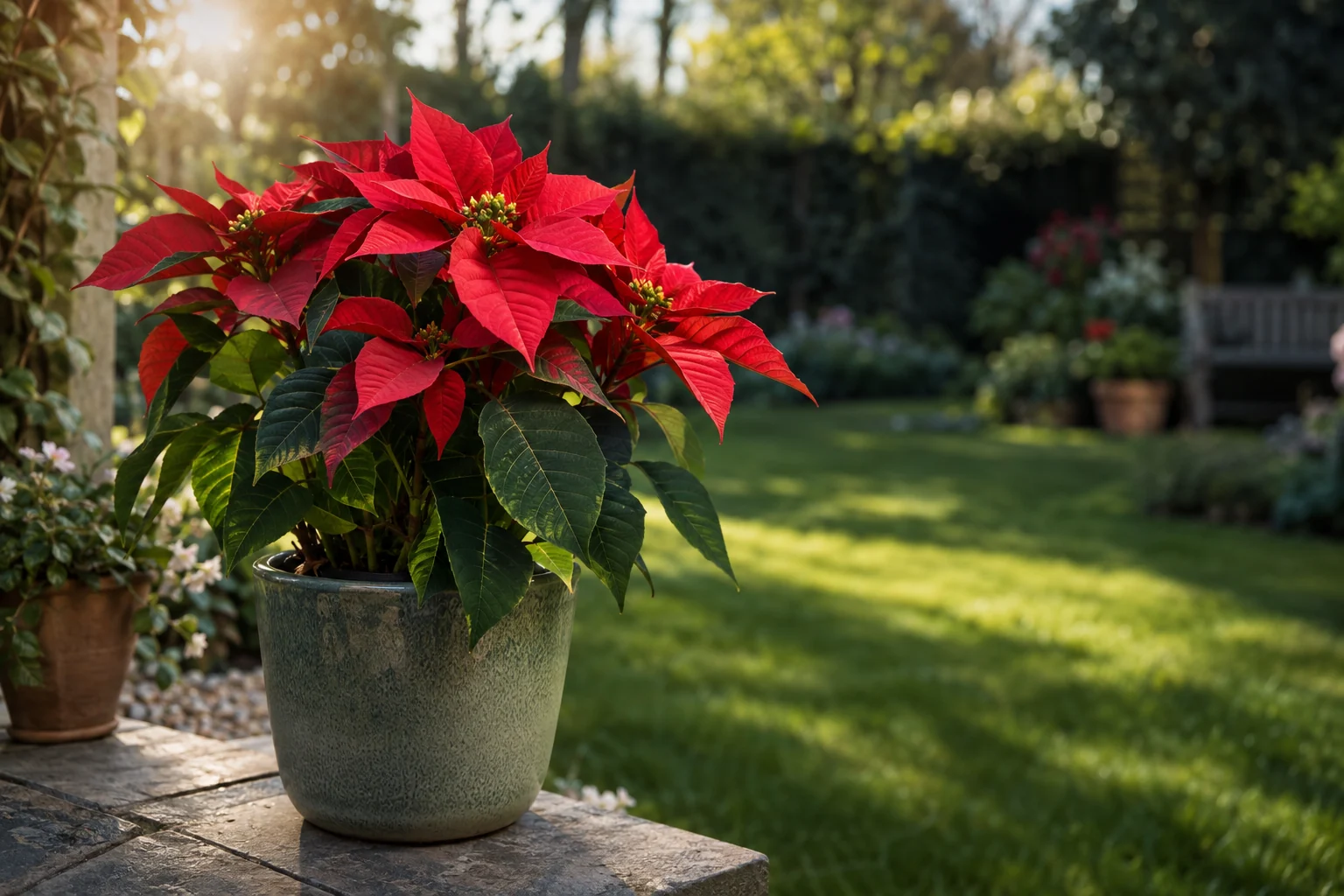
The short answer
Buy a poinsettia kept inside a warm shop, wrap it for the journey and go straight home. Keep it in a bright, steadily warm, draught-free spot, not behind curtains at night. Water thoroughly when the surface feels dry, drain fully and never leave it standing in a foil sleeve. In spring, cut back hard, repot and feed.
When to do it
Now: Not the month for this job. Use the chart to plan ahead.

A practical source of extra light for a poinsettia being kept as a foliage plant through a dull UK winter or grown on after spring. Turn it off during the deliberately dark autumn period if you are trying to colour the plant up again.
Check price on AmazonWe link to the exact model on Amazon UK. Prices change often, so check the live price before you buy. As an Amazon Associate we earn from qualifying purchases.
The Most Murdered Houseplant of the Festive Season: An Honest Introduction
Around this time every year, the poinsettias arrive. They stack up by supermarket tills, crowd the benches at garden centres and turn up, looking a little lost, beside the buckets of cut flowers at petrol stations. By the middle of January, a good many of them are in the compost bin. Others stand on the windowsill as a bare green stick with three red leaves still attached, mostly out of stubbornness.
I have contributed to that pile of casualties myself, more than once. The poinsettia is one of the most familiar Christmas plants in Britain and probably one of the most reliably killed. That is not because it is fussy in some mysterious way. It is because almost everything about the way we buy, carry and display it at this time of year works against it.
So this is not going to be a cheerful promise that keeping a poinsettia is easy. It isn't hard, exactly, but it is particular. Get a handful of things right and the plant will look good well into the new year and can carry on as a perfectly decent green houseplant afterwards. Get them wrong and no amount of tender care later will bring it back. And if you are hoping to see it turn red again next Christmas, I will be straight with you about that too, because most guides skip over how much effort it takes in an ordinary British house.
A Mexican shrub in a Midlands living room
It helps to know what you are dealing with. Euphorbia pulcherrima comes from Mexico and Central America, where it grows outdoors as a proper woody shrub, comfortably taller than a person, on frost-free hillsides. It is used to warmth, good light and a dry season. It is not used to a single-glazed bay window in a Yorkshire January, or a car boot in a Kent supermarket car park.
The red (or pink, cream or marbled) parts are not petals. They are bracts, which are modified leaves that colour up to attract pollinators to the true flowers. Those flowers are the small, rather unremarkable yellow-green knobs in the very centre of each cluster. That detail matters when you are buying, as you will see in a moment.
Being a euphorbia, the poinsettia also bleeds a milky white sap when a leaf or stem is broken. It can irritate skin and eyes, so it is worth a pair of gloves if you are pruning, and worth keeping the plant away from curious pets and small children. Its reputation for being deadly is overblown, though; a nibble is more likely to cause a stomach upset than anything dramatic.
The short version
Almost every poinsettia death comes down to one of three things: a chill (usually before it ever reaches your house), roots left sitting in water, or a draughty or overheated spot. Avoid those three and you are most of the way there. Everything else in this guide is detail.
Picking a Winner: How to Buy a Healthy Poinsettia in the First Place
The most useful thing you can do for a poinsettia happens before you hand over any money. A plant that has been stressed in the shop rarely recovers fully at home. It may look fine on the day, then drop half its leaves the following week, and you will blame yourself for something that happened before you met it.
Chilling damage is the big one. Poinsettias are tropical plants and cold air injures the tissues in a way that cannot be undone. The symptoms often take a few days to show, which is exactly why it catches people out. So the first rule is simple: look at where the plant has been standing before you look at the plant itself.
Check where it has been displayed
Walk past any poinsettias outside the shop, on market stalls, in garden centre forecourts, in the porch of a supermarket or anywhere near automatic sliding doors that open every few seconds onto a winter car park. However cheap or cheerful they look, they have probably been chilled. Buy from a plant that has sat inside the warm body of the shop.
Look at the centre of the bracts
Those little yellow-green flowers in the middle should be tight and fresh. If they are open and shedding yellow pollen, or have already fallen away, the plant is further through its display and will fade sooner.
Green leaves right down to the compost
A good plant is well clothed with dark green leaves all the way down the stems. Bare lower stems, yellowing leaves or fallen leaves lying in the sleeve all suggest stress, whether from cold, drought or wet roots.
Feel the compost
If you can, slip a finger down the edge of the pot. It should be just moist. Bone-dry compost with a wilting plant suggests it has been neglected on the shelf; sodden compost in a sleeve full of water suggests the roots are already suffering.
Be wary of plants kept in sleeves for ages
Poinsettias are often transported in plastic or paper sleeves. That is fine for the journey, but a plant that has stayed tightly sleeved for a long time on the shop floor tends to droop, with leaves hanging downwards. Choose one that is upright and perky.
Turn a leaf over
Poinsettias are prone to glasshouse whitefly. Gently tilt a few leaves and look underneath. If a little cloud of tiny white insects flies up, or the leaves feel sticky, put it back. Whitefly will happily move on to your other houseplants.
The opposite problem is easier to miss. Many shops and garden centres have warm-air heaters above the doors or blowers near the tills, and poinsettias are often stacked right underneath them because it is a good spot for impulse buys. A plant that has been blasted with hot, dry air will droop, crisp at the edges and drop leaves in much the same way as a chilled one.
A bigger, cheaper plant is not a bargain if it spent last week by the door. In my experience a modest plant from a well-run garden centre, kept indoors, away from heaters and properly watered, will outlast a showy one from a draughty forecourt every time. If you have the choice, buy from somewhere that clearly treats its poinsettias as tender plants rather than seasonal stock.
The Perilous Journey Home: Don't Kill It in the Car Park
You have found a good one. Well done. Now comes the part where a great many healthy poinsettias meet their end: the few minutes between the shop and your front door.
It is easy to forget, when you are wrapped in a coat and scarf, how cold it is outside in late November and December. To a poinsettia, a short walk across a frosty car park or a wait at a bus stop is a serious shock. As we have seen, the damage happens fast and shows up later, so the plant can look perfectly happy when you put it down at home and start dropping leaves a few days afterwards.
Wrap it, every time
Ask for a paper sleeve or bag at the till. Most garden centres keep them for exactly this reason. If none is offered, take a large carrier bag or a cardboard box with you and pop the plant inside, with the top folded over loosely. The aim is a pocket of still air around the leaves, not an airtight parcel.
A few more habits help:
- Make it the last thing you buy. If you are doing a big shop, pick up the poinsettia on your way to the checkout rather than wheeling it round the frozen aisle.
- Carry it in the car, not the boot. An unheated boot in winter quickly drops to the same temperature as the air outside. Put the wrapped plant in the footwell of a warmed-up car, wedged so it cannot topple over.
- Go straight home. Do not leave a poinsettia in a parked car whilst you nip into the post office, the pharmacy and the café. A car cools down remarkably quickly once the engine is off.
- Unwrap it promptly indoors. Once home, take it out of the sleeve fairly soon so the leaves are not squashed and drooping for days.
If you are having a poinsettia delivered, whether as a gift or an online order, unpack it as soon as it arrives rather than leaving the box in a cold porch. Check the compost, stand it somewhere warm and bright, and give it a few days to settle before deciding whether anything is wrong.
Giving one as a present? Wrap it for the journey even if you are only walking next door. A chilled gift that collapses on your friend's sideboard by New Year is nobody's idea of festive cheer, and they will almost certainly assume it was their fault.
Location, Location, Location: Finding the Right Spot Indoors
Once your poinsettia is home and unwrapped, where you put it matters more than anything you do to it afterwards. The ideal spot is bright, steadily warm and free from draughts. That sounds easy until you look round a typical British living room in December and realise how few places tick all three boxes.
Light: more than you might think
Poinsettias are often treated as table decorations and plonked in the middle of a dining table or on a dark sideboard. For a few days that does no harm. For weeks, it does. In their native habitat they get strong light, and British winter days are short and dim by comparison. The closer you can get the plant to a window, the better it will hold its leaves.
In winter, a south- or west-facing windowsill is the best place for it. You might worry about sun scorch, but low December and January sun through window glass in the UK is not strong enough to burn the leaves. It becomes a different story in summer, which I will come back to if you decide to keep the plant long term. A north-facing window will do in a pinch, but expect a slower, steadier loss of lower leaves over the winter.
Warmth: steady beats hot
Poinsettias like ordinary, comfortable room warmth. What they dislike is change: a blast of cold every time the back door opens, a radiator that roasts them in the evening and switches off overnight, or the hot updraught above a wood-burner. Put the plant somewhere you would happily sit in a T-shirt, out of the path of draughts, and not directly above a heat source.
Window glass deserves particular attention. In older houses with single glazing or tired double glazing, the air right beside the glass gets much colder than the rest of the room at night, whichever way the window faces. A plant with its leaves pressed against a cold pane can suffer chilling damage without ever leaving the house. Keep the leaves from touching the glass.
Beware the curtain trap
This is the one that catches most people. You put the poinsettia on the windowsill for the light, then draw the curtains at teatime. The plant is now shut in a narrow, cold pocket of air between the curtain and the glass, cut off from the warm room, for the whole night. Either move it onto a table inside the room each evening, or choose a spot where the curtains close in front of the sill rather than behind the plant. With blinds, the same applies if they sit inside the window frame.
Two less obvious hazards
Poinsettias are sensitive to ethylene, a gas given off by ripening fruit. A plant parked right next to a bowl of bananas and apples may droop and drop its bracts sooner than one elsewhere. It is not a dramatic effect, but there is no reason to invite it.
Very dry, centrally heated air can also cause the edges of the bracts and leaves to brown and crisp. Grouping houseplants together raises the humidity around them a little, and standing the pot on a tray of damp gravel (with the base of the pot above the water, not in it) helps too.
The Watering Tightrope: Neither Drought nor Swamp Will Do
After a chill, too much water is the next most common way to kill a poinsettia. In the wild it grows in places with a pronounced dry season, and its roots do not cope with sitting in wet compost. Waterlogged compost runs short of air, the fine roots begin to rot, and a plant with rotting roots cannot take up water. Which leads to a cruel twist: an overwatered poinsettia often wilts, its owner assumes it is thirsty, and waters it again.
Underwatering causes trouble too. A poinsettia that dries out completely will collapse dramatically and drop leaves. It will often perk up again after a drink if it is caught quickly, but repeated droughts take their toll. You are aiming for compost that is moist but never soggy, and never allowed to go bone dry.
How to water properly
- Check first. Push a finger into the compost. If the surface feels dry to the touch, it is time to water. If it still feels damp, leave it.
- Water thoroughly. Take the plant to the sink, remove any foil or decorative sleeve, and water until it runs out of the drainage holes at the bottom.
- Let it drain completely. Leave it on the draining board until it stops dripping, then return it to its spot.
- Use water at room temperature. Icy water straight from an outside water butt in December is an unnecessary shock. Water from the kitchen tap that has been left to stand for a while is fine.
- Never leave it standing in water. Check the saucer or outer pot a little while after watering and tip away anything that has collected.
How often that works out depends on how warm your room is, how big the plant is relative to its pot, and how much light it gets. A plant on a sunny sill in a warm house will dry out much faster than one in a cooler room. That is why I would rather check it every couple of days than follow a fixed calendar.
The foil sleeve problem
Many poinsettias are sold in festive foil wraps or decorative pots with no drainage. They look lovely and they hide a puddle beautifully. Water pours through the compost, collects in the foil, and the roots sit in it for days whilst you have no idea it is there. Either remove the foil altogether or take the plant out every time you water and put it back only once it has fully drained. If you want to keep it, poke a few holes in the bottom and stand it on a saucer.
One more trick: get to know the weight of the pot. Lift it just after a thorough watering and again when it needs a drink. The difference is surprisingly obvious, and after a week or two you will be able to tell by picking it up whether it needs water, without even touching the compost.
Good habits
- Checking the compost before every watering
- Soaking thoroughly at the sink, then draining fully
- Removing foil and emptying saucers after watering
- Using room-temperature water
- Watering less often in cooler rooms
Bad habits
- A splash every day "to be on the safe side"
- Leaving the pot sitting in a foil sleeve full of water
- Watering a wilting plant without checking the compost
- Letting the compost dry right out between drinks
- Icy water from an outdoor butt or a cold tap left running
Why Your Poinsettia is Dropping Leaves: A Diagnostic Guide
Leaf drop is a poinsettia's standard response to almost every kind of stress. When conditions are not right, it sheds leaves to cut down on the water it loses. That makes diagnosis a little like detective work: the symptom is the same, but the pattern, the timing and the state of the compost will usually point you to the cause.
Cold damage: sudden and widespread
This is the most common cause, and the hardest to accept, because it usually happened before the plant was in your care. The giveaway is speed: lots of leaves yellowing and falling at once, often within days of bringing it home, sometimes with the bracts dropping too. Leaves may look slightly darkened or limp before they fall.
There is no reversing chilling injury. The damaged leaves will go regardless. The real question is whether the plant has enough healthy tissue left to stabilise. Keep it warm, bright and evenly watered, resist the urge to fuss, and see what you have after a couple of weeks. Plants that keep a reasonable number of firm, green leaves often settle down. Plants left as bare stems rarely come back with any vigour.
Overwatering: gradual, from the bottom up
The second most common cause looks quite different. The lower leaves turn yellow and drop one or two at a time, working their way upwards. The compost stays damp for days, may smell stale or sour, and in bad cases the stems feel soft at the base. You may also notice small black flies hovering round the pot; these are sciarid flies, which breed in wet compost.
Stop watering straight away and remove any foil or cachepot so the pot can drain and breathe. Then wait until the compost surface is properly dry before watering again.
| What you see | Most likely cause | What to do |
|---|---|---|
| Many leaves yellowing and dropping at once, soon after purchase | Chilling on display or on the way home | Keep warm, bright and evenly watered; wait to see what survives |
| Lower leaves yellowing one by one, compost always damp | Overwatering or water trapped in a sleeve | Remove foil, let compost dry at the surface before watering again |
| Whole plant flopping, compost dry and pot light | Underwatering | Soak thoroughly at the sink, drain, then check more often |
| Whole plant flopping, compost wet and heavy | Root rot from overwatering | Do not water; check the roots (see below) |
| Brown, crispy edges on bracts and leaves | Hot, dry air from a radiator or heater | Move away from heat; group with other plants |
| Leaves hanging downwards but not falling | Left in a sleeve too long, draughts, or ripening fruit nearby | Unwrap, move to a steady spot away from the fruit bowl |
| Slow loss of lower leaves over late winter | Low light, or the plant simply ageing | Move closer to a bright window |
| Sticky leaves, tiny white insects underneath | Glasshouse whitefly | Isolate from other houseplants; wipe or treat leaves |
If you suspect root rot, slide the plant gently out of its pot over newspaper. Healthy roots are pale and firm. Rotting roots are brown, mushy and may smell unpleasant. If most of the roots have gone, the plant is unlikely to recover. If there is still a good amount of healthy root, leave the root ball out of the pot on newspaper for a while to let excess moisture wick away, then repot into fresh, just-moist compost and water sparingly until you see signs of new growth.
Do not panic over a single fallen leaf. Every poinsettia loses the odd one, especially lower down, and a plant that sheds two or three leaves over a week whilst everything else looks fine is simply adjusting to your house. It is the sudden mass exodus, or the steady march of yellow up the stems, that tells you something needs to change.
Keeping It Going: Care Through Winter and Into Spring
Right now, in late November, your job is to get the basics right and keep them steady. If your poinsettia is still in good shape by late January, with most of its leaves intact, you are past the danger zone. The emergency is over. What it needs now is a quiet, consistent routine rather than attention.
Keep the watering routine you have settled into
Moist but never waterlogged, checked rather than scheduled. As the heating comes on and goes off with the weather, the plant's needs will shift a little, so keep using your finger or the weight of the pot.
No feeding yet
The plant is not actively growing in the depths of winter, so fertiliser would be wasted at best. Hold off until you see new growth in spring.
Give it the best light you have
As the winter goes on, the plant leans towards the window. Give the pot a quarter turn every week or so to keep it even, and wipe dust off the leaves occasionally so they make the most of the dull days.
Keep an eye out for pests
Check under the leaves now and then for whitefly or the white, cottony blobs of mealybug, and deal with them early before they spread to your other houseplants.
Watch for new shoots
As the days start to lengthen after midwinter, you may see small new leaves appearing. That is a very good sign: the plant is settled and beginning to grow again.
At some point in late winter the bracts will start to fade, go greenish or drop. That is not a failure on your part. It is the natural end of the display. The coloured bracts only last a season, and the plant is moving on to its next phase.
Decision time
When the bracts have gone, you have a choice, and both answers are fine. You can compost it, having had weeks of colour for a modest outlay, and buy a fresh one next Christmas. Or you can keep it as a green foliage plant and perhaps, if you are determined, have a go at colouring it up next autumn. Nobody at GardenScout will judge you for the compost bin.
Come next spring: the reset
If you decide to keep it, the main work comes in spring, once the bracts have dropped and the days are clearly longer. After its display, the plant benefits from a short rest: water a little less, letting the compost dry slightly more between drinks, though not to the point of wilting.
Then, in spring, cut it back hard. Prune each stem down to a short stump with a few buds on it. It feels brutal, but it is what produces a bushy plant rather than a gangly one. Wear gloves for this job, as the stems will bleed that milky sap. A dab of cool water on the cut ends helps them stop.
Once new shoots appear after pruning, repot the plant into fresh houseplant compost, ideally in a pot only slightly larger than the old one, with drainage holes. Resume normal watering and start feeding with a balanced liquid houseplant fertiliser, following the instructions on the bottle.
Through Summer: Growing It On as a Foliage Plant
A poinsettia in its second year is, for most of the year, a pleasant green shrubby houseplant. It will not be the neat, compact dome you bought, and that is worth understanding before you start feeling disappointed.
Commercial growers keep poinsettias short and bushy using carefully managed growing conditions and growth-regulating treatments. Once you take over, those controls are gone, and the plant reverts to something closer to its natural, taller and more open habit. A home-grown second-year poinsettia is almost always leggier than a shop-bought one. That is not a sign you are doing anything wrong.
You can counter it a little by pinching out the tips of new shoots during late spring and summer. Each pinch encourages the stem to branch, which gives a fuller plant with more stems to carry bracts later on. Stop pinching once summer turns to autumn, as you want the shoots to be settled before the colouring process starts.
Through the warmer months:
- Light: keep it bright, but now watch out for strong direct summer sun through glass on a south-facing sill, which can scorch the leaves. A spot just back from the window, or an east- or west-facing sill, suits it better in summer.
- Water: it will need more water in warm weather and active growth. The rule stays the same: water thoroughly when the surface is dry, never leave it standing in water.
- Feed: continue with a balanced liquid feed through the growing season, as directed on the label.
- Pests: whitefly and mealybug are more active in warm conditions, so check under the leaves regularly.
I keep my second-year plants indoors all summer. A British summer can swing from warm to chilly and wet within a day, and even a sheltered patio offers more ups and downs than this plant enjoys. It also avoids bringing a summer's worth of garden pests back into the house in autumn.
The Dark Truth: Getting It to Colour Up Again in a UK Home
This is the bit most care guides tuck into a cheerful final paragraph. I am going to give it the space it deserves, because it is where most people's poinsettia ambitions quietly end.
Why it needs darkness
Poinsettias are short-day plants. More accurately, they are long-night plants: what triggers them to produce coloured bracts is a long, completely uninterrupted period of darkness every single night, sustained over several weeks in autumn. In Mexico, the lengthening nights of autumn do the job naturally. That is why they colour up for Christmas in the first place.
The difficulty is the word "uninterrupted". The plant responds to very small amounts of light. Switching on the living-room lamp for the evening, the glow of the television, a street light through the curtains, or someone flicking the landing light on at night can all be enough to break its long night and reset the clock. Commercial growers get round this with blackout polytunnels, timed lighting and precise control of temperature. A normal British home, full of people who quite reasonably like to see in the evenings, offers almost the opposite.
What you would actually have to do
From early autumn, every evening, the plant has to go into total darkness for the whole night: under a light-proof box, into a cupboard, or into an unused room with blackout that nobody goes into. Every morning, it comes back out into good light and warmth for the day. This carries on night after night for several weeks, until you can see colour developing in the bracts. Miss a few nights, or let a sliver of light reach it, and the process falters or stalls.
There is another snag peculiar to British houses. The places that are reliably dark, such as a spare room, a garage or the cupboard under the stairs, are often cold. Darkness without warmth will not do it; a chilled plant drops leaves instead of colouring up. So you need somewhere dark and warm, with someone to do the moving every day.
The method most likely to work
If you want to try, the most practical approach I know is a large, sturdy cardboard box that fits right over the plant, with any gaps taped up, kept in a warm room. Put it over at the same time every evening and lift it off at the same time every morning, and set a phone reminder for both. The routine is what matters. A box that goes on at eight one night and midnight the next will give you a green plant at Christmas.
Reasons to try
- Huge satisfaction if it works
- A plant with a history, not a throwaway
- Less waste than buying a new one each year
- You will learn a great deal about how plants respond to light
Reasons to think twice
- Weeks of strict nightly routine with no days off
- A single slip with a light can undo progress
- Dark rooms in UK homes are often too cold
- Results are usually smaller, patchier bracts on a leggier plant
- It may not colour in time for Christmas, or at all
When it works, the reward is real. Watching those top leaves blush red on a plant you have nursed through a whole year is a lovely thing. But even successful home attempts tend to produce a plant that looks a little different from a commercial one: taller, with smaller or fewer bracts, and sometimes uneven colour. It is a wonderful project for a keen indoor gardener. It is not the natural outcome of simply looking after the plant well.
A green poinsettia is still a perfectly good houseplant. If you get it through winter, cut it back in spring and grow it on happily all summer, you have kept a tropical shrub alive in a British home for a year, which is more than most people manage. Colour next Christmas is a bonus, not the measure of success.
Kit that makes this easier
A few tools that help with the jobs above. We link to the exact model on Amazon UK.
SANSI 36W Grow Light Bulb
A practical source of extra light for a poinsettia being kept as a foliage plant through a dull UK winter or grown on after spring. Turn it off during the deliberately dark autumn period if you are trying to colour the plant up again.

Check today's price: SANSI 36W Grow Light Bulb on Amazon UK
Frequently Asked Questions
The Bottom Line
Poinsettias do not deserve their reputation as fragile, impossible plants. They are tropical shrubs that have been dropped into the coldest, darkest, most draughty part of our year, sold from doorways and carried home through frosty car parks. Given a fair start, they are steady and long-lasting.
Keeping your poinsettia alive: the essentials
- Buy from inside a warm shop, never from doorways, forecourts or market stalls, and not from under a heater.
- Wrap it for the journey, carry it in a warm car and go straight home.
- Give it a bright, steadily warm, draught-free spot, and do not trap it behind the curtains at night.
- Water thoroughly when the surface is dry, drain it fully and never leave it sitting in a foil sleeve of water.
- Read leaf drop for clues: sudden means chill, gradual from the bottom means too much water.
- Come next spring, cut back, repot and feed if you want to keep it.
Getting it to colour again is possible, but it takes weeks of strict, nightly darkness in a warm room, and most UK homes make that awkward. Try it if you fancy the challenge. If not, enjoy a handsome green plant, or compost it with a clear conscience and choose a better-treated one next November.
- SANSI 36W Grow Light BulbBest for dark roomsView on Amazon
Buying for a gardener? See our gifts for houseplant lovers, checked on Amazon every day.