
How to Overwinter Fuchsias, Geraniums and Pelargoniums Indoors
Lift, prune and store tender favourites before frost arrives, then bring them back into growth for a bigger display next year.
It is early October, which means the garden is doing that annual thing where it looks both wonderfully abundant and faintly doomed. The pelargoniums may still be flowering their socks off in a sheltered pot. Your fuchsia could be carrying one last improbable flush. Then comes one clear night, a sharp little frost, and the whole summer display turns into something that resembles wet lettuce.
The good news is that you do not have to accept this as the natural end of the story. Tender fuchsias, bedding pelargoniums and many plants sold as "geraniums" can be saved indoors for winter, then grown on again next spring. It is not difficult, although it does reward a little tidiness and a willingness to inspect roots without squeamishness. Think less grand horticultural project, more useful autumn rescue mission.
The central rule is simple: get vulnerable plants under cover before a hard frost, remove the parts most likely to rot, and keep them cool enough to rest rather than attempting to turn a dark garage into the Costa del Sol. Here is how to do it properly.
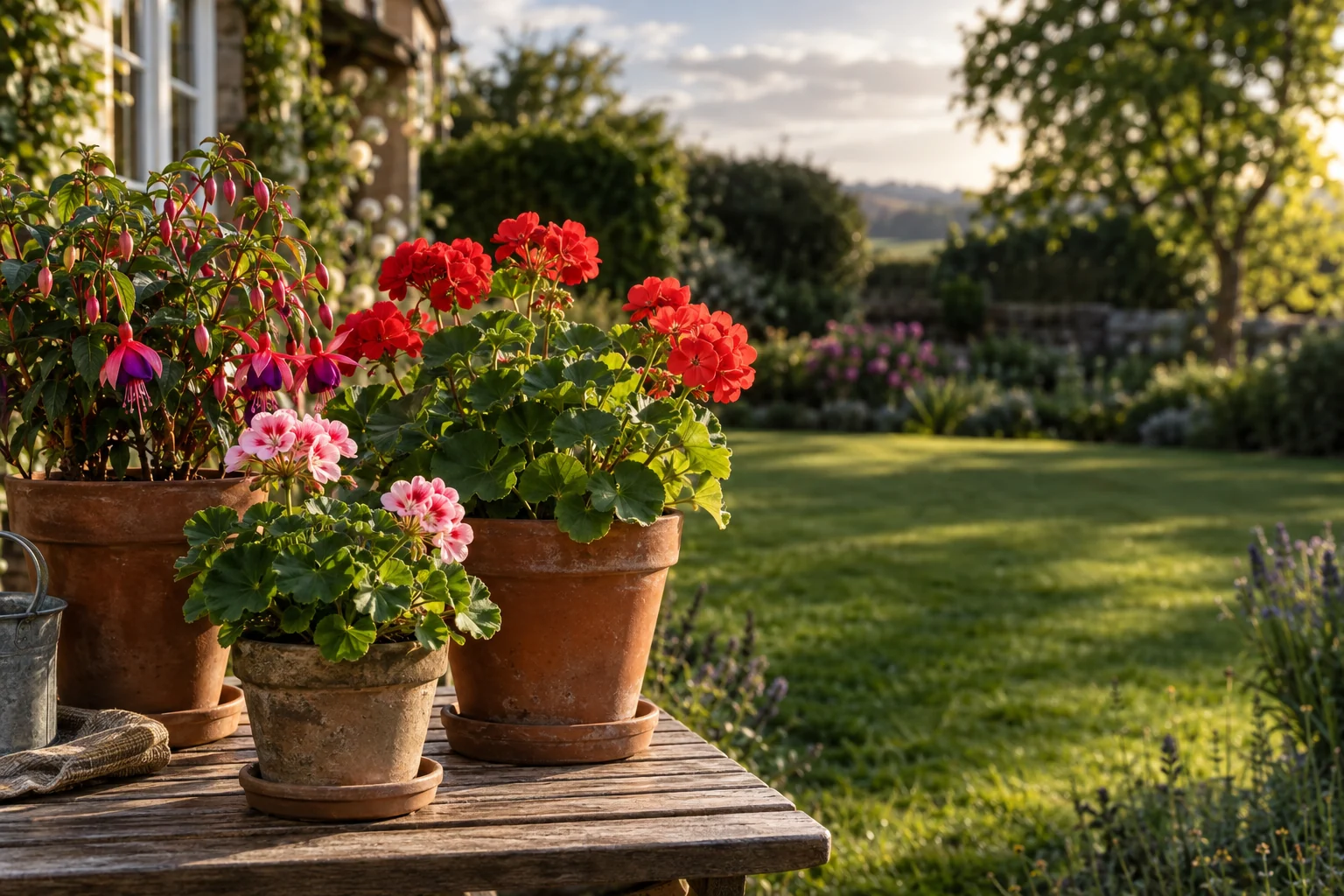
Why Overwinter Instead of Rebuy? The Case for Saving Your Tender Bedding
There is nothing wrong with buying fresh bedding in spring. A tray of young plants is one of the season's great optimistic purchases, right up there with seed packets and a new pair of gardening gloves that remain clean for approximately seven minutes. But lifting and saving your best plants can make a surprising difference to the cost, waste and quality of next year's display.
Plug plants commonly cost around £1.50 to £3.50 each. Established plants in 9 cm pots are often £3 to £6, whilst a larger patio specimen may cost £8 to £15. Replace a few baskets, window boxes and patio containers and the bill mounts rapidly. By contrast, the financial cost of overwintering plants you already own can be close to nothing if you have suitable pots, somewhere frost-free and a little compost or grit to hand.
The useful bit of autumn effort
Prioritise plants that are healthy, vigorous or especially meaningful. A tired, disease-ridden specimen is not a treasure requiring preservation at all costs. Save your strongest plants and compost the rest without guilt.
There is an environmental argument too. Bedding plants are often treated as single-season decorations, which can feel rather wasteful when the plant itself is perfectly capable of living for years. Saving a plant reduces the need for replacement stock, along with the compost, containers and commercial greenhouse inputs behind it. It also means fewer discarded plants and less peat-based plug compost entering the seasonal churn.
Then there is the horticultural advantage. An overwintered pelargonium or fuchsia is not starting from scratch in spring. Given sensible pruning and care, it has an established woody framework and a more substantial root system than a newly bought plug. That can translate into a fuller plant, more stems to carry flower and a display that gets going with real confidence once warm weather returns. Not instantly, mind. They will still wake up in their own time, like any sensible creature emerging from a British winter.
Finally, some plants simply deserve saving. Perhaps it is the coral-pink pelargonium you have propagated from a neighbour's cutting, the fuchsia that has followed you through several house moves, or the scented-leaved pelargonium whose foliage makes every time you brush past it smell faintly of summer. Gardening is allowed to be practical and sentimental at the same time. In fact, it usually is.
Know Your Plants: Telling Fuchsias, Geraniums and Pelargoniums Apart
Before lifting anything, it is worth sorting out one persistent naming muddle. In British gardens, "geranium" often means the bright bedding plant in a window box or patio pot. Botanically, that is usually a Pelargonium. A true geranium is a cranesbill: a hardy perennial from the genus Geranium, generally happy outdoors through winter and not the subject of this rescue operation.
Hardy cranesbills often form mounds in borders and have open, simple flowers in shades of blue, mauve, pink or white. They may die back in winter, but that is normal dormancy, not a cry for a spot beside the lawnmower in the garage. Leave them outside. Mulch or divide them at the appropriate time if needed, but do not haul them indoors simply because their bedding cousins have confused the issue.
A quick naming rule: if the plant is the classic summer bedding "geranium", it is almost certainly a pelargonium and is vulnerable to frost. If it is a cranesbill growing in a border, it is likely a true hardy geranium and can remain outdoors.
Pelargoniums worth saving
Zonal pelargoniums are the familiar upright bedding types, often with rounded leaves marked by a darker zone. These are excellent candidates for cool, bright indoor storage. They become surprisingly woody with age and can make handsome, generous plants if they are kept from rotting over winter.
Regal pelargoniums have larger, more dramatic flowers and a slightly grander air about them. They can be more temperamental, but that is not a reason to abandon them. Give them a bright frost-free place, avoid saturated compost and keep an eye on them. They are less forgiving of neglect than a sturdy zonal type, although many gardeners would say that is simply part of their personality.
Ivy-leaved pelargoniums are the trailing types used in baskets, troughs and tall containers. Their long stems can look rather chaotic by October, but they can still be overwintered successfully once cut back and tidied. Scented-leaved pelargoniums are especially worth keeping because their foliage is the star: rub a leaf and you may find hints of lemon, rose or spice. They also take well to being maintained as small, woody plants.
Which fuchsias need protection?
Fuchsias need a little more detective work. Some are genuinely hardy shrubs and can live outdoors year after year. 'Riccartonii' and 'Mrs Popple', for example, are hardy fuchsias with RHS H4–H5 ratings. With root protection, they can survive temperatures down to −10°C. A mature hardy fuchsia may lose its top growth after a harsh winter and still return from the base when spring arrives.
Most trailing basket fuchsias, along with many upright bedding forms, are half-hardy. These sit around RHS H2–H3 and are tender below 0°C. They are the plants to lift or bring under cover. If yours spent summer in a hanging basket and has been flowering with great enthusiasm, assume it wants protection unless you know it is a hardy variety.
Zonal pelargoniums
Classic upright bedding plants with rounded leaves; well suited to being cut back and stored in pots.
Regal pelargoniums
Larger-flowered, more particular plants that benefit from brighter, careful frost-free storage.
Ivy-leaved and scented pelargoniums
Trailing basket plants and fragrant foliage types, both worth keeping if they are clean and healthy.
Hardy versus half-hardy fuchsias
Hardy named shrubs may remain outside with root protection; tender basket and bedding fuchsias should be stored frost-free.
If there is no label and you are uncertain, take the cautious approach with a particularly valued fuchsia. It is much easier to return a protected plant outdoors next spring than it is to reverse a night of hard frost. You can also leave one less precious plant outside as an experiment if you are feeling scientific. Or reckless. The line is sometimes quite fine.
Timing Is Everything: When to Lift and What to Watch For
Early October is a useful moment to prepare, but it is not always the moment to strip every container bare. Plants still actively growing in mild weather benefit from the last of the season's warmth and light. The trick is not to lift so early that you interrupt healthy growth, nor so late that frost turns your careful plans into a post-mortem.
In much of England, mid-October is a sensible target for lifting tender bedding plants. In Scotland, late September may be more appropriate. Local conditions matter more than any date on a calendar, though. A sheltered urban courtyard can remain mild whilst an exposed garden or low-lying plot collects cold air and frosts much earlier. The cold always finds the dip in the lawn. It seems to enjoy it there.
Aim to move tender plants before a hard frost below −2°C. A light brush of frost may only soften tips or mark leaves, but repeated cold makes recovery much less certain. Pelargoniums, in particular, dislike it. Once their soft, water-filled stems have frozen, there is rarely a neat way back.
Do not rely on the kitchen window forecast
A forecast air temperature can look harmless whilst the garden experiences a ground frost. Put a min-max thermometer at plant level where your pots actually sit. Ground frosts can occur when the air temperature remains 2–3°C.
Use the Met Office five-day forecast as your first warning system, then combine it with what you know about your own garden. RHS frost-date maps provide useful broader context, but no map knows that your back fence funnels cold air straight towards the patio. A min-max thermometer does not need to be fancy; it simply tells you what happened overnight rather than what ought to have happened according to a forecast for a nearby town.
Typical cold-weather differences to plan around
Plants themselves offer useful clues. Pelargoniums often slow their flower production and begin to show yellow leaves as days shorten. This does not automatically mean they are ill. It may simply mean they have had a long summer and are ready to wind down. Fuchsias often begin to yellow and drop leaves naturally as they move towards dormancy. Again, this is helpful rather than alarming: dormancy is exactly what you want from a fuchsia going into cool storage.
Look also at the growing tips. If a light frost has left fuchsia tips soft, blackened or translucent, cut the damaged material away promptly. Do not store frost-damaged, wet foliage against healthy stems and hope for the best. Winter storage is a low-energy period for plants; it is also a high-opportunity period for rots and moulds.
Choose a dry day to lift and prepare plants if possible. Sodden compost is heavier, messier and more likely to conceal root trouble. There is no need to wait for perfect weather, because British autumn would find that a very amusing request, but avoid doing it in driving rain if you have the luxury of choice.
Lifting and Preparing Fuchsias for Dormant Winter Storage
A tender fuchsia is very happy to rest cool and almost dry through winter once it has been properly prepared. The important work happens before it enters storage: pruning, cleaning and an honest inspection of the roots. This is the point at which a plant either becomes a compact, manageable winter resident or carries half the problems of October into a dark corner until February.
Step 1: Prune hard and remove every leaf
Cut back stems to roughly one-third of their length. On upright varieties, leave around 15–20 cm of stem. Trailing varieties can be left a little longer if that gives you a more balanced framework, but resist the urge to preserve every lanky shoot. Long, soft growth is not useful in dormant storage and makes it harder to place plants sensibly.
Remove leaves by hand, along with old flowers, spent buds and seed pods. It feels rather severe, particularly if there are still flowers hanging there like tiny lanterns, but it is the correct approach for dormancy. Leaves transpire, decay and harbour fungal problems. A clean, leafless framework is much less likely to develop botrytis than a plant carried indoors with a damp canopy still attached.
Step 2: Lift, shake out and inspect the root ball
For a pot-grown fuchsia, ease the plant from its container and inspect the root ball. Healthy roots are white to cream and feel firm. A dense root system is not a concern in itself; many fuchsias become wonderfully rooty by the end of summer. What you are looking for is firmness and a lack of obvious decay.
Brown, mushy roots suggest root rot, including the possibility of Phytophthora. A plant with extensive soft root loss is rarely worth taking into winter storage, where cool damp conditions will not improve the situation. Compost it rather than allowing it to become a source of trouble near your healthy plants.
Also watch for vine weevil larvae: cream-coloured, C-shaped grubs in the compost. Adult weevils are active in the UK during August and September, and the larvae can consume 80–100% of a plant's root mass by February. That is quite an appetite for something with no visible commitment to the task.
Vine weevil action: at lifting time, a nematode solution containing Steinernema kraussei can be used while soil temperatures are at least 5°C. Treating before storage is far easier than discovering an apparently healthy fuchsia has almost no roots late in winter.
Step 3: Store a clean, resting plant
Once pruned and checked, place the fuchsia in its chosen frost-free place. A dormant fuchsia does not need a sunny windowsill or warm room. In fact, warmth encourages soft growth when light levels are low, which is exactly the sort of pale, weak material you do not want. Cool, protected and reasonably dry is the aim.
Do not leave the root ball to become bone dry for months, but do not water on a timetable either. Check occasionally. If the compost has become very dry and the root ball is shrinking away dramatically, a small drink is sensible. If it still feels damp, leave it alone. Overwintering plants are not asking for a service schedule; they are asking not to be drowned out of kindness.
It is worth labelling fuchsias before you tuck them away, especially if you have several varieties. A simple label can spare you the spring ritual of trying to identify a dormant stick by its vibes. Record whether it is upright or trailing, and whether you believe it is hardy or tender. You will thank your organised October self later.
Pelargonium Overwintering: Dry-and-Cool Method vs Potted-Up Approach
Pelargoniums offer two distinct routes through winter. The older, space-saving method is to lift plants, dry their roots and store them bare-root in paper. The more modern and generally dependable approach is to cut plants back, pot them into a sharply drained mix and keep them frost-free with enough light to remain semi-active. Both can work. The best option depends on your space, the number of plants involved and your tolerance for checking on them.
The traditional dry-and-cool method
The Victorian-style approach is familiar: shake most compost from the roots, allow them to dry for 24–48 hours, then wrap plants loosely in newspaper or place them in paper bags. They are stored or hung upside down in a frost-free shed, garage or similar space. It is beautifully economical in terms of room. You can save a surprising number of plants without turning the conservatory into a plant hospital.
It is also variable. Success rates are commonly around 40–70%, depending on conditions. Some plants come through beautifully. Others shrivel too far, mould or fail to restart. If you have a large number of ordinary zonal pelargoniums and limited space, it remains a perfectly reasonable gamble. For a favourite regal pelargonium or a special scented-leaved plant, I would choose the potted-up method instead.
The potted-up approach
Cut stems back by one-half to two-thirds and remove every yellow leaf, dead flower and weak shoot. Pot small specimens into 10–12 cm pots and larger ones into 15–17 cm pots. Terracotta or plastic both work; the more important point is that the pot drains freely and that the compost does not remain wet in low winter temperatures.
Use a mix of 50% peat-free compost and 50% horticultural grit or perlite. This is much more open than ordinary multipurpose compost and reduces water retention by approximately 40% compared with standard multipurpose compost. Pelargonium roots are quick to rot when cold and waterlogged. A plant can appear to be sitting quietly all winter, then collapse once spring warmth reveals what has happened below the surface.
Dry-and-cool method
- Uses very little shelf or bench space.
- Suitable for saving many straightforward bedding pelargoniums.
- Requires no pots during the storage period.
- Can work well in a reliably frost-free, cool place.
Its limitations
- Success can vary, with reported rates around 40–70%.
- Plants can desiccate too severely or develop mould.
- Not the first choice for cherished or temperamental varieties.
- Plants need careful checking before spring restart.
| Consideration | Dry-and-cool storage | Potted-up storage |
|---|---|---|
| Preparation | Shake off compost, dry roots for 24–48 hours, then wrap loosely in paper. | Prune by one-half to two-thirds and repot into a free-draining mix. |
| Space needed | Very little; useful where shelves and windowsills are scarce. | More space; each plant remains in a pot. |
| Winter medium | Loose paper or paper bags around dried roots. | 50% peat-free compost with 50% horticultural grit or perlite. |
| Best for | A larger collection of ordinary, healthy bedding plants. | Favoured plants, regal types, scented leaves and gardeners wanting a steadier method. |
| Main risk | Desiccation, mould and variable survival. | Cold, wet compost and root rot. |
Drainage beats enthusiasm
Winter pelargonium losses are more often caused by cold, wet compost than by lack of water. If in doubt, wait before watering. The plant can cope with being slightly dry far better than it can cope with roots sitting in a chilly puddle.
Whichever method you choose, do not bring aphids, whitefly or damaged foliage indoors as if they are invited guests. Inspect leaf joints, stem tips and the undersides of any foliage you retain. Clean plants make storage easier. If a plant is heavily infested or badly diseased, compost it and save yourself a winter's worth of disappointment.
Finding Your Frost-Free Space: Garages, Sheds, Conservatories and Beyond
The phrase "frost-free" sounds delightfully straightforward until you start looking around the average home. A centrally heated lounge is usually too warm and too dim for dormant plants. An open porch may be bright but can become bitterly cold. The ideal location is cool, protected from frost, reasonably dry and suitable for occasional inspection. It does not have to be glamorous. Plants are not judging your garage shelving.
The unheated garage
An unheated garage is often the most practical option. Its walls and floor provide thermal mass, so it typically remains 3–8°C warmer than the outside air. That is often enough to make the difference on a cold night. Place pots away from draughts near the door, off a freezing concrete floor if possible, and where they will not be knocked over by bicycles, footballs or the annual search for Christmas decorations.
Insulating a garage door with bubble-wrap polythene can reduce cold-air infiltration on sub-zero nights. Rolls suitable for the job are commonly around £15–£25 for 5 m × 1.5 m. A wireless min-max thermometer is useful here because garages can have surprisingly cold corners. Do not assume that because the centre feels fine, the shelf by the up-and-over door is equally civilised.
The garden shed
A shed can work, but its construction matters. A wooden shed may provide only around 1–3°C above outside conditions, making it less stable than a garage. Brick or concrete sheds generally offer more buffering, around 3–5°C above ambient. If your shed regularly freezes, it is not frost-free simply because you call it a shed with optimism.
Bubble-wrap insulation on walls and a single layer of polycarbonate lining can improve matters. For a 6 × 8 ft shed, this sort of lining may cost around £20–£35. It will not turn the building into a tropical greenhouse, nor should it. The goal is to soften the worst temperature dips and buy a margin of safety for dormant plants.
The conservatory
An unheated or only minimally heated conservatory is excellent for pelargoniums kept semi-active. Winter temperatures are typically 4–10°C, while the light levels are much better than those in a shed or garage. A south-facing conservatory gains useful warmth on sunny days, helping plants remain compact and alive rather than completely dormant.
The catch is overheating. A sunny February afternoon can send temperatures above 15°C even whilst the garden outside is thoroughly wintry. Ventilate if that happens. Warmth without enough light encourages thin growth, and a closed conservatory can become unexpectedly humid. Good light is an advantage; a steamy, overheated glass box is not.
Unheated garage
Usually the most stable practical space, commonly 3–8°C above outdoor temperatures because of its walls and thermal mass.
Wooden or masonry shed
Wooden sheds may be only 1–3°C above ambient; brick or concrete sheds are generally more stable at around 3–5°C above ambient.
Unheated conservatory
Typically 4–10°C in winter, with better light for pelargoniums. Ventilate if sunny-day temperatures rise above 15°C.
Min-max thermometer
The simplest way to find out whether a chosen space truly stays above freezing overnight.
Do not put tender plants directly against glass, exterior walls or a garage door. These surfaces can become much colder than the general air in the room. Group plants together for a little mutual buffering, but leave enough space for air to move around them. A damp, overcrowded cluster of pots is an excellent place to grow mould and a poor place to keep pelargoniums.
Winter Care: Keep Them Alive Without Waking Them Too Soon
Once plants are tucked away, the temptation is either to fuss over them weekly or to forget them until March. Neither is ideal. The best approach is calm supervision: occasional checks, swift action when something looks wrong, and no unnecessary watering.
For dormant fuchsias, look for shrivelled stems, obvious mould or compost that has become entirely dry. A little wrinkling is not automatically a crisis. Soft, blackening tissue is more concerning and should be cut away with clean scissors. If the plant is still firm at the base and the roots are healthy, it may yet recover well.
For potted pelargoniums, remove any leaf that yellows or collapses rather than allowing it to lie against the compost. Check stems for soft patches. Keep pots on the dry side, especially in a garage or shed where the plants receive little light and therefore use very little water. In a brighter conservatory, plants may remain more active and need slightly more attention, but the same principle applies: assess the compost before watering.
A sensible winter checking routine
- Inspect stored plants periodically for mould, collapsed stems and pests.
- Remove yellowing leaves and dead material promptly.
- Check that pots are not standing in water.
- Water only when compost has become genuinely dry, not because a certain day of the week has arrived.
- Use your min-max thermometer after cold snaps to confirm the storage area remained frost-free.
- Ventilate a sunny conservatory if temperatures climb above 15°C.
Air movement matters. You do not need to create a gale in the garage, but stale, wet air is never helpful. If weather permits, open the shed or garage briefly while you are checking plants. In a conservatory, make use of vents when sunny conditions send temperatures climbing. The point is to stop condensation lingering around stems and foliage.
It is also wise to keep stored plants separate from any houseplants carrying pests. An indoor outbreak of aphids or whitefly can find tender pelargoniums remarkably quickly, particularly if they are starting to make soft new growth. Winter is supposed to be the quiet season. There is no reason to let it become a buffet for insects.
Come Next Spring: Restarting Your Saved Plants
Spring is the reward for all this autumn restraint. As days lengthen and temperatures improve, begin checking your plants more closely for new buds and shoots. Fuchsias may show green growth from the base or nodes along the stems. Pelargoniums may push out fresh leaves from apparently bare woody stems. It is one of those small gardening moments that feels disproportionately cheering.
Start by trimming back any dead, shrivelled or blackened material to healthy tissue. Do not rush to declare a fuchsia dead because the upper stems look dry; check lower down. A plant can be alive at the base even when its top growth has not made it through. Pelargoniums often need old, weak stems shortened so new growth is encouraged from the sturdier framework.
Move plants into brighter conditions gradually if they have spent winter in a dark garage or shed. Resume watering carefully as growth begins. This is not the moment for a dramatic soaking. Roots need to wake up as much as stems do, and saturated compost remains a poor idea. Once growth is clearly underway, repot plants that need fresh compost or more room for their roots.
Keep tender plants protected until frosty conditions have passed in your area. A sunny spell in spring can make everyone impatient, including gardeners, but a sudden cold night can undo months of successful storage. Harden plants off before returning them to outdoor baskets, containers and beds. Start with sheltered conditions, then increase their exposure gradually.
This is also a good time to take cuttings from healthy new shoots if you want more plants. An overwintered favourite can become next year's collection, rather than merely replacing itself. That is the moment when autumn lifting begins to feel less like a chore and more like the beginning of a very satisfying little plant economy.
Common Problems and the Questions Gardeners Ask Most
Even a well-planned overwintering scheme has the occasional casualty. Do not take it personally. A winter with repeated cold snaps, a damp shed or one unnoticed vine weevil larva can change the outcome. The aim is not perfection. It is to give good plants a very good chance.
If it is a known hardy fuchsia such as 'Riccartonii' or 'Mrs Popple', root protection may be enough. These have RHS H4–H5 ratings and can survive down to −10°C with root protection. Most trailing and bedding fuchsias are much less hardy, however, and should be stored frost-free.
Some yellowing is normal as light levels fall and plants settle down. Remove affected leaves. If stems are soft and the compost is wet, the more likely problem is cold, waterlogged roots. Improve drainage, reduce watering and remove any rotting material.
A properly dormant, leafless fuchsia can rest in a cool, frost-free place without bright light. Pelargoniums kept potted and semi-active benefit more from a bright position, such as an unheated conservatory.
Remove visible larvae and inspect the root ball carefully. At lifting time, a biological nematode treatment containing Steinernema kraussei can be used when soil temperatures are at least 5°C. A severely damaged plant may not be worth keeping if most of its roots have been eaten.
You can, but warmth and low winter light often produce weak, stretched growth. Cool, bright and frost-free conditions are generally more useful than a centrally heated room.
If you have no suitable frost-free place at all, focus on taking cuttings from the healthiest pelargoniums before cold weather takes hold. That is not the same as overwintering mature plants, but it is an excellent fallback and takes far less room. For fuchsias, prioritise the most valuable plants and see whether a neighbour, family member or fellow gardener has a spare cold greenhouse, porch or garage shelf. Gardening has always worked best as a slightly informal mutual-aid scheme.
The GardenScout Verdict
Do the lifting now, before a hard frost catches you out. Save sturdy pelargoniums in a cool, bright and sharply drained setup; use the dry-and-cool method where space is tight and expectations are realistic. Prune tender fuchsias hard, remove every leaf and store them frost-free with minimal water. A little autumn work can spare you a spring shopping list, reduce waste and leave you with older, stronger plants ready to put on a proper show when warm weather returns.