The short answer
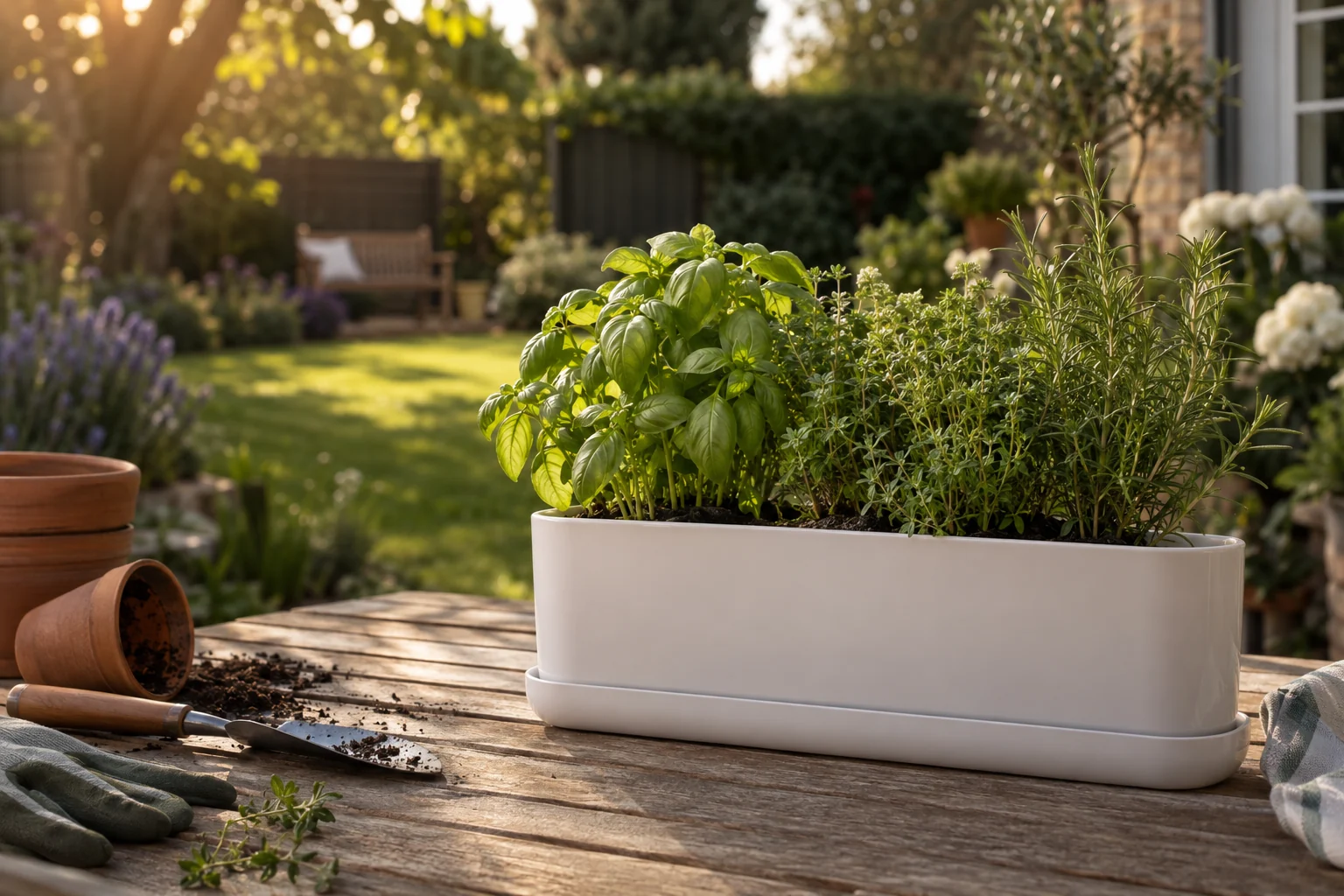
Give each herb its own pot with drainage holes, filled with 70% peat-free compost and 30% perlite or grit. Water only when compost is dry 2–3 cm down. Keep basil in the brightest spot above 15°C, sow coriander every 3–4 weeks from spring, and add supplementary light for basil and coriander in winter.
When to do it
Now: Not the month for this job. Use the chart to plan ahead.

Useful for the darker months when a UK windowsill cannot provide enough light, particularly for basil and other hungry herbs. Screw it into a suitable lamp and position it over the pots.
Check price on Amazon
This is made for keeping several supermarket-style herb pots watered on a windowsill. Its reservoir and felt pads help provide steadier moisture without requiring constant watering.
Check price on Amazon
A larger self-watering window box gives parsley, mint or several smaller herbs more room than cramped individual pots. The water-level indicator also makes it easier to avoid repeated overwatering.
Check price on AmazonWe link to the exact model on Amazon UK. Prices change often, so check the live price before you buy. As an Amazon Associate we earn from qualifying purchases.
Why Your Windowsill Herb Garden Keeps Dying (And How to Fix It for Good)
There is a particular sort of kitchen disappointment that arrives with a supermarket herb pot. You bring home a lush, cheap basil plant, put it proudly on the windowsill and imagine torn leaves over pasta for weeks. A few days later it is drooping, blackening or developing the general air of a plant that has seen things. Parsley is not much better. Coriander, given half a chance, will bolt or sulk. Even mint can look surprisingly offended indoors.
It is tempting to conclude that growing herbs indoors is a faff. It is not, exactly. It is simply different from leaving a houseplant in a bright room and hoping for the best. Kitchen herbs are edible crops. They need root room, light, air around the compost and a watering routine that reflects what the plant is doing rather than what the calendar says.
The good news is that you can keep basil, parsley, mint and coriander alive and productive on a windowsill through the UK year. The less thrilling news is that each has a slightly different opinion about how this should be done. Basil wants warmth and bright light. Mint is much more forgiving, which is one reason it has become the herb gardeners trust after basil has broken their hearts. Parsley is steady but slow. Coriander wants you to avoid disturbing its roots and, in warm bright conditions, can make a determined dash for flowering.
Fresh herbs are worth the modest effort. Dried herbs have their uses — no sensible cook is pretending dried oregano has no place — but they lose much of their volatile oils compared with fresh leaves. A few leaves picked just before cooking bring a brightness that a dusty jar at the back of the cupboard cannot quite manage.
The big reset
Do not treat a supermarket herb pot as a ready-made permanent plant. It is usually a crowded collection of seedlings grown for an immediate harvest. Divide it, pot sections into fresh compost with drainage, and give it a little breathing room. That one job changes the odds considerably.
Light is the main obstacle in a British winter. A useful windowsill may receive around 4–6 hours of usable light from November to February, compared with roughly 10–14 hours in summer. Even a south-facing sill does not magically create June in January. The solution is not to give up; it is to adjust expectations, choose the right herbs for the available light and, for basil and coriander in particular, add supplementary light when necessary.
What to do now, in November: move herbs into the brightest available position, check that no leaves touch cold glass, stop routine heavy feeding and water more cautiously. If your kitchen is cool and dim, keep mint and parsley going there and reserve basil for a warmer spot with additional light.
There is no mystique involved. You are trying to balance four things: enough light, warm-enough roots, free-draining compost and thoughtful harvesting. Get those broadly right and the windowsill becomes one of the most satisfying bits of the garden. It is gardening in slippers. Hard to dislike.
Know Your Herbs: Growth Profiles, Temperaments and What Each One Actually Needs
Before arranging pots like a miniature Chelsea display, it helps to be clear about who is likely to cooperate. The four herbs in this guide are all excellent kitchen plants, but they are not interchangeable. A north-facing bathroom window may suit mint; it is not a reasonable long-term address for basil.
Basil: glorious, greedy and very much a warm-weather plant
Sweet basil (Ocimum basilicum) is the herb most people want and the one most likely to object to an ordinary winter windowsill. It grows best at 18–24°C and should not be kept below 15°C. At lower temperatures it can blacken within 48 hours, which is dramatic but useful in one respect: basil is quite clear when it is unhappy.
Give it 6–8 hours of direct light where possible. A bright south-facing sill is the obvious choice, but take care in winter: the air inside a heated kitchen can be comfortable whilst the glass is cold enough to chill leaves and stems. Keep the pot slightly back from the pane at night, especially during a frost. Basil also has a high water demand when it is actively growing, but this does not mean keeping it in a wet saucer. Its roots need air as much as moisture.
Parsley: patient, useful and more tolerant than it looks
Parsley (Petroselinum crispum) is a better indoor herb than many gardeners give it credit for. It will tolerate indoor temperatures down to around 10°C, although it will grow more slowly in cool, low-light conditions. That slower pace is not failure. It is simply winter doing what winter does.
Parsley seed can take 14–28 days to germinate, compared with roughly 5–10 days for basil, so do not discard the pot after a week and assume the seeds were duff. Keep the compost evenly moist during germination, then water with more restraint. Parsley is biennial; second-year plants tend to bolt, producing flower stems rather than the foliage you want for the kitchen. Replace plants annually rather than arguing with them.
Mint: the sensible choice for less-than-perfect light
Mint (Mentha species) is the forgiving one. It can manage with 4–5 hours of light and copes with an indoor temperature range of roughly 8–20°C. That does not mean it wants darkness or soggy compost, but it makes mint a very practical candidate for an east- or west-facing window and a realistic winter plant where basil is not.
Keep mint in its own pot. Outdoors, mint spreads with the confidence of a plant that has read the deeds. Indoors it has less territory to conquer, but it still produces a busy root system and will compete strongly with anything sharing its container. A separate pot is tidier, easier to water and kinder to the rest of your herbs.
Coriander: quick, flavoursome and inclined to rush things
Coriander is often blamed for being difficult. In truth, it dislikes having its roots disturbed, resents shallow containers and can bolt under stress. A deeper pot makes a considerable difference. It also benefits from succession sowing: rather than waiting for one heroic pot to last indefinitely, sow a little every 3–4 weeks from spring onwards. That gives you young leaves coming along just as an older plant begins to think about flowering.
Put the fussier plants in the premium seat
Basil and coriander need the brightest position. Let parsley and mint occupy the slightly less sunny edge of the sill if space is tight.
Grow more than one pot of coriander
One large, ageing plant is a gamble. Several small sowings make fresh leaves far more likely across the season.
Respect basil's temperature limit
If your kitchen is chilly overnight, basil is not being precious. It genuinely needs warmth to remain healthy and green.
The Light Problem: Solving the UK's Biggest Windowsill Obstacle Season by Season
Light is the bit that makes indoor herb growing feel unfair. In summer, a south-facing kitchen window can seem almost too bright; in December it can look perfectly sunny to you whilst delivering only a fraction of what a basil plant would choose. Human eyes are very adaptable. Plants are less easily fooled.
In the UK, a south-facing windowsill receives approximately 4–6 hours of direct sun in December and January, rising to around 8–10 hours in June and July. That seasonal difference explains a great many apparent mysteries. Your basil did not suddenly become uncooperative in November. The available light changed, and it responded accordingly.
East- and west-facing sills tend to provide 3–4 hours of direct light. This can be adequate for mint and parsley, particularly once days lengthen, but it is not enough for basil and coriander to remain truly productive through winter without supplementary lighting. A north-facing window has near-zero direct sun in winter. Mint may survive there without artificial light; the others will not make much useful growth.
Read the window, not the room
A kitchen can feel bright because light bounces off pale cupboards, tiles and worktops. That is pleasant for people but not the same as direct light falling on leaves. Watch the actual sill for a day. When does the sun arrive? How long does it stay? Is the glass shaded by a neighbouring house, a deep roof overhang or a large evergreen? You do not need a spreadsheet, although I know some gardeners who would quite enjoy one. You need a realistic sense of the site.
Also remember that windows are not all identical. A deep sill can leave plants behind the brightest patch. A curtain, blind or café shutter can cut daylight surprisingly hard. A pot placed on the worktop half a metre from the glass receives far less light than one immediately beside it. In winter, those small decisions matter.
If light is limited, change the crop before blaming yourself
On a dim sill, mint and parsley are the sensible winter choices. Basil is best kept warm with supplementary light, or grown as a short-term crop rather than expected to perform miracles through a grey January.
Supplementary light: useful rather than extravagant
A grow light can turn a marginal windowsill into a workable winter herb station. Place it above the plants rather than at the side; leaves naturally grow towards light, and side-lighting produces lopsided plants that are forever trying to escape. Use it to supplement daylight, not as an excuse to put basil in a cupboard. The plant still benefits from the ordinary rhythms of the room and window.
For a small collection, keep the arrangement simple: basil and young coriander directly beneath the light, parsley nearby and mint wherever it has reasonable daylight. Rotate pots every few days if one side is clearly receiving more light. Turn them a quarter turn rather than spinning them randomly whenever you remember. Plants appreciate consistency, even if the rest of the kitchen is lived in by normal humans.
Winter clue: long, weak stems with wide gaps between leaves usually point to insufficient light. Moving the plant closer to the window or using supplementary light is more useful than adding fertiliser. Feed cannot replace light.
Containers, Compost and Drainage: The Foundation Most Guides Skip
A handsome ceramic pot with no drainage hole is not a herb planter. It is a cachepot: a decorative outer cover for a proper pot. This distinction sounds fussy until you have watched a basil plant collapse in a pool of stale water. Then it begins to feel like useful information.
Herb roots need a balance of moisture and oxygen. Compost with no route for excess water stays saturated, air spaces disappear and roots begin to fail. Basil is especially vulnerable: sitting in water can lead to root rot within 3–5 days. If that seems quick, it is. Indoor plants give you very little margin for error because rain does not flush a pot through and wind does not dry it as it would outdoors.
Use a saucer beneath every pot to protect the sill, then empty any standing water after around 30 minutes. This gives compost a chance to absorb what it needs without leaving the roots submerged. It is a small habit, and one of the most useful in this entire guide.
| Herb | Minimum container guidance | Why it matters | Best practical approach |
|---|---|---|---|
| Basil | 15 cm diameter per plant | Prevents crowded roots and helps compost dry evenly | Divide overcrowded shop pots into several containers |
| Mint | 20 cm or wider, individual pot | Mint spreads and competes strongly for root space | Keep it separate from every other herb |
| Parsley | 15 cm depth | Allows room for its taproot | Use a deeper pot rather than a shallow bowl |
| Coriander | 20 cm depth | Reduces stress that can encourage bolting | Sow directly where it will grow |
Choose a mix that drains but does not dry in an afternoon
A peat-free multipurpose compost can work very well for windowsill herbs, particularly when improved for drainage. A useful blend is 70% peat-free multipurpose compost and 30% perlite or horticultural grit. The added open material helps prevent the dense, airless conditions that indoor herbs dislike.
RHS-approved peat-free mixes from brands including Westland and Levington have been tested for domestic growing. Whichever peat-free mix you choose, check its texture as you fill the pot. It should feel open and slightly springy, not compressed into a wet block. If it is dry when you open the bag, moisten it gradually before potting rather than soaking it until it becomes sludge.
Do not put a layer of stones in the bottom of a pot as a substitute for drainage holes. It does not solve the basic problem. Excess water still has nowhere to leave the container. Use a pot with holes, place it in a saucer, and empty the saucer after watering. It is less romantic than a pebble layer, admittedly, but vastly more effective.
The quick repotting method
Water a supermarket herb lightly first, ease the rootball out and gently divide crowded clumps into manageable sections. Pot each section into fresh compost, firm only lightly, water once to settle it and allow excess water to drain away. Keep basil warm whilst it recovers.
Terracotta pots dry out more quickly than glazed ceramic or plastic, which may suit a heavy-handed waterer but can be demanding for basil on a hot summer sill. Glazed pots and plastic nursery pots retain moisture for longer. Neither is inherently better. The right choice is the one whose watering pattern you can manage reliably.
Watering Intelligence: Why More Herbs Die From Drowning Than Drought
If you take only one idea from this guide, make it this: indoor herbs usually die from overwatering, not underwatering. We see a leaf droop, panic, add water and feel briefly virtuous. The problem is that drooping can come from roots that are too wet to function as well as roots that are dry. Watering again compounds the mistake.
Roots need oxygen. In compost that remains saturated, the air spaces fill with water, roots struggle and disease has an easier time getting started. The symptoms can be confusing: yellow leaves, limp stems, lack of new growth and a faintly sour smell from the pot are all common signs that the roots have been wet too long.
Use the finger test, every time
Push your index finger 2–3 cm into the compost. Water only when it feels dry at that depth, not merely because the surface looks pale. The top layer can dry quickly whilst the root zone remains thoroughly damp, especially in a cool kitchen. Conversely, a small pot of basil in summer can look fine on top and be dry lower down. The finger test is more useful than a timetable.
Water slowly at the base of the plant until moisture begins to drain into the saucer. Avoid wetting basil leaves unnecessarily, as persistently wet foliage encourages fungal problems. After around 30 minutes, empty the saucer. This is the whole routine. It need not be more theatrical than that.
Basil: check often, water carefully
When actively growing, basil may need water every 2–3 days in summer and every 4–5 days in winter. Treat these as a prompt to check, not an instruction to water regardless.
Parsley and coriander: even moisture, never a bog
Both prefer compost that does not swing from bone dry to soaked. Deep containers help keep conditions more stable around the roots.
Mint: thirsty in growth, restrained in winter
Mint enjoys consistent moisture whilst growing but will not thank you for being kept wet when light levels are low and growth is slow.
Watering frequency changes with weather, pot material, heating, plant size and the amount of sun reaching the sill. A centrally heated kitchen can dry pots remarkably fast; an unheated utility room may leave them wet for far too long. This is why a rigid "every Sunday" schedule is useful only if Sunday happens to be the exact day the pot needs water. It seldom is.
When a plant droops, inspect before watering. Feel the compost, lift the pot and look at the leaves. A pot that feels heavy and wet needs brighter conditions and time to dry, not another drink.
A simple rescue for a waterlogged herb
Remove the pot from its saucer, let all free water drain away and move it somewhere bright and comfortably warm. Do not fertilise it, do not keep poking at the roots and do not water again until the compost has dried at 2–3 cm depth.
Feeding, Pruning and Harvesting: The Productive Cycle That Keeps Herbs Giving
Windowsill herbs do not need to be pampered with a different bottle for every day of the week. They do, however, need regular harvesting and modest feeding once they are established. The aim is not to produce huge, soft leaves at any cost. It is to maintain compact, flavoursome plants that replace what you pick.
Begin liquid feeding 4–6 weeks after potting, once plants have settled into their fresh compost. A balanced liquid fertiliser with an NPK around 5-5-5, used at half the recommended strength, every 2–3 weeks during the growing season is a sensible routine. Specialist herb feeds, including Vitax Herb Fertiliser, are formulated to avoid pushing excessive nitrogen growth. Tomorite can also be used when diluted. General-purpose feeds such as Miracle-Gro and Baby Bio are available alternatives, but apply them carefully: too much nitrogen can result in lush, sappy growth with weaker flavour.
From November to January, reduce feeding to once a month or stop altogether if plants are barely growing. Feeding a semi-dormant plant in low light does not turn it into summer basil. It merely encourages soft growth that the available conditions cannot support.
Harvesting is pruning, and pruning is the point
With basil, pinch or snip stems just above a pair of leaves. This encourages branching rather than one lanky stem reaching for the ceiling. Never strip a small plant bare. Take a little and let it rebuild. If flower buds appear, remove them promptly if your priority is leaf production; once basil starts concentrating on seed, leaf quality declines.
Pick parsley by taking outer stems close to the base rather than shaving leaves from the centre. Leave the young central growth to carry on. Mint responds very well to regular cutting and often becomes bushier as a result. Coriander is more finite: harvest outer leaves, avoid ripping at the centre, and have another young pot coming along behind it.
Basil
Pinch above leaf pairs. Remove flower buds and take frequent small harvests rather than one drastic haircut.
Parsley
Cut outer stems low down. Keep the central crown intact so it can continue making new foliage.
Mint and coriander
Cut mint regularly to keep it compact. Harvest coriander gently and sow replacements before the first pot is exhausted.
Pick before you need a mountain of leaves
Regular light harvesting is better for both plant and cook. It keeps growth compact and means you use herbs at their freshest, rather than waiting until the plant is overgrown and making a heroic batch of pesto at 10 pm.
Use clean scissors or snips if stems are thick enough to tear when pinched. Damaged, ragged stems are slower to recover. It is also worth removing yellowing or damaged leaves promptly, especially in winter when air movement is low. This keeps mould and fungal issues from getting a foothold around damp foliage.
Seasonal Survival Guide: Month-by-Month Calendar for Year-Round Success
Herbs grown indoors still follow the seasons, even when they live beside a kettle. Their growth slows as daylight shortens and picks up as the sun climbs higher. Working with that rhythm is much easier than trying to override it.
November–December: protect what you have
This is the stage of the year we are in now. The job is preservation, not dramatic growth. Move plants into the brightest available spot, turn them regularly and keep basil away from cold glass. Water less often than you did in summer, but do not allow small pots to become dust-dry beside a radiator. Mint and parsley are your dependable leaves now; coriander and basil may need supplementary light to remain useful.
Inspect plants weekly for yellowing leaves, fungus gnats and congested growth. Remove dead material. Stop routine feeding if growth has slowed to a crawl. A tidy, lightly harvested herb pot in December is a success. It does not need to look like a market garden.
January–February: the hardest months
January and February are usually the toughest period for a windowsill herb garden. Light is at its weakest, and on frosty nights window glass can drop significantly below room temperature even in a heated room. Basil should be kept back from the pane and in the warmest bright position possible. If it cannot be kept above 15°C, do not expect it to remain happy.
Mint may be nearly dormant, so reduce watering sharply and do not worry if it looks less vigorous. Start parsley seed indoors under a grow light if you want young plants ready for spring. Be patient; parsley remains a slow germinator even when everything is going right.
March–April: the useful turning point
Come next spring, increasing daylight makes a remarkable difference. Start new basil sowings, pot on herbs that have filled their containers and begin feeding again once plants are clearly growing. Sow coriander in succession every 3–4 weeks from this point onwards. This is the easiest way to keep it coming rather than relying on a single plant to behave indefinitely.
Open windows on mild days for fresh air, but avoid cold draughts directly over basil. The difference between ventilation and a chilly blast is worth noticing.
May–June: peak productivity
All four herbs can grow strongly now. Harvest heavily and frequently, continue modest feeding and check pots more often because compost dries faster. Basil can be sown outdoors or kept on a south-facing sill. Watch for aphids and whitefly as windows are opened more often and flying visitors discover your tender new leaves.
July–October: keep succession and shade in mind
In high summer, a south-facing sill can become very hot. Basil enjoys warmth but may still need checking for rapid drying. Coriander can bolt quickly in heat, so keep sowing fresh batches and avoid letting pots dry out completely. By early autumn, take stock: refresh tired compost, divide overcrowded supermarket herbs and decide which plants are worth carrying into winter.
The seasonal rule: water and feed in response to growth, not in response to habit. Bright, warm May needs a different routine from dim, cool December, even if the pots are sitting in exactly the same place.
Pest and Problem Diagnosis: What's Actually Wrong With Your Windowsill Herbs?
Indoor herbs are not immune to pests. In some ways they are an easier target: warm rooms, soft new growth and compost that can remain damp for too long. The reassuring part is that most common problems are easy to spot if you look closely before reaching for a remedy.
Fungus gnats: a warning light for wet compost
Fungus gnats (Bradysia species) are probably the most common indoor herb pest. The adults are small, dark flies that hover around the pot or drift up when you water. They are irritating, but the larvae in compost are the more meaningful problem because they can damage fine roots.
Adult fungus gnats are usually a sign that compost has been staying too wet. Begin with the underlying cause: allow the compost to dry more between waterings, empty saucers and make sure every container drains properly. Yellow sticky traps catch adults and help you judge whether numbers are falling. Nematode soil drenches are another option for persistent infestations.
Aphids: look at the soft tips first
Aphids cluster around tender new growth, especially on basil. You may see small green, black or pale insects, curled leaves or sticky residue. For a light infestation, wipe them away with a damp cloth or rinse the plant carefully. A diluted washing-up liquid solution of 1 teaspoon per litre can be used as a spray. Commercial insecticidal soaps are also used for this job.
Check undersides of leaves and the growing tips rather than only the obvious foliage. Aphids are not particularly subtle once established, but they do enjoy hiding in the bits you meant to inspect yesterday.
Whitefly: usually a summer visitor
Whitefly is more likely in summer when windows are open. Disturb the plant and a little cloud of white insects rises from the leaves. Yellow sticky traps are useful for monitoring and reducing adult numbers. Physical barriers and careful checking of new plants help prevent problems spreading through a small collection of pots.
Signs of a healthy herb
- New leaves are compact and appropriately coloured.
- Compost smells fresh and is moist rather than saturated.
- Stems are firm, with no blackened or mushy sections.
- Growth responds after careful harvesting.
Signs to act on
- Yellow leaves combined with constantly wet compost.
- Long, pale stems and wide gaps between leaves.
- Blackened basil leaves after a cold spell.
- Flying gnats, sticky growth or visible insects.
Diagnose before treating
Aphids need removing. Fungus gnats need drier compost as well as adult control. Pale, stretched growth needs better light. The same sad-looking leaf can have several causes, so inspect the plant, the pot and the compost before doing anything heroic.
Fungal issues are often prevented simply by improving air movement, watering at the base and removing decaying leaves. Do not pack pots so tightly together that foliage is permanently touching. A little space is not wasted space; it is an invitation for leaves to dry after watering and for you to spot problems early.
Kit that makes this easier
A few tools that help with the jobs above. We link to the exact model on Amazon UK.
SANSI 36W LED Grow Light
Useful for the darker months when a UK windowsill cannot provide enough light, particularly for basil and other hungry herbs. Screw it into a suitable lamp and position it over the pots.

Check today's price: SANSI 36W LED Grow Light on Amazon UK
Cole & Mason H105349 Burwell Self-Watering
This is made for keeping several supermarket-style herb pots watered on a windowsill. Its reservoir and felt pads help provide steadier moisture without requiring constant watering.

Check today's price: Cole & Mason H105349 Burwell Self-Watering on Amazon UK
LECHUZA BALCONERA Color 50 Self Watering
A larger self-watering window box gives parsley, mint or several smaller herbs more room than cramped individual pots. The water-level indicator also makes it easier to avoid repeated overwatering.

Check today's price: LECHUZA BALCONERA Color 50 Self Watering on Amazon UK
Frequently Asked Questions About Windowsill Herbs
Yes, if it is bright enough, but give each herb its own container. Basil should have the warmest, brightest position; coriander also needs strong light and a deep pot. Parsley and mint can occupy slightly less sunny places. Never put mint in the same pot as the others.
Cold is the usual culprit. Basil needs 18–24°C for best growth and should not be kept below 15°C. In winter, leaves close to cold glass can blacken quickly. Move the plant slightly back from the window, keep it in warmth and avoid overwatering whilst growth is slow.
Often, yes. The most useful step is to divide the crowded rootball into smaller clumps and repot them into fresh, free-draining compost in containers with drainage holes. Give the plants a few days to settle, then begin light harvesting once new growth appears.
Mint and parsley can manage in reasonable daylight, particularly on a bright sill. Basil and coriander are much harder to keep productive through a UK winter without supplementary light. A grow light is most helpful where winter daylight is weak or the only window faces east, west or north.
Take little and often. Leave enough foliage for the plant to keep photosynthesising and rebuilding. Basil and mint tolerate regular cutting well; parsley should be picked from outer stems; coriander is best treated as a succession crop rather than endlessly harvested from one ageing pot.
The GardenScout verdict
A year-round windowsill herb garden is entirely achievable, but it works best when you stop expecting every herb to behave like mint. Give basil warmth and strong light, give parsley time, give coriander depth and succession sowings, and give mint its own pot. Above all, use containers with drainage and water according to the compost rather than anxiety.
In November, simplify. Keep your brightest sill for the herbs that need it, cut back on watering and feeding, and accept that steady survival is a perfectly good winter result. Come spring, sow again, harvest more boldly and let the kitchen do what it does best: make growing things conveniently close to dinner.
- SANSI 36W LED Grow LightBest for dark windowsillsView on Amazon
- Cole & Mason H105349 Burwell Self-WateringBest for busy cooksView on Amazon
- LECHUZA BALCONERA Color 50 Self WateringBest for several herbsView on Amazon
Buying for a gardener? See our gifts for houseplant lovers, checked on Amazon every day.