The short answer
The Bosch VisiMow18V-100 suits a tidy, small lawn up to 100 m² where avoiding perimeter wire matters more than self-charging or app control. It is quiet and cuts evenly, but you carry it out, charge the battery yourself and still trim edges. It will not tackle long or wet grass, so cut it to 80 mm or less first.

Wire-free, dock-free mowing with a supplied 18V battery makes routine cutting notably simple on suitable lawns up to 100 m².
Check price on AmazonWe link to the exact model on Amazon UK. Prices change often, so check the live price before you buy. As an Amazon Associate we earn from qualifying purchases.
Introduction: Can a Wire-Free Robot Mower Really Be This Simple?
Robot mowers have spent years making a fairly ambitious promise: buy one, put your feet up, and allow a small wheeled machine to take care of the lawn. The reality has often involved a weekend on hands and knees with perimeter wire, a charging station that needs somewhere sensible to live, a socket within reach, and at least one mildly fraught conversation about why the mower has decided the herbaceous border is now part of its territory.
Then came the newer GPS and RTK-led machines. Clever things, undoubtedly. They can map routes and manage large, complicated gardens, but they may also ask you to learn an app, place an antenna, create virtual boundaries and generally become the garden's unpaid IT manager. There is a place for all that. It is not necessarily a modest lawn behind a terraced house.
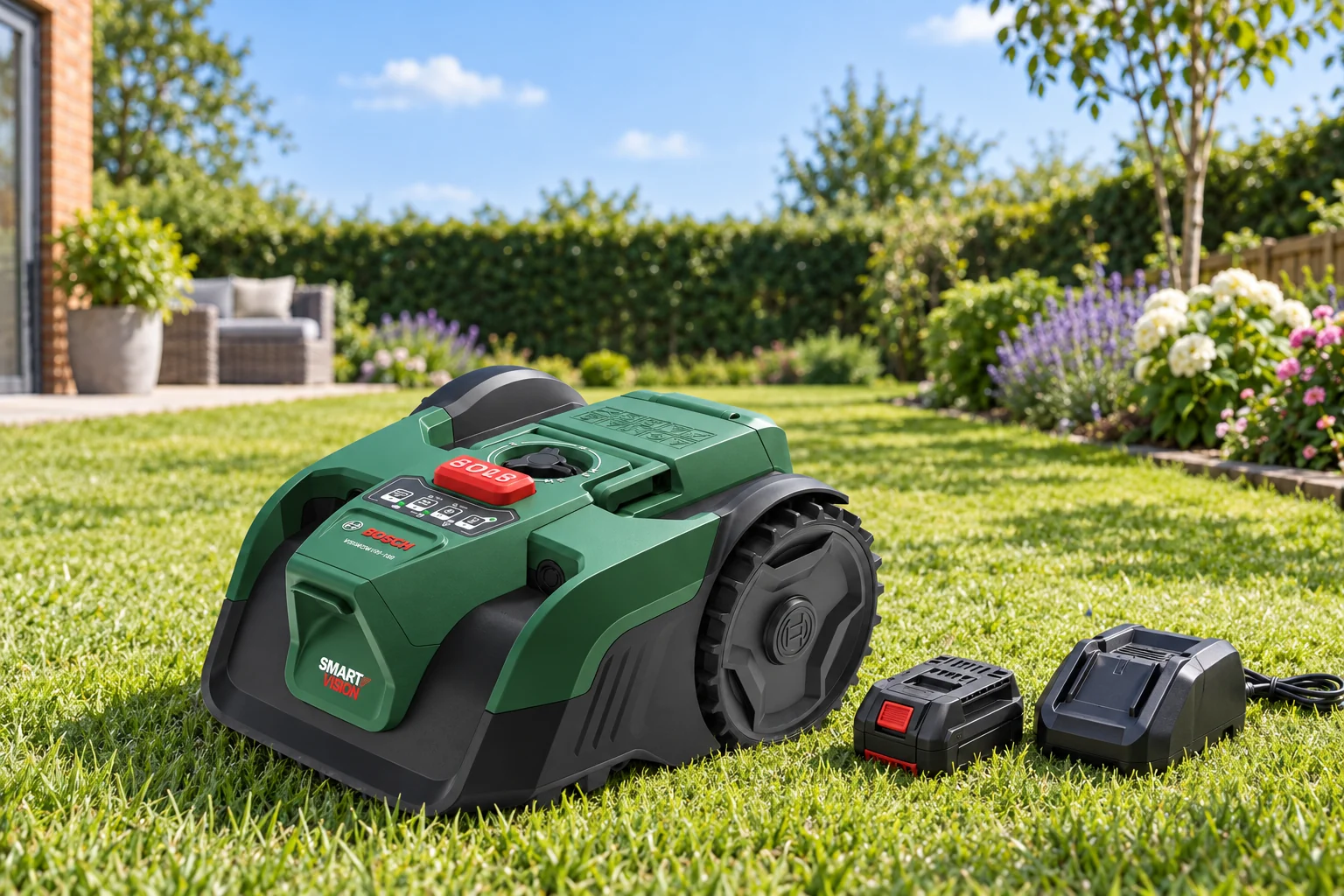
The Bosch Cordless Robot Lawn Mower VISIMOW18V-100 (Battery and Charger), model number 06008E1070, takes a deliberately less grand approach. It has no perimeter wire, no RTK antenna, no beacon, no permanent charging dock and no confirmed app control. You charge an 18V battery, carry the mower to the grass, set the cutting height and start it with physical controls. When it has finished, you bring it back in again.
That is less autonomous than the grandest robot-mower dream. It is also, for many small urban and suburban gardens, rather more useful. A mower you will actually take out and use beats a clever machine that remains in its box whilst you contemplate laying cable around every shrub.
The target garden here is clear: a lawn of roughly 40–100 m², reasonably open, kept in fair order and not dependent on formal stripes. Think compact rear gardens, little front lawns, neat rectangles behind semis, or a couple of manageable grass areas where carrying a 6.9 kg mower is easier than installing a permanent robotic system.
The short answer
Yes, this is one of the more genuinely simple robot-mower ideas: take it out, let it cut, take it in. But "simple" does not mean "zero gardening". You will still trim edges, clear obstacles, charge the battery and deal with long grass before it becomes a jungle.
In early November, most UK lawns are slowing down rather than asking to be cut weekly. That makes this a sensible time to measure the lawn, inspect awkward edges and decide whether a robot mower would actually suit your spring routine. Do not expect any compact robot to rescue long, wet autumn grass. That is not its job, and frankly it would rather not.
What Exactly Is the VISIMOW18V-100? Kit, Variants and Where It Sits
The product under discussion is specifically the Bosch Cordless Robot Lawn Mower VISIMOW18V-100 (Battery and Charger). It is Bosch order number 06008E1070, with EAN 4053423706550. The word "kit" matters here. This version arrives with the mower, one Bosch PBA 18V 4.0Ah battery and the Bosch AL 18V-44 charger.
There is also a bare-tool VisiMow18V-100, order number 06008E1001, supplied without a battery or charger. That version is useful context if you already own the appropriate Bosch battery equipment, but it is not the version covered by this guide. For a first-time buyer, the battery-and-charger package is the uncomplicated route. It gives you the bits required to operate the mower rather than sending you off into a small compatibility adventure.
Bare-tool VISIMOW18V-100
Bosch UK recommended retail price including VAT; battery and charger are not supplied.
Battery-and-charger kit
Bosch UK recommended retail price including VAT; includes one 4.0Ah battery and AL 18V-44 charger.
Bosch launched the VisiMow range as part of its 2026 lawn-mower collection. The machine is a compact, battery-powered, wire-free robot rather than a permanently installed lawn appliance. That distinction governs nearly every buying decision. It gives up auto-docking and remote control in favour of being easy to store, carry and start.
The "100" in the name is not decorative. Bosch recommends it for lawns up to 100 m². Treat that figure as the practical design limit. A robot mower does not become more capable because the lawn is only a little larger on paper, particularly when the extra square metres arrive as narrow side strips, difficult corners or a separate patch behind a shed.
One important distinction: this mower can be carried between separate lawn areas without another dock or mains connection. That does not make several disconnected lawns into one large 100 m² lawn. The combined amount of grass, garden shape and battery workflow still matter.
There is something pleasingly old-fashioned about that limitation. You are still the person in charge of the garden. The Bosch does the repetitive, slightly tedious part of maintenance mowing; it does not claim to have solved every lawn problem ever invented.
Full Technical Specifications at a Glance
Specifications can turn into a forest of figures, especially with robot mowers. For this model, however, the important ones are refreshingly easy to identify. Start with area. If your lawn is beyond 100 m², stop there and reassess. A mower sized correctly is usually calmer, more reliable and less disappointing than one bought with hopeful arithmetic.
The 16 cm cutting width is narrow. That is not automatically a weakness. On a modest plot, a narrower deck helps the mower work around stepping stones, beneath low shrubs and through the little changes of direction that make a UK garden look like a garden rather than a football pitch. It does mean the mower covers ground patiently rather than with a great deal of theatrical efficiency.
Its cutting system uses three pivoting blades. These make a fine, repeat-cut approach possible: the mower removes a small amount frequently, leaving clippings on the lawn rather than collecting them. That is mulching in the practical sense. Fine grass pieces settle back into the sward, where they are far less obvious than a thick layer of damp cuttings after a heavy one-off mow.
That regularity is central to the whole idea. The VisiMow is at its best when grass is already under control and it is simply asked to keep it that way. If you prefer to mow when the mood takes you, every few weeks, it may feel like an oddly expensive way to discover that grass has grown too long.
The height range is 20–60 mm, changed with a rotary dial in 10 mm increments. The body measures 42.9 × 34.8 × 22.6 cm, so it is small enough to store in a shed or utility area without rearranging the entire household. IPX5 protection is also specified, which is useful for cleaning and ordinary outdoor conditions, but it does not alter the basic good sense of avoiding mowing when the lawn is sodden.
The Wire-Free Promise: How Bosch's Boundary-Free Design Actually Works
"Wire-free" is one of those phrases that can mean several different things depending on the brand. Here it means exactly what a busy small-garden owner might hope: there is no perimeter cable to peg around the lawn, bury beneath edges, repair after a fork goes through it, or explain to the next owner of the house.
The VisiMow uses Bosch's SmartVision camera system together with ultrasonic and bump sensors. Bosch describes the arrangement as identifying grass and non-grass surfaces, whilst the other sensors help the mower respond to objects and boundaries. It does not build a detailed stored map and it does not cut in ordered, mapped stripes. Instead, it works in a random mowing pattern, altering direction when it encounters an edge or obstacle and gradually working over the lawn.
That sounds faintly haphazard because, well, it is. Yet random coverage is not necessarily poor coverage. Given enough running time on a suitable small lawn, it can produce an even result. Ideal Home found the finish on a 38 m² lawn even and smooth despite the mower's apparently wandering route. The appeal is that you do not need to teach it the garden first.
No perimeter wire
No cable installation, no wire breaks to trace and no need to make permanent changes around the lawn edge.
SmartVision recognition
The camera system is intended to distinguish grass from non-grass surfaces as the mower works.
Ultrasonic and bump sensors
These support obstacle response, though they do not make the mower infallible around every last-minute object.
Portable multi-zone use
Carry it to another suitable lawn area rather than installing a second dock or wire loop.
The useful comparison is with a conventional perimeter-wire robot mower. Those machines can be very capable once installed. They know where the boundary is because you have told them with a physical cable, and many return to a dock to recharge automatically. The price of that convenience is installation. Even a tidy wire installation takes time and planning, especially around beds, trees, paving, ponds and awkward lawn islands.
The VisiMow swaps that infrastructure for your involvement. You are the docking station, if we are being blunt. You put it out, collect it, charge it and store it. For a 50 m² lawn, that is scarcely a hardship. For a large garden where you want mowing to happen whilst you are away for a fortnight, it is a decisive limitation.
It also sits apart from larger RTK GPS robots. Models in that category can offer virtual boundaries and complex-zone management, but the setup may include a fixed reference antenna and app-based mapping. That sophistication can be excellent where it is justified. In a compact garden with a shed, a washing line and three pots of herbs, it can feel like installing air-traffic control for a wheelbarrow.
Boundary recognition still needs sensible edges
A wire-free mower is not a licence to leave the lawn boundary vague. Clear changes from grass to paving, concrete, block paving, soil or a distinct vertical edge give the system the best chance of recognising where the lawn ends. Untidy, overgrown edges are not helpful to the camera — nor, to be fair, are they helpful to you.
Connected passages deserve a reality check too. Bosch says a passage should be at least 120 cm wide and no more than 150 cm long if the mower is expected to travel through it as part of the same area. Measure the narrowest point, not the bit that looks generous from the patio. A narrow channel between a border and a shed can quickly turn a simple garden into a route-planning exercise.
Battery Life, Charging and the POWER FOR ALL Ecosystem
This is where the VisiMow's simplicity becomes a conscious trade. The mower is supplied with one replaceable Bosch PBA 18V 4.0Ah battery and an AL 18V-44 charger. The battery belongs to the 18V POWER FOR ALL ALLIANCE, which Bosch says spans more than 150 products across more than 10 brands.
That shared platform is worth more than a line in a brochure if you already own compatible cordless tools. A battery that can move between suitable garden and household kit is genuinely handy. It also means the mower is not attached to an outdoor socket. Charge the battery where you normally charge tools, then carry the mower to whichever lawn needs attention.
Bosch gives an average mowing time of less than four hours with the supplied kit battery, based on a dry 10 mm cut. Read that carefully. It is not a promise that every garden will be cut in a fixed amount of time, nor a reason to expect the machine to deal with a long, damp lawn in a single heroic pass. Grass density, moisture, lawn shape, slopes and the amount being removed all influence what happens in the real world.
Independent results give that statement some useful texture. Ideal Home's Sophie King reported around one hour to cut a 38 m² lawn. Expert Reviews' Stuart Milne reported roughly 90 minutes for coverage of a lawn of about 60 m². Those are not laboratory figures, nor are the lawns identical, but they are a sensible reminder that a 16 cm machine covers ground steadily rather than swiftly.
Plan around manual charging: there is no permanent dock and no automatic return-to-charge cycle. When the battery is depleted, the mower stops. You remove the battery, charge it separately and reinsert it before the next mowing session.
For an uncomplicated 30–60 m² lawn, that workflow is likely to feel perfectly reasonable. Put the VisiMow out whilst you make lunch, do some pottering or get on with something much less exciting, such as sorting recycling. Bring it in when the job is done. The absence of an outdoor base can be a positive if storage space is limited or you prefer not to leave an expensive machine visible in the garden.
As the lawn approaches 100 m², however, battery management becomes more significant. The mower does not autonomously recharge and resume, so you need to be available to collect it and continue another session if necessary. Bosch's area recommendation remains the guide, but the upper end is best treated as a garden-maintenance routine rather than a one-button, completely unattended system.
There is one small usability caveat from real-world testing. Ideal Home found inserting the battery straightforward but found removal fiddly even after pressing the release button. That is not a reason to dismiss the mower, but it is precisely the sort of mundane thing that matters when a design asks you to handle the battery after every session.
At this time of year, it is particularly sensible to charge and store the battery indoors rather than leave mower or battery outside in cold, wet conditions. Spring is when the regular routine earns its keep. Once the grass begins growing again, frequent light cuts are much kinder to both turf and robot mower than allowing a thick crop to develop between sessions.
Setup and Day-to-Day Use: Getting Started Without the Headache
The VisiMow's strongest argument may be the absence of an argument. There is no installation weekend. No boundary cable to route. No app to persuade into seeing your Wi-Fi. No dock to mount in exactly the right location. If you have ever put off a garden job because its preparation felt larger than the job itself, you will understand the appeal.
Before a mowing session, prepare the lawn in the ordinary, sensible way. Remove stones, branches, hoses, toys, tools, loose garden furniture and anything else the blades could strike or the sensors could misunderstand. A robot mower is not an excuse to leave a garden floor looking as though a toddler and a storm have collaborated on it.
For the very first use after winter, check the grass height. The mower is designed for maintenance rather than recovery. Expert Reviews advises reducing grass to roughly 80 mm or less before regular robotic mowing. Bosch's 20–60 mm cutting range also makes the sensible strategy plain: start at a higher setting if the lawn needs easing back into shape, rather than taking a dramatic amount in one go.
- Charge the removable 18V battery and insert it into the mower.
- Place the mower on a clear section of lawn with suitable, recognisable boundaries.
- Use the rotary dial to select a cutting height from 20–60 mm.
- Press ON | START for one second and wait for the LEDs to stop flashing.
- Press AUTO MOW for one second, then press ON | START to begin mowing.
Bosch describes the complete start-up process as taking around 25 seconds. That is the kind of figure one should take with a pinch of compost: it assumes you have already prepared the lawn and charged the battery. Still, the essential point holds. The process is short and physical. You operate the mower through the controls on its top panel, not through a phone.
Rotary height adjustment
Choose 20–60 mm in 10 mm steps. For most lawns, a moderate setting is a sensible starting point.
AutoMow
The standard mode for routine cutting, using the mower's random coverage pattern.
SpotMow
A focused mode for a local patch of about 2 m², useful after moving furniture or noticing a missed area.
Physical controls
There is no confirmed smartphone app, lawn mapping or remote customisation to manage.
The lack of app control is either a relief or a drawback, depending on what you hoped a robot mower would be. If you want schedules, remote monitoring, a digital map and notifications, this is not that machine. If you want to avoid turning lawn care into another app dashboard, it is a rather refreshing omission.
Height setting needs some seasonal judgement. Come late spring, when a healthy lawn is growing strongly and you want a tidier finish, a lower setting can be appropriate if the grass is already short and conditions are kind. In dry spells and through autumn, a higher setting is generally gentler on the turf. A longer lawn shades soil, helps conserve moisture and copes better with seasonal stress. Scalping a lawn in a drought has never improved anyone's weekend.
Because it mows randomly, do not stand at the window for five minutes and decide it has missed half the lawn. Give it time. The process looks less purposeful than stripes, but that is not the same as it being ineffective. If one small patch remains troublesome, that is where SpotMow earns its place.
Bosch Cordless Robot Lawn Mower VISIMOW18V-100 (Battery and Charger): Full Verdict on Performance and Value
The Bosch Cordless Robot Lawn Mower VISIMOW18V-100 (Battery and Charger) is not trying to be a miniature groundskeeping robot for every garden. That restraint is its best quality. Bosch has concentrated on a small, portable mower that handles regular cutting with surprisingly little ceremony.

On suitable turf, the cutting result appears to be the reassuring part of the story. Ideal Home described an even, smooth finish on a 38 m² lawn. Expert Reviews reported clean cuts and no scalping on a second lawn of around 30 m², even after the mower had worked for several hours until the battery expired. Those are encouraging outcomes for a compact random-pattern robot.
The three pivoting blades and mulching approach suit this regular, light-cutting role. There is no grass collector. Fine clippings are returned to the lawn. That is normal for this type of machine and can be a benefit when mowing often, but it will not suit someone who wants every visible clipping gathered into a box. If the grass is too long or wet, clippings become more obvious and the system loses much of its neatness.
Noise is another genuine strength. Bosch quotes 52 dB. Ideal Home called it the quietest robot mower the reviewer had tested, although Expert Reviews reported 44 dBA in its own assessment. The manufacturer's figure is the one to use for specification purposes, but both accounts point in the same direction: this is a quiet-running mower. It is far less socially disruptive than firing up a petrol machine near a neighbour's fence on a Sunday morning.
The random movement is less graceful than a conventional striped lawn, and some gardeners will never love the sight of it changing direction like a determined beetle. Yet it has practical advantages around odd-shaped lawns. Ideal Home found that it worked effectively around stepping stones, reached grass margins around them and covered areas beneath lower-growing shrubs. Expert Reviews found it could negotiate a box hedge border, concrete path and rockery.
There are limits. The biggest is edge performance. Expert Reviews found a 20–30 cm band of longer grass around the perimeter of one test lawn. Ideal Home likewise found the outer edges were not fully cut. This is not a tiny quibble. It means you should expect to retain a strimmer, shears or another mower for a finishing pass. Bosch itself indicates that robot mowers may leave around 100–150 mm at edges; actual results will depend heavily on the boundary arrangement.
Terrain is another limit that the headline slope rating cannot entirely explain. The mower is rated for slopes up to 35%, equivalent to about 19°. Yet Expert Reviews needed to retrieve it twice from a sharp dip on a test lawn. A garden can be technically within the slope limit and still contain hollows, ridges or abrupt transitions that a small robot dislikes. Walk your lawn and look at it from mower height, not standing height. That tends to be an illuminating exercise.
What it does well
- No perimeter wire, dock, RTK antenna or app setup required.
- Compact 6.9 kg body with carry handle makes storage and multi-zone use practical.
- Quiet 52 dB official noise rating suits close neighbours and small gardens.
- Independent reviewers found clean, even cuts on small lawns.
- SpotMow offers a useful fix for local patches of around 2 m².
- Supplied battery belongs to the wider 18V POWER FOR ALL ALLIANCE.
Where expectations matter
- It leaves border grass that needs manual trimming or mowing.
- No auto-return, auto-charge or remote management.
- Random movement does not produce formal lawn stripes.
- Not intended for substantially overgrown grass.
- Sharp dips and awkward contours can cause it to get stuck.
- The removable battery must be handled between mowing sessions.
So, is it good value? That depends less on the price tag than on whether its particular compromise suits your garden. If your alternative is a conventional robot requiring installation, dock placement and ongoing wire maintenance, Bosch's stripped-back approach has real value. If your priority is complete automation, scheduled mowing and a pristine edge-to-edge finish without intervention, it will feel incomplete.
For the right owner, though, that incompleteness is honest. The VisiMow does not pretend a small garden needs a command centre. It reduces the regular mowing chore whilst leaving the gardener responsible for the bits where human judgement is still useful.
How It Compares: VISIMOW18V-100 vs the Small-Lawn Robot Field
The VisiMow18V-100 is the only product recommended in this guide. It is still useful to understand the broad types of robot mower it sits alongside, because the best choice is often about deciding which sort of inconvenience you mind least.
Traditional perimeter-wire models, including entry-level ranges from names such as Husqvarna Automower and Gardena Sileno, ask for installation first and reward it with a more permanently autonomous routine. The wire defines the lawn; a charging dock remains in place; the machine can generally return to recharge. That is appealing if you want mowing to happen with minimal day-to-day involvement once the system is established.
RTK-based robots, such as models in the Mammotion category, take the other route. They may handle much larger and more complex spaces with virtual boundaries, but typically involve reference hardware and digital setup. For bigger gardens and users who enjoy configuring technology, that can be sensible. For a 45 m² rectangle behind a kitchen extension, it may be rather a lot of machinery and decision-making.
| Buying question | VisiMow18V-100 approach | Perimeter-wire robot context | RTK robot context |
|---|---|---|---|
| How is the lawn boundary set? | Camera-led grass and non-grass recognition with sensors; no boundary cable. | Physical perimeter wire defines the mowing area. | Virtual boundaries are typically created through satellite-based positioning and digital setup. |
| What must be installed? | No wire, permanent dock, beacon or antenna. | Boundary wire and charging station. | Reference or antenna hardware may be required, alongside app setup. |
| Who handles charging? | You remove and charge the battery separately. | The mower can return to its dock. | The mower can usually work from a permanent docking arrangement. |
| Best fit | Small, simple lawns where easy setup and secure storage matter. | Owners wanting a permanently installed, routine mowing system. | Larger or complex areas where mapping and multi-zone control justify the technology. |
| Main compromise | Manual charging, manual carrying and edge finishing remain part of the routine. | Installation and future wire repairs can be bothersome. | Greater technical setup than many compact gardens require. |
The Bosch is therefore best understood as a cordless lawn-maintenance tool with robotic navigation, rather than a permanent robotic lawn service. That might sound like a less glamorous definition. It is also a more accurate one, and accuracy tends to lead to happier purchases.
Is Your Garden the Right Size and Shape? Matching the Mower to Your Plot
The question is not simply "Is my lawn under 100 m²?" It is "Is my lawn under 100 m² in the way this mower needs it to be?" Two lawns with the same measured area can be entirely different jobs. One may be a simple 10 m × 10 m square. The other may be a collection of narrow strips around a patio, trampoline, shed, pond, raised beds and a child's football goal. The second lawn is more work for every mower, robot or otherwise.
Measuring a rectangular lawn is straightforward: multiply length by width. A 10 m × 10 m lawn is 100 m². So is a 12 m × 8 m lawn. Those dimensions offer a useful visual reference for the VisiMow's intended upper limit and are familiar scales for many terraced and semi-detached gardens.
For an irregular lawn, divide it into rough rectangles, squares or triangles, calculate each area and add them together. Do not fret over the last square metre. You are looking for a sensible estimate and, more importantly, an honest assessment of shape. Measure narrow connections at their tightest point. Inspect slopes, dips and edges. Note where the lawn meets soil or loose gravel rather than a clear hard boundary.
A strong match
You have a 30–80 m² lawn, clear edges, room to store the mower inside and no desire to install wire or learn another app.
A possible match
Your total grass area is close to 100 m², you can carry the mower between zones, and you accept that regular sessions and edge trimming are part of the deal.
Probably skip it
Your lawn is larger than 100 m², very uneven, regularly overgrown, full of tight passages or you want app control and fully automatic recharging.
Do not buy for the number alone
If your lawn measures 110 m² or 120 m², do not assume the extra area is insignificant. The mower may still cut grass, but you are asking a machine rated to 100 m² to cover more ground without a self-charging dock. That usually means more intervention and less of the convenience you were buying it for.
Features within a small lawn can be less of a problem than they first appear. Ideal Home found the VisiMow worked around stepping stones and beneath low-growing shrubs, while Bosch's portable arrangement means separate same-level grass areas can be addressed by moving the mower between them. That is a nice benefit in urban gardens split by paths or patios.
But narrow channels deserve caution. For a connected route, Bosch specifies a minimum width of 120 cm and a maximum length of 150 cm. A route that looks possible to a person with a mower may not be a route a random-navigation robot handles happily. Likewise, a sharp dip can be more troublesome than a gentle overall slope. Expert Reviews' experience of needing to retrieve the mower twice is useful evidence that smooth transitions matter.
November is a good month for this reconnaissance. The lawn is likely to be quieter, leaves make clutter easier to spot, and you can identify low spots before spring growth disguises them. Take a tape measure out. It is less thrilling than ordering a robot mower, admittedly, but it is also the step most likely to prevent an expensive disappointment.
Practical Questions Before You Buy
Not for most gardens. It is designed for routine maintenance mowing, not tall first cuts, and reviewers found grass remaining at the lawn perimeter. Keep a conventional mower or grass trimmer for overgrown grass and edge finishing.
No app or smartphone control is confirmed for this model. It is operated from its physical controls, which is a major part of its appeal for gardeners who prefer not to map or schedule the lawn digitally.
No. The VisiMow follows a random mowing pattern rather than mapped, ordered stripes. The aim is even grass height over repeated sessions, not a striped presentation finish.
Use it when conditions and grass growth are suitable, but do not expect it to tackle wet, long or neglected grass. In November, many UK lawns need little mowing. Store the mower and battery carefully, then begin a regular light-cut routine again when growth resumes in spring.
Clear distinctions between grass and non-grass are helpful. Paving, concrete, block paving, soil and vertical borders are all more legible than a loose, indistinct grassy edge flowing into beds or gravel.
The honest final picture is of a mower that makes the central mowing task easier rather than making gardening disappear. There is still a little setup before each run, a little tidy-up around the boundary and a little judgement about grass height and weather. That is not a failure of the concept. It is simply a more realistic version of robot mowing for a small British garden.
GardenScout verdict
The Bosch VisiMow18V-100 succeeds because it keeps its promise modest. It is a strong fit for a tidy, small lawn up to 100 m² where avoiding wire installation matters more than having a self-charging, app-controlled robot. Expect a quiet and capable maintenance mower, not a total replacement for edging tools, first cuts or ordinary garden common sense.
- Bosch Cordless Robot Lawn Mower VISIMOW18V-100 (Battery and Charger)Best for small lawnsView on Amazon
Buying for a gardener? See our gifts for lawn lovers, checked on Amazon every day.