
How to Scarify and Aerate Your Lawn (and Why It Matters)
The complete guide to clearing thatch, relieving compaction, and choosing between manual and powered tools — with real models, timings and honest pointers.
If your lawn has turned spongy underfoot, gone patchy and pale, or developed an alarming carpet of moss that no amount of mowing seems to shift, the problem almost certainly isn't on the surface — it's underneath. Two issues sit at the root of nearly every tired, struggling lawn I've come across: a thick layer of thatch choking the grass at soil level, and compaction sealing the ground so tightly that air, water and nutrients simply can't get down to the roots.
The good news is that both problems have a straightforward fix, and they're jobs you can absolutely do yourself. Scarifying clears away the thatch and moss; aerating punches the soil open again so it can breathe. Do them at the right time of year, with the right tools, and a sorry-looking patch of grass can bounce back into something you're genuinely proud of within a single season.
In this guide I'll walk you through exactly what each process does, why it matters so much, when to do it, and — crucially — how to choose between a cheap manual tool and a powered machine. I'll use real models throughout, from a £45 hand rake right up to a 40V cordless 2-in-1 machine, so you can see where your money actually goes.
Scarifying vs Aerating: What's the Difference?
People muddle these two jobs constantly, and it's easy to see why — they're both about lawn health, they're often done at the same time of year, and some machines do both. But they tackle completely different problems, and understanding which is which is the first step to fixing your lawn properly.
Scarification means getting rid of the unwanted moss and thatch. More precisely, scarifying is the process of removing debris — moss and thatch, leaves, old grass cuttings — from the lawn by catching it in bladed teeth. Picture a stiff comb with steel blades dragged through your turf, slicing vertically into that matted brown layer at the base of the grass and lifting it out. It's brutal-looking work, and a freshly scarified lawn looks like it's been through a war for a week or two, but that's exactly the point: you're clearing out the dead material that's been suffocating live growth.
Aerating involves making small holes in the soil to improve its drainage and allow air, water, and nutrients to penetrate the roots of the grass. By creating those holes, aerators ease soil compaction and let water, air and nutrients reach the roots more directly. Where scarifying is about clearing material away, aerating is about opening the ground up. Compacted soil — caused by foot traffic, heavy mowers, kids, dogs, and simply time — becomes so dense that rain pools on top instead of soaking in, and roots can't push down to establish themselves.
Here's the way I think about it: scarifying is the haircut and aerating is the deep breath. One clears the dead stuff off the top of the soil, the other lets the living roots underneath actually function. Both are key for maintaining healthy lawns, but they function differently, and each helps improve grass growth and soil condition in its own right.
To achieve optimal lawn health, using both scarifiers and aerators can be advantageous. They're complementary jobs — clearing the thatch first means the aeration holes you create afterwards aren't immediately clogged with debris.
Why Thatch and Compaction Quietly Wreck a Lawn
Let's talk about what's actually going wrong, because once you understand the mechanism it becomes obvious why these jobs matter so much — and why mowing, watering and feeding alone won't rescue a struggling lawn.
The thatch problem
Thatch is the layer of dead and living organic matter — old grass stems, roots, clippings and moss — that accumulates between the green blades you see and the soil surface below. A thin layer is actually beneficial; it insulates the soil and cushions foot traffic. But once it builds beyond around half an inch, it becomes a problem. Water hits the thatch and runs off or sits on top. Fertiliser gets trapped in the spongy layer and never reaches the roots. Moss moves into the damp, shaded conditions thatch creates, and pretty soon you've got a vicious circle: more moss, more thatch, less grass.
The tell-tale signs are a spongy, bouncy feel when you walk on the lawn, water pooling after rain, grass that looks thin despite regular feeding, and of course a visible scum of moss. If you part the grass with your fingers and see a thick brown felt at the base, that's thatch, and it needs scarifying out.
The compaction problem
Compaction is the silent killer. Every time you walk across the lawn, push a mower over it, or let the kids and dogs charge about, you're pressing the soil particles closer together and squeezing out the tiny air pockets that roots and soil life depend on. Clay soils compact fastest, but every lawn suffers from it over time.
The result is soil so dense that roots can't penetrate, water can't drain, and the beneficial microbes and worms that keep soil healthy are starved of oxygen. Grass growing in compacted soil develops shallow roots, which means it dries out fast in summer and struggles to compete with weeds and moss. Aerating breaks that seal and lets the whole underground ecosystem function again.
Better drainage
Aeration holes give surface water somewhere to go, ending the puddles that drown roots and breed moss.
Air to the roots
Opening compacted soil lets oxygen reach the root zone, which roots and soil microbes both need to thrive.
Deeper rooting
With thatch cleared and soil loosened, new grass can root deeper, building drought resistance and density.
Less moss
Scarifying physically removes moss whilst the improved drainage removes the damp conditions it loves.
When to Scarify and Aerate: Getting the Timing Right
Timing is where a lot of well-meaning gardeners come unstuck. Scarifying is aggressive — you're deliberately tearing material out of your lawn — so you only want to do it when the grass has the strength and conditions to recover quickly. Get the timing wrong and you can leave your lawn looking worse for months.
The general rule is that twice a year is ideal — once in spring and again in autumn — although it depends on the condition of your lawn. Those two windows give you grass that's actively growing and weather that's warm enough for recovery but not so hot that the lawn dries out and stresses.
Pro Tip: The two-window approach
Spring scarification clears out winter's moss and debris and wakes the lawn up for the growing season. Autumn scarification removes the build-up from summer and sets the lawn up to overwinter cleanly. If you only have time for one pass a year, early autumn is usually the safer bet — the soil is still warm, there's more reliable moisture, and the grass has weeks of mild weather to knit back together.
A few conditions matter regardless of season. The lawn should be slightly moist but never soggy — scarifying waterlogged turf tears the grass out by the roots, whilst bone-dry ground is hard work and risks damage. Mow a couple of days beforehand so the blades reach the thatch rather than just the grass tips. And avoid scarifying during a drought or a heatwave, because the lawn simply won't have the moisture to recover.
Aeration is gentler on the lawn, so you have slightly more flexibility, but the same spring and autumn windows work best because that's when the soil is workable and the grass is growing. The one firm rule for aerating is to do it when the soil is moist — trying to punch holes into rock-hard summer ground is both exhausting and ineffective.
Manual Tools: Cheap, Effective, and Hard Work
Let's start at the budget end, because for a lot of gardens it's genuinely all you need. Manual scarifiers require physical effort but are suitable for smaller lawns and spot treatments. They usually resemble rakes but are equipped with metal blades to slice through the thatch layer rather than the springy tines of an ordinary lawn rake.
The honest truth is in the name: manual scarifiers need neither electricity nor petrol, however they are extremely laborious. There's no sugar-coating it — dragging a bladed rake back and forth across even a modest lawn is a serious workout, and by the time you've covered a hundred square metres you'll have earned your cup of tea. Still, they are useful for very small areas or individual thatch patches, and there's a satisfying directness to the job that powered machines can't quite match.
Models worth knowing
Two manual scarifiers crop up repeatedly as solid, well-built choices. The Darlac DP888 lawn scarifier carries an RRP of £44.99, and the Greenman R1710 Scarifying Rake sits just alongside it at £45.95. Both are essentially the same proposition: a sturdy head of sharpened blades on a long handle, no motor, no maintenance beyond keeping the blades reasonably clean. For US readers, manual scarifiers can be purchased for about $50, and certain types of manual aerators can be purchased for as little as $30 — making the hand-tool route the cheapest way into proper lawn care by a wide margin.
Manual aerators come in a couple of forms. The simplest are spike aerators — essentially a roller or a set of solid prongs you push into the soil — whilst hollow-tine aerators (sometimes hand tools you step on like a fork) actually pull cores of soil out, which relieves compaction far more effectively than just poking holes. For a small lawn, a manual hollow-tine aerator is one of the best-value tools you can own.
Manual Pros
- Cheapest route in — around £45 for a quality scarifying rake
- No power, fuel, batteries or charging to worry about
- Virtually nothing to maintain or break
- Perfect for small lawns, spot-treating moss patches and tight corners
- Quiet, and you can stop the instant you've had enough
Manual Cons
- Genuinely exhausting — extremely laborious over any real area
- Slow going compared to a powered machine
- Harder to achieve a consistent depth across the whole lawn
- No collection — you rake up the debris separately afterwards
- Impractical for medium and large lawns
Powered Tools: Electric, Cordless and Petrol
Once your lawn gets beyond the size you're willing to tackle by hand — and for most people that threshold arrives surprisingly quickly — a powered machine transforms the job from a weekend ordeal into a manageable hour or two. There are three broad categories, each with a different sweet spot.
Electric (corded)
For larger gardens, electric scarifiers or petrol scarifiers are more efficient. Electric models are eco-friendly and easy to operate, making them popular for medium-sized lawns. A corded machine gives you unlimited runtime — no battery to flatten halfway through — and they tend to be lighter and cheaper than their petrol equivalents. The trade-off is obvious: you're tethered to a cable, which means managing the lead around obstacles and staying within reach of a socket.
Ranging between £100 and £250, you can get your hands on specialist brands like VonHaus and Einhell to give you the convenient style you need. That's a wide bracket, but it covers most quality corded scarifiers, and for a medium lawn a corded machine is often the best balance of price and capability.
Cordless (battery-powered)
Cordless machines are the fastest-growing category, and it's easy to understand the appeal — all the convenience of a powered tool with none of the cable. Current top cordless options include various Einhell Power X-Change models and cordless Greenworks machines, which offer genuine portability. The catch is battery management: runtime is finite, and a thorough scarify-and-aerate session can easily outlast a single charge on a larger lawn. If you go cordless, factor in the cost of a spare battery so you're not standing around waiting for a recharge.
Petrol
At the top end sit petrol machines. Petrol scarifiers, powered by fuel, are highly effective for extensive areas, providing power and speed to manage thick layers of thatch. If you've got a large lawn, a serious moss problem, or you're maintaining several properties, petrol is the workhorse choice. The downsides are the noise, the fumes, the heavier weight, and the ongoing maintenance — fuel, oil, spark plugs and the rest — that a petrol engine demands.
| Tool Type | Best For | Runtime | Typical Outlay |
|---|---|---|---|
| Manual rake | Small lawns, spot patches | Until you tire | Around £45 |
| Electric (corded) | Medium lawns | Unlimited (tethered) | £100–£250 |
| Cordless | Small–medium lawns | Limited by battery | Mid-range |
| Petrol | Large or thatch-heavy lawns | Unlimited (refuel) | Premium |
The WORX WG855E.9: A 2-in-1 Cordless Standout
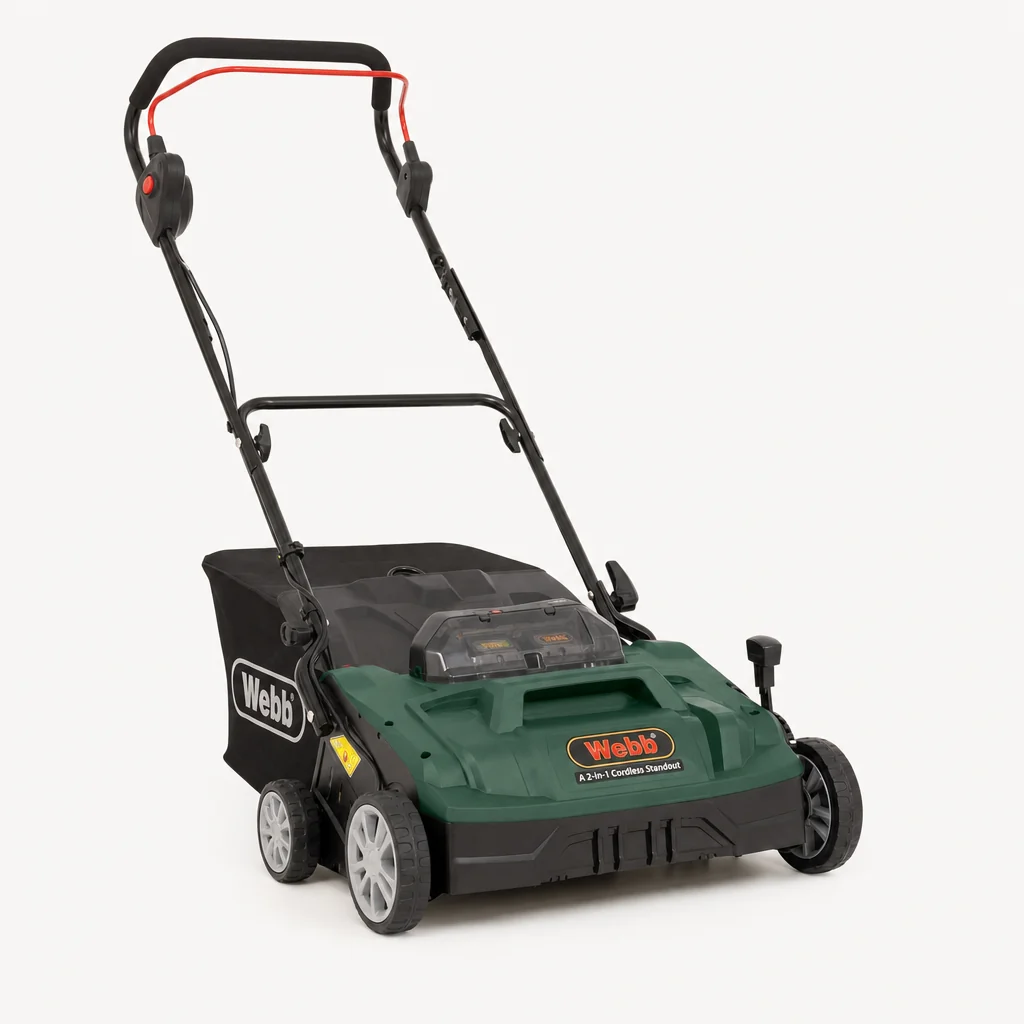
If there's one machine that captures why the cordless 2-in-1 category has become so popular, it's the WORX WG855E.9. It's a single tool that scarifies and aerates, swapping between the two jobs with a quick cartridge change, and it runs on WORX's familiar battery platform. I've spent enough time around this machine to have a clear sense of where it shines and where it doesn't, so let's get into the detail.
The WG855E.9 runs on two 20V batteries, making 40V of power, driving a 12 amp motor with an innovative brushless design for maximum torque, runtime and durability. The cutting width is 36cm — plenty for a small to medium-sized garden — and it weighs just over 10kg without batteries, which makes it easy to carry around. That low weight matters more than you'd think; nobody enjoys wrestling a heavy machine around flower beds, and the WORX is genuinely manageable.
The clever cartridge system
The defining feature is the two-in-one design. Because this is a 2-in-1 scarifier and aerator, it comes with a pair of removable cartridges. The scarifier cartridge uses hooked metal tines to remove thatch and moss from the grass, and the aerator cartridge has stainless steel blades to cut into the soil to allow air, water and nutrients to circulate. Changing the cartridges over is simple and tool-free — a genuinely well-thought-out bit of engineering that means you're not buying and storing two separate machines.
In terms of working depth, the scarifying cartridge has steel blades that remove thatch and moss up to 1/2" deep, while the aerating cartridge punches holes up to 2" deep. Depth is controlled by a lever on the base of the machine, with four settings: '+1' runs just above the surface, '0' at -3 mm, '-1' at -6 mm, and '-2' at -9 mm. That graduated approach is exactly what you want — start shallow on a tired lawn and only drop to the deeper settings once you've gauged how much thatch you're dealing with.
Pro Tip: Start at '+1' and work down
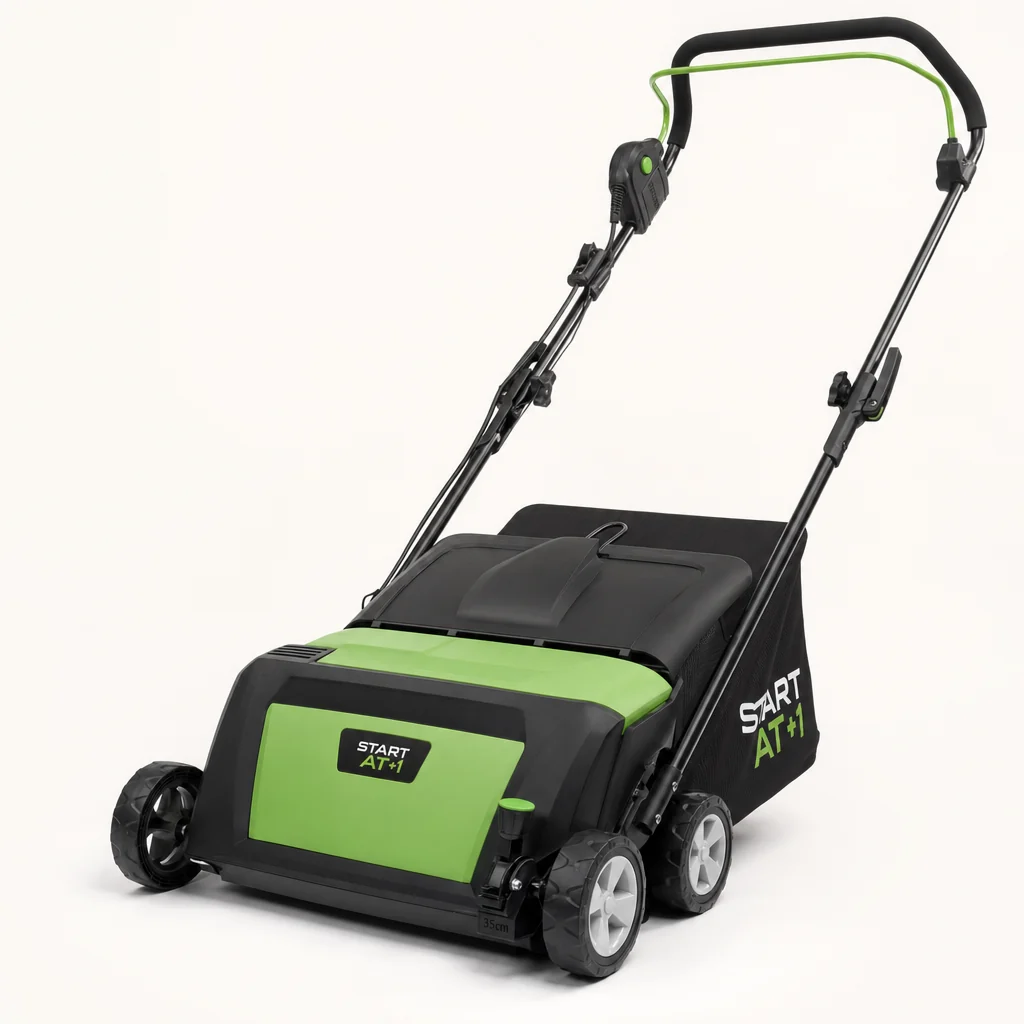
On your first pass, set the lever to '+1' so the blades skim just above the surface, then drop to '0' and '-1' on subsequent passes as you see how much material is coming out. Going straight in at '-2' on a lawn you've never scarified can pull out far more living grass than you intended. Ease into it.
Performance and collection
In use, the WORX gets through material impressively fast. The 40L collection box filled up in under a minute of scarifying — which tells you two things. First, it's pulling out a serious quantity of thatch and moss, which is exactly the job. Second, you'll be emptying that box frequently, so keep a tarp or a wheelbarrow close to hand to save yourself the constant trek to the compost heap.
On the battery front, you will need 2 × 5Ah batteries — they have a longer charge — and that's worth taking seriously. The brushless motor is efficient, but scarifying and aerating are demanding jobs that drain cells quickly. For a small lawn you'll be fine on one charge; for anything larger, a second set of batteries on standby is close to essential.
Pros
- Comfortable, soft handle, and easy to see the charge indicator through the transparent window
- Robust scarifier and aerator combo that effortlessly improves the lawn
- Very easy to use and store — it's very light weight
- Tool-free cartridge swap between scarifying and aerating
- Brushless motor delivers strong torque and longer runtime
Cons
- Fine for smaller spaces, but unless you have plenty of spare batteries it will take a while to do a large garden
- Collection bag fills quickly — frequent emptying needed
- Runtime is limited on a single set of batteries
- Supplied tool-only, so batteries are an additional cost
The VonHaus Electric Alternative
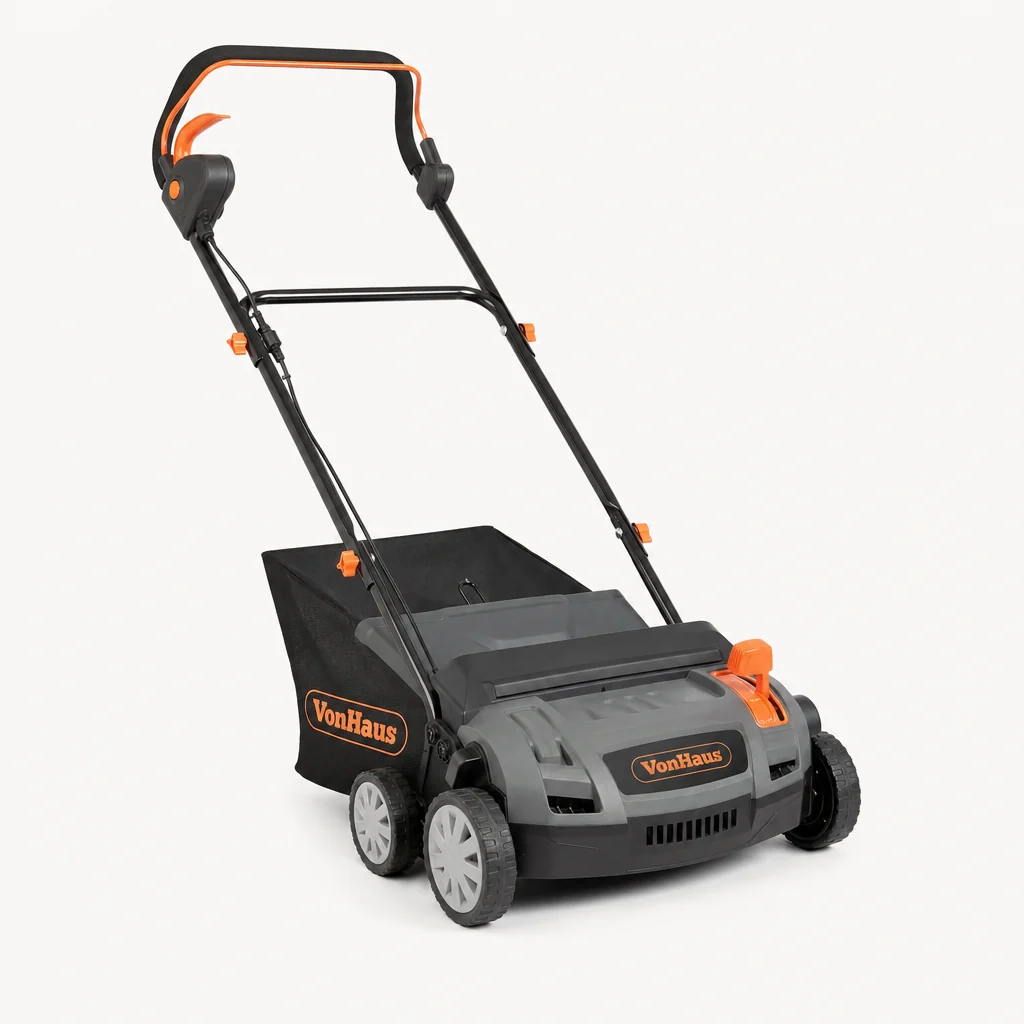
If the idea of managing batteries puts you off, the corded route is well worth a look, and VonHaus is one of the brands that consistently turns up at this end of the market. The standout is the VonHaus 1500W Electric Lawn Scarifier/Aerator, which sits squarely in the medium-lawn category and offers a different set of trade-offs to the cordless WORX.
It's a 1500W electric lawn scarifier aimed at medium lawns of 100–300m², built as a 2-in-1 scarifier and electric lawn rake with interchangeable drums — so, like the WORX, it covers both jobs by swapping the working head. The 32cm working width helps cover more grass with each pass, and there are four depth settings ranging from -12mm to +4mm, letting you choose between lighter raking and deeper scarifying. A 30L collection bag gathers moss, thatch and lawn debris as you work, saving you the separate rake-up that manual tools demand.
| Feature | WORX WG855E.9 | VonHaus 1500W | Manual Rake |
|---|---|---|---|
| Power source | 40V cordless | 1500W corded | Muscle |
| Working width | 36 cm | 32 cm | Varies |
| Depth settings | 4 (+1 to -2) | 4 (+4mm to -12mm) | Single |
| Collection box | 40 L | 30 L | None |
| Does both jobs | Yes — cartridge swap | Yes — drum swap | Scarify only |
| Best lawn size | Small–medium | Medium (100–300m²) | Small |
| Runtime limit | Battery-dependent | Unlimited (tethered) | Stamina-dependent |
The two machines make a neat comparison. The WORX wins on portability, the cordless freedom of movement and a slightly wider 36cm cut with the larger 40L box. The VonHaus counters with unlimited runtime — there's no battery to flatten on a 300m² lawn — and that's a meaningful advantage if your garden sits at the larger end of the medium bracket. For me, the deciding factor usually comes down to lawn size and layout: lots of obstacles and tight corners favour cordless, whilst a big open stretch favours the corded machine you can keep running indefinitely.
Both 2-in-1 machines spare you the cost and storage hassle of owning separate scarifying and aerating tools — a genuine advantage if you're tight on shed space or just want to keep things simple.
How to Actually Do the Job: A Step-by-Step
Tools aside, technique makes an enormous difference to your results. Here's the approach I'd recommend whether you're working with a hand rake or a powered machine.
1. Pick your moment
Wait for spring or autumn, with soil that's slightly moist but not soggy. Avoid droughts and heatwaves — the lawn needs moisture to recover.
2. Mow first
Cut the grass a couple of days before so the blades or tines reach the thatch rather than just skimming the tips.
3. Treat moss if heavy
If you've got a serious moss problem, a moss treatment a week or two ahead lets you rake out dead moss far more easily.
4. Scarify in passes
Start shallow, then go over the lawn in two directions — say north-south then east-west — for thorough coverage. Empty the collection box as it fills.
5. Aerate next
Swap to the aerating cartridge or tool and work over the lawn again, focusing extra attention on the most compacted, high-traffic areas.
6. Overseed and feed
A freshly opened lawn is the perfect seedbed. Scatter grass seed over thin patches, apply an appropriate feed, and water it in.
Don't be alarmed by how your lawn looks immediately afterwards. A properly scarified lawn looks thrashed — brown, sparse, frankly a bit shocking. That's normal and even desirable; it means you've genuinely cleared the thatch out. Within two to three weeks of growing weather, with overseeding and a feed, it knits back together thicker and greener than before.
Pro Tip: Don't skip the aftercare
The single biggest mistake I see is people scarifying hard, then doing nothing afterwards. You've just created the perfect conditions for new grass — bare soil, open ground, no competing thatch. Overseed and feed straight away and you'll harness all that effort. Leave it, and you risk weeds and moss colonising the bare patches before your grass does.
Which Should You Buy? Matching the Tool to Your Lawn
There's no single right answer here — the best tool depends entirely on your lawn's size, your budget, and how much physical effort you're prepared to put in. Here's how I'd steer different people.
The small-lawn owner
A manual scarifying rake like the Darlac DP888 or Greenman R1710, plus a manual hollow-tine aerator, will cost you under £80 all-in and handle a small lawn perfectly. Just be ready for the workout.
The medium-lawn owner
This is the powered sweet spot. The cordless WORX WG855E.9 suits gardens with obstacles and corners; the corded VonHaus 1500W suits larger, more open medium lawns where runtime matters.
The large-lawn owner
For extensive areas or thick thatch, petrol is the workhorse — providing the power and speed to manage thick layers that cordless machines struggle to sustain.
The do-it-all gardener
If you want one machine for both jobs, a 2-in-1 like the WORX or VonHaus saves money and shed space versus buying separate scarifying and aerating tools.
Frequently Asked Questions
The Verdict
Final Thoughts
Scarifying and aerating are the two jobs that quietly separate a thriving lawn from a struggling one. Clearing the thatch lets your grass breathe, feed and drain; relieving compaction lets the roots push down and the whole soil ecosystem function. Neither is glamorous, and a freshly scarified lawn looks alarming for a fortnight — but the payoff over a season is genuinely transformative.
On tools, the answer scales with your lawn. For small areas, a £45 manual rake like the Darlac DP888 or Greenman R1710 does the job for the price of a takeaway, provided you don't mind the graft. For medium lawns, the powered 2-in-1 machines are the smart middle ground — the cordless WORX WG855E.9 is a lightweight, versatile standout with its tool-free cartridge swap, 36cm cut and 40L box, whilst the corded VonHaus 1500W trades portability for the unlimited runtime that bigger lawns appreciate. For large or thatch-heavy plots, petrol remains the workhorse.
Whatever you choose, the principles stay the same: do it in spring or autumn, on slightly moist soil, start shallow and work down, and — above all — overseed and feed afterwards. Do that, and the lawn you've been quietly disappointed in for years can become the one you're proud to walk barefoot across.
Budget
Small lawns & spot patches — hard graft, low cost
Best All-Rounder
Cordless 2-in-1, 36cm, 40L box — medium lawns
Corded Choice
Unlimited runtime for 100–300m² lawns