
Lawn Edging Tools & Half-Moon Edgers That Give Crisp Borders
A hands-on comparison of manual edging irons, long-handled shears and powered edgers — and how to pick the right one for sharp, clean lawn lines.
There's a peculiar satisfaction in a sharply edged lawn that no amount of mowing alone can replicate. You can have the most velvety, stripe-perfect turf in the street, but if the boundary between grass and border bed is a ragged, sprawling mess, the whole thing looks unkempt. A clean edge, by contrast, frames everything. It's the gardening equivalent of a good haircut — suddenly the lawn looks intentional, cared-for, and twice as tidy as it did ten minutes earlier.
The trouble is that "edging tools" covers an enormous and genuinely confusing spread of kit. At one end you've got a simple half-moon iron — a flat, crescent-shaped blade on a wooden shaft that you step on like a spade. At the other you've got 30cc petrol walk-behind machines that cut a trench you could lose a marble in. In between sit long-handled shears, rotary wheel edgers, battery stick edgers and corded electric trenchers. Each does something subtly (or wildly) different, and buying the wrong one is how people end up with a shed full of tools that never quite do the job.
I've spent a good deal of time with all three families — manual irons, shears and powered edgers — and in this guide I'll walk you through what each is genuinely good for, which models stand out, and how to match a tool to your lawn rather than to a marketing photo. We'll get into the Burgon & Ball RHS iron, the Echo and Craftsman powered machines, the EGO and Toro cordless options, and a whole clutch of long-handled shears from Bahco, Darlac, CK and Fiskars. By the end you'll know exactly what to reach for.
The Three Families of Edging Tool
Before we look at individual products, it helps to understand the three fundamentally different jobs being done here, because the biggest buying mistakes come from confusing them.
Manual half-moon edgers (edging irons)
A crescent-shaped flat blade on a shaft. You position it on the lawn edge and push down with your foot, slicing a clean vertical cut through the turf. This is the tool for creating or recutting an edge — establishing a fresh, sharp boundary line, especially against beds and paths.
Long-handled edging shears
Tall shears with vertical or horizontal blades that let you trim the wispy overhanging grass at the edge whilst standing upright. They don't cut a new line into the soil; they tidy the grass that flops over the line you've already established. This is a maintenance tool.
Powered edgers
Petrol, corded or battery machines with a spinning blade that cuts a defined vertical groove, usually along a hard edge like a path or driveway. Fast, repeatable and brilliant over long runs — but overkill for a small garden and prone to scalping a soft bed edge if you're not careful.
The honest truth about most gardens
For the vast majority of domestic lawns, the ideal kit is a half-moon iron to cut the edge once or twice a year, plus a pair of long-handled shears for the in-between tidying. A powered edger only really earns its place when you've got long, frequently-trimmed runs against hard surfaces — or a very large garden where doing it by hand becomes a chore.
Manual Half-Moon Edgers: The Foundation Tool
If I could own only one edging tool, it would be a half-moon iron, no hesitation. It's the tool that actually creates the crisp line everyone admires. The technique is simple: lay a plank or stretch a string line for a straight edge, stand on the line, and rock the blade in slightly overlapping cuts, pushing down with your foot each time. Within minutes you've sliced a perfectly vertical wall of turf, and that vertical face is exactly what reads as "professional" from across the garden.
Burgon & Ball RHS Stainless Half Moon Lawn Edger
This is the one I keep coming back to as the premium benchmark. It carries the Royal Horticultural Society endorsement, which isn't just a sticker — RHS-endorsed tools are tested against a quality standard, and this is the most thoroughly specified half-moon edger I've handled. The stainless steel blade slices cleanly and, crucially, soil doesn't cling to it the way it does on cheaper mild-steel heads. That stainless face also resists the rust that turns a neglected edging iron into a blunt, pitted disappointment within a couple of seasons. The handle and shaft use FSC-certified timber, so there's an environmental tick in the box too.
What you're paying for here is longevity and a clean cut. A stainless half-moon that's looked after will outlast several budget irons, and the cutting experience is noticeably smoother — less drag, less effort per push.
Razor-Back Half-Moon Turf Edger
Over in the heavy-duty camp sits the Razor-Back, a US-favourite step edger built around a hardwood handle and a properly robust head. Where the Burgon & Ball leans towards refined, repeatable edging, the Razor-Back is the tool I'd grab for serious bed renovation — slicing through compacted turf, established root mats and the rough edges of a border that's been left to its own devices for a few years. It's the kind of tool that shrugs off abuse. If your main task is reclaiming overgrown edges rather than maintaining tidy ones, this is the more appropriate weapon.
True Temper Dual-Wheel Rotary Edger
The True Temper takes a different mechanical approach entirely. Rather than a step blade, it's a wheel-based manual edger — you push it along an existing edge and a star-shaped cutting wheel spins through the overhang. It's not the tool for cutting a brand new line into virgin turf, but for maintaining an edge you've already established, especially along a path, it's quick, low-effort and requires no bending or stepping. Think of it as the manual middle ground between an iron and a powered machine.
The budget field: ATUHOLA, Jardineer, Ace and others
There's a busy budget tier worth knowing about. The ATUHOLA 41-inch uses a forged steel blade with saw-tooth edges and pitches itself hard on ergonomics, with design choices aimed at reducing back strain — a genuine consideration if you've got a long edge to do in one go. The Jardineer 40-inch goes for a V-shaped serrated blade and is marketed specifically at renovating neglected edges, where those serrations help saw through tangled growth. The FLY HAWK / Lilyvane 36-inch is a lightweight stainless option with adjustable-height claims, and the Ace Steel Half Moon 48-inch is about as basic as it gets — a plain wood handle, sold through Ace Hardware, doing the fundamental job without frills.
For regional buyers, the ProYard 37-inch pairs an ash wood shaft with a fiberglass D-handle (a nicer grip than a plain T-bar in my experience), and the specialist Lesche 54-inch long-handle uses aircraft-quality steel with a heat-treated edge — it's actually marketed to the metal-detecting and prospecting crowd, but that heat-treated edge and extra reach make it a surprisingly capable garden tool too.
| Model | Blade | Best for | Standout feature |
|---|---|---|---|
| Burgon & Ball RHS | Stainless steel | Premium clean edging | RHS-endorsed, FSC shaft |
| Razor-Back | Heavy-duty steel | Bed renovation | Hardwood handle, brute strength |
| True Temper Rotary | Star wheel | Maintaining edges | Push-along, no stepping |
| ATUHOLA 41" | Forged, saw-tooth | Back-friendly use | Ergonomic design focus |
| Jardineer 40" | V-shape serrated | Neglected edges | Serrations for tangled growth |
| Lesche 54" | Aircraft steel | Long reach | Heat-treated edge |
Why a manual iron wins
- Creates a genuinely crisp, vertical cut edge nothing else matches
- No fuel, batteries, cables or noise
- Total control around curves and tight corners
- A good stainless one lasts decades
- Cheap to run forever — no consumables
The limitations
- Hard physical work over long runs
- Requires stepping and bending — tough on backs and knees
- Slow compared to powered options across big gardens
- Doesn't trim the overhanging grass; you still need shears or a rake
Long-Handled Edging Shears: The Maintenance Workhorse
Once you've cut your edge, grass keeps growing and flopping over it. That's where long-handled shears come in. They let you snip the overhanging blades whilst standing upright — a blessing for anyone who'd rather not crouch over a strip of lawn with hand shears. The category splits into two blade orientations, and the difference genuinely matters.
Vertical vs horizontal blades: Vertical-bladed shears cut downward along the side of the edge — perfect for trimming the grass that's grown sideways over a border or path. Horizontal-bladed shears cut across the top, like a tiny pair of hovering grass clippers, ideal for tufts the mower missed along the lawn's perimeter. Some keen gardeners own both; if you can only have one, vertical is the more "edging" of the two.
Bahco P75 and P74: The Professional Pair
Bahco makes two long-handled shears that bracket the category beautifully. The P75 is the vertical-blade model: a 7.5-inch fully hardened, double-bevelled blade on a 33-inch handle, giving a 37-inch overall length. It wears a Xylan anti-rust coating, weighs in at 5 lbs, and crucially carries a 5-year guarantee. That double-bevelled, fully hardened blade is the tell of a serious tool — it holds an edge far longer than the soft pressed-steel blades on cheap shears.
The P74 is its horizontal-blade sibling: 8-inch Xylan-coated blades, a 36-inch handle, 44-inch overall length, again 5 lbs and a 5-year guarantee. The longer overall reach makes it comfortable for running along a lawn perimeter without stooping. Between the two, the P75 is the dedicated edge-trimmer and the P74 the perimeter-tidier.
Darlac DP812: The Award-Winner
If I had to recommend one pair of edging shears to most British gardeners, the Darlac DP812 would be near the top. It won a BBC Gardeners' World Best Buy, and having used it I understand why. The standout feature is the telescopic aluminium handles, adjustable from 66cm right out to 108cm — so you can dial in the length to your height and avoid the back-bending that plagues fixed-handle shears. The 29cm carbon steel blades have a wavy, non-stick-finished edge that grips and shears wet grass rather than pushing it aside, and the whole thing is genuinely lightweight. Best of all, it's backed by a lifetime warranty, which tells you how confident Darlac are in it.
CK Legend: German Engineering
The CK Legend is the precision-engineered choice. German-made, it pairs aluminium handles with chrome-plated, drop-forged steel blades and — the headline feature — a self-sharpening design, where the cutting action keeps the edges keen with use rather than dulling them. The handles extend from 64cm to 105cm, and at just 1.5kg it's noticeably lighter to swing than the 5 lb Bahco pair. This is a professional-grade tool that feels it the moment you pick it up.
Fiskars, Spear & Jackson, Byhagern and Bulldog
The Fiskars 36-Inch Long-Handle Rotating Grass Shears are a clever budget option — a 360° rotating stainless steel blade (4.5-inch) lets you angle the cut without contorting your wrists, all on a lightweight loop grip. For purely handheld work, Fiskars also makes the Swivel Soft Touch Grass Shear, a 4.5-inch rotating stainless-blade tool with a comfort grip that earned a Bob Vila "Best Overall" nod among handheld shears.
The UK-favourite Spear & Jackson 4867RS covers the long-handled mid-market reliably. Byhagern shears go for a vertical-blade design with long handles, rubber grips and non-stick-coated hardened blades — a solid budget pick. And Bulldog (including the Bulldog Premier) serve the professional end with the reassuring detail that spare parts — locking nut kits, sprung washers — are available; worth knowing, as the plastic adjustment knob is the part most likely to take a knock over years of use.
For the smallest, fiddliest jobs, the Q-yard QY-741F is a tiny handheld marvel: a carbon-steel non-stick-coated blade with a micro-serrated edge and compound lever technology that delivers roughly twice the cutting power for the effort, at around half a pound in weight. Perfect for snipping right into corners a big tool can't reach.
| Shear | Blade orientation | Handle / reach | Notable |
|---|---|---|---|
| Bahco P75 | Vertical, 7.5" | 37" overall | Double-bevelled, 5-yr guarantee |
| Bahco P74 | Horizontal, 8" | 44" overall | Long reach, 5-yr guarantee |
| Darlac DP812 | Carbon steel wavy | 66–108cm telescopic | GW Best Buy, lifetime warranty |
| CK Legend | Drop-forged steel | 64–105cm | Self-sharpening, 1.5kg |
| Fiskars 36" | 360° rotating, 4.5" | 36" handle | Lightweight, budget |
| Q-yard QY-741F | Micro-serrated | Handheld | 2x cutting power, ~0.5 lb |
Pro Tip: telescopic handles are worth it
If your back complains after garden work, prioritise adjustable telescopic handles like those on the Darlac DP812 (66–108cm) or CK Legend (64–105cm). Setting the handle to your own height transforms shearing from a stooped grind into a comfortable upright task — and you'll actually keep your edges tidy because the job stops being a misery.
Petrol Edgers: Power for the Long Run
When the edges get long, the runs get frequent, and the surfaces get hard, petrol comes into its own. These machines cut a clean, defined groove along paths, drives and patios with a speed and consistency no hand tool can match — and they keep going regardless of battery charge, which matters on big commercial-style plots.
Echo PE-225 Curved-Shaft Gas Lawn Edger
The Echo PE-225 is the standout in this group, and not just in my view — it took Bob Vila's "Best Overall" rating in their 2026 round-up, and it's the most-reviewed powered edger I came across. At its heart is a professional 21.2cc 2-stroke engine on a curved shaft, a configuration that's comfortable to run along a path and easy to follow a line with. It's the petrol edger I'd point a serious domestic user or light professional towards: reliable, well-supported and genuinely capable of crisp results all day.
If you'd rather have one engine doing several jobs, Echo also offers the PAS-225VP, a gas multi-head system that turns the same powerhead into a string trimmer, edger and more — sensible if you want to declutter the shed and share one engine across attachments.
Craftsman E410 and SE2200: Walk-Behind and Stick
Craftsman covers two useful petrol bases. The E410 is a 9-inch push walk-behind edger powered by a 30cc 4-cycle engine, with 6 height positions and an available electric-start option. A 4-cycle engine means no fuel-mixing — you just put petrol in — and the walk-behind format with a proper guide wheel makes long, dead-straight runs along a driveway almost effortless. Those 6 depth settings let you go shallow on a tidy-up or deep when re-establishing a buried edge.
The SE2200 is the entry-level gas stick edger: a 25cc 2-cycle engine with an attachment-capable conversion system, so it can grow into a multi-tool setup later. It's lighter and more nimble than the walk-behind, better suited to following curves, but you'll be holding its weight rather than wheeling it.
Husqvarna 525ECS: The Commercial Choice
For professional and heavy regional use, the Husqvarna 525ECS brings a 25.4cc X-TORQ engine on a curved shaft. The X-TORQ design is Husqvarna's fuel-efficiency-and-lower-emissions technology, and it's a genuinely commercial-grade tool backed by a 2-year limited warranty for professional use. If you're edging for a living, this is built for the daily grind.
| Petrol edger | Engine | Format | Best suited to |
|---|---|---|---|
| Echo PE-225 | 21.2cc 2-stroke | Curved-shaft stick | Serious domestic / light pro |
| Craftsman E410 | 30cc 4-cycle | 9" walk-behind | Long, straight hard edges |
| Craftsman SE2200 | 25cc 2-cycle | 7.5" stick | Curves, growth into multi-tool |
| Husqvarna 525ECS | 25.4cc X-TORQ | Curved shaft | Commercial / daily use |
Petrol strengths
- Unmatched power and run-time for long jobs
- Walk-behind formats give perfectly straight, repeatable cuts
- Multiple depth settings for tidy-ups or full recuts
- Professional durability (X-TORQ, 4-cycle options)
Petrol drawbacks
- Noisy, smelly and need fuel mixing on 2-cycle models
- Heavy and overkill for small gardens
- More maintenance — spark plugs, filters, fuel storage
- Can scalp soft bed edges if mishandled
Cordless Battery Edgers: The Modern Middle Ground
For most modern gardeners, cordless is the sweet spot — the convenience of powered cutting without the fuel, fumes and pull-starts. Battery tech has come on enormously, and these machines now have genuine bite. The trade-off is run-time versus charge, and the fact that you're often paying separately for batteries.
EGO Power+ Multi-Head 56V Edger System
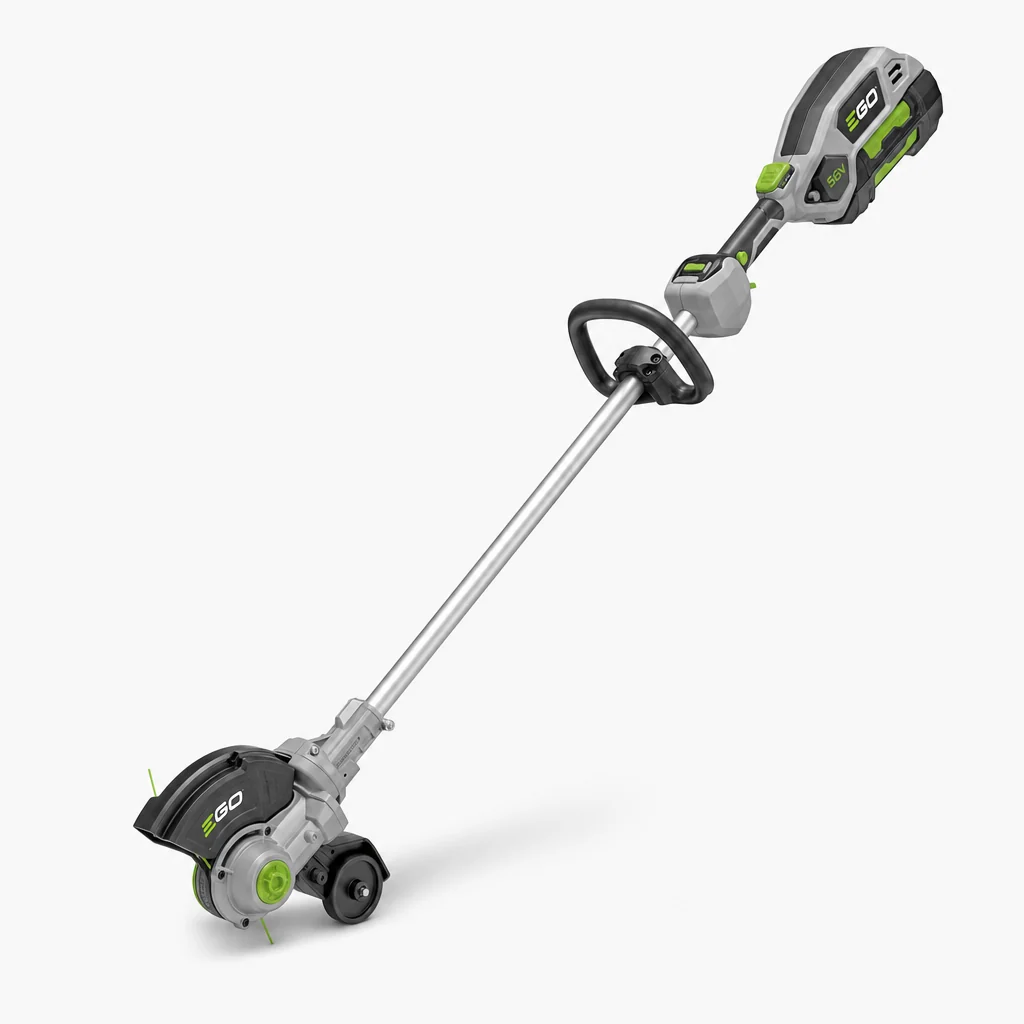
EGO's 56V platform is one of the most respected in cordless garden kit, and the Multi-Head edger taps straight into it. You get a choice of 2.5Ah or 4Ah battery options, the edger is attachment-compatible (so the powerhead can run other EGO heads), and a battery and charger are included — no nasty "battery sold separately" surprise. The 56V system has the grunt to cut a proper edge, and if you're already in the EGO ecosystem with a mower or trimmer, sharing batteries makes this an easy add.
Toro 60V Max 8-inch Brushless Stick Edger
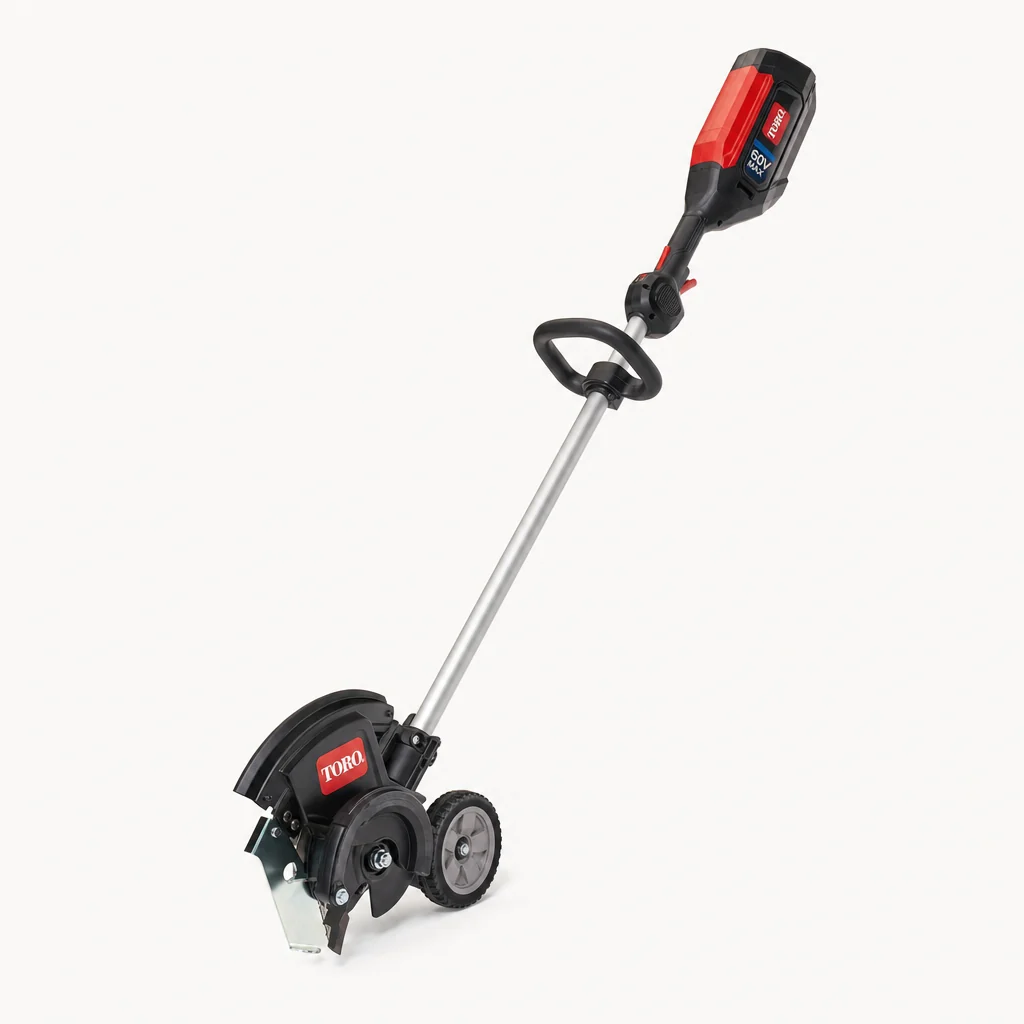
The Toro is the premium cordless pick. It runs a 54V-typical, 60V-max brushless motor — brushless meaning more efficiency, more power and a longer motor life than older brushed designs. It adds Toro's RunSmart intelligence and variable speed control, so you can dial the power up for heavy growth or down to conserve battery on lighter work. An 8-inch cutting capacity and that brushless punch make it a genuinely capable tool that doesn't feel like a compromise against petrol.
Greenworks 60V, Kobalt 40V and Craftsman V20
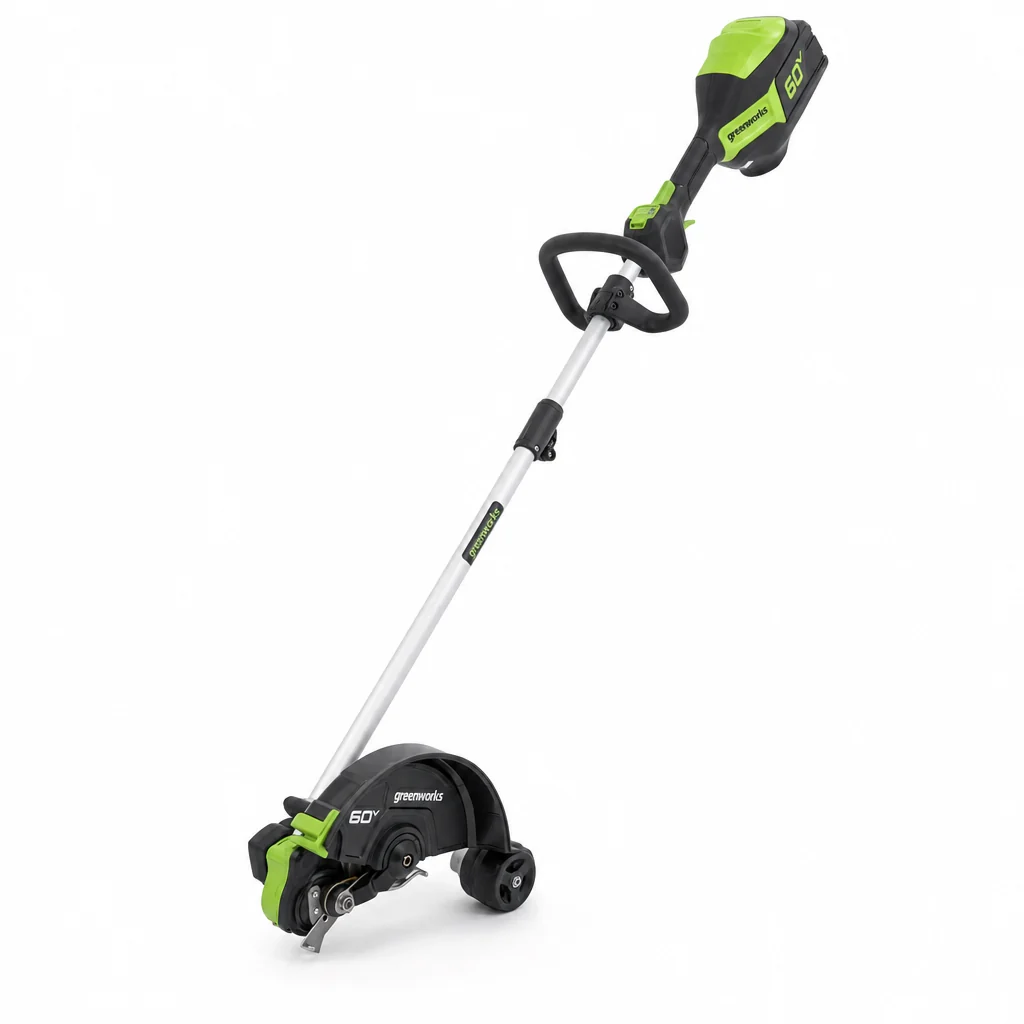
The Greenworks 60V 8-inch sits in the mid-range with a lightweight design and an 8-inch cut — a sensible, no-drama choice on a popular battery platform. The Kobalt 40-Volt Max Multi-Head brings a brushless motor, a variable-speed trigger and a standout 5-year limited warranty on a 40V system, plus that multi-head versatility. And at the budget end, the Craftsman V20 is a 7.5-inch edger on a 20V platform with a 2.0Ah battery (sold separately), 4 depth positions and a pivoting handle — a tidy entry point if you just want occasional cordless edging without spending much.
Battery platform lock-in matters. The single biggest factor in choosing a cordless edger isn't the edger — it's whether you already own (or plan to own) other tools on the same battery system. Buying into EGO 56V, Toro 60V or Kobalt 40V because you've got their mower means free batteries to share. Buying a standalone edger on a fourth, unrelated platform means yet another charger cluttering the shed.
Corded Electric Edgers: Cheap, Light and Endless Run-Time
Don't overlook corded electric. For a small-to-medium garden within reach of a socket, a corded edger is the cheapest way into powered cutting, with no battery to flatten and no fuel to mix — just plug in and go for as long as you like.
WORX, Craftsman and Scotts
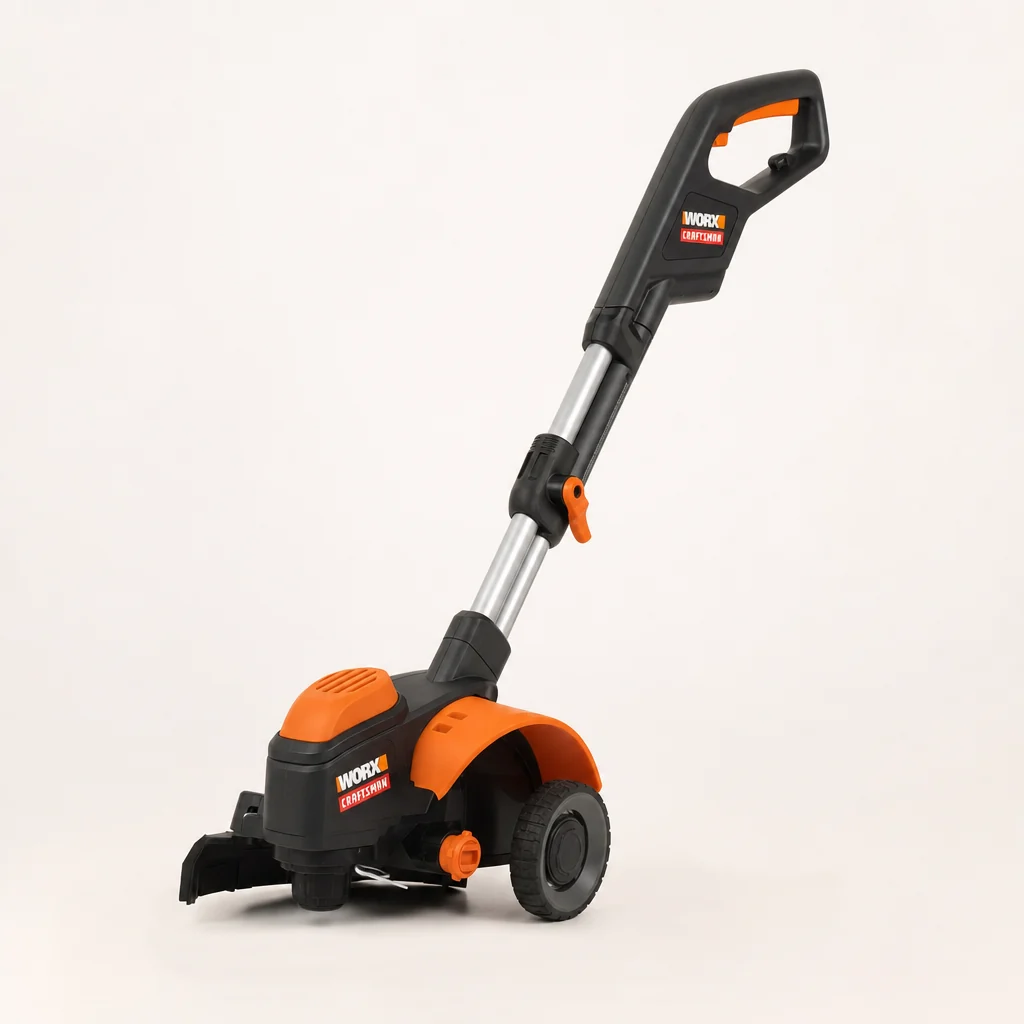
The WORX 12A 7.5-inch Edger/Trencher is a lightweight 14 lb machine with a 12-amp motor and a genuinely useful detail — a blade wear indicator, so you know exactly when to swap the blade rather than guessing. The "trencher" billing means it'll dig a planting or cable trench as well as edge, doubling its usefulness. The Craftsman 7.5-inch Push Walk-Behind 12A brings a high-torque motor, 3 blade-depth settings and a line-cutting guide to keep your runs straight. And the Scotts 11A 7.25-inch Edger/Trencher offers an 11-amp motor with 3 precise depth positions (1", 1.25" and 1.5") plus a reassuring 3-year warranty.
| Corded edger | Motor | Depth settings | Notable |
|---|---|---|---|
| WORX 12A | 12 amp | — | 14 lb, blade wear indicator |
| Craftsman 12A walk-behind | 12 amp high-torque | 3 settings | Line-cutting guide |
| Scotts 11A | 11 amp | 1" / 1.25" / 1.5" | 3-year warranty |
Corded upsides
- Cheapest route into powered edging
- Unlimited run-time — never stops mid-job
- Light and low-maintenance
- Trencher models double as cable/planting tools
Corded downsides
- Tethered to a socket — range limited by cable
- The cable itself is a nuisance to manage near edges
- Not practical for large or remote gardens
- Need an outdoor-rated extension and RCD protection
How the Categories Stack Up
To put the three powered routes and the manual options into perspective, here's how I'd score each family across the things that actually matter when you're trying to get a crisp border. These are my own weightings based on time spent with the tools.
Which Edging Tool Is Right for You?
The small-garden tidy-keeper
You've got a modest lawn and just want sharp edges. Get a Burgon & Ball RHS half-moon iron to cut the line once or twice a year, and a pair of Darlac DP812 shears for the in-between trims. That's the whole solution, and it'll last decades.
The renovator
Reclaiming overgrown, neglected edges? Reach for the Razor-Back or Jardineer V-shape for cutting through root mats, then a corded WORX trencher if you've got cable or planting trenches to dig too.
The big-garden owner
Long runs against paths and drives every fortnight? A Craftsman E410 walk-behind or the cordless Toro 60V brushless will save your back and deliver dead-straight, repeatable lines.
The professional
Edging for a living means durability above all. The Echo PE-225 or commercial Husqvarna 525ECS are built for daily use, with the support and warranty to match.
The cordless convert
Already own a battery mower? Stay on-platform — the EGO 56V, Kobalt 40V (5-year warranty) or Greenworks 60V let you share batteries and skip the petrol faff entirely.
The budget-watcher
Keeping costs down? An ATUHOLA or Ace half-moon iron plus the rotating Fiskars 36-inch shears cover the essentials for very little outlay.
Getting Crisp Edges: Technique Tips
The tool matters, but technique matters just as much. A few habits transform results regardless of what you're holding.
Use a guide for straight runs
A scaffold plank laid along the lawn or a taut string line between two pegs gives you something to cut against. Freehand straight lines almost always wander; a guide makes them razor-sharp.
Use a hose for curves
For sweeping curved beds, lay a garden hose in the shape you want and follow it with a half-moon iron. The hose flexes into beautiful natural arcs that look far better than nervous freehand attempts.
Overlap your cuts
With a half-moon iron, make slightly overlapping cuts rather than spaced-out ones. Gaps between cuts leave little ragged tags of turf that spoil the line. A continuous slicing rhythm gives an unbroken edge.
Maintain a slight bevel
Angle the cut very slightly away from the lawn so the soil face leans inward. This stops the edge crumbling and collapsing back over the season, keeping your crisp line crisp for longer.
Clear the debris
Once cut, lift out the sliced turf strips and brush away loose soil. A clean groove shows off the vertical face — and gives shears or a powered edger a clear path next time.
Pro Tip: time your recut
The best time to cut a fresh edge is when the soil is moist but not waterlogged — usually spring and again in autumn. Dry, baked summer soil fights the blade and crumbles; sodden winter soil smears and collapses. Catch it just right and a half-moon iron glides through like a knife through cake.
Frequently Asked Questions
The Verdict
There's no single "best" edging tool, because the three families solve genuinely different problems — and the smartest gardeners own at least two of them. If you take one thing from all of this, let it be that a quality half-moon iron is the foundation of every crisp border. The Burgon & Ball RHS stainless model is my pick for most people: it cuts cleanly, sheds soil, resists rust and lasts decades, with the RHS endorsement and FSC shaft to back it up. For renovating wild edges, the heavy-duty Razor-Back is the tougher choice.
Pair that iron with long-handled shears for maintenance, and the Darlac DP812 — a Gardeners' World Best Buy with telescopic 66–108cm handles and a lifetime warranty — is hard to beat for value and back-friendliness, with the Bahco P75/P74 pair and the self-sharpening CK Legend as premium upgrades.
If your garden is large, or you edge long hard runs often, powered kit earns its keep. The Echo PE-225 is the standout petrol machine — a professional 21.2cc engine and a "Best Overall" reputation — whilst the Toro 60V brushless and EGO 56V lead the cordless field with the convenience of no fuel and shared battery platforms. For tight budgets near a socket, the corded WORX and Scotts trenchers deliver powered edging for very little.
Match the tool to your lawn, learn the simple technique of guiding cuts and maintaining a slight bevel, and you'll be enjoying that crisp, framed-looking border that makes the whole garden look cared-for — season after season.