
Manual vs Electric Lawn Scarifiers: What's Right for Your Lawn?
From humble hand rakes to petrol-powered muscle — I've dug through the whole category to help you match the right dethatching tool to your lawn size and thatch severity.
There's a peculiar satisfaction in scarifying a lawn. You start with a tired, spongy patch of grass that hasn't seen a proper going-over in years, and you finish with a mountain of dead thatch and moss on the tarp beside you — visible proof that your turf can finally breathe again. But before you get to that satisfying end result, you've got a decision to make: manual, electric, or petrol?
It's a question I get asked constantly, and the honest answer is that there's no single "best" scarifier. The right tool depends entirely on how big your lawn is, how bad your thatch and moss problem has become, and — let's be frank — how much effort you're willing to put in on a chilly spring morning. A springbok rake in the hands of someone with a 20m² courtyard lawn is perfect. That same rake handed to someone with a 500m² plot is a recipe for blistered palms and a half-finished job.
In this guide I'll walk you through all three categories in proper detail, compare the standout models I've come across in both the UK and US markets, and give you clear buying picks based on your specific situation. Whether you're after a £45 rake or a 139cc petrol beast, there's a section here for you.
First Things First: What Scarifying Actually Does
Before we compare machines, it's worth being clear about what scarifying is — because a surprising number of people confuse it with raking, mowing, or aerating, and those distinctions matter when you're choosing a tool.
Thatch is the layer of dead grass, moss, and organic debris that accumulates between the green blades of your lawn and the soil surface. A thin layer (under about 1cm) is actually beneficial — it insulates roots and retains moisture. But once it thickens beyond that, it becomes a barrier. Water, air, and nutrients can't reach the roots properly, moss thrives in the damp spongy conditions, and your lawn starts to look patchy and tired no matter how often you feed it.
Scarifying uses vertical blades or robust wire tines to cut down through that thatch layer and pull it out. That's the crucial difference from a lawn rake, which drags debris off the surface without cutting into it. True scarifiers have fixed steel blades set to a depth; lawn rakes (sometimes marketed as "raker" or "dethatcher" attachments) use sprung wire tines. Many electric machines cleverly offer both via interchangeable drums, and that versatility is a big part of what makes them so popular.
Raking / Dethatching
Sprung wire tines comb through the surface to lift loose moss and light thatch. Gentle, quick, and ideal for regular light maintenance.
Scarifying
Fixed vertical steel blades slice down into the thatch layer and tear it out. More aggressive, essential for neglected or heavily mossed lawns.
Aerating
Some 2-in-1 machines swap in a spiked drum to punch small holes into the surface, improving air and water penetration to the roots.
The best time to scarify is during your lawn's active growing season — typically spring or early autumn in the UK — so the grass can recover quickly. Scarifying a dormant or stressed lawn in the height of summer or dead of winter can do real damage.
The Three Camps: A Quick Overview
Let's set the scene with a broad-strokes comparison before we dive into individual models. Each category has a natural home, and knowing where the boundaries lie will save you from over- or under-buying.
| Factor | Manual (Rakes) | Electric (Corded & Cordless) | Petrol |
|---|---|---|---|
| Best lawn size | Up to ~50m² | Up to ~400m² | 400m² and beyond |
| Thatch severity | Light moss & debris | Light to moderate-heavy | Heavy, neglected turf |
| Physical effort | High | Low | Low-moderate |
| Running cost | None | Low (electricity) | Higher (petrol & oil) |
| Noise | Near silent | Moderate (102–104dB) | Loud |
| Maintenance | Minimal | Minimal | Regular (engine servicing) |
| Storage footprint | Tiny | Compact (often folding) | Large & heavy |
You'll notice these categories overlap in the middle. That's deliberate — the 200–400m² lawn is the true battleground where corded electric, cordless, and even entry-level petrol machines all make a genuine case for themselves. We'll untangle that grey area later on. For now, let's start where the whole hobby began: the humble hand rake.
Manual Scarifiers: Cheap, Quiet, and Harder Work Than You Think
The manual scarifying rake is where most gardeners start, and for good reason. There's no cable to trip over, no battery to charge, no petrol to store, and no motor to break down. You buy it once, hang it in the shed, and it'll outlast several powered machines. For a small lawn — say a townhouse back garden or a neat front strip — a good rake is genuinely all you need.
Greenman R1710 Scarifying Rake
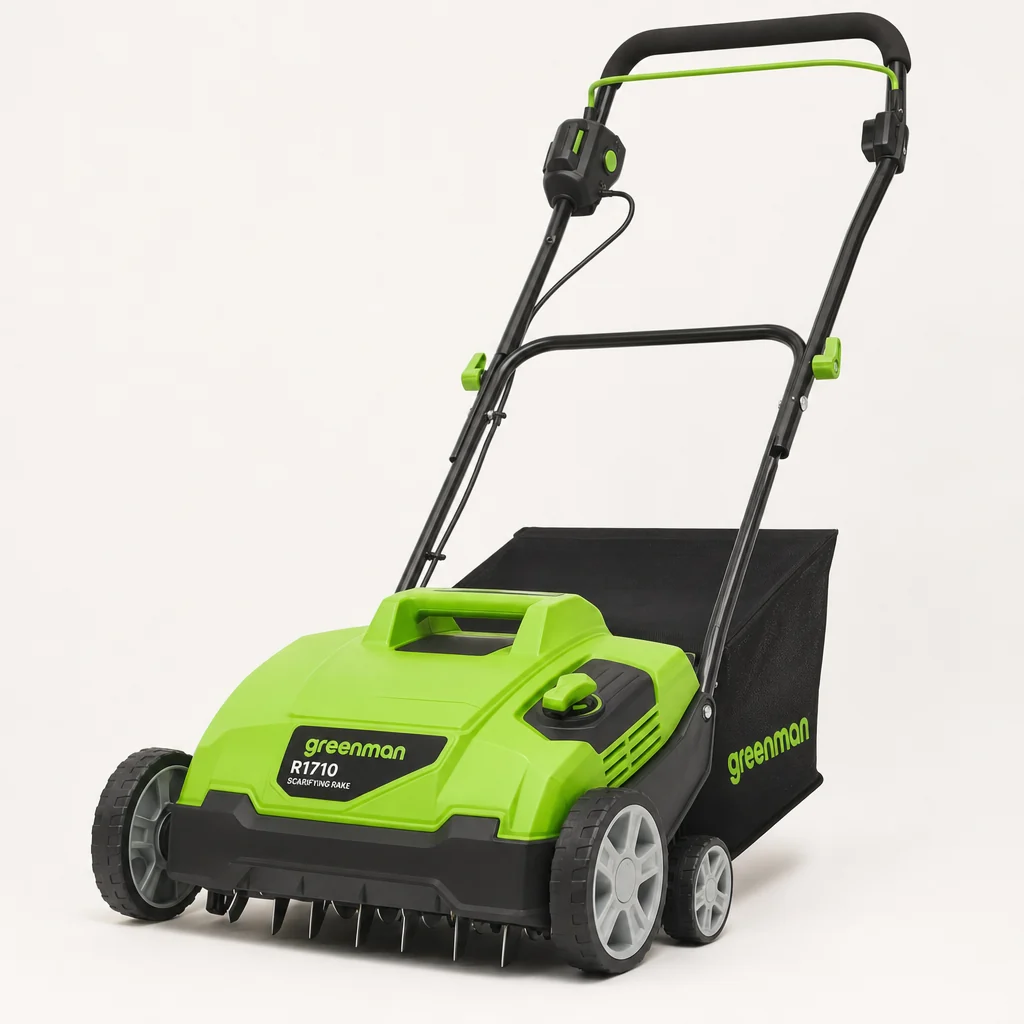
The Greenman R1710 is one of the standout manual tools I've come across, and its 4.5-star rating reflects that. At an RRP of £44.95 it's not the cheapest rake on the shelf, but it's a proper scarifying rake rather than a flimsy leaf-gatherer. The tines are designed to bite into the thatch layer as you pull, and used with a bit of technique — short, firm strokes, changing direction on your second pass — it lifts a genuinely impressive amount of dead material.
The catch, of course, is you. Manual scarifying is a workout. Doing a whole lawn properly means covering every square metre twice, in a criss-cross pattern, dragging against the resistance of the thatch. On anything larger than about 50m² you'll feel it in your shoulders and lower back the next day. That's not a criticism of the tool — it's just physics.
Darlac Manual Lawn Scarifier
The Darlac model takes a slightly different approach with an emphasis on being lightweight, and it features an extendable handle that reaches up to 1.5m. That adjustable reach is a genuinely thoughtful touch — it lets taller users work with a more comfortable posture and reduces the amount of stooping, which is exactly where back strain creeps in during a long session. The lighter build also means less fatigue over time, though inevitably a lighter tool applies a little less downward pressure into the thatch, so you compensate with more strokes.
Pros
- No running costs, ever — buy once and forget
- Near-silent operation, so no annoyed neighbours
- Tiny storage footprint; hangs on a shed hook
- Nothing to break, service, or charge
- Total control over depth and pressure
- The Darlac's 1.5m extendable handle eases back strain
Cons
- Genuinely hard physical work over any real area
- Impractical beyond roughly 50m²
- Struggles with heavy, matted moss
- Results depend heavily on your technique and stamina
- No collection — you rake up the debris separately
Pro Tip
Even if you buy a powered machine, keep a decent hand rake around. It's perfect for touching up edges, awkward corners, and around obstacles where a wheeled scarifier can't reach. I use mine after every powered pass to tidy the borders.
Electric Corded Scarifiers: The Sweet Spot for Most Gardens
For the majority of UK homeowners, a corded electric scarifier is the sensible choice. You get real cutting power without the effort, without the running costs of petrol, and without the weight and maintenance of an engine. The trade-off is the cable — you're tethered to a socket, and you have to keep the lead behind you and out of harm's way. For most gardens up to around 400m², that's a perfectly acceptable compromise.
This category has become genuinely competitive, so let's go through the standout models one by one.
Bosch ALR 900 — The Refined All-Rounder
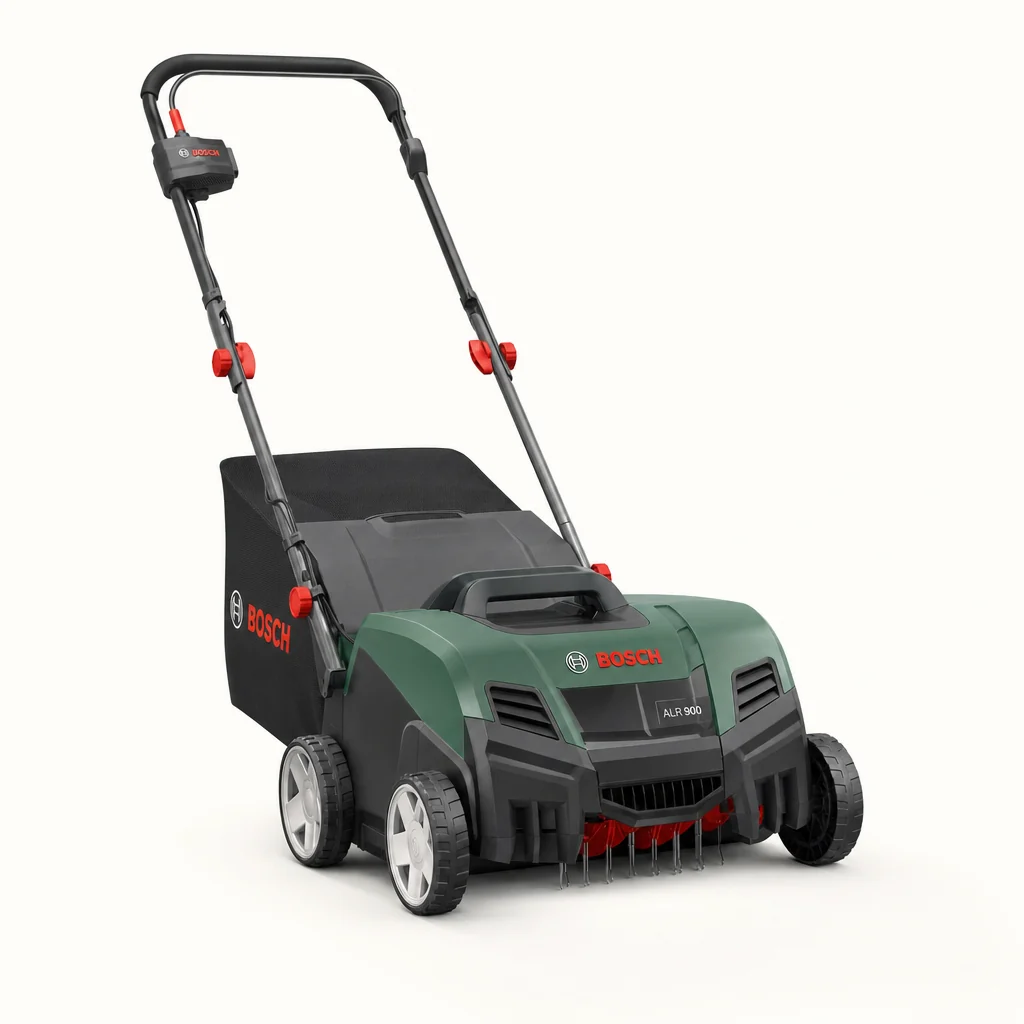
Bosch's ALR 900 is consistently ranked top-tier for domestic use, and having looked closely at its design I understand why. It weighs just 9.4kg — noticeably lighter than the equivalent Makita — which makes a real difference when you're pushing it back and forth for an hour. The 320mm cutting width and 900W motor are modest on paper, but the clever bit is the PowerDrive system: it automatically increases torque when it encounters thicker moss or thatch, so the machine digs in harder exactly when it needs to rather than bogging down.
The 50L collection box is one of the largest available in this class, and the Jet-Collect system — where air inlets help draw debris into the box — genuinely reduces the number of times you stop to empty it. It's worth being honest, though: the ALR 900 is really a lawn raker with tines rather than a hard-bladed scarifier. If your lawn is heavily matted and neglected, this is a lighter raking function that'll refresh the surface beautifully but won't cut as deeply as a true blade-drum machine.
VonHaus 2-in-1 Electric Scarifier — The Power Merchant
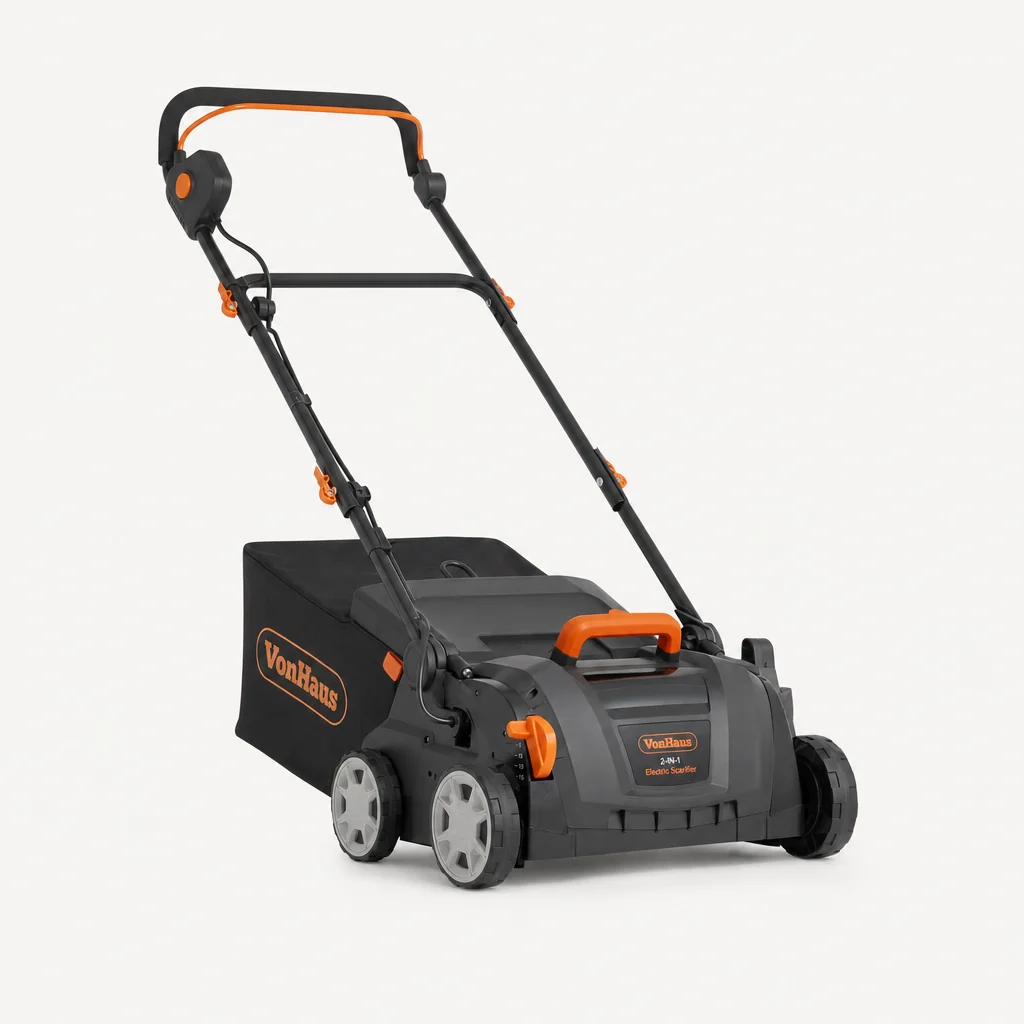
If raw motor power is your priority, the VonHaus 2-in-1 leads the corded pack with a beefy 1800W motor — the highest in the corded electric category. It has a generous 38cm working width, a dual-drum interchangeable system that swaps between scarifying and aerating, and a substantial 55L collection bag that's among the largest in class. There's a dual start system for safety and a built-in thermal cutout that protects the motor from overheating during a long, heavy session.
The depth settings are well-judged, running from -12mm through -9mm and -3mm up to a +6mm raking position, and the overall machine width of 60cm means you cover ground quickly. My reservations are around build quality: the plastic chassis and motor housing feel less robust than the Bosch, so long-term reliability is a genuine question mark. There's also a small design niggle — a gap between the collection box and the blades that lets some debris escape, meaning a quick rake-up afterwards. At 104dB it's also the loudest in the corded group, so ear defenders aren't a bad idea.
Hyundai HYSC1500E — The Warranty Champion
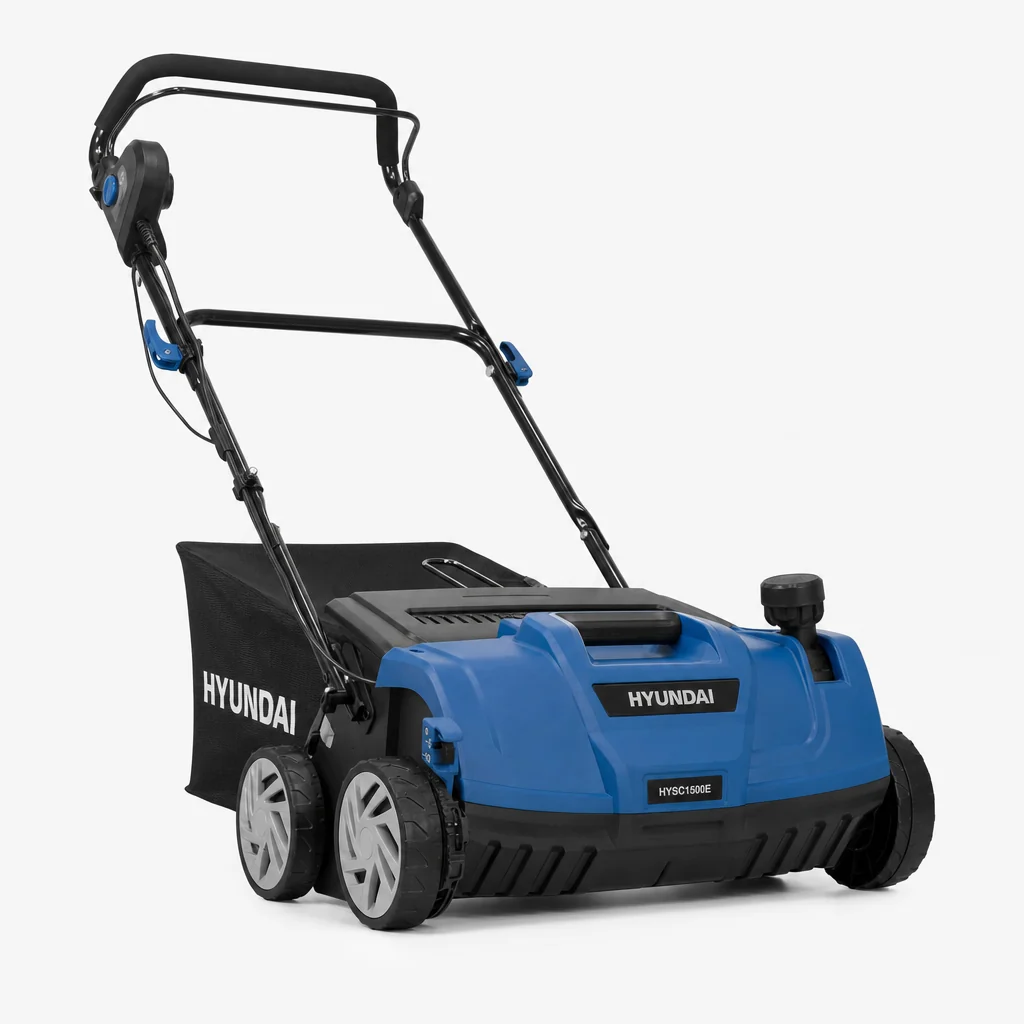
The Hyundai HYSC1500E is the model I'd point most people towards if they want a true scarifier rather than a raker, and there are several reasons. It's a proper two-drum machine: it ships with a scarifying drum carrying 20 hardened steel blades and a separate raking drum fitted with steel tines. That means you can genuinely dig into a neglected lawn with the bladed drum, then switch to the tine drum for lighter seasonal maintenance.
The five working-depth settings (-12mm, -9mm, -6mm, -3mm and a +10mm raking height) give you precise control, and the 10m power cable is generous. The machine measures 102dB(A) — a touch quieter than the VonHaus — and rolls on well-sized wheels, 200mm at the front and 165mm at the rear, which makes manoeuvring across uneven turf noticeably easier. The adjustable-height handle stretches the overall dimensions from 920mm up to 1170mm in length and 820mm to 1030mm in height, so you can dial in a comfortable working posture.
What really seals it for me is the 3-year platinum warranty backed by UK-based parts support. Powered garden tools have a habit of developing niggles, and knowing you can get parts and cover in the UK for three years is genuinely reassuring. The 45L collection box is described as nearly twice the size of some competitors, and at 11.5kg net it's still light enough to carry to the shed one-handed.
Pro Tip
When using a bladed scarifier on a neglected lawn for the first time, resist the temptation to go straight to maximum depth. Start on a shallower setting (-3mm or -6mm), do one pass, and see how much thatch comes out. You can always go deeper on a second pass — but you can't un-scalp a lawn you've torn to shreds.
Flymo Lawnrake Compact 3400 — The Lightweight Starter
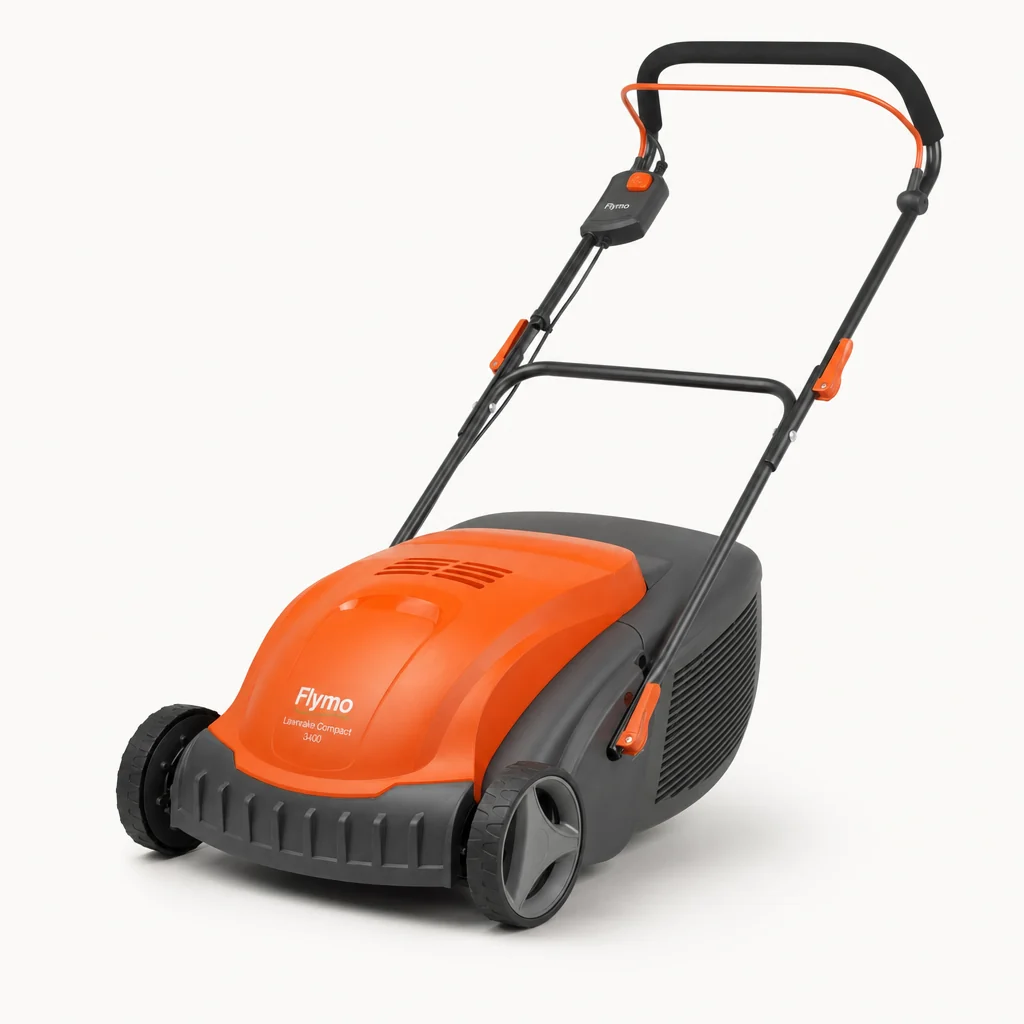
At the gentler end of the corded range sits the Flymo Lawnrake Compact 3400. With a 750W motor and a 34cm working width, it's the least powerful of the corded machines here, and its 34L collection box is on the smaller side. But that's rather the point — this is a lightweight electric raker aimed at people with modest lawns who want to step up from a hand rake without buying a big, heavy machine. If your thatch problem is light and you just want an easy annual tidy-up, the Flymo is an unintimidating, manageable little tool.
The US Corded Picks
American readers have a slightly different set of options, and a few models deserve a mention. The WEN DT1516 is a strong value pick with a 15-amp motor spinning at 3300 RPM and a wide 16-inch clearing path. It's a proper 2-in-1 machine, shipping with a 24-tine dethatching head and a 20-blade scarifying head, plus five depth positions running from +1/4 inch down to -1/2 inch. Reviewers note solid construction for the price point and it'll knock out a 5,000 sq ft lawn in under two hours, helped by an automatic overload shutdown that protects the motor. The one recurring complaint is the collection bag, which proves insufficient for heavy thatch accumulation — you'll be emptying it often on a badly neglected lawn.
The Sun Joe AJ805E is another popular US option, built around a 13-amp motor, a 15-inch width and a big 13.2-gallon collection bag. It's pitched as ideal for lawns around 4,000 sq ft, which sits it neatly in the mid-size bracket. And the LawnMaster GV1212B offers something genuinely unusual: a 12-amp motor paired with 19 cutting positions, giving you extraordinarily granular control over dethatching depth — handy if you like to fine-tune between light seasonal tidies and deeper corrective work.
Cordless Scarifiers: Freedom From the Cable
Cordless battery scarifiers are the fastest-growing part of this market, and it's easy to see the appeal. No cable means no snagging, no dragging a lead behind you, and no risk of accidentally running the blades over your own extension cord (something more common than manufacturers would like to admit). The trade-off is runtime and, historically, a little less brute power — although brushless motors have narrowed that gap considerably.
WORX WG855E.9 — Compact 2-in-1 Convenience
The WORX 36cm Scarifier and Aerator (model WG855E.9) is a well-regarded cordless 2-in-1, carrying a 4.5-star rating at an RRP of £229.99. The 36cm working width matches the mid-range corded machines, and the interchangeable design covers both scarifying and aerating duties. As a "0.9" bare-tool designation suggests, you'll want to check whether it comes with a battery and charger or expects you to supply your own from an existing WORX ecosystem — worth confirming before you buy if it's your first WORX tool.
Greenworks G40DT35 — The 40V Alternative
The Greenworks G40DT35 runs on Greenworks' 40V battery platform, offers a 34cm width, and comes with a 2-year warranty. If you already own other 40V Greenworks garden tools — a mower, a trimmer, a blower — then buying into the same battery system makes a great deal of sense, since you can share packs across the whole shed. That ecosystem logic is genuinely one of the strongest reasons to go cordless in the first place.
The US Cordless Options
Across the Atlantic, the Greenworks 40V 15-inch cordless is a standout, built around an efficient brushless motor with a 15-inch dethatching path and five depth-adjustment positions. Its quick-swap tine reels make maintenance and switching modes painless. The LawnMaster CLGVB4816, priced at $289.99, also leans on brushless efficiency and delivers a 48-minute runtime on a charge — enough to cover a decent-sized lawn in one go, though you'll want a spare battery on standby for anything larger or heavily matted.
Battery runtime figures like the LawnMaster's 48 minutes are best-case numbers measured on light work. Deep scarifying through thick, wet thatch draws far more current and will drain a battery considerably faster, so factor in a spare pack if your lawn is large or badly neglected.
Petrol Scarifiers: Serious Power for Serious Lawns
When your lawn creeps past 400m², or when the thatch is so severe that electric machines simply bog down, it's time to consider petrol. These machines bring engine-driven torque that no electric motor can quite match, and crucially you're never limited by cable length or battery life. The downsides are equally clear: they're heavy, loud, need regular engine servicing, and you'll be buying petrol and oil to run them. But for large, neglected lawns, nothing else does the job as effectively.
Cobra MTS3040 — Best Overall Petrol for Large UK Lawns
The Cobra MTS3040 is my pick of the petrol machines for UK homeowners with large lawns. It's powered by a 139cc Briggs & Stratton engine — a reassuringly well-known and well-supported powerplant — driving a 40cm cutting width, the widest here. Like the better electric machines, it uses interchangeable scarifier and aerator cassettes, so you get genuine versatility rather than a one-trick tool. The combination of engine reliability, generous width, and cassette flexibility is exactly what a large lawn demands.
Hyundai HYS3200 — Reliable Petrol at Lower Entry Cost
If you want petrol power without stretching to the Cobra's price, the Hyundai HYS3200 makes a strong case. It uses the same class of 139cc engine but with a slightly narrower 32cm cutting width, and it has a strong reputation for reliable petrol performance at a lower entry point. It's rated as adequate for lawns up to around 400–500m², which covers a great many "large" gardens comfortably. If your plot sits at the upper end of what electric can handle and you want the extra headroom of an engine without going all-in, the HYS3200 is a sensible, dependable choice.
Petrol Pros
- Engine torque handles the heaviest, most matted thatch
- No cable limits or battery runtime anxiety
- Widest cutting paths cover large lawns fast
- Cassette systems (Cobra) add scarify/aerate versatility
- Trusted 139cc Briggs & Stratton engine on both picks
Petrol Cons
- Heavy and cumbersome to store and move
- Loudest option — ear protection essential
- Ongoing petrol and oil running costs
- Requires regular engine maintenance and servicing
- Overkill (and overspend) for smaller gardens
Power & Coverage Compared
To help visualise how these machines stack up, here's a rough comparison of raw motor/engine power and the maximum lawn sizes each is realistically suited to. Remember that width, drum type, and your own patience all factor into real-world results — but this gives a useful sense of the pecking order.
Relative Power (corded electric motors, W)
Approximate Maximum Lawn Size by Type
What jumps out is that motor wattage doesn't tell the whole story. The Bosch ALR 900, at half the VonHaus's power, is still rated top-tier for domestic use because its PowerDrive torque system and refined design punch above the raw number. Higher wattage helps when the going gets tough, but a well-engineered 900W machine can outperform a crudely built 1800W one on a typical lawn. Don't buy on headline power alone.
Head-to-Head: Corded Electric Contenders
Since corded electric is where most buyers will land, here's a direct comparison of the three UK machines I'd shortlist. Between them they cover the whole spectrum from refined raker to true bladed scarifier.
| Feature | Bosch ALR 900 | Hyundai HYSC1500E | VonHaus 2-in-1 |
|---|---|---|---|
| Motor | 900W PowerDrive | 1500W | 1800W |
| Working width | 320mm | 360mm | 380mm |
| Collection | 50L | 45L | 55L |
| Depth settings | 4 (-5 to +10mm) | 5 (-12 to +10mm) | 5 (-12 to +6mm) |
| Weight | 9.4kg | 11.5kg | 11.5 kg |
| Noise | — | 102dB(A) | 104dB |
| Drums included | Tine raker | Blade + tine | Scarify + aerate |
| Warranty | — | 3 years | 2 years |
| Best for | Refined raking | True scarifying | Raw power/width |
My read on this: the Bosch is the machine for someone who wants a lightweight, refined tool for regular maintenance raking and values quality engineering. The Hyundai is the pick for someone with a genuinely thatched lawn who wants true bladed scarifying plus a raking drum, and rates a long warranty highly. The VonHaus is for the buyer chasing maximum power and width per pound, provided they can accept a plastickier build and a bit of debris escaping the collector.
Our Ratings by Category
Rather than crown a single winner — which would be meaningless given how differently these tools serve different lawns — here's how I'd score each category against what it's designed to do.
Manual Rakes (e.g. Greenman R1710)
Corded Electric (e.g. Hyundai HYSC1500E)
Cordless (e.g. WORX WG855E.9)
Petrol (e.g. Cobra MTS3040)
Who Should Buy What?
Let's turn all this into concrete recommendations. Here's how I'd match each type of gardener to the right tool.
The Small-Garden Owner
Lawn under 50m² with light moss? A quality hand rake like the Greenman R1710 (£44.95) or the extendable-handle Darlac is all you need. Cheap, silent, zero maintenance.
The Occasional Tidier
Modest lawn, light annual dethatching? The Flymo Lawnrake Compact 3400 or Bosch ALR 900 give powered ease without heavy blades or intimidating bulk.
The Serious Lawn Keeper
A genuinely thatched lawn up to ~400m²? The Hyundai HYSC1500E's twin blade-and-tine drums and 3-year warranty make it the standout true scarifier.
The Cable-Hater
Awkward layout or existing battery ecosystem? Go cordless — the WORX WG855E.9 or a Greenworks 40V machine free you from the lead entirely.
The Large-Lawn Owner
500m²+ or badly neglected turf? Petrol is the answer. The Cobra MTS3040's 40cm width and cassette system tackles the toughest jobs.
The Value Hunter
Want engine power without top spend? The Hyundai HYS3200 delivers reliable 139cc performance for lawns up to 400–500m² at a lower entry point.
Frequently Asked Questions
The Verdict
There's no single champion in this category, because "best" depends entirely on your lawn. That's the honest truth, and any guide that crowns one universal winner is doing you a disservice.
If your lawn is small and your thatch light, a manual rake like the Greenman R1710 is genuinely all you need — cheap, silent, and unbreakable. For the huge middle ground of typical gardens up to around 400m², corded electric is the sensible sweet spot, and the Hyundai HYSC1500E is my standout for its true blade-and-tine dual drums, five depth settings, and reassuring 3-year platinum warranty. If you crave raw power the VonHaus 2-in-1 and its 1800W motor deliver, whilst the refined, lightweight Bosch ALR 900 is perfect for regular maintenance raking.
Prefer freedom from the cable? The WORX WG855E.9 and Greenworks 40V machines make excellent cordless choices, particularly if you already own compatible batteries. And when your lawn is large or badly neglected, only petrol will do — the Cobra MTS3040 with its 40cm width and interchangeable cassettes is the pick for big jobs, with the Hyundai HYS3200 offering dependable 139cc power at a friendlier entry point.
Work out your lawn size, be honest about your thatch severity, and buy the tool that matches — not the biggest, loudest machine on the shelf. Your lawn (and your back) will thank you.