
Robot Lawn Mowers: Are They Worth It for a Typical UK Garden?
A real-world look at boundary-wire versus wire-free models, the install hassle nobody talks about, and which garden sizes actually benefit from going robotic.
Let me be honest with you. For years I was firmly in the "robot mowers are a gimmick" camp. The early models needed a boundary wire pinned or buried around the entire perimeter of the lawn, and that single requirement was enough to put me off — and plenty of other gardeners I've spoken to felt exactly the same way. The thought of spending a weekend on my knees with a peg hammer, threading wire around flower beds and praying I didn't sever it the first time I aerated the lawn, was a hard no.
But something has shifted over the last five years. The technology has evolved at a genuinely remarkable pace, and the headline change is this: wireless robot lawn mowers have gone mainstream. Camera vision, RTK satellite positioning and LiDAR have largely replaced the dreaded boundary wire, and the whole proposition suddenly looks very different. So in this guide I want to cut through the marketing and answer the question properly — are these things actually worth it for a normal British garden, and if so, which type and which size?
How Robot Mowers Actually Work in 2026
Before we get into specific models, it's worth understanding the three broad approaches on the market, because the navigation method shapes everything: the install, the reliability, the price, and even how close to your borders the mower can cut.
Boundary-wire (the old way)
A perimeter wire defines the lawn. Reliable once installed, but the install is the deterrent — digging or pegging wire around the whole garden, plus any island beds you want to protect.
RTK + Vision hybrid
A satellite antenna or cloud-based corrections give centimetre-accurate positioning, with cameras handling obstacles. Brilliant on open lawns, but RTK can struggle under dense tree cover where the sky is blocked.
Pure vision / LiDAR
The newest wave. Cameras (and on premium models, a LiDAR sensor) build a map of the garden with no wire and no antenna at all. The genuine "drop and mow" dream — though performance depends heavily on the software.
The crucial takeaway is that the boundary wire — the very thing that made early robot mowers a faff — is no longer a requirement on most modern models. That single change is why I'd now happily recommend one to the right gardener.
The Market at a Glance
The range of robot mowers available now is enormous, and prices reflect that. Entry-level wire-free models start at around £600, whilst premium machines built for large gardens and estates can cost £3,000 and beyond. Most brands offer a ladder of models scaled to garden size — from compact units aimed at 400m² lawns right up to machines that can manage estates of 5,000m² and more.
What matters for you, though, isn't the extremes — it's matching the right machine to the right garden. A 5,000m² estate-grade mower in a small back garden is overkill and a waste of money; equally, a 150m² vision mower will spend its life sulking in a 1,200m² plot. Let's break the market into the three categories that actually make sense.
Small Gardens: Up to Around 600m²
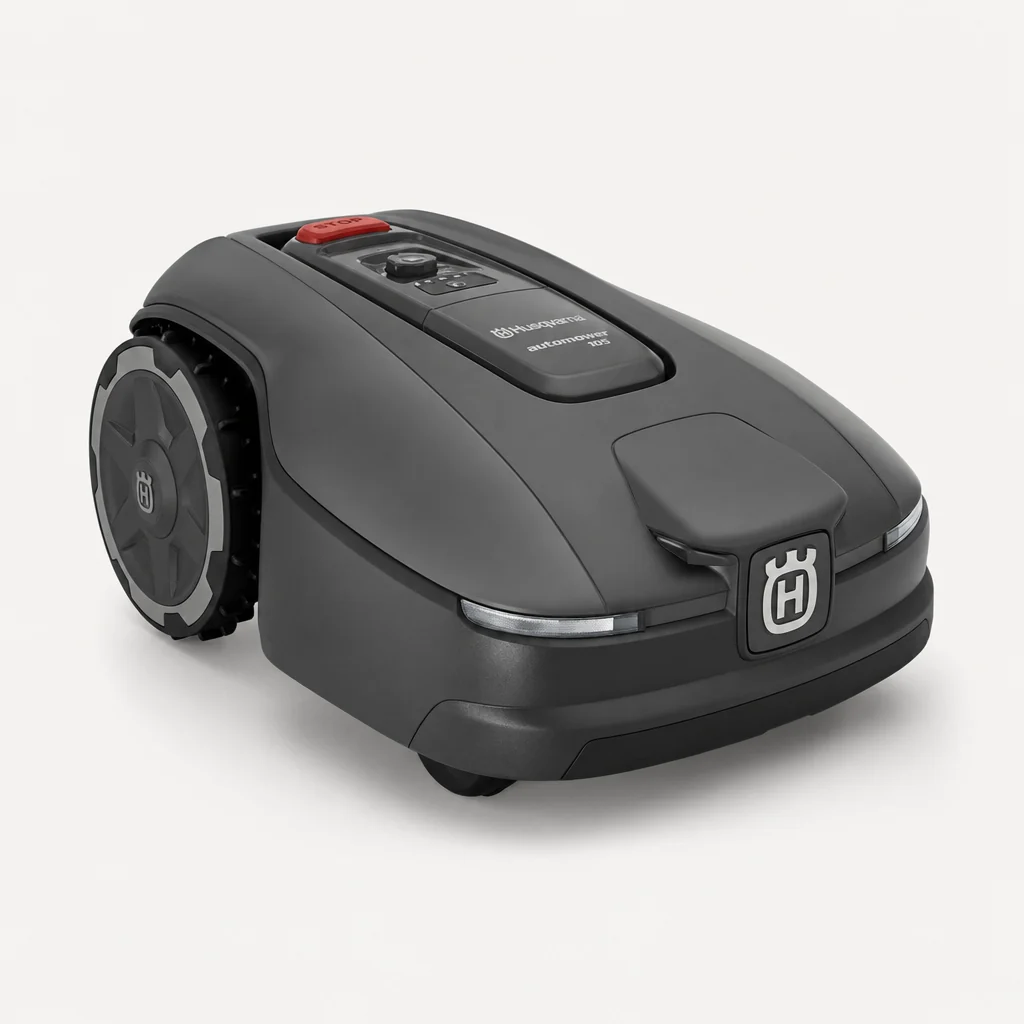
This is where the most accessible — and frankly the most charming — models live. If you've got a modest suburban lawn, this is your category, and it's also where the price of entry is lowest.
LawnMaster OcuMow 16 — the genuine "drop and mow"
The OcuMow 16 is fascinating because it strips the concept right back. It uses Optical Grass Recognition — a camera-only system with no RTK and no GPS — and it's designed for lawns up to 150m². The headline feature is its sheer lack of fuss: no boundary wire, no charging station, and no outdoor power socket required. You quite literally drop it on the grass and let it mow. It runs a 24V 4.0Ah battery and offers a cutting height range of 20–60mm.
For a small, simple, relatively flat lawn, that simplicity is a real selling point. It's available from B&Q, Argos and Currys, so it's easy to get hold of on the high street rather than waiting on a niche import.
Camera-only navigation like the OcuMow's works best on open, well-lit lawns. Deeply shaded gardens or very intricate shapes are where a vision-only system has to work hardest — worth bearing in mind if your lawn is more woodland glade than bowling green.
Segway Navimow i105E — RTK precision for small plots
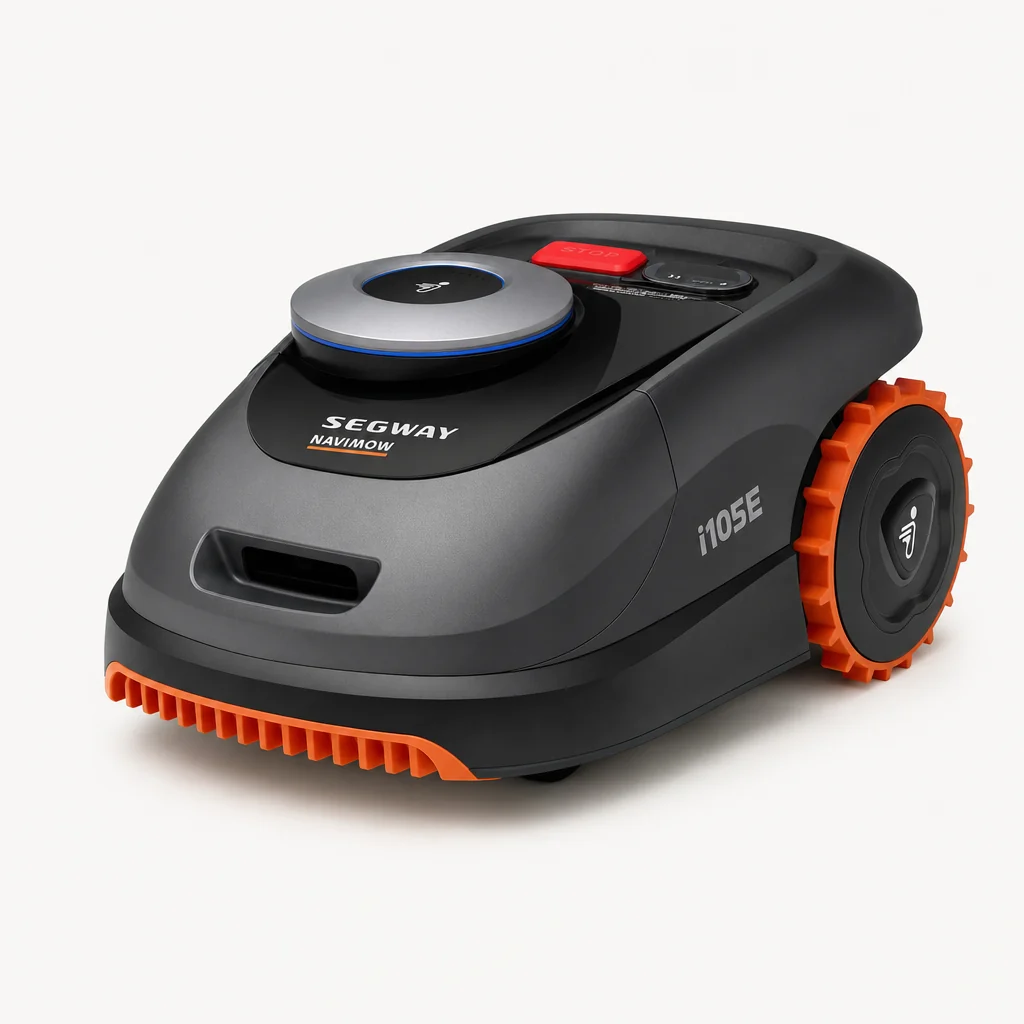
If you want more positional accuracy, the Navimow i105E steps things up with Segway's RTK + Vision hybrid (the EFLS 2.0 system). It's recommended for lawns up to 500m², with a maximum of around 600m². On a single charge it runs for 60 minutes and recharges in 90 minutes, and it keeps the noise down to a neighbourly 58dB. Slope capability is up to 30% (roughly 17°), which covers most gently undulating British lawns.
It's also reassuringly clever about the things that matter in a real garden — it can detect over 150 types of obstacle and includes animal-friendly behaviour, which is no small thing if you've got hedgehogs visiting at dusk. Cutting height is adjustable across 20–60mm, and connectivity covers Bluetooth, Wi-Fi and optional 4G.
Mammotion's mini contenders
Mammotion's YUKA Mini 2 range, released in March 2026, pushes vision-based mowing further. The 800 model uses a Triple-Camera AI Vision system with no RTK antenna required and is rated for lawns up to 800m², whilst the 1000 model adds LiDAR to a dual-camera setup. These represent the newest thinking in small-to-medium wire-free mowing.
Medium Gardens: 600m² to 1,500m²
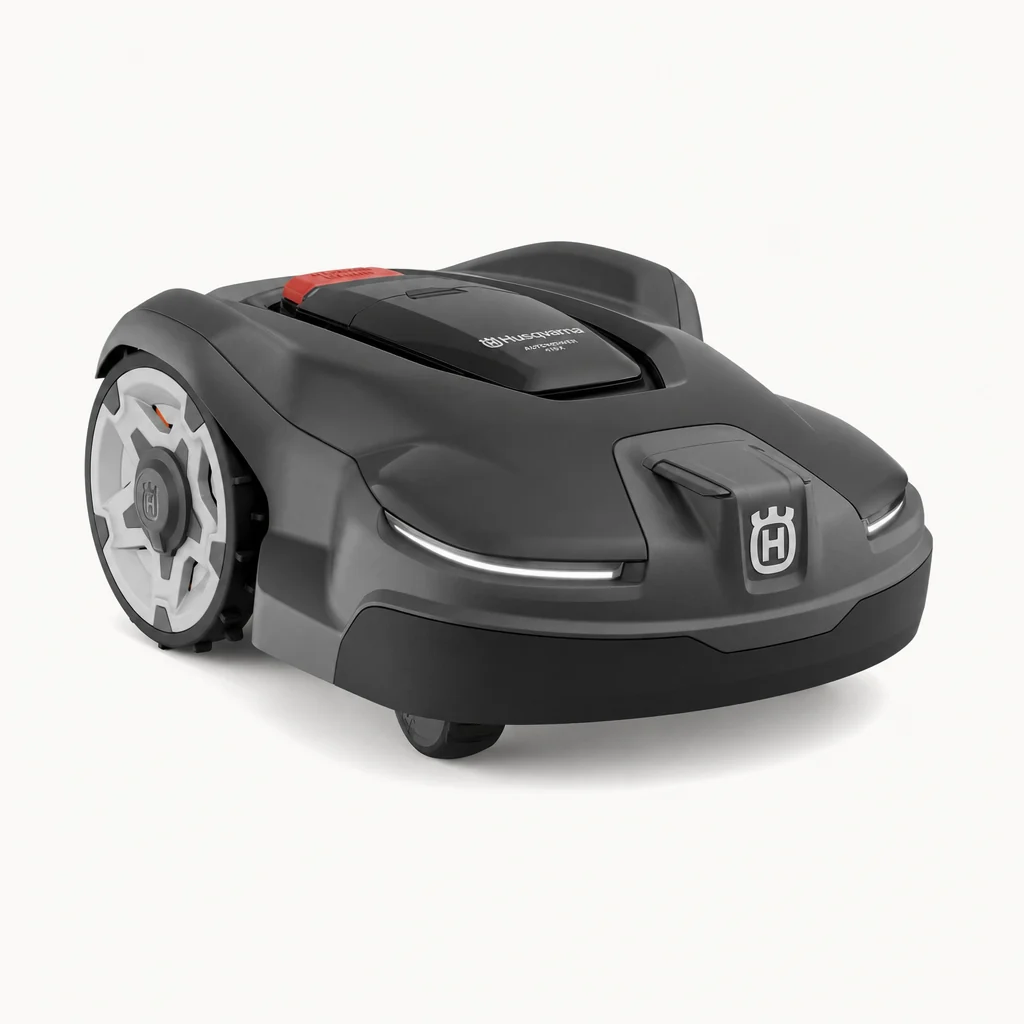
This is the sweet spot for a lot of UK homeowners with a decent-sized lawn — big enough that mowing it manually is a genuine chore, but not so vast that you need an estate-grade machine. The competition here is fierce, and it's where the WORX, Segway and Mammotion ranges really go head to head.
WORX Landroid Vision Cloud
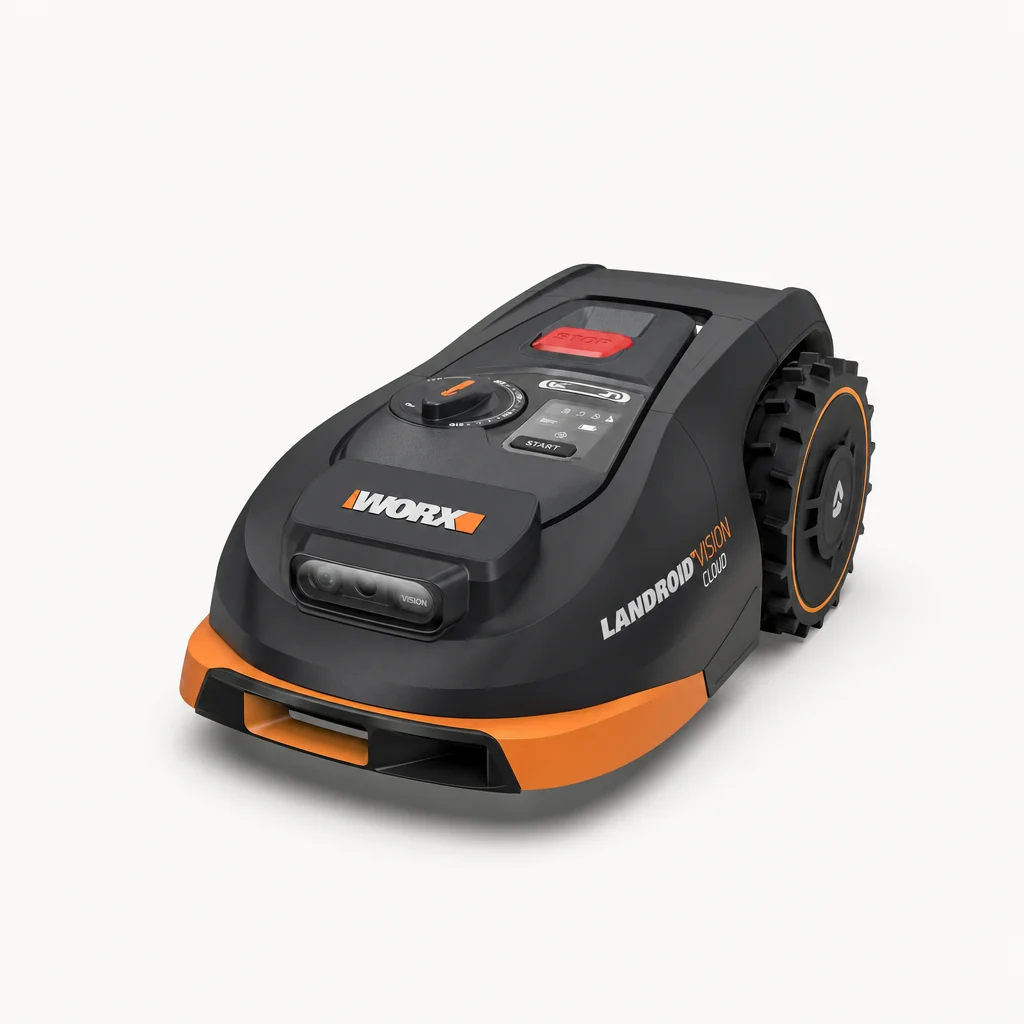
WORX has leaned hard into wire-free vision technology. The Landroid Vision Cloud WR303E uses RTK Cloud + Vision AI with lifetime free RTK corrections and no antenna required, and it's aimed at lawns of around 300–500m². The WR305E uses the same clever cloud-RTK approach, scaling up to 500m². The big appeal of the cloud-correction model is that you skip installing a separate RTK base station in your garden — fewer boxes, fewer cables, less to go wrong.
If you want pure vision without any RTK at all, the Landroid Vision WR220 uses a 140-degree HDR AI camera and is rated for lawns up to a substantial 1,500m².
Segway Navimow i108E
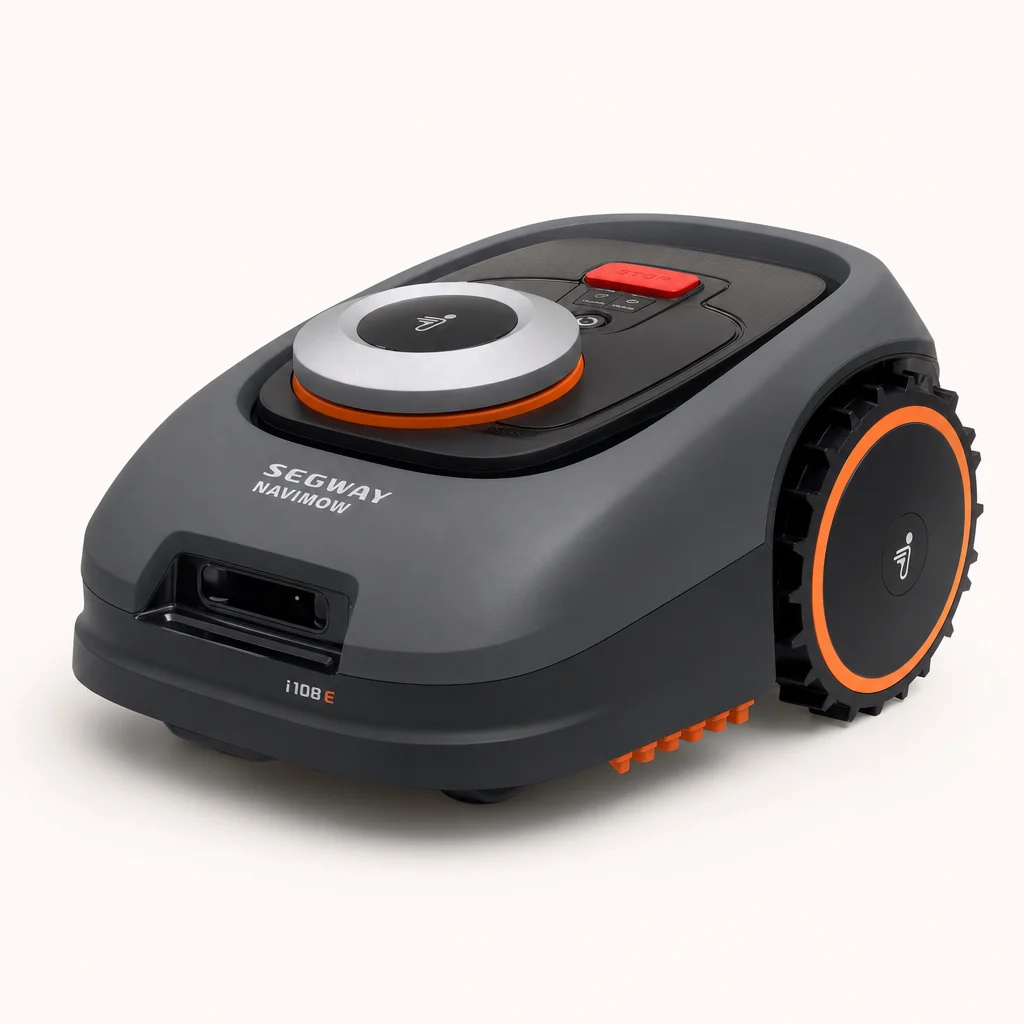
The i108E is the bigger sibling of the i105E we met earlier. It uses the same RTK + Vision EFLS 2.0 system but adds a larger battery for lawns up to 800m², with a brisk 90-minute recharge time. If you liked the look of the i105E but have a slightly bigger plot, this is the natural step up.
Mammotion LUBA Mini AWD — the slope specialist
Here's where things get interesting for awkward gardens. The LUBA Mini AWD combines RTK, a Triple-Camera AI Vision system and NetRTK, and is designed for lawns of 800–1,500m². But the standout figure is its slope capability: it can tackle inclines of up to 38.6° — that's an 80% gradient. If your garden has a proper bank or a sloping section that you currently dread mowing, all-wheel-drive machines like this are in a different league. A 6.1Ah battery delivers 150 minutes of runtime, which is generous for the category.
The 2026 LUBA Mini 2 AWD refines the formula further with 360° LiDAR, dual-camera AI vision and NetRTK for lawns up to 1,000m². Its genuinely clever party trick is an asymmetrical cutting deck — a 7.8-inch main disc paired with a 4.7-inch edge disc — which Mammotion describes as a breakthrough that lets the mower cut flush against solid boundaries. Anyone who's ever had to go round the edges with a strimmer afterwards will understand why that matters.
Pro Tip
The single biggest practical frustration with robot mowers is edge cutting — most leave a thin strip of uncut grass along walls and fences. If a tidy, strimmer-free finish matters to you, prioritise a model with an offset or asymmetrical cutting deck like the LUBA Mini 2 AWD. It's a feature worth paying for.
Comparing the medium-garden options
| Model | Navigation | Max lawn | Standout |
|---|---|---|---|
| WORX Landroid Vision Cloud WR305E | RTK Cloud + Vision AI | 500 m² | No antenna; free lifetime RTK |
| WORX Landroid Vision WR220 | Vision-only (140° HDR) | 1,500 m² | No GPS/RTK reliance |
| Segway Navimow i108E | RTK + Vision (EFLS 2.0) | 800 m² | 90-min fast recharge |
| Mammotion LUBA Mini AWD | RTK + Triple Cam + NetRTK | 1,500 m² | 80% slope, 150-min runtime |
| Mammotion LUBA Mini 2 AWD | LiDAR + Dual Cam + NetRTK | 1,000 m² | Flush edge cutting |
Large Gardens and Estates: 1,500m² to 5,000m²+
If you're lucky (or unlucky, depending on how you feel about lawn maintenance) enough to have a really large plot, this is where robot mowers stop being a convenience and start being a genuine labour-saving investment. These are serious machines with prices to match.
Segway Navimow X Series
The Navimow X4 Series is positioned as Segway's flagship 2026 all-wheel-drive mower, with UK shipments arriving from 2nd May. It spans an enormous range of capacities, from 2,000m² right up to a frankly estate-scale 5,000m². For very large, complex gardens this is exactly the sort of machine designed to cope.
Mammotion LUBA 3 AWD Series
Released in March 2026, the LUBA 3 AWD Series brings 360° LiDAR, dual-camera AI vision and NetRTK to large gardens, with multiple models covering everything from 1,500m² up to 5,000m². The clever bit for sprawling, broken-up gardens is multi-zone support — the series handles many separate zones for complex lawns, and the 5,000m² model supports up to 50 distinct zones. If your "lawn" is really several lawns joined by paths and archways, that flexibility is invaluable.
Gardena SILENO free — the quiet operator
Gardena's SILENO free takes a slightly different approach, powered by LONA 2.0 AI mapping technology that uses GPS combined with onboard sensors to digitally map and manage the lawn — no boundary wire needed. But its real party piece is how unobtrusive it is. In real-world testing it ranked among the quietest robotic mowers, maintaining a working noise level of just 57–58dB(A), and users consistently praise how quiet it is in operation. Runtime per charge sits at roughly 65–80 minutes. If you've got close neighbours or simply value a peaceful garden, that low-decibel running is a genuine quality-of-life feature.
Eufy Robot Lawnmower E15
Eufy's E15 uses pure vision FSD technology with high-precision cameras and intelligent AI algorithms for accurate mapping and obstacle avoidance, communicating via Wi-Fi or 4G with no need for a boundary wire or an RTK station. It's designed for lawns up to 800m², with later models adding LiDAR. It's a good example of how the pure-vision approach is filtering across brands.
The Install Hassle: What Nobody Tells You
This is the part of the buying decision I think gets glossed over most, so let's talk about it honestly. The "no wire" revolution has slashed the worst of the install pain, but it hasn't eliminated setup entirely.
Mapping your garden
With wire-free models you typically drive the mower around the perimeter (or let it map itself) to define the boundary in software. It's far quicker than burying wire, but it isn't instant — set aside an afternoon, especially for complex shapes.
RTK antenna placement
RTK models that aren't cloud-based need an antenna with a clear view of the sky. Cloud-RTK options like the WORX Landroid Vision Cloud sidestep this entirely — one fewer thing to mount and wire up.
Tree cover and shade
Dense tree canopy can interfere with RTK satellite signals, and deep shade challenges camera-only systems. If your garden is heavily wooded, a LiDAR-equipped model tends to cope better.
Power and docking
Most models need a charging dock with an outdoor power supply. The exception worth noting is the LawnMaster OcuMow 16, which needs no charging station and no outdoor socket at all — about as low-hassle as it gets.
If the idea of any setup at all puts you off, the simplest options are the cloud-RTK and pure-vision wire-free models. They turn what used to be a weekend job into something closer to setting up a robot vacuum.
Boundary-Wire vs Wire-Free: The Honest Verdict
So which approach should you actually choose? Here's how I weigh it up after looking at where the technology has landed.
Wire-free strengths
- No perimeter wire to dig, peg or accidentally cut
- Far quicker setup — often an afternoon of mapping rather than a weekend
- Easy to redefine zones in software if your garden layout changes
- Cloud-RTK options remove the need for a separate base station
- Multi-zone support (up to 50 zones on the LUBA 3 5,000) suits complex gardens
Things to weigh up
- RTK can struggle under dense tree cover where the sky is blocked
- Camera-only systems work hardest in deep shade or very intricate layouts
- Premium LiDAR models command higher prices
- Most models still leave an uncut edge strip unless they have an offset deck
- Initial mapping still takes time on large or fiddly plots
For the overwhelming majority of UK gardens, I'd now steer you towards a wire-free model. The boundary wire was the single biggest barrier to entry, and removing it changes the whole calculation. The only real caveats are heavily wooded gardens (where you'll want LiDAR) and anyone who genuinely doesn't mind a wire and wants the absolute lowest purchase price.
How I Rate the Category
The category as a whole has matured beautifully. Convenience is the clear standout — once set up, a robot mower keeps your lawn permanently trimmed with essentially zero input from you. The two areas that still hold the technology back from a perfect score are edge cutting (improving fast with offset decks) and value at the premium end, where prices climb steeply.
Which Garden Sizes Actually Benefit?
Small suburban lawns
Up to around 150–500m². A LawnMaster OcuMow 16 or Segway Navimow i105E gives you genuine hands-off mowing at the lowest entry cost.
Medium family gardens
600–1,500m². The strongest value case overall — a WORX Landroid Vision Cloud or Mammotion LUBA Mini AWD turns a real chore into a non-event.
Sloping or banked gardens
The LUBA Mini AWD's 80% slope capability is transformative if you currently dread mowing a bank by hand.
Large gardens & estates
1,500–5,000m²+. The Navimow X4 Series and LUBA 3 AWD, with up to 50-zone support, are where the biggest time savings live.
If I had to name the category that benefits most, it's the medium family garden. A small lawn can honestly be done with a push mower in ten minutes, and an estate justifies almost any expense. But the 600–1,500m² plot is the awkward middle — big enough that manual mowing eats a chunk of your weekend, small enough that the wire-free models are affordable. That's the bullseye.
Frequently Asked Questions
On most modern models, no. Wire-free robot mowers using camera vision, RTK or LiDAR have become mainstream, and the boundary wire that deterred so many gardeners is no longer a requirement on the majority of current machines.
It varies hugely. The Segway Navimow i105E manages up to a 30% gradient (around 17°), whilst all-wheel-drive machines like the Mammotion LUBA Mini AWD can tackle inclines of up to 38.6° — an 80% gradient. For banked gardens, AWD is the way to go.
Generally no. The Gardena SILENO free runs at just 57–58dB(A) and the Segway Navimow i105E at around 58dB, which is quiet enough to run without annoying the neighbours.
This is the technology's weak spot — most models leave a thin uncut strip along walls and fences. The Mammotion LUBA Mini 2 AWD addresses this with an asymmetrical deck (a 7.8-inch main disc and 4.7-inch edge disc) designed to cut flush against solid boundaries.
Better models build this in. The Segway Navimow i105E, for instance, can detect over 150 obstacles and includes animal-friendly behaviour — reassuring if you have hedgehogs or pets in the garden.
The Bottom Line
Are robot lawn mowers worth it for a typical UK garden? After years of scepticism, my answer is a genuine yes — for the right garden and the right model. The arrival of mainstream wire-free navigation has removed the one barrier that used to make these machines a hassle, and the result is a category that finally delivers on the dream of a permanently tidy lawn with no weekend graft.
If you've a small lawn, the LawnMaster OcuMow 16 offers true drop-and-mow simplicity from around £600. For the medium family garden — the real sweet spot — the WORX Landroid Vision Cloud and Mammotion LUBA Mini AWD strike the best balance of capability and sensible pricing, with the LUBA's 80% slope ability a standout for awkward plots. And for sprawling estates, the Segway Navimow X4 Series and Mammotion LUBA 3 AWD bring 50-zone support and serious coverage.
My honest advice: don't over-buy. Match the machine to your garden size, prioritise an offset cutting deck if a strimmer-free finish matters to you, and choose LiDAR if your garden is heavily wooded. Get that right, and a robot mower stops being a gimmick and becomes the most quietly useful thing in your shed.