
How to Attract Bees and Pollinators All Season
Build a garden that offers nectar, pollen, shelter and somewhere to nest from the first mild days of spring until autumn finally closes the curtains.
Why Your Garden Is Failing Pollinators — and How to Fix It All Season Long
It is mid-October, and this is one of the best moments to look properly at the gaps in a garden. The summer colour has largely packed up. A few stalwarts are still having a go. Ivy may be humming quietly at the back of a fence. But stand outside on a mild afternoon and you can see exactly what is missing: not much is flowering, and there is very little on which a bee can refuel.
That absence matters more than it first appears. Bee populations and bumblebee species richness in Britain have declined significantly in recent decades, and some species have been lost entirely. It is a gloomy picture, certainly, but it need not make gardening feel like an exam you are about to fail. A modest garden, a front border, a courtyard or a collection of containers can all be useful. The important thing is to make those useful moments last.
The familiar problem is what I think of as the feast-and-famine border. Many gardens have an exuberant burst in May and June: alliums, roses, aquilegias, hardy geraniums and the first lavender. Then the show thins out. Early spring can be sparse, too, even though queen bumblebees are emerging from hibernation and need fuel immediately. By August, a surprising number of otherwise handsome gardens are mostly foliage, clipped spheres and spent flowers. Lovely for a photograph. Not much help to a hungry insect.
Pollinators are not simply "bees", either. They include bumblebees, solitary bees, honeybees, hoverflies, butterflies, moths, beetles and other invertebrates. They do not all use the same flowers or nest in the same places. A long-tongued bumblebee can work a foxglove very differently from a hoverfly visiting an open umbel. This is why a garden planted with one very popular flower can still be rather limited. A lavender hedge is not a bad thing. It just cannot do every job, all year, whilst looking perfectly symmetrical.
The most useful change is succession, not a single "bee plant"
A continuous relay of flowers from late winter to autumn is more valuable than one dramatic peak. Think of it as stocking a pantry rather than putting on one excellent lunch. Include plants with overlapping flowering periods so a cold spell, pruning mishap or slow-starting perennial does not leave a complete blank.
There is also a pleasingly practical side to this. You do not need to rip out the garden and begin again with a wildflower meadow, though a small patch of longer grass can be valuable. Start by adding a few plants at the weak points of the calendar. Then leave some bare ground, a little untidiness and a safe source of water. The cumulative effect is considerable.
Start with a calendar, not a shopping list. Walk around your garden now and note what is in flower. Then write down what you remember flowering in March, April, August, September and October. Those thin months are where new planting earns its keep.
Scoring the All-Season Approach: Our Evaluation Framework at a Glance
A pollinator garden is not a product you can unpack on a Saturday morning and admire by tea time. It is a method: choose plants with complementary flowering periods, provide a range of flower shapes, and make room for the nesting and sheltering places that insects need. Its greatest strength is that it works at almost any scale. Its minor irritation is that it asks you to think a season or two ahead.
GardenScout's assessment below is for the all-season planting approach as a whole, rather than any individual plant. The scores are deliberately practical. They consider whether a typical UK gardener can source and grow the plants, whether the outcome helps wildlife, and whether the garden continues to offer food when the usual summer display begins to fade.
Plant availability scores highly because more than 90% of the recommended species are commonly stocked by UK garden centres or available from RHS-affiliated nurseries. There is no need to hunt down obscure introductions or spend winter refreshing an auction page. Some plants are easiest bought as small perennials or shrubs; others, notably phacelia, are simple to grow from seed. The building blocks are reassuringly ordinary.
Ease of implementation gets an 8 because the physical jobs are uncomplicated. Planting a hellebore is planting a hellebore; allowing ivy to flower is mostly a matter of restraint. The deduction is for timing. Beginners often buy plants when they look good at the garden centre, which naturally means buying everything in flower at the same moment. The result can be a glorious June and very little either side of it.
Ecological impact is the standout score. Peer-reviewed studies have shown that pollinator-friendly gardens can increase local bee visits by up to 70%. The potential is strong because you are improving two things at once: the availability of food and the availability of habitat. It is not only about attracting visitors for a few weeks; it is about helping them make a living in the neighbourhood.
Budget friendliness remains good because the project can be built in stages. Divide an established perennial, sow a packet of annual seed, stop removing every fallen stem and reclaim a small piece of lawn. None of those needs a landscape contractor, a delivery lorry or a sense of financial recklessness. The one cost is patience. Perennial borders become more useful as they mature.
What works in its favour
- Suitable for gardens, courtyards, balconies and even a few well-chosen pots.
- Improves the garden's look beyond the classic early-summer peak.
- Supports a wider range of insects than repeating one flower type.
- Can be expanded gradually as space, time and confidence allow.
What catches people out
- Flowering periods vary with weather, aspect and local conditions.
- Some useful plants need room to grow rather than constant clipping.
- A neat-as-a-pin garden can remove vital nesting and overwintering habitat.
- There is no single plant that covers every pollinator and every month.
The Spring Awakening: Feeding Pollinators from February to April
Late winter and early spring are the first serious test of a pollinator garden. Queen bumblebees can emerge from hibernation as early as February. They must feed, find a nest site and begin a colony in a landscape which, after a British winter, can look rather as though everything is still asleep under a damp duvet.
A garden with no early flowers provides no support during this vulnerable window. That sounds blunt because it is. The good news is that early flowers are often among the most charming plants we grow: understated, brave and usually appearing when any sign of life is welcome. They also give you a reason to step outdoors with a mug on a pale morning and see whether the first queen has arrived.
Helleborus orientalis — February to April
Oriental hellebores bring early, outward-facing flowers when little else is available. Use them in soil that does not bake dry, particularly beneath deciduous shrubs where they can enjoy winter light and some summer shade.
Pulmonaria officinalis — March to April
Lungwort is an excellent answer to a shadier border. Its flowers arrive early, whilst its foliage continues to earn its space after the flowering show is over. It is the sort of hardworking plant that does not need to shout about it.
Crocus tommasinianus — February to March
Often called the tommy crocus, this AGM holder is ideal for planting through grass, beneath deciduous trees or at the front of a border. Plant in autumn for flowers the following late winter and early spring.
Prunus spinosa — March to April
Blackthorn flowers before its leaves emerge, creating a very useful early resource. It is best suited to a hedge or larger boundary, rather than being squeezed into a tiny ornamental bed and expected to behave itself.
Salix caprea — February to March
Pussy willow is another AGM holder and its early catkins are valuable. It is a shrub or small tree with real presence, so choose a position where it has room rather than treating it as a decorative twig in permanent confinement.
For most gardens, the simplest combination is crocuses in the lawn or beneath a deciduous shrub, hellebores along a border edge, and pulmonaria in the damper or shadier corner. If you have a hedge, blackthorn is more useful than a purely formal evergreen wall. If you have the room for willow, it can make a genuine early-season difference.
Right now, in October, is the time to plan and plant spring bulbs. Crocus tommasinianus is a good candidate for naturalising, but avoid mowing the leaves immediately after flowering. Let the foliage feed the bulb for the following year. It may look slightly less regimented for a short while. The pollinators will not complain, and nor should the crocuses.
Make spring overlap on purpose
Do not rely on one early plant. A cold snap can slow flowers or keep insects tucked away, whilst a mild spell can bring queens out quickly. Crocus, hellebore and pulmonaria together create overlap across February, March and April, which is much safer than hoping a single flowering period lands perfectly.
Try also to resist the impulse to clear every corner in January. Hollow stems, leaf litter and tucked-away crevices can shelter overwintering insects. There is a difference between leaving a garden to become a bramble empire and allowing it a few useful rough edges. We are aiming for the latter. Your neighbours can relax.
The Peak-Season Engine Room: Maximising Late Spring and Summer
May to July is usually the easy bit. Gardens are full, the light is kinder, and there is a general sense that everything is finally getting on with it. Yet this is also where it is easy to settle for a border that looks pollinator-friendly without providing a particularly varied menu.
A monoculture lavender bed can be popular with bees, particularly when it is in full flower, but a mixed border of the same size generally supports more types of pollinator. Different insects have different mouthparts, body sizes, landing preferences and foraging habits. Giving them only one flower shape is rather like opening a café that sells nothing but toast. Plenty of people may be delighted. Plenty more will leave hungry.
Flower-shape diversity is the useful principle here. Tubular flowers, such as foxglove (Digitalis purpurea), suit long-tongued bumblebees including Bombus hortorum. Flat, open flowers, including achillea and echinacea, are accessible to short-tongued bees and hoverflies. Composite flowers, such as scabious and centaurea, offer resources to a particularly broad range of visitors. Build a border with each category represented and it will be more resilient, more lively and generally more interesting to watch.
| Flower form | Useful examples | Best placed for | Why it broadens the garden's appeal |
|---|---|---|---|
| Tubular | Foxglove (Digitalis purpurea) | Long-tongued bumblebees | Deep flowers reward insects equipped to reach nectar that is inaccessible to many others. |
| Flat and open | Achillea, Echinacea | Short-tongued bees and hoverflies | Open landing platforms make feeding straightforward for a broad range of small insects. |
| Composite | Scabious, Centaurea | Many pollinator groups | Numerous small florets provide repeated feeding opportunities across one flower head. |
| Flower spikes | Lavender, Nepeta | Bees working through a border | Masses of individual flowers provide a concentrated, easy-to-find forage patch. |
Nepeta 'Six Hills Giant' is one of the best perennials for bridging the long middle section of the year. It flowers from May to September, which is an exceptional window for a border plant. Give it sunshine and reasonably free-draining soil, then allow it to make a generous mound. A light trim after its first major flush can help keep it tidy and encourage further flowering. This is not a tiny, politely invisible catmint; let it soften a path edge or spill around roses rather than imprisoning it in a narrow strip.
Lavandula angustifolia 'Hidcote' flowers from June to August. It is drought-tolerant, holds an RHS Award of Garden Merit and suits sunny, well-drained ground. It is a very good argument for including it, but it is not an argument for planting nothing else. Pair lavender with different flower forms and blooming periods so it becomes part of the engine room rather than the entire engine.
Foxgloves deserve a little planning. They are biennial or short-lived perennials, so allow a few to set seed where you want future plants. If you deadhead every spike with military efficiency, you may find next year's display has vanished. Centaurea and scabious can contribute that open, busy quality which makes a border feel alive rather than merely planted.
When choosing plants, aim to repeat a few strong performers through the border rather than planting one of everything in a scattered collector's shelf. Pollinators benefit from visible drifts of flowers, whilst you benefit from a garden that looks coherent. Three clumps of nepeta, several lavender plants and a ribbon of scabious can be more useful than a lone specimen of each, lost among unrelated foliage.
Deadhead selectively. Removing spent flowers can extend a display on some plants, but do not turn the job into a crusade. Leave some seedheads and stems for structure and potential shelter, and avoid removing every possible bit of plant material simply because it has stopped looking postcard-perfect.
Watering also affects the summer supply. A newly planted perennial border needs help while roots establish, particularly in dry spells. Water deeply at the base rather than briefly sprinkling the foliage. Once suitable plants are established in suitable positions, the aim is not to create a permanently thirsty display, but to help them settle in without allowing the flowering relay to stall in its first season.
Bridging the Autumn Abyss: Keeping Pollinators Fed from August to October
Late summer is where a great many gardens quietly run out of puff. The roses have had their grand moment, bedding has become a little tired around the edges, and the early perennials are producing more brown than bloom. Meanwhile, pollinators are still busy. Solitary bees are provisioning larval cells, and many insects are making the most of the last substantial feeding opportunities before the weather turns.
August and September are not a footnote. They are a crucial part of the season. The good news is that late flowers can be among the most dramatic plants in a border. They arrive just when the garden needs renewed energy and when lower autumn light makes rich pinks, reds, purples and golds look especially good.
Verbena bonariensis — July to October
Verbena bonariensis brings airy height and small purple flower clusters over a long season. Its open habit means it can weave through other plants rather than creating a solid wall at the front of the border.
Echinacea purpurea — July to September
Its open, central cone and broad petals make echinacea visually bold and accessible. Use it in a sunny border where it can become part of the late-summer relay.
Aster × frikartii 'Mönch' — August to October
'Mönch' carries the aster season deep into autumn. It is particularly useful because it begins when many summer favourites are fading rather than competing for the same short slot.
Sedum 'Herbstfreude' — September to October
Often known as Autumn Joy, this sedum brings late flowers and valuable structure. Its spent flowerheads can remain attractive afterwards, so there is no need to rush in with secateurs at the first sign of frost.
Helenium 'Moerheim Beauty' — July to September
Helenium is a warm-coloured late-season workhorse. It can carry a border through the transition between summer and autumn, when that handover is often otherwise rather abrupt.
Rudbeckia fulgida — August to October
Rudbeckia extends the yellow and gold part of the palette well into autumn. It works beautifully alongside asters, heleniums and ornamental grasses, though the insects are chiefly interested in the flowers, not your colour theory.
The real late-season heavyweight, however, is often hiding in plain sight. Common ivy, Hedera helix, flowers from September to November. It is arguably the single most important late-season food source for UK pollinators, supporting a wide range of bee species and other invertebrates. That is a remarkable return from a plant frequently treated as an enemy of tidy fences.
The ivy rule: do not cut it during flowering
Ivy should be managed where it overwhelms structures or smothers plants, but never cut it back during its September-to-November flowering period. If it needs controlling, schedule the work outside that window. A mature flowering section on a wall, tree trunk or boundary can be a late-autumn lifeline.
This is also the point at which restraint pays dividends. Leave sedum heads standing. Keep a few seedheads intact. Avoid wholesale clearing on the first dry weekend of autumn simply because the garden has begun to look less polished. You can still remove diseased material, clear paths and keep areas around doors sensible. Pollinator gardening is not a request to abandon all standards. It is an invitation to be strategic about what you tidy and when.
Think in layers for autumn. Verbena can provide height, asters and rudbeckias sit in the middle, sedum offers robust low-to-mid structure, and ivy supplies late flowers on a vertical surface. This uses the same square metre several times over without making the border feel crowded.
Beyond Plants: The Habitat Tweaks That Double Your Garden's Pollinator Power
Flowers are essential, but they are only half the story. A pollinator has to nest, shelter, overwinter and find water as well as feed. The conventional manicured garden is rather good at removing all of these things. Bare soil gets covered. Hollow stems are cut down. Fallen leaves are collected. Old wood disappears. Lawn is mown tightly and regularly. Then we wonder why wildlife has difficulty moving in.
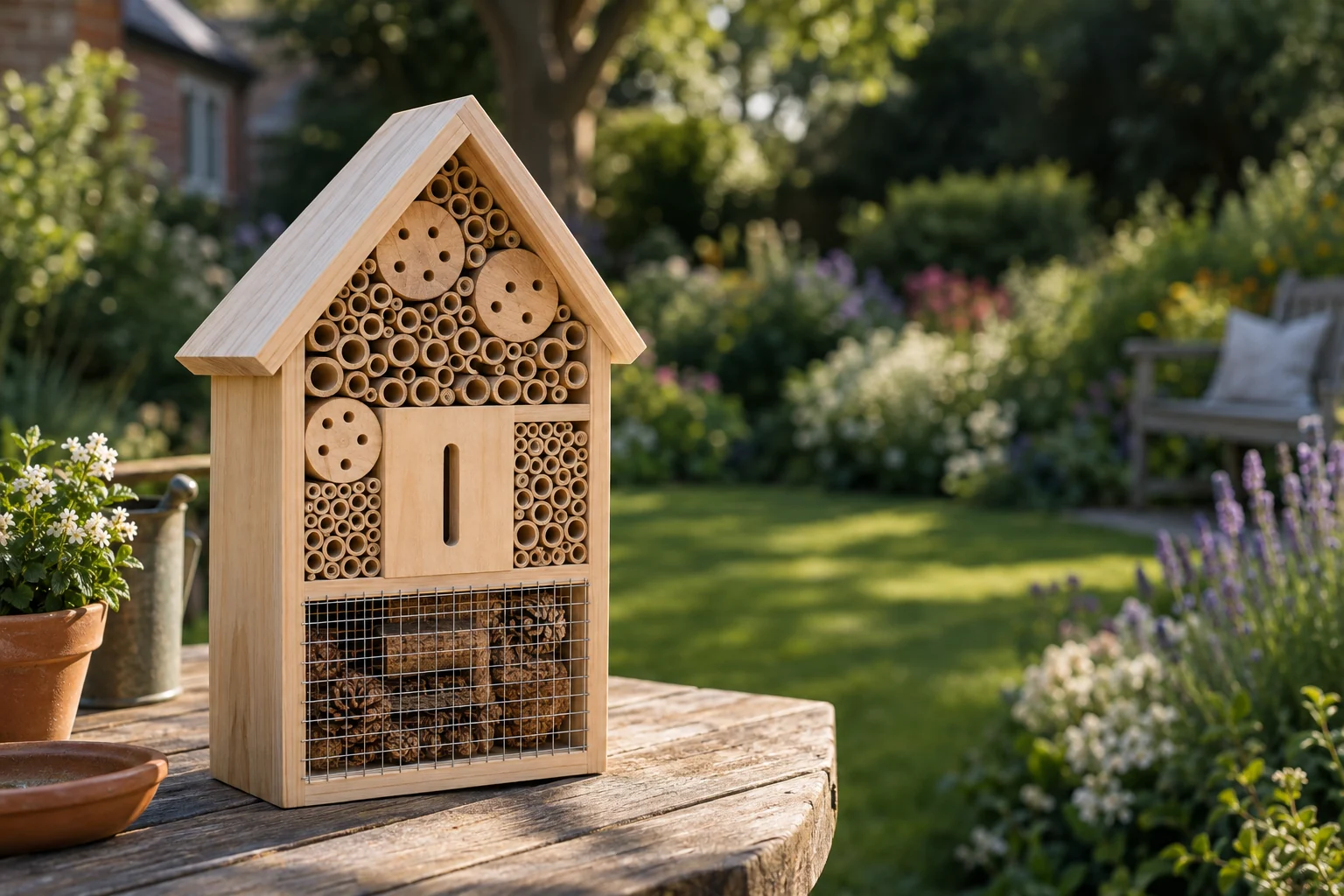
The most important fact to remember is that a large proportion of the UK's wild bee species are ground-nesting. They do not want a decorative insect hotel hanging on a fence. They need patches of open, well-drained ground, often in a sunny place, where they can excavate their nests. A small patch can make a meaningful difference.
To make a ground-nesting zone, remove a small patch of turf in a sunny, sheltered position. Loosen the soil to a depth of 15–20 cm without enriching it heavily, and keep it open rather than immediately replanting it. A space as small as 0.25 m² can support dozens of mining bee nests. If your soil is heavy and slow to drain, horticultural grit can improve drainage; a 25 kg bag costs around £4–£6. If the existing soil is already sandy or free-draining, the job may cost nothing but the loss of a tiny square of lawn.
This is not an area that needs daily fussing. In fact, the opposite is true. Avoid walking across it, covering it with mulch, or deciding halfway through spring that it would look nicer filled with annual bedding. Put it somewhere you can observe without disturbing it. Small volcano-like heaps of excavated soil are often the first sign that mining bees have moved in.
Give insects a drink without creating a drowning hazard
Use a shallow dish or saucer with stones, pebbles or marbles breaking the surface so insects have somewhere safe to land. Keep the water topped up and refresh it regularly. A deep container of plain water is not helpful if a bee cannot climb back out.
Dead stems matter, too. Hollow or pithy stems can offer shelter to insects, and seedheads provide winter structure. Rather than cutting every perennial down in autumn, leave at least some standing until spring. You can still keep the front of a formal border neat if that matters to you; allow the gentler, less visible areas to carry more of the ecological workload.
Logs, a tucked-away pile of prunings and dense evergreen cover can all add shelter. None requires a special corner labelled "wildlife zone" with a jaunty sign. A log placed discreetly behind a shrub, a few leaves left beneath a hedge and a patch of long grass around the edge of a border are enough to start making a garden feel less sterile.
Finally, avoid pesticides wherever possible. A plant that has been treated to remove insects is clearly not a useful feeding place for insects. Healthy soil, appropriate planting positions, tolerance of a little leaf nibbling and encouraging natural predators will take you a long way. Perfection is overrated. A rose leaf with an aphid or two is not the end of civilisation.
Plant by Plant: How the Top Performers Stack Up
If you only have space for a handful of additions, choose plants that cover a long flowering period, suit ordinary UK conditions and offer something different from the rest of the border. The six plants below are particularly useful building blocks. They are not the only good choices, and no comparison can capture every local condition, but together they create a strong backbone from early summer through autumn.
There is one important warning before we get to the table: the "best" plant is still the plant that suits your garden. Lavender dislikes ground that sits wet in winter. Ivy needs a place where it can be allowed to mature and flower. Phacelia is an annual, not a permanent shrub border solution. The most pollinator-friendly plan in the world cannot persuade a sun-lover to flourish in cold shade.
| Plant | Flowering window | Particular strength | Best role in an all-season garden |
|---|---|---|---|
| Lavandula angustifolia 'Hidcote' | June–August, around 10 weeks | AGM holder; drought-tolerant; well documented as a highly attractive forage plant for bees. | Sunny, well-drained planting repeated through summer borders. |
| Nepeta 'Six Hills Giant' | May–September | One of the longest flowering windows of any perennial in this group. | A long-running bridge from late spring into early autumn. |
| Phacelia tanacetifolia | May–July (sow March–May) | Useful as a seed-grown, flower-rich annual addition. | Fill a temporary gap whilst permanent planting establishes. |
| Centaurea nigra | Summer flowering | Composite flower form that supports a wide range of visitors. | Add flower-shape diversity to sunny, naturalistic planting. |
| Aster × frikartii 'Mönch' | August–October | Strong late-season flowering when many borders begin to empty. | Carry the nectar supply into autumn. |
| Hedera helix | September–November | Supports a wide range of bee species and other invertebrates. | Essential late-autumn food on a suitable wall, fence or boundary. |
Lavender 'Hidcote' is widely available, adaptable to dry sunny sites and a reliable summer performer. Just remember that its flowering window is June to August. Without earlier and later companions, it leaves substantial parts of the year uncovered.
Nepeta 'Six Hills Giant' is the plant I would use where a border needs stamina. From May to September, it is there for much of the main gardening season, often creating a soft, bee-busy haze around more upright perennials. It works especially well beside roses, though roses themselves are not necessarily the main pollinator event in a border. Nepeta provides the dependable background support.
Phacelia tanacetifolia is helpful when you are creating a new area or want quick cover during a transition. As an annual, it gives you flexibility. You can sow it where a permanent planting scheme is not ready, use it to soften a bare patch, then change direction next season. That makes it particularly useful for gardeners learning what light and moisture conditions they actually have, rather than what they hoped they had.
Common knapweed, Centaurea nigra, earns its place through accessibility and breadth. Its composite flowerheads offer many tiny feeding points and can help make a planting feel less reliant on spikes and bells. Aster 'Mönch' then takes up the baton as summer slips away. It is hard to overstate how welcome an August-to-October plant becomes once you have watched an otherwise empty border in September.
Ivy is the outlier because it is not a conventional border perennial at all. It climbs or spreads, needs managing and can become too enthusiastic in the wrong place. But a mature flowering ivy is ecological gold in autumn. The right approach is not to plant it everywhere blindly; it is to value an established flowering section, prevent it from overwhelming vulnerable plants or structures, and never cut it during the flowering period.
A Simple Planting Plan You Can Start Now
October is not the month for sowing every possible seed and expecting a miracle by Tuesday. It is, however, a brilliant time to plan, plant bulbs, assess your border structure and make room for shrubs and perennials while the soil still holds some warmth. The goal is to do the useful groundwork now, then fill and adjust as spring arrives.
Begin with a simple map. It does not need to be a scale drawing worthy of a planning application. Sketch the border, lawn edge, fence, wall, pots and any area that gets real sun. Mark where you already have flowers in early spring, high summer and autumn. Then identify the gaps. Most people find that spring and late autumn need the most help.
- Plant crocuses now in grass, beneath deciduous shrubs or through the front of a border for February and March flowers.
- Choose one early perennial area for hellebores and pulmonaria, especially where the soil is not baking hot in summer.
- Reserve a sunny section for lavender and nepeta, ensuring drainage is good enough for lavender to thrive.
- Add late-season structure with asters, sedum, rudbeckia, helenium or verbena, depending on the space available.
- Protect or allow flowering ivy where it can be managed safely and does not swamp other plants.
- Create one habitat feature, even if it is only a 0.25 m² bare-soil patch or a shallow water dish with safe landing stones.
Do not feel obliged to complete every step this season. A garden is not a showroom installation. It changes, matures, surprises you and occasionally ignores your plan altogether. Start with the two biggest calendar gaps, then review next year. If April still looks bare, add more early flowers in autumn. If September is quiet, make space for another aster or protect more flowering ivy.
The useful rule of three: aim for at least three different plants flowering in any part of the season. That gives pollinators choice and gives your garden a buffer if one plant flowers poorly, is damaged by weather or simply has an off year.
Common Questions About Attracting Bees and Pollinators
No. Containers with a sequence of flowering plants, a small strip of border, a flowering climber or ivy on a boundary and a shallow water source can all help. The important thing is regular availability of flowers and avoiding the instinct to make every surface sterile and bare.
Not necessarily. A practical compromise is to leave a less frequently cut edge, a small patch beneath trees or an area around a boundary. You can keep paths, sitting areas and the main lawn manageable whilst allowing part of the garden to offer more flowers and shelter.
Many heavily double flowers have less accessible pollen and nectar because their reproductive parts have been replaced by extra petals. When planting specifically for pollinators, favour simple, open flowers alongside any ornamental doubles you enjoy.
It can provide an additional nesting opportunity for some cavity-nesting species, but it does not replace habitat. A large proportion of UK wild bee species are ground-nesting, so sunny, open, well-drained soil is just as important, and often more so.
Do not cut it during its September-to-November flowering period. Manage it at another point in the year if it needs containing, and retain mature flowering growth wherever it can safely remain.
The GardenScout Verdict: Build the Relay, Then Let It Work
The most successful pollinator gardens are not necessarily the wildest, the largest or the most complicated. They are the ones that keep asking a useful question: what is available to eat here this month? If the answer is "not much", that is your next planting opportunity.
Start with early crocuses, hellebores and pulmonaria. Carry the middle of the season with nepeta, lavender, foxgloves and open flower forms. Plan deliberately for August through October with verbena, echinacea, asters, sedum, helenium and rudbeckia. Then protect flowering ivy, leave some stems standing, offer water and make one sunny patch of bare soil available to ground-nesting bees.
GardenScout's final word
A succession of pollinator-friendly plants, backed up by simple habitat tweaks, is one of the most effective changes a UK gardener can make. It is practical, adaptable and far more valuable than a brief burst of flowers in early summer. Begin now by spotting the gaps, planting for spring and deciding which corners can be allowed to be a little less tidy. The bees, hoverflies and butterflies will do the rest — usually whilst you are meant to be getting on with something else.