
Hanging Baskets That Look Full and Last All Summer
The practical route to baskets with staying power: choose a liner that works, build a sensible plant mix, and master the small daily jobs that keep flowers coming when the weather turns properly warm.
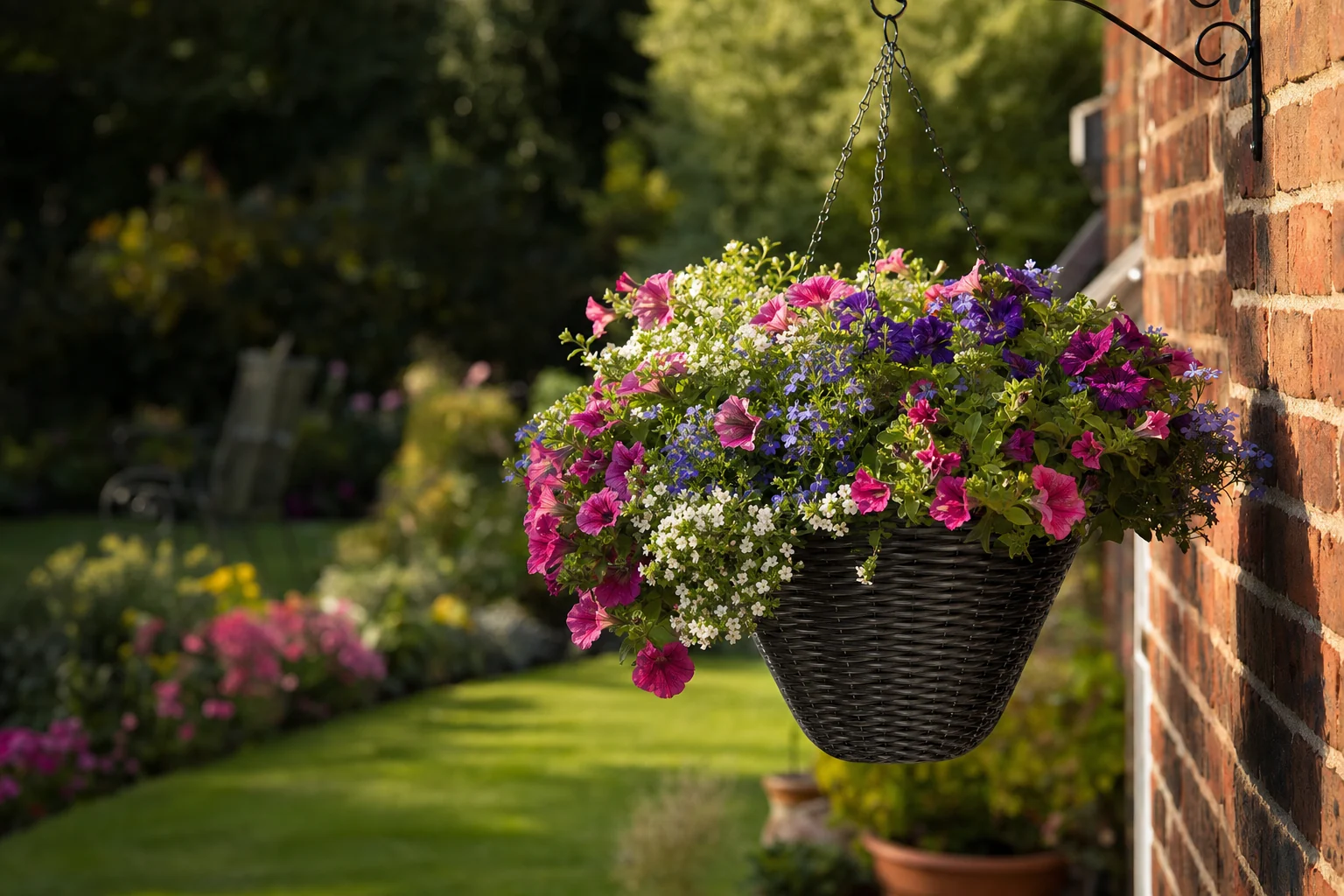
Why Most Hanging Baskets Fail by July (And How to Beat the Odds)
There is a very specific sort of gardening disappointment reserved for hanging baskets. You put them up in late spring, take approximately forty photographs of them, and spend a few days admiring your own excellent judgement. Then summer gets underway. A hot spell arrives, life gets busy, and the glorious mound of colour gradually becomes a wiry, lopsided arrangement with three flowers and the demeanour of a plant that has seen things.
It is not because hanging baskets are difficult in the mystical, green-fingered sense. They are difficult because they are exposed containers with a very small margin for error. Roots sit above ground in a limited volume of compost, where sun and wind can pull moisture away at surprising speed. Unlike a border, there is no deep, cool reserve of soil beneath them. Unlike a substantial patio pot, there is not much room for a forgotten watering to be absorbed without consequence. A basket is essentially a beautiful little weather station that reports every lapse in care immediately and, sometimes, rather theatrically.
The first usual culprit is irregular watering. Hanging baskets should be checked once a day, and warm weather can mean they need water more than once. Full sun, a drying breeze and a densely planted display make a demanding combination. The second is food. Flowering plants are doing a great deal of work all summer: producing shoots, roots, leaves and repeat blooms from a finite store of nutrients. Potting compost does not provide an endless buffet. Without regular supplemental feeding, plants can slow down just as you want them to be at their best.
The third problem happens before the basket has even gone up: the wrong plants, or the wrong mix of plants, for the place. A shade-loving fuchsia cannot be expected to enjoy a relentlessly sunny wall. Equally, a basket filled entirely with plants that want constant sun will not suddenly become philosophical about a cool, shaded porch. Plants are remarkably accommodating, but they do have preferences. Ignoring them is less "creative gardening" and more "setting up a small, leafy grievance".
The three-part answer
A long-lasting basket is built around three connected decisions: a liner and container approach that manages moisture, a plant combination matched to the site, and a steady feed-and-water routine. Get all three broadly right and the rest becomes maintenance rather than rescue work.
That is encouraging news, really. You do not need a secret variety available only to prize-winning gardeners, nor a daily ceremony involving seven products and a clipboard. You need to understand what the basket is asking for and make those jobs easy enough to repeat. The best hanging basket is not necessarily the one with the most plants on planting day. It is the one you can keep evenly watered, sensibly fed and lightly groomed through the season.
Think of a basket as a high-performance container rather than a low-maintenance decoration. It has limited reserves of water and nutrients, so consistency matters far more than a heroic intervention after it has started to struggle.
The Basket Itself: Materials, Capacity and What Actually Matters
Before choosing a plant, look at where the basket will hang and how you are realistically going to care for it. This sounds terribly obvious, but it is the bit most likely to be skipped in the rush towards petunias. A basket over a sunny front door may look splendid, but it is also exposed, high up and potentially awkward to water. A basket near a tap, protected from the worst wind and viewed from the kitchen window has every chance of becoming the better display simply because it will get noticed and watered.
Wire baskets and solid containers approach the job differently. A wire basket lined with a natural material creates that classic all-round planted effect. Plants can emerge from the sides as well as the top, which is why a well-grown wire basket can look like a floating ball of colour rather than a pot with a fringe. It is an undeniably lovely look. It also leaves more of the compost surface and sides exposed to drying conditions, so it rewards an attentive watering routine.
A solid hanging container is usually the less dramatic option at first glance, but it has a practical advantage: the compost is more enclosed. That can make moisture management simpler, especially for gardeners who cannot check baskets twice on a hot day. You lose some of the wraparound planting potential, but you gain a little forgiveness. There is no universal winner. The right choice depends on whether maximum visual fullness or steadier moisture retention is the priority for your particular spot.
Do not treat the hanging point as an afterthought. A fully planted basket becomes heavier after watering, and the support needs to be secure and appropriate for that load. Check the bracket, chain, hook and fixing into the wall or fence, not merely the basket itself. A handsome display is no use at all if it makes an unscheduled descent onto the path. If you have the faintest doubt about a fixing, address it before planting. Compost, water and trailing plants are much easier to handle before they are arranged several feet above your head.
Match the basket to its microclimate
Watch the intended spot for a day. Is it sunny from breakfast until evening, or does it receive only a bright patch of afternoon light? Is there wind funnelling around a corner? These details decide which plants are sensible.
Plan the watering route before planting
If watering requires a ladder, a long trek with a heavy can or a negotiation with a parked car, it will eventually be postponed. Put demanding baskets where the routine is painless.
Respect wind as well as sunshine
Wind strips moisture from compost and foliage. A basket in a breezy place may dry quickly even when the day itself does not feel especially hot.
One final point: avoid treating a hanging basket as a miniature garden border. Garden soil is too heavy for the job and can compact in a container, making drainage and root growth more difficult. Baskets need a lightweight growing medium designed to hold enough moisture without becoming sodden. That balance is the foundation of almost every successful display.
Liner Showdown: Coconut Coir, Sphagnum Moss and Modern Alternatives
The liner is not just there to stop compost falling through a wire basket. It has a quiet but important role in how the root zone behaves. It influences drainage, moisture retention, insulation and the ease of planting through the sides. This is not quite as glamorous as choosing flower colours. It is, however, the difference between a basket that remains manageable and one that dries into a sulk whenever the sun appears.
Coconut coir is a popular choice because it is lightweight, biodegradable and able to retain moisture whilst still allowing drainage. It is also pH neutral and is widely used as a sustainable alternative to peat. For a gardener making several baskets, coir is often a reassuringly straightforward material: it comes in ready-formed liners, has a tidy natural appearance and does not require the sort of handling that leaves you looking as though you have wrestled a damp haystack.
Sphagnum moss is the traditional material, and there is a reason it remains so well regarded. It is natural, absorbent and provides excellent moisture retention, while also helping to insulate roots. A moss-lined basket has a softer, more old-fashioned appearance than a rigid ready-shaped liner, which suits cottage-style planting beautifully. The trade-off is that it can be messier and slower to arrange. That is not a criticism, exactly. It is simply a different sort of gardening afternoon.
Foam and felt-style liners are often chosen for convenience. They are easy to cut when you are adding side-planted trailers, and their consistent thickness makes them less fiddly to fit. Their limitation is that drainage must be considered carefully. Any liner is capable of holding too much water if the basket has poor drainage or if watering is not adjusted for cool, wet weather. A material that saves moisture is useful; a permanently wet root zone is not.
| Consideration | Coconut coir | Sphagnum moss | Foam or felt liner |
|---|---|---|---|
| General character | Natural, lightweight and structured | Traditional, soft and highly absorbent | Uniform and easy to shape or cut |
| Moisture approach | Retains moisture while permitting drainage | Excellent moisture retention and root insulation | Needs thoughtful drainage management |
| Planting through sides | Possible with careful cuts | Possible while building the liner | Usually simple to cut openings |
| Look | Neat, natural and understated | Classic and informal | Usually hidden once planted |
| Best suited to | Gardeners wanting an easy natural liner | Traditional baskets and moisture-conscious planting | Quick assembly and side-planting layouts |
Whichever liner you choose, fit it properly. A loose liner leaves odd gaps where compost shifts and dries unevenly. A liner pressed too tightly into the basket can reduce the available root space. You are aiming for a supported, even layer that follows the shape of the basket without becoming a rigid obstacle. Put simply: snug, not strangled.
Liner choice will not replace watering
Even the most moisture-friendly liner does not make a hanging basket self-watering. It slows the rush towards dryness; it does not remove the need for daily checks in summer. That distinction saves a lot of disappointment.
There is also a visual consideration. If your basket will be seen close-up, perhaps beside a front door or seating area, the texture of coir or moss becomes part of the display. If it hangs high on a wall and will mostly be admired from a distance, that matters much less. In the latter case, prioritise the liner that makes your care routine easier. Plants have no interest in whether you selected the most picturesque liner. They are more concerned with whether their roots are alternately baked and drowned.
The Art of the Mix: Plant Combinations That Actually Fill Out
The phrase "full hanging basket" can tempt people towards one simple strategy: put in as many plants as physically possible. Resist that urge. Fullness is not just density. It comes from plants with different jobs growing into one another over time. A basket should develop a rounded shape, with flowers and foliage at different levels, rather than simply becoming a crowded crown of plants competing for the same patch of compost.
The useful framework is thriller, filler and spiller. It sounds faintly like a gardening-themed crime drama, but it is an excellent way to think about planting. The thriller gives the centre some structure or height. The filler creates bulk around it. The spiller trails over the edge and softens the outline. You do not need to apply the formula with military precision, but it stops a basket becoming either a flat disc of flowers or a collection of long, bare stems.
For a sunnier position, pelargoniums are valuable because they cope well with bright conditions and have a naturally confident presence. Osteospermum suits full sun too, bringing daisy-like flowers and a more open, architectural shape. Calibrachoa, often sold as Million Bells, is compact, prolific and self-cleaning, making it a particularly useful choice for the trailing or mounding parts of a basket. It gives plenty of colour without demanding that you pick off every faded flower.
For shade or gentler light, fuchsias are one of the great favourites. Their pendulous flowers feel made for hanging baskets, and they are a much more sensible proposition than forcing sun-lovers to endure a gloomy corner. Busy Lizzies, or impatiens, can provide rapid volume in suitable conditions, whilst lobularia, commonly called sweet alyssum, offers a softer froth of small flowers. Bacopa is another excellent trailing component, bringing a looser, delicate edge that works well alongside bolder blooms.
There is one important note with impatiens. Downy mildew can be a risk, so choosing New Guinea impatiens is a sensible route where disease resistance is a priority. It is never wise to assume that a plant will perform identically in every garden, but selecting an appropriate type gives your display a better starting point. Healthy plants, good air movement and sensible watering habits are helpful companions too.
Thriller: the centre with purpose
Use one plant, or a small central grouping, with upright interest. Fuchsia, pelargonium and osteospermum can each provide a focal point when matched to the light levels of the site.
Filler: the body of the basket
Fillers make the planting look generous before trailers have reached the edge. Impatiens, sweet alyssum and compact flowering plants are useful for knitting a composition together.
Spiller: the softened outline
Trailers create the cascading finish people associate with a well-established summer basket. Bacopa and calibrachoa are particularly effective where their conditions suit.
Colour is important, but habit is more important. A basket using three shades from one palette can be spectacular if it has a good range of growth forms. Conversely, a basket with six bright colours but no structural contrast can read as a crowded supermarket bouquet suspended from a chain. Start with the place, choose plants for the conditions, then decide whether you want calm tonal colour, a hot mix, pastels or a deliberately riotous combination. There is room for all of them.
Try not to combine plants with sharply different watering needs just because the flowers look good together on the bench. The basket will only be as happy as its least compatible resident.
It is also worth allowing space for plants to grow. A newly planted basket can look a little restrained. That is fine. Many summer bedding plants are selected precisely because they develop quickly in warm weather. If every centimetre is packed at the outset, roots compete sooner, watering becomes less even and plants can race upwards instead of filling out. A little patience at planting time is one of those boringly effective bits of advice. It pays off.
Build around the conditions, not the label photo
That glorious full-sun basket shown on a plant tag may have been grown under conditions your front porch cannot offer. Choose plants for the reality of your space first. The colour scheme comes second, however tempting the picture may be.
Compost, Moisture Retention and the Foundation No One Talks About
Most hanging-basket problems are discussed at flower level: why has it stopped blooming, why are the leaves yellow, why does it look sparse? The answer often begins below the surface. Roots need a compost that is light enough for a hanging container, free-draining enough to avoid waterlogging and capable of retaining useful moisture between waterings. Those needs pull in different directions, which is why ordinary garden soil is unsuitable. It is too heavy, can compact readily and does not behave well in a basket.
A proprietary hanging-basket compost is formulated with this particular challenge in mind. These mixes commonly include materials such as perlite for drainage, coir for moisture retention and controlled-release fertiliser to give plants an initial reserve of nutrients. Multi-purpose compost can still be used for container growing, but a basket-specific mix is designed around the exact compromise a suspended container needs to make: it must not dry instantly, but it must not remain saturated either.
That last point matters more than many gardeners realise. The instinct when faced with a thirsty basket is to add more water-retaining material, more compost and more frequent watering. Sometimes that is correct. Sometimes it creates a root zone that stays wet for too long, reducing root health and causing plants to wilt despite the apparent abundance of moisture. It feels counterintuitive because a wilted plant looks thirsty. Roots, alas, do not always follow the visual script.
Water-retaining gel crystals or granules can be mixed into compost at planting time. Used correctly, they can help reduce watering frequency. The important phrase is "used correctly". Follow the product instructions closely, mix the material evenly through the compost and remember that it expands as it absorbs water. Overdoing it can cause the compost to swell and disturb plants, which is a spectacularly unhelpful result from something purchased to make life easier.
The sensible role for moisture-retaining additives
Use them as a buffer against rapid drying, not as permission to ignore a basket for several hot days. They are most useful alongside daily observation, a suitable liner and a compost that still drains freely.
When planting, firm compost gently around the root balls, but do not compact it into a brick. Water through after planting so that the compost settles around roots. Then pay attention over the first week. That early period tells you a great deal about how the basket is behaving in its final position. Does water run through immediately? Does it pool? Are plants wilting by afternoon? Is one side drying faster than the other? These are not failures. They are useful bits of intelligence before the peak of summer arrives.
There is a modest but powerful habit here: lift or support the basket slightly when you water, if it is safe to do so, and get a feel for its weight. A freshly watered basket feels different from one that has dried significantly. This is not a scientific instrument, but it becomes a useful instinct surprisingly quickly. Combine it with a finger test in the compost and you are far less likely to water by guesswork alone.
Feeding for Flowers: The Nutrient Timeline That Keeps Baskets Blooming
Flowers are not free. Every new bloom is the result of a plant using water, light and nutrients to make something briefly beautiful and then, if all goes well, making another one. A hanging basket is particularly demanding because it has only the nutrition in its compost and whatever you add through feeding. Once those initial reserves begin to diminish, plants often continue to look green enough for a while, but flowering loses momentum. This is the point where a basket can quietly drift from impressive to merely present.
The three letters on fertiliser labels, N-P-K, refer to nitrogen, phosphorus and potassium. Nitrogen supports leafy growth. Phosphorus contributes to root development and flowering. Potassium supports overall plant health and disease resistance. It is not necessary to turn this into a chemistry exam, but understanding the broad roles helps you avoid one common mistake: feeding flowering baskets in a way that encourages lots of soft green growth and comparatively few flowers.
For baskets grown for summer blooms, high-potash liquid feeds are generally preferred. Tomato feed is a familiar and effective example for flowering plants because it is associated with supporting flowers and fruit rather than simply pushing leafy growth. The label still matters, of course. Mix and apply any feed according to its directions; more fertiliser is not a shortcut to more flowers. Too much can stress plants and upset the balance in the compost. Gardening has an enduring sense of humour about excess enthusiasm.
During the active growing season, experts recommend liquid fertiliser every one to two weeks. For a basket intended to perform through summer, every two weeks should be viewed as the minimum reliable rhythm rather than an optional flourish. June to September is the key period for many summer displays. Put the feed somewhere you will see it, choose a regular day, and make it a small routine rather than a vague intention.
| Feeding approach | What it supports | Where it can fall short |
|---|---|---|
| Fresh compost alone | An initial nutrient reserve after planting | Does not sustain heavy flowering through a long summer by itself |
| Regular balanced liquid feed | General growth and a broad nutritional top-up | May not be the most flower-focused choice for a display basket |
| Regular high-potash liquid feed | Continuous flowering alongside general plant health | Still requires correct dilution and routine application |
Feeding and watering are connected. Never regard feed as a substitute for water, and do not assume a wilted plant needs fertiliser. Address the moisture situation first. Equally, repeated heavy watering leaches nutrients from compost over time, which is another reason the feed routine becomes more important as summer progresses. A basket in vigorous growth is using what you give it. That is good news. It means the display is working. You simply have to keep up with it.
A simple calendar reminder is more useful than a complicated schedule you never follow. Choose a repeat day for feeding, adjust according to the product label, and keep the routine going whilst plants are actively growing and flowering.
If a basket is producing lots of leaf but not many flowers, reassess the feeding approach and light levels before blaming the plant. If flowering has slowed in a dense, tired-looking basket, combine feeding with a tidy-up: remove spent flowers, trim overly long stems where appropriate and check that water is reaching the root zone. Plants respond well when several small problems are addressed together.
Watering in the Heat: Frequency, Technique and the Daily Checklist
Watering is the main event. Everything else matters, but this is the task that most directly determines whether a basket keeps its shape and colour through warm weather. Hanging baskets must be checked daily during the British summer, even when the sky is grey. Cloudy does not necessarily mean damp, especially where wind is involved. A basket can dry out within a day, and the plants inside it cannot send their roots further down to look for a better arrangement.
In full sun during warm spells above 20°C, a basket may need watering twice a day: once in the morning and again later in the day. This is not an instruction to pour water in automatically at every opportunity. It is an instruction to check. The compost, the weather, the basket's exposure and the plant growth all determine the actual need. An established, densely planted basket on a hot wall can be thirsty again surprisingly quickly. A shaded basket after a wet evening may not need anything at all.
Use the finger test, not hope
Push a finger a short way into the compost. If it is dry beneath the surface, water promptly. The top layer can look dry whilst compost below still has moisture, and a damp-looking surface can conceal a dry root zone. Your finger is a better guide than appearances.
Water thoroughly enough for moisture to reach the root zone. A quick sprinkle across leaves and the compost surface may make everything look refreshed for ten minutes, but it does not necessarily rehydrate the roots. Water steadily, aiming at the compost rather than the flowers, and allow time for it to soak in. If water starts running straight through a very dry basket, pause briefly and water again. Dry compost can become reluctant to re-wet, so a slower approach is more effective than one dramatic deluge.
Morning: inspect before the day heats up
Check compost moisture, look for limp foliage and water if needed. A properly hydrated basket is better equipped to handle a hot afternoon than one already running short.
During warm weather: check again
Full sun and drying conditions can create a second watering need. Do not assume the morning watering will cover every basket until evening.
Look for uneven drying
The exposed side of a basket may dry more rapidly. Rotate a removable basket if practical, or be especially attentive to the side taking the most sun and wind.
After rain: check rather than assume
Dense foliage can shelter the compost from a shower. Conversely, prolonged rain can leave a basket wet enough that extra watering would be harmful.
A basket that wilts in the afternoon is not always beyond saving. If the compost is dry, water it thoroughly and give the plant time. Many bedding plants recover surprisingly well after a short dry spell. Repeated drought stress is different. It weakens growth, interrupts flowering and makes plants more vulnerable to further problems. The aim is not perfection at every minute of every day; it is avoiding the repeated hard swings from soaked to bone dry.
Conversely, do not panic-water a plant simply because it looks limp. If the compost is wet and the plant is wilting, the issue may be root stress from overwatering or poor drainage. In that situation, more water is the gardening equivalent of replying to every computer problem by pressing the same button harder. Check first. Diagnosis saves plants.
Rain does not automatically water a basket properly. The plant canopy can act like a small umbrella, so always assess the compost itself after a shower before deciding the job has been done for you.
For busy weeks, the most useful preparation is not a promise to "remember". It is reducing friction. Keep a watering can nearby, make sure the hose reaches, use a safe watering wand for higher baskets and place the most demanding displays where you pass them each day. Hanging baskets reward habits, not grand intentions.
Deadheading, Pruning and the Mid-Summer Rescue Cut
Feeding and watering keep the plant growing. Deadheading tells it to keep flowering. When a flower fades and begins setting seed, the plant can divert energy towards reproduction rather than making more blooms. Removing spent flowers helps maintain a neater display and encourages many popular basket plants to continue producing flowers. It is one of those tiny jobs that has a disproportionate effect on the overall impression.
For plants that need it, deadhead every few days or at least once a week. You do not need to turn it into a solemn inspection. Take a few minutes with a cup of tea nearby, pinch or snip off faded flowers and remove any yellow leaves or damaged stems. The basket will look better instantly, and you will spot pests, dry compost or overcrowded growth before those problems become harder to manage.
Some plants take much of this task off your hands. Calibrachoa, bacopa and Verbena bonariensis are largely self-cleaning, meaning spent flowers naturally drop away. This does not mean they are maintenance-free. They still need water, feeding and an occasional look-over. It simply means you are not required to pick every individual faded flower from the display, which is a small mercy during a busy summer.
Self-cleaning choices
- Reduce the time spent removing individual spent flowers.
- Keep a tidier appearance between maintenance sessions.
- Useful for baskets placed high or in awkward positions.
- Still benefit from feeding, watering and occasional trimming.
Plants needing deadheading
- Petunias, pelargoniums and fuchsias benefit from regular attention.
- Faded blooms can make a full basket look tired very quickly.
- Skipping the job can reduce the sense of continuous flowering.
- A neglected basket may need a more decisive tidy-up later.
Petunias, pelargoniums and fuchsias all repay regular deadheading. With petunias in particular, inspect the stems as well as the flower heads. A faded bloom often has a developing seed structure behind it, and removing that whole spent section is more effective than just pulling off the petals. Do this gently and regularly, rather than waiting until the basket looks like it has hosted a very small, very messy party.
By midsummer, some baskets become leggy even with good care. Stems stretch, the centre opens up and flowers migrate to the ends. This is the moment for a rescue cut: trim back the longest, weakest growth, remove tired flowers and leaves, water properly and resume feeding. It can feel brutal, particularly when the basket is already looking underwhelming. But a considered trim encourages fresh branching and gives the display a chance to rebuild.
Do not wait for perfection
Deadheading is easiest when it is frequent and casual. A few minutes every several days is far kinder to you and the plants than an enormous late-July clean-up involving sticky fingers and mild resentment.
Pruning should never be a substitute for resolving the real issue. If a plant is thin because it is constantly drying out, a trim alone will not solve it. If flowers have slowed because nutrients are depleted, cutting stems back without feeding will only buy time. The strongest mid-summer reset combines tidying, watering, feeding and a quick review of whether the basket's position is making life unnecessarily difficult.
Common Problems Diagnosed: Yellowing, Wilting, Pests and Petal Drop
Hanging baskets communicate in a limited but fairly expressive vocabulary. Yellow leaves, limp stems, sticky growth, dropped petals and sparse flowering are all messages. The trick is not to respond to every message with the same solution. Watering a nutrient problem does not fix it. Feeding a waterlogged root system does not fix it. Buying another plant and popping it into the gap is, occasionally, emotionally satisfying, but also does not fix it.
Yellow leaves are often associated with nitrogen deficiency, especially where plants have been growing hard and have not received regular feeding. A balanced liquid fertiliser can help address that. But yellowing can also occur when compost stays too wet. In waterlogged conditions, roots struggle to function properly and cannot absorb nutrients effectively, even if those nutrients are present. Before feeding, test the compost and inspect drainage. That small pause is the difference between care and escalation.
Wilting is similarly double-sided. If the compost is dry, the answer is straightforward: water thoroughly. If the compost is wet and a plant remains wilted, suspect root stress, poor drainage or overwatering. Check that drainage openings are not blocked and let the compost move away from saturation before watering again. A basket needs air around roots as well as water. This is why "more water" is such an unreliable universal answer.
Another frustrating issue is compost that has become hydrophobic: so dry that water runs over or through it without properly soaking in. In that case, slow watering in stages can help re-wet the compost. Where it is safe and practical to do so, a controlled submersion approach can also fully rehydrate the root zone. The point is to allow moisture time to penetrate, not to flood the basket indiscriminately. Once recovered, return to regular checks so it does not dry to that extreme again.
Before treating a sick-looking basket, inspect the compost beneath the surface, the drainage route, recent weather and your feeding routine. Symptoms can look similar whilst having completely different causes.
Pests are another reason to inspect frequently. Look under leaves and around new growth, where problems can begin quietly. Early action is always easier than trying to restore a basket after pests have distorted fresh growth or weakened flowering stems. Good general care helps here too: plants that are neither drought-stressed nor sitting in stagnant, waterlogged compost are better placed to cope with the ordinary pressures of a summer garden.
Who Will Get the Best Results From This Approach?
The good news is that a great hanging basket is not reserved for gardeners with endless time. It is more suitable for gardeners who are willing to do small jobs at sensible intervals. The routine is regular, but it is not complicated: check water, feed on schedule, remove faded flowers, and respond early when something looks wrong. Once you get into that rhythm, the basket becomes a pleasing daily detail rather than a looming responsibility.
Front-door gardeners
Ideal if you pass the basket every day and can notice dry compost, fading flowers or a change in growth before it becomes a crisis.
Sunny-space growers
Choose drought-tolerant plants where appropriate, use a moisture-conscious liner and commit to checking frequently during warm spells.
Shaded-porch gardeners
Build around fuchsias and suitable shade-tolerant plants rather than trying to recreate a blazing patio display in low light.
Busy households
Self-cleaning varieties, convenient basket positions and a simple feeding reminder reduce maintenance without pretending the basket needs none.
If you travel regularly or know that summer watering will often be impossible, it may be wiser to use fewer baskets, place them in gentler conditions or choose more forgiving container planting. There is no shame in this. A single well-managed basket is more attractive than five increasingly resentful ones. Gardening should improve the view, not add a daily layer of low-grade anxiety.
The same principle applies to ambitious colour schemes. Start with one basket and learn how quickly it dries in your garden. Notice which plants keep their shape, which need deadheading and how your preferred compost behaves. The following year, you will plant with actual knowledge of your own conditions rather than a hopeful interpretation of a display bench in May. That is when hanging baskets become much easier.
The GardenScout Verdict
A hanging basket that stays full through summer is not a mystery product or a lucky one-off. It is the result of making a few sound decisions in the right order. Begin with a basket and liner suited to the site. Use lightweight, free-draining, moisture-retentive compost. Combine plants with compatible needs and different growth habits. Then protect that good start with daily moisture checks, regular high-potash feeding during active growth and simple deadheading.
The main limitation is also the point: these are living displays, not outdoor ornaments. In warm weather they need attention, sometimes twice a day. But that attention is brief, satisfying and very visible in the result. Give a basket consistent care and it can remain the thing that made you stop at the door in May — only now it is doing the same job in the height of summer, when it really earns its place.