
Choosing a Log Store That Keeps Firewood Dry and Ready to Burn
The useful bit of garden storage that protects your fuel, improves seasoning and saves you from trying to light a stove with logs that feel like cold sponges.
Why Your Firewood Storage Is Probably Letting You Down
It is mid-September, which means the evenings are drawing in, the first proper jumpers have appeared by the door, and plenty of us are looking at the log pile with renewed interest. This is also the point at which a rather depressing discovery is often made: the wood you thought was safely tucked away is damp, musty, soft around the edges, or reluctant to burn.
That is rarely just bad luck. It is usually storage. A pile of logs sitting directly on paving, soil or a tarp may look reasonably protected from a distance, but it is not necessarily drying. Water can rise from beneath. Rain can blow into the stack from the side. A cover pulled tightly around every face can trap humid air where you most need movement. The result is a neat-looking pile that remains stubbornly wet inside.
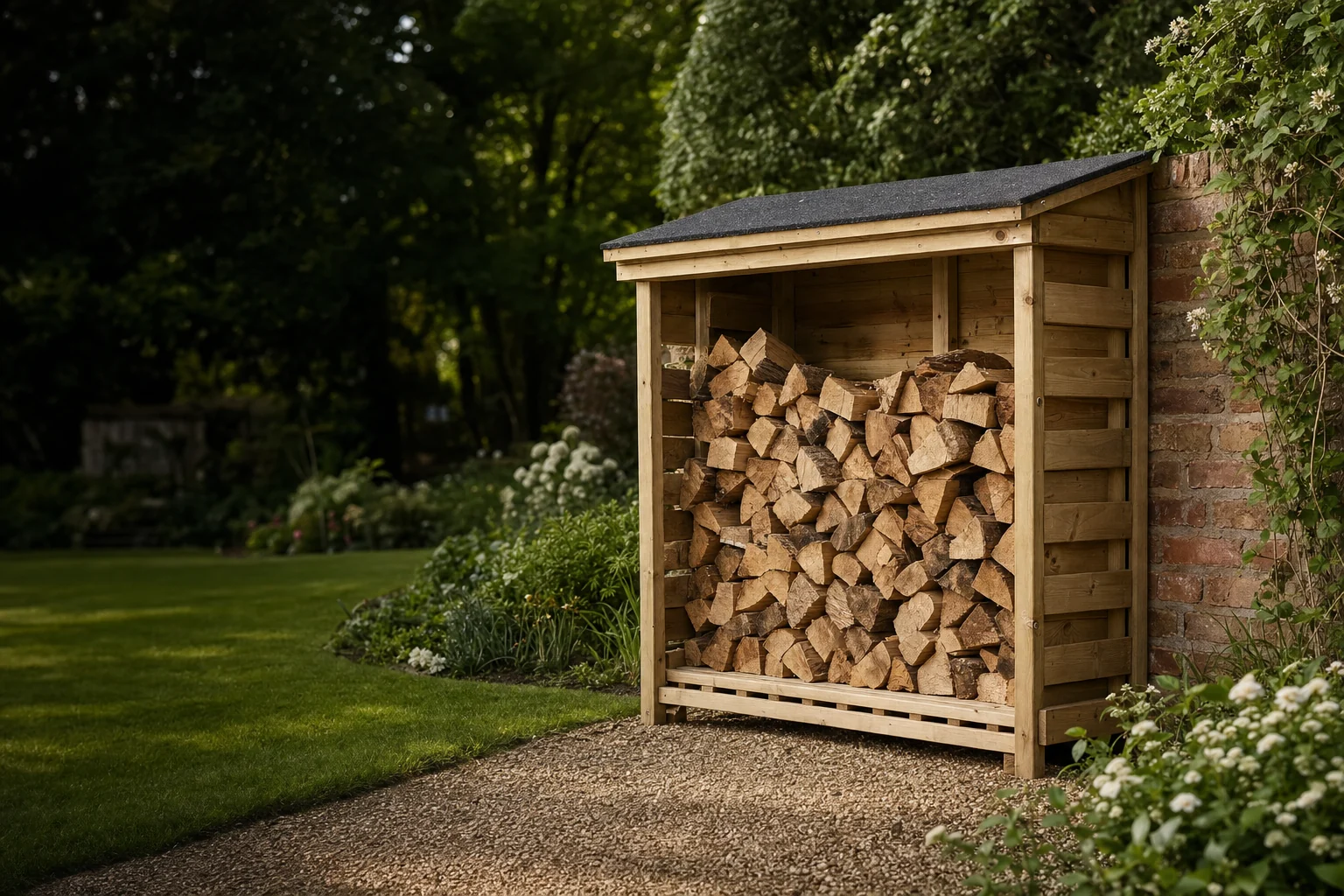
A log store is not merely a decorative wooden rack for the patio. At its best, it is a working piece of garden infrastructure. It keeps fuel raised away from ground moisture, protects the top of the stack from rain and gives the logs enough ventilation to lose moisture gradually over time. Those three jobs need to happen together. Miss one, and the store becomes less useful than it first appears.
For burning, seasoned logs should have a moisture content of around 20–25%. That is the practical figure to keep in mind when you are buying, stacking and checking wood. Seasoning may take from six months to two years, depending on the type of wood and the drying conditions. A log store cannot turn freshly cut timber into perfect fuel overnight. Nothing can. What it can do is provide the conditions in which the drying process has a fair chance of succeeding.
The important distinction
A roof keeps rain off. A properly designed store does more: it keeps logs off damp ground and allows enough airflow for moisture to leave the stack. If a design excels at only one of those things, it is storage rather than serious seasoning space.
Wet or insufficiently seasoned wood is a poor bargain, even if it was inexpensive to buy or free to collect. It is harder to light, slower to establish, and gives less satisfying heat because energy is spent driving water out of the log before the wood can burn well. It also makes every fire feel needlessly fussy. You find yourself adding kindling, poking at half-lit pieces and wondering whether the stove has developed a personal grudge.
The good news is that log-store shopping is much less mysterious once you stop treating every model as a miniature shed. The questions are simple. How much wood do you use? Are you seasoning green logs or keeping already-seasoned fuel dry? Can the store sit in a breezy position? Do you need a permanent structure, a compact rack, or a lockable metal unit?
Before choosing a size, look at your own fuel habit rather than the size of your stove. A modest store works well for a household that buys small quantities regularly; anyone seasoning a larger batch needs room for air gaps, access and rotation rather than one heroic, immovable wall of timber.
The Science of Seasoning: What a Log Store Actually Needs to Do
Firewood dries from the outside in. Once wood has been cut and split, water begins leaving the exposed surfaces and end grain. The process is gradual, and it depends on air being able to reach those surfaces repeatedly. This is why split logs dry more effectively than whole rounds, and why a stack with space around it is more helpful than a tightly packed heap in the darkest corner of the garden.
A good store balances three environmental jobs: it manages airflow, rain and contact with the ground. Think of it as a very simple drying machine with no plug, no moving parts and no capacity for sympathy if you site it badly.
Airflow around the stack
Slatted sides, open fronts or open ends allow cross-ventilation. This carries moisture away from the log surfaces and helps prevent the stagnant conditions that can encourage mould.
Rain protection from above
A sloping roof directs rainfall away from the top of the pile. A roof with a sensible overhang is particularly useful because rain rarely falls politely in a straight vertical line in a British garden.
Clearance below the logs
Keeping the bottom row off soil, turf and wet paving prevents the lower logs from sitting against persistent damp. It also lets air reach beneath the stack, which is easy to overlook and genuinely important.
Airflow is the part people most often underestimate. It can feel counterintuitive: surely enclosing wood protects it better? It protects it from direct rain, perhaps, but a fully enclosed box can hold damp air around the pile. If the wood was not dry when it went in, that moisture has nowhere particularly useful to go. The logs may stay sheltered and still remain too wet to burn well.
That is why traditional log stores often have slatted sides and an open front. The arrangement is not an aesthetic flourish. It permits cross-ventilation, particularly when the store is positioned where ordinary outdoor air can move through it. You do not need a gale blasting through the garden all winter. You simply need to avoid creating a sealed, humid cupboard for timber.
A roof is equally important, but its job is specific. It should protect the top of the pile from repeated wetting. Wood can cope with an occasional splash of rain far better than it can cope with being soaked again and again from above. Sloping roofs are useful because they shed water rather than allowing it to settle. Integrated gutters, where provided, give that runoff a clearer route away from the store.
Ground clearance is the quiet hero of the arrangement. A very ordinary-looking rack becomes much more useful when it keeps logs raised. Soil stays damp long after a bright morning. Paving can hold puddles. Grass and leaf litter retain moisture. If the bottom course of logs is sitting directly on any of those things, it is likely to stay wetter than the rest and can pass dampness into neighbouring pieces.
Aim for dry, not sealed
The ideal store is weather-deflecting rather than airtight. Cover the top, raise the stack, leave routes for air to move, and avoid wrapping every side of a log pile in impermeable material.
Stacking matters too. Place split logs with enough order that they do not collapse, but do not force every gap out of the pile. A little unevenness is not a disaster. In fact, small channels between pieces can help air reach further into the stack. Keep bark and debris from building up at the base, and resist the urge to cram in one last armful if it stops air moving through the front.
At this time of year, the practical job is not to expect newly cut logs to be ready for the first cold snap. It is to inspect what you already have. Move any wood that is sitting directly on the ground. Clear fallen leaves from beneath the stack. Make sure the roof is still doing its job. If you are buying a store now, use it first to protect dry or nearly dry logs through autumn and winter, then use the brighter, breezier months ahead to build a properly rotated seasoning routine.
At a Glance: Key Options Across the Reviewed Stores
There is no single "best" log store because the right answer changes with the amount of wood you handle, the look you want in the garden, and how permanent the installation needs to be. The useful dividing line is not simply timber versus metal. It is whether a store offers the combination of protection, airflow, raised storage and capacity that matches your household.
The Charles Bentley wooden range is the approachable, traditional route. It uses pressure-treated FSC Mixed Nordic spruce, with slatted construction, a sloping roof and a kindling shelf. The Small model is the clearest example because its dimensions and capacity are published: it holds 0.76 cubic metres and measures 152cm high, 117cm wide and 56cm deep.
Biohort's WoodStock stores take a more architectural route. They use galvanised steel with a polyamide coating, solid aluminium framing and a sloping roof with an integrated gutter. They are much taller than the low-profile metal options and are designed around logs up to 35cm long. The WoodStock 150 and 230 differ chiefly in width, which is the dimension that changes their practical capacity most noticeably.
Trimetals is a different proposition again. Its Log Store is designed for gardeners who want their stack protected behind a front-opening door, with two padlock points, ventilation gaps and a reinforced metal floor. The LogGuard follows the same useful principle of raised, ventilated metal storage, with a heavy-duty metal floor as standard.
The SPECSTAR rack is the portable alternative. It is a steel frame paired with a weather-resistant cover, and its cover uses downward air vents to reduce condensation whilst leaving the ends available for ventilation. That makes it an interesting choice for temporary use, overflow storage or renters who do not want to build a fixed structure.
Pressure-treated spruce
Kindling shelf
20-year guarantee
20-year guarantee
25-year guarantee
Vented fabric cover
| Model | Material | Useful published detail | Standout feature |
|---|---|---|---|
| Charles Bentley Small Wooden Log Store | Pressure-treated FSC Mixed Nordic spruce | 152 × 117 × 56cm; 0.76m³ capacity | Kindling shelf and slatted sides |
| Biohort WoodStock 150 | Galvanised steel with polyamide coating | 157 × 102 × 199cm | Integrated gutter and aluminium frame |
| Biohort WoodStock 230 | Galvanised steel with polyamide coating | 229 × 102 × 199cm | Wider format with integrated front rain gutters |
| Trimetals Log Store | PVC-coated galvanised panels | 1.96 × 0.89 × 1.13m externally | Lockable front-opening door |
| SPECSTAR Firewood Log Rack | Powder-coated steel and Oxford fabric cover | Approximately 183cm long | Downward air vents in the cover |
Size First: How Much Log Storage Do You Really Need?
Size is where a log-store purchase becomes either quietly brilliant or permanently annoying. Too small, and you will have a beautiful store containing the neatest third of your firewood whilst the rest lives under a tarpaulin somewhere less convenient. Too large, and it can dominate a modest garden or tempt you to pack it so tightly that the airflow you paid for becomes theoretical.
A useful benchmark is that a 5ft Cottesmore model stores 0.9 cubic metres, roughly the volume of a builders' ton bag. Extra-large stores can hold two cubic metres of logs. These figures are not instructions, but they help make capacity feel more real. If your usual purchase is around the size of a builders' bag, a store around that capacity gives you a sensible starting point. If you buy or process a larger amount, think about whether you need separate seasoning and ready-to-burn areas.
The Charles Bentley Small's 0.76 cubic metre capacity is a practical example of a compact store. It is enough to make a proper difference for households using a stove occasionally, particularly if you buy dry wood in manageable quantities. It is less suited to anyone who wants to put away a substantial annual supply in one place. That is not a criticism. It is simply the reality of volume, which remains stubbornly immune to optimistic stacking.
When planning space, remember that the dimensions on a product page describe the store, not the clear working area around it. You still need room to approach the front, lift logs without snagging them on a fence, sweep debris from underneath and inspect the roof. A store squeezed into a narrow gap may technically fit, but it can become a place you avoid using properly.
Depth matters as much as width. A shallow store is easy to access and makes it simpler to rotate stock: take older, drier wood from one side or the front, and replenish with newer material. A deeper unit can hold more, but it may encourage wood to disappear into a dark back row. If you cannot see or reach the back of the pile easily, you are less likely to manage it as a seasoning system.
Occasional stove users
A compact raised store can be enough when you buy small loads of dry logs and want a tidy supply near the house.
Home seasoners
Prioritise airflow, access and the ability to keep newer wood separate from logs that are approaching burning condition.
Security-conscious households
A lockable metal store is worth considering where seasoned logs are left in an accessible front or side garden.
Renters and flexible spaces
A freestanding rack and cover offers a useful, removable solution without committing to a substantial permanent structure.
For wood that is still seasoning, avoid working right up to the stated capacity. A store that is packed to its absolute limit may hold the most logs, but it offers less scope for ventilation and sorting. Leaving a little breathing room is not wasted space; it is part of the drying strategy.
Timber Charm on a Budget: Charles Bentley FSC Wooden Log Stores
Wooden log stores remain popular for good reason. They sit naturally beside fences, sheds and planted borders, and a well-proportioned timber store rarely feels out of place in a garden. The Charles Bentley FSC wooden range is built around that familiar format: pressure-treated FSC Mixed Nordic spruce, slatted panels for air circulation, a sloping roof for runoff and a lower shelf intended for kindling.
The small model is priced at £149.99 and measures 152cm high, 117cm wide and 56cm deep. It weighs 29kg and has a stated capacity of 0.76 cubic metres. It arrives flat-packed with English assembly instructions. Those are useful, grounded specifications for someone who wants a dedicated store without moving into the territory of a large metal structure or an outbuilding-sized installation.
The kindling shelf is the detail I particularly like in principle. Kindling has a habit of wandering. It starts in a basket by the back door, migrates to a crate in the garage, then ends up in a damp carrier bag because somebody brought in the last dry pieces and forgot to restock it. A dedicated lower shelf gives it a home, keeps it off the ground and makes it easier to keep the fire-lighting essentials together.
The slatted design also makes good practical sense. Timber stores can look enclosed because the framework is substantial, but those gaps are doing useful work. They allow wind to move across the logs and stop the structure behaving like a sealed box. Put the store in a breezy but not wildly exposed place, and it becomes a sensible environment for keeping split wood dry and for progressing the seasoning of wood that was not ready when it arrived.
What works well
- Pressure-treated FSC Mixed Nordic spruce suits the traditional garden-store look.
- Slatted sides support the airflow that firewood needs.
- A sloping roof helps direct rain away from the stack.
- The kindling shelf makes better use of a small footprint.
- The Small model's 0.76 cubic metre capacity is easy to understand and plan around.
Things to consider
- A timber store still needs careful siting and a stable base to keep the lowest logs dry.
- Its compact capacity will not replace a larger seasoning area for heavy wood users.
- Flat-pack assembly is part of the job, rather than something to postpone until the weather is unkind.
- It does not offer the lockable front arrangement found on the Trimetals Log Store.
The Single Tall and Large versions share the same useful design language: pressure-treated FSC Mixed Nordic spruce, slatted construction, sloping roof and a kindling shelf. That consistency is helpful because it means you can choose a scale that works for the space without abandoning the features that matter for drying.
There is a wider lesson here. Do not dismiss wooden stores as purely decorative, but do not expect timber alone to solve a damp-firewood problem. The store needs its base checked, its roof kept clear of leaves, and its stack managed. If rainwater runs off the roof straight into the bottom row, or if the rear of the store is pressed against a permanently wet hedge, the design is being asked to fight the garden rather than work with it.
For many gardens, though, this is the sweet spot: a store that looks at home outdoors, gives smaller fuel supplies a proper place to live, and encourages you to stack wood in a way that makes sense. There is something pleasingly civilised about reaching for dry kindling rather than opening a damp plastic box and hoping for the best.
Galvanised and Guaranteed: Biohort WoodStock 150 vs WoodStock 230
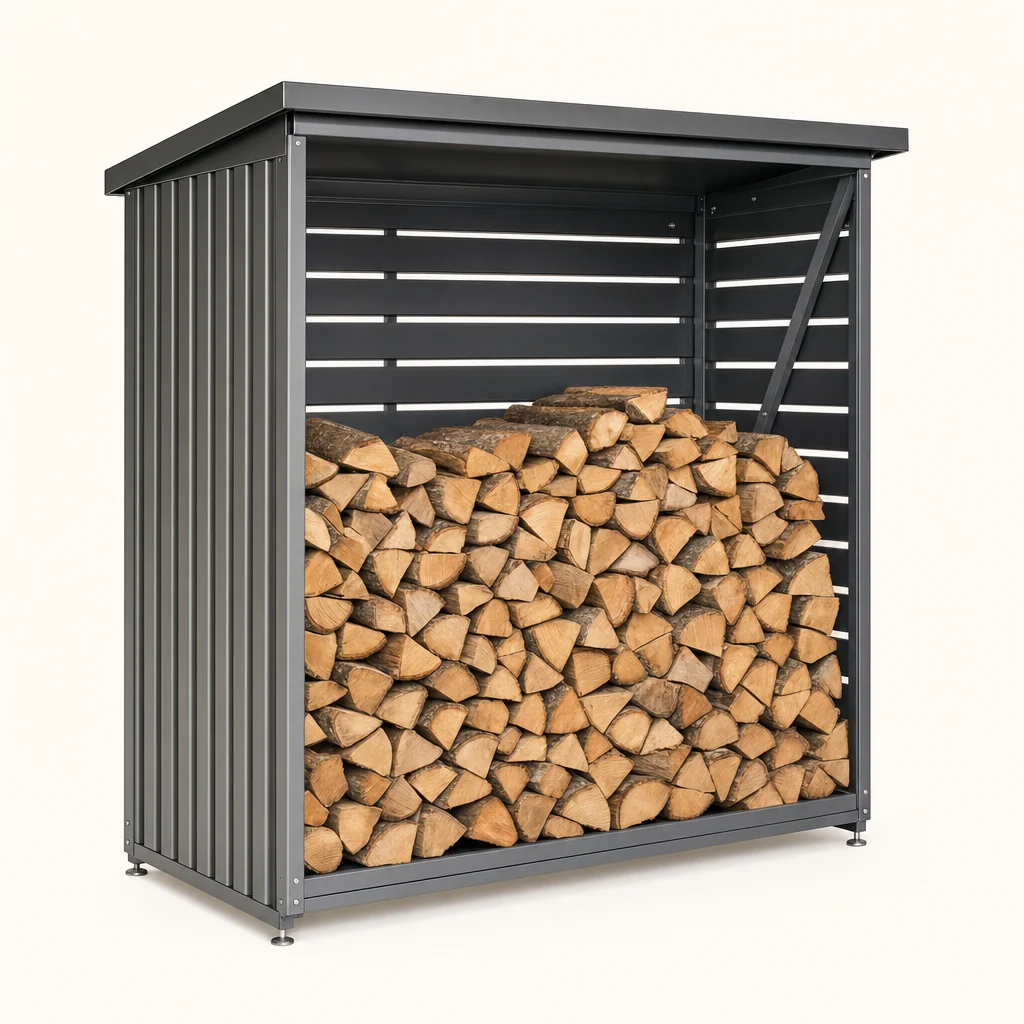
Biohort's WoodStock range occupies a more premium, engineered corner of the market. The construction is galvanised steel with a polyamide coating in metallic shades, supported by a solid aluminium frame. This is a very different visual and structural proposition from a conventional slatted wooden store. It is cleaner-lined, taller, and designed for gardeners who want a long-term outdoor fixture rather than a simple timber rack.
The WoodStock 150 measures 157cm wide, 102cm long and 199cm high. It is designed to store logs up to 35cm long and is priced at £649. The roof slopes and includes an integrated gutter, a detail that helps direct runoff rather than allowing water to drip wherever the wind fancies. Optional additions include a back wall, floor panel and door package.
The WoodStock 230 uses the same 102cm depth and 199cm height but stretches to 229cm wide. That extra 72cm of width is not a trivial adjustment. It gives significantly more stacking run and makes the 230 a more plausible choice for a household maintaining a larger reserve of logs. It is priced at £849 and has integrated front rain gutters, with optional floor, rear panel and double front doors.
Both models come with a 20-year manufacturer guarantee covering corrosion. That is one of the strongest reasons to consider a galvanised steel store if you are planning for the long haul. Timber can look wonderfully warm and traditional, but metal is appealing where you want crisp geometry, minimal routine maintenance and a structure that is not relying on exposed wooden slats to remain smart year after year.
| Feature | Biohort WoodStock 150 | Biohort WoodStock 230 |
|---|---|---|
| Width | 157cm | 229cm |
| Depth | 102cm | 102cm |
| Height | 199cm | 199cm |
| Log length | Up to 35cm | Up to 35cm |
| Roof drainage | Sloping roof with integrated gutter | Sloping roof with integral and front rain gutters |
| Guarantee | 20 years against corrosion | 20 years against corrosion |
| Price | £649 | £849 |
The question between these two is less about quality, because the core construction is shared, and more about the role the store must play. The WoodStock 150 makes sense where you want a substantial, upright store but have a narrower run available. The WoodStock 230 is better where width is available and you want more room to stack, sort and maintain a meaningful reserve.
Do think carefully about the optional rear wall, floor and doors before treating them as automatic upgrades. A rear wall may suit a very exposed position or an open garden boundary, but air movement is still valuable for drying. A floor panel can make sense where the base requires it, but the essential requirement remains that logs are kept away from persistent damp. Doors can add neatness and protection, yet they should be used with an eye on ventilation rather than turning the whole store into an enclosed cupboard.
Galvanised, coated steel construction
The metal body and aluminium frame are the key distinction from the wooden alternatives, offering a more permanent, modern-looking garden structure.
Integrated drainage detail
Gutters are a practical touch on a roofed store because they guide runoff away from the timber and the area immediately around the base.
Made for orderly storage
Both sizes accept logs up to 35cm long, helping you plan how the stack will sit rather than discovering halfway through that every piece needs turning sideways.
Fort Knox for Firewood: The Trimetals Log Store and LogGuard
A lockable firewood store will not be necessary for every garden. In a secluded back garden, a neatly stacked pile may be perfectly safe and there is no need to turn buying logs into a security briefing. But seasoned firewood represents time, effort and money. If it is stored beside a driveway, at the front of a property, or in a shared-access area, it is entirely reasonable to want it protected.
The Trimetals Log Store is the security-led option here. It uses PVC-coated galvanised panels and has a spring-assisted front-opening door with two padlock points. The padlocks are not included, so factor in suitable ones when planning the installation. That front door is a notable difference from an open wooden store or an uncovered rack: the wood is not simply visible and reachable from the path.
It measures 1.96m wide, 0.89m deep and 1.13m high externally. Internally, the width is 1.80m and the depth is 0.84m. The front internal height is 0.89m and the back is 1.09m, creating the roof slope. It weighs 52kg. Those proportions make it a low, broad unit rather than a tall upright store, which may be an advantage beneath a window, near a boundary or where you do not want a very prominent vertical structure.
Ventilation gaps are integrated into the design, which is important. The presence of a door does not have to mean the wood is sealed away from air. A reinforced metal floor keeps logs raised from the ground, again addressing one of the big causes of damp lower courses. The manufacturer describes the panels as 50% thicker with twice the paint thickness of competitors, and the store carries a 25-year corrosion-free guarantee.
The bars above are not a performance score. They simply show the relationship between the published dimensions, with the widest measurement used as the reference point. It is a useful reminder to check internal space rather than assuming every centimetre of an outer shell becomes usable stacking room.
Why it stands out
- Two padlock points add a degree of security not offered by open racks.
- The spring-assisted front-opening door makes access more controlled than lifting a loose cover.
- Integrated ventilation gaps avoid the sealed-box problem.
- The reinforced metal floor raises the logs from damp ground.
- The 25-year corrosion-free guarantee is a strong long-term assurance.
Where it may not suit
- Its low profile is not ideal if you specifically want a tall, narrow storage format.
- You will need to supply padlocks separately if security is part of your plan.
- The enclosed front means ventilation gaps need to remain unobstructed.
- At 52kg, it is not a casual move-it-around-the-garden rack.
The Trimetals LogGuard takes a similarly practical approach. It is a secure weatherproof metal store with integrated ventilation panels and a heavy-duty metal floor as standard. That floor matters because it keeps the stack raised, preventing ground damp from becoming the bottom layer's permanent companion.
Neither security nor weatherproofing should mean abandoning good stocking habits. Do not overfill a metal store until the ventilation panels are blocked. Keep the floor swept. Store the driest logs where they are easiest to reach, and use the space behind or beside them for wood that has longer to season. A lockable store is very good at protecting fuel; it is not a replacement for rotation.
Rack, Stack and Cover: The SPECSTAR Firewood Rack
Not everyone needs, wants or is allowed to install a permanent log store. Renters may need a solution that can move with them. Small gardens may need seasonal flexibility. Some households simply want a trial run before committing to a larger wooden or metal structure. This is where a covered rack earns its place.
The SPECSTAR 6ft Firewood Log Rack with Cover is built around a steel frame with 1.2mm thickened steel tubes and a double powder-coated finish. Its cover is 600D Oxford fabric with a PU waterproof layer and UV-resistant coating. The rack measures approximately 183cm long, 35cm deep and 122cm high, and it uses downward air vents in the cover.
The important thing about this style is that the cover is intended to shelter the top and sides while leaving the ends open. That open-ended arrangement is deliberate. It allows air to reach the logs whilst the cover sheds rain from above. It is a much better approach than wrapping a stack tightly in a sheet and hoping that trapped moisture will somehow become less damp through optimism alone.
A good role for a covered rack
Use a rack like this for already-seasoned logs near the back door, a temporary overflow stack, or a portable reserve whilst you decide whether a permanent store suits your garden. It is especially useful when the priority is tidy, raised storage rather than creating a large long-term seasoning bay.
Portability is the attraction, but it comes with a responsibility: choose the site carefully. A lightweight-looking rack full of logs is not actually light, and the ground beneath it needs to be reasonably level and firm. Avoid putting it where the cover will constantly rub against a rough wall or hedge. Leave room at the ends for airflow, and do not use a position that funnels every gust of rain sideways into the pile.
The downward vents are useful because condensation can become an issue beneath fabric covers. Moist air needs an escape route. Even so, check under the cover periodically, especially after prolonged wet weather. If you notice moisture gathering inside, make sure the cover is sitting properly and that the rack ends have not been blocked with bags, bins or an ambitious pile of garden furniture.
A fabric-covered rack is not a substitute for sensible siting. It works best on a raised, free-draining surface with open ends and some exposure to moving air. If the rack is tucked into a permanently shaded, soggy corner, the cover can only do so much.
The rack is also useful as a second stage in a broader setup. You might season logs in an open-sided store farther down the garden, then transfer the driest wood to the covered rack beside the house for convenient winter use. That small bit of organisation is surprisingly pleasant on a dark evening. It means you are not trekking across wet grass in slippers because the nearest logs are also the least dry ones. We have all made choices. Some of them involve slippers.
Siting and Stacking: The Decisions That Matter More Than the Brand
You can buy a very well-designed log store and still undermine it with one unfortunate choice of position. The best site is usually somewhere with reasonable airflow, a firm base, access from the house and enough shelter that the stack is not battered by every sideways downpour. This is a balancing act rather than a hunt for the one mythical perfect corner.
Start with the ground. A hard, level surface is helpful, but the essential requirement is that the logs are raised and that water does not sit around the base for long periods. Avoid the lowest point of the garden, anywhere beside a dripping roof edge, or a patch where winter puddles linger. If a spot is unpleasant to stand in after rain, it is unlikely to be ideal for storing firewood.
Next, think about wind. A little moving air is good. A permanently dead corner behind a dense evergreen hedge is not. Positioning a store with its open or slatted side facing the direction from which gentle, regular air movement arrives can help. Do not place it so exposed that rain drives through the whole stack, but do not imprison it against solid boundaries on every side either.
Then consider access. This is not glamorous, but it is decisive. You need to be able to carry logs to the store when restocking and from the store when the weather is awful. A distant spot can work beautifully for seasoning, especially in a larger garden, but it is sensible to maintain a smaller ready-to-burn supply nearer the door. The two-stage arrangement is often easier than trying to make one location serve every purpose.
- Put older, drier logs where they are easiest to reach. That encourages sensible rotation instead of repeatedly taking the newest logs because they are nearest.
- Keep the lowest layer clear of soil and leaf litter. Even a raised floor benefits from an occasional sweep beneath it.
- Stack securely without compressing every gap. Stable logs are essential; a completely airless wall is not.
- Protect the top first. A sloping roof or fitted cover is most useful when it prevents repeated soaking from above.
- Inspect after prolonged rain. Check the roof, gutters, cover and lower rows, not merely the dry-looking outer face.
Come next spring, when longer days and breezier weather return, it is a good time to reorganise. Pull out any logs that have clearly remained damp, clear away debris, and create separate zones for wood at different stages. Freshly split wood should not be mixed indiscriminately with the driest fuel if you can avoid it. Keeping a rough first-in, first-out system is kinder to your future self.
Frequently Asked Questions About Log Stores
It should have enough structure to keep the stack stable and protected, but sides should not prevent airflow. Slatted sides, ventilation gaps and open ends are useful because they let moisture leave the timber rather than trapping humid air around it.
No. A cover protects against rain, but seasoning also needs air movement and ground clearance. A cover that seals every side of a stack can make drying slower by trapping moisture beneath it.
Seasoned logs should have a moisture content of around 20–25%. Reaching that level can take from six months to two years, depending on the wood and the drying conditions.
Choose timber if you prefer a traditional garden look and want open, slatted ventilation. Choose galvanised metal if you value a more permanent, low-maintenance structure, or want features such as a metal floor, integrated drainage or locking points. The siting and stacking approach matters with either material.
It can be very convenient to keep a smaller supply nearby, provided the area is dry, accessible and allows the store's ventilation to remain open. Avoid placing it directly beneath a roofline that regularly pours water onto the store or its base.
The GardenScout Verdict
The best log store is not necessarily the largest, most expensive or most heavily enclosed. It is the one that suits the volume of wood you actually use and gives that wood the three things it needs: rain protection above, air movement around it and separation from damp ground below.
For a compact, traditional solution, the Charles Bentley wooden range offers the essentials in a familiar slatted format, with the Small model providing 0.76 cubic metres of capacity. Biohort's WoodStock 150 and 230 make sense when you want a taller, more permanent galvanised steel structure with integrated drainage and a long corrosion guarantee. The Trimetals Log Store is the standout where secure, raised storage matters, whilst the SPECSTAR rack is a sensible flexible option for temporary, secondary or renter-friendly storage.
Whatever you choose, give it a good site, stack with airflow in mind, and treat the store as part of the seasoning process rather than a place to hide logs until the temperature drops. Your stove, your evening and your patience will all be better for it.