
Choosing a Soil pH and Moisture Meter
And Trusting the Reading
Cheap probes can be genuinely handy garden tools. They can also be spectacularly confident nonsense. Here is how to tell the difference before you start liming perfectly good soil.
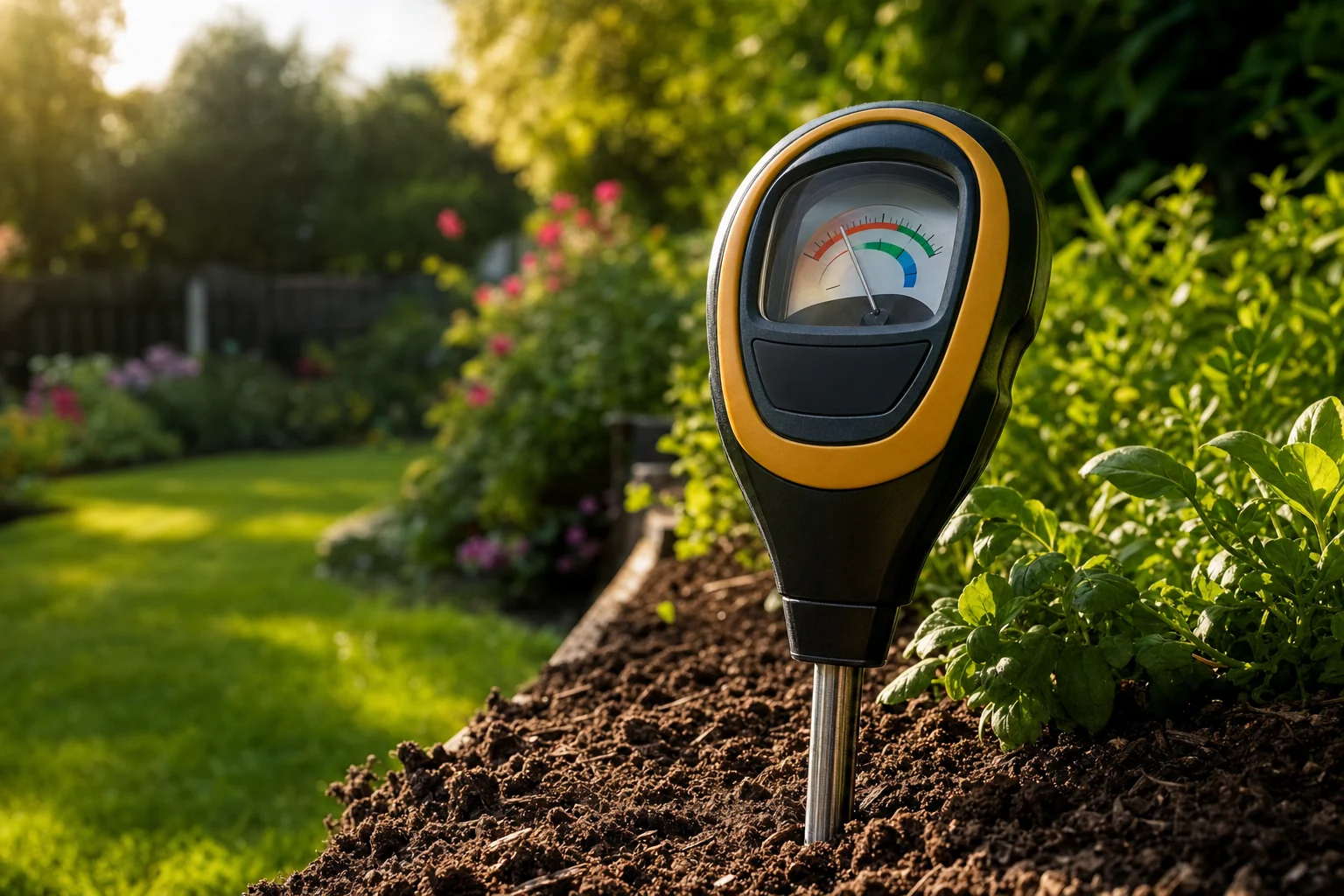
Why Your Soil Meter Might Be Lying to You (And What to Do About It)
There is a particular kind of gardening frustration reserved for the little soil probe. You push it into one corner of a pot and it declares the compost slightly acidic. Move it three inches, without changing anything else, and now your treasured camellia is apparently living in a hostile alkaline wasteland. Pull it out, wipe it off, try again, and the needle seems to have developed a personal grudge.
That experience is common because the familiar low-cost probe is trying to do a surprisingly difficult job with a very simple bit of hardware. Soil is not a neat, uniform substance. It is a busy mixture of mineral particles, decomposing organic matter, water, air pockets, fertiliser residues, roots, worms and salts. A reading can alter with depth, recent watering, where the feed was applied, and whether you happened to hit a damp lump of compost. The meter is not necessarily broken. It is simply being asked a question it cannot answer very precisely.
That does not make cheap meters useless. Far from it. A basic moisture probe can save an overwatered houseplant, stop you soaking a bed that is already damp beneath its dusty surface, and reveal the dry patch beneath a rain-shadow. A rough pH indication can also be helpful when you are trying to establish whether an area is clearly problematic rather than merely a little off ideal.
The trouble starts when a broad indication is treated as a laboratory result. If the needle says 6.5, it is tempting to believe you have learned that your soil is exactly pH 6.5. You have not. With a passive, battery-free combination meter, you may only have learned that this particular patch of damp soil produces an electrical response that the dial associates with the middle of its scale. That is a very different thing.
The sensible rule
Use a cheap probe to identify patterns, not to make irreversible decisions. If it repeatedly suggests a dramatic problem, confirm that finding with a chemical kit or a proper calibrated pH tester before adding lime, sulphur or a large dose of fertiliser.
In this guide, I am not going to sneer at the modest soil meter. It has earned a place in plenty of sheds and potting benches. But it pays to understand what it is measuring, why moisture matters so much, and when the honest answer is to put the probe down and test a soil sample properly.
The Science Behind the Probe: What Cheap Meters Actually Detect
The battery-free pH section of a cheap three-in-one meter works rather like a tiny, crude galvanic cell. Inside the probe are dissimilar metals. When those metals are inserted into moist soil, the soil solution allows electrochemical reactions to take place between them. That creates a small voltage, and the meter translates that voltage into a position on its pH scale.
It is clever in the way a mechanical rain gauge is clever: no batteries, no menus, no charging cable to lose in a drawer. Stick it in, wait a moment and you have a result. But the simplicity is also the weakness. The resulting electrical signal does not belong exclusively to hydrogen ions.
And pH, strictly speaking, is about hydrogen ions. It is a measure of how acidic or alkaline a solution is, determined by hydrogen ion concentration. A proper pH measurement system is designed to respond specifically to that chemistry. A cheap galvanic probe is responding to general electrochemical activity in the soil. Hydrogen ions play a part, certainly, but so do dissolved mineral salts, nutrients, fertiliser residues, organic compounds and all manner of other ions present in the sample.
Water completes the circuit
Dry soil is a poor conductor. Without enough moisture around the probe, the meter cannot produce a stable, meaningful response. This is why dry compost routinely causes strange pH readings.
Fertiliser can look like a pH change
Dissolved feed and salts alter conductivity and electrochemical activity. A probe may react strongly even where the actual hydrogen ion concentration has not changed in the way the dial implies.
Soil is layered, not blended
The top few centimetres of a bed can behave differently from the root zone below. A single push of a probe is a snapshot of one tiny point, not a census of the whole border.
True pH testing needs selectivity
Colour-changing indicators and calibrated pH electrodes are intended to identify pH itself. They still require careful use, but they are not relying on the same broad galvanic signal.
The practical consequence is a sizeable precision problem. This type of galvanic signal is not specific enough to confidently separate fine differences in pH. Differences smaller than around one to two pH units are not a safe basis for action. That matters because the pH scale is logarithmic, not a gentle ruler from "a bit acidic" to "a bit alkaline". A shift of one unit represents a tenfold change in hydrogen ion activity.
So a meter that seems to distinguish between 6.2 and 6.4 is lending the situation a level of precision it has not earned. Equally, a meter that tells you one area is somewhere around 5.5 and another is somewhere around 7.0 may be giving you an interesting clue, but not a verdict. The tiny increments printed on a dial can be much more precise than the method behind them. Garden equipment does enjoy a reassuringly specific number.
One reading is never the reading. For any meaningful comparison, test several spots at the same depth, in similarly moist soil, and look for a repeated pattern. If the readings bounce wildly, the uncertainty is useful information in itself.
There is another important distinction. The moisture and light functions found on many multi-function meters are not necessarily using the same principle as the pH function. That is why a low-cost all-in-one device can be quite useful in two of its jobs and distinctly woolly in the third. You do not need to throw it away; you simply need to put each function in the right mental drawer.
Meet the Budget Contenders: What the Popular Cheap Meters Offer
The classic budget soil meter is a long, slender probe with an analogue display near the handle. It asks for no battery and makes no great fuss. The SONKIR MS02 is one of the best-known examples of the format, combining moisture, pH and light measurement in a compact three-in-one tool. It is precisely the sort of thing gardeners buy because it promises an immediate answer to the questions that crop up every weekend: should I water this, is this compost too acidic, and is this corner actually as sunny as I think it is?
Its stated pH range is 3.5 to 8. The moisture display uses a scale from 1 to 10, whilst the light measurement is marked from 0 to 2,000 lux. The probe is 7.9 inches long, and the complete unit measures 11.5 by 2.0 by 1.5 inches. At 56g, it is light enough to move from pot to pot without becoming another bit of cumbersome kit to drag out. Most importantly for the casual user, it requires no batteries.
There is a wonderfully revealing real-world example of the MS02's pH limitation. In dry potting soil, it produced a reading of 7.5. Once the same material had been wetted, the reading moved to 6.5. That is a whole pH unit of difference created by moisture condition alone. It does not mean wetting compost magically made it a full unit more acidic. It means the electrical environment around the probe changed, which is exactly what these passive meters are sensitive to.
That result should not be read as a special failing of one model. It is the central limitation of the whole category. Any meter relying on a broad soil-conductivity-style signal needs water to work at all, and the amount and composition of that water affect what it sees. Testing dry soil is therefore not merely slightly less ideal; it is likely to be unreliable.
The AiGerdinn 2-in-1 takes a slightly different approach. It combines moisture and pH readings in a dual-dial arrangement, so both are visible at once. There is no battery requirement and no function switch to flick between settings. That is a genuinely sensible ergonomic improvement over the common single-dial layout, where you change mode and wait for the needle to settle again. For someone wandering around containers with one hand holding a watering can, fewer little operations are welcome.
AiGerdinn also offers a four-in-one version with an oversized 1.95-inch dial. It adds light and a "fertility" reading to pH and moisture. Raintrip makes a comparable inexpensive four-in-one unit, likewise combining pH, moisture, light and a broadly labelled nutrient or fertility function. The word "fertility" deserves a raised eyebrow. Soil fertility is not one measurable substance. It is a wide, complicated idea involving nutrient availability, organic matter, structure, biology and more besides. A single needle cannot hand you a complete nutritional diagnosis.
| Feature | SONKIR MS02 | AiGerdinn 2-in-1 | AiGerdinn 4-in-1 | Raintrip 4-in-1 |
|---|---|---|---|---|
| Primary readings | pH, moisture, light | pH and moisture | pH, moisture, fertility and sunlight | pH, moisture, light and fertility |
| Display approach | Analogue display with selectable function | Two dials shown together | Oversized 1.95-inch dial | Analogue display |
| Battery requirement | No batteries required | No batteries required | Not required for operation | No batteries required |
| Useful strength | Includes a defined light scale | Reads pH and moisture simultaneously | Large display and broad overview | Fast in-ground indication |
| Important caution | pH varies greatly with soil moisture | pH remains a broad indication | "Fertility" is not a full nutrient analysis | pH markings are not finely graduated |
On the Raintrip, a comparison test produced a pH indication around 6.5 to 6.6 against a lab result of 6.42. That is encouraging, and it shows why people can have good experiences with these meters. But one close result is not proof that every reading will be that close in every soil. The display also lacks gridlines between its labelled pH values, making any attempt at fine interpretation rather optimistic. It is best regarded as "around the mid-sixes", which is useful enough for a preliminary look.
Where Cheap Meters Earn Their Keep (And Where They Fall Apart)
Let us give the humble probe its due. The moisture setting is often the reason to own one. It is not measuring pH by proxy; it is responding to the electrical resistance or conductance between sensing parts of the probe. Wetter soil generally conducts more readily than dry soil. That is a much more direct relationship, and it is exactly the question most of us need answered before reaching for the hose.
Do not become obsessed with whether a pot scores 4 rather than 5. The useful thing is the direction and repeatability. If a particular container usually reads around 6 after watering and is down near 2 when the plant begins to droop, you have learned something valuable about that plant, that compost and that pot. You have established a personal watering reference point. That is far better than watering to a calendar because Tuesday feels like watering day.
Cheap probes are also good at exposing unevenness. A large pot can look evenly moist on top whilst its centre is dry. A border can look wet after rain but be parched under the canopy of a thirsty shrub. Take readings at several spots and depths, and you can map the variation. The absolute scale may not be laboratory-perfect. It does not need to be. You are looking for the dry patch that needs attention, not preparing a thesis.
The pH function has a narrower, but still legitimate, role. It can flag a gross issue. If several carefully taken readings in a bed consistently sit around the acidic end of the scale, or persistently crowd the alkaline end, that is worth investigating. The meter has done its job as a screening tool. It has told you, "This might not be a small difference." Then you confirm it before changing the soil.
Light measurement can be unexpectedly useful too. On a three-in-one meter, the light sensor is mechanically separate from the soil probe. It is assessing ambient light rather than trying to infer chemistry from a muddy electrical signal. The MS02's 0–2,000 lux scale is helpful for comparing one location against another, especially in gardens where "full sun" turns out to mean forty minutes of sunshine at half past ten.
Where a cheap meter helps
- Checking whether soil below the surface is dry before watering.
- Comparing damp and dry areas of the same bed or greenhouse bench.
- Spotting a possible extreme acidity or alkalinity problem.
- Comparing light levels around the garden before choosing where to plant.
- Giving beginners a reason to observe the root zone rather than just the surface.
Where it misleads
- Choosing amendments based on a single pH reading.
- Trying to distinguish small differences such as pH 6.2 versus 6.7.
- Testing bone-dry compost and expecting a reliable result.
- Diagnosing a nutrient deficiency from a generic "fertility" scale.
- Forcing a long probe through compacted ground or woody roots.
There are a few habits that make even a cheap meter more useful. First, insert it gently. If the soil is hard, make a pilot hole with a dibber or slim stick rather than bending the probe or scraping off its coating. Second, use it in actual soil or compost, not pebbles, pure bark, or an airy growing medium with little contact around the metal. Third, wipe the probe after every use. Dried-on compost and fertiliser are not neutral passengers.
Most importantly, give the result context. Look at the plant. Feel the compost. Think about when it last rained, when you last fed, and whether the pot is rootbound. A probe is an extra sense, not a replacement for the ones on your hands and face. There is no shame in putting a finger into compost. It remains one of gardening's most reliable technologies.
A useful first-pass routine
For moisture, take three readings: near the edge, midway in, and close to the plant's root zone. For pH, sample several places only when the soil is evenly moist, then treat the average trend—not the most dramatic individual needle position—as your starting point.
Moving Up: What Digital Meters Change — And What They Do Not
A digital display feels like a major step forward, and in one respect it is. It removes the awkward business of deciding where a wavering analogue needle sits between markings. The Expert Gardener 3-in-1 Digital uses a digital readout, whilst moisture-only digital meters such as the KEYAHAPPY Soil Moisture Meter focus on the job many gardeners actually perform most often.
A clear number is easier to read than a needle. It is not automatically a truer number. That is the vital distinction. The display may be electronic, but accuracy depends on the sensor technology, the calibration, the soil conditions and how the reading is interpreted. Digital meters can apply a controlled electrical input across probe points and measure the response. Compared with a passive galvanic arrangement, a controlled signal can reduce some noise and make the measurement process more repeatable.
That is particularly relevant for moisture. A powered device can make consistent comparisons of resistance or impedance, and a digital display makes it easy to log readings over time. If you are trying to learn how quickly a large indoor plant dries between waterings, or you are managing many containers with the same compost mix, this can be genuinely convenient.
For pH, however, do not let the decimal point hypnotise you. A display capable of showing 6.4 is not necessarily measuring soil pH to one decimal place. It may simply be presenting a calculated value with one decimal place. Unless the meter uses a proper pH electrode system and is calibrated with buffer solutions, the number should still be treated as an indication rather than a precise result.
The meter that really belongs in a different league is a calibrated pH pen such as the Apera Instruments GroStar GS2 Soil pH Pen Tester. This is not merely a cheap probe with an LCD. It is designed for pH work in soil, coco coir, rockwool and nutrient solutions, and its stated accuracy is ±0.1 pH. It uses a replaceable spear-tip probe and supports straightforward two-point calibration.
The practical details matter here. The GS2 includes pH 7 and pH 4 calibration solutions, potassium chloride soaking solution, a cleaning brush and a dibber for making a hole before inserting the probe. Its impact-resistant spear glass tip is described as ten times stronger than a conventional version, whilst a PTFE ring is intended to reduce clogging from soil particles. It is waterproof to IP67, runs on AAA batteries and has an automatic shut-off function. The pen carries a two-year warranty, with a one-year warranty for the probe.
That sounds rather more involved because it is. Calibration solutions must be used. The electrode needs to be cared for and stored correctly. You do not buy this sort of instrument, leave it muddy in the greenhouse all winter, and expect science to happen in spring. But if you regularly grow plants that care deeply about root-zone pH, manage hydroponics or coco, or want measurements that can sensibly guide amendments, the maintenance is part of owning a proper tool.
| Question | Battery-free analogue probe | Basic digital meter | Calibrated pH pen |
|---|---|---|---|
| Best everyday job | Quick moisture checks and rough comparisons | Easy-to-read repeat moisture monitoring | Meaningful pH measurement where precision matters |
| pH approach | Broad electrochemical response in moist soil | Electronic reading, dependent on sensor design | Dedicated pH electrode with calibration |
| Setup | Insert and read | Insert, operate and read | Calibrate, maintain electrode, then measure |
| Ongoing care | Keep probe clean and dry after use | Keep sensor clean and maintain power | Clean, soak and calibrate as instructed |
| Trust level for soil amendments | Screening only | Confirm by another method | Suitable when correctly maintained |
The lesson is not that everyone needs a professional pen. Most home gardeners do not. It is that "digital" is a display description, not a promise of laboratory-grade chemistry. Buy the level of tool that matches the consequence of being wrong.
The Chemical Test Kit Alternative: Slower, Messier, More Honest
If you want a more trustworthy answer about pH without owning and maintaining an electrode, the modest chemical test kit is often the sweet spot. It is slower than stabbing a probe into a pot, yes. It involves a little soil preparation and a small amount of faff, also yes. But the chemistry is asking a much more specific question.
In a typical colour-based pH test, you take a small soil sample, mix it with distilled water and add an indicator chemical. That chemical changes colour according to hydrogen ion concentration. You then compare the developed colour with a printed chart. It is not magic, and your eyes are still involved, but the indicator reaction is responding to pH itself rather than the general electrical liveliness of whatever is around the probe.
That makes it far less vulnerable to a simple change in soil wetness. It also avoids the classic problem of inserting a probe into a patch that has recently received a concentrated dose of feed. You are testing a prepared sample, not the instant electrical mood of one damp centimetre of compost.
Sample broadly, not narrowly
Take small portions from several places in the area you are assessing, remove obvious stones and debris, and mix them. A blended sample is usually more representative than one heroic scoop from beside a plant.
Use distilled water
Tap water can itself contain dissolved minerals and vary in pH. Distilled water helps ensure the result is about the soil sample rather than the water coming from the kitchen tap.
Read colour carefully
Good natural light helps. Colour matching remains subjective, particularly if neighbouring chart shades are close or you have difficulty distinguishing certain colours.
Repeat if the result matters
A second test is cheap insurance. If two prepared samples disagree, pause before changing anything in the bed.
Paper-strip kits are the simplest form, using a colour chart for comparison. Capsule-style soil kits can test pH and, in some cases, nutrients. The Luster Leaf Rapitest Soil Test Kit, for example, tests pH alongside nitrogen, phosphorus and potash. The Expert Gardener 20-piece paper pH test kit uses a straightforward colour-chart approach.
There are limits. Colour kits tend to work in broad increments, often around 0.5 to 1.0 pH units, and interpreting a colour chart is inherently subjective. A result can still have an error margin of roughly ±1 pH unit. That means a kit is not the same as a carefully calibrated meter or a laboratory analysis. But it is honest about being a broad categorisation tool. It does not pretend that a tiny needle movement has revealed the soil's secrets.
For ordinary garden decisions, broad can be enough. Knowing that a bed is clearly acidic, near neutral, or distinctly alkaline is usually more useful than chasing tenths. The important thing is that the method is suited to the decision you plan to make.
I particularly like chemical kits for checking a new garden, a neglected allotment plot, a bed that repeatedly grows poorly, or soil intended for plants with firm preferences. They are also a good reality check if a cheap probe has started delivering melodramatic results. If the probe says one thing and a properly prepared colour test says another, I would trust the chemistry before I trusted the needle.
Head-to-Head: Probe Meter vs Chemical Kit vs Proper pH Pen
Choosing between these options is less about finding one winner than knowing what you need to know. A moisture probe answers a live, in-the-moment gardening question. Is this pot dry down where the roots are? A chemical kit answers a broader soil question. Is this bed generally acidic, neutral-ish or alkaline? A calibrated pH pen is for the gardener who needs repeatable pH information and is prepared to look after the instrument that provides it.
There is no point buying a highly capable pH pen if you will not calibrate it. Equally, there is no point expecting a simple analogue probe to make a careful amendment plan for a whole vegetable plot. Different tools, different jobs. Gardening is full of this. You would not use secateurs to dig a hole, though someone somewhere has certainly tried.
| Key dimension | Cheap probe meter | Chemical pH kit | Calibrated pH pen |
|---|---|---|---|
| Time to result | Usually seconds once inserted | Several minutes including sample preparation | Quick measurement after preparation and calibration |
| pH measurement basis | General electrochemical response | Hydrogen-ion-sensitive colour indicator | Dedicated pH electrode |
| Moisture reading | Yes; often its most useful function | No | Not its primary purpose |
| Soil disruption | Very little, but probe must enter the root zone | Requires a small collected sample | Requires a prepared access hole or sample |
| Ease for beginners | Very easy to start using | Easy once the steps are followed | More demanding because it needs maintenance |
| Best use of result | Watering and spotting broad variation | Confirming general pH category | Managing pH where accuracy has consequences |
The best all-round approach for many gardeners is not either-or. Keep a simple moisture meter for routine checks. Use a chemical kit when you are investigating soil pH. If your gardening becomes more specialist—hydroponics, intensive container growing, or repeated work with acid-loving plants—then a calibrated pen becomes easier to justify.
And there is one more option worth remembering: if you have a genuinely serious soil problem, a professional analysis may be the sensible route. Persistent crop failures, an unknown site history, major reclamation work, or a planned programme of substantial amendments all justify information that is more complete than pH alone. Soil texture, organic matter and nutrient status can matter just as much as acidity.
How to Test Soil Without Fooling Yourself
Technique matters more than most meter packaging admits. A decent instrument can give a poor result if you use it carelessly, and a modest instrument can become much more useful if you apply some consistency. The goal is not to turn Saturday morning into a laboratory exercise. It is simply to remove the most obvious ways of producing nonsense.
For moisture readings
- Choose a depth that reflects where the active roots are, rather than only the dry-looking surface.
- Insert the probe gently. If the soil is compacted, make a narrow pilot hole first.
- Wait for the display to settle rather than reading it mid-wobble.
- Test more than one point, particularly in larger pots, raised beds and beneath dense foliage.
- Compare readings taken in the same pot or bed over time. Your own pattern matters more than chasing a universal number.
- Wipe the probe clean afterwards. Do not store it buried in compost or standing in water.
For cheap-probe pH readings
- Do not test bone-dry soil. The probe needs moist soil to function at all.
- Try to compare areas when they have similar moisture conditions.
- Avoid freshly fertilised patches if possible; dissolved salts can influence the response.
- Take several readings across the area and look for a broad trend.
- Do not adjust the soil based on a small difference. Treat a result as a prompt to investigate.
- Confirm any reading that would lead you to add lime, sulphur or significant fertiliser.
For chemical kits and pH pens
With a kit, the big improvement comes from sampling properly. Do not collect all your soil from the very edge of a border, directly beside a fertiliser granule, or from the one wet depression where water always sits. Take a few small samples from the area, mix them, and follow the instructions exactly. If you are testing pots, sample the root-zone compost without damaging a plant unnecessarily.
With a pH pen, the instructions are not optional decoration. Calibrate at the stated points using the supplied buffer solutions, keep the electrode clean, and use the recommended soaking solution. A neglected pH electrode can be as misleading as a cheap probe, only with a more expensive display and a far more convincing decimal place.
The houseplant keeper
Choose a simple moisture-focused meter. It is fast, low-fuss and useful for learning how your pots dry between waterings.
The vegetable grower
Use a probe for moisture patterns, then keep a chemical kit for pH checks before making changes to a productive bed.
The specialist grower
Consider a calibrated pH pen if you grow in coco, rockwool or nutrient solution, or need controlled root-zone conditions.
Frequently Asked Questions About Soil Meters
Trust it as a broad clue, especially if several readings point in the same direction. Do not trust small differences or use one reading as the basis for a major soil amendment. Cheap galvanic probes are affected by moisture, salts and general ion content, not pH alone.
Because water helps complete the electrical circuit around the probe. It also dissolves and mobilises salts and minerals. In one documented example, dry potting soil read 7.5 and the wetted version read 6.5 on the same type of budget meter.
Usually, yes. Moisture sensing is more directly related to conductivity or resistance in the soil. It is still best used comparatively, but it can provide very practical watering guidance when you learn the pattern in your own pots and beds.
Do not force it. A long slim probe is easy to bend or damage. Make a narrow hole with a dibber first if the soil is compacted, then insert the probe gently so it has good contact with the surrounding soil.
When the pH result affects regular, important decisions: managing nutrient solutions, growing in coco or rockwool, or maintaining a tightly controlled root zone. It is worth it only if you will calibrate and care for the electrode properly.
The GardenScout Verdict
Buy the tool for the question
A cheap soil pH and moisture meter is worth having if you understand its limitations. Use it for what it does well: checking moisture at root depth, comparing damp and dry patches, mapping light, and noticing whether a pH problem may be large enough to investigate.
Do not treat its pH needle as a court judgement. A passive probe measures a broad electrical response shaped by water, salts, minerals and organic matter. It cannot reliably resolve fine pH differences, and dry soil can make its reading thoroughly unconvincing.
For ordinary garden pH checks, a chemical kit is often the more honest next step. For serious or specialist growing, a calibrated pH pen such as the Apera GroStar GS2 offers a far more purposeful route to accuracy, provided you accept the maintenance that comes with it.
The short version? Trust a cheap meter to help you observe. Trust a proper test to help you alter the soil. Your plants—and your back, after carrying bags of unnecessary lime—will be grateful.