
Choosing an Electric or Cordless Tiller for Beds and Allotments
When a cultivator earns its keep, when a fork is still the better tool, and how to match the machine to the soil beneath your boots.
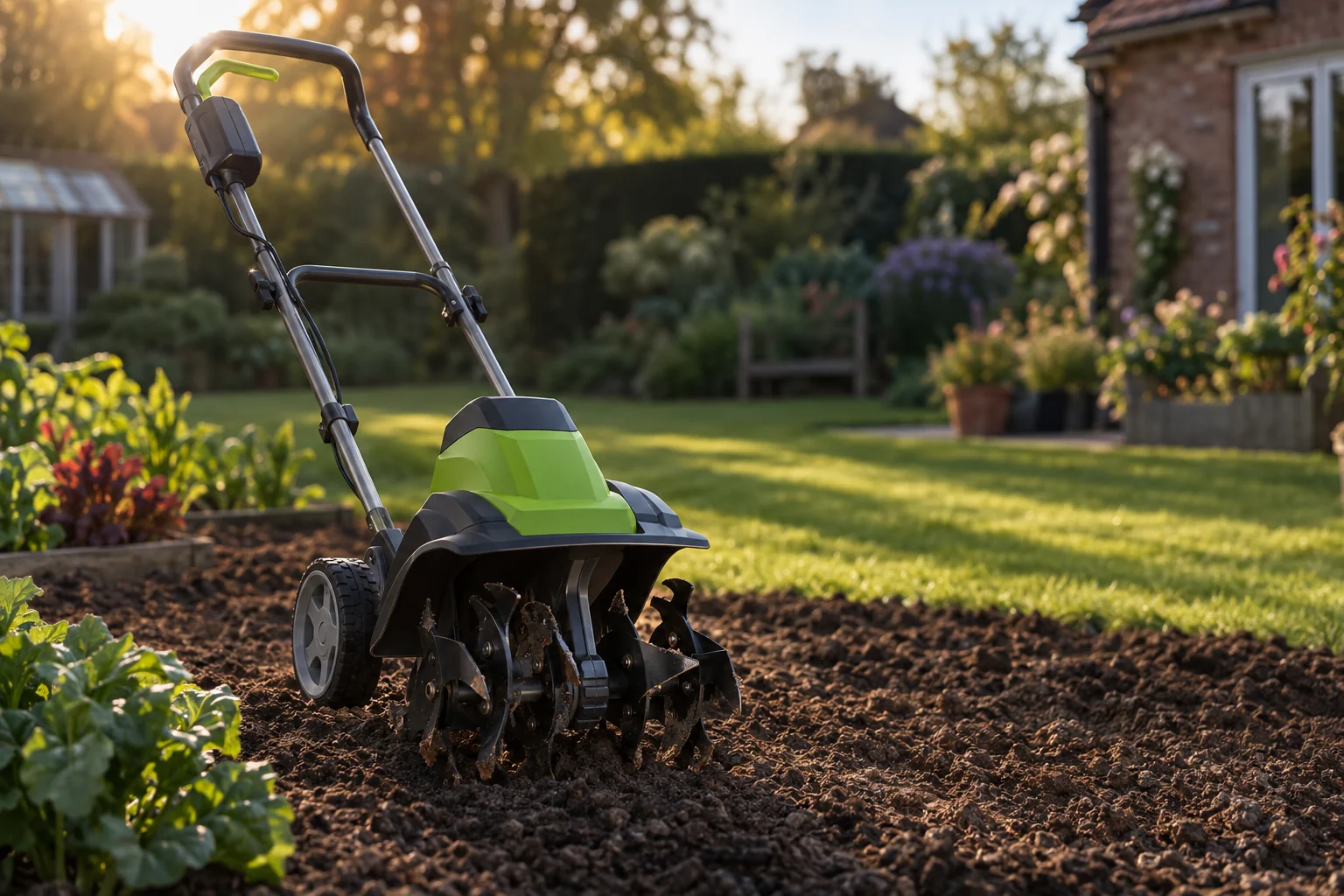
Do You Really Need a Tiller? When a Machine Beats a Fork
It is late October, the tomatoes are finally out, the bean stems are looking increasingly like soggy string, and the allotment has reached that honest, slightly muddy point in the year. You can see exactly what needs doing. The trouble is that your back can see it too.
This is where the fork-versus-machine question starts. A good digging fork remains one of the most useful tools in any British garden. It lets you feel stones, perennial roots and buried bits of former shed. It can lift rather than smear heavy ground, and it does not require charging, servicing or a weatherproof extension lead. A fork is wonderfully simple. It is also, after an afternoon on compacted clay, quite capable of making you walk like an elderly cowboy.
A small tiller or cultivator becomes worthwhile when cultivation is frequent rather than occasional. If you are managing more than roughly 20–30 square metres of vegetable beds, turning over a network of raised beds, or repeatedly incorporating compost between crops, a machine can take the repetitive strain out of the job. It is especially helpful for gardeners with sore wrists, knees, shoulders or hips. There is no medal for finishing a plot in pain.
The important distinction is this: a compact cultivator is usually best at working already workable ground. Its rotating tines break up surface compaction, stir in compost or well-rotted manure, chop through light annual weeds and produce a finer tilth for sowing. It is very good at refreshing a bed that has been cultivated before. That is a different task from opening a neglected lawn, removing bramble roots or breaking untouched, concrete-hard clay. For those jobs, the fork still gets first go.
The sensible rule
Buy a tiller to reduce repeated work, not to replace every digging tool you own. A cultivator is at its happiest in established beds after weeds, woody roots and large stones have been dealt with.
For beds and allotments, corded electric and cordless machines are usually the most proportionate choices. They are lighter and less intimidating than petrol machinery, have no fuel to store, and make far more sense for the modest strips and paths of a typical plot. Petrol still has a role on larger or newly reclaimed ground, but it brings noise, weight and maintenance with it. In a row of closely packed allotments on a quiet Sunday morning, that is not always a popular combination.
Understanding the Tiller Market: Corded, Cordless and Petrol Explained
Tillers are often sold under two names: tiller and cultivator. In practice, the labels can be a little optimistic. Compact electric and battery machines are commonly front-tine cultivators: the tines sit at the front, spin into the soil and the gardener guides the tool from behind. They are designed to loosen and mix ground rather than plough a field. For the average productive garden, that is generally exactly what is wanted.
Corded electric
A mains-powered cultivator runs for as long as it is plugged in. It suits gardens where beds are close to a safe outdoor socket and the cable route is straightforward.
Cordless battery
A battery model is free of trailing cable and particularly handy on an allotment, where power is often absent or nowhere near the beds that need attention.
Front-tine design
The familiar layout on compact electric and cordless machines. The tines work in front of you, so control depends on steady walking and letting the machine bite gradually.
Petrol cultivator
Petrol offers range without batteries or cable, but usually at the cost of more weight, more noise and the routine of fuel, oil and engine care.
Corded electric is the uncomplicated choice for a small home garden. Put simply, it has no battery timetable to manage. If you have several compact beds within easy reach of the house, a cable can be a minor inconvenience rather than a major nuisance. The catch is obvious: a tiller is a tool that moves around unpredictably, and a cable is a thing that has a remarkable tendency to be exactly where you do not want it. You need to work methodically, keep the cable behind you, and never use one in wet conditions where electrical safety is compromised.
Cordless is the format that makes the most sense on many allotments. Pick it up, walk to the bed, work the section, move on. There is no lead looped around the brassica cage and no hunt for a socket that may not exist. The trade-off is runtime. A battery cultivator asks you to think in sessions: what needs doing today, how much ground is genuinely ready, and do you have a spare battery charged? This is not a hardship once you get into the rhythm, although it does reward a little planning.
Voltage is useful shorthand, but it is not a magic measure of digging ability. A lighter single-battery tool can be perfectly effective in light, maintained soil. A 36V arrangement using two 18V batteries, such as the Einhell GE-CR 30 Li, is aimed at more sustained work. A 40V platform, such as Greenworks', combines a larger battery system with the convenience of using the same battery across other garden tools. The whole package matters: the tines, transmission, machine weight, soil condition and the way you use it.
Petrol is for the gardener who truly needs the extra reach and endurance. It is not inherently better simply because it is louder. Larger rear-tine and counter-rotating machines are more suited to serious ground-breaking, where the tines need to bite into compacted earth rather than merely stir the top layer. Yet for an established allotment bed, a petrol machine can be cumbersome and excessive. It can also turn a pleasant half-hour of soil preparation into a small mechanical event.
Electric and cordless strengths
- Less physical effort than repeated forking and raking.
- Useful for mixing compost into established beds.
- Compact formats are easier to store than large petrol machines.
- No petrol handling for the battery and mains-powered options.
Their real limitations
- They cannot make wet clay suitable for cultivation.
- They can bounce or skip on hard, dry, compacted ground.
- Deep perennial roots and large stones still need manual removal.
- Cordless work is governed by battery capacity and charging routine.
Key Specifications at a Glance: What the Numbers Actually Mean
Specification lists can make any garden tool look heroic. The useful trick is translating each number into a gardening job. The Greenworks 40V cordless tiller/cultivator provides a helpful example because its figures describe the sort of compact machine many allotment gardeners are considering: portable, adjustable and intended for cultivation rather than battlefield archaeology.
(8.25–10in)
(5in)
per minute
(1,000 sq ft)
(29.3lb)
Working width tells you how many passes are required. A 21–25cm width is narrow enough to steer between crops and around raised-bed corners, whilst broad enough to make a clear difference over a fork. It will not turn a large plot in a handful of passes, but it is less likely to send soil flying into the neighbouring path or clobber your precious garlic.
Depth matters even more. A maximum of 12.7cm is useful for incorporating organic matter, loosening the root zone of an existing bed and making a seedbed. It is not a deep first-digging tool. When you are reclaiming a patch, dealing with buried turf, or trying to improve heavy ground, a fork or spade remains necessary to open the lower layers without creating a compacted smear beneath the worked surface.
Tines deserve more attention than they usually get. Steel tines are what actually meet the soil, roots and occasional unfortunate brick. Four tines are a common compact-cultivator arrangement. Their shape, speed and ability to keep turning under resistance affect the result as much as the voltage printed on the battery. A machine that skips on baked soil is not necessarily faulty; it may simply be telling you that the soil needs preparation before a machine can work it.
Weight is a mixed blessing. A lighter tool is easier to lift out of the shed, carry down an allotment track and manoeuvre at the end of a bed. A little mass, however, helps tines bite rather than skate. Around 13.3kg is manageable for many people, but do not assume it will feel like 13.3kg when it is hopping over dry clay. The handle position and your own balance matter as much as the bare figure.
Read depth figures with a gardener's eye
A stated maximum depth describes the tool's capability in cooperative soil, not a guarantee in every bed. Soil moisture, compaction, stones and turf roots all affect how deeply the tines can work in one pass.
The comparison between the Greenworks and the EarthWise TC70040 illustrates why these details matter. The EarthWise is listed with a 27.9cm (11in) working width and an 20.3cm (8in) depth, against Greenworks' 25cm (10in) width and 12.7cm (5in) depth. The width difference is modest. The depth difference is more consequential. On paper, an additional 7.6cm of depth can change the kind of cultivation a machine is suited to. It still does not cancel out the need to assess the soil in front of you, but it is a meaningful distinction.
Head-to-Head: Cordless, Corded and Petrol for Real UK Allotments
There is no universal winner because an allotment is not one uniform strip of soil. It may have a fluffy raised bed beside a hard, old path edge, a recently manured potato patch and a corner that has not been properly cultivated since somebody owned a Nokia with buttons. Think about the job you do most often, rather than the most dramatic job you might face once every five years.
| Feature | Greenworks 40V cordless | Einhell GE-CR 30 Li | Corded electric type | Small petrol cultivator type |
|---|---|---|---|---|
| Power source | 40V lithium-ion battery | 36V from two 18V batteries | Mains electricity | Petrol engine |
| Working width | 21–25cm (8.25–10in), adjustable | 30cm | Varies by model | Varies by model |
| Working depth | Up to 12.7cm (5in) | Up to 20cm | Varies by model | Varies by model |
| Machine weight | About 13.3kg (29.3lb) | 8.2kg | Varies by model | Usually the heaviest option |
| Working session | Battery-dependent; up to 40 minutes is quoted | Battery-dependent; up to 21 minutes with two 2.5Ah batteries, or up to 60 minutes with two 6.0Ah batteries | Continuous whilst safely connected to mains | Fuel-dependent |
| Between sessions | About 2 hours to recharge | Swap or recharge batteries | Move cable and continue | Refuel and maintain engine |
| Best fit | Established beds, smaller plots and gardeners invested in the 40V platform | Medium areas needing a wider, deeper cordless option | Home gardens close to a socket | Larger, tougher or more remote cultivation jobs |
The Greenworks is the neat, practical choice for gardeners who want cable-free cultivation but do not need to go deeply into the soil. Its adjustable width of approximately 21cm and 25.4cm (8.25in and 10in) is useful where beds have narrow access or established crops remain in place. The rear wheels also make moving it around simpler than dragging a machine by the handles like a stubborn suitcase.
The Einhell GE-CR 30 Li is the more substantial cordless proposition on the figures. It offers a 30cm working width, up to 20cm of depth and four cultivating blades, but weighs only 8.2kg. Its gear-driven transmission and adjustable depth gauge are worth noting for anyone who wants a battery-powered machine that can take on more than a quick surface scratch. It also folds for storage, which is the sort of mundane feature that becomes deeply attractive when the shed is already full of pots you are definitely going to wash one day.
A corded machine is often the best value in a domestic garden, provided the cable genuinely suits the layout. It never pauses because the battery has run down just as you reach the final bed. On an allotment, though, that cable can become a complete non-starter. A long lead across communal paths is inconvenient and potentially unsafe, whilst generators bring their own noise and faff. This is why cordless tools have changed the conversation for plot holders.
Petrol should be a deliberate choice, not an automatic upgrade. If the plot is large, distant from power and repeatedly demands hard work, it can be justified. If your real task is aerating a few established vegetable beds every spring and mixing compost in autumn, it is likely to be more machine than you need.
For an allotment, portability is not a luxury specification. Consider the walk from car park to plot, the width of gates and paths, and whether you can comfortably lift the machine into storage after a damp afternoon.
Soil Types and Tiller Performance: Matching the Machine to Your Plot
This is the bit that matters most. Manufacturers can describe widths, batteries and blade counts until the labels peel off, but the soil decides whether the machine feels helpful or hopeless. Before choosing a tiller, take a handful of your soil when it is neither sodden nor bone dry. Does it crumble? Does it smear? Are there flints everywhere? Does it contain more roots than earth? The answers are more valuable than an impressive-looking box.
Sandy and light soils
Light, free-draining soil is where compact cordless cultivators feel most convincing. The tines can penetrate readily, compost is easy to mix through and a modest machine is unlikely to be overwhelmed. An 18V or 20V tool may be entirely adequate for a small number of maintained beds. The danger here is overdoing it. Repeatedly pulverising sandy ground can leave it too loose and prone to drying. Cultivate only as much as the next crop requires, then add compost and mulch to support moisture retention.
Loam
Loam is the cooperative friend of the vegetable garden: crumbly, fertile and forgiving when treated properly. Most electric and cordless tillers work well in it, especially when you are preparing a bed after clearing a crop or folding in compost. A couple of measured passes may be enough. Do not keep going simply because the machine is enjoyable. It is rather satisfying, admittedly, but soil does not need to resemble cake crumbs to grow good carrots.
Clay
Heavy clay is the soil that exposes a cultivator's limits. Work it wet and the tines can smear and compress it, damaging the very structure you are trying to improve. Work it after a long dry spell and compacted clay can be hard enough that a compact cultivator bounces across the surface rather than bites. That is not a contest you need to win with more throttle.
On clay, wait for a workable moment: moist enough to crumble, not wet enough to form a sticky ribbon in your hand. Clear the bed, loosen the surface with a fork if necessary, then use a tiller for the finishing work and incorporation of organic matter. Over time, compost, leaf mould and careful timing make a greater difference than repeatedly attacking the soil with machinery.
Chalky and stony ground
Stones and flints are hard on tines. Steel tines are a sensible starting point, but no compact cultivator enjoys a collision with a buried lump of chalk or an old paving fragment. Walk the bed first and remove obvious stones. If the tines repeatedly snag, stop and investigate rather than forcing the machine. This is also ground where a fork gives useful information; it tells you whether you are dealing with a few stones or a former builder's yard.
Peaty and silty soils
Soft soils are easy to cultivate, sometimes too easy. A powerful or enthusiastic machine can rapidly reduce their surface to fine dust, particularly when dry. Use a shallow, steady pass and judge the result before returning for another. In beds that have been mulched well, a broad fork or ordinary fork may be all that is needed to relieve compaction without disturbing the soil profile.
The Greenworks has been noted for bouncing on hard ground. That is a useful real-world observation, not a trivial complaint. Tines need a starting bite. When a dry clay surface has set hard, they can skip and chatter rather than digging in. If rain is not expected, watering the bed around 24 hours before cultivation can soften the surface crust. Alternatively, break the top layer with a fork first. It takes a few minutes and can transform the machine from irritating to useful.
Battery Life, Range and Runtime: The Honest Truth About Cordless Performance
Battery figures need reading with the same calm suspicion you would apply to a packet claiming that one biscuit is a serving. They are useful, but the conditions matter.
For the Greenworks 40V cultivator, a 2Ah battery is quoted at up to 37 minutes no-load, whilst a 4Ah battery is quoted at up to 74 minutes no-load. "No-load" is the key phrase. It means the machine is running without being asked to cut and turn actual soil. Tilling soil asks far more of the motor and battery, especially if the bed is dry, rooty, stony or compacted. In practical use, expect meaningful resistance to reduce the time available. Plan on a shorter session than the headline suggests, particularly on a first pass.
Another quoted figure for the Greenworks is up to 40 minutes of running time and up to 93 square metres (1,000 square feet) of cultivation. Treat coverage in the same way: it will depend on how deeply you work, how many passes are required, how often you stop to clear debris and whether the soil is actually ready. A neatly maintained raised-bed system is a very different prospect from a weedy, compacted plot in late winter.
A useful way to plan is by bed, not by theoretical acreage. Ten beds measuring around 1.2m by 2.4m each add up to roughly 29 square metres of cultivated area. In reasonably open, established soil, that is the sort of manageable task for a cordless session, particularly if you are only cultivating the top layer before planting. A full five-rod allotment is around 125 square metres, and not all of it needs tilling at once. Even so, if you intend to cultivate large areas in one day, a second battery or a realistic charging break makes life much easier.
The Einhell's figures show how battery capacity changes the rhythm. Two 2.5Ah batteries are quoted for up to 21 minutes; two 6.0Ah batteries are quoted for up to 60 minutes. A pair of 4Ah batteries is associated with around 30 minutes. Those numbers are not just for comparison-shopping. They help you decide whether you are buying a quick-bed tool or a machine intended to work through a larger planting session.
A spare battery is really a time-management tool
One battery encourages sensible, focused sessions. A second battery lets you work a longer day without waiting. Neither makes difficult soil easier, so spend as much thought on bed preparation as on battery capacity.
Battery-platform compatibility is also worth considering. Greenworks' 40V battery works across more than 75 tools in its range. Einhell's Power X-Change system uses compatible 18V batteries across its own tool family. If you already own tools in one of those systems, matching the cultivator to your existing batteries can be genuinely practical. If you do not, think ahead. A battery ecosystem is most appealing when you will use it for more than one occasional garden job.
Come next spring, charge batteries the day before a planned cultivation session rather than on the morning itself. Clear the bed first, remove netting and irrigation lines, and have compost ready beside the work area. Then the battery is spent doing useful work, not idling whilst you hunt for a rake or untangle a length of fleece that appears to have developed independent political ambitions.
Using a Tiller Well: Technique, Timing and Care
A cultivator works best when you resist the urge to force it. Start at one edge of the bed, hold the handles securely and allow the tines to begin breaking the surface. Move slowly. If the machine is leaping forward, pulling too hard or skidding across the top, ease back and take a shallower pass. The objective is an even cultivation, not an impressive display of soil projection.
For an established vegetable bed, autumn is often a useful moment to clear old crops and lightly cultivate only where you are incorporating compost or preparing a vacant area. In late October, avoid leaving freshly tilled soil naked if heavy winter rain is likely. A layer of compost, leaf mould, cardboard beneath organic mulch, or a green manure crop can protect the surface and feed the soil life that does much of the real work for free.
Come next spring, cultivate only when the bed is dry enough to crumble. This is particularly important with clay. If a squeezed handful forms a shiny, sticky lump, leave it. There will be another day. Running tines through wet soil may look productive for ten minutes and create a structure problem that lasts far longer.
A practical working sequence
- Remove crop residues, thick weeds, twine, netting and any obvious stones.
- Fork out perennial roots such as couch grass or bindweed rather than chopping and spreading them.
- Add compost where it is needed, then make a shallow first pass.
- Check the texture and moisture before making a second pass.
- Rake only enough to create the finish required for the crop you are about to sow or plant.
After use, disconnect the power source before cleaning. Brush off soil and plant debris, inspect the tines for wrapped roots or string, and store the machine somewhere dry. Foldable handles, as on the Einhell GE-CR 30 Li, are particularly useful in a crowded shed or garage. Batteries should be kept dry and protected from temperature extremes. This is unglamorous advice, but it is also how a tool remains helpful rather than becoming an expensive shelf ornament.
Never use a cultivator to deal with established perennial weeds by simply chopping them up. Roots of couch grass and bindweed can be spread through the bed. Lift and remove them first, then cultivate the cleaner soil.
Pricing and Value: What You Get at Each Budget Level
Price only tells part of the story with cordless tools because batteries and chargers can change the equation sharply. A tool-only purchase can make excellent sense for gardeners who already own compatible batteries. For everyone else, it is important to check whether the package includes the power source required to use it. It is a small detail with a large effect on the first afternoon you hoped to spend cultivating.
The Greenworks 40V cordless tiller is listed in the UK at £199 tool-only, with other UK listings at £169.99 tool-only and £199.99 tool-only. The Einhell GE-CR 30 Li has been listed from £134.99, with listings around £139.99 to £171, and at £219.95 with two 4Ah lithium-ion batteries and charger. These are useful guideposts rather than a reason to buy the cheapest listing at all costs. The right value depends on whether you already have batteries, how often you will use the machine and whether its depth and width suit your actual beds.
Einhell GE-CR 30 Li
36V cordless model using two 18V Power X-Change batteries.
Greenworks 40V
Tool-only UK listing; adjustable working width of approximately 21cm and 25.4cm (8.25in and 10in).
Einhell kit option
Listed with two 4Ah lithium-ion batteries and charger.
For a small home garden with only a couple of beds, corded electric can still be the most straightforward route if your outdoor power arrangement is safe and convenient. There is little point paying for cordless flexibility if the tool will never leave a compact patio garden. Conversely, a plot holder who has to carry tools along a path or through gates may find cord-free working worth far more than a modest headline saving.
The temptation with an allotment is to buy for the biggest possible job: the abandoned corner, the overgrown half-bed, the patch that looks as if it has been harbouring a minor geological event. Buy instead for the work you will repeat. If that means preparing beds between crops, mixing compost and freshening a seedbed, a compact cordless cultivator can be a very satisfying purchase. If it means reclaiming untouched land, budget first for hand tools, time and organic matter. Machinery can help later.
Small-bed gardener
A corded tool can work well where beds are close to a safe mains supply and cable management is simple.
Established allotment holder
A cordless cultivator suits routine work across maintained beds, especially where there is no convenient electricity supply.
Heavy-clay plot owner
Choose a cultivator as a finishing tool, but keep a robust fork central to your soil-improvement plan.
Frequently Asked Questions
It can help once turf, woody roots, large stones and surface compaction have been dealt with, but a compact cordless cultivator is not the ideal first tool for untouched ground. Start with a fork, remove the obstructions and use the machine for subsequent cultivation.
No. Wait until clay is moist and crumbly rather than sticky. Cultivating wet clay can smear the soil and harm its structure. If it is dry and hard, loosen the crust with a fork or water the area roughly 24 hours beforehand.
It is useful for refreshing established beds, mixing compost and creating a seedbed. It is not a substitute for deeper preparation where soil is compacted, newly reclaimed or poorly structured.
Not necessarily. For a few established beds, one charged battery may suit a focused session. A second battery is useful if you cultivate regularly over a larger area or want to complete several beds without a charging pause.
Only with care. Keep well away from crop roots, irrigation lines and supports. A narrow working width can help in open paths between rows, but hand weeding and a hoe are usually safer close to plants.
GardenScout verdict
For most maintained beds and ordinary allotment jobs, an electric or cordless cultivator is a sensible labour-saving tool rather than a miracle cure. Corded models suit nearby home beds; cordless machines make much more sense where sockets are absent and you need to move freely between plots.
The Greenworks 40V is a compact option for shallow cultivation in established ground, with adjustable width and a useful wider battery platform. The Einhell GE-CR 30 Li offers a broader, deeper cordless alternative, with a 30cm working width and up to 20cm of working depth. Neither removes the need for a fork on hard clay, stony soil or new ground. That is not a failure. It is simply good gardening judgement: use the machine where it excels, and let the fork handle the difficult conversations.