
Chainsaws for Home Gardens: Cordless, Electric or Petrol?
Choose the bar length, power source and safety kit that make sense for pruning, firewood and the occasional serious garden job — without buying more saw than you can comfortably manage.
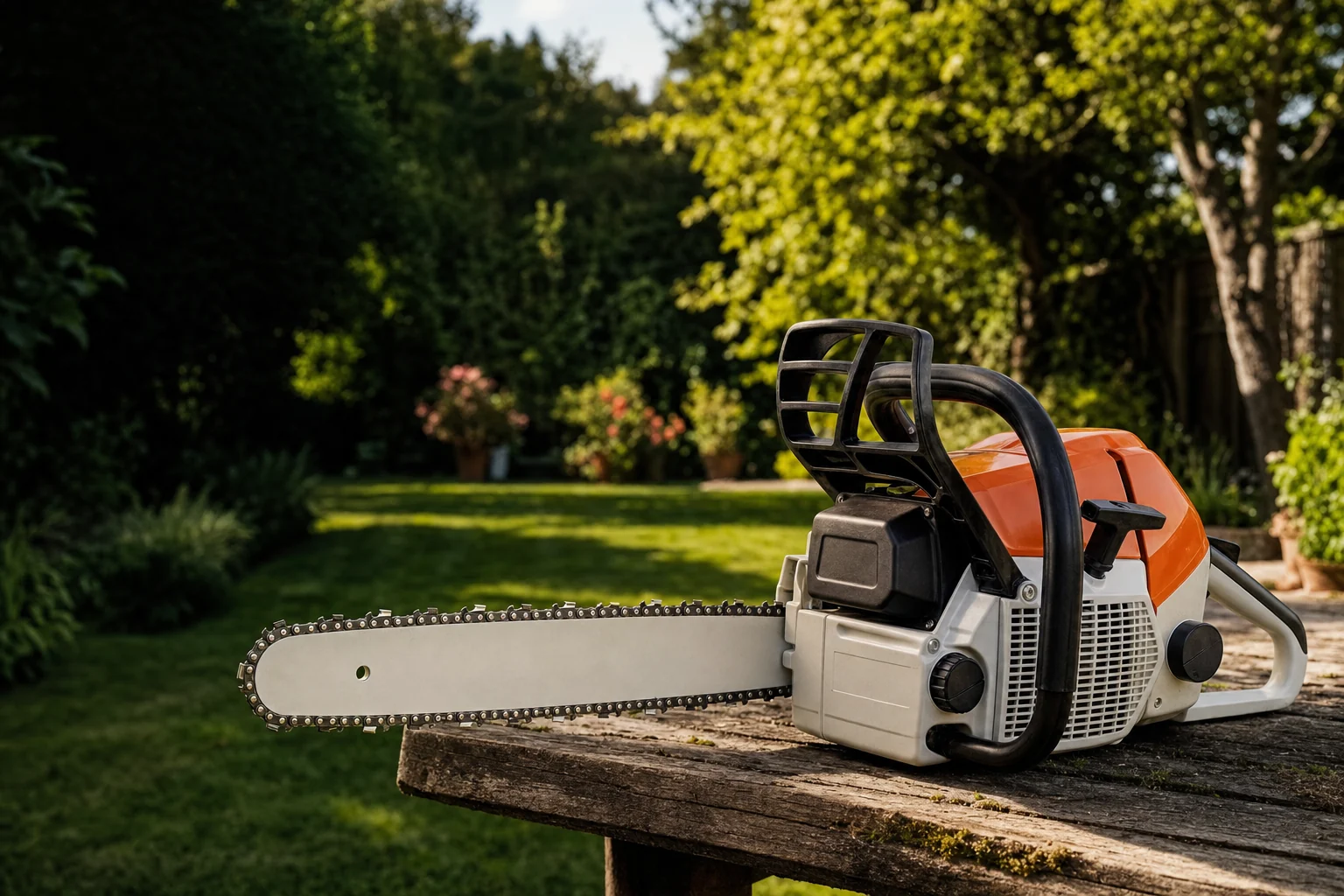
Chainsaw or overkill? Matching the right tool to your garden jobs
Most home gardeners do not need a chainsaw very often. That is precisely why it is easy to buy the wrong one. A huge petrol saw can feel reassuring in a shop, all engine casing and purposeful teeth. Then it lives in a shed for eleven months, needs attention when you finally want it, and is wildly cumbersome for taking a dead branch off an apple tree. At the other end of the scale, a small cordless saw can be a joy for quick pruning but a fairly dispiriting companion when faced with a stack of seasoned oak rounds.
The useful starting point is not brand, battery platform or the colour of the casing. It is the wood in front of you. Be honest about the jobs you actually do, rather than the heroic woodland-management future you may have imagined whilst looking at the compost heap.
In a typical UK home garden, chainsaw work usually falls into three camps. The first is light pruning: removing storm-damaged limbs, reducing material already on the ground, and cutting branches of roughly 10cm diameter or less into manageable pieces. This is where a compact cordless saw is often at its most persuasive. It is quiet by chainsaw standards, starts without ceremony and is far less tiresome to lift repeatedly.
The second is small-tree and log work: dealing with felled stems, limbing a tree once it is safely down, or cutting logs up to around 25cm across. This is the territory where a proper 36–40V cordless model, or a corded electric saw used close to the house, makes a very credible case. You need enough chain speed to cut cleanly, enough bar to avoid awkward manoeuvres, and sufficient runtime to finish a sensible session without turning battery swaps into the main event.
The third is serious firewood processing. If you regularly work with larger trunks, particularly dense hardwood, or have logs up to 50cm across, the conversation changes. A high-output 56V cordless saw can now handle work that would once have automatically meant petrol. But petrol still has a place where cutting is sustained, timber is substantial and there is no socket or battery stockpile within reach.
Start with the thickest regular job
Choose for the largest timber you process routinely, not the occasional exceptional trunk. One oversized log every few years is usually a job for a professional, a log merchant's splitter, or a borrowed specialist tool — not necessarily a reason to own the heaviest chainsaw in the catalogue.
Bar length matters because it influences what can be cut comfortably, but it is not a badge of bravery. A longer bar is heavier, more awkward in close branches and easier to catch where you did not intend. A smaller bar with a sharp chain and suitable power is generally the nicer garden tool. It is the difference between a well-balanced pair of secateurs and trying to prune lavender with a hedge trimmer. Both technically cut. Only one leaves you feeling pleased with yourself.
Power source matters just as much. Cordless offers the easiest everyday ownership. Corded electric gives long, uninterrupted sessions in a fixed spot. Petrol provides independence and endurance for demanding work. None is universally "best"; the useful question is which compromise you are happiest to live with.
Power types at a glance: what the numbers actually mean
Chainsaw specifications can look rather more scientific than the choice really is. Voltage, watts, cubic capacity, chain speed and bar length all matter, but they describe different things. If you understand the basic language, it becomes much harder to be dazzled by a large number in bold type.
Cordless: voltage is the rough guide, not the whole story
For battery chainsaws, voltage is a useful first indication of the work a platform is designed to tackle. The light 18–20V tier is aimed at pruning and branches under roughly 10cm. These machines are handy, often compact, and particularly attractive if you already own batteries for a drill, hedge trimmer or mower in the same system. Their great strength is immediacy. Pick it up, check the oil, make the cut, put it away. No cable to route. No fuel to mix. No performance of persuading an engine that today is, in fact, a working day.
Move to 36–40V and you are in the versatile middle ground for branches, general limbing and smaller logs up to about 25cm. This is a very sensible category for many gardens with wood burners, mature shrubs, fruit trees or occasional storm clearance. Some tools achieve 36V by running two 18V batteries together. That may sound slightly like a design committee has been involved, but it is practical for anyone already invested in that battery system.
At 56V and above, cordless chainsaws become genuinely serious cutting tools. They are capable of handling larger logs, with some models equipped for timber approaching 50cm in width. The trade-off is familiar: the saw itself is heavier, the battery is another substantial item to manage, and buying into a high-capacity system makes most sense when you have enough work to justify it.
Corded electric: watts and working radius
Corded saws are commonly rated by motor power in watts. Home machines are typically in the 1,800–2,400W range. What matters in practice is that the motor has a constant mains supply. There is no battery charge to watch and no fuel tank to refill. If you process logs beside the garage, on a driveway, or at a log store within roughly 20–30 metres of an outdoor socket, that is not a minor convenience. It can be the deciding advantage.
The cable is both the answer and the nuisance. You need to keep it behind you, well away from the chain, and you need to work within its reach. A corded saw is excellent in a defined safe workspace; it is much less charming at the far end of a long, overgrown garden. Extension leads and brambles have an unhappy relationship. One tends to win, and it is never the extension lead.
Petrol: cubic capacity is about sustained muscle
Petrol saws are usually described by engine displacement in cubic centimetres, or cc. For a homeowner, 35–50cc covers a very large share of serious firewood and felling work. Smaller models below 35cc are entry-level tools and may struggle when dense hardwood gets beyond 20cm. That does not make them bad machines; it simply means their natural habitat is lighter work.
A bigger engine can keep working hard for longer, far from mains power, and without the pauses needed for charging. It also brings fuel handling, exhaust, vibration, engine maintenance and more noise. Petrol is still an excellent answer in the right place. It is simply not automatically the answer for every branch in every back garden.
One important distinction: bar length does not grant permission to tackle a tree. Felling involves hazards that cannot be solved by buying a longer bar. If the tree is large, close to buildings, tangled with other trees, damaged, or near any utility line, bring in a qualified tree professional.
Cordless chainsaws: the 56V case study — EGO Power+ CS2005 in detail
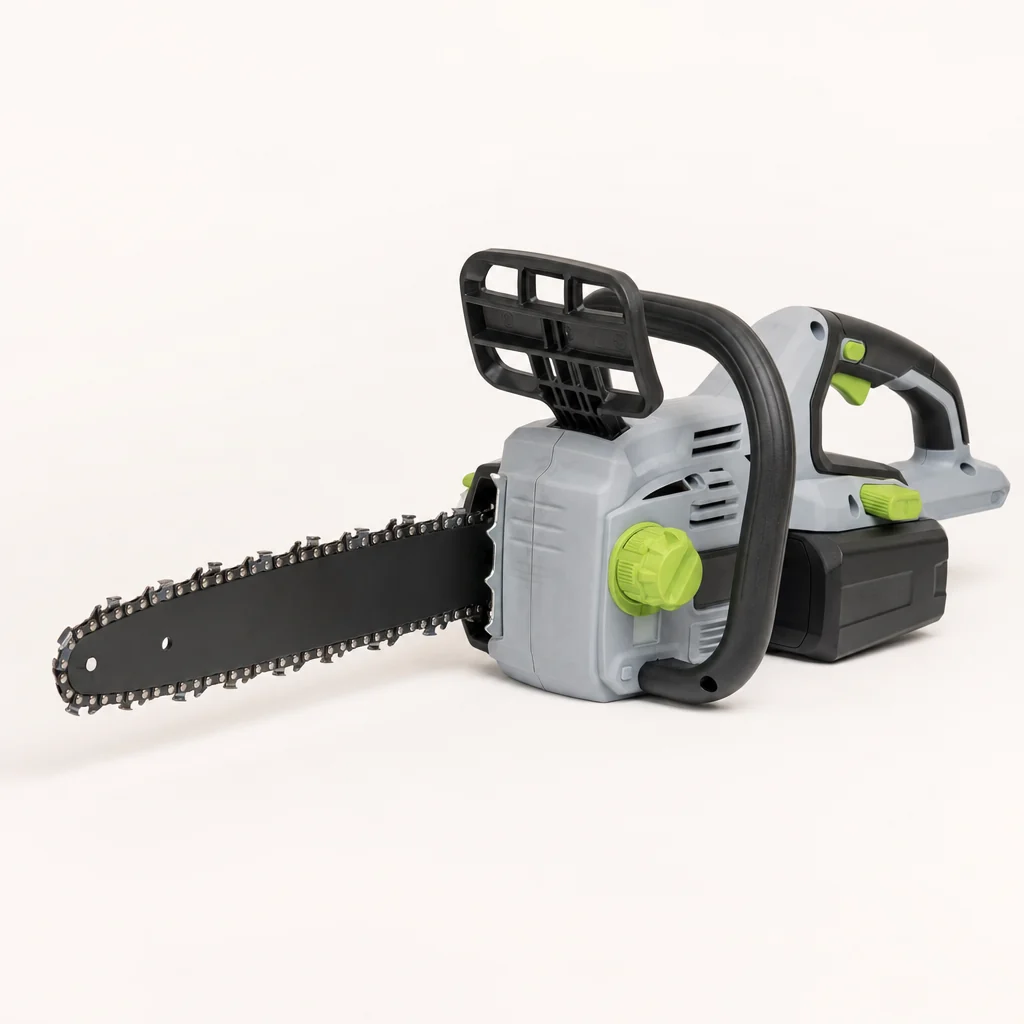
The EGO Power+ CS2005 is useful because it demonstrates just how far cordless chainsaws have moved beyond the "handy little pruning gadget" category. This is a 56V machine with a 50cm bar, a claimed 55cc petrol-equivalent motor and a chain speed of up to 25m/s. It is intended for a gardener who has real wood to process, not merely a few windfalls after a breezy weekend.
Without its battery, the saw weighs 5.9kg. That needs treating with respect. It is not a casual one-handed tool, and it should not be treated as one. A 50cm bar gives it a credible role in cutting thick branches and logs up to 50cm wide, but also means you need a clear working area and sound handling technique. For firewood processing, that is a fair exchange. For weaving around a dense ornamental border, it is rather like taking a wheelbarrow into a cloakroom.
The supplied kit includes a 6.0Ah battery and rapid charger. EGO's manufacturer benchmark is up to 135 cuts through 15 × 15cm timber per charge, or up to 230 cuts through 10 × 10cm timber. Those figures are best used as a useful comparison point rather than a promise written into the grain of every log. Timber species, moisture content, chain sharpness, cutting pressure and weather all influence the result. A clean piece of uniform timber on a test bench has a much easier afternoon than a knotted, grubby round that has spent a year by the fence.
Still, the scale of those claims tells you where the CS2005 belongs. It is for the person who wants to make a proper dent in a pile of logs during an afternoon, rather than trim two branches and congratulate themselves with tea. The digital display shows battery charge percentage and speed-select mode, which sounds like a small feature until you are midway through a batch of cuts and deciding whether to finish the current pile or sensibly stop before the battery does it for you.
Its automatic chain-brake sensor is another meaningful feature. Chain brakes are not optional decoration: they are a critical safety device. The omnidirectional arrangement is designed to respond to movement from different directions. That does not make risky cutting acceptable, of course. It is a safeguard, not an invitation to improvise.
Where the CS2005 fits — and where it does not
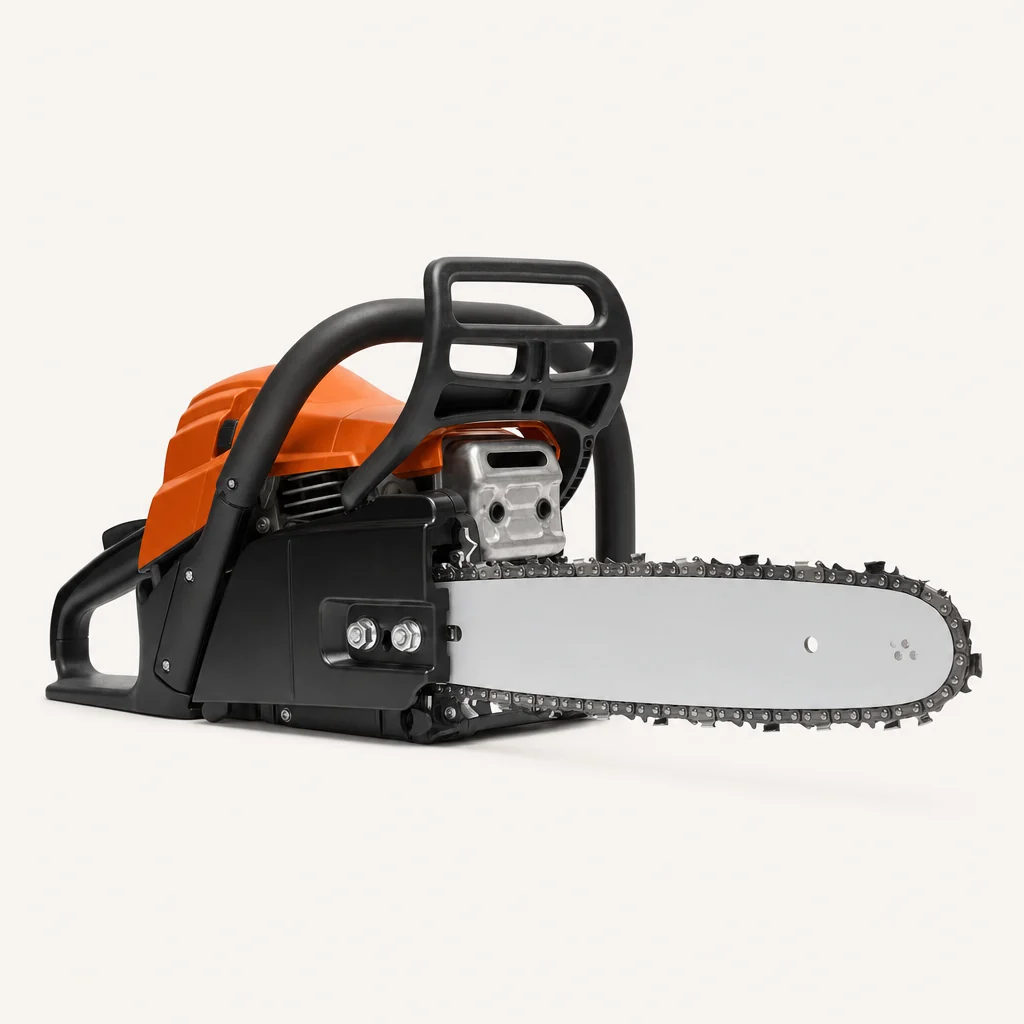
For a garden with a wood burner, fallen mature timber, or regular delivery of chunky logs, this sort of 56V saw can replace a light petrol machine for many jobs. It avoids exhaust fumes at the cutting station, starts immediately and has no two-stroke fuel to store. If you have neighbours close by, the quieter character of battery power is also a kindness. They may not send a thank-you card, but they will notice.
There are limitations. The CS2005 uses a two-bolt chain-tensioning arrangement and a scrench stored beneath the saw. That approach is precise, but it is slower than a tool-free system when you need to adjust tension or replace the bar and chain. The bar-and-chain change takes around a minute rather than the roughly 15 seconds possible with toolless designs. For occasional maintenance, that is hardly a tragedy. For someone constantly swapping cutting equipment, it could become irritating.
It is also a substantial saw to buy if your only requirement is pruning a few fruit-tree branches each winter. Smaller equipment is less fatiguing, easier to store and, crucially, less likely to encourage you to use a chainsaw where a pruning saw or loppers would have been the calmer choice.
| Feature | EGO Power+ CS2005 | Makita DUC355Z | Stihl MSA 220 C-B |
|---|---|---|---|
| Battery system | 56V | Dual 18V batteries, producing 36V | 36V Li-Ion |
| Bar length | 50cm | 35cm | 30cm |
| Chain speed | Up to 25m/s | Up to 20m/s | Up to 20 m/s |
| Weight | 5.9kg without battery | About 4.4kg with two 5Ah batteries | 3.5kg with battery |
| Natural role | Large logs and heavy domestic cutting | Limbing, smaller logs and pruning | Grab-and-go tidying work |
Mid-range cordless: the Makita DUC355Z and the 36V sweet spot
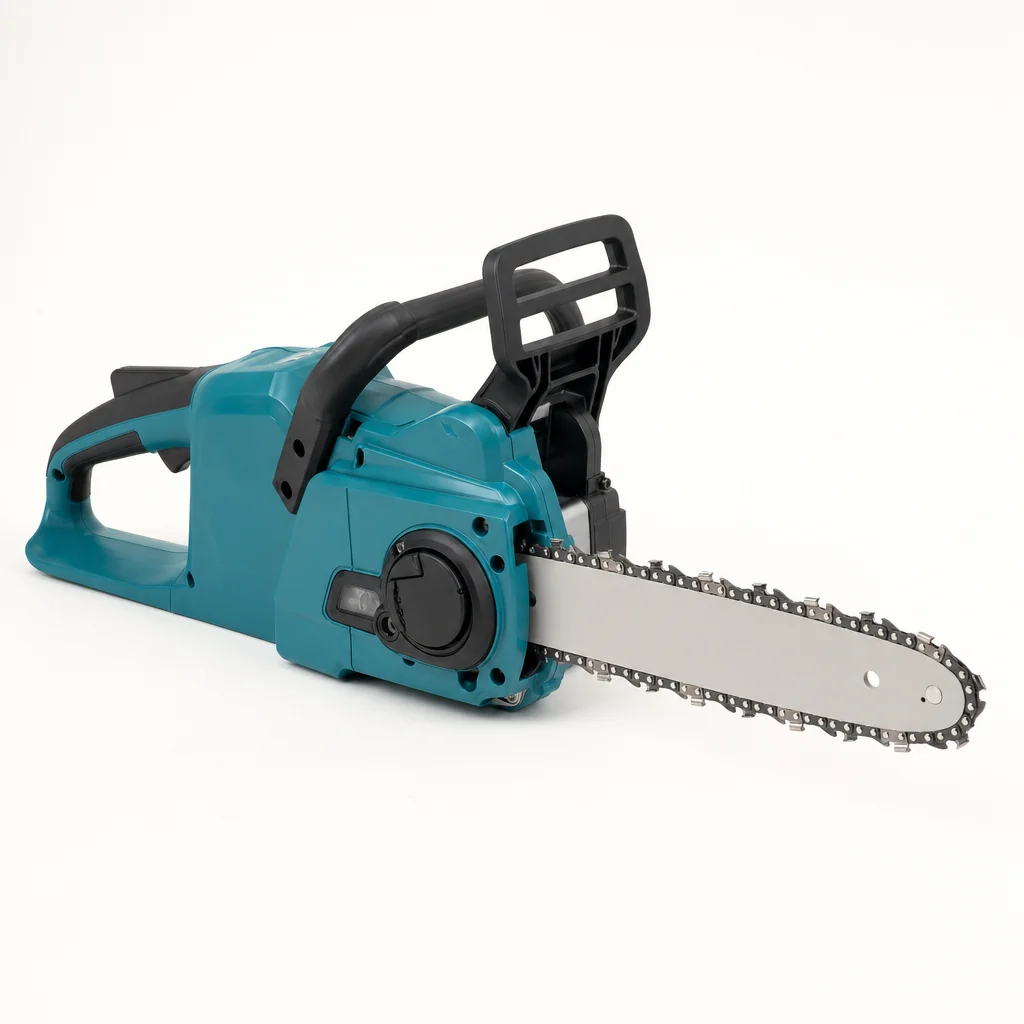
There is a particularly useful class of chainsaw between the tiny pruning tools and the heavy 50cm-bar machines. The Makita DUC355Z sits neatly in it. It runs two 18V LXT batteries in series to produce 36V, carries a 35cm bar and uses a brushless direct-drive motor. For many established gardens, this is close to the sweet spot: enough saw to process fallen branches and smaller logs, without turning every job into a strength exercise.
The standard chain is a 3/8-inch low-profile type, and the maximum chain speed is 20m/s. In use, chain speed matters because it affects how confidently the saw moves through wood. You should never force any chainsaw through a cut; that is hard on the machine, tiring for you and a good way to produce poor results. A capable saw with a sharp chain should pull through steadily while you maintain a stable, controlled position.
At approximately 4.4kg with two 5Ah battery packs fitted, the DUC355Z has enough weight to feel like a proper two-handed saw but remains far more manageable than a large petrol machine or a 50cm-bar cordless saw. It has variable trigger control, constant-speed control, adjustable automatic chain lubrication and tool-free chain tensioning. That final feature is particularly friendly for domestic users. Chains stretch as they bed in and chainsaws shake. Being able to inspect and adjust tension without turning a quick job into a hunt for a tool is genuinely useful.
For gardeners already using Makita's 18V LXT range, the appeal is obvious. The bare DUC355Z is available at around £240, while a package with 5Ah battery and charger can reach around £420. The arithmetic is far more attractive if suitable batteries and a charger are already in your shed. If they are not, look at the whole system rather than just the chainsaw's ticket price. Batteries are part of the tool, not a small optional garnish.
What works well
- Two 18V batteries provide a 36V platform without requiring a separate battery family.
- The 35cm bar is well suited to limbing, garden pruning and smaller firewood.
- Tool-free chain tensioning makes routine adjustment less of a faff.
- Brushless direct drive and a 20m/s chain speed give it purposeful cutting performance.
- Adjustable automatic lubrication lets you keep chain oil flowing appropriately.
What to consider
- It needs two batteries at once, so ownership only makes simple sense within the LXT ecosystem.
- Dense hardwood uses battery capacity more quickly than softwood.
- A 35cm bar is versatile, but not the natural choice for repeated 50cm-log processing.
- Battery charging needs organising before a larger session rather than during it.
With a pair of 5.0Ah packs, real-world use has shown around 60–80 cuts in softwood. Pine and larch are friendlier customers than oak and ash, so expect fewer cuts in dense hardwood. That does not make the saw inadequate. It simply makes planning sensible. Have charged batteries ready, stack your timber so you are not wasting power moving about, and stop for a break before fatigue begins to turn good technique into wishful thinking.
The battery-system question
If you already own compatible 18V LXT batteries, the DUC355Z is a very logical garden purchase. If you do not, compare the complete cost and the future usefulness of each battery platform. A battery that also runs your drill, hedge trimmer or mower is easier to justify than one that spends its life waiting for a storm.
The smaller Stihl MSA 220 C-B illustrates the other end of cordless convenience. It uses a 36V Li-Ion system, has a 30cm bar, weighs 3.5kg with battery and includes a tool-free chain tensioner and automatic oiler. That makes it an appealing grab-and-go machine for tidying work, but it is not intended to replace a petrol saw for heavy cutting. This is not a flaw. It is a reminder that every compact saw has a job it does brilliantly, and another it should politely decline.
Corded electric chainsaws: when mains power is the sensible answer
Corded chainsaws are unfashionable in the way a sturdy wheelbarrow is unfashionable. They lack the glamour of a battery display and the drama of petrol. Yet for the right garden, they are brilliantly practical. If you cut wood in one reliable spot near the house, they offer something both other power types must work around: effectively uninterrupted runtime.
A typical corded home chainsaw uses a motor in the 1,800–2,400W range. The Ryobi RCS1835, for example, is an 1,800W model with a 35cm bar and a weight of 3.8kg. It has automatic oiling and tool-free tensioning — two features that matter more to day-to-day ownership than a great deal of brochure language. It is a sensible sort of saw for an occasional user who wants a capable tool without batteries to charge or fuel to handle.
For a homeowner processing firewood beside a log store, patio or driveway, the working routine can be wonderfully straightforward. Set up a stable cutting area, run an appropriate outdoor extension lead from a suitable socket, arrange the cable behind the work zone, and get on with the job. There is no concern over whether the second battery was put on charge after last weekend's hedge trimming. We have all done it. The battery will be at 12 per cent precisely when one has made a cup of tea and become psychologically committed to finishing the pile.
Continuous power at the cutting station
A mains-powered saw does not run flat. For a planned firewood session in one place, that can be more useful than portability.
Keep the working radius honest
In domestic use, a 20–30 metre extension-lead range is the practical ceiling. If timber is beyond that, moving logs to the saw may be safer and simpler than taking the cable through the garden.
Oil still matters
Mains power removes charging and fuel concerns, not chain maintenance. Fill chain oil, check the chain, and keep the bar groove clean just as you would with any other saw.
Best for controlled garden work
A cable is easiest to manage on paving or a tidy driveway. It is less suited to climbing through shrubbery, damp long grass or a patch of bramble that has gone fully feral.
The big safety consideration is obvious but worth stating plainly: never cut anywhere near the cable. Route it over your shoulder or behind your body, never across the workpiece, and pause if it snags or shifts. Do not simply step over it and carry on in the manner of somebody who has decided physics is negotiable. It is not.
Corded machines suit gardeners who value a reliable, occasional-use tool and do not need to roam around the plot. They are often less convenient for pruning scattered branches because moving the lead becomes most of the job. But in a designated timber-processing space, that same limitation turns into a virtue: the work stays contained, the footing is easier to assess, and the saw remains close to safe power.
A sensible autumn approach: now is a good time to sort fallen wood and set up a clear log-processing area before wetter winter weather arrives. Keep the saw work separate from leaf-clearing chaos, and do not work alone if you can avoid it.
Petrol chainsaws: where 35–50cc still rules for serious home firewood
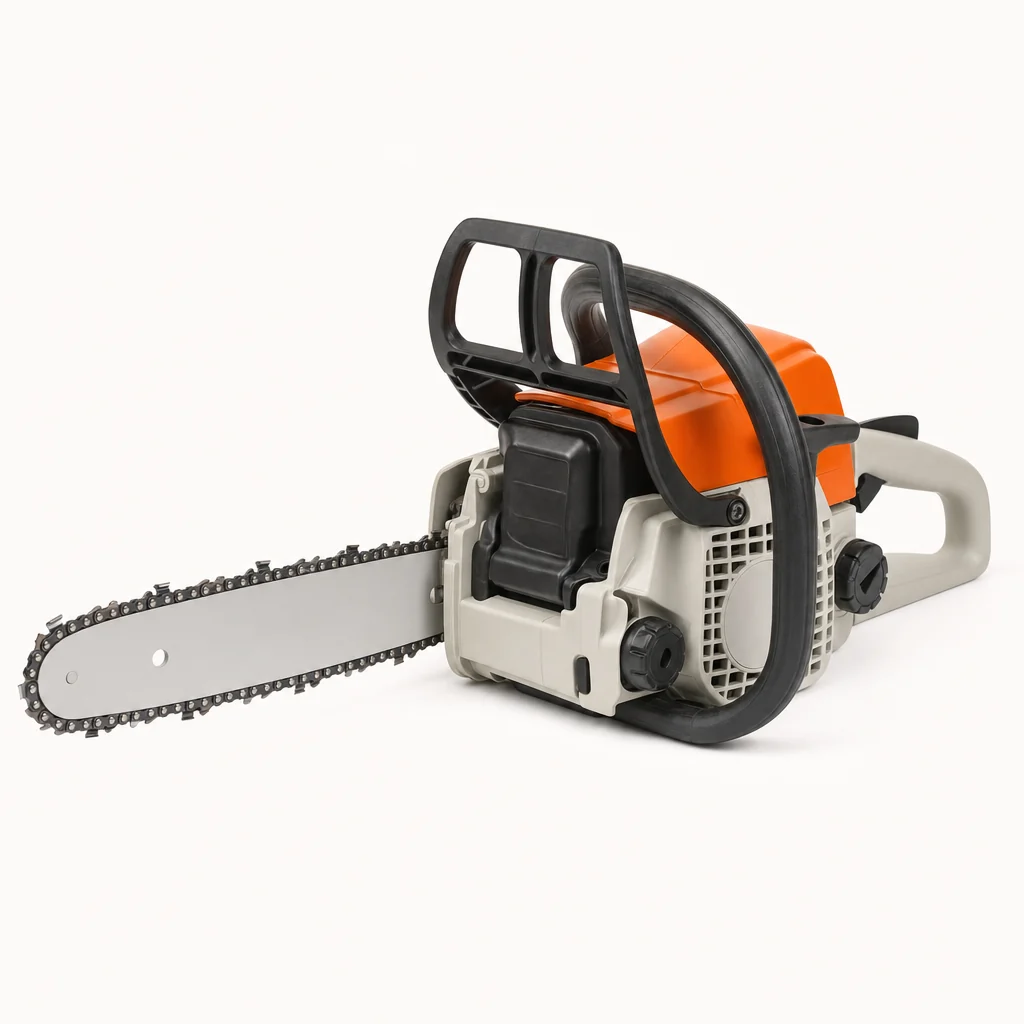
Battery technology has changed this category dramatically, but petrol is not finished. Far from it. For gardeners dealing with regular quantities of hardwood, working well away from buildings or mains power, or cutting timber over 30cm in diameter, a 35–50cc petrol chainsaw still has the advantage of sustained output and total daily runtime.
That is the crucial distinction. A good cordless saw can be very powerful. A petrol saw can keep making that power for as long as you are prepared to refuel it. If you have a sizeable rural garden, manage a smallholding, or process a serious delivery of hardwood logs, that endurance can outweigh the messier ownership experience.
Homeowner petrol saws commonly use bars in the 35–45cm range, have chain speeds of around 18–25m/s and weigh around 4.5–6.5kg with bar and chain. Fuel tanks are commonly around 300–400ml, giving roughly 30–45 minutes of continuous running. Continuous running, incidentally, is not a target. Most garden cutting should involve frequent pauses: to move timber, check the work area, assess the cut, rest your hands and notice whether you are getting tired.
The Husqvarna 135 is a familiar homeowner reference point, with a 38cc engine and a 40cm bar. Stihl's MS 170, at 30.1cc, is an entry-level option, while the MS 180 has a 31.8cc engine. The numbers make the hierarchy clear. These smaller petrol saws may be perfectly useful for lighter cutting, but homeowners expecting to work through dense, sizeable hardwood should not assume that "petrol" alone guarantees effortless performance.
Petrol earns its keep through repetition
If you make a handful of cuts several times a year, petrol's maintenance demands may outweigh its strengths. If you have a recurring stack of hardwood and no convenient power source, the balance can swing completely the other way.
Petrol ownership asks more of you. You must store fuel responsibly, maintain the engine, keep the chain sharp and be comfortable with starting and handling a loud, vibration-heavy tool. There are fumes too. In an open garden this is manageable, but it is one reason a battery or corded model feels much more pleasant for short jobs near the house.
There is also a behavioural advantage to smaller and quieter equipment that is easy to overlook. People are more likely to use a cordless or corded saw for the job it was bought for, then put it down. Petrol can encourage the "while I've got it started…" approach. That is when a sensible bit of log cutting can drift into ambitious tree surgery. Resist that urge. The garden will survive until another day.
Safety kit and safe habits: the non-negotiable part of buying a chainsaw
A chainsaw is not simply a faster pruning saw. It is a powerful cutting tool with a chain moving at speed, and it deserves a proper safety plan. The saw is only part of the purchase. If your budget covers the machine but not the protective kit, the right answer is to wait.
At a minimum, wear chainsaw protective trousers or chaps, chainsaw protective boots, suitable gloves, a helmet with visor, and hearing protection. The helmet and visor protect against flying debris; hearing protection is especially important with petrol machines but remains sensible with electric tools; boots provide grip and protection around the feet; and protective trousers are designed for chainsaw use. Ordinary gardening gloves, trainers and sunglasses are not a substitute. They are better than bare hands, perhaps, but so is a tea towel in a rainstorm.
Before every cut
- Read the saw's manual and understand its controls, chain brake and tensioning system.
- Check chain tension, chain condition, bar condition and chain-oil level.
- Clear trip hazards, pets, children, tools and loose garden furniture from the area.
- Make sure the timber is stable and cannot roll, shift or pinch the chain.
- Stand with secure footing and hold the saw with both hands.
- Plan where the cut will finish before the chain enters the wood.
- Use the chain brake whenever moving between cuts or setting the saw down.
Never use a chainsaw above shoulder height. Do not stand on a ladder. Do not try to hold a branch with one hand and cut it with the other. Do not cut timber balanced on a knee, or on a pile that will settle and trap the bar halfway through. These sound like instructions written by somebody with no faith in humanity. They are, unfortunately, instructions written because people have tried all of them.
Kickback is the issue every new owner needs to understand. It can happen when the upper part of the bar nose contacts timber or another object, causing the saw to jerk sharply back towards the user. The precise handling advice is in each saw's manual, but the general rule is simple: know where the bar nose is, do not let it contact material unexpectedly, maintain a firm two-handed grip, and work from a stable position.
For pruning, the safest approach is often to use a hand pruning saw or loppers for smaller material and reserve the chainsaw for branches already on the ground. Cutting overhead limbs, working in trees and making felling cuts are not casual extensions of garden DIY. If the job involves height, tensioned branches, damaged trunks, awkward lean, buildings, fences or neighbouring property, use a qualified tree surgeon.
September is a particularly tempting time to "tidy up" after summer growth. It is also a time when wet leaves, damp paving and low autumn light can make footing deceptive. Pick a dry, bright window. Leave yourself more space than seems necessary. And stop before you are tired. The log pile is not going anywhere.
Bar length, chain care and the little jobs that determine how well a saw cuts
Every chainsaw feels more powerful when its chain is sharp, correctly tensioned and properly lubricated. Conversely, even an impressive machine becomes frustrating with a dull chain. It cuts slowly, produces poor chips, encourages you to push harder and turns a controlled job into a noisy wrestling match. None of that is good for you, the saw or the wood.
Think of bar length as working capacity rather than a target. A 30cm bar, as on the Stihl MSA 220 C-B, is wonderfully handy for pruning and smaller logs. A 35cm bar, like that on the Makita DUC355Z and Ryobi RCS1835, is a broadly useful domestic size. A 50cm bar, as on the EGO CS2005, is designed for larger timber. It offers reach and cutting capacity, but makes far less sense if your jobs are mainly tangled branches beneath a shrub canopy.
A chain should sit snugly against the guide bar without hanging loose, yet still move freely by hand when the saw is switched off and made safe according to the manufacturer's instructions. New chains often need checking more frequently because they settle in. Stop and inspect rather than assuming it will be fine. A chain that is too loose can derail; a chain that is too tight creates unnecessary wear and heat.
Keep chain oil topped up
Automatic lubrication is useful, but it still depends on oil being in the reservoir. Running a chain dry shortens the life of both chain and bar.
Match the bar to the work
Choose a manageable bar length for your regular timber. Extra length is not a benefit when it only adds weight and awkwardness.
Keep grit out of the cut
Logs dragged through soil, gravel or old paving debris blunt chains quickly. Brush timber off and keep the bar clear of the ground.
Clean before storage
Remove sawdust and oily debris after use, inspect the chain and bar, and store the tool where children and damp cannot reach it.
For firewood, a stable sawhorse or proper log-support arrangement makes a huge difference. The aim is to prevent the wood moving and to ensure the chain does not strike the ground at the end of the cut. Work methodically: bring a small batch of logs to the station, cut them to length, then switch off and move the finished pieces. Reaching, twisting and stepping over timber with a running saw is exactly the sort of routine that becomes unsafe by degrees.
Do not overlook the chain brake. Test it as directed in the manufacturer's instructions and use it deliberately. It should be engaged before you walk even a few steps with the saw, while you assess a new cut and whenever you set the machine down. Good chainsaw use has a rhythm: cut, brake, move, assess, cut. It soon becomes automatic, which is exactly what you want from a safety habit.
Which type of chainsaw suits your garden?
By now, the choice is probably clearer. This is less about declaring a winner and more about recognising your garden's pattern of work. A suburban gardener who cuts a few fallen branches and occasional logs has different needs from somebody heating part of their home with wood, and both have different needs from a rural household managing regular fallen timber.
The occasional pruner
Choose a compact cordless model if your work is mainly branches under around 10cm. It is easy to bring out, easy to store and far less intimidating for short, controlled tasks.
The log-store gardener
Choose corded electric if you process timber in one place within reach of mains power. Continuous runtime is extremely appealing when the cable can be managed safely.
The serious firewood user
Look at a 56V cordless saw or a 35–50cc petrol model if larger logs and repeated hardwood work are a normal part of your year.
Choose cordless when convenience, lower noise and mobility matter most. It is the best all-round route for many domestic gardens, especially where you already own compatible batteries. A 36V model such as the Makita DUC355Z covers a broad range of sensible garden work, while a 56V machine such as the EGO CS2005 makes a compelling argument for bigger firewood jobs.
Choose corded electric when your cutting happens in a fixed location. It is the underappreciated answer for people who process logs at home and do not need to walk the saw around a large plot. You exchange portability for the reassurance of constant power. For many people, that is a very good bargain.
Choose petrol when the work is genuinely substantial, remote or repeated. It remains the practical choice for sustained hardwood cutting and jobs far beyond an extension lead. But go into it knowing that its strengths come with more maintenance, more noise and more responsibility.
There is another perfectly sensible conclusion, too: perhaps you do not need a chainsaw at all. Loppers, a pruning saw, a bow saw or a professional tree service may be the better answer if your work is infrequent or mainly involves standing branches. Gardening is full of tools that promise efficiency. The clever purchase is the one that gets used safely and often enough to earn its shelf space.
Frequently asked questions about home-garden chainsaws
GardenScout verdict
For most home gardens, cordless is the easiest place to start: compact 18–20V machines for pruning, and 36V models for versatile log and limb work. Choose corded electric if you cut firewood in one tidy location near power and want uninterrupted runtime. Keep petrol for the jobs that truly demand its endurance: repeated hardwood processing, remote work and larger timber.
Whatever you choose, buy the safety equipment at the same time, learn the saw's controls before the first cut, and let the size of your regular job dictate the bar. A modest saw used well is infinitely more useful than a monster machine gathering dust in the shed.