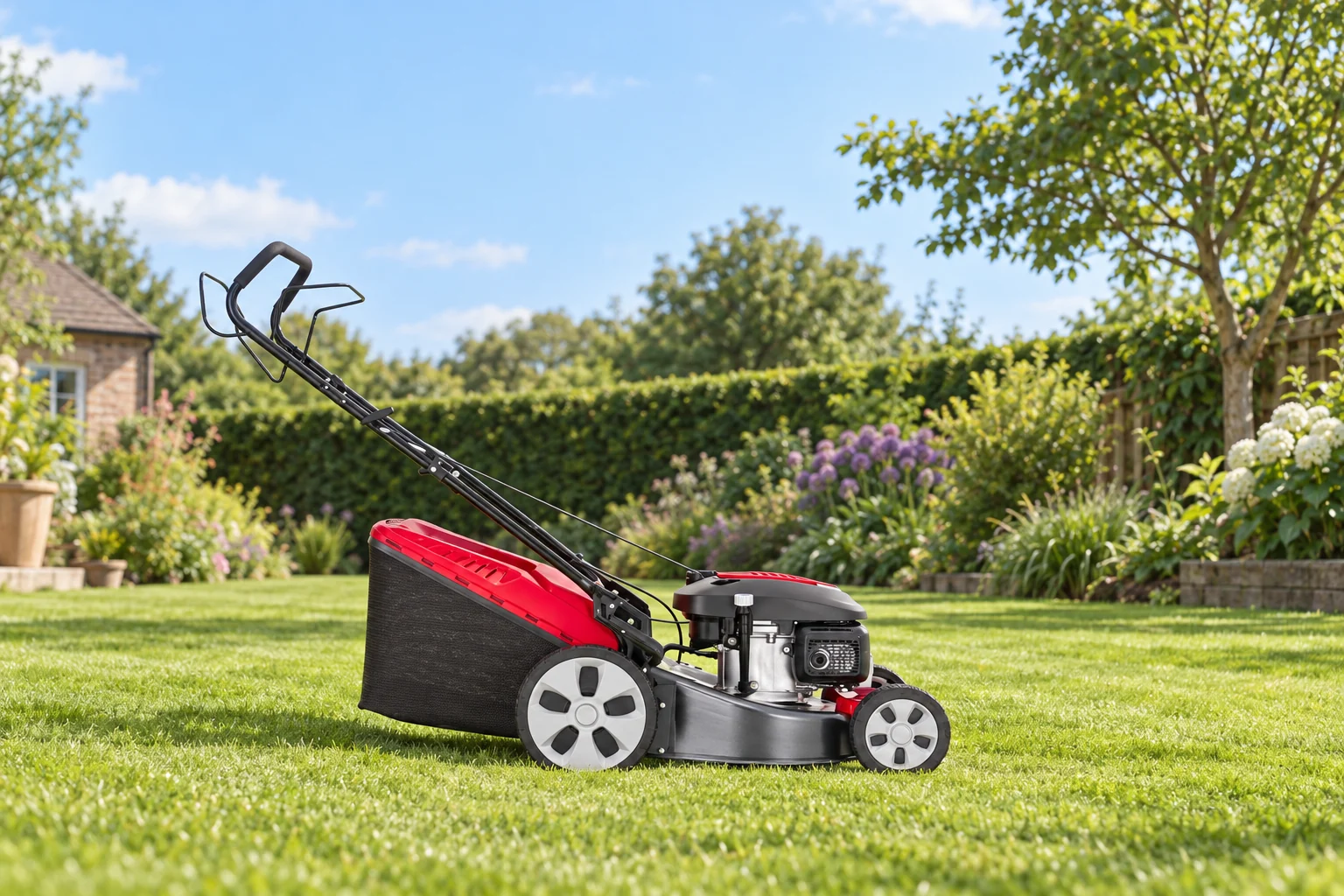
The short answer
Yes, the Mountfield SP46 Elite is still worth buying in 2026 if your lawn is medium to large, bumpy or sloping, and battery runtime worries you. Its Honda engine and rear-wheel drive suit lawns up to 1,200m². At 30kg with a pull-start, it is less suited to small, flat lawns, where a lighter cordless mower is better.

Honda-powered, self-propelled 46cm petrol mower with 60-litre collector and 22–80mm cut, ideal where battery runtime won't stretch.
Check price on AmazonWe link to the exact model on Amazon UK. Prices change often, so check the live price before you buy. As an Amazon Associate we earn from qualifying purchases.
Introduction: Does Petrol Still Have a Place in 2026?
Walk into any garden centre this year and you could be forgiven for thinking petrol mowers had quietly been taken round the back and retired. The shiny end of the aisle is all batteries: interchangeable packs, charge indicators, brushless motors and tidy little docking stations. A lot of it is genuinely excellent. I have no wish to argue anybody out of a cordless mower that suits their garden.
But there is a "but", and it's a fairly large one. Batteries run out. On a modest suburban lawn that hardly matters, because you'll be finished long before the pack is. On a bigger plot, or one with a slope, a soggy dip, a bumpy paddock-ish corner and grass that got away from you during a wet fortnight, the arithmetic changes. Thick grass draws more power. Self-propelled drive draws more power. Climbing draws more power. And the moment the last bar on the battery blinks off, you're either waiting for a recharge or paying for a second pack.
Petrol doesn't have that problem. When the tank is low you top it up and carry on. That one simple fact is why petrol mowers are still very much alive on rural and semi-rural plots, on the big back gardens of older houses, and anywhere the lawn is more of a field with ambitions than a carefully edged rectangle.
The Mountfield SP46 Elite is one of the more sensible examples of the breed. It's a four-wheeled, rear-wheel-drive, self-propelled rotary mower with a 46cm cut and a Honda GCVx145 engine, carrying a UK RRP of £439. That places it in the comfortable middle of the petrol market: not a bargain-basement push mower, not a semi-professional machine either. Mountfield pitches it at medium-sized lawns, while its own rated mowing area stretches up to 1,200m², which is a very decent chunk of grass for a walk-behind mower.
So the question I want to answer isn't the tired "petrol versus battery" squabble. It's a more useful one: if your lawn is large or rough enough that battery runtime genuinely worries you, does the SP46 Elite make sense in 2026? And, because it's mid-November and the mowing season has all but wound down, I'll also cover what to do if you're buying one now to have ready for spring.
The short answer is yes, for the right garden. The longer answer involves 30kg of steel, a pull cord, a 60-litre grass bag and a few caveats that are worth knowing before you commit. Let's get into it.
The quick answer: the SP46 Elite makes most sense on lawns from medium to large, especially uneven or gently sloping ones, where you want to mow in one go without thinking about charge levels. If your lawn is small, flat and close to the house, a lighter cordless mower will almost certainly be the happier choice.
Mountfield SP46 Elite: What You Actually Get Out of the Box
First, a little housekeeping, because mower names can be slippery. The machine I'm talking about here is the Mountfield SP46 Elite, product code 2L0486038/M19, EAN 8008984816169. The important word is "Elite". Mountfield has also sold a standard SP46, which looks very similar at a glance but uses a different, STIGA-made engine. The Elite is the Honda-powered version with a 22–80mm cutting range, and it's the one worth having if the engine pedigree is part of the appeal.

Check today's price: Mountfield SP46 Elite on Amazon UK
Mountfield has had the SP46 Elite in its line-up since at least 2023, so this isn't a brand-new design that's still finding its feet. In mower terms that's rather reassuring: a model that's been around a few seasons has usually had its spares supply and dealer familiarity bedded in.
What arrives is refreshingly straightforward. This is a complete petrol mower, so there's no battery and no charger in the box, and none needed. Here's the confirmed kit:
The mower itself
Supplied almost fully assembled, with a steel deck, the Honda GCVx145 engine fitted, and large grooved wheels on ball bearings. You complete the final assembly (essentially the handle and collector) using the instructions.
60-litre hybrid grass collector
A textile bag with a rigid top and a full-bag indicator. The fabric body collapses down for storage, which is handy when shed space is at a premium.
Mulching plug
Slot it in, leave the bag off, and clippings are chopped and returned to the lawn rather than collected. Without the bag or plug, the mower rear-discharges.
That's it. What you won't find is petrol or engine oil. Mountfield doesn't indicate that either is supplied as standard, so budget for both from day one and buy them before the mower arrives, unless you fancy staring at a brand-new machine you can't start. You'll want fresh unleaded petrol, a suitable fuel can, and the correct four-stroke engine oil as specified in the manual. The sump takes 0.4 litres and the fuel tank holds 0.95 litres, so neither requirement is huge, but they are requirements.
The box is a manageable size for a mower of this class: around 85.5 × 56 × 49cm, with a packed weight of 32.8kg. That's a two-person lift if you have steps to negotiate, or a careful one-person shuffle with a sack truck. Once assembled, the mower itself weighs 30kg and measures 155cm long, 55cm wide and 123cm high.
Owners on UK dealer sites tend to describe assembly as easy, though there's a recurring grumble that the instructions could be clearer. That matches my general experience of mower manuals, which seem to be written by people who already know how to do it. Take your time, lay the parts out on a dry surface, and don't overtighten the handle knobs.
Check you've got the right one
Before you buy, make sure the model is listed as the SP46 Elite, ideally with code 2L0486038/M19 or EAN 8008984816169, and that it mentions the Honda GCVx145 engine, a 46cm deck, a 60-litre collector and a 22–80mm cutting range. If the description talks about a STIGA 139cc engine, a different grass-box size or another model number, it isn't the Elite configuration described here.
Under the Hood: The Honda GCVx145 Engine Examined
Ask a room of mower mechanics what they'd most like to find under a cowling and a good number will say "a Honda". It isn't snobbery so much as experience. Honda's small engines have a long-standing reputation in UK garden machinery for starting reliably, running smoothly and lasting well when they're looked after. A Honda badge on a mid-priced mower is a meaningful signal, and it's the centrepiece of what you're paying for with the SP46 Elite.
The specific unit is the Honda GCVx145 OHV Autochoke. Let's unpack that name, because each part means something.
145cm³, four-stroke petrol
The engine displaces 145cm³ and runs on ordinary unleaded petrol. Being a four-stroke, it has a separate oil sump, so you don't mix oil into the fuel as you would with a two-stroke strimmer or chainsaw. You fill the tank with straight petrol and keep the sump topped up with oil. Simple, cleaner-running, and much less faff.
OHV: why the valve layout matters
OHV stands for overhead valve. The intake and exhaust valves sit in the cylinder head, above the piston, rather than off to one side as they did in the older side-valve engines that powered many mowers a generation ago. It sounds like an engineering footnote, but it has practical consequences. An overhead-valve combustion chamber is more compact, which tends to mean more efficient burning of the fuel, cooler running and better power for the size. Cooler running, in turn, is kinder to the engine over the years. Most decent modern mower engines are OHV now, but it remains a good sign that you're not buying old technology.
Autochoke: the bit you'll actually notice
This is the feature that makes day-to-day ownership more pleasant. On older petrol mowers you'd prime the carburettor with a little rubber bulb, set a choke lever, pull, pull again, mutter, adjust, and pull once more. The autochoke handles the cold-start mixture for you. Dealers describe the GCVx145 as easy-starting thanks to the autochoke and transistorised ignition, and owner feedback includes the kind of "started first pull" comments you hope to read about a petrol mower.
It's still a recoil pull-start, mind. There's no electric start on this model, so you do need to be comfortable giving a cord a firm, smooth tug. For most people that's no problem at all. For anybody with shoulder trouble or reduced grip strength, it's worth trying a pull-start mower in a shop before committing.
Is 2.75kW enough?
The detailed dealer specification quotes a net output of 2.75kW at 2,900rpm. For a 46cm rotary deck that's a well-matched figure. It isn't about raw speed; it's about having enough in reserve that the blade doesn't bog down when it meets a thick patch, a damp-ish corner, or grass that's been left a week too long. A well-specified petrol engine on a mid-sized deck tends to hold its blade speed better in heavy going than an underpowered one, and that's what gives you a cleaner cut and better collection.
Owners on dealer sites describe it as powerful enough for medium-sized lawns, which is exactly the job it's meant for. What you shouldn't do is treat that power as permission to mow anything. Mountfield's manual is clear that this is a lawn mower for cutting grass, and that you shouldn't strain the machine with heavy-duty work beyond its intended use. More on that in the suitability section.
Oil first, always
The single most expensive mistake new petrol owners make is starting the engine before adding oil. The manual warns that running with insufficient oil can seriously damage the engine and may invalidate the warranty. Add the correct four-stroke oil, check it on level ground, and only then add fuel. Make it a habit to check the dipstick before every mow, too. It takes ten seconds.
Full Specification Breakdown: Numbers That Matter for UK Lawns
Spec sheets are a bit like seed catalogues: lots of numbers, and only some of them change what happens in your garden. Here are the ones that genuinely matter on the SP46 Elite, and what they mean when you're out there on a Saturday morning.
Cutting width: 46cm
Forty-six centimetres is a nicely judged middle size. It's wider than the compact decks you'll find on many small domestic mowers, so you cover open lawn with noticeably fewer passes, yet it's narrower than the 51–53cm machines that start to feel like steering a sofa around flower beds, trees and garden furniture. Mountfield calls it a mower for medium-sized lawns; dealer guidance ranges from about 800m² up to 1,200m², and Mountfield's own rated mowing area is 1,200m². Treat those as sensible ceilings rather than targets. If you're regularly mowing something close to the top figure, you'll be out there a while, self-propelled or not.
Cutting height: 22–80mm
Six settings, adjusted from a single central lever, covering 22mm at the bottom to 80mm at the top. That's a genuinely useful spread. The lowest setting gives a short, tidy finish on a well-kept lawn in high summer; the highest lets you take a first pass over grass that's grown long before bringing it down gradually. Owners particularly like the single-lever adjustment, and so do I in principle: anyone who has crouched over a mower fiddling with four separate wheel clips will understand why.
Rear-wheel drive and a fixed 3.7km/h
The drive goes to the rear wheels, which is the right choice for this kind of mower. When the grass collector fills up, weight shifts towards the back, pressing the driven wheels into the ground and improving grip. Going uphill, weight also transfers rearwards. Front-wheel-drive mowers, by contrast, can lose traction exactly when you need it most, as the front lifts slightly on a climb or when the bag gets heavy. On sloping or undulating British gardens, rear-wheel drive is the sensible arrangement.
The drive runs at a single fixed speed of 3.7km/h. There's no variator to speed up across open lawn or slow down round the borders. In practice, 3.7km/h is a comfortable, steady walking pace, but if you're a brisk stroller or a gentle ambler, you may find it doesn't quite match your natural speed. You can always release the drive lever and push it yourself around fiddly bits.
Wheels, deck and collector
The wheels are generous: 200mm at the front and 280mm at the rear, grooved, on ball bearings, with a soft tread. Larger wheels ride over bumps rather than dropping into every dip, which matters for both comfort and cut quality on uneven ground. The deck is steel, and the 60-litre collector with its full indicator means fewer trips to the compost heap. Note what isn't fitted: no rear roller, no blade-brake clutch, no wash port and no front carry handle.
Want stripes? This isn't the mower for them. The RHS points out that wheeled rotary mowers without a rear roller don't produce good-quality stripes. The SP46 Elite will give you a neat, even, practical finish, but if a bowling-green stripe is the goal, you'll want a roller mower instead.
Real-World Suitability: Which Lawns and Gardeners Will This Suit Best?
This is the section that should decide it for you, because a mower is only "good" relative to the garden it's mowing. A brilliant mower on the wrong lawn is just an expensive, heavy thing in the shed.
Lawn size: where the SP46 Elite earns its keep
I'd put the sweet spot at lawns that are comfortably bigger than a typical new-build back garden, running up to the kind of generous plot you find around older houses, cottages and semi-rural properties. Dealer guidance suggests around 800m² as a comfortable working figure, with Mountfield rating the mower for up to 1,200m². Below a few hundred square metres, the SP46 Elite is frankly more machine than you need: a lighter cordless mower would be quicker to get out, quieter, and less hassle to store. Well above the 1,200m² mark, it may be time to look at a ride-on, because even with self-propulsion you'll be walking a long way.
The real point, though, is runtime. On those bigger lawns, a petrol mower simply keeps going. Top up the 0.95-litre tank and you're back in business within a minute. No juggling of battery packs, no half-finished lawn waiting for a charge, no "I'll do the rest tomorrow" (which, in a British summer, often means "I'll do the rest in a week, after the rain").
Rough and uneven ground
Plenty of UK lawns aren't so much lawns as negotiated settlements with nature. Molehills from last winter, a bumpy patch where the old shed stood, tussocky grass under the fruit trees. Here the SP46 Elite's large rear wheels, soft tread and powered drive help a great deal, as does a decent engine that can hold blade speed through thicker grass. The 80mm top setting means you can take a high first pass over grass that's grown long, then follow up a few days later on a lower setting. Mountfield's own manual recommends exactly that approach for long or thick grass.
On bumpy lawns, I'd generally mow a notch or two higher than you might on a flat one. The RHS lists low cutting heights and uneven surfaces among the main causes of scalping, where the blade nicks the tops of humps and leaves brown, bare patches. A slightly longer cut looks better on undulating ground anyway.
Slopes and banks
This is where self-propulsion really pays for itself. Pushing a 30kg mower up a gentle bank, turning, and coming back down again, row after row, is properly tiring. With rear-wheel drive doing the hauling, you're mainly steering. Mountfield explicitly presents the drive and large rear wheels as helpful on slopes and uneven ground, and dealers echo that. For terraced gardens and gently sloping lawns, it's a meaningful advantage, and it's the single biggest reason to choose a self-propelled model over a push mower at this size.
Use common sense on steeper ground. Mow across the slope rather than straight up and down where it's safe to do so, keep your footing secure, and avoid mowing banks when they're wet and slippery.
Ideal for
Owners of medium-to-large lawns, particularly sloping or bumpy ones, who want to finish in one session and like the reassurance of a Honda engine.
Also a good fit
Gardeners who want three ways to deal with clippings (collect, mulch or rear-discharge) and value a big 60-litre bag that doesn't need emptying every few lengths.
Think carefully if
You have to carry the mower up steps, lift it into a car, or prefer to vary your walking speed. At 30kg with a fixed-speed drive, it's not the most flexible machine.
Probably skip if
Your lawn is small and flat, you want near-silent mowing, or you'd rather not deal with petrol, oil, pull-starting and seasonal servicing.
Who might struggle
Weight is the honest drawback. Thirty kilos is fine rolling across a lawn, especially with drive engaged, but it's a lot to lift over a step or into the back of an estate car. One owner's feedback describes it as heavy for their wife, which is a fair warning for anyone who'll be sharing mowing duties. Equally, if you'll be emptying the bag frequently, remember that letting go of the safety bar stops the engine on a mower without a blade-brake clutch, so you'll be pull-starting again after each trip to the compost heap. The autochoke makes this easy enough on a warm engine, but it's part of the rhythm of ownership.
Rough ground isn't scrub
"Handles rough lawns" doesn't mean "clears an overgrown field". The SP46 Elite is a conventional rotary lawn mower. Mountfield's manual warns against using it on anything other than grass and against straining it with heavy-duty work. For waist-high growth, brambles, nettles or ground littered with stones and hidden debris, reach for a strimmer, brush cutter or a dedicated rough-cut mower first. Then bring the SP46 Elite in to tidy up.
How the SP46 Elite Stacks Up: Petrol Self-Propelled Mower Context
The SP46 Elite is the only mower I'm recommending in this piece. I'm not going to pretend I can line it up against half a dozen named rivals spec-for-spec, but it does help to understand where it sits, and what you gain or give up compared with the other broad routes you might take.
Its natural peer group is the self-propelled petrol rotary in the mid-market price bracket, with a cutting width in the mid-40s to high-40s of centimetres. That's a crowded field, and the engines vary considerably. At the cheaper end, it's common to find mowers powered by own-brand or less established engines. That doesn't automatically make them bad, but it does make the Honda GCVx145 a genuine quality signal at £439 RRP. It's one of the things that tends to make a mower easier to service, easier to source parts for, and more appealing on the secondhand market years down the line.
The more useful comparison for most readers, though, is between the SP46 Elite and the other kinds of mower you might realistically be weighing up:
| Feature | Mountfield SP46 Elite | Typical cordless self-propelled mower | Typical petrol push mower |
|---|---|---|---|
| Power source | Honda GCVx145 petrol, 2.75kW | Rechargeable battery pack(s) | Petrol engine |
| Mowing time | Refuel and continue; 0.95-litre tank | Limited by battery capacity; recharge or swap packs | Refuel and continue |
| Effort on slopes | Rear-wheel drive does the hauling | Drive helps, but draws extra battery power | All your own effort |
| Starting | Pull-start with autochoke | Button or key | Usually pull-start |
| Noise | 83dB(A) at the operator's ear | Generally much quieter | Similar petrol noise levels |
| Weight | 30kg | Generally lighter | Varies; often lighter without a drive system |
| Maintenance | Oil, fuel, air filter, spark plug, blade | Mainly blade and battery care | Oil, fuel, filters, blade |
| Clipping options | Collect, mulch, rear-discharge | Varies by model | Varies by model |
Reading across that table, the trade-off becomes clear. Cordless wins on noise, weight, convenience and low maintenance. Petrol wins on uninterrupted mowing time, and self-propelled petrol wins on effort over large or sloping ground. The SP46 Elite sits right at the point where those petrol advantages start to matter more than the cordless ones.
It's also worth repeating the distinction from earlier: the standard SP46 isn't the same mower. It uses a STIGA-made engine rather than the Honda. If you see two very similar-looking Mountfields at different prices, check which engine is fitted before assuming they're interchangeable.
Two sets of numbers are worth visualising. The first is how much lawn this mower is meant for, according to Mountfield and UK dealer guidance. The second is the wheel sizing, which explains a lot about how it behaves on bumpy ground.
The bigger rear wheels are the driven ones, which is exactly where you want the most grip and the best ability to roll over lumps. It's a simple bit of design, but it's the reason the SP46 Elite feels more planted on uneven ground than a small-wheeled mower.
Strengths and Weaknesses: An Honest Assessment
No mower is perfect, and anyone who tells you otherwise is probably selling one. Here's how the SP46 Elite's strengths and weaknesses balance out, based on its specification, Mountfield's own information and the feedback of UK owners and dealers.
Pros
- Honda GCVx145 engine: a strong reliability reputation, autochoke for easier starts, and 2.75kW that's well matched to a 46cm deck.
- Rear-wheel self-propulsion: takes the effort out of slopes and larger areas, with traction improving as the bag fills.
- Broad 22–80mm cutting range: a tidy short cut in summer, a high first pass over long grass when needed.
- Single-lever height adjustment: one lever moves all six settings; owners find it genuinely easy.
- 60-litre collector with full indicator: fewer interruptions and less guesswork.
- Three-in-one versatility: collect, mulch with the supplied plug, or rear-discharge.
- Large 200/280mm wheels: ride over bumps better than small-wheeled mowers.
- Folding handles and collapsible bag: easier storage than a fixed-handle machine.
- No runtime anxiety: refuel and carry on, however big the lawn.
Cons
- 30kg: heavy to lift over steps or into a car, and some owners find it a handful.
- Fixed 3.7km/h drive: no speed variator to match your walking pace.
- Pull-start only: no electric start option on this model.
- No blade-brake clutch: releasing the bar stops the engine, so you restart after emptying the bag.
- 83dB(A) at the ear: noticeably louder than cordless; ear protection is sensible.
- No rear roller: not the mower for proper stripes.
- No wash port: cleaning under the deck is a manual job.
- Petrol ownership: fuel, oil, seasonal servicing and safe storage all come with the territory.
- Warranty small print: the five-year cover depends on terms, including servicing.
Looking at that balance sheet, a pattern emerges. Nearly every con is either a consequence of being a petrol mower (noise, fuel, servicing, pull-start) or a feature Mountfield has left off to hit the price (variable speed, blade-brake clutch, roller, wash port). None of them is a design flaw, as such. They're trade-offs. Whether they matter depends entirely on your garden and your temperament.
One minor recurring niggle in owner feedback is collection in less-than-ideal conditions: one owner reported the chute blocking. That's a single account, and in my experience almost every rotary mower will clog if you ask it to collect damp, long grass in one pass. Mountfield's manual advises against mowing wet grass, and that advice is the real fix. Mow when the lawn is dry, take long grass down in stages, and keep the underside of the deck clean.
The hand-arm vibration figure of 5.9m/s² is also worth a mention. It isn't unusual for a petrol rotary, but on a large lawn it's a good reason to take a short break part way through and to wear decent gloves. Your hands will thank you on Monday.
Ownership Costs and Long-Term Value: Beyond the £439 Price Tag
The SP46 Elite carries an RRP of £439 including VAT, which is the figure Mountfield lists and the one dealers quote as the recommended price. Plenty of dealers sell below RRP, especially outside the spring rush, so it's worth shopping around, but £439 is the sensible baseline for judging value.
The purchase price is only part of the story with petrol, though. Here are the ongoing essentials to factor in:
Mower RRP
Including VAT; dealer prices may be lower
Fuel tank
Fresh unleaded petrol, bought separately
Engine oil
Four-stroke oil to the manual's spec
Warranty
Subject to Mountfield's terms and servicing
Fuel
Your fuel bill depends on two things you control (how big your lawn is and how often you mow) and one you don't (whatever the pump is charging this week). The good news is that a 145cm³ engine is a modest drinker, and with a 0.95-litre tank you're filling with small quantities at a time. The more important consideration is freshness. Mountfield's manual warns that petrol can go stale after around 28 days. Stale fuel is one of the commonest causes of hard starting and rough running in mowers of every brand.
So my advice is to buy little and often. Rather than filling a big can in April and expecting it to last until September, pick up enough for a few weeks' mowing at a time. Use a proper, clearly labelled fuel can, and store it somewhere cool, ventilated and well away from the house and any ignition source.
Oil and servicing
The sump holds just 0.4 litres, so an oil change uses very little. With four-stroke mower engines, an annual oil change is the usual minimum, with more frequent checks during the season. Beyond that, the routine is the familiar petrol-mower list: keep the air filter clean, check the spark plug, keep the blade sharp and balanced, and scrape the underside of the deck so clippings don't build up and rot against the steel.
None of this is difficult, but it does take a bit of time and a willingness to get your hands slightly oily. If you'd rather not, a local mower dealer will service it for you, and that brings us neatly to the warranty.
The warranty question
Mountfield advertises a five-year warranty, subject to terms and conditions. Dealer specifications describe the standard cover as two years, with extension to five years dependent on servicing and the manufacturer's conditions. In plain English: don't assume you'll automatically get five years. Register the mower, read the terms, and find out what servicing is required and by whom. Keep your receipts. If the five-year cover depends on regular servicing, it's well worth doing, both for peace of mind and because a regularly serviced Honda engine is precisely the kind of thing that keeps a mower going for many seasons.
The real long-term value
A mid-priced mower with a well-regarded engine, a steel deck and a sensible spec tends to hold its usefulness for years if it's serviced and stored properly. The SP46 Elite's value isn't in being cheap; it's in being the kind of mower you buy once for a large lawn and keep, rather than replacing a struggling budget machine every few seasons.
Compared with a cordless mower, the running costs look different rather than simply higher or lower. You're paying for fuel and oil instead of electricity, and for servicing instead of eventual replacement batteries. For a large lawn where a cordless setup would need multiple battery packs to finish the job, petrol is often the more straightforward proposition.
Buying in November: What to Do Now, and Come Spring
It's mid-November as I write this, which is either the worst or the best time to think about a new mower, depending on how you look at it. Worst, because you won't be using it much for months. Best, because the spring rush hasn't started, dealers are quieter, and you'll have time to get everything sorted without the lawn growing round your ankles while you wait.
Right now: a last high cut, if conditions allow
Grass doesn't stop growing entirely in a mild British November, and a tidy lawn going into winter is less likely to harbour disease and moss in long, matted growth. If you have a dry, mild day and the ground is firm rather than squelchy, a final light cut on a high setting is fine. On the SP46 Elite I'd use one of the upper settings, well above the summer height, and only take off the very tips. The RHS suggests up to around 40mm for spring and autumn on an ordinary domestic lawn; at this time of year, err on the longer side.
Do not mow if the lawn is frosty or waterlogged. Mountfield's manual says to avoid wet grass, and mowing soggy turf compacts the soil, clogs the deck and churns up the surface. Petrol power doesn't change that. If in doubt, leave it until spring.
If you're buying one now
Use the quiet weeks to do all the setup jobs properly:
- Unbox it on a dry, stable surface and complete the assembly of the handle and grass collector at your leisure, instructions in hand.
- Register the mower for the warranty and note down any servicing requirements.
- Buy the correct four-stroke engine oil now, so it's ready.
- Hold off buying petrol until you're about to use the mower. Fuel bought now will be stale long before spring.
- Store the mower somewhere dry, with the handles folded and the collector collapsed to save space.
If you already own a petrol mower: winter care
Because petrol goes stale in roughly a month, don't leave fuel sitting in the tank over winter. Run the engine until it uses up what's in the tank, or follow the manual's storage guidance. Then clean the underside of the deck, check the blade, and store the mower dry and covered. Winter is also a good time to book a service, ahead of the spring queue at the dealer.
Come next spring: the first proper mow
When the grass starts growing in earnest (typically somewhere around March or April, depending on where you live and how the weather behaves), here's how to start the season with the SP46 Elite:
- Check the oil on level ground before the first start, and add fresh unleaded petrol outdoors.
- Clear the lawn of stones, twigs, dog toys and anything winter has deposited. Molehills are best raked flat first.
- Start high. Set the cutting height near the top of the range for the first couple of cuts. The RHS advises removing no more than a third of the grass height in one go.
- Lower gradually over several weeks towards your summer height. The RHS suggests around 25mm in summer for an ordinary domestic lawn; on bumpy ground I'd stay a little higher to avoid scalping.
- Try mulching once you're mowing regularly and only taking a little off each time. Short clippings disappear into the sward and return nutrients to the soil.
- Vary your direction from week to week. The RHS notes that repeatedly mowing in the same direction contributes to scalping and wear.
Verdict: Is the Mountfield SP46 Elite Still Worth Buying in 2026?
After all that, here's where I land. The SP46 Elite isn't trying to win the battery mower's argument. It's not quiet, it's not light, and it won't start with a button. What it does offer is a very well-chosen set of fundamentals for a particular kind of garden: a Honda GCVx145 engine with autochoke, rear-wheel drive with large wheels, a 46cm steel deck, a 22–80mm cutting range and a 60-litre collector, all for a £439 RRP.
On a medium-to-large lawn, particularly a bumpy or sloping one, those fundamentals add up to a mower that simply gets the whole job done in one go. That's the thing battery owners on big plots so often miss. If you've ever stood on a half-mown lawn waiting for a battery to charge, you'll know exactly what I mean.
The GardenScout verdict
Yes, the Mountfield SP46 Elite is still worth buying in 2026, if your lawn is big enough, rough enough or sloping enough that cordless runtime genuinely concerns you. The Honda engine, rear-wheel drive and broad cutting range make it a practical, long-term machine for exactly those gardens.
If your lawn is small and flat, or you can't face pull-starts, refuelling and servicing, choose a lighter cordless mower instead. And whichever you buy, check the warranty terms and look after it properly; that's where the real value of a petrol mower lies.
Frequently asked questions
- Mountfield SP46 EliteBest for larger lawnsView on Amazon
Buying for a gardener? See our gifts for lawn lovers, checked on Amazon every day.