
Log Splitters & Axes for Prepping Firewood at Home
Manual, hydraulic and electric splitters plus kindling tools — a full field guide for fire-pit and log-burner owners who'd rather split smart than swing hard.
There's a particular satisfaction in feeding your own split logs into a wood-burner on a bitter January evening — and an equal frustration when you're stood in the garden, wedge stuck fast in a knotty round of oak, questioning every life decision that led you there. I've spent a good few winters working my way through the various ways of turning tree into fuel, and the honest truth is this: the "best" tool depends entirely on how much wood you're processing, how much space you've got, and how much of the graft you actually want to do yourself.
This guide pulls together the whole spread — from a hand-forged Swedish axe you'll hand down to your grandchildren, right up to a 35-ton petrol beast that'll happily eat a full trailer of logs before lunch. Along the way I'll cover the electric splitters that dominate the UK garden shed, the clever kindling gadgets that keep children's fingers attached, and the battery-powered cordless option that's quietly changing how people think about the job. Let's get into it.
The Firewood Toolkit at a Glance
Before we dive into individual models, it helps to understand the landscape. Firewood prep splits — pun fully intended — into four broad categories, each suited to a different scale of operation. Here's the quick lay of the land.
If you burn a couple of baskets of logs a week from a well-stocked shed, a good axe or a compact electric splitter will see you right. If you're clearing your own woodland, coppicing, or supplying a couple of neighbours, you're firmly into hydraulic territory — and the question becomes electric versus petrol. Everyone else falls somewhere in between.
Manual Axes: The Traditionalist's Choice
Let's start where firewood prep started. A good splitting axe requires no fuel, no electricity, no maintenance beyond the occasional sharpen and oiling, and it'll outlast almost anything else in your shed. It also demands technique, a decent chopping block, and a level of physical fitness that not everyone's keen on. But when it clicks — when you drop the head cleanly through a straight-grained round and it falls apart in two — there's genuinely nothing more satisfying.
Fiskars X27 Super Splitting Axe
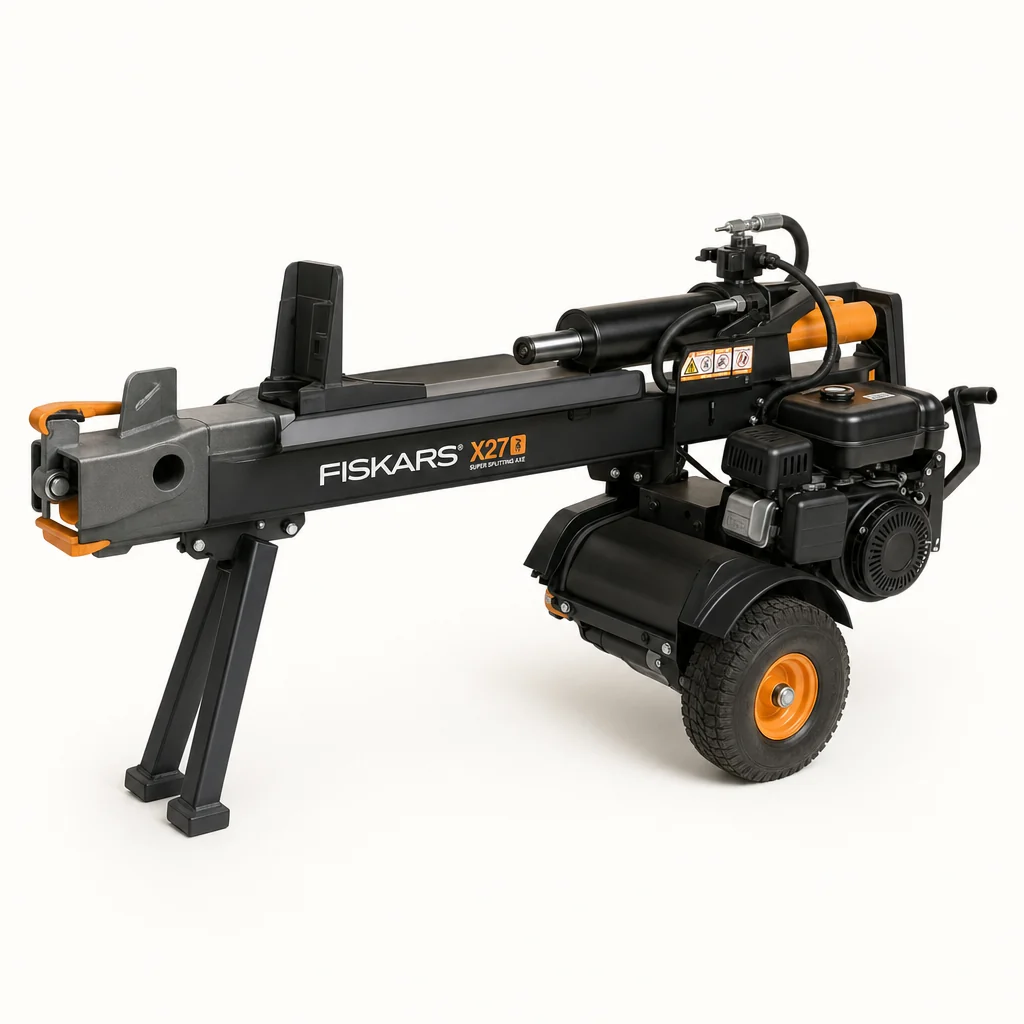
The X27 is the one I recommend to more people than any other single tool, and it's almost universally cited in reviews as the best-value option for good reason. It pairs a genuinely sharp blade with a long handle that generates real swing power — the extra length gives taller users in particular a lovely arc that lets gravity do a lot of the work. The composite construction means it shrugs off overstrikes that would splinter a wooden haft, and it's virtually maintenance-free.
For tall folks working through medium and larger rounds, the X27's reach is its headline feature. If you're on the shorter side you may prefer a slightly stubbier axe for control, but for sheer splitting authority on seasoned hardwood, this thing punches well above its price.
Hults Bruk Agdor 20
If the Fiskars is the sensible workhorse, the Hults Bruk Agdor 20 is the heirloom. At around $134 it's a considered purchase, but you're paying for a hand-forged steel head and a long, tapered blade profile that easily handles logs up to 8 inches in diameter. There's a heft and balance to a forged axe that a moulded one simply can't replicate, and with proper care it'll serve for decades. This is the axe for the person who genuinely enjoys the ritual of splitting and wants a tool that rewards good technique.
Husqvarna Composite Splitting Axe S2800
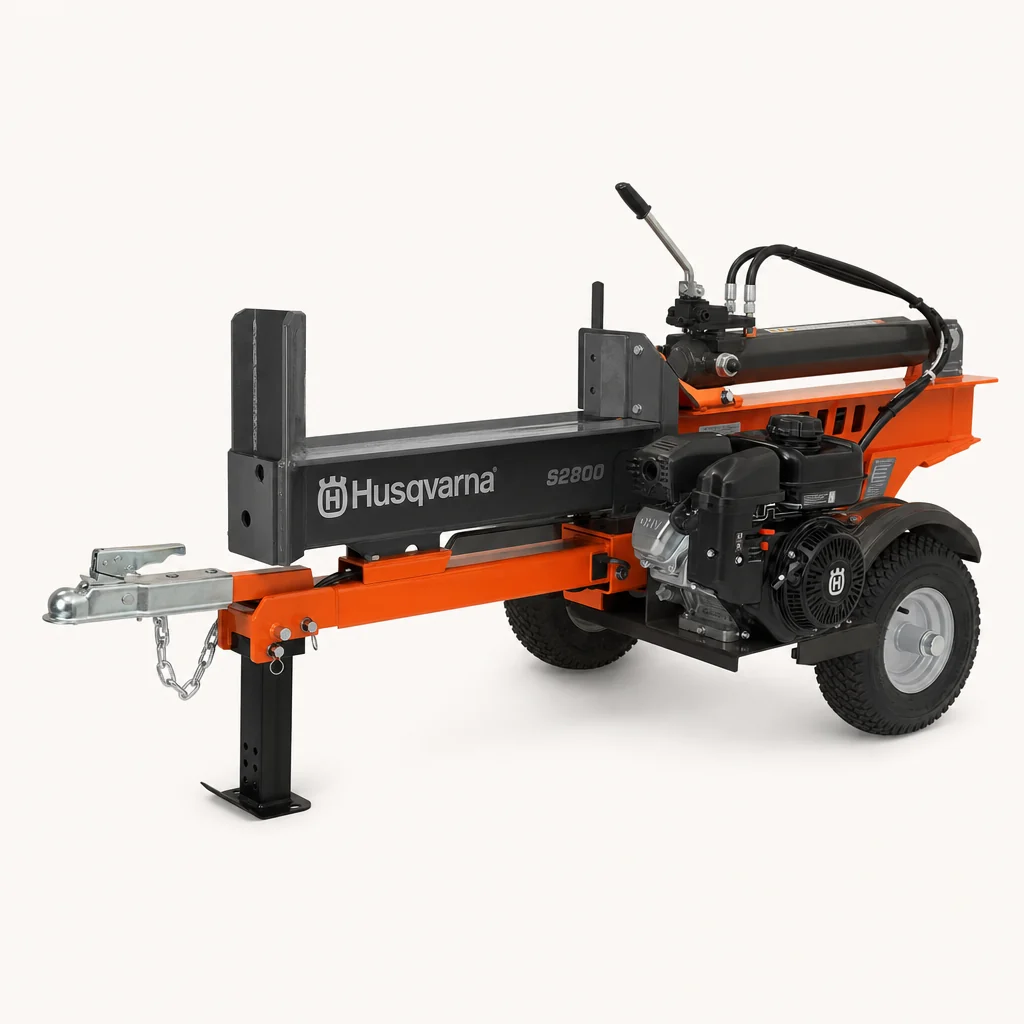
The Husqvarna S2800 sits cleverly between the two, priced around $130. It runs a 28-inch composite handle that keeps overall weight down whilst concentrating mass in the head — exactly where you want it for splitting. The result is an axe that's easy to wield repeatedly without your shoulders paying for it the next morning, yet still delivers a proper wallop where it counts. The shorter handle also lends itself to more controlled, single-handed positioning work when you're setting up a stubborn round.
Handle length matters
The Fiskars X27's 36-inch handle suits taller users and generates maximum swing arc; the Husqvarna's 28-inch handle favours control and lower fatigue.
Head weight placement
Both the Husqvarna and Fiskars concentrate weight in the head — the physics that turns your swing into splitting force rather than wasted momentum.
Forged vs composite
The Hults Bruk Agdor 20's hand-forged head offers heirloom durability and balance; composite axes trade that romance for near-zero maintenance and overstrike resistance.
Pros
- No running costs, no fuel, no electricity
- Fiskars X27 widely rated best value
- Hults Bruk Agdor 20 handles 8-inch logs and lasts decades
- Silent — no neighbours disturbed
- Genuinely enjoyable once technique clicks
Cons
- Physically demanding — not for everyone
- Struggles badly on knotty or twisted grain
- Requires a solid chopping block
- Slower than hydraulics for bulk volume
- Real risk of injury without proper form
Kindling Tools: Small Splits, Zero Drama
Here's a category that solves a very specific problem beautifully. Splitting a full round is one job; reducing those splits down into finger-thin kindling to get a fire going is another — and it's the one where axe injuries most commonly happen, because people are working with small, unstable pieces and swinging sharp tools close to their hands. The Kindling Cracker family removes that danger entirely.
Kindling Cracker
The design is elegantly simple: a cast iron ring with a fixed wedge sitting inside it. You drop a log into the 6.5-inch diameter ring, tap the top with a mallet or a blunt lump of wood, and the wedge does the splitting. Your hands never go near the sharp edge, and because you're driving down with a mallet rather than swinging an axe, it requires considerably less force than swinging an axe outright. It's genuinely a tool a sensible older child can use under supervision, and it's brilliant for anyone with grip strength or mobility concerns.
Kindling Cracker XL
The XL scales the concept up with a 9-inch inside diameter ring, letting you feed in larger logs that wouldn't fit the standard model. It keeps every advantage — the blade-free-to-your-hands design, the less effort than axes appeal — while handling chunkier stock. If you're processing bigger rounds down rather than just tidying up kindling, the XL is the one to reach for.
Pro Tip
Bolt your Kindling Cracker down to a low, stable stump or a purpose-built base. The whole point of the enclosed-ring design is safety and efficiency, and both improve dramatically when the unit can't skitter about as you strike it. A wobbling Cracker is a frustrating Cracker.
The Kindling Cracker is often the tool I suggest first for nervous beginners. Because it requires less force than an axe and keeps your hands away from the wedge, it removes the two things that put people off manual splitting — the effort and the fear.
Electric Log Splitters: The UK Garden Favourite
For the vast majority of British homeowners with a log-burner and a modest annual wood requirement, an electric hydraulic splitter is the sweet spot. They plug into a standard socket, make far less noise than petrol, produce no fumes so you can use them in a garage or outbuilding, and they take the physical strain out of the job entirely. Forest Master, a UK-engineered brand, more or less owns this space — so let's look at their range in detail.
Forest Master FM5D — The Compact Entry Point
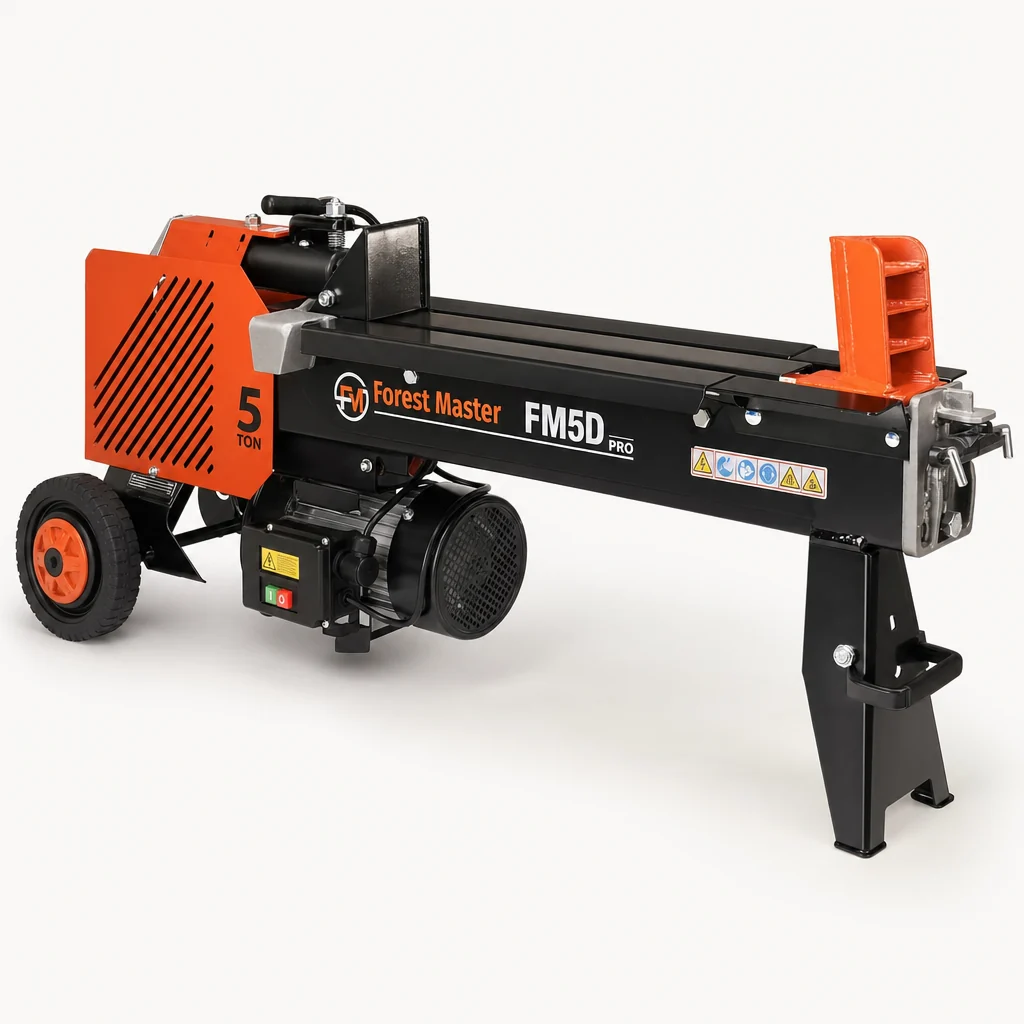
The FM5D is the natural starting point and a genuine UK bestseller. It runs a 2200W motor delivering 5 tons of splitting force, and crucially it manages a cycle time of under 9 seconds — properly quick for an entry-level machine. It handles logs up to 300mm (12 inches) long, which covers the standard log-burner size neatly.
What I like is that it arrives ready to work: it's pre-filled and ready to use straight out of the box, supplied with a workbench and safety guard, and it's rated IP54 for weather resistance so a bit of drizzle won't kill it. Operation is two-handed, meaning both your hands are occupied with the controls and nowhere near the wedge — a simple but effective safety feature. Plug it into any standard 3-pin socket and you're away.
Forest Master FM10D / FM10T (7-Ton) — The Clever One
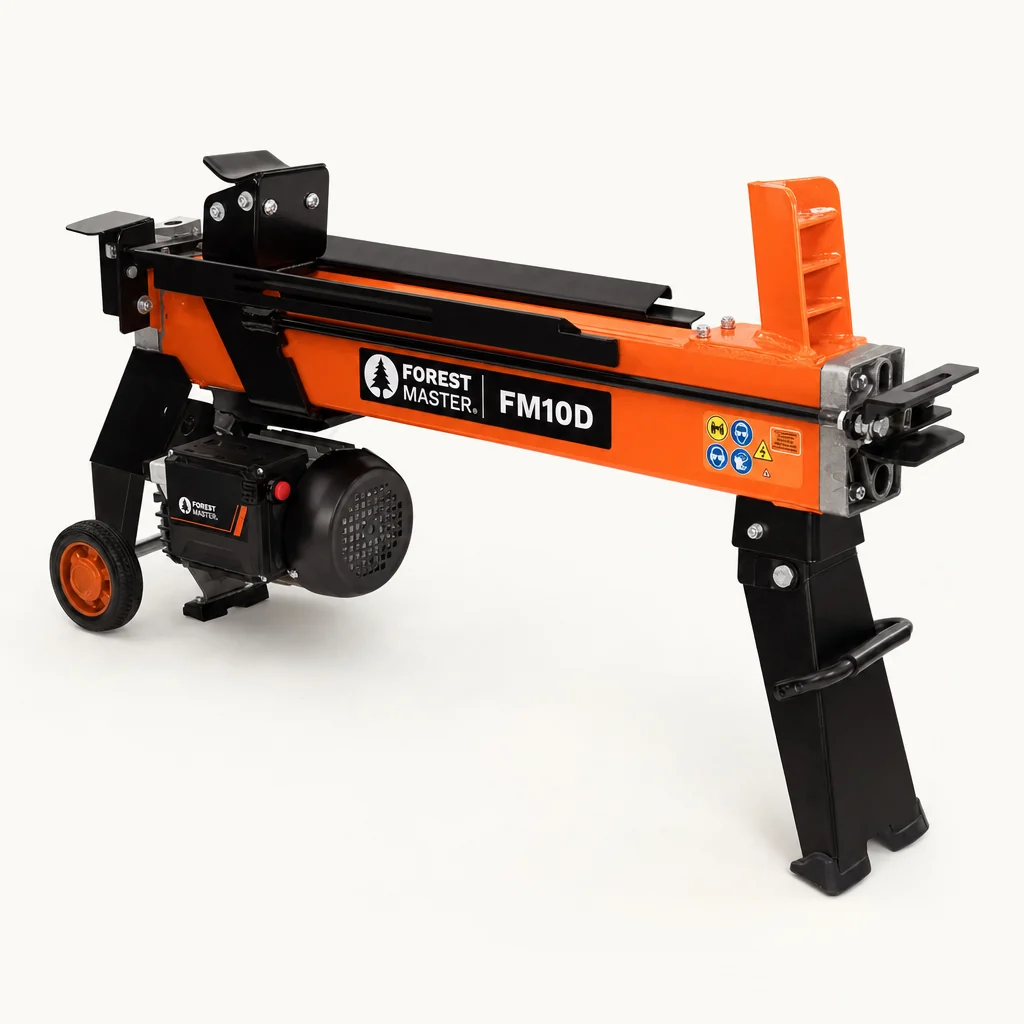
This is where Forest Master's engineering gets genuinely interesting. The 7-ton FM10 (also available in a 5-ton variant) runs the same 2200W motor but adds the patented DuoCut blade, which splits from both ends of the log simultaneously. The upshot is that it produces results similar to a 10-ton traditional splitter despite its 7-ton rating — you're effectively getting more splitting done per stroke because both ends of the log are being worked at once.
It handles logs up to 450mm (18 inches) long and cuts logs up to 400mm in diameter, a serious step up in capacity over the FM5D. The cycle time is a 15-second adjustable affair, and there's a ram-stop feature that lets you shorten the stroke for smaller logs so you're not waiting for the full travel every time. Reassuringly, it's UK-engineered with lifetime technical support and an extendable 2-year warranty.
The FM10 also comes in a spread of stand configurations to suit your setup, which is a genuinely thoughtful touch:
FM10D — Ground level
The base unit, designed to sit and work at ground level — the most affordable configuration.
FM10T — T-stand with wheels
Raises the machine to a comfortable working height and adds wheels for easier repositioning.
FM10TW — Trolley with castors
A castor-wheeled trolley setup for maximum manoeuvrability around the yard.
FM10-AT — All-terrain stand
Built for rougher ground where standard castors would struggle.
Forest Master FM16D — The Heavy-Duty Electric
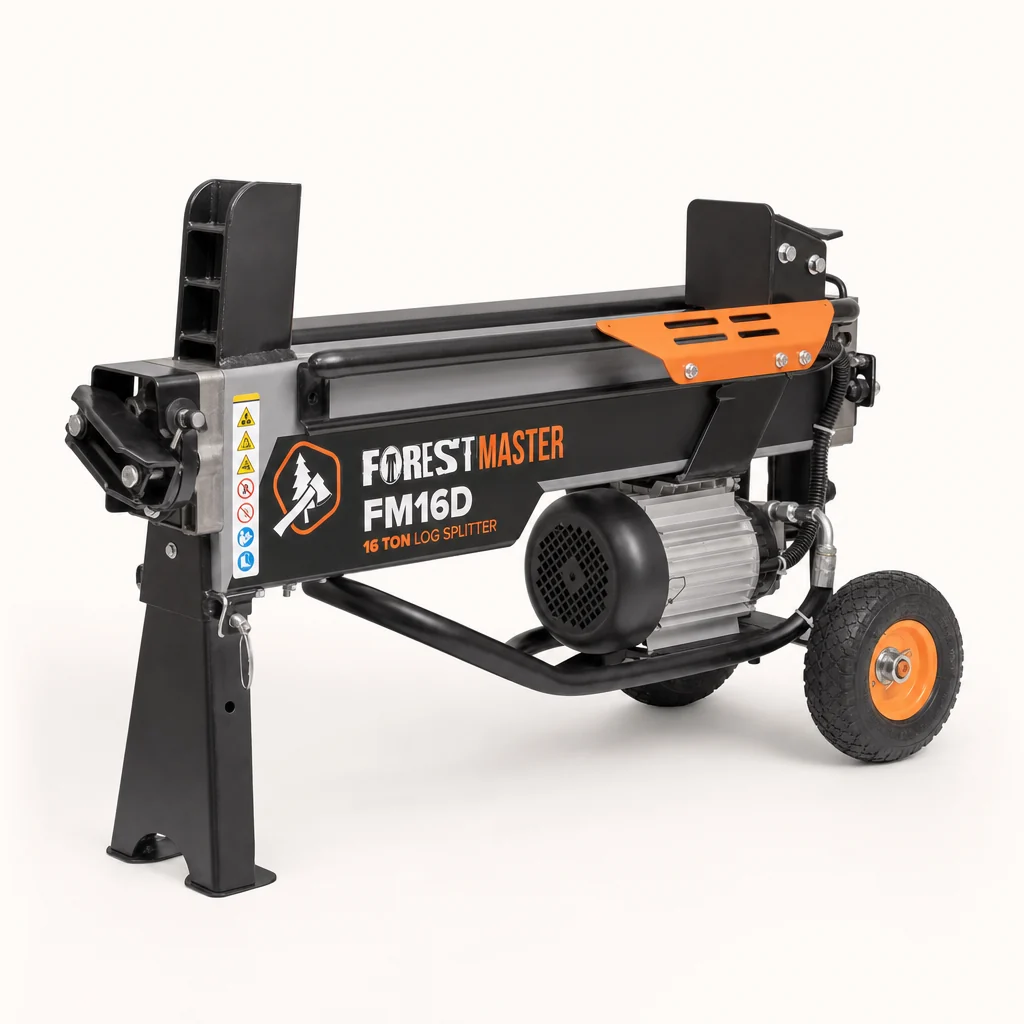
Sitting at the top of the electric range, the FM16D steps up to 8 tons of force driven by a slightly beefier 2300W motor. If you find the 5-ton and 7-ton models occasionally stalling on your gnarliest rounds, the extra grunt here is the answer whilst keeping all the benefits of mains-electric operation — no fumes, low noise, no fuel to store.
Pro Tip
Don't be fooled by tonnage figures alone. The Forest Master FM10's DuoCut blade shows that clever geometry can deliver 10-ton-equivalent results from a 7-ton machine. When comparing splitters, factor in the blade design and cycle time, not just the raw force number on the box.
DeWalt 60V MAX 9-Ton: Cutting the Cord
Here's the model that genuinely made me sit up. Battery power has transformed lawnmowers, chainsaws and strimmers, and DeWalt has now brought it to log splitting with the 60V MAX 9-Ton — a cordless hydraulic splitter that delivers 9 tons of force from a 60-volt brushless motor, feeding a 5-inch wedge through a 3.5 GPM hydraulic pump. It'll split logs up to 25 inches long, which is a genuinely generous capacity.
The appeal is obvious the moment you use one. There's no cable tethering you to the shed, no petrol to mix or store, no carburettor to gum up, and no winterisation faff at the end of the season. Noise is described as conversation-level — you could genuinely chat to someone beside it whilst it works, which is remarkable for a hydraulic splitter. Cycle time sits at 16–20 seconds, a touch slower than the quickest electrics but perfectly workable.
The Battery Question
The one thing to plan around is runtime. With two 60V packs fitted, you can expect roughly an hour of intermittent splitting on mixed hardwoods — less on really dense wood, more on softer green timber. For anyone wanting to work continuously, DeWalt sensibly recommends a third battery so you can charge one whilst the other runs, keeping you going indefinitely. If you're already invested in the DeWalt 60V platform for other tools, that battery pool makes this an even easier decision.
Build quality is reassuringly solid too — a stout steel frame, a nicely machined 5-inch wedge, and coil-wrapped hydraulic lines that suggest this was designed to be dragged around a working yard rather than mollycoddled. It's backed by a Lifetime Limited Warranty, which tells you DeWalt has faith in it.
Pros
- Total cordless freedom — no cable, no petrol
- Conversation-level noise output
- No carb, fuel or winterisation maintenance
- Generous 25-inch log capacity, 9-ton force
- Backed by a Lifetime Limited Warranty
- Slots into existing DeWalt 60V battery collections
Cons
- Roughly 1 hour runtime on two packs
- Third battery recommended for continuous work
- Cycle time slower than fastest electrics
- Battery investment adds to overall cost
- Runtime drops on dense hardwood
Petrol Splitters: When You're Processing Serious Volume
Once you're clearing woodland, running a smallholding, or supplying firewood commercially, electric and battery machines simply can't keep pace. This is petrol territory, and here the numbers get properly muscular. Two names dominate: Timberwolf for British-built quality across a broad range, and Bilt Hard for value-focused high-tonnage units.
Timberwolf TW-2 — The Gateway Petrol
The TW-2 is Timberwolf's entry-level petrol splitter and a popular choice for homeowners and small firewood businesses alike. It's driven by an 8.5 HP Honda engine and manages up to 1 cord of wood per hour — a huge leap over anything mains-powered. It comes with a standard hydraulic log lift, which saves your back from heaving heavy rounds up onto the beam, and a 4-way wedge that quarters logs in a single pass rather than just halving them. It's compact and towable, so you can hitch it up and take it to the woodpile rather than lugging logs to it.
Timberwolf TW-LS and TW-HD — Stepping Up
The TW-LS pushes into more serious territory with a 12HP electric-start engine, a 4-inch hydraulic cylinder, a table grate to catch your splits, a hydraulic block lift and an auto-cycle function that returns the ram automatically so you can keep feeding logs. The TW-HD shares the 12HP engine but offers a 5-inch cylinder option and pushes output to 1.5 cords per hour — a genuine workhorse for anyone treating firewood as more than a hobby.
Timberwolf Alpha Series — The Commercial Monster
At the top sits the Alpha Series, and the figures speak for themselves: a choice of 22.1HP or 24.5HP engines producing a colossal 58,905 lbs of splitting force and churning out 2 cords of uniform-sized firewood per hour. It carries both a hydraulic wedge lift and a hydraulic log lift capable of loading 500-pound blocks — this is machinery for people who process trees, not logs. Timberwolf has also confirmed a new diesel option arriving in 2026 for operators who prefer it.
Bilt Hard LOG-X Series 35-Ton
The Bilt Hard LOG-X 35-Ton takes a different angle: maximum tonnage for the money. It's powered by a 10hp 301cc OHV engine with a lengthy 23-inch stroke, and it'll handle logs up to 24 inches long weighing as much as 100 lbs. There's a 2-inch ball coupler for towing, and buyers can choose between a 16 GPM setup paired with the 301cc electric-start Raven engine or a 270cc electric-start Honda GX270. For sheer splitting power per pound spent, it's a compelling proposition for the DIY woodland owner.
| Feature | Timberwolf TW-2 | Timberwolf Alpha | Bilt Hard LOG-X 35-Ton |
|---|---|---|---|
| Engine | 8.5 HP Honda | 22.1 / 24.5 HP | 10hp 301cc OHV |
| Force / Output | Up to 1 cord/hr | 58,905 lbs · 2 cords/hr | 35-ton, 23" stroke |
| Log Lift | Hydraulic, standard | Hydraulic, 500 lb blocks | Handles up to 100 lb logs |
| Wedge | 4-way | Hydraulic wedge lift | Single, 24" max log |
| Towable | Yes, compact | Yes | Yes, 2" ball coupler |
| Best for | Homeowners, small biz | Commercial operators | Value-focused woodland owners |
A "cord" is a stacked stack of wood measuring 4ft × 4ft × 8ft. When Timberwolf quotes 2 cords per hour on the Alpha Series, that's an enormous volume — enough to make short work of a full winter's supply in an afternoon. Most home users will never need anything close.
Manual Hydraulic Splitters: The Quiet Middle Ground
There's a category that deserves more attention than it gets: the manual hydraulic splitter. These use a hand-pumped hydraulic ram to generate serious splitting force with no motor, no fuel and no electricity — just your arm working a lever. They're slower than powered machines but far less effort than an axe, completely silent, and they'll happily tackle wood that would defeat you with a swing. For a flat, garage or anyone who values quiet, they're brilliant.
Sun Joe LOGGER JOE LJ10M
The LOGGER JOE LJ10M delivers 10 tons of force through its hand-pumped hydraulics, splitting logs around 18 inches long by 8 inches wide via an 8-inch ram stroke. It's a tidy, no-drama unit that stores away compactly and needs nothing but you to run it.
Bilt Hard 12-Ton Manual
Bilt Hard's 12-ton manual splitter ups the force with a two-speed pump system and twin steel handles that let you work efficiently through logs around 18 inches long. The two-speed pump is the clever bit — a fast mode to close the gap quickly and a high-force mode for the actual split.
Titan 10-Ton Manual
The Titan 10-Ton uses a two-stage hydraulic pump to deliver its 10 tons of force, again handling logs up to 18 inches. Like its rivals, it trades speed for silence, portability and zero running costs.
Pros
- 10–12 tons of force with no motor or fuel
- Completely silent operation
- No running costs whatsoever
- Two-speed pumps speed up the cycle
- Compact, portable storage
Cons
- Slow compared to powered splitters
- Still requires physical pumping effort
- Generally limited to ~18-inch logs
- Not suited to high-volume work
- Repetitive pumping can tire the arms
Head-to-Head: How the Categories Stack Up
Let me put some of the leading options side by side so you can see where each shines. I've picked one representative model from each of the main powered categories.
| Feature | Forest Master FM10 (7-Ton) | DeWalt 60V MAX 9-Ton | Timberwolf TW-2 |
|---|---|---|---|
| Power source | Mains electric, 2200W | Battery, 60V MAX | Petrol, 8.5 HP Honda |
| Force | 7-ton (10-ton equivalent) | 9-ton | Up to 1 cord/hr |
| Max log length | 450mm (18 in) | 25 inches | Large, log-lift fed |
| Cycle time | 15 sec adjustable | 16–20 sec | Fast, auto-cycle capable |
| Noise | Low | Conversation-level | Loud (petrol engine) |
| Fumes | None | None | Yes — outdoor use only |
| Warranty | Extendable 2-year | Lifetime Limited | Commercial-grade build |
| Best for | UK home log-burners | Cord-free convenience | Small firewood businesses |
Performance in Perspective
To visualise the yawning gap between the categories, here's a rough sense of relative splitting throughput — from a hand axe up to the commercial Alpha Series. These bars illustrate scale rather than precise lab figures.
Pro Tip
Season your wood before splitting where you can — but split before final drying. Freshly felled "green" wood splits more easily along the grain, yet you want it to finish drying as splits (which season far faster than whole rounds). It's the best of both worlds. And always split with the grain, working from the outside edges of a large round inwards.
Our Ratings
Weighing up the whole spread — value, capability, safety, ease of use and running costs — here's how I'd score the category as a home-firewood proposition overall. No single tool wins outright; the beauty of this market is that there's a genuinely right answer for every situation.
Who Should Buy What
The Occasional Burner
A few logs a week from a bought-in shed. The Fiskars X27 and a Kindling Cracker cover everything you need for pennies in running costs.
The Committed Home User
Regular log-burner use through winter. The Forest Master FM10 (7-Ton) with its DuoCut blade is the UK sweet spot — quiet, fumeless and capable.
The Off-Grid Splitter
No socket near the woodpile? The DeWalt 60V MAX 9-Ton frees you from the cable, especially if you already run DeWalt batteries.
The Woodland Owner
Clearing your own timber or supplying neighbours? The Timberwolf TW-2 or Bilt Hard LOG-X 35-Ton bring cord-per-hour throughput.
The Quiet Seeker
Value silence and no fumes but want more than an axe? A manual hydraulic like the Sun Joe LOGGER JOE LJ10M delivers 10 tons in total quiet.
The Firewood Business
Processing at scale? The Timberwolf Alpha Series and its 58,905 lbs of force with a 500 lb log lift is built for the job.
Frequently Asked Questions
The Verdict
Split Smart, Not Hard
There's no single winner here, and that's precisely why this market works so well. The right tool is entirely a function of your log pile. For the majority of British home log-burner owners, the Forest Master FM10 (7-Ton) is my standout pick — its DuoCut blade punches like a 10-ton machine, it swallows 18-inch logs, runs quietly and fumeless, and it's UK-engineered with lifetime technical support behind it.
If you crave freedom from cables and fuel, the DeWalt 60V MAX 9-Ton is a genuinely clever bit of kit — conversation-quiet, maintenance-light and backed by a Lifetime Limited Warranty. For serious volume, the Timberwolf range scales from the homeowner-friendly TW-2 right up to the frankly monstrous Alpha Series with its 58,905 lbs of force.
And never underestimate the humble manual tools. A Fiskars X27 for splitting and a Kindling Cracker for the fine stuff will keep a fire-pit or wood-burner fed indefinitely for a fraction of the cost of anything powered — with the bonus of fresh air, exercise and total silence. Whatever your scale, there's a tool here that turns a chore into something close to a pleasure. Choose the one that fits your pile, and enjoy the fire.
Whichever route you take, invest in a solid chopping block, wear stout gloves and steel-toed boots, and take your time — firewood prep is one of those jobs where haste genuinely leads to injury. Get the setup right and it becomes one of the most rewarding rituals of the colder months. Here's to a well-stocked shed and a warm hearth.