
The Best Greenhouse Staging and Shelving for Maximising Space
Fold-down, tiered and aluminium staging compared — practical, no-nonsense advice for squeezing every last seed tray into both pocket-sized lean-tos and sprawling walk-in greenhouses.
If you've ever stood in your greenhouse in early March, juggling a tray of leggy tomato seedlings in one hand and a watering can in the other, wondering where on earth you're going to put everything, then you already understand why staging matters. A greenhouse without good staging is basically a glass box with a soil floor — and a soil floor only ever grows one layer of plants. Get the right shelving in there and suddenly that same footprint can hold three, sometimes four, levels of productive growing space. It's the single biggest "free" upgrade most growers overlook.
I've spent a good few seasons fiddling with different staging setups — folding benches that lift away when the cucumbers go vertical, chunky two-tier aluminium units that become the workhorse of the whole structure, and tiered toppers that catch every last scrap of light. In this guide I'll walk you through the three main types — fold-down, tiered and aluminium freestanding — and compare them honestly for both small and large greenhouses. I'll be specific about heights, load ratings, dimensions and durability so you can match the right bench to your space rather than guessing.
There's no single "best" here. The best staging for a 4ft x 6ft starter greenhouse is completely different from what you'd want in a 12-footer running tomatoes, peppers and a propagation station. So let's break it down properly.
Quick Specifications at a Glance
Before we get into the weeds, here are the core numbers you'll keep bumping into across the staging market. These are the figures that actually matter when you're trying to fit a bench under a sloping roof line or work out whether a tier will hold your watered trays without buckling.
A couple of these figures deserve a quick comment. That 760–910mm height band is roughly worktop height, which is no accident — staging is meant to be a comfortable place to pot up, prick out and potter without bending double. And the load range is enormous: an entry-level folding shelf rated for 25kg is a completely different beast from a strength-tested two-tier module that swallows 77kg of bagged compost per section. Knowing which end of that range you need is half the battle.
Why Staging Is the Real Space Multiplier
Let me make the case plainly. The floor of your greenhouse is one growing surface. Add a single run of staging down one side and you've doubled it — pots underneath in the shade for things that don't mind low light, pots on top in the brightness for seedlings that crave it. Add a tiered topper and you've got a third level. In a small greenhouse, where every square foot is precious, this vertical thinking is the difference between cramming in six trays and comfortably housing twenty.
The clever part is that good staging doesn't just stack space — it organises light. Tiered shelving gives additional growing-table area whilst maintaining access to light, and the topper shelves are typically half the depth of the main tables and slatted, so they let light and air filter down to whatever's below. You're not casting your lower plants into permanent shadow; you're layering them intelligently. That's why a well-thought-out staging arrangement can feel airy and productive rather than cramped and gloomy.
Pro Tip
Keep heavy pots low and trays high. A watered seed tray weighs only around 4kg, so it's perfectly happy on an upper tier or topper shelf, whilst your big bags of compost and weighty mother plants belong on the bottom slats where the centre of gravity stays low and stable. It's a small habit that keeps the whole bench rock-steady all season.
Fold-Down Staging: The Small-Greenhouse Hero
If your greenhouse is on the compact side — and most home greenhouses are — fold-down staging is where I'd start the conversation. The whole idea is gloriously simple. The shelf lifts up and secures when you need a work surface, then folds flat against the greenhouse frame when you don't. In a structure where every centimetre counts, the ability to make your bench disappear is genuinely transformative.
The classic use case is the tomato-and-cucumber dance. In spring you want a flat surface for seed trays and module trays, so the bench is up and working hard. Come summer, when your tomatoes and cucumbers shoot skyward, you fold the table down in one easy movement to give those plants the vertical room they need. One bench, two completely different jobs across the season — that's smart use of a tight footprint.
The Vitavia Folding Staging is the model I keep coming back to as the benchmark here. It's a single-tier unit that folds flat against the greenhouse frame, built from anodised aluminium with a slatted surface that lets soil pass straight through and ensures water drains away rather than pooling. It measures 1.20m long, 0.81m deep and 0.56m high, and it's available in silver. Crucially, it's lightweight and practical — exactly what you want from something you'll be raising and lowering regularly.
Folds Flat When Idle
Lifts up and secures when needed, then folds away against the frame — ideal where greenhouse space is genuinely limited.
Slatted, Free-Draining Surface
The slatted top lets soil fall through and water drain away, so you're never left with a puddled, soggy bench after watering.
Lightweight Anodised Aluminium
Easy to raise and lower one-handed, and the anodised finish shrugs off the humid greenhouse atmosphere.
Now, the honest caveat. Fold-down models like the Vitavia tend to carry modest load ratings — typically in the 10–25kg range, with the Vitavia folder rated to a maximum of 25kg. That's plenty for trays, modules and small pots, but it's not where you stack your heaviest mother plants or a wheelbarrow's worth of compost bags. Treat a folding bench as your nimble propagation and potting surface rather than a heavy-duty load-bearing shelf, and it'll serve you beautifully.
The Vitavia Folding Staging is designed to fit Vitavia greenhouses specifically. If you've got a different frame, check the bracket fixings carefully before buying any frame-mounted folding unit — compatibility is the thing that catches people out most often.
Tiered Staging: Stacking Light, Not Just Pots
Once you've outgrown a single working surface, tiered staging is the natural next step. The principle is that you build upwards in deliberate, light-aware layers. The main tier sits at comfortable worktop height; a topper shelf — usually around half the depth of the table below it and slatted — sits above to catch the brightest light for your most demanding seedlings.
What I really like about tiered setups is how they let you exploit otherwise-wasted corners. Tiered structures are ideal for prominent positions where you want to show off plants, and they let you make full use of areas that would otherwise sit in low light. The topper shelves slat through light and air, so the layering doesn't strangle the plants below. You can fit a tiered topper to standard benching or run it on a free-standing central bench, depending on how your greenhouse is laid out.
On the dimensions front, the numbers are worth keeping in your back pocket. A typical topper adds around 40cm of height above the main bench, and the topper shelf at roughly 24.5cm deep is just enough to hold a 15cm pot or a seedling tray placed sideways. That's a deceptively useful amount of extra real estate for things like cell trays of brassicas or a row of chilli pots that want the top light.
For freestanding tiered units, the Vitavia 2-Tier Staging is a sensible reference point — an anodised aluminium frame with a slatted surface for efficient water drainage, and it's a popular choice as a permanent work surface. If you'd rather build modularly, Harrod Horticultural's two-tier and three-tier ranges let you scale the same idea up considerably, which we'll come to shortly.
Tiered Strengths
- Multiplies growing area without enlarging the footprint
- Slatted toppers pass light and air to plants below
- Great for showing off display plants in prominent spots
- Fits onto standard benching or a central bench
- Around 40cm of extra height for a 15cm pot or sideways tray
Tiered Trade-offs
- Toppers are shallow — only ~24.5cm deep
- Upper tiers are best for lighter loads, not heavy pots
- More structure can feel busy in a very small greenhouse
- Reaching the top tier can be a stretch in lower-eaved houses
Aluminium Freestanding Staging: The Long-Haul Workhorse
If fold-down is the nimble specialist and tiered is the clever space-stacker, freestanding aluminium staging is the dependable workhorse you build the whole greenhouse around. This is the heavy-duty, permanent bench that everything else orbits — and it's where I'd spend the bulk of my budget in a larger greenhouse.
The reason aluminium dominates this category comes down to one word: humidity. A greenhouse is a warm, damp box for much of the year, and that environment is brutal on timber. Aluminium staging simply doesn't care. It's lightweight, it doesn't rust, it holds its shape forever, it drains well between the slats, and it wipes clean in seconds. In a damp greenhouse, aluminium wins easily — it won't rot, it won't warp, and it gives pests nowhere to hide.
The durability gulf there is the headline. Wooden staging rots within three to five years in a greenhouse and demands an annual coat of preservative to even reach that. Aluminium, by contrast, lasts 20 years or more with literally zero maintenance. Over a couple of decades you're comparing one purchase against four or five timber replacements plus a tin of preservative every spring. The maths writes itself.
Harrod Horticultural is the brand I'd point most people towards in this category, because they build a properly thought-out range in-house. Their single-tier staging stands 81cm (32") high and comes in a variety of lengths and widths, all aluminium construction with a maintenance-free service life. Importantly, the kits include safety-edged, double-folded aluminium trays — the edges are folded over so there are no sharp lips to catch your hands or your watering arm on. That's the kind of detail you only appreciate after a season of leaning over a bench.
Stepping Up to Two and Three Tiers
The Harrod two-tier staging keeps that same 81cm/32" height but adds a top tray over bottom slats, and it's strength-tested to hold a hefty 77kg of bagged compost per module. The safety-edged, double-folded trays come supplied as standard, and the kit arrives with all the necessary trays, nuts and bolts for self-assembly — you'll need a spanner and a bit of patience, but nothing exotic. It's offered in a natural aluminium finish (the green option was discontinued through simple lack of demand), which honestly suits most greenhouses better anyway.
For serious growers, the three-tier model stands a towering 122cm/48" and gives you a top workbench plus two lower tiers for growing and storage. The trays here are safety-edged and double-folded for extra strength, and there's a neat option to swap in 5.5cm/2" aluminium slats for the lower tiers — six slats replace one solid tray — if you'd rather maximise drainage and light penetration than have a flat surface. That flexibility to mix trays and slats tier by tier is exactly the sort of modularity that makes these ranges so adaptable to how you actually grow.
Mixing Trays and Slats
On a three-tier unit, I'd keep a solid tray on top as a clean potting workbench, then run slats on the lower tiers. The slats let light and air down to anything tucked below and stop water pooling, whilst the solid top gives you somewhere to spill compost without it raining onto the plants beneath. Six 5.5cm slats swap in for one tray on the Harrod three-tier, so it's an easy choice to make at assembly.
Cantilever vs Freestanding: The Sinking-Leg Problem
Here's a real-world issue that catches out almost everyone with a gravel or soil greenhouse floor, and it's worth flagging loudly. Freestanding staging legs slowly sink into a loose floor across the course of a season. It happens so gradually you don't notice until one day the bench is tipping out of level and every tray is draining to one corner. Suddenly half your seedlings are sitting in a puddle and the other half are bone dry.
The fix is cantilever staging — the type that hangs off the greenhouse frame itself rather than standing on its own legs. Because it's bolted to the structure, it stays exactly where you put it, season after season, with no sinking, no tipping and no annual re-levelling. Several brands offer cantilever integral staging designed for their own specific frames, so if you're committed to a particular greenhouse make, it's well worth checking whether a frame-mounted option exists.
If your greenhouse has a solid paved or concrete base, freestanding legs are perfectly stable and you can ignore the sinking issue entirely. It's specifically gravel and bare-soil floors where cantilever staging earns its keep — so match your bench type to your floor type, not just your plant list.
Head-to-Head: The Three Staging Types Compared
Let's pull the threads together. The table below sets the three main approaches side by side on the metrics that actually decide which one belongs in your greenhouse. Think of it as a starting filter rather than a verdict — the right pick depends heavily on your greenhouse size and floor.
| Feature | Fold-Down Staging | Tiered Staging | Freestanding Aluminium |
|---|---|---|---|
| Best for | Small greenhouses | Mid-size, display growing | Larger greenhouses |
| Typical height | 0.56m (single) | +40cm topper above bench | 81cm–122cm |
| Load capacity | Up to 25kg | Light on upper tiers | 77kg per module (2-tier) |
| Surface | Slatted, free-draining | Slatted toppers, ~24.5cm deep | Trays + slats, mix-and-match |
| Material | Anodised aluminium | Anodised aluminium | Aluminium |
| Folds away? | Yes — flat to frame | No | No |
| Maintenance | Minimal | Minimal | Zero, 20+ year life |
| Standout trait | Disappears when not needed | Stacks light, not just pots | Heavy-duty workhorse |
What the table makes clear is that these three aren't really competitors so much as teammates. In a larger greenhouse I'd happily run all three: a full freestanding aluminium bench down one side as the backbone, a tiered topper on it to catch light, and a fold-down bench on the opposite wall for the spring potting rush that tucks away once the climbers take over. The categories solve different problems, and there's no rule saying you have to pick just one.
Material Showdown: Aluminium vs Timber
I touched on this above, but it deserves its own section because it's the decision that quietly determines whether your staging is a one-time purchase or a recurring chore. Wooden staging has a certain cottage-garden charm, and I understand the appeal — but in the specific environment of a heated, humid, regularly-watered greenhouse, the practicalities are pretty stark.
Aluminium
- Lasts 20+ years with zero maintenance
- Won't rot, rust, warp or harbour pests
- Slatted surfaces drain and let light through
- Lightweight and easy to wipe clean
- Holds its shape indefinitely
Timber
- Rots within 3–5 years in a greenhouse
- Needs preservative treatment every single year
- Can warp and give pests somewhere to hide
- Heavier and harder to reconfigure
- More replacements over the long run
If you're set on a wooden look for aesthetic reasons, go in with eyes open: budget for that annual coat of preservative and accept you'll likely be rebuilding within five years. For everyone else — and certainly for anyone who'd rather spend greenhouse time growing than maintaining — aluminium is the straightforward, sensible call. The whole modern UK staging market has converged on aluminium slatted designs for exactly this reason.
Sizing Staging to Your Greenhouse
This is where I see the most expensive mistakes, so let's be methodical. The key dimensions to nail down before you buy are depth, height and total run length, and they interact with your greenhouse in ways that aren't always obvious from a product listing.
Depth Sets Your Reach
A main bench around 0.81m deep gives generous working space, whilst a topper at ~24.5cm holds a 15cm pot or a sideways seedling tray. Deeper isn't always better — you still need to reach the back without climbing in.
Height Affects Comfort and Headroom
Standard staging sits between 760mm and 910mm — comfortable worktop height. A three-tier unit at 122cm needs adequate eave height, so check your roof line before committing to the tall option.
Load Rating Must Match Your Plants
Ratings run from 25kg up to 200kg per tier. A watered seed tray is only ~4kg, so trays are easy — but heavy mother plants and compost bags want a high-rated lower tier underneath them.
Modularity Lets You Grow Into It
Harrod's tiered ranges come as self-assembly kits with all trays, nuts and bolts supplied, so you can start with a single tier and add height later rather than buying everything at once.
For a Small Greenhouse (up to roughly 6ft x 8ft)
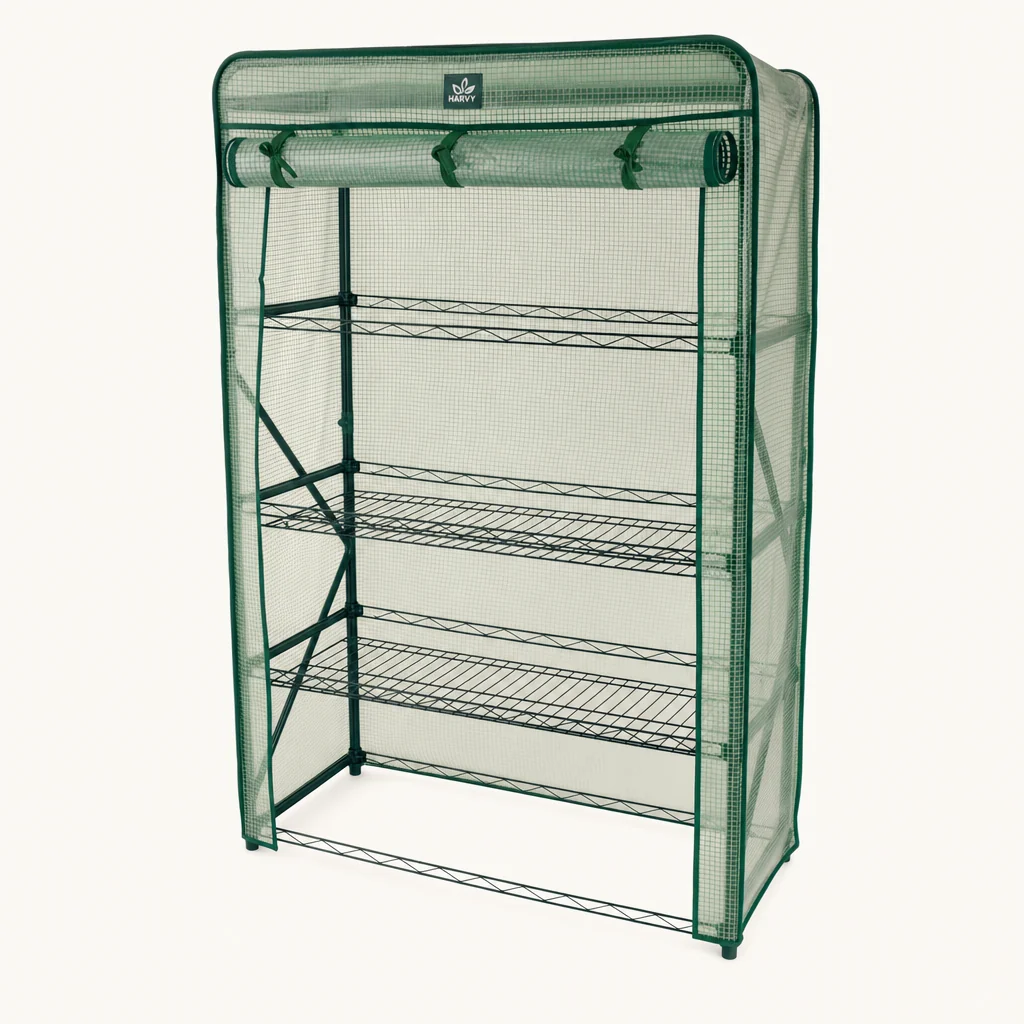
Lead with a fold-down bench. The Vitavia Folding Staging at 1.20m long fits neatly down one side, gives you a proper spring potting surface, and folds flat to liberate vertical space once your cordon tomatoes and cucumbers get going. If you want a permanent work surface as well, a compact two-tier unit on the opposite side stacks your light-hungry seedlings without eating floor space. Keep load expectations realistic in a small house — you're working with that 25kg folding limit and the lighter upper tiers, so think trays and small pots rather than a forest of heavy mother plants.
For a Large Greenhouse (10ft and up)
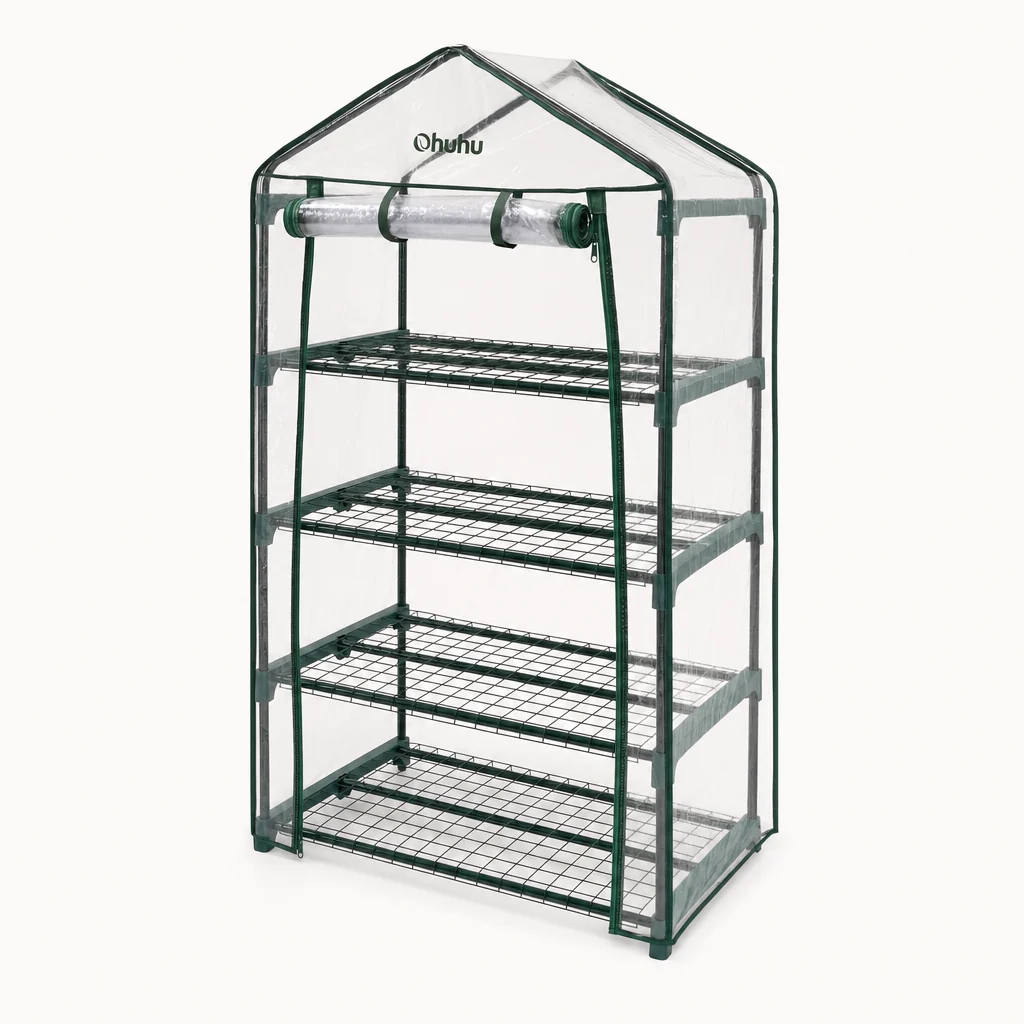
Here I'd build around freestanding aluminium. A Harrod two-tier bench, strength-tested to 77kg of compost per module, becomes the reliable backbone — heavy pots and bags on the bottom slats, working trays on top. Add a three-tier unit at 122cm in a brighter corner for serious vertical stacking, mixing solid trays up top with 5.5cm slats below for drainage. And if your floor is gravel or soil, prioritise cantilever-style frame-mounted staging wherever your greenhouse make offers it, so nothing sinks and tips over the season.
Who Should Buy What
To make this properly actionable, here's how I'd steer different types of grower. Find the description that sounds most like you and you'll have a clear starting point.
The Spring Seed-Starter
You need lots of tray space in March and April, then want it gone by June. A fold-down bench like the Vitavia Folding Staging is made for you — work surface when you need it, flat to the frame when the climbers take over.
The Small-Greenhouse Grower
Every centimetre counts. Pair a folding bench with a compact two-tier unit to stack light-hungry seedlings vertically without surrendering your limited floor.
The Large-Greenhouse Owner
You want a permanent, heavy-duty backbone. A Harrod two- or three-tier aluminium bench, rated to 77kg per module, handles compost, mother plants and trays for the next two decades.
The Tidy Potterer
You like a clean, organised work area and hate maintenance. Aluminium's wipe-clean, zero-upkeep, 20-year service life is exactly your kind of low-fuss.
The Gravel-Floor Grower
Your bench keeps sinking and tipping. Switch to cantilever staging that hangs off the frame — it stays put and level all season, no re-levelling required.
The Display Gardener
You want to show plants off. Tiered staging in a prominent position stacks your specimens at eye level whilst the slatted toppers keep everything beneath well lit.
How the Staging Types Rate
Pulling it all together, here's how I'd score the three approaches across the qualities that matter day to day in a greenhouse. Remember these are characterisations of each type — your individual experience will tilt depending on the specific model and your greenhouse.
The freestanding aluminium category scores so highly because it gets the fundamentals right and then barely asks anything of you afterwards. The only mark against it is assembly — these are self-build kits that need a spanner and a methodical hour or two — but that's a one-off cost against decades of zero-maintenance service. Fold-down staging would score similarly on durability and drainage but trades load capacity for its party trick of vanishing, whilst tiered staging shines on space efficiency and light management at the expense of upper-tier strength.
Frequently Asked Questions
The Verdict
There's no single winner here, and that's genuinely the right answer rather than a cop-out. The three staging types solve three different problems, and the best greenhouse setups often use a combination of all of them.
For small greenhouses, fold-down staging is the hero — the Vitavia Folding Staging gives you a proper potting surface in spring and then disappears flat against the frame when your climbers need the headroom, all from a lightweight, free-draining, anodised aluminium unit. For display and mid-size growing, tiered staging stacks light as cleverly as it stacks pots, with slatted toppers adding around 40cm of bright real estate without casting your lower plants into shadow.
And for larger greenhouses and serious growers, freestanding aluminium is the unbeatable backbone. Harrod Horticultural's two- and three-tier ranges — strength-tested to 77kg per module, safety-edged, and built to last 20+ years with zero maintenance — are exactly what you want carrying the heavy lifting season after season. Just remember the floor: if you're on gravel or soil, prioritise cantilever staging so nothing sinks and tips.
Whatever you choose, choose aluminium and choose slatted. In the warm, humid reality of a working greenhouse, it's the material and surface that quietly keep on performing whilst timber rots and solid benches puddle. Get the staging right and you'll grow more in the same glass box than you ever thought possible.