
Compost Bins Compared: Tumblers, Daleks and Hot Bins
Which style suits your space, speed and effort level — an honest, hands-on look at the three composting archetypes every UK gardener eventually chooses between.
If you've ever stood in a garden centre staring at a wall of compost bins wondering why one costs a tenner and another costs the better part of two hundred quid, you're not alone. Composting kit has quietly become one of the most varied corners of the gardening world, and the choices genuinely matter — not just for your wallet, but for how much faffing you'll be doing on a wet February morning.
In this guide I'm comparing the three families of compost bin that dominate UK gardens: the humble Dalek-style cold composter, the increasingly popular rotating tumbler, and the premium insulated hot bin. Each one answers the same question — "where do my kitchen scraps and grass clippings go?" — in a completely different way. By the end you'll know exactly which camp you belong in.
I've broken everything down by the three things that actually decide whether a compost bin works for you: the space it needs, the speed it delivers usable compost, and the effort it demands week to week. Let's dig in.
The Three Archetypes at a Glance
Before we get into individual models, it helps to understand what genuinely separates these designs. They're not just three price points of the same thing — they work on fundamentally different principles.
Dalek (Cold Composter)
A bottomless plastic cone that sits on bare soil. Worms and microbes come up from below, and decomposition happens slowly at ambient temperature. The UK's most common — and cheapest — type.
Tumbler (Rotating Drum)
A sealed barrel mounted on a frame that you spin to aerate the contents. The mixing speeds up the process and keeps pests firmly locked out, since there's no open bottom.
Hot Bin (Insulated)
A thickly insulated unit engineered to trap the heat that decomposition naturally generates, reaching 40–60°C. That heat composts waste far faster and works right through winter.
The one-sentence summary
Daleks are cheapest and most forgiving but slowest; tumblers offer faster, pest-proof composting with a bit of physical effort; hot bins are the fastest, year-round option but cost the most and demand a steady supply of waste to stay hot.
Dalek-Style Cold Composters: The Default Choice
If your council ever ran a subsidised compost bin scheme, the bin you were offered was almost certainly a Dalek. The nickname comes from the obvious resemblance to a certain Time Lord's nemesis — a tapering cone with a lift-off lid. The reigning name here is Blackwall, whose Compost Converters are made in the UK from recycled plastic and come with a generous 5-year guarantee.
There are two sizes worth knowing. The Blackwall 220L is the compact, best-selling option — ideal for smaller gardens and a genuine budget buy. The larger Blackwall 330L steps things up for average to larger gardens, and it was voted Best Budget Buy by BBC Gardeners' World, which tells you everything about where it sits in the value stakes.
The Dalek's open bottom is both its genius and its weakness. Because it sits directly on soil, worms, beetles and microorganisms migrate up into the heap freely, doing the hard work for you. There's nothing to plug in, nothing to assemble, and nothing to break. You simply pop it on a patch of earth, start layering in greens and browns, and wait.
The trade-off is that "wait" is the operative word. Cold composting at ambient UK temperatures can take many months — sometimes the best part of a year — to produce crumbly, finished compost. And that same open base is an open invitation to rodents if you're careless with food waste. Blackwall does offer a base plate as an add-on for the 330L, which helps considerably with pest resistance.
Pros
- By far the cheapest way into composting
- No assembly and no power required
- UK-made from recycled plastic, UV-stabilised against degradation
- 5-year guarantee on both sizes
- Worms enter naturally through the open base
- 330L voted Best Budget Buy by BBC Gardeners' World
Cons
- Slowest method — finished compost can take many months
- Open bottom offers low pest resistance as standard
- No insulation, so activity stalls in cold weather
- Turning the heap means digging it out, which is awkward
- Best avoided for cooked food, meat or dairy
A Dalek must sit on bare soil, not paving or decking, to work properly. The connection to the ground is what lets soil life colonise your heap. If you've only got a patio, a tumbler or hot bin will serve you far better.
Tumbler Composters: Speed Without the Spade
Tumblers solve the Dalek's two biggest annoyances in one go: they're fully enclosed against pests, and turning the contents is as simple as giving the drum a spin rather than wrestling a garden fork through a sticky heap. The aeration that comes from regular turning is what accelerates decomposition — oxygen keeps the helpful aerobic microbes happy and working hard.
Most quality tumblers use a dual-chamber design, and this is the feature I'd genuinely insist on. With two chambers, you fill one until it's full, then leave it to finish whilst you start loading fresh waste into the second. Without that, you'd be adding raw scraps to nearly-finished compost forever and never have a "done" batch. Let's look at the standouts.
Outsunny 80L & 160L Dual-Chamber Tumblers
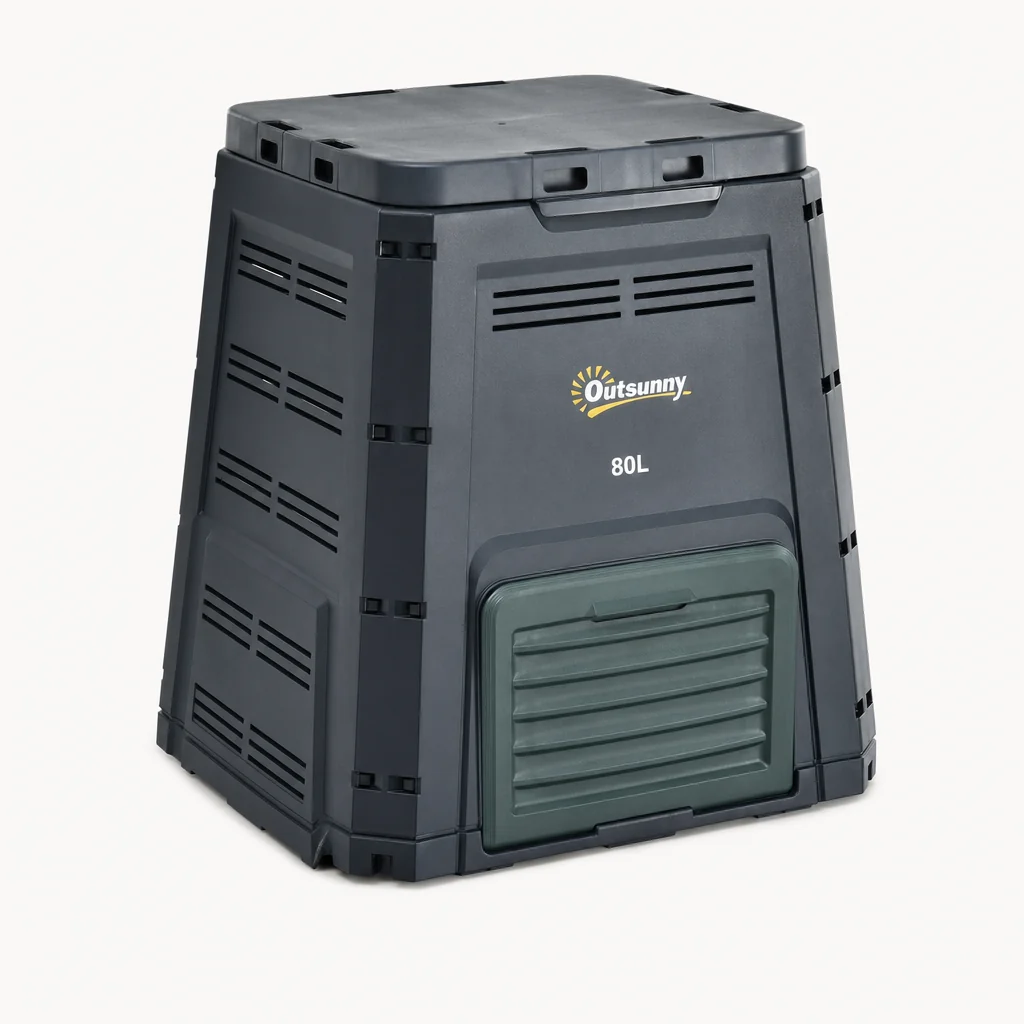
The Outsunny range is the affordable entry point. The compact 80L model suits very small gardens, whilst the 160L is the mid-size workhorse. Gardeners' World gave the 160L a solid 4 out of 5, calling it well made and reasonably priced.
It stands 92cm tall with a useful 32cm of clearance to the base — handy for sliding a bucket or barrow underneath when emptying. The one real quirk is the chamber door, which measures just 22.5cm × 13.5cm. That's a fairly small letterbox, so you'll need to chop bulky waste down before it'll fit. Not a dealbreaker, but worth knowing.
Maze 180L Dual-Chamber Tumbler
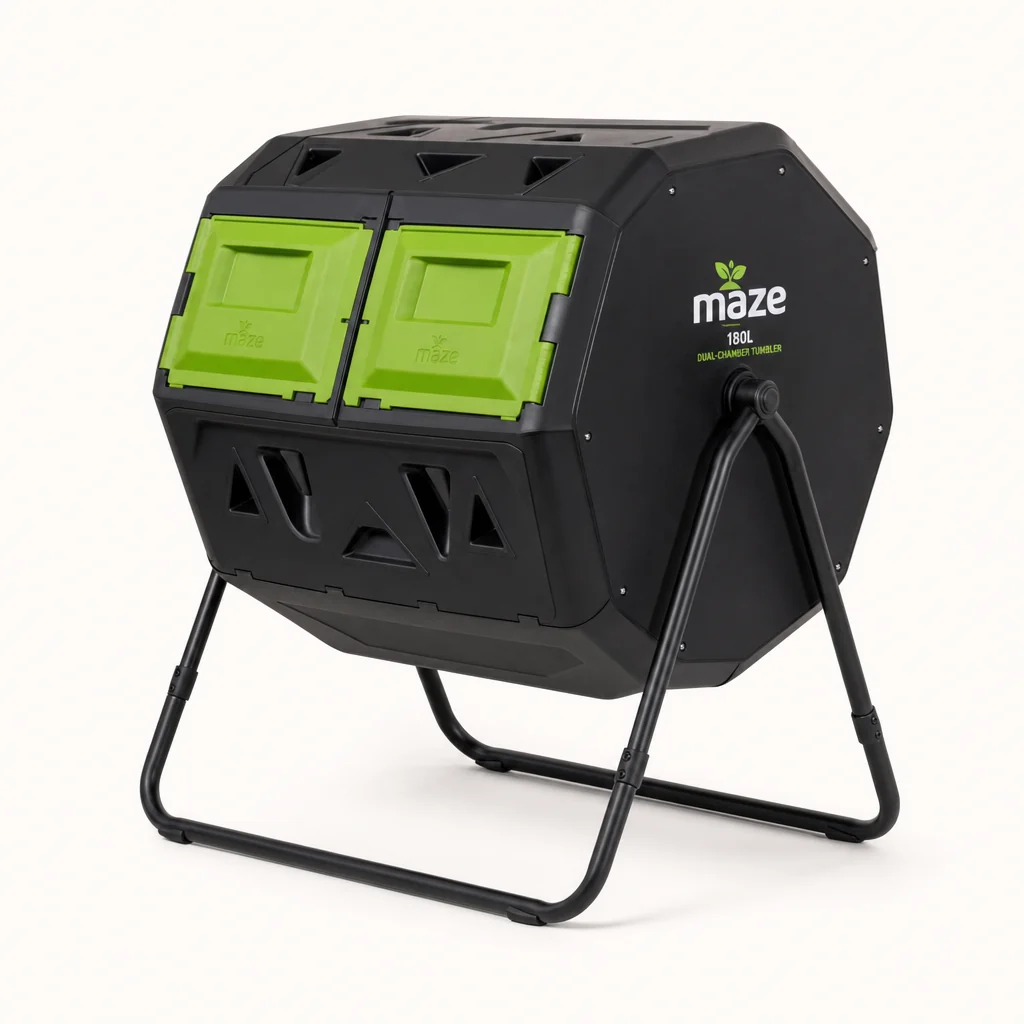
The Maze is the one I'd point most people towards if budget allows. It earned a superb 4.5 out of 5 from Gardeners' World, and the reasons are tangible. Its standout feature is a geared turning mechanism paired with a sturdy handle, which makes spinning the 180L drum genuinely easy even when it's full and heavy — the single most common complaint about cheaper tumblers. The gearing also locks the drum in position, so it won't roll about whilst you're emptying it.
It's tall at 109cm with 35cm of ground clearance, and the doors are reassuringly large — no chopping gymnastics required. Build quality is excellent too: the barrel is 90% recycled plastic, UV-protected, sitting on a powder-coated zinc frame, backed by a 3-year warranty.
Joraform JK270
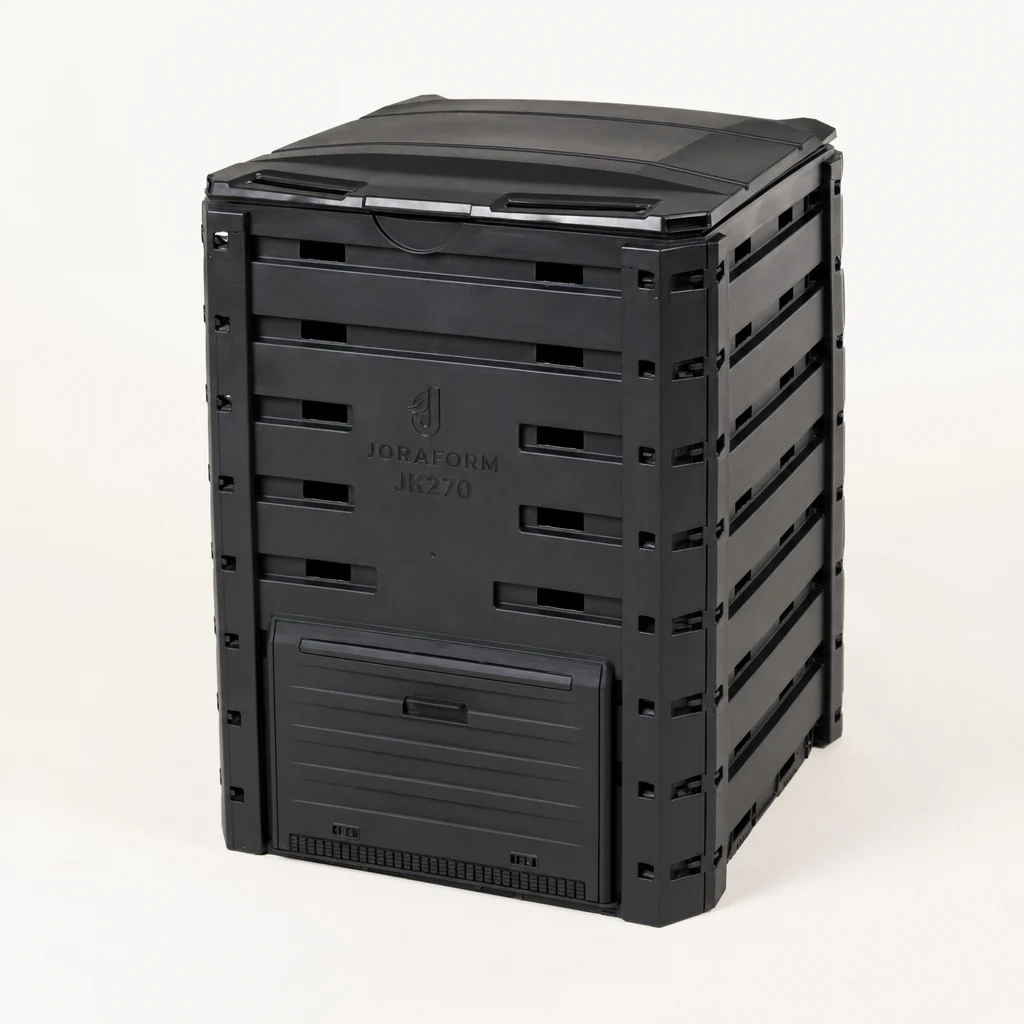
The Joraform JK270 sits in a class of its own. This is a premium, Swedish-designed dual-chamber tumbler built from insulated galvanised steel rather than plastic, and the insulation is the whole point. With a capacity of 9.5 cubic feet (around 269L) split across two chambers, the thick insulation lets it reach high internal temperatures quickly — so quickly, in fact, that it can handle tougher materials including meat and dairy scraps when it's managed properly.
It effectively blurs the line between a tumbler and a hot bin, combining the pest-proof, easy-turning convenience of a drum with the heat and speed of insulation. The catch, predictably, is price — it's the most expensive tumbler option by a comfortable margin.
Pro Tip for tumbler owners
Tumblers can become a heavy, sloppy mess if you load too many wet "greens" without enough dry "browns" like shredded cardboard or dead leaves. Aim for a rough balance, and if it ever turns soupy, just add a few handfuls of torn cardboard and give it a spin to bring it back.
Pros
- Fully enclosed — excellent pest resistance
- Turning is quick and clean, no digging
- Dual chambers give you a continuous supply
- Works on patios and hard standing
- Maze's geared mechanism makes turning effortless
Cons
- Smaller capacity than a hot bin or large Dalek
- Cheaper models have small loading doors (chopping needed)
- Standard plastic models stall in cold weather
- A full drum is heavy without geared assistance
- Joraform's hot-capable version is pricey
Hot Bins: The Year-Round Powerhouses
Hot bins are where composting gets serious. The principle is beautifully simple: decomposition naturally produces heat, but in a Dalek or tumbler that heat escapes instantly. Wrap the process in thick insulation and you trap it, allowing the internal temperature to climb to 40–60°C. At those temperatures everything happens faster, the bin keeps working through winter, and the heat helps break down a wider range of waste.
The HOTBIN Range
HOTBIN is the dominant name in UK hot composting, and its bins are made from ARPRO® Expanded Polypropylene (EPP) — the same lightweight, insulating material used in car bumpers and bike helmets — with chunky 50mm walls. The range scales neatly with household size.
HOTBIN Mini (100L)
The smallest in the range, ideal for singles and couples with modest garden waste. It arrives with no assembly required and needs just 2.5kg (about 5 litres, or one small kitchen caddy) of waste per week to stay hot.
HOTBIN 200L (Mk2)
The core model and the one most households want. With 200L of capacity it's recommended for 3–5 person households, and like the Mini it arrives fully assembled and ready to fill.
HOTBIN Mega 450L
A large-scale unit aimed at allotments and community gardens. To stay properly hot it wants roughly 20kg of waste per week — this is not a bin for a quiet household.
HOTBIN Mega 700L
The biggest of the lot. Same proven science as the 200L, just scaled up to an industrial footprint for high-volume sites.
Green Johanna 330L
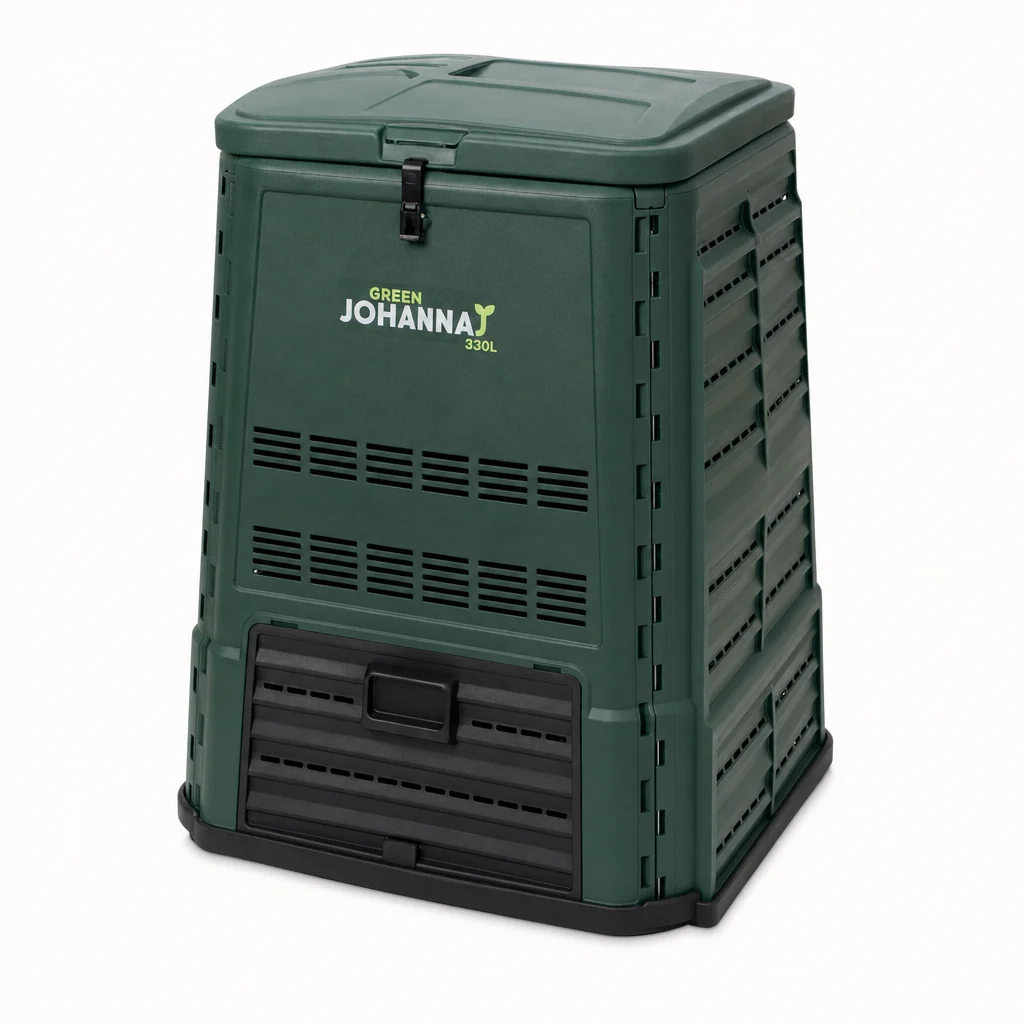
The main alternative to HOTBIN is the Green Johanna, another Swedish-designed insulated hot composter with a 330L capacity. It takes a slightly different approach to the same goal. Crucially, it's designed to be rodent-resistant, thanks to a base plate that closes off the underside — a notable advantage if vermin are a concern at your plot. It uses a patented airflow system to keep the process oxygenated, and for the truly committed there's an optional Winter Jacket that adds extra insulation to keep things cooking through the harshest cold snaps.
The catch with hot bins
Hot bins only stay hot if you feed them enough. The Mini needs at least 2.5kg a week and the Mega 450L wants around 20kg. If your waste stream dries up — say you go on holiday for a fortnight — the temperature drops and you're effectively running an expensive cold composter until you build the volume back up.
Pros
- Far faster than cold methods at 40–60°C
- Works year-round, right through winter
- Handles a wider range of waste than a Dalek
- HOTBIN Mini and 200L arrive fully assembled
- Green Johanna's base plate offers strong rodent resistance
- Optional Winter Jacket extends cold-weather performance
Cons
- The most expensive of the three archetypes
- Needs a consistent, sufficient supply of waste to stay hot
- Mega sizes demand serious volume (20kg/week for the 450L)
- More active management than a "fill and forget" Dalek
Head-to-Head: How They Really Compare
Here's the comparison I wish I'd had when I bought my first bin — the three archetypes side by side on the factors that actually matter.
| Feature | Dalek (Blackwall) | Tumbler (Maze 180L) | Hot Bin (HOTBIN 200L) |
|---|---|---|---|
| Composting speed | Slow (months) | Moderate–fast | Fastest |
| Works in winter | Largely stalls | Slows down | Yes, 40–60°C |
| Pest resistance | Low (open base) | High (sealed) | High |
| Effort per week | Low (but slow) | Moderate (spin drum) | Moderate (managed) |
| Works on a patio | No (needs soil) | Yes | Yes |
| Assembly | None | Some | None |
| Best capacity | 220L / 330L | 180L dual | 200L |
| Relative cost | Lowest | Mid | Highest |
Matching the Bin to Your Garden
Specs only get you so far — the right bin really comes down to who you are and how you garden. Here's my honest steer for the most common situations.
The Budget Beginner
Get a Blackwall Dalek — the 330L if you've got the space. It's cheap, indestructible, and the perfect low-stakes way to learn what composting is all about. Just put it on soil.
The Patio Gardener
With no bare soil, a Dalek is out. An Outsunny or Maze tumbler is your answer — sealed, pest-proof and perfectly happy on hard standing.
The Impatient Grower
If waiting months drives you spare, a HOTBIN 200L delivers compost fast and keeps going all winter. Just be sure you generate enough waste to feed it.
The Rodent-Wary
Worried about vermin? The Green Johanna's base plate, or any sealed tumbler, locks pests out. Avoid open-bottomed Daleks if rats are a known problem.
The Allotmenteer
High volume needs scale. A HOTBIN Mega 450L or 700L eats the green waste a busy plot generates — provided you can supply around 20kg a week.
The Zero-Waste Cook
Want to compost meat and dairy? You need genuine heat. The insulated Joraform JK270 or a hot bin can handle scraps a cold bin never should.
Frequently Asked Questions
My Verdict and Ratings
There's no single "best" compost bin — only the best one for your circumstances. But if I'm scoring each archetype on what it sets out to do, here's where I land.
The Bottom Line
For most UK gardeners dipping a toe into composting, the Blackwall 330L Dalek remains an unbeatable starting point — cheap, durable and rightly crowned Best Budget Buy by BBC Gardeners' World. If you're short on soil or sick of fighting pests, the Maze 180L tumbler is the all-rounder I'd recommend, its geared mechanism turning the worst chore of composting into a five-second spin (and its 4.5/5 from Gardeners' World is well earned).
And if speed and year-round performance are your priorities — and you generate enough waste to feed it — the HOTBIN 200L or the rodent-resistant Green Johanna 330L are genuinely transformative, turning scraps into finished compost while your neighbours' cold heaps sit frozen and dormant.
Pick the one that fits your space, your patience and your waste stream, and you really can't go wrong. Happy composting.