
The Best Self-Watering Planters for Holidays and Hot Spells
Reservoir planters compared for patios and balconies — plus clever DIY alternatives that cost next to nothing.
There's a particular flavour of dread that visits every gardener the night before a summer holiday. You've spent months coaxing tomatoes up their canes, nursing a tumble of trailing petunias into a proper show, and now you're about to abandon them for a fortnight of relentless July sunshine. The neighbour who "definitely will pop round" almost never does, and even when they do, they either drown everything or forget entirely. I've lost more container plants to a two-week trip than I care to admit.
Self-watering planters are the honest answer to this problem. Rather than relying on your memory, a timer, or the kindness of strangers, they store a reservoir of water beneath the soil and let the plant help itself — drawing up exactly what it needs, when it needs it. In my experience they're the single biggest upgrade you can make to a patio or balcony garden if you travel at all, or if you simply live somewhere that bakes in a heatwave.
In this guide I'll walk you through how these clever pots actually work, compare the best reservoir planters currently worth buying — from German-engineered LECHUZA systems to app-controlled smart towers — and finish with a few DIY approaches that'll keep things alive for a long weekend without spending a penny. Whether you're kitting out a tiny balcony or a sprawling terrace, there's something here to keep the water flowing whilst you're sipping something cold elsewhere.
How Self-Watering Planters Actually Work
Before we get into specific models, it's worth understanding the mechanism, because it explains why some designs cope with a hot spell far better than others. The vast majority of self-watering planters rely on capillary action, also known as wicking. In practical terms, the planter uses thick strings, wicks or a capillary material to move water from a water tank up into your plant's roots.
Here's the elegant part: the plant essentially waters itself on demand. Water is pulled up through the soil to the leaves until it's absorbed, at which point the plant draws up more. There's no float valve to jam, no electricity required in most cases, and no risk of the whole reservoir dumping into the pot at once. The soil takes only what it can hold, and the rest waits patiently below.
A well-designed self-watering pot has three components working together. First, a reservoir at the base that holds anywhere from a couple of quarts to several gallons of water. Second, a wicking system — either dedicated wicks, a fabric disk, or a column of moisture-retentive substrate — that bridges the gap between water and roots. Third, an overflow or drainage feature so heavy rain doesn't leave your plant sitting in a swamp. Miss any one of these and you either get a bone-dry pot or root rot; get all three right and you've got a planter that genuinely looks after itself.
Pro Tip
Self-watering planters shine for thirsty, consistent-moisture lovers — tomatoes, basil, ferns and most annual bedding. They're a poor match for succulents, cacti and Mediterranean herbs like rosemary and lavender, which actively prefer to dry out between drinks. Match the planter to the plant's temperament, not just your holiday dates.
What to Look For Before You Buy
Not every reservoir planter is built for the same job, and the marketing rarely makes the differences clear. Over years of testing these on my own south-facing terrace — which turns into a frying pan by mid-afternoon — I've settled on a handful of criteria that actually matter when the temperature climbs.
Reservoir capacity relative to pot size
A big-looking planter with a mean little tank will run dry in days during a heatwave. Look for a reservoir sized generously against the growing volume — the difference between a 2-quart and a 3.7-gallon tank is the difference between refilling twice a week and refilling once a month.
A visible water gauge
The single most useful feature. A dial or float indicator tells you at a glance whether you need to top up, so you're not guessing or overfilling. It's also invaluable for calibrating how long a full tank lasts before you commit to a fortnight away.
UV stability and frost resistance
Outdoor planters live a hard life. Cheap resin fades and cracks within a season or two. The better designs are UV-stabilised and rated to shrug off frost, so they survive winter storage without splitting.
Root aeration and anti-drowning design
The best planters lift the growing insert on elevated "feet" or use slatted bases so roots sit above the waterline. This prevents the roots from drowning and keeps oxygen circulating — crucial for avoiding rot in a sealed system.
Overflow drainage
Drainage knockouts or an overflow channel let excess rainwater escape rather than pooling. Without it, one heavy summer downpour can turn your self-watering pot into a stagnant bog.
LECHUZA: The German-Engineered Benchmark
If self-watering planters had a blue-chip name, it would be LECHUZA. This German brand has been quietly setting the standard for years, and when people ask me for a "buy once, cry once" recommendation, this is usually where I point them. The build quality genuinely feels a cut above the resin competition.
What sets LECHUZA apart is its substrate. Rather than relying solely on wicks, the system uses LECHUZA-PON granulate — a lightweight, pH-neutral mix of pumice and zeolite that sits between the soil and a 3-4 quart reservoir. This granulate does three jobs at once: it wicks water upward, it provides superb oxygenation to the roots, and it acts as a physical buffer separating the wet reservoir zone from the soil itself. The result is remarkably consistent moisture without the sogginess that plagues cheaper wick-only pots.
The range spans multiple models, typically from around 8 to 12 inches in diameter, so there's something to suit a windowsill herb pot or a statement patio planter. Prices reflect the engineering — the range runs from roughly the £30–40 mark for smaller pots up to well over £150 for the largest, most decorative pieces. It's not the cheapest way into self-watering, but the substrate system and materials justify the outlay if you're planting something you want to keep for years.
Pros
- PON granulate delivers exceptional root oxygenation and consistent moisture
- pH-neutral substrate suits a wide range of plants
- Genuinely premium build quality that lasts years
- Wide model range from windowsill to statement size
- Reservoir cleanly separated from soil, reducing rot risk
Cons
- Premium pricing puts it at the top of the market
- 3-4 quart reservoir is modest for the biggest thirsty plants in extreme heat
- PON substrate is an ongoing cost if you re-pot regularly
- Overkill for short-term or purely seasonal displays
The Best Value and Everyday Options
Not everyone wants to spend LECHUZA money, and happily the mid-market is where self-watering has really come of age. A few models stand out for hitting a genuine sweet spot between price, looks and performance.
GARDENIX DECOR Self-Watering Planters
Sold as a 3-pack of 7-inch pots, these are my go-to recommendation for anyone furnishing a balcony or clustering plants on a patio table. Each pot is infused with coco coir for natural pH balance, and the design is genuinely thoughtful: a dial-style growth tracker and water gauge on the side, a nested inner pot that lifts the plant on legs above a reservoir rated to last 10+ days, and hydroponic wicks delivering targeted hydration. Slats around the base ensure 360° airflow, and in Better Homes & Gardens trials this arrangement produced 25% fewer fungal issues than conventional pots.
At 6.5 inches tall with a matte finish in eco-friendly shades like gray and teal, they slot neatly into modern spaces. The pre-mixed coir pellets are a nice touch too — they accelerate establishment by around 15%, so new plantings settle in and bloom faster.
Bloem Self-Watering Window Box
For rails, ledges and window sills, the Bloem window-box style (the medium runs to 21 inches long) is a robust, sensible choice. It carries a two-week reservoir and a snap-in wicking disk that spreads moisture evenly across the whole box — important in a long planter where the far end tends to go dry. It's UV-stabilised, comes in six colours including a handsome terracotta, and the rolled rim plus drainage knockouts channel excess water away. It happily supports veggies like tomatoes without rot, and at just 4 lb the frame is light enough to lift comfortably and even stacks for expanded yields.
Mainstays Resin Self-Watering Planter
The budget-friendly all-rounder. Available in two colours and four sizes, it's aimed squarely at houseplants that thrive on consistent moisture, though it works equally well outdoors. An interior funnel feeds a built-in reservoir, slats on the base of the inner compartment give good drainage and airflow, and the removable insert sits on elevated feet to keep roots from drowning. Nothing fancy, but it nails the fundamentals at a price that lets you buy several.
A "10-day" or "two-week" reservoir rating almost always assumes moderate conditions. In a genuine heatwave with full sun and drying winds, expect real-world autonomy to drop by a third or more. Always test your setup over a normal week before trusting it with a fortnight away.
Eco-Conscious and Design-Led: Tierra Verde
If sustainability sits high on your list, the Tierra Verde Self-Watering Planter deserves a proper look. It's crafted from 100% recycled rubber sourced from post-consumer tyres, which is about as satisfying an origin story as garden kit gets — old tyres kept out of landfill and turned into something genuinely lovely.
The aesthetic is deliberately understated: earthy tones such as slate gray and soft white, with a slightly tapered, rectangular form that ranges from 10 to 18 inches and lends a modern, boho-chic vibe. The mid-size measures 10×20 inches. Beneath the good looks sits an integrated sub-irrigation system with a generous bottom reservoir holding up to 2 quarts.
Performance backs up the styling. In Better Homes & Gardens' 2025 tests, plants grown in this model showed 30% faster growth rates compared to standard pots — a meaningful margin that reflects how effective consistent sub-irrigation is at keeping plants in their happy zone. The rubber construction also has a practical bonus: it's naturally flexible and won't crack in frost the way rigid resin can.
For the Vegetable Grower: Vego, Gusta Garden and Dexceder
Ornamentals are one thing, but if you're growing food on a balcony or patio, you want a planter with the reservoir capacity and structural support to see a crop through to harvest. Three models stand out here, each targeting a slightly different grower.
Vego Garden Self-Watering Rolling Tomato Planter
Purpose-built for tomatoes and other climbing veg, this is an excellent solution for anyone who wants a proper crop without daily watering. It keeps plants supplied with the right amount of moisture for optimal growth, eliminating the daily-watering chore, and it includes a sturdy trellis to support vertical growth — ideal for the cramped confines of a balcony or patio. The clever addition is a set of rolling wheels, letting you shift a heavy, fruit-laden plant effortlessly to chase the sun or, just as usefully, wheel it into shelter when harsh weather threatens.
Gusta Garden Sissi Four-Tier Planter
Where floor space is at an absolute premium, the Gusta Garden Sissi goes vertical with a four-tier design that's ideal for balconies and small patios. Water poured into the top distributes evenly throughout the whole system, so a single top-up feeds every level. The tiered layout also helps protect crops from pests, and it's well suited to strawberries, herbs, lettuces and flowers — a genuinely productive little tower for a compact space.
Dexceder 31.5-inch Rattan-Effect Planter
For lush window boxes on rails, balconies or patios, the Dexceder is a smart pick for time-poor gardeners. It houses two removable inner pots and a large reservoir with a substantial 3.7-gallon capacity, meaning refills only every few weeks for most plants. Its sub-irrigation system uses negative pressure to draw water up as the plant needs it, keeping soil aerated and roots healthy, and water-level indicators take the guesswork out. Built from thick PP plastic that mimics a rattan weave, it withstands UV rays, frost and weather without fading or cracking — a properly durable choice that looks far more expensive than it is.
Pro Tip
Thirsty crops like tomatoes will empty a reservoir far faster than ornamentals, especially once they're fruiting heavily in high summer. For a two-week trip, prioritise the largest-reservoir models — the Dexceder's 3.7 gallons or the Vego's capacity — and group everything in a spot that gets morning sun but afternoon shade to slow evaporation.
The Smart Option: LetPot MP1 Modular Planter
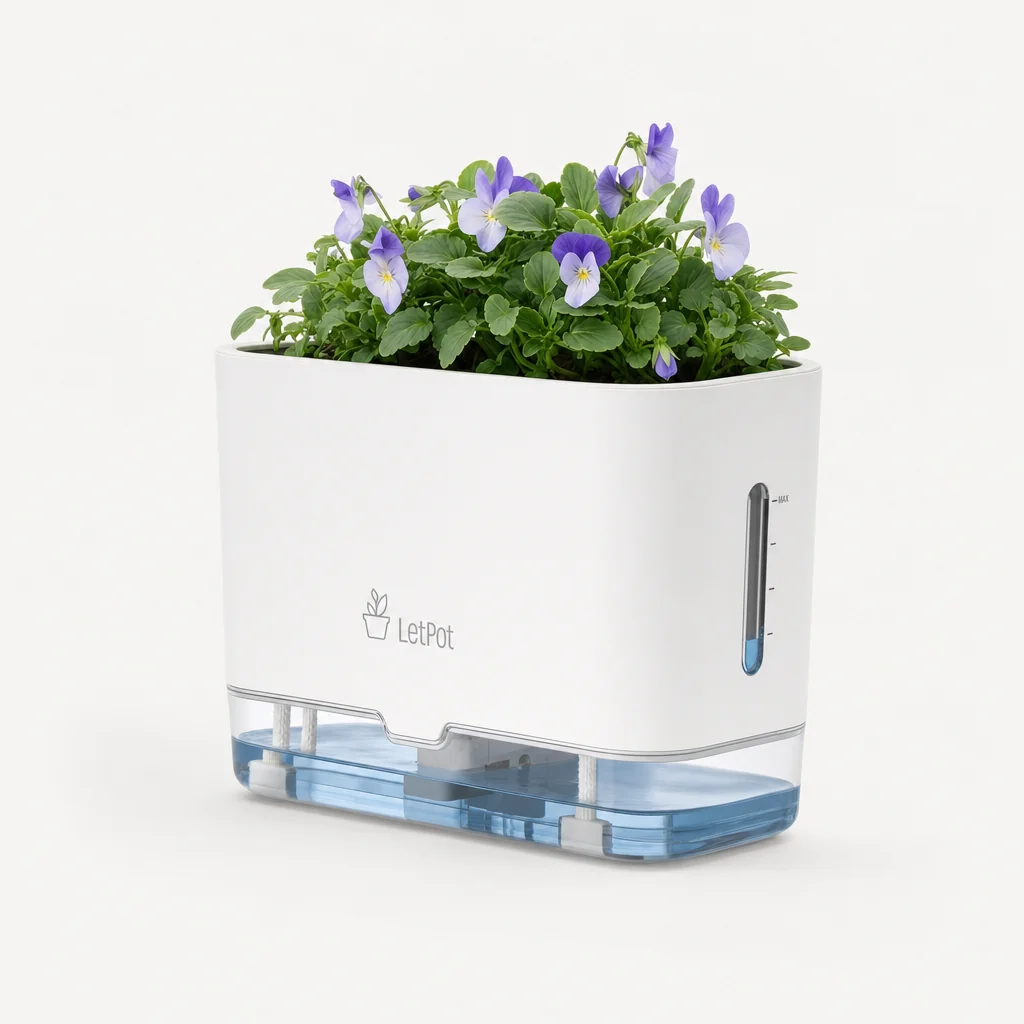
At the far end of the spectrum sits the LetPot MP1, which drags the humble self-watering planter into the connected age. This is a modular smart planter controlled via a mobile app, ideal for both hydroponic and soil cultivation, and it seamlessly integrates automatic watering and water circulation rather than relying on passive wicking alone.
The MP1 is built around six interconnected growing chambers with integrated water distribution, so a whole cluster of plants runs from one system. It carries an IP66 waterproof rating, meaning it's protected against dust and low-pressure water jets from all directions — properly rated for outdoor as well as indoor use, which many "smart" garden gadgets aren't. The headline figure, though, is the autonomy: fill it up once and you can forget about watering for 30 to 45 days. That's holiday-proof by any standard.
There's a neat trick up its sleeve for the ambitious, too. The onboard pump can lift water up to 3 metres, making it ideal for a vertical tower hydroponic garden — so you can build upward on a balcony and still keep everything fed from a single reservoir. It's the most complex option here and asks for a bit of setup and the occasional app fiddle, but for a tech-minded grower who travels a lot, the payoff is genuine peace of mind.
App control
Monitor and adjust watering from your phone, wherever you are — useful for tweaking a schedule remotely before a hot spell.
IP66 weatherproofing
Dust-tight and resistant to water jets from any direction, so it copes with the great outdoors as well as a kitchen counter.
30–45 day autonomy
A single fill covers even a long holiday, thanks to active pumping and circulation rather than passive wicking alone.
3-metre lift height
The pump can feed a vertical tower garden, opening up serious yields in a small footprint.
Head-to-Head Comparison
Here's how the leading contenders stack up against one another. I've focused on the details that actually matter for a holiday or a heatwave — reservoir size, how long you can leave it, and where each one truly belongs.
| Model | Reservoir / Autonomy | Standout Feature | Best For |
|---|---|---|---|
| LECHUZA | 3–4 quart reservoir | PON pumice & zeolite substrate | Long-term, premium plantings |
| GARDENIX DECOR | 10+ day reservoir | 25% fewer fungal issues; growth tracker | Balcony & patio clusters |
| Tierra Verde | Up to 2 quarts | Recycled rubber; +30% growth | Eco-minded, design-led |
| Bloem Window Box | 2-week reservoir | Snap-in wicking disk; UV-stable | Rails & window ledges |
| Dexceder Rattan | 3.7-gallon capacity | Negative-pressure sub-irrigation | Large window boxes, low effort |
| Vego Rolling Tomato | Large, with trellis | Rolling wheels; vertical support | Balcony tomato growers |
| LetPot MP1 | 30–45 day autonomy | App control; IP66; 3m pump lift | Tech-savvy, frequent travellers |
Reservoir figures are quoted as manufacturers state them and in the units they use — some in quarts, some in gallons. When comparing, remember that a bigger tank paired with a smaller, less thirsty plant is what buys you the longest hands-off stretch.
DIY Self-Watering Alternatives
Perhaps you've only got a long weekend away, or you don't fancy buying new planters for pots you already love. The good news is that the same capillary principle behind every commercial model can be recreated at home for pennies. These won't match a purpose-built reservoir for a fortnight, but for a few days they're brilliant — and I've relied on all of them at one time or another.
The wick-and-bottle method
Cut a length of cotton rope or a strip of old towel, bury one end a few inches into the pot's soil and drop the other into a bottle or bucket of water sitting alongside. Capillary action does the rest, drawing water into the soil at the plant's pace. Use a thicker wick for thirstier plants and a larger reservoir for longer trips.
The inverted bottle drip
Fill a plastic bottle, pierce a couple of tiny holes in the cap, and invert it into the soil. It releases water slowly as the surrounding soil dries. Cheap and cheerful, though harder to control precisely than a wick — test the flow rate before you leave.
The capillary mat tray
Stand several pots on a water-retentive mat (or a folded towel) in a shallow tray kept topped up with water. The mat wicks moisture up through each pot's drainage holes. Perfect for grouping lots of small pots — a common trick with seedlings and herbs.
The bucket-in-bucket reservoir
Nest a drilled inner pot inside a larger watertight container, add a wicking column of soil or rope reaching down into the base, and you've essentially built a LECHUZA-style planter from junk. It's fiddly but genuinely effective, and a satisfying weekend project.
Pro Tip
Whatever method you use, move containers out of blazing direct sun and cluster them together before you leave. Grouped pots shade one another's soil and raise local humidity, dramatically slowing evaporation. Mulching the surface with bark or gravel buys you extra days too — often the difference between coming home to survivors and coming home to casualties.
Our Rating and Verdict
Taken as a category, self-watering planters have earned a firm place in my garden, and the current crop is the strongest I've used. Here's how they score across the measures that matter for holidays and hot spells.
The Verdict
There's no single "best" self-watering planter, because the right one depends entirely on what you're growing and how long you're away. But the category as a whole is a resounding success, and I'd struggle to garden on my terrace without them now.
For a lifetime investment in a plant you cherish, LECHUZA and its PON substrate remain the benchmark — beautifully made and kind to roots. For everyday balcony and patio duty on a sensible budget, the GARDENIX DECOR three-pack, with its 25% reduction in fungal problems, is my most-recommended choice. Eco-minded gardeners should look hard at the recycled-rubber Tierra Verde and its 30% growth advantage. And if you disappear for weeks at a time, the app-controlled LetPot MP1, with 30–45 days of autonomy and an IP66 rating, is as close to worry-free as this hobby gets.
Whichever route you choose, pair it with a shady position, a good mulch and a quick dry-run before your trip, and you'll come home to a thriving display rather than a row of crispy regrets.
Who Should Buy Which?
The Frequent Traveller
Go straight for the LetPot MP1. A single fill covers 30–45 days, so even back-to-back trips won't leave your plants gasping.
The Balcony Gardener
The GARDENIX DECOR three-pack or the vertical Gusta Garden Sissi make the most of tight space with minimal fuss.
The Veg Grower
The Vego rolling tomato planter and the 3.7-gallon Dexceder deliver the reservoir capacity thirsty crops demand.
The Eco-Conscious Buyer
Tierra Verde's recycled-tyre construction and proven growth boost tick the sustainability and performance boxes together.
The Long-Term Investor
LECHUZA's engineered PON system is built to keep a treasured plant thriving for years, not just one season.
The Budget-Minded
The Mainstays resin planter or a DIY wick-and-bottle setup keeps things alive without spending much at all.
Frequently Asked Questions
Self-watering planters won't turn a black thumb green, but they will free you from the tyranny of the daily watering can and let you enjoy a holiday without spending it worrying about your tomatoes. Match the model to your plants and your travel habits, do a dry run before you go, and you'll wonder how you ever managed without them.