
Choosing a Pressure Washer for Patios, Decking and Cars
Pressure ratings explained in plain English — plus my picks for light, medium and heavy jobs from Kärcher, Bosch and Nilfisk.
If you've ever stood in a shop aisle (or scrolled an endless product page) staring at numbers like "110 bar" and "145 bar" with absolutely no idea whether that's enough to shift the green slime off your patio without blasting your decking into matchsticks — you're in exactly the right place.
I've spent a good while getting to grips with the domestic pressure washer market, and the single most common mistake I see people make is chasing the biggest number on the box. The truth is more nuanced, and frankly more interesting. A machine that's perfect for reviving years of grime from block paving can genuinely ruin a softwood deck or strip the wax clean off your car's bonnet. Match the tool to the task and you'll get spotless results; get it wrong and you'll be sanding splinters out of your decking all summer.
So this guide does two things. First, I'll demystify the whole bar-versus-PSI business and explain why pressure isn't the whole story. Then I'll walk you through five genuinely excellent models — from a compact entry-level Kärcher right up to a serious large-patio workhorse — so you can buy once and buy right.
Bar vs PSI: The Numbers Decoded
Let's clear up the confusion straight away. Bar and PSI are both units of pressure — they're just measuring the same thing in different languages. Here in the UK, most pressure washers quote their figures in bar, whilst American machines and a fair few spec sheets use PSI (pounds per square inch).
The conversion is delightfully simple: 1 bar equals roughly 14.5 PSI. So when you see a Kärcher K2 rated at 110 bar, that's equivalent to about 1,600 PSI. Step up to a K5 at 145 bar and you're looking at roughly 2,100 PSI. Keep that 14.5 multiplier in your back pocket and you'll never be baffled by a spec sheet again.
The Truth About Pressure Numbers
Bar pressure alone tells you almost nothing about real-world performance. A 140-bar machine with an excellent flow rate and a quality pump will outperform a poorly engineered 165-bar model every single time. Pressure is the force of the water; flow rate is how much of it you're delivering — and it's flow that dictates how quickly you actually clean a surface.
This is the bit nobody tells you. Whilst PSI (or bar) determines the force of the water hitting the surface, the flow rate — measured in litres per hour here in the UK, or gallons per minute across the pond — determines how much water is being shifted. Think of it like this: pressure is how hard you're scrubbing, flow is how big your sponge is. You need both working in harmony. A high-pressure, low-flow machine will clean a tiny spot beautifully but take an age to cover a large patio.
Pressure Tiers by Task: Your Cheat Sheet
Right, here's the genuinely useful bit — the pressure ranges you actually want for each job. Bookmark this, because it'll save you from both disappointing results and expensive damage.
| Task | Bar Range | PSI Equivalent |
|---|---|---|
| Cars, bikes, garden furniture | 90–125 bar | 1,300–1,800 PSI |
| Wooden decking (softwood) | 35–100 bar | 500–1,500 PSI |
| Composite decking | 100–140 bar | 1,500–2,000 PSI |
| Patios, driveways, brickwork | 125–170 bar | 1,800–2,500 PSI |
| Heavy concrete / deep stains | 170–220 bar | 2,500–3,200 PSI |
A few things jump out from that table. Notice how cars sit at the gentle end — 90 to 125 bar (1,300–1,800 PSI) is the sweet spot, and honestly you can wash a vehicle effectively anywhere between 1,200 and 1,900 PSI as long as you pair it with a wide spray pattern. Go much higher and you risk damage. In practice, 110 bar is plenty for lifting road grime without stripping wax or eating into the clear coat.
Wooden decking is the most delicate customer of the lot. Softwood wants just 500 to 1,500 PSI (35–100 bar). Anything more aggressive and you'll splinter the wood fibres, gouge the surface, or leave visible streaks that look worse than the dirt you started with. Composite decking is hardier — it'll happily take 1,500 to 2,000 PSI, and that extra grunt helps lift mildew and algae buildup without harming the material.
Patios, driveways and brickwork are where you finally get to unleash some real power: 125 to 170 bar (1,800–2,500 PSI). And only proper heavy concrete with deeply ingrained stains justifies that top tier of 170 to 220 bar.
Higher pressure is not always better. For car paint, wood decking and older mortar, dial things down to avoid damage. Block paving responds well to around 140 bar with a rotary nozzle — but exercise caution near mortar joints, as excessive pressure can erode the pointing. A surface cleaner attachment spreads the load evenly and prevents streaking on patios.
Understanding the UK Duty Tiers
Beyond raw pressure, the industry sorts domestic machines into three broad duty classes. Understanding these helps you avoid both under-buying (a frustrating, underpowered machine) and over-buying (paying for capability you'll never use).
Light Duty
Best for small areas of lightly soiled paving, bicycles, small cars and garden furniture. These have low-powered motors (1,200W–1,600W), water pressure below 90 bar, low flow rates, and short hoses around 3–5 metres. Perfect for flats, small courtyards and the occasional car wash.
Medium Duty
The sweet spot for most households. Ideal for domestic paved areas, decking, cars and even 4x4s. Expect a medium-powered motor (1,600W–2,000W), mid-range pressure of 100–130 bar and medium flow rates. This is where the majority of buyers should be looking.
Heavy Duty
For extensive paving, grimy larger vehicles, commercial vans and caravans. These semi-professional machines — from the likes of Kärcher, Bosch, Nilfisk and Stihl — pack high-powered motors (1,800W–2,500W), high pressure (130–150 bar) and high flow rates. The priciest of the bunch, but built to keep going.
Pro Tip
If you have a mixed bag of jobs — a softwood deck, a block-paved drive and a couple of family cars — don't buy the most powerful machine you can afford and hope to "be gentle". Instead, buy a capable medium-duty model with good nozzle options and a surface cleaner. The flexibility to dial down is worth far more than raw, uncontrollable grunt.
The Five Models I'd Recommend
Now to the machines themselves. I've focused on the mainstream domestic electric category that suits the vast majority of UK and US households. The list is led by the Kärcher K-Series — comfortably the most recognisable range for home use — alongside strong alternatives from Bosch and Nilfisk.
Quick word on the Kärcher naming system, because it genuinely helps: lower numbers (K2) are compact, entry-level machines; higher numbers (K7) are more capable and feature-rich, aimed at frequent or heavier cleaning. Each step up the ladder adds performance and features. It's an elegantly simple way to shop.
1. Kärcher K2 Power Control — The Light-Duty Champion
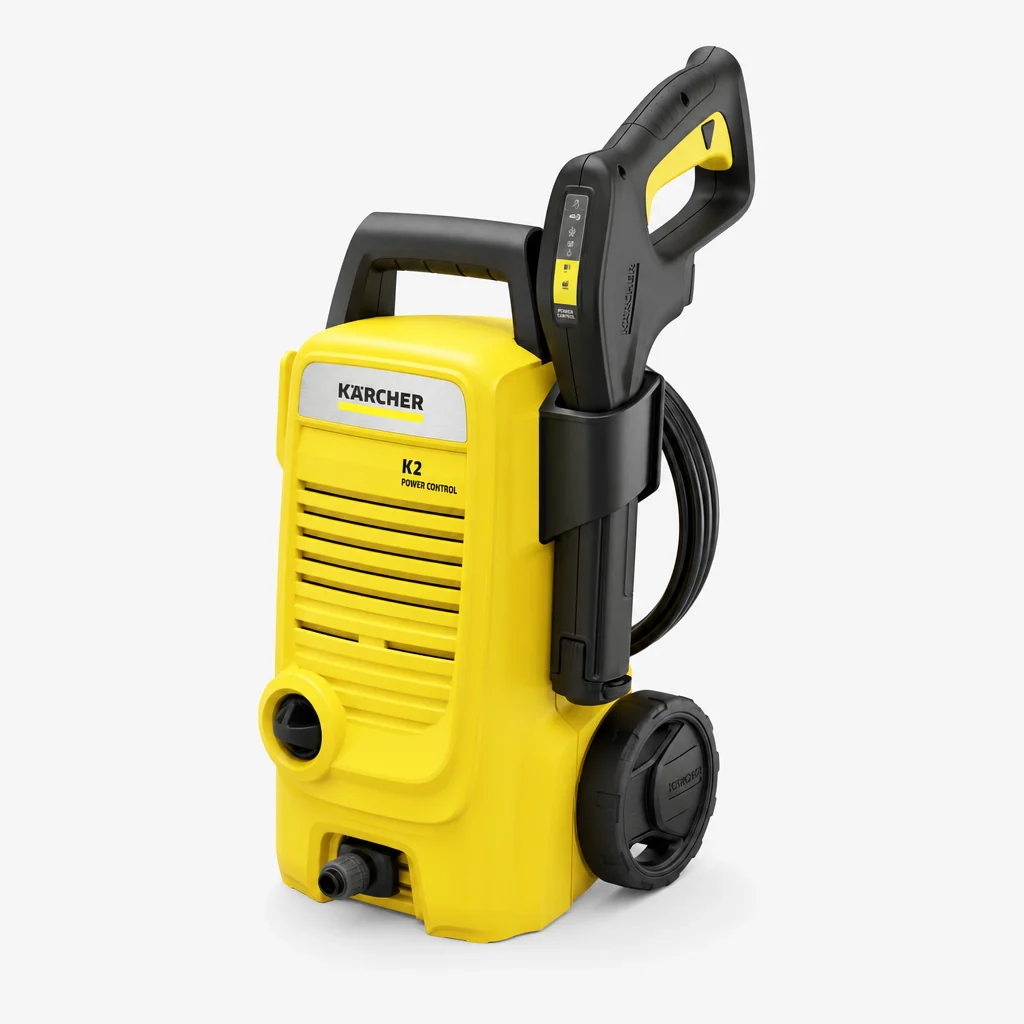
The K2 is where most people's pressure-washing journey begins, and for good reason. With a maximum pressure of 110 bar and a flow rate of 360 litres per hour, it sits squarely in the light-duty bracket — and that's exactly what makes it so well suited to cars, bikes, garden furniture and lightly soiled patios.
That 110-bar figure (around 1,600 PSI) is bang in the middle of the recommended car-washing range, which is no coincidence. It's gentle enough that you won't strip wax or torment delicate paintwork, yet it has the puff to lift everyday road grime. It'll also handle softwood decking provided you keep the lance moving and don't dwell — though for serious decking work you'd want the ability to throttle right back.
Pros
- Pressure perfectly pitched for cars without risking the clear coat
- Compact and easy to store in a small shed or cupboard
- Gentle enough for softwood decking with care
- The most accessible entry point into the trusted K-Series
Cons
- The 360 l/h flow rate makes large patios a slow job
- Not enough grunt for heavy concrete or deep ingrained stains
- Light-duty build isn't suited to very frequent, prolonged use
2. Kärcher K4 Power Control — The All-Rounder
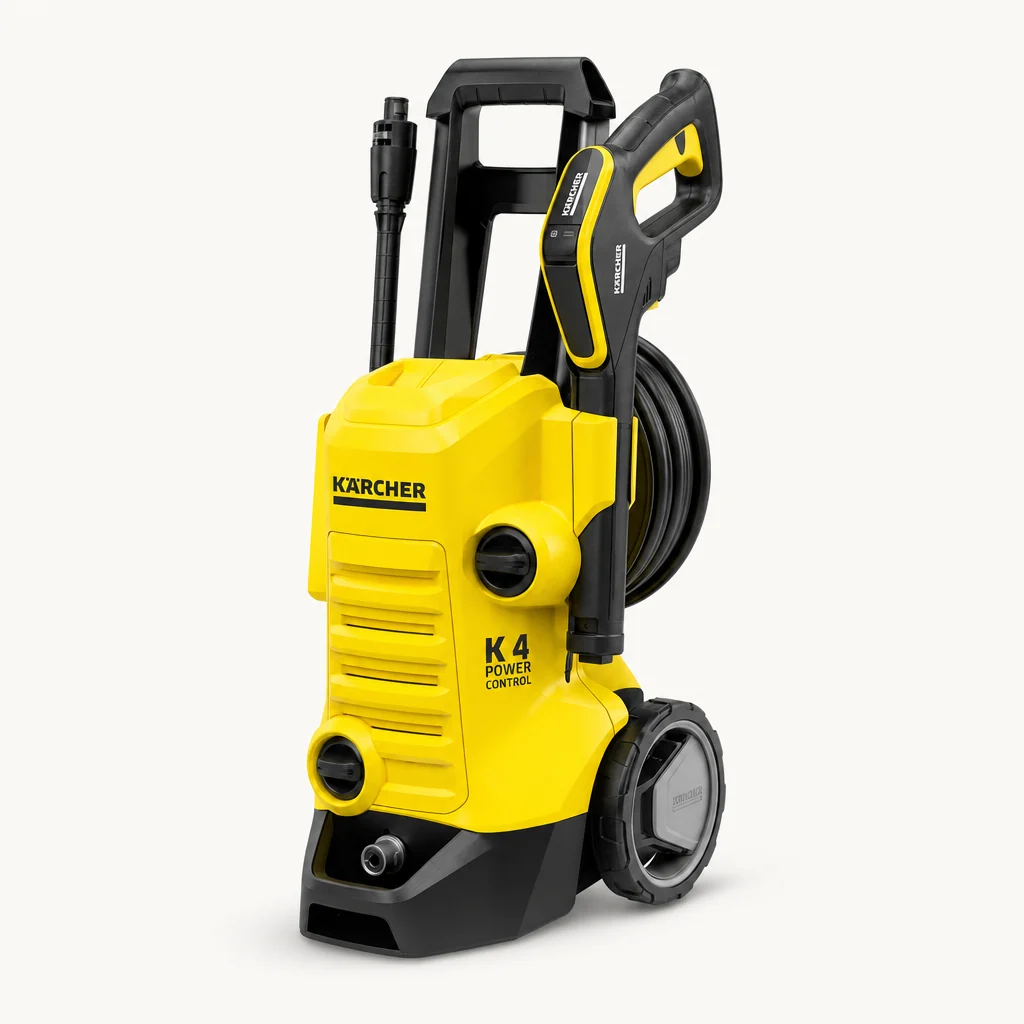
If I had to recommend a single machine to a typical household sight unseen, it'd be the K4. Rated at 130 bar and built around an induction motor — quieter, more durable and longer-lasting than the universal motors found in cheaper machines — it's the natural default for anyone juggling patios, driveways and cars.
That 130 bar lands right at the gentle end of the patio range (125–170 bar) whilst still being entirely happy washing vehicles when you back off with a wider spray. It's the Goldilocks of the range: not so weak that block paving frustrates you, not so fierce that you're nervous around your car or decking.
The induction motor is the headline upgrade over the K2 and K3. It runs more smoothly, copes far better with extended sessions, and tends to last considerably longer — a genuinely meaningful difference if you see yourself reaching for the machine regularly through the warmer months.
Pros
- Durable, quieter induction motor built for regular use
- 130 bar handles patios and driveways comfortably
- Versatile enough to safely wash cars with technique
- The sensible default for most family homes
Cons
- Sits at the lower edge of the patio pressure range
- Large or commercial cleaning jobs will want the K5's flow
- Heavier and bulkier than the entry-level K2
3. Kärcher K5 Power Control / Premium — The Step Up
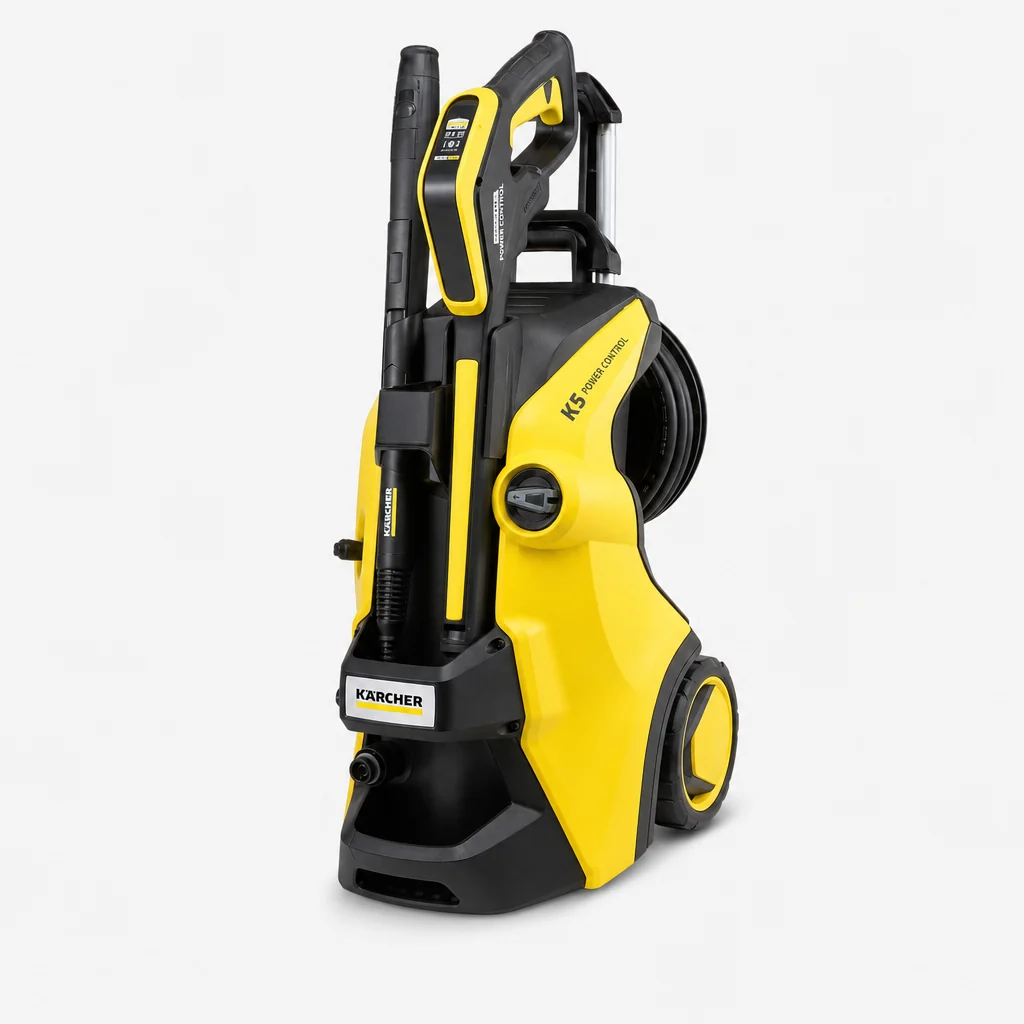
When patios get big, vehicles get large, or you simply want to finish faster, the K5 earns its keep. At 145 bar (around 2,100 PSI) with a flow rate of 500 litres per hour, this is the model for large patios, caravans and SUVs.
That extra flow is the real story here. Remember our earlier point about flow rate dictating coverage speed? Jumping from the K2's 360 l/h up to the K5's 500 l/h is a substantial increase, and it shows when you're working across a large area — you cover ground noticeably quicker. Pair the K5 with a surface cleaner attachment and a sizeable patio becomes a far less daunting afternoon.
At 145 bar the K5 is well inside the patio and driveway range, but it's worth being mindful around your car. Drop to a wide spray and keep your distance, and 145 bar is perfectly manageable for vehicles — just don't get carried away dwelling on one spot.
4. Bosch UniversalAquatak 135 — The Lighter Alternative
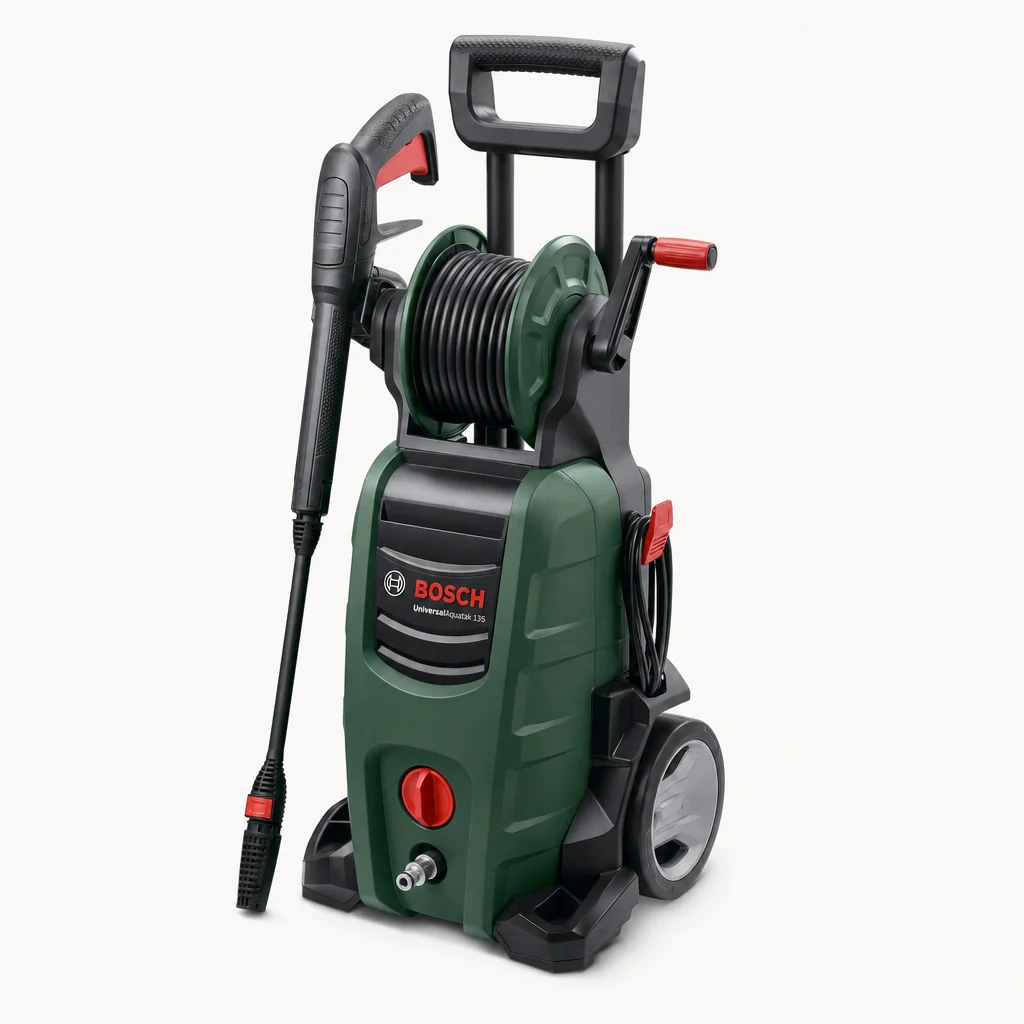
Bosch's UniversalAquatak 135 makes a compelling case as a lighter, neater alternative to the K4. With 135 bar of pressure driven by a 1,900W motor, it lands firmly in medium-duty territory — capable across patios, decking and cars in much the same way as its Kärcher rival.
Its standout feature is the twist-to-change 3-in-1 nozzle. Rather than swapping physical lances or fishing around for the right attachment, you simply twist the nozzle to switch between spray patterns. It's the kind of small convenience that makes a real difference when you're moving between a delicate car wash and a heftier patio scrub mid-session.
Pros
- Clever twist-to-change 3-in-1 nozzle saves fumbling with attachments
- 135 bar covers patios, decking and cars capably
- Lighter and more compact than the K4
- Trusted Bosch engineering
Cons
- Not as much flow-driven coverage speed as the K5
- Pressure still sits at the lower end for tougher patio stains
5. Nilfisk Core 140 — The Engineering Pick
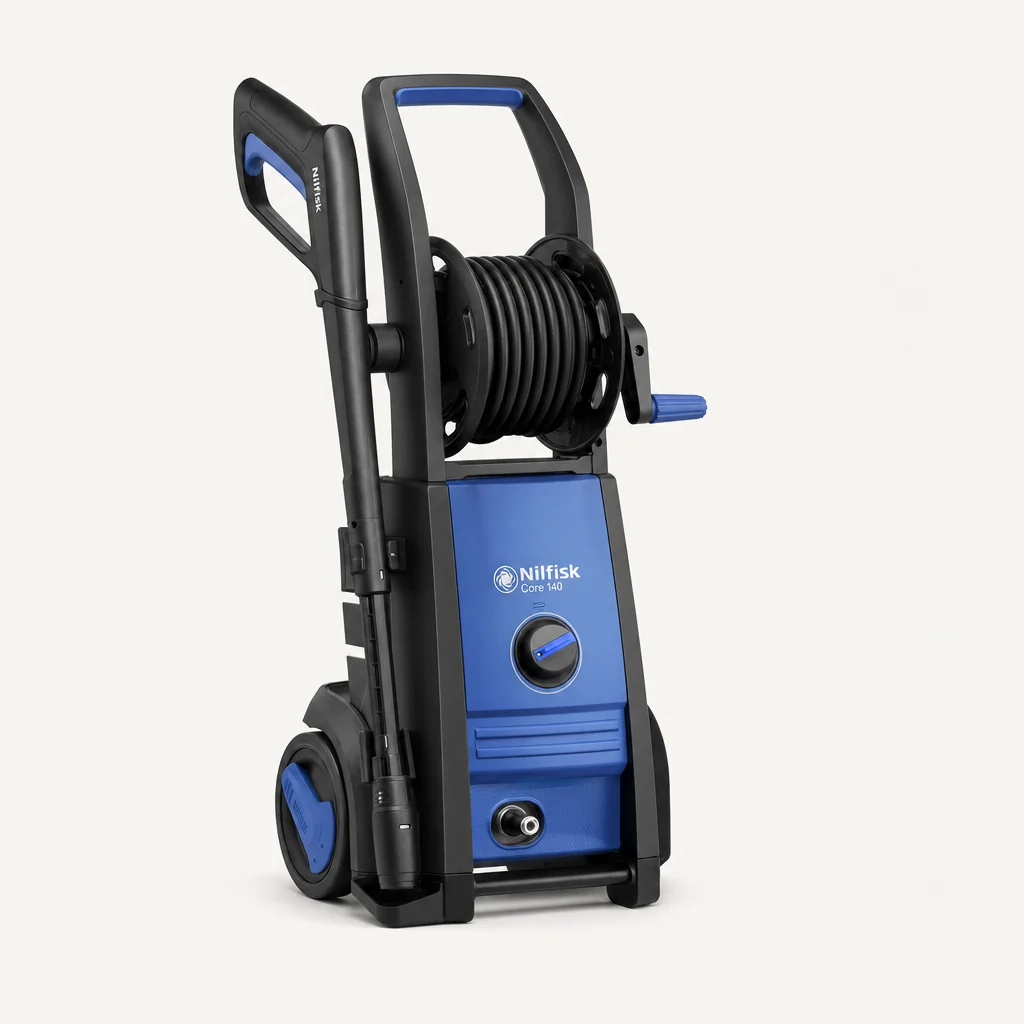
Nilfisk is the brand that quietly impresses people who care about build quality, and the Core 140 is a fine example. With 140 bar of pressure from an 1,800W motor, it matches the medium-duty competition on paper — but it's the details that set it apart.
Chief among those is the metal pump. Many machines in this class use plastic pump components to keep costs and weight down; Nilfisk's metal pump promises greater longevity and a sturdier feel under pressure. Add in an integrated hose reel — which keeps your hose tidy and saves the eternal battle with tangled coils — and a compact Scandinavian design that's easy on the eye and easy to store, and you've got a thoroughly considered package.
Pros
- Durable metal pump rather than plastic internals
- Integrated hose reel keeps everything tidy
- 140 bar handles patios and driveways well
- Compact, attractive Scandinavian design
Cons
- Less ubiquitous than Kärcher, so accessories can be harder to find
- Still a medium-duty machine, not a heavy-stain specialist
Head-to-Head: How They Compare
Numbers side by side often tell the clearest story. Here's how the medium-duty trio and the bookend Kärchers stack up on the figures that matter.
| Model | Pressure | Flow / Motor | Standout Feature |
|---|---|---|---|
| Kärcher K2 | 110 bar | 360 l/h | Compact, car-friendly |
| Kärcher K4 | 130 bar | Induction motor | Durable all-rounder |
| Kärcher K5 | 145 bar | 500 l/h | High flow for large areas |
| Bosch Aquatak 135 | 135 bar | 1,900W | 3-in-1 twist nozzle |
| Nilfisk Core 140 | 140 bar | 1,800W | Metal pump + hose reel |
Visualising the pressure ratings makes the spread crystal clear — and reminds you just how closely matched the medium-duty machines really are:
And here's where flow rate, that under-appreciated spec, really separates the K2 from the K5 — the difference in how quickly you'll cover a large patio:
Who Should Buy What
Specs are one thing; your actual life is another. Here's the quick-fire matchmaking.
The Car Enthusiast
If your main mission is gleaming bodywork without harming the finish, the Kärcher K2 at 110 bar is ideal — right in the safe car-washing window with no temptation to overdo it.
The Typical Household
Mixed jobs — a patio, a drive, a couple of cars? The Kärcher K4 with its durable induction motor is the sensible, do-everything default.
The Big-Garden Owner
Large patios, an SUV or a caravan to keep clean? The Kärcher K5's 145 bar and 500 l/h flow rate will get you finished far quicker.
The Detail-Minded Buyer
Value build quality and tidy storage? The Nilfisk Core 140's metal pump and integrated hose reel, or the Bosch's clever twist nozzle, will appeal.
Our Overall Rating
Taking the range as a whole — and judging it as the practical, mixed-task toolkit most households actually need — here's how I'd score the category leaders.
Frequently Asked Questions
The Verdict
Choosing a pressure washer really comes down to one honest question: what are you actually cleaning, and how often? Resist the pull of the biggest number on the box. For pristine cars and gentle garden duties, the Kärcher K2 at 110 bar is genuinely all you need — and its modest pressure is a feature, not a flaw, when delicate paintwork is involved.
For the broadest sweep of household jobs, the Kärcher K4 remains my default recommendation, thanks to its durable induction motor and that versatile 130 bar. If you're blessed with large areas to clean, the K5 and its generous 500 l/h flow rate will save you real time. And don't overlook the alternatives — the Bosch UniversalAquatak 135 with its slick twist nozzle and the beautifully built Nilfisk Core 140 with its metal pump and hose reel both more than hold their own.
Get the pressure right for the surface, respect the limits of wood and paintwork, and add a surface cleaner for your patio. Do that, and whichever of these machines you choose, you'll be looking at sparkling results for years to come.