
Choosing a Garden Kneeler Seat That Doubles as a Bench
The modest flip-over garden kneeler is one of those bits of kit that looks faintly unnecessary until your knees, hips or lower back inform you otherwise. Then it becomes rather brilliant.
Why Your Knees and Back Deserve Better
There is a particular kind of gardening optimism that begins with, "I'll just pull a few weeds." Twenty minutes later you are on your knees in a border, reaching over a clump of geraniums, one kneecap pressed into a stone, trying to remember when standing up became a multi-stage engineering project.
Kneeling on bare soil is hard going. Kneeling on a thin foam pad is a marginal improvement, but it does not solve the awkward bit: getting down there in the first place, then hauling yourself upright again without putting all the load through one knee, one wrist or a nearby shrub that did not volunteer for the job. For older gardeners, anyone with arthritic joints, dodgy balance or a recovering knee, that transition is often more limiting than the actual gardening.
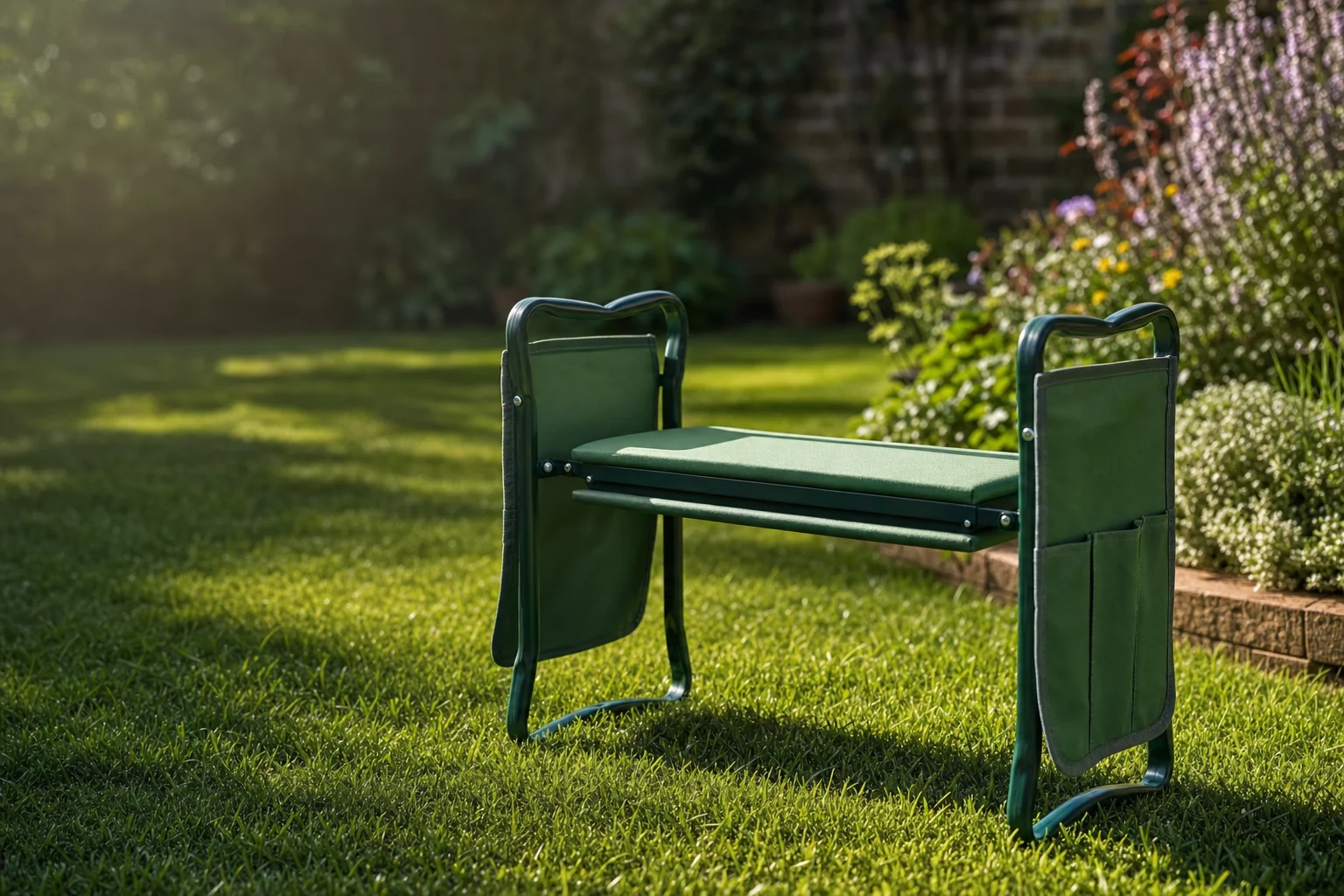
That is the appeal of a garden kneeler seat that doubles as a bench. It is one folding steel frame, one padded central platform and two useful orientations. Use it the conventional way up and the pad sits close to the ground for kneeling, whilst the raised sides become support rails. Flip the whole thing over and the same pad becomes a compact garden bench, roughly chair height on models such as the Garrett Wade, where the seat stands 17.5 inches from the ground.
It sounds almost comically simple. It is. Good garden tools often are. Yet that pair of upright rails changes the experience enormously because it gives you something firm and purposeful to push against. In kneeling mode they are handles; seated, they behave like armrests. No graceful pirouette required. No clutching the wheelbarrow tyre. No alarming lunge at the greenhouse staging.
The real benefit is the return journey
A kneeler-bench is not merely a cushion with legs. Its value is in providing two stable handholds at the moment you lower yourself down and, more importantly, push yourself back up. If getting off the ground is the part you dread, prioritise handle height and frame stability above pocket count or decorative extras.
There is another practical advantage. Sitting for pruning, deadheading, potting and working along a raised bed is kinder to the back than hunching. Then, when you need to weed at soil level, flip the frame over and carry on. One bit of equipment covers two very common postures, folds away afterwards and generally weighs less than a bag of compost.
How the Flip Works: Anatomy of a Kneeler-Seat
Most designs follow the same basic pattern. Picture a rectangular tubular-steel frame with a padded platform across the middle. At either short end is an upright loop of steel. Those loops are the clever bit: depending on which way up the unit is facing, they are either legs or handles.
In kneeling mode, the broad padded surface is near ground level and the two end frames rise above it. The Garrett Wade Portable Bench & Kneeler has four inches of clearance beneath the kneeling pad, enough to keep your knees off wet soil without making you feel perched precariously high above the border. Its handles are there to grip as you lower yourself and push back up.
Turn the unit through 180 degrees and the geometry reverses. The handles become the legs on the ground; the padded kneeling surface is lifted into a seat. On the Garrett Wade it is 17.5 inches high, while Gardeners Edge lists a seat height of 17.25 inches. That is usefully close to an ordinary chair height, which matters more than people initially realise. Very low stools can be troublesome for stiff hips because they leave you with further to rise and a more acute bend at the knee.
Support rails in kneeling mode
The raised frame gives both hands a positive, symmetrical place to push. It is far better than bracing one hand in wet soil and hoping the other finds something solid.
A proper working perch in bench mode
The flip side suits jobs that keep you in one spot: potting, sowing, clipping back spent flowers or teasing bindweed out of a bed without turning your spine into a question mark.
Fold-flat storage
Most use folding legs or sides. The Gardeners.com Deep Seat model folds its sides in for compact storage, making it more realistic to own if shed space is already contested territory.
Tool storage where it is useful
Many include detachable pouches. They are handy for secateurs, labels, twine and a trowel, though they should be viewed as convenience rather than a reason to choose a weaker frame.
The mechanism itself is usually uncomplicated, which is reassuring. There are no batteries, catches to charge or clever electronics to sulk in January. What does deserve attention is the way the frame locks open. Gardeners Edge uses spring-action handlebars and legs that lock securely; the crucial point is that the frame should be fully deployed before you trust it with your weight.
Do not half-open it
Before sitting or kneeling, put the frame on level ground and make sure both sides are fully open and locked into position. A folding kneeler is wonderfully simple, but only when it is actually in its working shape rather than halfway through packing itself away.
The Contenders: Ten Models Worth Knowing
This is a category rather than one single product family, and there are plenty of near-identical folding frames about. The differences are not always glamorous, but they matter: pad width, rated capacity, handle geometry, frame footprint and the quality of the folding mechanism will affect whether you love the thing or leave it sulking behind the shed.
Gardeners.com Deep Seat Garden Kneeler is the premium, wide-base option. It measures 24 inches long, 12.5 inches wide and 19.5 inches high, weighs 9 lb and carries a 250 lb rating. Its 8.5-inch-wide kneeling pad uses 3/4-inch premium foam, and the powder-coated tubular-steel frame is designed with a broad stance and sides that lock for raising and lowering. It has been a flagship design for decades. That longevity is reassuring for gardeners who prefer a product with a proper track record.
VEVOR Garden Kneeler & Seat is sold in several configurations. Published listings disagree about the widest pad option, so check the exact variant dimensions before ordering. Some variants are listed at 330 lb while one listing quotes 360 lb; use the figure shown for the exact model you are buying. It uses thickened 0.03-inch steel tubing, EVA padding, powder-coated steel and 600D Oxford-fabric tool bags. Anti-slip tubing at the base and side handles give it a particularly practical spec for a budget-minded gardener who still wants a substantial stated load rating.
Garrett Wade Portable Bench & Kneeler is a compact steel-framed design with a soft, nylon-covered foam pad, rated to 330 lb. It weighs 8.85 lb, has a 24 by 11-inch overall footprint and a soft, nylon-covered foam pad measuring 16 by 6.5 inches. Its 17.5-inch seat height and four-inch kneeling clearance are especially useful reference measurements, and it includes two tool pouches plus detachable leg protectors for hard surfaces.
Hoselink Garden Kneeler Seat is a lightweight fold-up option with dual tool pockets. It makes sense for gardeners who value an easy carry and simple storage, though stability is the point to examine closely before choosing it for someone who relies heavily on the handles.
Gardeners Edge Folding Garden Kneeler/Bench with Tool Pouch is the lightest confirmed option at 6 lb. Its steel frame has a durable powder-coat finish, spring-action handles and legs that lock securely. The seat area measures 16 inches wide by 6.25 inches deep and is 17.25 inches high. It uses 3/4-inch non-absorbent poly-foam pads, but its 200 lb rating is the lowest here.
Costway Folding Garden Kneeler and Seat Bench uses an EVA foam pad and has a 260 lb capacity. It is a straightforward budget choice for gardeners who want the basic flip-over concept without chasing heavy-duty figures.
KVR Upgraded Garden Kneeler has a 7.9-inch-wide pad, an optimised handle height intended to make pushing up easier and a 330 lb capacity. It is a sensible middle-ground prospect when the priority is more room for the knees than the narrowest pads provide.
TITIUNCLE takes the heavy-duty route: 420 lb capacity, 8.5 lb weight and an anti-tip geometry designed to resist tipping on slopes and uneven ground. Its removable soft seat cushion can stay in place for sitting, come off for kneeling or be used indoors on a hard chair. For a gardener who needs the strongest stated capacity and does not work only on billiard-table-flat turf, it is the standout on paper.
Onadak Heavy Duty Garden Kneeler pairs a 400 lb rating with an extra-thick, 10-inch EVA foam pad. It has a carry handle, quick-fold mechanism and an attached multi-pocket tool bag. Wide padding and high capacity are its clear attractions.
Outsunny Garden Kneeler Foldable Seat Bench has a 58 cm-wide steel frame and a removable tool bag. That wide-frame measurement is worth noting because a generous footprint is often more valuable than a long list of accessories when you are using the handles to stand.
| Model | Capacity | Weight | Useful distinguishing feature |
|---|---|---|---|
| Gardeners.com Deep Seat | 250 lb | 9 lb | Wide base, locking sides and 3/4-inch premium foam |
| VEVOR (check exact variant) | Up to 360 lb* | 6.83 lb* | Published pad dimensions vary by listing; anti-slip bottom tubing |
| Garrett Wade | 330 lb | 8.85 lb | 17.5-inch seat height and detachable leg protectors |
| Gardeners Edge | 200 lb | 6 lb | Spring-action locking frame and non-absorbent pads |
| TITIUNCLE | 420 lb | 8.5 lb | Anti-tip geometry and removable cushion |
| Onadak | 400 lb | — | 10-inch EVA pad and quick-fold design |
Weight Capacity: The Number Most Reviews Get Wrong
Capacity figures are useful, but they are not a licence to stop thinking. A garden kneeler is not loaded like a shelf in a warehouse. You sit down onto it, shift position, reach sideways for a weed, then shove up on one handle more enthusiastically than the other. Those are dynamic, uneven forces. The rated number is a starting point, not the whole safety story.
My rule is simple: do not buy right on the limit. Leave yourself sensible headroom for clothing, tools in the pouch, the movement of sitting down and the fact that real gardens are not laboratory floors. If the frame feels flexy, rocks on a paving joint or makes you wary before you have even settled your weight, it is not the right one regardless of the number printed in the listing.
The published spread is substantial. Gardeners Edge sits at the low end with 200 lb. Gardeners.com Deep Seat is rated to 250 lb, Costway to 260 lb, and Garrett Wade and KVR to 330 lb. One VEVOR listing quotes 360 lb, but confirm the rating and pad width on the exact variant before buying. Onadak lists 400 lb, while TITIUNCLE goes to 420 lb.
A high capacity is welcome, but it does not automatically mean a better kneeler for every person. A lighter gardener may get more benefit from a broader pad, secure locks and a stable footprint than from choosing the largest number on the chart.
There is a notable real-world result for VEVOR: a user weighing 440 lb reported that the 360 lb-rated model held successfully, whilst another 260 lb user described it as a good stool. That is encouraging anecdotal evidence, not a reason to exceed a manufacturer rating. Treat it as a sign that frame design can matter as much as headline capacity, then buy within the stated limit anyway. Gardening is supposed to reduce stress, after all, not introduce an impromptu structural-engineering exam.
Stability Testing: Standing Up Is the Crucial Moment
The most dangerous moment is rarely when you are quietly sitting on the bench. It is when you are kneeling, slightly tired, perhaps twisted towards a border, and push up with more force through one handle than the other. That asymmetric shove tries to rock the frame sideways. On smooth, level paving it may be uneventful. On soft soil, a slope or an uneven patio, it is the moment that separates a confidence-building aid from something you merely tolerate.
Base width is the first thing I would inspect. A wider footprint gives the frame more resistance to lateral tipping. Outsunny's 58 cm steel frame is appealing in that regard, whilst the Gardeners.com Deep Seat is specifically built around an extra-wide base. TITIUNCLE's anti-tip geometry has been tested on slopes and uneven ground, where other kneelers required more careful positioning when users pushed up from their handles.
That does not mean you can put any model at a jaunty angle on a bank and expect miracles. It means the design is working in your favour rather than against you. On a slope, position the kneeler as level as practical, take both handles and rise steadily. Avoid using one rail as a lever while your other hand remains busy clutching a trowel. Yes, we have all done it. No, it is not the recommended technique.
Signs of a stable design
- A wide frame footprint that resists side-to-side rocking.
- Properly opened, locking folding legs or handles.
- Non-slip contact points for patios and hard greenhouse floors.
- Handles high enough to grip with both hands comfortably.
Situations requiring caution
- Soft soil that lets one side sink lower than the other.
- Sloping lawns, loose gravel and irregular paving joints.
- Standing while twisting sideways or relying on a single handle.
- Using a partly folded frame because "it'll only take a second".
VEVOR's anti-slip tubing at the bottom legs is valuable for wet patio gardening, particularly in a British spring when "dry surface" can feel more like a theoretical concept. Garrett Wade takes a different approach with detachable leg protectors for hard surfaces. Both address the same real problem: steel against damp paving can slide more readily than you might expect when you put your full effort into standing.
Before every session, give the open frame a small, deliberate rock with your hands. If one foot is perched on a stone or sinking into mulch, move it. That ten-second check is boring. So is falling over. Choose boring.
Padding, Comfort and Your Knees
The pad is not a decorative afterthought. It is the part that decides whether the kneeler actually gets used. Too little cushioning over compacted soil, a frost-stiff lawn or a gravelly border can leave you with sore knees and a perfectly serviceable piece of equipment gathering dust. Which is rather like buying waterproof boots and only wearing them indoors.
Gardeners.com and Gardeners Edge both specify 3/4-inch foam padding. The latter uses non-absorbent poly-foam on both sides, a detail that is more important than it sounds. Outdoor pads are exposed to wet grass, muddy gloves and rain that arrives sideways. A pad that takes on water becomes cold, heavy and less pleasant to kneel on, and it will generally have a harder life than one designed to resist it.
EVA foam, used by VEVOR, Onadak and Costway, is typically the more robust, water-resistant choice for this sort of garden equipment. It is closed-cell and durable, although it can feel firmer than softer poly-foam. Neither material is automatically superior. The best choice depends on your joints and the length of time you normally spend down at soil level.
Water resistance matters outdoors
Non-absorbent poly-foam and EVA are better suited to damp lawns and wet borders than a sponge-like cushion that holds moisture against your knees.
Width is comfort as well as capacity
A wider pad gives more room to reposition than a narrow seat. KVR's 7.9-inch pad and Gardeners.com's 8.5-inch pad are useful middle-ground figures.
Long sessions expose thin padding
For gardeners with knee pain or bursitis, a minimum of two inches of cushioning is often recommended; three inches of memory foam makes a notable difference during sessions beyond 15 minutes.
There is a caveat to that last point. The listed integrated pads on these flip-over frames are generally thinner than the two- or three-inch cushioning some sensitive knees would ideally prefer. If you know you need serious padding, consider whether you can comfortably place an additional weather-resistant kneeling mat over the built-in pad without compromising your footing or the frame's stability. Do not create a wobbly tower of cushions. Comfort is useful only while you remain safely supported.
A quick knee test before you commit
Try kneeling with your weight distributed between both knees for a few minutes, not just a quick press in a shop or showroom. A pad can feel fine for ten seconds and distinctly less friendly once you begin actually weeding. If your knees are especially tender, width and foam quality deserve priority over tool pockets.
Choosing the Right Model for Your Garden
Start with your body, then your garden, then the product extras. It is tempting to be drawn to a detachable tool pouch packed with compartments, but it is not much consolation if the pad is too narrow or you do not feel steady standing from it.
If you are light on your feet and want the least cumbersome model to carry, Gardeners Edge at 6 lb and a VEVOR listing at 6.83 lb are compelling, although its exact pad width should be checked before ordering. Gardeners Edge is particularly easy to move, though its 200 lb rating should be considered carefully rather than waved away. If you want more stated capacity without a big weight penalty, VEVOR's 360 lb version is notable.
For someone who sees the handles primarily as mobility support, I would put frame stability ahead of all else. Gardeners.com's wide base and locking sides, Garrett Wade's steel-framed construction with its padded, nylon-covered foam surface, Outsunny's 58 cm width and TITIUNCLE's anti-tip design are the designs that demand the closest look. The latter is especially interesting for uneven gardens because level ground is a lovely ideal and not always something an old lawn has agreed to provide.
For a gardener who works largely on a patio, deck or greenhouse floor, lower-leg grip should be non-negotiable. VEVOR's anti-slip tubing and Garrett Wade's detachable hard-surface leg protectors address that job directly. A kneeler that is perfectly adequate on lawn can behave very differently when wet paving adds a little slide to the equation.
For joint-conscious gardeners
Look for a broad, locked-open frame with handles you can grasp squarely with both hands. Stability comes first; pad width comes second.
For uneven gardens
Prioritise a wide footprint and anti-tip design. TITIUNCLE's slope-focused geometry and Outsunny's 58 cm width are relevant benchmarks.
For lighter carry and storage
Gardeners Edge and VEVOR are the lighter confirmed choices. Check capacity and pad width before assuming lighter is automatically better.
The seat height deserves a mention here too. The Garrett Wade's 17.5 inches and Gardeners Edge's 17.25 inches are useful because they put the user close to the height of a normal chair. If you have stiff hips, that makes seated work more practical and reduces the distance you must rise. There is no substitute for trying the movement yourself where possible: sit, place both hands on the rails, stand slowly and note whether your knees and hips feel supported rather than rushed.
GardenScout Assessment: What Matters Most
It would be misleading to score every one of these models as though they were interchangeable. They are not. Some lean towards lightweight portability, some towards wide pads, some towards high stated capacity and some towards stability on awkward terrain. The category itself, though, scores highly as a practical answer to a very ordinary gardening problem.
Our editorial view
As a category, a flip-over kneeler-bench is a genuinely useful aid for gardeners who alternate between low border work and seated tasks. That is an editorial judgement based on the practical features discussed here, not a laboratory score.
The strongest argument for buying one is not that it makes gardening effortless. It does not. You will still have to weed the border, and the dandelions will remain infuriatingly committed to their cause. What it does is remove a needless barrier between you and jobs you enjoy. You can alternate between sitting and kneeling, save your knees from direct contact with cold ground and give yourself something reliable to hold when standing.
The limitation is equally clear: no folding kneeler is a substitute for sensible movement, stable footing or medical advice when mobility is seriously restricted. If you need a firm, substantial support to get up from the ground, do not assume every lightweight folding frame will do that job equally well. Choose one with plenty of capacity headroom, a wide base and locks that inspire confidence, then use it on the most level ground available.
Frequently Asked Questions
Yes, particularly because the raised side frames offer handholds when lowering yourself down and rising again. The benefit is less about avoiding all kneeling and more about making the transition safer and less punishing for knees, hips and back.
Choose a model with comfortable headroom rather than one rated exactly to your body weight. Capacity figures range from 200 lb on Gardeners Edge to 420 lb on TITIUNCLE, but stability, surface conditions and the way you use the handles matter too.
EVA is durable and naturally water-resistant, but it can feel firmer. Poly-foam can feel softer; where it is specified as non-absorbent, it is better suited to outdoor conditions. The better choice is the one your knees find comfortable whilst still coping with damp garden use.
Yes, but look for grip at the base and inspect the surface first. VEVOR uses anti-slip tubing and Garrett Wade has detachable leg protectors for hard surfaces. Wet paving, moss and uneven joints all deserve extra caution.
Garrett Wade lists a seat height of 17.5 inches, and Gardeners Edge lists 17.25 inches. That is close to normal chair height and is considerably easier to stand from than a low ground-level stool.
Final Verdict
A small bit of kit with a properly useful purpose
A flip-over garden kneeler seat is one of the better purchases for anyone whose enthusiasm for gardening exceeds their knees' enthusiasm for kneeling. The winning formula is simple: choose enough capacity headroom, a stable and broad frame, handles you trust when pushing up, and padding you will actually be happy to kneel on.
For maximum stated load capacity and uneven-ground reassurance, TITIUNCLE is the heavy-duty benchmark. For a comparatively wide-pad, lightweight option, VEVOR is worth considering, but verify the exact listed dimensions before ordering. Gardeners.com offers a mature, wide-base premium design, Garrett Wade provides useful hard-surface protection and chair-like seat height, and Gardeners Edge suits those who value a notably light carry weight but remain comfortably inside its 200 lb limit. Choose the frame that makes you feel steady. Your borders will get more attention, and your knees may finally stop filing formal complaints.