
Potting Benches and Work Stations That Save Your Back
Standing-height potting benches with useful sinks, sensible storage and materials that can cope with a British garden.
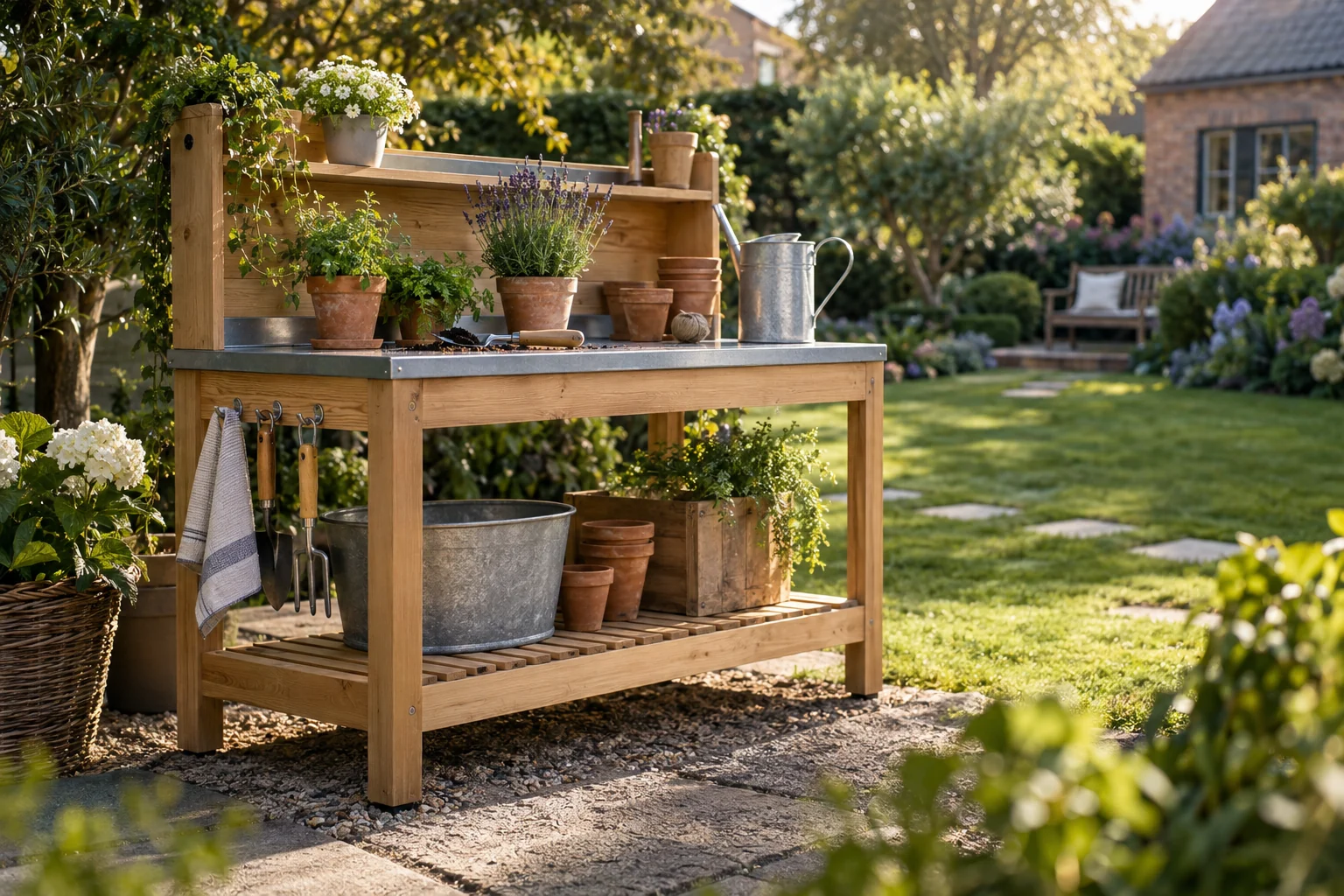
Why Your Back Deserves a Better Potting Bench
October is the moment when a potting bench earns its keep. There are tulip bulbs to sort, tender plants to lift, containers to clear, spring bulbs to plant, and a steady stream of grubby pots arriving from every corner of the garden. It is also when many of us rediscover that kneeling beside a bag of compost is not quite as charming as it seemed in April.
The old approach is familiar: a tray balanced on the patio, a bucket used as a seat, compost on the ground and a growing ache between the shoulders. It works, in the same sense that carrying a sofa upstairs on your own works. You can do it. You may simply regret it later.
A good potting bench brings the job up to standing height. Instead of repeatedly folding yourself towards the ground, you can work with your shoulders relaxed and your elbows close to your sides. Pots, labels, secateurs and compost can have a proper home. The result is not merely tidier; it cuts out a surprising amount of reaching, twisting and getting back up again.
This matters whether you garden for ten minutes after work or disappear happily into the shed for an entire Sunday. Repetition is the real offender. Bending once to pick up a terracotta pot is unremarkable. Bending fifty times whilst pricking out seedlings, filling containers and tidying away afterwards is a different sort of afternoon.
Back-saving is not a marketing slogan
In practical terms, a back-friendly work station has a surface at a useful standing height, enough depth that you are not reaching over the bench, firm footing that does not wobble under compost, and storage within easy reach. A sink is helpful, but a stable, well-proportioned worktop is the part that does the daily heavy lifting.
The most useful designs in this guide sit around the standing-work range. The Yaheetech Sliding Tabletop bench has an 87.3cm worktop, while the FOYUEE metal model is approximately 89cm high (35 inches). Both put ordinary potting tasks at a much more civilised level than the floor. The SERWALL sink bench is a different proposition: its overall height is 119.9cm (including shelving above the main work area), and it offers a generously capable central station for gardeners who value substantial storage and a weather-resistant build.
There is no single perfect height for every gardener. We are not all built from the same cutting. But the underlying rule is straightforward: the bench should allow you to stand naturally, rather than hunching over a low surface or raising your shoulders towards your ears. The best choice is the one that makes you forget about your posture because you are busy enjoying the job.
How We Assess a Back-Friendly Work Station
Potting benches look deceptively simple. A few shelves, a top and perhaps a plastic sink: what could possibly be complicated? Quite a lot, as it turns out. A bench can be beautifully photographed and still be too low, too shallow, too lightly built or too awkward to leave outside with confidence.
Our first test is always working height. For a standing bench, the important measurement is the actual work surface, not the highest point of a backboard or shelf. A raised shelf is useful for seed trays and labels, but it does not help your back if the worktop itself is down around knee level. For many adult gardeners, a surface in the mid-80cm range is a comfortable starting point.
Next comes load capacity. Compost is heavier than it looks, especially after a damp week. So are terracotta pots, watering cans, bags of bark and the assorted collection of "things I will definitely use later" that migrates towards a potting area. We pay particular attention to separately stated capacities for the tabletop, middle shelf and bottom shelf. A strong top is useful, but it is equally important to know whether the shelf below will safely hold a bag of compost rather than merely a packet of labels.
A practical benchmark for a serious potting surface is around 60kg of stated tabletop capacity. That comfortably covers ordinary repotting jobs, a filled tray of plants and the occasional bag of compost without turning the worktop into a suspenseful engineering experiment.
Sink design is assessed as a working feature, not a decorative flourish. Can you wash roots or soak pots without making a mess of the main surface? Is the tub removable for emptying? Does a sliding worktop mean you must choose between sink and workspace? These are not deal-breakers, but they shape how the bench feels to use on a busy afternoon.
Material is another dividing line. Fir wood has the warm, traditional look many gardeners want, but it needs attention in a damp climate. HDPE benches are less romantic and generally more matter-of-fact, but the material is designed to resist rot, moisture and UV damage. Metal benches can be very strong and easy to wipe down, though exposed finishes and fittings still deserve a close look if they will live outdoors all year.
Assembly matters too. A potting bench is not a greenhouse, and nobody wants an all-day construction project just to acquire somewhere to stand a bag of compost. Published assembly times are useful indicators, although it is sensible to allow a little longer if you are working alone, on uneven paving, or after a cup of tea that somehow became lunch.
Finally, we consider storage. Good storage is not about accumulating drawers for the sake of it. It is about reducing repeat journeys and awkward reaches. Hooks for hand tools, a lower shelf for pots, a drawer for labels and twine, and a middle shelf at a useful height can turn an ordinary bench into a genuinely efficient work station.
Those bars do not declare a winner on their own. A 30kg worktop is ample for everyday potting, whilst nearly 100kg makes more sense for gardeners who like to keep several heavy supplies close at hand. The point is to buy for the way you actually garden, not the way you imagine you might garden during a particularly optimistic January.
The Full Line-up at a Glance: Specs That Actually Matter
There is no shortage of generic wooden potting tables, and plenty will do a basic job. The models worth looking at more closely are those that make a deliberate effort to solve the usual annoyances: a missing sink, a low work surface, nowhere to put tools, an unsteady frame, or timber that begins to look tired after a wet winter.
The Yaheetech Sliding Tabletop bench is one of the more adaptable designs. Its worktop is 87.3cm high, which places it firmly in the useful standing range, and its width extends from 94cm to 140.5cm. The slide reveals a dry sink measuring 40 × 32.3 × 12.2cm. Four rubber castors make it mobile, and two of those wheels lock so the unit can be secured when you are working. It has a stated 30kg tabletop limit, a 5kg top shelf limit and a 20kg lower shelf limit.
The Yaheetech sink-and-drawer model is broader at 114.8cm and stands 120.9cm tall overall. Its removable sink measures 34 × 26.9 × 7.9cm. This version has a drawer and hooks as well as the shelves, and its tabletop capacity is 59.9kg. That is a meaningful jump from the sliding model if your working habit involves heavier containers or a compost bag sitting on the bench beside you.
SERWALL's sink model takes a different path. It uses HDPE rather than timber, with a stated tabletop capacity of 99.8kg. The removable sink is 34.5 × 23.9 × 11.4cm, giving it more depth than the Yaheetech removable basin. Its right-hand tabletop slides to create a longer surface, extending the available working area to 126.7 × 39.1cm. For gardeners who leave a bench out in all weathers, the material choice is arguably its biggest attraction.
FOYUEE's metal potting bench is simpler, but simplicity has its charms. It has an 89cm working height, a stated 136.1kg capacity and a lower shelf measuring 91.4 × 55.9cm with raised edges. It is also mounted on castors. There is no sink specification to complicate things. If your main requirement is a strong upright work surface, rather than a miniature outdoor utility room, that directness may suit you perfectly.
There are also compact options. Yaheetech's compact metal-top bench is 77.5cm wide, 37.1cm deep and 90.2cm high, with three layers of storage and a 59.9kg top capacity. It is a sensible format where a patio, balcony or shed wall cannot spare the room for a wider station. The compromise is obvious: less space for spreading out means more discipline is needed during a messy job.
At the more traditional end, the Eartheasy cedar bench has a 86.4cm standing height and takes approximately an hour to assemble. Cedar has an established appeal for garden furniture, particularly if you like the look of natural timber ageing outdoors. As with any wood bench, a little routine care is part of the ownership experience rather than an optional extra.
Head-to-Head: Yaheetech, SERWALL and FOYUEE
These three approaches cover most of what gardeners want from a back-saving work station. Yaheetech offers the familiar timber potting-bench experience, with sinks and storage integrated into a traditional shape. SERWALL focuses on weather-resistant HDPE and substantial capacity. FOYUEE strips the idea back to a robust metal bench at a useful working height, with wheels and a generously sized lower shelf.
It is worth being precise about what the numbers mean. The Yaheetech Sliding Tabletop model measures 94cm wide in its compact arrangement and 140.5cm when extended. That is a big swing in footprint. It makes the bench attractive where space changes according to the task: narrow beside the shed most days, then opened out for a serious repotting session.
The SERWALL sink bench begins at 101.1cm wide and provides an extended work area of 126.7 × 39.1cm when the tabletop is slid. It is less of a mobile, fold-away-minded design and more of a permanent outdoor station. The stated 99.8kg tabletop capacity supports that impression. It is the sort of bench that can sit beside a greenhouse door and become the place where every pot, tray and plant passes through.
FOYUEE is not attempting to compete on concealed sinks or sliding timber. Its approximately 89cm (35-inch) work height is its ergonomic trump card, and the 136.1kg stated capacity suggests a bench that is happy dealing with weight. The 91.4 × 55.9cm lower shelf is also notably generous. Raised edges are a quietly excellent detail here: a bag of compost or a stack of pots is far less likely to shuffle itself onto the floor when you turn around.
| Feature | Yaheetech Sliding Tabletop | SERWALL with Removable Sink | FOYUEE Metal Bench |
|---|---|---|---|
| Working height | 87.3cm | Overall height 119.9cm | ~89cm (35 in) |
| Overall width | 94–140.5cm | 101.1cm | Not stated |
| Main tabletop capacity | 30kg | 99.8kg | 136.1kg |
| Sink included | Yes, beneath sliding top | Yes, beneath sliding top | No |
| Sink dimensions | 40 × 32.3 × 12.2cm | 34.5 × 23.9 × 11.4cm | — |
| Material | Fir wood | HDPE | Metal |
| Storage arrangement | Top shelf and bottom shelf | Top, middle and bottom shelves | Lower shelf with raised edges |
| Mobility | Four castors; two lockable | Not stated | Castors |
| Assembly time | Not stated | 15–20 minutes | Not stated |
The obvious caveat is that capacity is not the whole story. A 136.1kg capacity does not make a bench more comfortable if it is the wrong height for you. Conversely, a 30kg top can be completely adequate for seed sowing, potting on, dividing small perennials and dealing with everyday containers. This is why the sensible question is not "which bench is strongest?" but "what will I ask it to do on an ordinary Saturday?"
Choose a station, not a trophy
If you want a permanent all-weather area beside the greenhouse, the HDPE SERWALL design has a compelling practical case. If you need a movable bench at a genuinely useful potting height, the Yaheetech Sliding Tabletop's castors and 87.3cm top are more relevant. If sinks are not part of your gardening routine, the FOYUEE metal model directs its capacity towards a straightforward, heavy-duty work surface.
Ergonomics Deep Dive: Standing Height, Reach and Less Strain
A potting bench cannot cure an existing back problem, and it is not a substitute for medical advice. What it can do is remove some of the avoidable awkwardness from routine garden jobs. In practical ergonomics, the basic aim is simple: set your work where your arms can operate naturally, without a deep forward bend or permanently lifted shoulders.
For standing work, a useful rule of thumb is to position the surface roughly 5–10cm below elbow height. That gives room for your hands to move whilst allowing your shoulders to remain relaxed. For a gardener around 170cm tall, this often places a comfortable general-purpose potting height around 85–92cm. There will always be individual variation. Someone taller may want more height; someone who prefers to sit on a stool for detailed seed work may choose a different arrangement altogether.
Against that range, the Yaheetech Sliding Tabletop's 87.3cm top lands neatly in the middle. The FOYUEE's 89cm height does much the same. Neither is an adjustable bench, so the right answer is still to stand beside a similarly high table or kitchen counter before buying. A two-minute reality check is better than discovering that your new work station asks you to stoop every time you fill a 9cm pot.
The SERWALL bench should be read differently. At 119.9cm overall, it includes an upper structure above the main working level. Its overall height makes it a more substantial station visually and practically, but gardeners should focus on where the actual tabletop falls in relation to their elbows rather than treating the total height as a direct worktop measurement. Upper shelves are excellent for tools, labels and small pots; they are not where you want to be repeatedly lifting heavy compost.
Keep the worktop within your natural reach
A potting surface around 85–92cm suits many gardeners for routine standing work. The 87.3cm Yaheetech sliding worktop and 89cm FOYUEE bench sit in this broadly useful zone.
Depth matters as much as height
The reviewed benches are around 43–47cm deep. That is enough room for a tray, pot and compost without turning the back edge of the bench into an expedition requiring a stretched shoulder.
Put small tools at hand level
Hooks, shelves and drawers reduce the repeated bend-and-search routine. Keep secateurs, dibbers and labels where you can reach them without twisting away from the bench.
Stability is part of comfort
A bench that shifts as you press compost into a pot makes you brace your body unnecessarily. Lock castors before starting work, and site the bench on firm, level ground.
Reach depth is easy to overlook because potting benches are not especially large pieces of furniture. Yet it changes how a bench feels. The Yaheetech models listed here are between 45cm and 47cm deep, while the SERWALL sink model is 42.9cm deep. That is a useful range: deep enough to contain the mess, shallow enough that the rear edge remains accessible without leaning heavily across the surface.
There is also a small but important point about foot placement. A lower shelf should not force you to stand too far away from the bench. If the shelf projects where your toes naturally want to go, you may find yourself leaning forward. Before assembling any bench, consider where it will sit and whether you have enough clear paving around it to stand close and move around safely.
For long jobs, change position anyway. Shift your weight, take a short walk to the compost bin, swap hands for repetitive filling, and use a stool for fine jobs such as pricking out. A standing bench makes this easier because it gives you choices. The ground does not.
A useful autumn arrangement
Keep a crate of empty pots below the bench, compost beside rather than underneath it, and your planting tools on hooks or the upper shelf. That simple layout removes the three most common reasons for bending: retrieving pots, lifting compost and hunting for a missing dibber.
Built for Britain: Weatherproofing That Is Worth Taking Seriously
British weather is wonderfully democratic. It rains on expensive garden furniture, budget garden furniture and the carefully folded instruction leaflet you left on the bench for "just one minute". A potting bench that lives outdoors has to cope with more than the occasional shower. It must deal with persistent damp, frost, wet compost, algae, leaf litter and periods when nobody gets around to maintenance.
HDPE is the practical standout material among these options. SERWALL uses HDPE, which is stated to resist rot, moisture, UV damage, splintering, cracking and fading. The bench also uses 304 stainless steel hardware. That combination is particularly appealing if the work station will be exposed beside a greenhouse, against a north-facing fence or on a patio where winter sun is mostly theoretical.
There is a pleasing honesty to HDPE garden furniture. It does not pretend to be timber. If you love the grain, warmth and changing colour of wood, it may not give you the same satisfaction. But it asks less of you. A wipe-down and an occasional check of the fittings is a much smaller commitment than a yearly timber-care routine.
Fir wood, used in the Yaheetech benches, has the traditional potting-shed look that many gardens suit beautifully. It is also a softwood, so it benefits from being treated as part of the garden rather than as indoor furniture that has wandered outside. If it is left exposed without protection, damp cycles can take their toll. An annual coat of exterior wood oil or preservative is a sensible habit, with particular attention paid to end grain, joints, screw holes and the underside of shelves.
Painted timber can offer another layer between the wood and the weather, but paint is not invincible. Check it each spring, especially around edges that take knocks from pots and compost bags. Touching up a small scuff is considerably easier than restoring a shelf after water has repeatedly entered the exposed timber beneath.
Metal benches, such as the FOYUEE model, are often easier to clean after a muddy session. A metal surface does not absorb damp compost in the way timber can. Still, treat castors and joints as points worth inspecting. Wheels collect grit, hair, twine and the odd quantity of compost that seems to breed when nobody is looking. A quick clean before winter can stop a mobile bench becoming a surprisingly heavy static object by spring.
The simplest way to protect any bench is positioning. Give it firm, well-drained ground, keep it clear of permanently wet soil, and avoid trapping it tightly against a fence where air cannot circulate. A little shelter from the worst rain and prevailing wind helps timber, metal and plastic alike.
Autumn is the right time to make these decisions. Before winter settles in, clear the lower shelves, brush away compost, tighten visible hardware and make sure water is not sitting in a sink or on a sliding top. If you are buying a bench now, assemble it on a dry day, treat timber before loading it up, and give yourself enough surrounding space to work comfortably in a coat. Gardening does not stop because the temperature drops; it merely requires more layers and a better sense of humour.
Sink, Shelf, Store: Getting the Most from the Useful Bits
A sink on a potting bench is not plumbing in the kitchen sense. It is a contained place for wet, messy jobs: soaking pots, rinsing roots, holding a little water during planting, washing soil from tools or keeping drainage gravel from scattering across the patio. If you have ever tried to divide a damp perennial on a bare wooden top, you will understand the appeal immediately.
The Yaheetech sink-and-drawer bench has a removable basin measuring 34 × 26.9 × 7.9cm. That is a handy shallow format for cleaning pots, holding labels whilst you work and collecting compost spillages. The Yaheetech Sliding Tabletop design uses a larger tub at 40 × 32.3 × 12.2cm. That extra depth gives it more scope for rinsing roots or holding several small pots at once.
SERWALL's removable sink measures 34.5 × 23.9 × 11.4cm. It is narrower than the Yaheetech sliding tub, but it is also deep enough to be useful for root washing and soaking. The extra depth matters when you are working with a pot-bound perennial, a muddy dahlia tuber or a stack of seed trays that need a brief rinse before storage.
Both sliding-top concepts come with a trade-off worth understanding before you buy. When the tabletop is slid across to reveal the sink, you gain access to the tub but lose some uninterrupted worktop. When it is closed, you have a larger flat surface but the sink is hidden. For most gardeners, that is entirely workable: slide it open for the wet part, close it for filling pots. But it is not the same as having a full-size worktop and a permanently open sink side by side.
What a sink does well
- Contains wet compost, loose grit and muddy roots.
- Gives small pots somewhere to soak before cleaning.
- Can be removed for emptying and rinsing.
- Encourages you to do messy jobs at bench height, not on the ground.
What to bear in mind
- A sliding sink means part of the top is unavailable when open.
- It is not a plumbed wash station, so water still has to be carried or supplied nearby.
- Shallow tubs are best for light rinsing rather than large-scale washing.
- Any sink left full outdoors will need emptying before frost.
Shelf capacity deserves the same scrutiny as the sink. A 25-litre bag of compost can weigh around 12–13kg, whilst a 70-litre bag may weigh 25–30kg. That is why the SERWALL sink model's 99.8kg tabletop capacity is significant, and why its 31.8kg lower shelf is useful for serious storage. It lets you keep substantial materials close by rather than lifting them repeatedly from the ground.
The Yaheetech Sliding Tabletop bench has a stated 5kg top shelf capacity and a 20kg bottom shelf capacity. Think of the upper shelf as a home for seed packets, labels, gloves, small hand tools and lighter pots. The lower shelf is better for empty plastic pots, a watering can, trays and modest supplies. That is a perfectly logical division if you work neatly, but it is not the bench to use as a warehouse for multiple large compost bags.
The Yaheetech sink-and-drawer bench gives a 59.9kg tabletop capacity, a 10kg middle shelf capacity and a 20kg lower shelf capacity. Its drawer earns its place for the small things that otherwise vanish: pencil, labels, plant ties, spare blades, twine, dibbers, a notebook and the plant tag you are certain you will need later. Hooks are useful for secateurs and trowels, provided you make a habit of returning them there. This sounds obvious. It is also how one prevents a trowel becoming an archaeological discovery in a compost bin next March.
For the FOYUEE model, the lower shelf is the storage story. At 91.4 × 55.9cm, it gives a broad platform, and its raised edges help keep supplies in place. That makes it particularly suited to a practical arrangement: compost low down, filled pots on the main top, and a small caddy of tools beside your dominant hand. You can work in a compact loop without constantly turning, bending or balancing things precariously on the edge of the bench.
Setting Up Your Bench for Autumn and Beyond
Buying the right bench is only half the job. How you set it up determines whether it genuinely saves effort or simply becomes another horizontal surface for collecting pots. October is ideal for creating a simple routine before winter weather and spring seed sowing make the area much busier.
Start with the site. Put the bench close enough to the greenhouse, shed, tap or compost store that you will actually use it. A beautiful potting station at the far end of the garden may look heroic, but it loses some of its ergonomic advantage if every bag of compost has to be carried across wet grass. Level paving, compacted gravel or a firm deck is preferable to soil, especially for wheeled models.
Then organise by frequency. The items used every session should sit between knee and shoulder height: hand trowel, secateurs, labels, pencil, dibber, small scoop and a brush. Empty pots can go below. Spare materials can go on the lower shelf or nearby in a weatherproof box. Keep only what belongs to potting there. A work bench burdened with old flowerpots, broken trays, mystery screws and six years of spare netting is not organised; it is merely a shed without walls.
The regular container gardener
A bench with a removable sink and nearby shelves makes repotting, feeding and clearing containers far less repetitive.
The all-weather gardener
An HDPE station with stainless hardware suits an exposed garden where timber maintenance is unlikely to become a favourite weekend ritual.
The small-space gardener
A compact bench or a sliding-top design offers a dedicated workspace without surrendering the entire patio to gardening furniture.
For the next few weeks, use the bench for bulb planting and pot clearance. Place a crate of bulbs on the lower shelf, a tray of labels and marker pen above, compost beside the bench, and pots directly in front of you. Work in batches: fill several pots, plant several bulbs, label them, then move them away. Your shoulders will thank you, and you will spend much less time searching for the same packet of bulbs under a mound of compost.
Come late winter and early spring, the same station becomes a seed-sowing base. This is where a cleaned, dry worktop and accessible upper shelf really shine. Keep seed trays and labels in reach, but avoid storing damp compost permanently on timber. Sweep up at the end of each session. It takes less than a minute and stops the bench becoming a habitat for slugs, mould and the sort of soil-stained clutter that makes a simple job feel harder than it is.
Finally, give yourself permission to adapt the layout. If you always reach for secateurs with your right hand, put them on the right. If bags of compost are too heavy to lift from a lower shelf comfortably, keep smaller amounts in a lidded tub at bench-side height. Ergonomics is not about following rules for the sake of it. It is about arranging the work so your body does less unnecessary work.
Frequently Asked Questions
For many gardeners, a worktop around 85–92cm is a useful starting point. The Yaheetech Sliding Tabletop bench at 87.3cm and the FOYUEE metal bench at 89cm both sit in that range. The best height is one that lets you work with relaxed shoulders and without leaning forward.
Yes, especially on patios and in small gardens where the bench sometimes needs to move for storage, cleaning or access. The Yaheetech Sliding Tabletop has four rubber castors, with two lockable wheels. Locking wheels are important: a bench should not roll away whilst you are filling a pot.
It can, but timber needs care. Treat fir regularly with an exterior wood oil or preservative, keep the bench off persistently wet ground, clear damp compost from shelves and inspect the finish each spring. A sheltered spot will make the task easier.
It is genuinely useful if you divide plants, wash pots, rinse roots or regularly work with wet compost. For dry seed sowing and basic potting on, a plain large worktop may be more valuable than a sink. Choose the feature that matches the jobs you do most often.
For normal potting, a stated tabletop capacity around 60kg is reassuring. If you plan to store multiple compost bags or heavy containers on the bench, a higher figure is worthwhile. The SERWALL sink model is stated for 99.8kg on the tabletop, while the FOYUEE metal bench is stated for 136.1kg.
GardenScout's practical verdict
The best back-saving potting bench is not necessarily the biggest or the most elaborate. It is the one with a work surface at the right height for you, enough capacity for the way you garden, and storage that keeps the essentials within easy reach. For a mobile timber station with a proper standing-height top, the Yaheetech Sliding Tabletop design is particularly well judged. For a durable outdoor work station with a deep removable sink and substantial stated capacity, SERWALL's HDPE bench makes a strong case. And if your priority is a straightforward, high-capacity metal work surface at 89cm, FOYUEE's design cuts neatly through the fuss. Whichever route you choose, getting the compost off the ground is one of those small garden upgrades that your back notices immediately.