
Sprinklers and Oscillating Systems for Watering the Whole Lawn
Oscillating, rotary and travelling sprinklers compared for lawn size, shape, water pressure and the slightly chaotic reality of British gardens.
Covering Every Corner: What This Sprinkler Review Covers and Why It Matters
A lawn sprinkler is one of those garden purchases that looks blissfully simple. You connect hose. Water comes out. Grass becomes greener. Job done.
Except it is not quite that simple, is it? A narrow rectangular lawn does not want the same sort of sprinkler as a broad, awkwardly shaped patch of grass behind a mature border. A compact town garden does not need a travelling machine designed to march 200 feet along a hose like a tiny cast-iron tractor. And a claimed coverage figure means very little if your tap cannot supply the pressure that produced it.
For whole-lawn watering, three families do most of the useful work: oscillating sprinklers for rectangles, rotary or impact sprinklers for circular and irregular spaces, and travelling sprinklers for very large lawns. Each can be excellent in the right place. Each can also be hilariously inefficient in the wrong one. A broad oscillating spray on a skinny lawn is mostly a method for watering paving slabs, fences and the neighbour's cat.
The practical way to begin is with lawn size. For a lawn below roughly 90 m², a compact sprinkler with controllable range is generally easier to manage than a large high-output unit. Between 90 and 220 m², rectangular oscillators become especially persuasive, because this is the territory of the ordinary British back lawn: longish, squarish, often hemmed in by beds and boundaries. From 220 to 500 m², stronger oscillators and rotary systems have more room to justify themselves. Beyond 500 m², the time-saving argument for a travelling sprinkler becomes much stronger.
Pressure matters just as much as the footprint. A sprinkler's output is a partnership between its design and the water arriving at the hose connector. If the supply is modest, the sprinkler still runs, but its reach, width and evenness may be different from the headline performance. There is no clever nozzle setting that can create water pressure from thin air. If there were, gardeners would have invented it before compost bins.
Start with shape, then size
Choose a rectangular sweep for a rectangular lawn, a circular spray for open or curved ground, and a travelling system where the lawn is too large to water comfortably from a single fixed position. Coverage figures are useful only after that first decision is right.
Watering during hosepipe restrictions may be limited or prohibited depending on local rules. A sprinkler is not a loophole with a jaunty little gear mechanism, so check the current restrictions from your water supplier before setting one running.
The models here span that entire scale. Gardena's Aqua S is a controlled, compact oscillator for lawns from 90 to 220 m². Hozelock's Rectangular Oscillating Sprinkler Plus is rated for 200 m². At the larger end, the Aqua Joe SJI-OMS16 covers up to 3,600 square feet, while Eden quotes up to 4,973 square feet from its 20-nozzle unit. For expansive ground, Nelson's Rain Train and the Melnor 4501 each quote coverage up to 13,500 square feet.
Those are very different machines with very different jobs. Treating them as interchangeable is how perfectly good sprinklers end up in a shed, under a bag of lawn seed, quietly resenting everybody.
Sprinkler Types Decoded: Oscillating vs Rotary vs Travelling
Before comparing models, it helps to understand what the moving parts are trying to achieve. The basic architecture determines the shape of the watered area, the likely level of control and how much rearranging you will do on watering day.
Oscillating sprinklers: the rectangle specialists
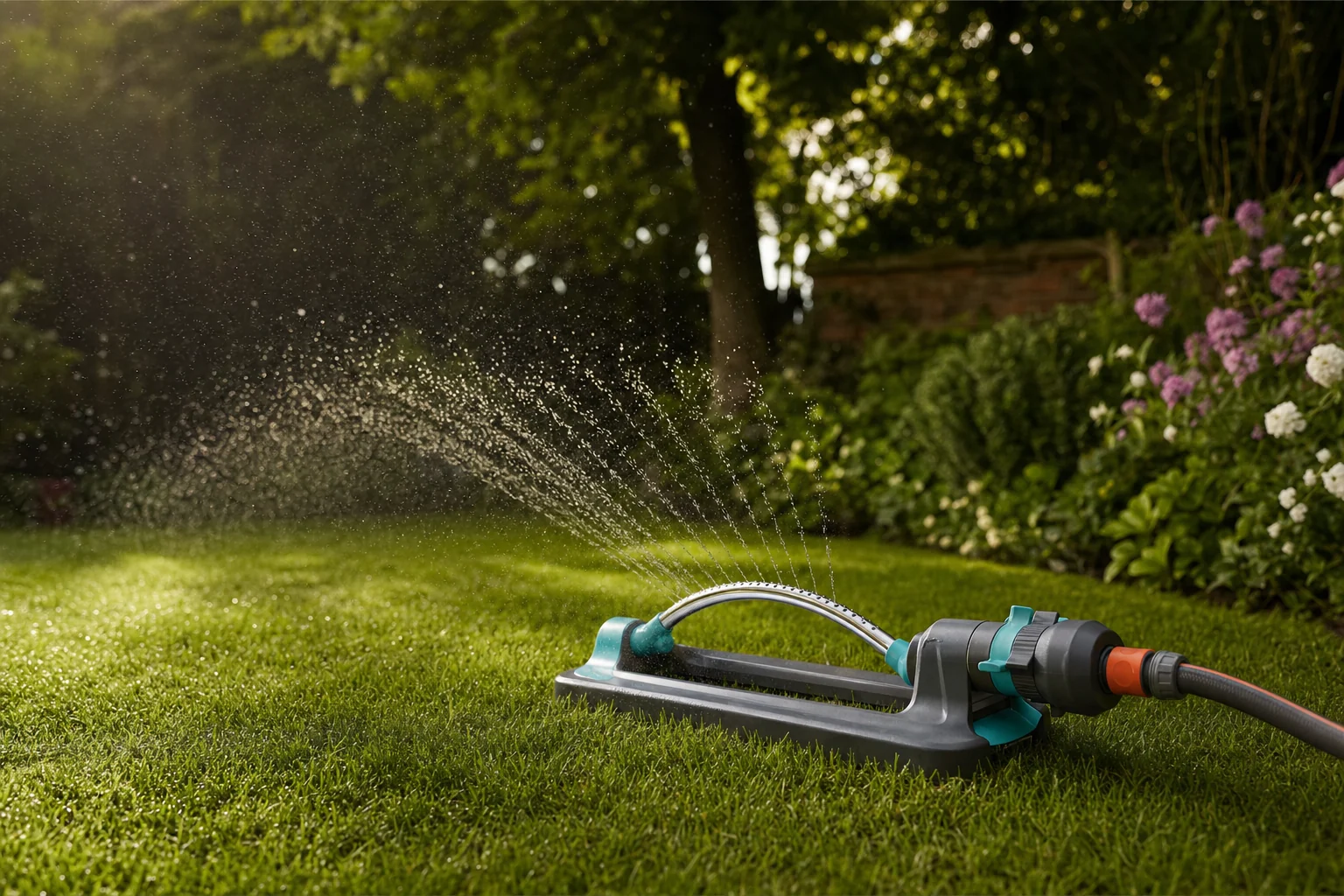
An oscillating sprinkler has a horizontal tube with a line of nozzles. The tube sweeps back and forth, sending a fan of water over a rectangular area. It is the classic sprinkler shape, and it remains popular because most lawns are more rectangular than circular. Even gardens that look informal on a planting plan tend to contain a fairly practical rectangle of grass.
Oscillators are at their best when you can place the sprinkler centrally and tune its sweep to keep spray within the lawn boundary. Models such as the Gardena Aqua S, Aqua Joe SJI-OMS16, Eden oscillating sprinkler and Dramm ColorStorm all work from this fundamental idea, though the materials, nozzle count and controls vary.
The movement usually comes from a water-powered drive. In the Aqua Joe and Eden designs, a turbo-drive mechanism uses the flow of water to power the sweep. That is an elegant arrangement: no mains power, no batteries, no electronics that suddenly demand attention halfway through a heatwave. It does, however, mean water quality and water flow matter. Fine grit is not a friend to small nozzles and moving parts.
Rotary and impact sprinklers: circles, arcs and broad open ground
Rotary sprinklers throw water around a circular pattern. Impact or pulsating sprinklers do it with the familiar click-click action, where a spring-loaded arm repeatedly strikes the water stream and turns the head in increments. They are wonderfully suited to open lawns, roundish sections of grass and gardens where a rectangular sweep would miss corners or repeatedly soak a path.
The Hozelock Round Sprinkler Pro is a pulsating example, whilst the Dramm 9-Pattern Turret Sprinkler takes a simpler stationary rotary approach with multiple selectable spray patterns. A rotary head does not need to move back and forth, so it can be a more natural match for a lawn with curved edges, a central tree or a broad island bed.
There is a useful pressure benchmark here. At 40 PSI, a rotary sprinkler can irrigate a diameter of 24 to 32 feet. At 60 PSI, the stated diameter range rises to 36 to 49 feet. That difference is significant. It is the difference between a full pass across a medium lawn and a ring of thirsty grass around the perimeter.
Travelling sprinklers: for lawns that genuinely need a route map
A travelling sprinkler is rather more theatrical. You lay out a hose in the path you want it to follow, connect the sprinkler, and it advances along the hose while watering. The hose is the track. No buried rail, no complicated installation, just a deliberate hose route and a machine that follows it.
That approach makes sense on lawns above 500 m², particularly where the lawn is long, broad or irregular enough that repeated sprinkler moves would become a nuisance. Nelson's Rain Train travels up to 200 feet and covers up to 13,500 square feet. The Melnor 4501 also quotes coverage up to 13,500 square feet, with self-propelled movement, three-position speed control and automatic shut-off.
Oscillating architecture
A sweeping nozzle bar creates a rectangular watering zone. It is usually the least wasteful option for straight-edged lawns.
Rotary or impact architecture
A rotating stream creates a circular or arc-shaped zone, making it useful where lawn edges are curved or less predictable.
Travelling architecture
A self-propelled sprinkler follows a laid-out hose path, spreading the work across very large areas without constant repositioning.
The pattern is the product
Do not be seduced by a huge headline coverage figure if the shape is wrong. A slightly smaller sprinkler that covers the lawn neatly is usually more useful than a bigger one that spends half its time irrigating the patio.
Specs at a Glance: The Numbers Behind the Key Models
The figures below reveal a category with a surprisingly broad spread of capability. There is a world of difference between a carefully adjustable unit for a 90 m² lawn and a travelling sprinkler intended to cover 13,500 square feet. Bigger is not automatically better. It is simply bigger, and occasionally much more awkward to store.
The Gardena Aqua S 18700-20 is the most explicitly garden-scale option in this group. It is designed for 90 to 220 m², offers a maximum range of 7 to 17 metres and a maximum spray width of 13 metres. Those numbers are useful because they describe adjustability as well as reach. You are not merely buying a sprinkler that can throw water 17 metres; you are buying one that can be brought back for a more modest lawn.
The Hozelock Rectangular Oscillating Sprinkler Plus is rated for 200 m², putting it squarely in the medium-lawn bracket. It is a sensible comparison point for the Gardena: both are aimed at gardeners who need a rectangular pattern without stepping into the physically larger, higher-output class.
Aqua Joe's SJI-OMS16 moves into a more muscular category. It covers up to 3,600 square feet, or 335 m², through 16 clog-resistant nozzles. Its stated maximum coverage distance is 70 feet, or 21 metres, at a maximum pressure of 120 PSI, with maximum flow of 6.65 gallons per minute. Those are high-end operating conditions, so it is more helpful to regard them as the ceiling of the design than a promise for every hose and tap combination.
The Eden oscillating sprinkler is larger again on paper, with 20 nozzles and stated coverage up to 4,973 square feet. It has three width adjusters, two independent slide adjusters for range, and a flow-control knob. Crucially, testing at 90 PSI recorded an actual range of around 51 feet and a width of 48 feet. That real-world measurement is the important bit. It shows how far advertised area and measured spray geometry can drift apart, even at a stated pressure.
| Feature | Gardena Aqua S 18700-20 | Aqua Joe SJI-OMS16 | Eden Oscillating Sprinkler |
|---|---|---|---|
| Coverage | 90–220 m² | Up to 3,600 sq ft / 335 m² | Up to 4,973 sq ft |
| Nozzles | — | 16 clog-resistant nozzles | 20 nozzles |
| Maximum range | 7–17 m | 70 ft / 21 m | Approx. 51 ft at 90 PSI |
| Pattern control | Maximum width up to 13 m | Oscillating sweep | Width, range and flow controls |
| Cleaning support | Removable filter and cleaning needle | Built-in pin clean-out tool | — |
| Base or body detail | Metal components | Extra-large solid-metal base | Sturdy metal base |
Elsewhere, Dramm's ColorStorm oscillator covers up to 3,036 square feet in a 66 by 46 foot pattern. Its 18 brass nozzle jets work across a pressure range of 30 to 90 PSI, with a flow rate from 2.5 to 4.5 gallons per minute. Morvat's spike sprinkler takes a different route, using an aluminium stake and brass head, with adjustable angles and 360-degree movement. It is stated to reach up to 49 feet and cover 7,542 square feet at 250 PSI.
That 250 PSI figure is not a normal domestic-garden expectation. It reinforces the broader point: coverage claims are inseparable from pressure conditions. Compare the geometry, controls and construction, not only the grandest area claim.
Small to Medium Lawns: The Oscillating Contenders Head to Head
For lawns up to 220 m², the Gardena Aqua S 18700-20 is the standout for controlled coverage. It is not trying to be an estate machine. Thank goodness. Instead, it offers a range suited to compact and medium rectangular lawns, with a maximum spray range of 7 to 17 metres and width up to 13 metres.
That flexibility is more valuable than it sounds. A small lawn can be difficult to water neatly because its boundaries are close. If the spray is too wide, the excess has somewhere very obvious to go: patio furniture, windows, gravel paths, the barbecue you forgot to cover. A range that can be reduced lets you keep watering intentional rather than spectacular.
The Aqua S also makes a convincing case on maintenance. Its water connection incorporates a stainless steel filter to stop dirt particles getting into the sprinkler. The filter is removable and rust-free, and Gardena includes a cleaning needle for clearing blocked nozzles. This is quietly excellent design. A sprinkler's weak point is often not some dramatic cracked body; it is a nozzle that becomes partially blocked, starts spraying sideways, and creates an oddly lush patch of lawn six feet from where it ought to be watering.
The five-year manufacturer's guarantee is another meaningful detail. Guarantees do not make a product indestructible, naturally. A lawnmower can still meet one at speed. But a five-year term signals more confidence than the shortest cover in this category, particularly when paired with UV and frost protection.
Hozelock's Rectangular Oscillating Sprinkler Plus, rated for 200 m², is the straightforward alternative for a similar lawn scale. It suits the gardener who wants the basic logic of an oscillator: set it in place, let the bar sweep, move it if needed. The main decision between it and the Gardena comes down to how much adjustment and maintenance support you value on an irregularly proportioned lawn.
The Orbit Pro Series Oscillating Sprinkler sits at the more basic end of the category. It will appeal if the goal is uncomplicated rectangular watering rather than a long feature list. That can be perfectly reasonable. Not every lawn needs a sprinkler that feels as though it has a maintenance schedule. But where water contains sediment, or where the lawn needs more carefully trimmed spray boundaries, the Gardena's filter and nozzle-cleaning provisions become more persuasive.
| Consideration | Gardena Aqua S | Hozelock Rectangular Plus | Orbit Pro Series Oscillating |
|---|---|---|---|
| Best lawn scale | 90–220 m² | Up to 200 m² | Small to medium rectangular lawns |
| Spray range | 7–17 m maximum | Up to 250 sq m | — |
| Maximum spray width | 13 m | 16m width | — |
| Filter and cleaning | Stainless steel filter, removable filter and cleaning needle | Built-in filter | — |
| Weather protection | UV and frost protected | — | — |
| Guarantee | 5 years | — | — |
Gardena strengths
- Coverage range is clearly matched to lawns from 90 to 220 m².
- 7–17 m range and up-to-13 m width give useful control.
- Stainless steel filter helps keep dirt out of the watering mechanism.
- Cleaning needle and removable filter support long-term maintenance.
- UV and frost protection, backed by a five-year guarantee.
Gardena limitations
- Not designed as a single-position solution for very large lawns.
- Rectangular spray geometry is less natural on curved or highly irregular grass.
- Like every oscillator, performance still depends on the pressure reaching it.
The boring feature that matters
A removable filter and a proper cleaning needle are not glamorous. They are, however, exactly the sort of details that keep an oscillator working evenly after a season of sediment, hose debris and general garden life.
For a conventional back lawn, I would lean towards control over raw capacity every time. The Gardena is particularly well judged because it acknowledges that medium lawns are rarely empty rectangles. They have borders, toys, bird feeders, washing lines and at least one patch you would rather not water. The ability to keep the spray where it belongs is half the battle.
Medium to Large Lawns: Heavy-Metal Oscillators That Mean Business
Once the lawn grows beyond roughly 220 m², the lightweight oscillator can start to feel a little optimistic. It may still do the job, but it needs more moves, more hose repositioning and more patience. That is where the Aqua Joe SJI-OMS16, Eden 4,973-square-foot model and Morvat spike sprinkler enter the conversation.
Aqua Joe's SJI-OMS16 is built around durability and stability. Its extra-large solid-metal base is the headline feature, paired with a sealed turbo-drive motor gear unit. The nozzle bar has 16 clog-resistant nozzles, and the supplied pin clean-out tool gives you a direct answer if one begins to misbehave.
The sealed drive matters because moving sprinkler mechanisms spend their lives around water, grit and grass clippings. A sealed motor gear unit is a sensible attempt to reduce dirt ingress into the moving parts. It does not remove the need for basic care, but it is a better starting point than leaving the drive arrangement exposed to every stray particle carried through the hose.
The solid-metal base is equally practical. A broad, weighty base helps prevent a sprinkler from creeping, twisting or tipping as the hose shifts. On a breezy day or an uneven lawn, that stability is useful. Plastic sleds can work perfectly well, but a large oscillator with a metal base is less likely to behave like it has suddenly developed wanderlust.
Aqua Joe quotes up to 3,600 square feet, or 335 m², with a maximum reach of 70 feet at 120 PSI and maximum flow of 6.65 gallons per minute. The figure establishes its upper potential, not a universal everyday result. A practical installation should begin with a short observation period: let it run, walk the edge of the lawn, and see where the water actually lands. It is not exciting, but neither is discovering the dry strip after a week of sunny weather.
Eden's larger oscillator adds a notably comprehensive set of area controls. Three adjusters control spray width; two independent slide adjusters set the range; and a flow-control knob reduces the watering area further. That is an appealing toolkit for a large lawn that is not a clean rectangle. You can narrow the sweep near a border, shorten one end where the lawn meets a path, and reduce output rather than accepting an all-or-nothing pattern.
However, its stated maximum area deserves sensible interpretation. At 90 PSI, the actual measured range was about 51 feet with a width of 48 feet. That is still a substantial watering footprint. It is simply not the same as taking the boldest coverage figure at face value. The lesson is not that Eden is poor; the lesson is that sprinkler boxes, like fishing stories, tend to reward context.
Morvat's sprinkler is a different proposition again. Rather than a sled-based oscillator, it uses a solid aluminium stake and an all-brass head. It offers adjustable angles, a 360-degree turn, up to 49 feet of reach and a stated 7,542-square-foot coverage figure at 250 PSI. The stake format makes it potentially useful for placing water into a particular part of the lawn or a large open area where a circular pattern is more suitable.
Why bigger oscillators appeal
- Broader coverage reduces how often a sprinkler must be moved.
- Metal bases improve stability on uneven ground.
- Adjustable width and range help manage a complex lawn outline.
- Clog-resistant nozzles and clean-out tools make maintenance less fiddly.
What to watch
- Maximum figures may rely on very high pressure conditions.
- Large spray patterns can waste water on borders and hard surfaces.
- A fixed oscillator still needs moving if the lawn extends beyond its practical reach.
Large Estate Lawns: Do Travelling Sprinklers Earn Their Place?
For a very large lawn, a travelling sprinkler can feel faintly ridiculous until you use one properly. Then it makes a great deal of sense. Instead of shifting a fixed sprinkler every half hour, you set out a hose route, start the machine and let it advance along the line while it waters.
The setup is important. The hose is not merely supplying water; it is defining the route. Lay it in a route with smooth curves rather than sharp kinks. Keep it clear of objects that could snag it. Make the path deliberate. Travelling sprinklers reward a few minutes of preparation with a much calmer watering session afterwards.
Nelson's Rain Train is the heavyweight example. It covers up to 13,500 square feet, travels up to 200 feet and uses adjustable aluminium spray arms that give a stated coverage range from 15 to 55 feet in diameter. Its body is rust-resistant cast iron with chip-resistant paint, it weighs 17 pounds, and it includes automatic shut-off.
Those details are not accidental. A travelling sprinkler has to pull itself along the hose while coping with the drag, bends and occasional lumps of lawn underneath. Weight and a robust body can be useful here. The Rain Train's 17-pound cast-iron construction is very much aimed at repeated use over serious ground rather than casual occasional watering of a postage-stamp lawn.
The Melnor 4501 offers the same stated coverage ceiling of up to 13,500 square feet, with a 15 to 55 foot spray distance. It is self-propelled, has three-position speed control, automatic shut-off and fits a 5/8-inch garden hose. At 2.5 pounds, it is dramatically lighter than the Nelson. That makes it easier to handle and position, though the two machines are clearly built around different physical approaches.
The hose defines the route
Plan the hose line before turning on the water. Gentle bends and an uncluttered path help a travelling sprinkler follow the course predictably.
Speed control changes the watering approach
The Melnor 4501 has three-position speed control, allowing the user to adjust how it progresses along the hose path.
Automatic shut-off prevents a forgotten session
Both the Nelson Rain Train and Melnor 4501 include automatic shut-off, a welcome feature when a garden job runs longer than planned.
| Feature | Nelson Rain Train | Melnor 4501 | Orbit 58322 |
|---|---|---|---|
| Type | Travelling sprinkler | Travelling sprinkler | Travelling sprinkler |
| Stated coverage | Up to 13,500 sq ft | Up to 13,500 sq ft | — |
| Travel | Up to 200 ft | Self-propelled | — |
| Spray range | 15–55 ft diameter | 15–55 ft | — |
| Body detail | Rust-resistant cast iron | 2.5 lb unit | Cast-iron construction |
| Automatic shut-off | Yes | Yes | — |
A travelling sprinkler is a poor fit for a tiny lawn. It needs enough open ground for the hose path to make sense. On a large lawn, though, that same hose-guided movement can replace repeated lifting, dragging and resetting of a fixed sprinkler.
Do they earn their place? On lawns above 500 m², yes, potentially very much so. The real attraction is not just coverage; it is systematic coverage. A fixed sprinkler asks you to remember where it has been. A travelling sprinkler follows a planned route, which makes watering a large area feel less like a series of improvised moves.
Build Quality and Longevity: Which Sprinklers Will Survive a British Summer and Winter?
A sprinkler lives a fairly hard life. It is dragged over grass, tugged by hose, left in direct sunlight, occasionally knocked by a boot and sometimes forgotten outside when the weather turns. The best designs recognise this and put effort into the parts that normally fail first: filters, nozzles, drive gears, bases and moving joints.
Gardena's Aqua S makes durability a prominent part of the proposition. It combines durable materials with metal components to stay firm on the ground, includes a stainless steel filter at the water connection, and is protected against frost and UV radiation. Those last two protections matter in a British garden. Summer sun can be surprisingly punishing for plastic parts, whilst an unexpected cold snap catches out anybody who has confidently declared winter "probably finished now".
The stainless steel filter is particularly worthwhile. It is there to prevent dirt particles entering the sprinkler, but it also makes the maintenance process more tangible. You can remove it, inspect it and clean it. The built-in cleaning needle provides the same useful practicality for blocked nozzles. These are not glamorous upgrades. They are the details that prevent a sprinkling system turning into a one-season novelty.
Aqua Joe takes a sturdier, more overtly industrial route with its extra-large solid-metal base and sealed turbo-drive motor gear unit. The base adds stability, whilst the sealed drive is designed to keep the moving mechanism protected. Its built-in pin clean-out tool is another nod to reality: water contains particles, garden hoses collect debris and nozzles occasionally need intervention.
Eden also uses a sturdy metal base and a dirt-resistant turbo-drive motor. Dramm's ColorStorm is another robust oscillator, weighing 2.35 pounds and using a heavy-duty metal base. It employs 18 brass nozzle jets, works within a 30 to 90 PSI pressure range, and includes a needle plug for nozzle cleaning. Brass nozzles are a reassuring material choice in a component that spends its working life under flowing water.
At the heavy end, Nelson's Rain Train is rust-resistant cast iron with chip-resistant paint. The Orbit 58322 travelling sprinkler also uses cast-iron construction. That sort of material is inherently reassuring for a machine expected to crawl around a large lawn season after season. It does not mean you should leave it full of water through a hard freeze, of course. It means the basic chassis is built for a more demanding role.
Winter storage remains good sense
Frost protection is valuable, but it is not an invitation to abandon basic care. Disconnect, drain and store a sprinkler when prolonged freezing weather is expected. The few minutes spent doing that are much cheaper than replacing a split fitting in spring.
Which Lawn and Gardener Does Each System Suit?
The most useful buying decision is not "Which sprinkler is best?" It is "Which sprinkler will make my particular lawn least annoying to water?" That is a more modest question, but it tends to produce much better outcomes.
Compact rectangular lawn
Choose a controlled oscillator such as the Gardena Aqua S. Its 90–220 m² coverage, 7–17 m range and up-to-13 m width are tailored to lawns where accuracy matters.
Open medium lawn
Consider a larger oscillator such as Aqua Joe or Eden if broad rectangular coverage and fewer repositioning stops are the priority.
Large estate-style lawn
A travelling sprinkler such as Nelson Rain Train or Melnor 4501 makes sense where a planned hose route can cover a great deal of ground.
If your lawn has curved edges, trees in the middle or an awkward shape, do not ignore the rotary option simply because oscillators are familiar. A Hozelock Round Sprinkler Pro or Dramm 9-Pattern Turret may create a more natural watering zone. The goal is to minimise dry corners and overspray, not to follow the most traditional-looking solution.
For gardeners concerned about blockages or older plumbing, the Gardena's filter and cleaning needle are unusually useful. For those who want a substantial base and sealed drive, Aqua Joe is more compelling. For maximum adjustment of an expansive oscillating pattern, Eden's multiple width, range and flow controls deserve attention. And for truly large ground, the travelling machines are in a category of their own.
There is also a simple operational truth: the best sprinkler is one you will actually use properly. A massive unit may be technically capable, but if it is inconvenient to deploy on your lawn, it will not get deployed. A smaller, controllable sprinkler that comes out regularly can be the better gardening tool.
Frequently Asked Questions
Yes. Their sweeping nozzle bars create a rectangular pattern, making them a natural fit for square and rectangular lawns. The key is choosing one with enough range and width adjustment to keep the spray within your boundaries.
The Gardena Aqua S 18700-20 is designed for areas from 90 to 220 m². It has a maximum range of 7 to 17 metres and a maximum spray width of 13 metres.
Water pressure and flow influence how far a sprinkler throws water and how evenly it covers an area. Eden's oscillator, for example, recorded an actual range of around 51 feet and width of 48 feet at 90 PSI, demonstrating why a headline maximum area needs to be read alongside operating conditions.
Travelling sprinklers are most useful on very large lawns, especially those over 500 m², where moving a fixed sprinkler repeatedly would be tiresome. The hose acts as the track, letting the unit follow a planned path while watering.
Choose a model with maintenance support and use it. The Gardena Aqua S has a removable stainless steel filter and cleaning needle, whilst the Aqua Joe SJI-OMS16 has a built-in pin clean-out tool. Regular cleaning helps maintain an even spray pattern.
Final Verdict: Match the Machine to the Map
There is no single champion across every lawn, because the category is doing three distinct jobs. Oscillating sprinklers are the sensible default for rectangular grass. Rotary and impact designs make better sense where a circular pattern suits the space. Travelling sprinklers are a specialised but genuinely useful answer for large lawns that would otherwise demand constant repositioning.
For small to medium lawns, the Gardena Aqua S 18700-20 is the most thoughtfully specified choice in this group. Its 90–220 m² design range, 7–17 metre maximum range, 13-metre maximum width, stainless steel filter, cleaning needle, UV and frost protection, and five-year guarantee form a very complete package. It is practical rather than flashy, which is exactly what a good garden tool should be.
For a larger rectangular lawn, Aqua Joe brings a serious solid-metal base, sealed turbo-drive mechanism and 16 clog-resistant nozzles. Eden offers extensive control over width, range and flow, but its measured performance at 90 PSI is the useful reminder to assess coverage claims sensibly. If your lawn is broad, open and considerably larger, Nelson Rain Train and Melnor 4501 make the strongest case for the travelling approach.
GardenScout's take
Buy the sprinkler pattern before you buy the coverage claim. A well-controlled oscillator is hard to beat on an ordinary rectangular lawn; a rotary design wins where circles make sense; and a travelling sprinkler earns its storage space only when the lawn is genuinely large enough to need one. Pick with the shape of your grass, your pressure and your tolerance for moving hoses in mind. Your lawn will thank you. Your patio may finally stay dry.