
The Best Automatic Watering Timers and Tap Computers
Battery, dual-outlet and connected tap timers that keep the garden watered whilst you are away, busy, or simply enjoying a cup of tea indoors.
Why Your Garden Needs a Tap Timer
It is mid-September, and the garden has reached that slightly confusing point in the year. The nights are cooler, the borders are beginning to soften around the edges, and yet a warm, breezy spell can still dry out containers with startling speed. Tomatoes under glass, late salad crops, hanging baskets and anything in a pot remain remarkably capable of demanding attention at precisely the moment you are trying to pack for a weekend away.
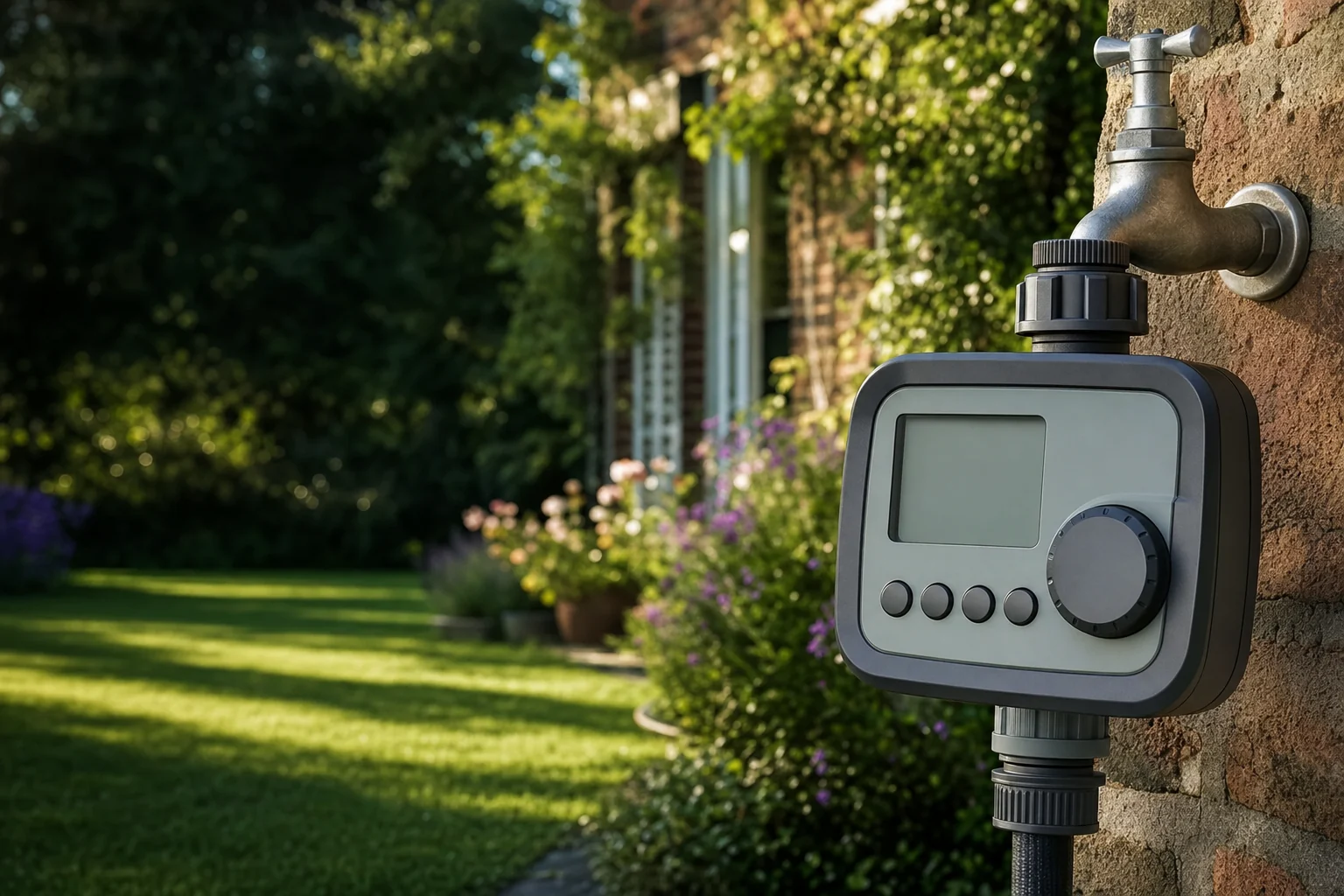
An automatic watering timer, often called a tap computer, is the small device that makes this less dramatic. It screws on to an outdoor tap, sits between the tap and hose or irrigation line, and opens and closes the water supply on a programme you set. There is no need to run a mains cable down the garden. Most use ordinary batteries; others use a mechanical timer dial or solar power. The basic idea is gloriously simple: the timer remembers to water when you do not.
That matters in Britain because our rainfall has a talent for being both frequent and unhelpful. A quick shower can make paving wet without putting meaningful moisture into a greenhouse border or a row of thirsty pots under an eave. Conversely, a dry fortnight in late spring or summer can turn a container garden into a daily rota. Miss one hot afternoon and basil wilts theatrically. Miss two, and it begins composing its resignation letter.
Tap timers are especially useful for gardens divided into jobs. Perhaps one line serves a greenhouse full of tomatoes and cucumbers, whilst another waters patio pots. Perhaps you have a kitchen garden that needs regular, modest irrigation and an ornamental border that only needs a deeper soak less often. Dual-outlet models let those areas run separately from one tap, which is a great deal more sensible than trying to make every plant accept the same watering schedule.
They are not an excuse to stop looking at the garden. No timer can see that a dripper has fallen out of a pot, that a hose has kinked behind a terracotta urn, or that three days of steady rain have made additional watering unnecessary. But they remove the repetitive, easy-to-forget part of the task. That is enough to make a real difference during holidays, school runs, work trips and those weeks when life gets a little too good at filling the diary.
Start with the plants that cannot wait
In September, prioritise greenhouse crops, containers, newly planted shrubs and any sheltered spot that rain struggles to reach. Established plants in open ground usually need less intervention as autumn progresses. A timer should support good watering judgement, not replace it with blind optimism.
There is another practical reason to use one. During periods when water use is restricted, a timer will not magically exempt you from local rules. You still need to follow any hosepipe or usage restrictions in force. What it can do is help you deliver water carefully at the root zone through drip irrigation, rather than standing over a hose and accidentally watering the path, the fence and one very pleased slug.
The Contenders at a Glance: Five Timers, Five Approaches
These timers are not interchangeable. That is the first thing to understand before becoming distracted by a screen, an app or a particularly handsome dial. The best choice depends on how many watering areas you have, whether you enjoy using an app, and how much precision your garden genuinely needs.
Hunter's BTT-100 is the focused single-zone choice. It runs from two 1.5V AA alkaline batteries, has an IPX6-rated housing and is controlled through Bluetooth from a smartphone at distances of up to 10 metres. Its published operating range is broad: 0.5 to 8 bar pressure and 1.9 to 2,271 litres per hour. That makes it suitable for anything from a restrained drip line to a more demanding hose-end setup, provided the rest of the irrigation system is designed sensibly. It also has a two-year manufacturer warranty.
The Hunter BTT-200 takes the same basic approach and adds a second independently controlled zone. It is the obvious Hunter choice where one tap has to look after two different parts of the garden. The body is slightly larger than the BTT-100, but still compact enough to sit neatly beneath an outdoor tap. It uses the same pair of AA batteries, Bluetooth scheduling and weather-resistant IPX6 plastic housing. Note that some BTT-100 features — including confirmed flow rate, pressure range, passcode protection, suspend duration and cycling mode — have not been independently verified for the BTT-200; check the manufacturer's current specification before purchasing.
The Melnor AquaTimer 2-Zone is for gardeners who would rather deal with a large LCD screen than a phone app. It has two independently scheduled valves and a properly flexible timetable, from hourly watering through to weekly programmes. A rain delay can pause watering for up to seven days, while manual access means you can still use the tap without dismantling the whole arrangement. It is a very practical proposition for anyone who wants dual-zone control without connectivity entering the conversation.
Orbit's 62041 Pro Flow heads in the opposite direction. There are no batteries, no display and no app. You turn a mechanical dial; it waters for the period you select; it stops. Its metal construction is a pleasing change in a category crowded with plastic housings. This is not the model for intricate schedules, but it is an exceptionally approachable answer to temporary watering jobs and gardeners who regard another app as a personal insult.
Netro Pixie is the solar-powered wild card. Its appeal is obvious before we even get into finer details: a smart, single-zone timer powered by the sun removes the routine task of replacing batteries. It belongs at the more connected end of this category, whereas the Orbit is deliberately, almost proudly, not connected at all.
| Timer | Zones | Control approach | Power | Best suited to |
|---|---|---|---|---|
| Hunter BTT-100 | One | Bluetooth app and manual button | Two AA batteries | A single greenhouse, border or container system |
| Hunter BTT-200 | Two | Bluetooth app and manual control | Two AA batteries | Two distinct watering areas from one tap |
| Melnor AquaTimer 2-Zone | Two | On-unit LCD programming | Two AA batteries | App-free independent schedules |
| Orbit 62041 Pro Flow | One | Mechanical dial | No batteries | Simple timed watering and temporary setups |
| Netro Pixie | One | Smart timer | Solar-powered | Low-maintenance connected watering |
It is tempting to assume the cleverest model is automatically the best. Often it is not. A single dial can be exactly right for an allotment plot where you only need to water for a while after visiting. Equally, a Bluetooth unit makes much more sense if you are managing seedling irrigation, where brief and repeated watering cycles may matter. Match the timer to the watering problem, not to the urge to own the newest gadget.
Hunter BTT-100 Review: Bluetooth Simplicity in a Single Zone
The Hunter BTT-100 is what a modern tap timer ought to feel like: compact, purposeful and not especially interested in becoming the star of your patio. At roughly 12.7 cm high, 12.4 cm wide and 6.1 cm deep, it does not dominate a wall-mounted outdoor tap. The plastic housing is rated IPX6, which means it is designed to withstand powerful water jets. In normal garden terms, it should be comfortable living outside through rain and the occasional overenthusiastic hose-down.
Two 1.5V AA alkaline batteries are included, which is a small but welcome detail. I have lost count of the number of garden gadgets that arrive ready to impress, only to be stopped cold by the absence of two batteries from the kitchen drawer. The BTT-100 gives a blinking LED warning when battery replacement is needed, rather than leaving you to discover the problem after a row of thirsty pots has staged a protest.
The safety provision is also sensible. Automatic watering shuts off after one hour. This is not a substitute for building the right programme in the first place, but it is useful protection against a long manual run being left unattended. Water has a remarkable ability to find the one place you would rather it did not go. A one-hour ceiling is the kind of quietly boring feature that becomes very exciting only when it prevents a mess.
The Bluetooth connection works at up to 10 metres. In a typical compact back garden, that is enough to stand at the kitchen door, by the patio table or near the greenhouse and adjust the programme. A brick wall can reduce the practical range, as can metalwork and the general clutter of a real garden. It is worth treating the stated range as a useful open-air maximum rather than a promise that your phone will communicate flawlessly from behind two solid walls and a boiler cupboard.
Where the BTT-100 shines is programming flexibility. Start times and runtimes can be set through the app, with duration available from one second to 24 hours. There is also a cycling mode, which repeats watering within a user-defined window. That is genuinely useful for drip irrigation, seed germination and situations where a long watering session would lead to runoff. Rather than dumping water onto dry compost in one go, you can apply it in shorter bursts and give the growing medium a chance to absorb it.
Manual runs can be set for up to 360 minutes, and the physical push button offers a direct way to operate the unit without reaching for a phone. That distinction matters. A connected garden device should still be usable when your phone is charging upstairs, your Bluetooth is being contrary, or you are wearing muddy gloves and have no desire to swipe through a screen.
The BTT-100 can suspend irrigation for up to 99 days. This is a proper seasonal pause rather than an awkward sequence of deleting every programme and trying to remember what you had set come spring. For a UK garden, it is useful when the main watering season winds down in autumn, or when you are closing a greenhouse system after summer crops have finished.
Cycling mode for measured watering
Repeated watering during a selected window is particularly helpful for drip systems, germinating seed and dry compost that needs time to take up water.
Programming without a dial marathon
Start times, duration and manual runs are set from a smartphone, avoiding the familiar dance of pressing one tiny button until the right symbol eventually appears.
Passcode protection
A passcode can prevent unwanted programme changes. That is more useful on shared growing spaces than in a locked private garden, but it is a thoughtful option.
Pros
- Very broad published flow and pressure operating range.
- AA batteries are included, with a visible low-battery alert.
- Flexible programmes, including one-second runtimes and cycling mode.
- Manual button means the timer remains useful without the app.
- Seasonal suspend setting can pause irrigation for up to 99 days.
Consider before buying
- It controls one zone only.
- Bluetooth is local control, so distance and walls affect where you can manage it from.
- Gardeners who dislike smartphone setup may prefer the Melnor's LCD controls.
Who is the BTT-100 really for?
It is the strongest fit for a garden with one important watering area: a greenhouse, a patio full of containers, a new hedge line or a compact vegetable bed on drip irrigation. It is more capable than a basic countdown timer, but does not make you pay for a second outlet you will never use.
Hunter BTT-200 Review: Two Zones, One Tap, Total Control
The Hunter BTT-200 is the natural move from "I need watering help" to "I have realised that my garden has entirely different ideas about watering." Two zones make a meaningful difference. You might have tomatoes and peppers under cover on one line, where regular irrigation is useful, and more resilient patio shrubs on the other. Or a vegetable bed on one outlet and hanging baskets on the second. Trying to run both from one schedule usually means one group gets too much or the other gets too little.
At roughly 15.2 cm high, 12.4 cm wide and 7.6 cm deep, it is a little larger than the BTT-100. That is inevitable: there are two controlled outlets to accommodate. It remains a compact outdoor unit rather than a wall of plumbing. Its IPX6 plastic construction is intended for outdoor use, and it carries UL/cUL, FCC, CE and RCM approvals.
It uses two 1.5V AA alkaline batteries, included in the box, just as the BTT-100 does. A blinking low-battery LED provides a warning that the power source needs replacing. There is also the same automatic one-hour shut-off. For two-zone gardens, that safeguard has even more appeal: there are simply more lengths of hose, more connectors and more potential for a small problem to become a soaking.
The app-based system allows start times and runtimes from one second to 24 hours. You can schedule cycling mode and manual runs up to 360 minutes. The central advantage is not merely that there are two outlets. It is that the zones can be treated as separate horticultural jobs. This is exactly how gardens work in real life.
A greenhouse does not behave like an exposed herb planter. A young hedge does not behave like established lavender. A line of salad leaves may appreciate frequent, modest applications of water, whilst a border shrub is generally better served by an occasional deep soak when conditions are dry. The BTT-200 gives you the means to reflect those differences without fitting a second timer to another tap.
Bluetooth range is up to 10 metres, and the smartphone can manage an unlimited number of Hunter timers. That matters if you have more than one tap or run different systems around a larger garden. The BTT-200 itself solves the two-zone problem at one tap; the wider Hunter setup can also make sense where the front garden, rear garden and greenhouse all have separate water points.
As with the BTT-100, a passcode can protect programming from unwanted changes. On an allotment, a school garden or a shared courtyard, this is more than a gimmick. Somebody adjusting a timer because they think it looks like a tap can undo carefully planned watering in seconds. In a private back garden, it is mostly a reassuring extra. Still, there is no harm in keeping the grandchildren from accidentally turning your tomato schedule into a small-scale monsoon.
Independent zones, not a compromise split
The point of two outlets is to give different areas their own timetable. Use that freedom. Do not duplicate the same programme merely because it is quicker.
Pause when the season changes
The irrigation suspend function can halt scheduled watering for up to 99 days, useful as autumn rain begins to do more of the work outdoors.
Manual runs when the garden asks for more
A programme is a baseline, not a prison. Manual watering up to 360 minutes gives you a straightforward way to respond to unusual warmth or a newly planted area.
Pros
- Two zones bring proper flexibility to one outdoor tap.
- Uses the same convenient AA battery platform as the BTT-100.
- Bluetooth programming supports highly short or very long runtimes.
- Manual operation confirmed; cycling mode and long seasonal suspend are listed as features but have not been independently verified for the BTT-200 — confirm with the manufacturer's current specification.
- Outdoor-rated IPX6 housing.
Consider before buying
- A larger body than a single-zone timer, though still compact.
- Best results depend on planning each outlet as a genuinely separate zone.
- Those wanting controls on the device itself may find the Melnor more immediately familiar.
For a small garden with only one collection of pots, the BTT-100 is easier to justify. For a garden with a greenhouse plus outdoor containers, or vegetables plus ornamental planting, the BTT-200 is the more sensible fit. The extra outlet is not about having more kit. It is about allowing the garden to make more sense.
Melnor AquaTimer 2-Zone Review: Old-School LCD, New-School Scheduling
The Melnor AquaTimer 2-Zone is a refreshing reminder that an automatic watering system does not have to involve a phone. Its large LCD display is front and centre, and all scheduling happens at the timer itself. For some gardeners, that is not a compromise. It is the entire point.
There are plenty of people who use smartphones constantly but do not especially want one involved in the garden. Others garden with a partner, parent or neighbour who might need to alter a watering programme without borrowing somebody else's phone or learning an unfamiliar app. A visible display and on-unit controls keep the system democratic. You set it. Anyone standing by the tap can see what it is doing.
Each valve has an independent schedule. Watering can be set from hourly, with up to 24 watering events a day, right through to weekly. Duration runs from one minute to six hours. That is a useful range because it covers both ends of garden watering: short, repeated sessions for seed trays or very small drip systems, and longer applications for a larger bed or a line of containers.
The hourly setting deserves a little restraint. Just because a timer can run 24 times in one day does not mean most gardens should. Repeated micro-watering can be appropriate during germination or for carefully managed growing media. In an ordinary border, it risks encouraging shallow roots and using water unnecessarily. The clever feature is the option, not a command to use it with wild abandon.
The Smart Rain Delay pauses the schedule for up to seven days, then resumes automatically. This is exactly the sort of practical function British gardeners need in autumn and spring, when forecasts can be unsettled and a period of rain can make a pre-set programme unnecessary. It is still wise to check the garden rather than trusting a weather app as though it were an oracle, but a pause button is infinitely better than forgetting to change every individual schedule.
The Melnor requires two AA batteries, and they are not included. Put a fresh pair on the shopping list when fitting the timer. A typical battery life of around 12 months means a new set should comfortably cover a conventional April-to-October watering season, assuming normal use.
The manual option is another quietly excellent feature. It allows immediate tap access for jobs such as filling a bucket. This sounds obvious, but it is something many people only think about after plumbing an irrigation system into the tap and then discovering they need water for washing tools, topping up a pond container or making a muddy patio less muddy. A manual override keeps the arrangement useful rather than fussy.
There is a lot to like here for a gardener who values legibility. The large LCD should make it easier to check settings than tiny symbols on a compact body. It also avoids one of Bluetooth's mild irritations: walking out to the tap with a phone, only to find you have forgotten the connection range or the handset has decided it is a good time for an update.
Pros
- Two independently scheduled valves without a smartphone dependency.
- Large LCD display keeps programming visible and accessible.
- Wide frequency range, from hourly to weekly.
- Rain delay can pause watering for up to seven days.
- Manual access is useful for everyday tap jobs.
- Backed by a seven-year limited warranty.
Consider before buying
- AA batteries are required but not supplied.
- No app-based control for gardeners who prefer to programme from indoors.
- Its one-minute minimum runtime is less granular than Hunter's one-second setting.
The Melnor makes particular sense for shared gardens, straightforward dual-zone setups and gardeners who want the reassurance of seeing the programme on the device. It is neither flashy nor trying to be. That is rather the charm. Sometimes you want a watering computer that behaves like a watering computer, rather than a tiny management consultancy attached to the tap.
Orbit 62041 Pro Flow and Netro Pixie: The Mechanical and Solar Wildcards
The Orbit 62041 Pro Flow and the Netro Pixie sit at opposite ends of the tap-timer spectrum. One rejects batteries entirely. The other uses solar power as part of a smart, single-zone approach. Put them beside each other and you have a neat summary of modern garden equipment: one says, "turn the dial"; the other says, "the sun can help." Both have their place.
Orbit 62041 Pro Flow: the uncomplicated fallback
The Orbit 62041 Pro Flow is a mechanical sprinkler timer. It needs no electricity and no batteries, and there is no menu to work through. You turn the timer dial, water runs, and the timer stops the flow at the end of its mechanical cycle. It is made from metal rather than plastic, which gives it a distinctly heavy-duty proposition in a category where sun-faded plastic is common.
The absence of batteries is more useful than it first appears. There is no chance of a battery running down halfway through a programmed watering season, no low-power screen to interpret, and no need to remember which drawer contains spare AAs. In reported use, the timing has been accurate, the flow has been good and the unit has not leaked, including when left with the water supply on for a week according to test reporting. That is a reassuringly solid result for the simplest timer in this guide.
But simplicity has a cost. There are no separate daily schedules, no rain delay and no remote adjustment. You cannot programme a precise early-morning routine for the next fortnight and then leave for holiday. This is a timer for a task you are actively setting up: water the allotment for a while after a visit, run a sprinkler on a newly seeded patch, or give a temporary garden display a measured soak.
Netro Pixie: the solar alternative
The Netro Pixie is the philosophical opposite. It is a single-zone smart timer with solar power. Its appeal is low routine maintenance: rather than planning battery changes as part of your gardening calendar, it draws power from sunlight. That makes it especially interesting for gardeners who like connected control but dislike the small, recurring chore of battery replacement.
There is a useful lesson in comparing the two. Do not choose mechanical simply because it feels indestructible, and do not choose solar simply because it feels modern. Think about your actual pattern of gardening. If you water only when you are present and want a dependable countdown, the Orbit is beautifully direct. If you want a smart timer but are tired of adding batteries to the list of things that need managing, the Netro Pixie offers a different route.
| Question | Orbit 62041 Pro Flow | Netro Pixie |
|---|---|---|
| Power approach | Battery-free mechanical operation | Solar-powered |
| Control style | Turn the dial | Smart timer control |
| Best garden use | Simple, attended watering tasks | Single-zone low-maintenance smart watering |
| Scheduling complexity | Deliberately basic | Connected approach |
| Body material noted | Metal | Not the deciding point |
Choose the Orbit when failure-proof simplicity matters most
A communal allotment tap, a children's growing patch, a temporary summer display or a festival garden does not necessarily need a detailed weekly schedule. It may simply need water to stop reliably after a chosen period. That is where a mechanical dial remains wonderfully hard to argue with.
No battery to fail mid-cycle
The Orbit's mechanical operation removes battery anxiety entirely. It is an especially useful quality for an occasional-use timer kept as a backup.
Solar power without the AA routine
The Pixie's solar-powered design suits gardeners looking for a connected single-zone timer without routine battery replacement.
Keep temporary watering temporary
For jobs where you are present and simply want water to stop after a set period, a mechanical timer can be more practical than a complex programmable system.
Performance by the Numbers: Flow, Pressure and Battery Reality
Published numbers can make watering equipment seem more scientific than it is. In reality, the performance of a timer depends on the tap, water pressure, hose length, fittings, elevation, filters and whatever you connect downstream. A timer can be excellent, but it cannot persuade a kinked hose to become a finely tuned irrigation network. That remains, sadly, beyond current technology.
The most useful verified figures here are Hunter BTT-100's published flow range of 1.9 to 2,271 litres per hour and pressure range of 0.5 to 8 bar, or 50 to 800 kPa. That is an extremely broad working range. At the lower end, think of a restrained irrigation setup such as a single dripper. At the upper end, think of a much more substantial demand, such as a large sprinkler arrangement. The important message is not that you should chase the maximum. It is that the timer can support very different styles of garden watering.
The bars above show the full stated operating span, not a performance score. Flow is not better simply because it is higher. A row of pots on drip irrigation may need only a controlled trickle. A sprinkler needs substantially more. Your job is to choose irrigation hardware that matches the plants and then programme it for sensible delivery.
For many UK domestic supplies, the Hunter BTT-100's 0.5 to 8 bar compatibility gives considerable room to work. Typical domestic mains pressure commonly sits around 1 to 4 bar, so the stated range covers the usual household context with headroom. If you are at the awkward end of water pressure, such as a high garden fed by a weak supply, it is still worth testing the actual flow at the tap before committing to a long run of drippers or a demanding sprinkler.
Long irrigation lines deserve particular care. Every metre of hose, every sharp bend and every small fitting introduces some resistance. The result can be frustratingly uneven watering: pots nearest the tap receive plenty, while those at the far end are merely offered a hopeful mist. Keep runs logical, use compatible fittings and, if your system is complex, test each outlet before trusting it during a holiday.
Flow and pressure figures are published for the Hunter BTT-100. Equivalent figures for the Melnor AquaTimer, Orbit 62041 Pro Flow, Hunter BTT-200 and Netro Pixie are not used here, so there is no false impression of a like-for-like numerical comparison.
Battery life is often treated as a minor issue until the first dry weekend when it is not. The Melnor's typical battery life is around 12 months on two AA batteries. In a normal UK watering season, broadly April to October, that suggests a fresh set should last through the main growing months and beyond under standard use. It is still good practice to start spring with fresh batteries and keep a spare pair somewhere dry and memorable. "Somewhere memorable" is doing a lot of work there. A labelled box is better than a drawer of mystery chargers.
For the Hunter BTT-100 and BTT-200, the blinking low-battery LED is your cue to act early. Do not wait for the timer to stop working entirely. Replace batteries before leaving home for more than a few days, especially if the timer is caring for containers, greenhouse crops or recent planting. The automatic shut-off provision is useful, but it cannot water plants after the power is gone.
Mechanical and solar power offer different forms of reassurance. The Orbit needs no batteries at all, so there is no replacement schedule. The Netro Pixie uses solar power, potentially removing the routine AA task. Neither changes the basics: inspect hoses, clean filters where relevant, ensure connections are sound and run a full test before relying on any system.
App Wars: Bluetooth and Wi-Fi Interfaces in Real Life
Apps are either a blessing or a small personal affront, depending on the day. In a tap timer, the useful question is not whether an app exists; it is whether it makes watering clearer and easier than controls on the device itself. Hunter's Bluetooth approach does a good job of keeping the complexity in the phone, while leaving a manual button on the timer for immediate use.
The Hunter app can manage an unlimited number of timers. That becomes genuinely useful once you move beyond a single tap. One BTT-100 might control a greenhouse drip line, while a BTT-200 handles patio pots and a vegetable bed elsewhere. Instead of trying to remember separate schedules or walking between timers, you can keep the programmes in one place.
Scheduling is the real strength. You can set start times and runtimes from one second to 24 hours, initiate manual runs up to 360 minutes and use cycling mode within a chosen watering window. The broad duration range means the same basic interface can handle a short pulse for germinating seeds and a much longer session for a larger irrigated area. It is flexible enough that the limiting factor is usually your watering plan, not the timer.
The 99-day irrigation suspend function is equally practical. It allows you to pause a schedule without deleting it. As we move through autumn, that is helpful for outdoor systems that are no longer needed every day but may become useful again during an unexpectedly dry spell. Come next spring, it also makes waking the system up less of a memory test. The schedule can remain there, waiting patiently, unlike the label you wrote on a plant pot last March.
Local Bluetooth control
Hunter's Bluetooth connection works up to 10 metres. It suits a back garden where you can reach the tap area from nearby, rather than long-distance control from another location.
One interface for several timers
Unlimited Hunter timers can be managed from the smartphone, useful for gardeners with several taps or distinct irrigation areas.
Passcode protection
A schedule lock is particularly worthwhile where a timer is accessible in a shared allotment or communal garden.
Bluetooth has an important limitation: it is local. If you are on holiday, Bluetooth does not give you a remote control centre from the beach. It gives you a way to programme and alter the timer when you are within range. For many gardens that is entirely adequate, because the important thing is that the schedule continues when you leave. But it is worth being clear about what you are buying.
Orbit's B-hyve timer takes a different route. It has three outlets that can be controlled separately, with Bluetooth and Wi-Fi capability. With its Wi-Fi Hub (included in the box), it can be programmed and controlled from anywhere. It also connects with local weather stations, allowing the system to remain off if it is raining or has recently rained. Its app offers customised schedules, rain delays and smart watering suggestions, while a built-in flow meter helps ensure plants receive the intended water volume.
The B-hyve's remote capability makes it a compelling option for gardeners who travel regularly or manage several zones that need closer oversight. Its 24-, 48- and 72-hour rain delays are useful for a quick weather-led pause, while low-battery auto shut-off and manual watering provide practical safeguards. Three separate outlets are a serious step up from the single- and dual-zone models in this guide, particularly where a vegetable garden, greenhouse and container display all share one water source.
Use smart features to reduce watering, not merely automate it
The best connected system is not the one that waters most often. It is the one that gives each zone only what it needs. Rain delays, cycling programmes and separate schedules are all opportunities to apply water more carefully.
The Melnor remains the counterargument to all this. Its LCD-based programming has no signal range, no Wi-Fi hub and no phone dependency. If you live with patchy connectivity, share the garden with someone who wants physical controls, or simply prefer an appliance that tells you its settings on a screen, it may be the calmer choice.
My view is straightforward. Choose Bluetooth if you want sophisticated schedules and you are happy to programme locally. Choose Wi-Fi-enabled control if true remote access and weather-aware adjustment matter to your routine. Choose the LCD route if clarity at the tap is more valuable than another interface in your pocket. And choose mechanical if every one of those sentences made you tired.
Choosing the Right Timer for Your Garden
Once the specifications are out of the way, choosing becomes pleasingly practical. Begin by counting zones, not plants. A zone is an area that should receive the same watering at the same time. Ten tomato plants in one greenhouse can be one zone. Six pots of herbs on the patio may be a second. A newly planted border on the other side of the garden could be a third, especially if its needs are different again.
Do not make zones too complicated. Most home gardens do not need every pot individually programmed like a laboratory experiment. Group plants with similar needs and use the timer to deliver water efficiently. Tomatoes, cucumbers and thirsty containers can usually sit together. Established drought-tolerant planting may not need an automated line at all by September, unless weather is unusually dry.
The greenhouse grower
Choose the Hunter BTT-100 for one carefully programmed watering line, particularly where cycling mode helps manage drip irrigation or seedling watering.
The split-zone gardener
Choose Hunter BTT-200 or Melnor AquaTimer 2-Zone when one tap needs to serve two areas with different schedules.
The no-app gardener
Choose Melnor for detailed programming on a large LCD, or Orbit for a simple attended watering period with no batteries.
For a single-zone garden, the decision is mostly about controls. The Hunter BTT-100 is the better fit if you like programming with a smartphone, want very short runtimes and value cycling mode. The Orbit 62041 Pro Flow is for uncomplicated watering sessions when you are nearby. The Netro Pixie appeals if solar-powered smart control is the priority.
For two zones, decide whether an app makes life easier. The Hunter BTT-200 suits gardeners who want Bluetooth-based flexibility, manual runs, cycling mode and the ability to coordinate multiple Hunter timers from one smartphone. The Melnor is more attractive if you want the whole programme readable and adjustable directly on the unit, along with a seven-day rain delay.
For three zones, Orbit B-hyve is the standout among the models discussed here. Three individually controlled outlets can save a lot of awkward splitting and swapping around. Its Wi-Fi Hub enables control from anywhere and weather-station connection adds a useful layer of rain awareness. That is valuable if you travel, though it is not a replacement for arranging a neighbour or friend to check the garden during a long absence. Timers control water. They do not notice a broken hose or a windblown pot.
Installation habits that prevent most problems
Fit the timer securely to the outdoor tap and connect the irrigation system without forcing threads or overtightening fittings. Then test it before depending on it. Run each outlet manually, walk the full length of every hose and check each dripper or sprinkler. Look for leaks at connections, sagging hose that may kink, drippers that have slipped out of pots and water pooling where it should not.
Do this in daylight and do it again after the system has run automatically for the first time. A dry test is not enough. Water behaves differently once pressure is in the line. It will find weak joins, loose connectors and that one hose you accidentally placed under the wheel of a bench. Better to discover these on a Tuesday afternoon than halfway through a holiday.
Before leaving the garden in a timer's care, run a complete watering cycle while you watch. Check that water reaches the final pot or dripper, that every connection remains dry on the outside, and that the timer closes fully at the end.
As autumn develops, reassess the programme rather than allowing summer settings to carry on indefinitely. Reduce watering when weather is cooler and rainier. Greenhouse crops may still need regular attention because they are sheltered from rain; outdoor containers may need far less. Come next spring, inspect the system again, fit fresh batteries where needed and test the programme before tender plants depend on it.
Frequently Asked Questions About Tap Timers
A tap timer needs the tap supply available in order to open and water on schedule. Before relying on it, check that the timer, hose and every connection are sound by running a complete cycle under supervision. Test reports indicate the Orbit 62041 Pro Flow ran without leakage when the supply was left on for a week, though every garden setup should be checked individually.
There is no universal answer. Check compost with a finger below the surface and water when it is drying, rather than following a fixed summer routine. Sheltered pots and greenhouse crops can still need frequent irrigation in warm spells, whilst outdoor containers may need much less after sustained rain.
Yes, if the two areas need different watering. A greenhouse and a border, for example, should not automatically share one programme. If everything on your system has similar needs, a single-zone timer is simpler and entirely adequate.
Cycling mode breaks watering into repeated sessions within a window. It can be useful for drip irrigation, germinating seeds and dry growing media that would otherwise shed water across the surface before it has time to soak in.
Once programmed, the timer can continue with its schedule. Bluetooth control itself is local, however: Hunter's stated range is up to 10 metres. For true control from anywhere, a Wi-Fi-enabled system such as Orbit B-hyve with its Wi-Fi Hub is the relevant type of setup.
Final Verdict: The Best Timer Is the One You Will Actually Set Up Properly
A tap timer is one of those garden purchases that feels modest until the first time it saves a greenhouse full of plants during a hot weekend away. Then it suddenly becomes the household favourite. Not glamorous, perhaps. Neither is remembering to water 18 containers every evening. Yet one of those is a great deal more relaxing.
The Hunter BTT-100 is the best all-round single-zone Bluetooth option in this group. Its broad published flow and pressure range, included AA batteries, cycling mode, generous runtime options and 99-day suspend setting make it far more adaptable than a simple countdown timer. It is an excellent choice for a greenhouse or one carefully planned irrigation area.
The Hunter BTT-200 is the better Hunter choice where the garden has two distinct needs. It brings Bluetooth-based connected flexibility to two outlets, which is precisely what a greenhouse-plus-patio or vegetables-plus-border setup requires. The Melnor AquaTimer 2-Zone is the standout for gardeners who want detailed dual-zone scheduling without an app, with its large LCD, manual option and seven-day rain delay.
Orbit's 62041 Pro Flow earns its place through simplicity. No batteries, no menu and no fuss. It is best as a dependable timer for attended watering rather than an automated holiday system. Netro Pixie, meanwhile, offers the appealing combination of smart single-zone watering and solar power. Orbit B-hyve is the model to consider when three separately managed zones and remote, weather-aware control are the real priorities.
GardenScout's short version
For one zone and flexible Bluetooth programming, choose the Hunter BTT-100. For two independently controlled zones, choose Hunter BTT-200 if app control suits you, or the Melnor AquaTimer 2-Zone if you prefer an LCD. Choose the Orbit 62041 Pro Flow for uncomplicated battery-free timing, Netro Pixie for solar-powered smart watering, and Orbit B-hyve where three outlets and true remote control will make life easier.