
The Best Multi-Tools and Combi Systems for Trimming, Pruning and Blowing
One powerhead, a changing cast of attachments, and far less shed clutter: how EGO, STIHL and Husqvarna combi systems compare for the modern UK garden.
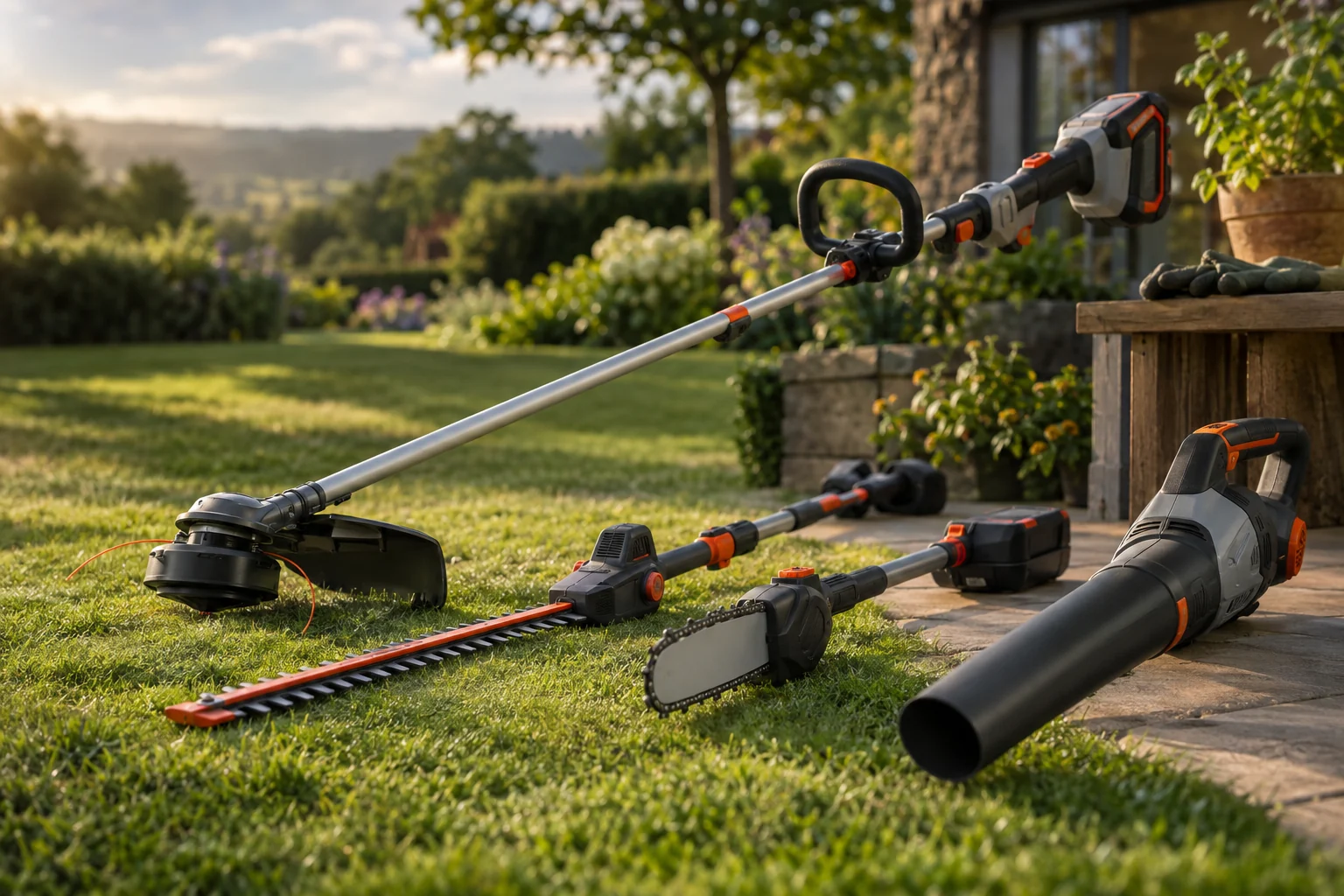
One Powerhead to Rule Them All: Why Combi Systems Are Changing Garden Tool Ownership
It is early October, which means the garden is beginning to look as though it has relaxed into itself. Hedges have put on their final untidy flourish, lawn edges are still growing when the weather is mild, and fallen leaves have started gathering in all the places you had hoped they would not. There is pruning to do, paths to clear, and that perennial task of dealing with grass that has developed ambitions beyond its allotted border.
Traditionally, this is where the tool shed gets involved. A strimmer sits beside a hedge trimmer. A blower occupies the awkward gap behind the lawnmower. There may be a pole pruner balanced somewhere high enough to make retrieving it a small expedition. If the tools are cordless, there are often several batteries and chargers too: all useful, all slightly different, and all capable of vanishing precisely when you need one.
A combi system takes a more sensible route. Instead of buying a complete motor, battery connection and handle for every job, you buy one powered head and fit the attachment required. A line trimmer becomes a hedge trimmer; the hedge trimmer becomes a pole saw; the pole saw can become a blower. The principle is not terribly glamorous. It is, however, wonderfully practical.
The real appeal is ownership, not novelty
A good combi system is not trying to make every task feel identical. It is trying to prevent you from owning several separate motors, battery formats and chargers when one well-chosen platform could do the work.
That is especially appealing in a typical British garden, where the jobs arrive in bursts. You may need a trimmer every week through the main growing season, a hedge attachment a handful of times each year, a pole saw for occasional branches, and a blower whenever autumn decides to redecorate the patio. Separate machines can still be the better answer for people who use one tool hard and often. A professional gardener clearing long runs of rough grass every day, for example, is likely to prefer a dedicated brushcutter.
For a homeowner, though, the arithmetic is different. The attachment that lives quietly on a shelf for most of the year need not have its own motor and battery. It simply needs to be ready when the hedge gets shaggy or the apple tree drops a limb across the path.
The systems here take three distinct approaches. EGO packages a broad working set around its 56V ARC Lithium platform. STIHL offers a KombiMotor that opens the door to a notably wide attachment family. Husqvarna starts with a trimmer-led 36V combi machine and extends outwards into a substantial ecosystem. The question is not merely which one has the most impressive list. It is which system best suits the jobs you genuinely do.
Meet the Contenders: Full System Specs at a Glance
The EGO MHBC1204E is the fullest ready-made package of the three approaches. Its PH1420E powerhead uses a brushless high-torque motor, runs on EGO's 56V ARC Lithium batteries and weighs 2.8kg before an attachment or battery is fitted. It has an aluminium shaft, an adjustable loop handle and IPX4 weather resistance. That latter point is welcome in Britain, where a dry forecast can be a fairly optimistic suggestion rather than a promise.
The supplied 5.0Ah battery has LED charge indicators and EGO's Keep Cool technology. The package also includes a single-shoulder AP1500 harness. EGO gives the tools a five-year domestic warranty and a two-year professional warranty. It is clearly intended to be a serious home-garden system rather than a lightweight occasional-use gadget.
The EGO MHCC1002E is the more compact entry into the same 56V world. It uses the PH1400E brushless powerhead and comes with a 2.5Ah ARC Lithium battery, a loop handle and the AP1500 single-shoulder strap. The tool warranty is five years, while the supplied battery carries a three-year warranty. It is a useful reminder that a combi system need not begin with every possible attachment in one grand, shed-filling sweep.
STIHL's KMA 80 R approaches the idea as a KombiMotor first. The brushless motor reaches up to 7,000rpm and the powerhead weighs 3.1kg. STIHL lists maximum voltage as 40V, whilst the AK platform is generally described as a 36V system; in practical terms, it is the AK battery family that matters when choosing batteries and compatible equipment. With an AK 30 battery fitted, the stated weight is about 4.4kg.
Voltage figures can look like a quick way to rank cordless tools, but they are not a complete performance measure. Motor design, battery capacity, attachment load and how hard the tool is being worked all matter. Think of the battery platform as part of a system, not a league table.
What's in the Box: Attachment Line-Ups Compared
The EGO MHBC1204E makes its case with breadth immediately. The kit includes four working attachments: the STA1600 line trimmer, BCA1200 brushcutter, HTA2000 hedge trimmer and PSA1000 pole saw. Alongside those are the PH1420E powerhead, the 5.0Ah battery, charger and AP1500 shoulder harness. It is a very practical collection for a garden with lawn edges, hedges, taller shrubs and the occasional branch that has no respect for the limits of a pair of secateurs.
STA1600 line trimmer
A 38cm cutting diameter makes this the everyday attachment for lawn edges, fence lines and the grass that gathers around raised beds, trees and garden furniture.
BCA1200 brushcutter
Its 40cm cutting diameter gives a slightly broader sweep for rougher grass and heavier clearing work where a conventional lawn edge has become a patch of vegetation with opinions.
HTA2000 hedge trimmer
The 51cm blade is suited to routine shaping and tidying of accessible hedge faces and evergreen screening.
PSA1000 pole saw
The 25cm bar is the attachment for selective pruning from the ground, rather than climbing a ladder with a saw and making poor decisions in public.
The MHCC1002E takes a narrower route, pairing the PH1400E with the HTA2000 hedge trimmer and PSA1000 pole saw, plus a 2.5Ah battery. Those are the two confirmed working attachments in this kit. That makes sense for gardeners whose main awkward jobs are hedge maintenance and higher pruning. It is less of an all-in-one grounds-care package: if line trimming is central to your routine, note that a line trimmer attachment is not confirmed as part of this kit and should not be assumed.
STIHL's KMA 80 R is more modular still. It can be bought as the KombiMotor alone or in configurations with an FS-KM trimmer head. Its wider KombiSystem family includes hedge trimmers, pole pruners, the BG-KM blower, cultivator and edger attachments. STIHL states compatibility with 14 different Kombi attachments, covering trimming, sweeping, mowing and clearing work.
Buy for the next three jobs, not every imaginable job
An attachment range is only valuable if it solves real work in your garden. Start with the three jobs that repeatedly make you borrow, hire or wrestle with an unsuitable tool. You can add the specialist attachment later if that need genuinely appears.
Husqvarna's 325iLK is supplied with the TA850 trimmer attachment. From there, it can accept brushcutter, hedge trimmer, edger, pole saw, tiller, sweeper, blower, scissor, bristle-brush and de-thatcher attachments: 13 in total. It is one of the broadest routes for gardeners who want their battery platform to stretch beyond cutting and pruning into seasonal clearing and soil work.
Power, Runtime and Battery: The Numbers That Actually Matter
Battery capacity can feel a little abstract until you are halfway along a hedge with a perfectly good tool that has run out of puff. The important thing is not just the number on the battery label, but the attachment fitted and the work being asked of it. Trimming soft grass along a path is a different demand from cutting dense hedge growth or pruning woody branches.
The EGO MHBC1204E arrives with a 5.0Ah ARC Lithium battery. With the hedge trimmer attachment, EGO gives a runtime of up to 45 minutes, and the battery can be charged in 40 minutes. That is a useful working figure for a domestic garden, although "up to" matters. A light annual tidy on a reasonably maintained hedge is not the same as reclaiming a neglected boundary that has spent three years plotting its escape.
Expect the pole saw to be more demanding when making repeated cuts, because sawing wood asks more of the motor than lightly trimming foliage. Similarly, a line trimmer will work harder in wet, long grass or thick weeds than it will when simply defining a tidy lawn edge. The sensible cordless habit is to think in jobs rather than minutes: finish the front hedge, clear the main path, then recharge while you make tea. That last part is not strictly essential, but it does improve most gardening plans.
The MHCC1002E's 2.5Ah battery gives the smaller EGO set a lighter starting point. On comparable work, it has half the capacity of the 5.0Ah pack supplied with the MHBC1204E. For a compact garden and occasional pruning, that may be entirely adequate. For several hedges, long boundaries or a property where tools need to work for extended spells, the larger battery changes the experience considerably.
STIHL provides useful runtime guidance for the KMA 80 R across the AK range: approximately 25 minutes with the AK 10, approximately 45 minutes with the AK 20, and approximately 65 minutes with the AK 30. The AK 30 therefore offers the longest stated working period of the three. This is a system worth choosing deliberately, because the powerhead may be bought without a battery. If you already own compatible AK equipment, that can be a major advantage; if you do not, plan the battery and charger as part of the purchase from the outset.
Husqvarna's 325iLK is supplied without a battery. The recommended BLi20 is rated for 45 minutes of light use or 20 minutes of tougher work. The wider 36V battery range runs from the BLi10 at 20 minutes to the BLi950X backpack battery at up to 5 hours 40 minutes. That range makes Husqvarna unusually flexible if the machine will be used regularly over a larger area, though backpack batteries make most sense where sustained work, rather than occasional domestic tidying, is the aim.
In the Garden: Real-World Performance Across Tasks
Line trimming and edging
For most gardeners, the line trimmer is the attachment that earns its keep most regularly. Even a carefully mown lawn has the areas the mower cannot reach: beneath shrubs, beside fencing, around water butts, along paths and around the base of fruit trees. The EGO STA1600 has a 38cm cutting diameter, which is broad enough to make progress without becoming cumbersome around beds and borders.
The Husqvarna 325iLK includes the TA850 trimmer attachment and has a 42cm cutting width. That extra width is useful on longer grass runs and wider edges, although the wider the cut, the more care is needed near bark, paving and treasured plants. A line trimmer can tidy a bed beautifully; it can also remove the first few centimetres of a young shrub's bark with alarming efficiency. Keep the head moving, work at a shallow angle, and do not use it as a precision paintbrush.
STIHL's FS-KM attachment route suits gardeners who prefer to build their system around trimming first, then add specialist heads. The KMA 80 R's brushless motor reaches up to 7,000rpm, providing the responsive feel required for keeping line work neat rather than merely violent. In any system, take a few moments to alter the loop handle and harness position for your height. Comfort is not a luxury when you are working a boundary for half an hour.
Rough grass and heavier clearing
The EGO BCA1200 brushcutter is a different proposition from the line trimmer. At 40cm, its cutting diameter is 2cm wider than the STA1600. More importantly, it is the attachment to reach for where the grass is coarse, the weeds are assertive, or a rarely visited patch has started looking like it is applying for nature reserve status. The PH1420E's high-torque designation is particularly relevant here: this is the sort of task that separates a capable powerhead from a light-duty one.
There is a seasonal judgement involved. In October, clearing rough growth around paths, sheds and compost areas can make the garden easier to manage through winter. Avoid indiscriminate cutting in wildlife-rich corners, though. Long grass, seedheads and decaying stems can shelter insects and small animals. Tidy the routes and the areas you use; leave the deliberate wild bit looking deliberate.
Hedge cutting
The 51cm HTA2000 hedge trimmer supplied in both EGO kits is a sensible domestic length. It lets you cover hedge faces without treating every shrub as a topiary project. Autumn is a good time for light maintenance cuts on suitable hedges, particularly where a mild spell has encouraged fresh, untidy growth. Avoid hard pruning unless the plant and timing are appropriate; a combi system supplies the cutting power, but it cannot make a badly timed cut wise.
For taller or awkward hedges, the chief advantage of a combi system is not magic reach. It is reduced equipment duplication. You can use the same powerhead for the hedge attachment and then exchange it for the pole pruner when branches demand attention. Keep both feet on the ground where possible. The point of a pole attachment is not to make ladders more exciting.
Pruning with a pole saw
The EGO PSA1000 has a 25cm bar, suitable for selective branch work rather than wholesale tree surgery. This is a genuinely useful autumn attachment for removing damaged limbs, clearing a branch from a path, or dealing with growth that is rubbing against a fence or outbuilding. It is not a substitute for understanding tree structure, and it is not the right tool for any branch that could fall onto a person, building, greenhouse, cable or neighbour's prize greenhouse.
STIHL's HT-KM pole pruner and Husqvarna's compatible pole-saw attachment give their systems the same broad capability. What matters is steady technique: assess where the branch will go, keep the cutting zone clear, wear appropriate protective equipment, and do not overreach. Cordless tools are quieter and easier to start than petrol machines; they are not less capable of making a serious mess of an unsafe cut.
Blowing and seasonal clearing
Blowing is where a multi-tool begins to feel particularly convenient in October. Leaves accumulate far faster than anyone imagines in September. STIHL's BG-KM blower attachment is a proper clearing attachment for dry leaves, clippings and debris on paths, patios and driveways. That makes it a proper clearing attachment for dry leaves, clippings and debris on paths, patios and driveways.
Use a blower as a gathering tool, not a leaf-displacement scheme. Direct leaves into a pile, leaf cage or composting area rather than simply moving them from one side of the patio to another. It sounds obvious. It is also the sort of thing one notices after the third gust sends the whole lot back again.
Where combi systems shine
- One battery platform can support several seasonal jobs.
- Attachments take less storage room than complete machines.
- They are especially practical when pruning, trimming and clearing are occasional rather than daily tasks.
- A single familiar powerhead makes switching jobs less intimidating.
Where a dedicated tool may win
- Frequent, heavy brushcutting can justify a purpose-built machine.
- Changing attachments interrupts the flow of a long day's work.
- Long pole attachments can feel more demanding than a compact standalone tool.
- The initial choice needs thought: a poor battery platform is expensive to outgrow.
Head to Head: How These Systems Stack Up on the Specs That Count
There is no universal winner because the systems are sold with different priorities. EGO makes the strongest case for the gardener who wants a large set of core attachments immediately. STIHL is compelling where flexibility and the breadth of the KombiSystem matter most. Husqvarna is a trimmer-led route with an extensive attachment catalogue and unusually broad battery options.
| Feature | EGO MHBC1204E | STIHL KMA 80 R | Husqvarna 325iLK |
|---|---|---|---|
| Battery platform | 56V ARC Lithium | 40V maximum / 36V AK platform | 36V lithium-ion |
| Motor | Brushless high-torque | Brushless, up to 7,000rpm | Brushless |
| Powerhead weight | 2.8kg | 3.1kg | 3.8kg |
| Weather protection | IPX4-rated | IPX4 water resistant | IPX4 water resistant |
| Battery supplied in stated package | 5.0Ah | Optional | Sold separately |
| Charge time | 40 minutes | Depends on battery and charger | Depends on battery and charger |
| Included working attachments | 4 | Unit-only or trimmer configuration | TA850 trimmer |
| Attachment ecosystem | Trimmer, brushcutter, hedge trimmer and pole saw in kit | 14 Kombi attachments | 13 compatible attachments |
| Blower option | Yes | BG-KM blower attachment | Compatible blower attachment |
| Stated domestic warranty | 5 years on tools | 2 years | 2 years |
Within EGO's own line-up, the choice between the MHCC1002E and MHBC1204E is fairly clear. The smaller package is a neat route for hedge cutting and pole pruning, with a 2.5Ah battery. The MHBC1204E is the all-round garden-care system: its 5.0Ah battery has double the capacity, it brings line trimming and brushcutting into the kit, and the PH1420E is the high-torque powerhead. If grass edges and rough vegetation are regular jobs, the larger package is the more complete starting point.
Husqvarna's stated 42cm trimmer cutting width is the widest of the figures here, while its 3.8kg machine weight is also higher than the EGO and STIHL powerhead figures. That is not automatically a drawback. It simply means fit and balance deserve attention. A machine that feels stable and comfortable with a harness may be more pleasant to use than a lighter one that does not suit your posture.
Choosing the Right System for Your Garden
The most useful way to choose is to walk around your garden before shopping. Really walk it. Notice where grass meets fences, where hedges run beyond the mower's reach, which branches shade a path, and where leaves gather. Then list the jobs in order of frequency. It is less exciting than comparing motors, admittedly, but it produces a better purchase.
For the all-round home gardener
The EGO MHBC1204E is the logical fit if you want trimming, brushcutting, hedge cutting and pole pruning covered from day one.
For gradual system builders
STIHL's KMA 80 R makes sense when you want to choose attachments over time, including a dedicated blower option.
For wide-ranging garden tasks
Husqvarna's 325iLK suits gardeners drawn to its broad selection of compatible clearing, cutting and cultivation attachments.
If your garden is small and your chief frustration is an overgrown hedge plus a few higher branches, the EGO MHCC1002E is admirably focused, with its confirmed hedge trimmer and pole saw attachments. There is no rule saying every household needs a brushcutter or line trimmer as part of the same kit. Conversely, if you have a long boundary, rough corners and a lot of grass that refuses to respect your plans, beginning with a trimmer and brushcutter capability will prevent an early upgrade.
Also consider the batteries you already own. Battery systems become better value through repetition. A compatible battery that can move from your combi system to a mower, blower or other garden tool is more useful than a battery which serves one machine and then spends eleven months contemplating its purpose in a drawer.
Do not overlook physical storage
Measure the space where the system will live. The powerhead may be compact, but long shafts and attachments need a sensible home. Wall hooks, a dry shed and a place where batteries can be stored protected from damp make a meaningful difference to ownership.
October Jobs: Using a Combi System Well Right Now
At this point in the UK gardening year, a combi system can be very useful indeed. This is not the moment for frantic cutting simply because you own a new attachment, but it is an excellent time to make the garden easier to live with through autumn and winter.
Use the line trimmer to neaten lawn edges before growth slows substantially. Clear grass away from fence bases and the edges of paths so wet weather does not make everything look immediately untended. Use the brushcutter selectively on rough strips and access routes, whilst leaving habitat corners intact. A deliberately retained patch of long grass is far more valuable than one that has merely been forgotten until March.
Light hedge maintenance can keep paths open and prevent soft growth from flopping across gates. With the pole saw, deal with clearly damaged or obstructive small branches where the cut can be made safely from the ground. For major work, protected trees, overhead hazards or substantial limbs, call a qualified tree professional. The garden will still be there when they arrive. You would like to be too.
The blower attachment comes into its own as leaves start falling. Clear slippery paths and steps regularly, but do not treat every leaf as rubbish. Dry leaves can become leafmould, which is one of the easier and more satisfying garden products to make. Gather them into a ventilated pile or bag, leave nature to get on with the damp, slow work, and next autumn you may have a dark, crumbly material your borders will appreciate.
Care, Safety and Keeping the System Useful for Years
Combi systems are mechanically straightforward, but they reward a little routine care. Before changing attachments, remove the battery. Wipe grass, sap and debris from the connection points. Check the shaft coupling is clean and properly secured. These are modest habits, yet they prevent the kind of irritation that leads to a tool being blamed for a problem caused by a teaspoon of compacted grass.
After hedge cutting, remove green residue from the blade area. After using a pole saw, clear sawdust and inspect the working end before storage. After trimming, brush away wrapped grass. Keep batteries dry and protected from extremes of temperature. It is tempting to leave everything in the unheated shed until spring, especially after a wet afternoon, but batteries are the expensive heart of a cordless system and deserve better than that.
Wear eye protection for all cutting and blowing tasks. Use sturdy footwear. Gloves help with handling attachments and clearing debris, although they should not go near moving cutting equipment. For brushcutting and line trimming, be particularly alert to stones, wire, hidden edging and fragments of old pots. Gardens are full of archaeological surprises, and most of them do not improve a spinning cutting head.
Finally, resist the temptation to turn a multi-tool into a multi-tasker. Fit the appropriate attachment, use it for its intended job, and take a break when your arms or concentration begin to fade. One powerhead may do several things. You do not need to do all of them before lunch.
Frequently Asked Questions
Final Verdict: The Best Combi System Is the One You Will Actually Use
Combi systems are at their best when they reduce friction. Less storage. Fewer batteries to manage. Fewer motors sitting idle. One familiar powerhead that can deal with the regular edges, the occasional hedge, the inconvenient branch and the annual leaf invasion.
GardenScout verdict
The EGO MHBC1204E is the strongest all-in-one starting point here, pairing a 56V high-torque powerhead with line trimmer, brushcutter, hedge trimmer and pole saw attachments. The STIHL KMA 80 R stands out for gardeners who want to build into a 14-attachment KombiSystem, including a blower. Husqvarna's 325iLK offers a versatile 36V route for those attracted to a trimmer-led system with 13 compatible attachments and a notably broad battery range.
There is a small pleasure in using a tool system that makes sense. On a cool October morning, when you can trim the path edge, clear the fallen leaves and deal with one low-hanging branch without excavating half the shed, gardening feels less like equipment management and more like gardening. Which, after all, is the point.