Trowels, Forks and Dibbers: The Hand Tools Worth Owning
The small tools that do the close work properly: choosing steel, blade shape and handles for planting, weeding and potting without filling the shed with duplicates.
Why Your Hands Deserve Better: The Case for Proper Garden Hand Tools
There is a particular kind of gardening annoyance reserved for a cheap trowel. It usually arrives when you are halfway through planting something that ought to have been in the ground ten minutes ago. The handle shifts. The blade bends. Compost ends up on your shoes, the paving, and somehow inside a pocket. You look at the tool in your hand and wonder why it was allowed anywhere near soil in the first place.
Small hand tools are easy to dismiss because they are small. A spade looks serious. A fork looks purposeful. A trowel can look like a souvenir from a garden centre gift aisle. Yet for most of the jobs that make a garden feel looked after — planting plugs, teasing out weeds, filling pots, lifting seedlings, working around established roots — it is the hand tool doing the actual precision work. The big tools prepare the stage. The little ones get the applause.
The false economy is not merely that a flimsy tool must be replaced. It is that bad tools make gardening feel needlessly awkward. A blunt edge smears clay instead of slicing it. A narrow grip forces you to clench harder. A fork with bendy tines skates across compacted ground rather than getting underneath it. Over a season, those tiny frustrations add up. Gardening should leave you tired because you have done something satisfying, not because you have spent an afternoon wrestling a bit of pressed metal.
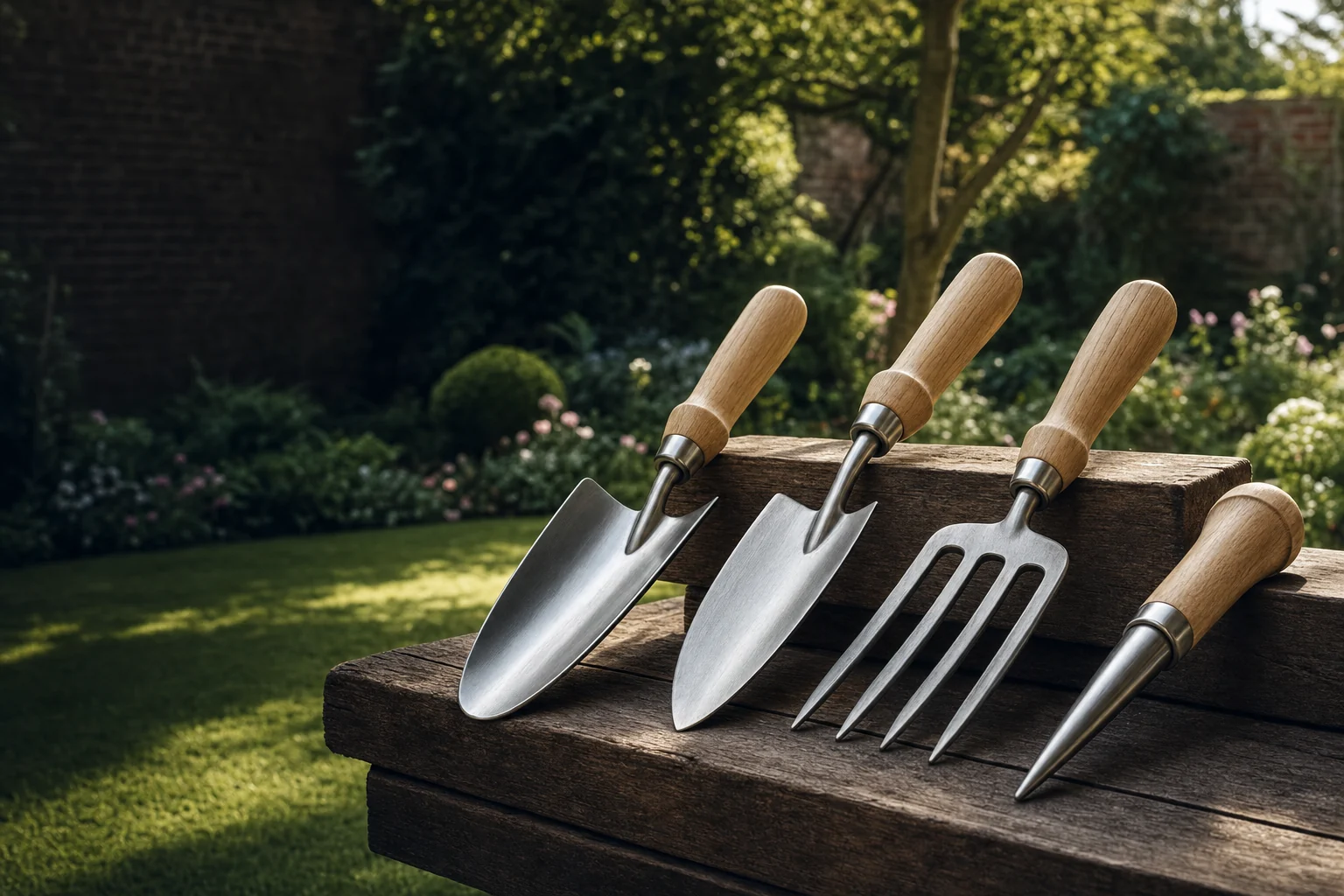
This guide focuses on the three close-range workhorses worth understanding: trowels, hand forks and dibbers. They are not a branded set, nor should they be treated as one. Each does a different job, and buying the right shape matters more than buying three matching handles. A stainless-steel trowel from Fiskars, Spear & Jackson, Bahco, Bulldog, DeWit or another established maker may suit one gardener brilliantly and be the wrong answer for another with sticky clay and a fondness for bulbs.
The useful question is therefore not, "Which is the best hand tool?" That is about as helpful as asking for the best vegetable. The useful question is: which metal, blade profile and grip will make your particular gardening jobs easier? If you mostly fill containers, a broad trowel is your accomplice. If you plant plugs amongst packed perennial roots, a narrow transplanting blade starts to make far more sense. If you sow rows of seeds, a dibber can be the quiet hero you never knew you were missing.
The sensible starting point
Build a small working trio before buying specialist extras: one broad trowel for compost and backfilling, one sturdy hand fork for loosening and weeding, and one dibber if you sow, plant plugs or set bulbs regularly. That combination covers a surprising amount of ordinary gardening.
I would also resist the temptation to judge a tool from a photograph alone. A polished blade tells you very little about its stiffness. A handsome wooden handle may be wonderful in the hand or shaped like a rather elegant potato. Pick tools up where possible. Notice where the handle sits in your palm, whether the shaft feels solid where it meets the head, and whether the tool seems designed for digging or merely for being photographed next to a terracotta pot.
Steel Yourself: Stainless vs Carbon in the Vegetable Patch
Metal choice is where hand-tool conversations can become oddly tribal. Stainless devotees like the low-maintenance calm of a tool that can be rinsed, dried reasonably well and returned to the shed without a ritual. Carbon-steel gardeners enjoy the sharper, harder-working feel of a blade that bites into soil with real intent. Both camps have a point. Neither material is automatically "better".
Carbon steel contains more carbon than the mild steel used for basic, flexible tools. In garden-tool terms, it is prized because it can be hard, stiff and capable of taking a crisp working edge. That matters when you are cutting into compacted ground, slicing through a fibrous weed root, or using the shoulder of a trowel to break a small clod. It is the material choice I would lean towards for a hand fork or trowel that will regularly meet heavy soil.
Its compromise is plain and unglamorous: carbon steel oxidises. Leave it wet, caked in soil and forgotten behind a pot for a fortnight, and it will complain. Not theatrically, perhaps, but rust begins where attention ends. A quick rinse, a wipe dry and an occasional light oiling are usually enough to keep a carbon-steel tool happy. That is not a hardship for keen gardeners, but it is a real part of ownership. If that sounds like a chore you will absolutely not do, buy stainless and enjoy the freedom.
Stainless steel earns its reputation through corrosion resistance. Chromium in the steel forms a passive protective layer, helping the blade cope with wet compost, rain showers and the general dampness of British sheds. It is the obvious choice for gardeners who work in containers, use potting benches often, or simply want tools that require less fuss. A stainless trowel is also easy to clean thoroughly between jobs, which is useful when moving between propagation work and ordinary garden soil.
There is a caveat. "Stainless" is not a synonym for indestructible. Tool quality depends on the grade and thickness of the steel, the way the head is formed, and the join between blade and handle. Very light stainless blades can flex under sideways levering in stony soil. That does not make stainless poor; it makes it poorly suited to being used as a miniature crowbar. The trowel did not volunteer for archaeology.
The practical distinction is more useful than the metallurgical one. Choose stainless if your gardening involves lots of wet compost, regular container work, or a tool rack that has a complicated relationship with rain. Choose carbon steel if you garden in heavy ground, expect to cut and lever with confidence, and are willing to maintain the tool as you would a decent pair of secateurs.
It is also worth separating blade material from handle material. A stainless head can have a timber, polymer or soft-grip handle. A carbon-steel head can be fitted to ash, hardwood or a moulded composite grip. One decision does not settle the other. In fact, the best combination for many gardeners is often a stainless trowel for potting work and a more robust carbon-steel fork for the difficult, rooty corners of the border.
Do not let soil choose for you
Clay, stones and established roots reward stiffness. Compost, raised beds and containers reward easy cleaning and a blade that glides through loose medium. Match the steel to the soil you actually have, not the soil shown on the packet of wildflower seeds.
Whatever the metal, inspect the joint. A forged or securely socketed connection between handle and head is a reassuring sign on a working tool. A blade attached by a visibly flimsy collar is more likely to develop play over time. The join takes a great deal of strain when you twist, lift and pull. It deserves your attention more than a decorative leather hanging loop, lovely though those can be.
Trowel Taxonomy: Why Blade Shape Changes Everything You Plant
"A trowel is a trowel" is one of the more persistent gardening myths, right up there with "this pot will be big enough for years". Trowels may share a family resemblance, but their blade profiles alter the job completely. Width changes how much compost you can carry. Curvature changes how cleanly the blade holds material. A pointed tip changes how easily it enters ground. Even the shoulder angle affects whether you can press down with the heel of your hand without feeling as though you are operating a tiny shovel designed by an enemy.
The standard broad trowel is the all-rounder. Its gently cupped blade shifts compost from bag to pot, backfills around transplants, lifts loose soil and makes general planting pleasantly uncomplicated. If you are buying only one trowel, this is the sensible type. It is particularly good in raised beds and containers, where the soil is loose enough that capacity matters more than penetration.
Broad does not mean clumsy. A well-shaped standard trowel should still have a tip capable of opening a planting hole, but its real talent is moving material efficiently. It is the one you want when filling a run of pots, topping up a planter, or returning excavated compost around a newly planted perennial. A narrow blade can do these jobs, of course. Eventually. You could also fill a wheelbarrow with a teaspoon.
The transplanting trowel is narrower, longer and usually more deeply curved. This is the tool for plug plants, bulbs, seedlings and tight spaces between established plants. Its slim blade allows you to open a neat hole without disturbing the entire surrounding root zone. In a crowded herb bed or a packed border, that precision is not a luxury. It is the difference between adding one plant and accidentally excavating the whole neighbourhood.
Some transplanting designs include depth markings. These can be helpful as a quick visual guide for bulbs and seedlings, though I would not treat them as laboratory equipment. Soil settles, compost varies, and planting depth is often more about the plant than the ruler. Still, when you are placing a tray of plugs at a consistent depth, marks on the blade are a useful little nudge rather than a gimmick.
Then there is the narrow, pointed digging trowel. It sits somewhere between the standard and transplanting types, and it is arguably the most useful compromise for gardeners with heavier soil. The point gets into ground with less drama. The blade is narrow enough to work around roots. Yet it has enough width to move a modest amount of soil. For ordinary border planting, especially where the earth has ideas above its station, this shape is often the best place to start.
At the other end of the spectrum are potting trowels, which often have a wider, more squared scoop. They are designed less for digging and more for transferring compost accurately. Their appeal becomes obvious when you are filling small pots in a shed or greenhouse. A properly cupped potting trowel reduces spills and makes the repetitive work faster. It will not impress much in compacted garden soil, but that is like criticising a loaf tin for being poor at pruning roses.
For heavy border soil, favour a defined point
A pointed blade concentrates pressure at the tip, helping the trowel enter firm ground rather than merely polishing its surface.
For plug plants, choose a narrow profile
A slim transplanting blade makes a hole with minimal disturbance around neighbouring roots and keeps planting surprisingly tidy.
For containers, capacity beats sharpness
A wider, deeper scoop shifts more compost per movement and reduces the number of times you have to chase escaped potting mix around the bench.
For lifting weeds, do not twist a thin blade hard
Trowels are excellent for easing out smaller rooted weeds, but repeated sideways levering is hand-fork territory.
Handle angle is easy to overlook until you use an awkward one. A trowel whose handle follows the line of the blade feels direct and compact for potting. A slightly raised or contoured grip can offer better knuckle clearance when working into borders. Neither is universally superior. The important thing is that your wrist can stay neutral when you push down. If you must cock your hand at an uncomfortable angle to get the tip into the soil, that tool will become irritating long before it becomes worn out.
For gardeners with smaller hands, very chunky grips can feel cumbersome despite their ergonomic claims. For gardeners who wear gloves or have less grip strength, a broader handle may be more comfortable because it spreads pressure across the palm. This is why a few seconds holding a tool are more useful than several paragraphs of marketing copy. Your hands have the final vote.
Fork in the Road: Hand Forks for Weeding, Aerating and Breaking Soil
The hand fork is the tool people often buy after a trowel and then wonder how they managed without. It does not look dramatic. It has a few tines and a handle. But in established beds, where plants are close together and the soil surface is compacted by weather, watering and life in general, it is astonishingly capable.
A good hand fork has three principal jobs. First, it gets underneath weeds, particularly those with a stubborn tap root or a low crown. Second, it aerates the top layer of soil between plants without turning the whole bed over. Third, it breaks up clumped compost and surface crust in pots, trays and raised beds. The broad idea is the same in all three cases: insert, lift or rake lightly, and avoid disturbing more soil than the task requires.
The distinction between three and four tines is worth understanding. Three-tine forks tend to offer wider gaps and a more focused entry into firm soil. That makes them particularly good for getting alongside deep-rooted weeds and levering gently beneath them. Four-tine forks provide a slightly broader working face and often feel more effective for shallow raking, surface cultivation and breaking up loose compost. Neither arrangement is objectively better. One is simply more persuasive in a particular patch of garden.
Tine profile matters as much as tine count. Flat or square-section tines generally feel more resistant to flex when you apply leverage. They suit difficult ground and robust weeding. Round-section tines are often perfectly adequate for loose soil and light cultivation, but can feel springy when faced with compacted clay or a root that declines to cooperate. If the fork will spend most of its life in a raised bed, that may not matter. In an old border with stones and perennial roots, it matters rather a lot.
| Task | Three-tine hand fork | Four-tine hand fork | Narrow transplanting trowel |
|---|---|---|---|
| Deep-rooted weeds | Strong choice for getting beside a root and easing it upwards. | Useful, but the wider head can disturb more surrounding soil. | Helpful for making access, less suited to repeated levering. |
| Surface aeration | Effective where space is tight or soil is firm. | Excellent for shallow scratching between plants. | Not its natural job. |
| Breaking potting compost | Capable, with a more open action. | Very good for teasing apart clumps and mixing the surface. | Useful only in a pinch. |
| Working among dense roots | Better where careful, narrow entry is required. | Best in more open spaces between plants. | Good for creating a precise planting slot. |
| Heavy sideways force | Choose stiff, well-formed tines for this work. | Also capable when strongly built, but avoid using any fork as a pry bar. | Not recommended for repeated forceful twisting. |
There is a temptation to use a hand fork as a miniature digging fork and simply wrench away at everything. I understand it. A perennial weed has just made a personal insult of your border. Still, controlled leverage is the better technique. Push the tines in beside the root, rock gently, loosen the soil around it, then lift. A stout fork will cope with this beautifully. Even a stout fork cannot repeal the laws of metal fatigue.
Angled or twisted tines, found on some designs, can help soil release as you draw the fork through loose material. It is a pleasant feature rather than a must-have. The bigger quality indicators are rigidity, a comfortable handle and a secure connection between the head and shaft. A fork that feels solid at the join will inspire more confidence than one decorated with any number of polished accents.
For weeding, position beats force
Get the tines close to the root, loosen the soil around it and lift with a short rocking movement. Pulling hard from the surface usually leaves the important bit behind — the root — which is very much not the outcome we were hoping for.
For containers, hand forks earn their keep in another way. They are excellent for working slow-release fertiliser into the upper layer of compost, roughing up a compacted surface, and teasing roots apart before repotting. Use a light hand. Roots are not pasta, however much some of them resemble it after a year in a small pot.
One final note on tine tips: sharp points are helpful for entry, but they do not need to be knife-sharp. A fork should penetrate soil, not turn the potting bench into a hazard. If a tool is blunt enough to skid off hard ground, a careful touch-up may help; otherwise, look first at soil moisture. Even the finest fork will struggle with ground baked hard in a dry spell.
The Underrated Third Musketeer: Dibbers Done Right
The dibber has an undeserved reputation as the boring member of the hand-tool family. It is, after all, essentially a pointed stick. There is no clever mechanism, no complicated blade profile, no satisfying row of tines. And yet, for anyone who sows seeds, grows plugs or plants bulbs in quantity, it can be the tool that saves the most time and creates the neatest results.
A dibber makes a hole by displacing soil rather than removing it. That is its small but important trick. In prepared, friable ground or compost, you push it in, withdraw it, place the seed or plug, then close the soil around the planting point. There is less mess, less repeated scooping and often less disturbance to the structure around the plant. With delicate plugs, that tidy hole can reduce the amount of handling needed at the root ball.
The straight dibber is the classic form: a tapered wooden or metal rod with a comfortable end to grip. It is ideal for seed trays, plug planting and shallow work in soft ground. Its simplicity is the appeal. You can move along a row quickly, making evenly spaced holes with a rhythm that becomes rather satisfying once you have found it. It is one of those tools that seems unnecessary until the day you plant several trays of seedlings and realise you have stopped reaching for the trowel altogether.
A T-bar dibber adds a cross handle, allowing you to apply body weight more comfortably. This makes it better for deeper holes, particularly bulbs or plug planting into prepared outdoor beds. The crossbar helps keep the tool vertical and saves your wrist from doing all the work. It is not a substitute for a bulb planter in every circumstance, especially in very firm ground, but it is a remarkably efficient option in loose, well-worked soil.
Why a dibber is useful
- Makes repeated planting holes quickly and consistently.
- Disturbs less surrounding soil than scooping every hole with a trowel.
- Excellent for plug plants, seeds and orderly bulb planting.
- Leaves one hand free to handle seedlings carefully.
- Simple to clean and easy to store.
Where it is not enough
- Cannot remove stones, roots or clods from a planting hole.
- Struggles in hard, dry or unprepared ground.
- Does not move compost or backfill like a trowel.
- A very fine tip can be too delicate for forceful use.
- Another tool to misplace in the greenhouse, naturally.
Wooden dibbers remain popular because they feel warm and natural in the hand. Ash and oak are traditional choices, and a smooth timber handle has a tactile quality that plastic never quite replicates. The weakness is not the wood itself but neglect: leaving it permanently damp can roughen the surface and shorten its life. A simple wipe and dry storage go a long way.
Stainless-steel dibbers are particularly good on a potting bench. They wipe clean easily, do not mind wet compost, and make sense where hygiene matters. If you are moving between batches of seedlings, cleaning soil from the tool before changing jobs is a sensible habit. It will not solve every plant-health problem in the garden, but it removes one easy route for carrying old soil from one tray to another.
Brass-tipped wooden versions occupy a nice middle ground. The wood provides the comfortable grip; the metal tip handles repeated contact with soil. They are handsome things, certainly, but their real advantage is that the working end bears the wear whilst the handle remains comfortable and pleasantly light.
For plugs, make the hole slightly wider and deeper than the root ball, lower the plant in by its leaves rather than its stem, then firm gently around it. The dibber makes the hole; your fingers still provide the finesse.
Handles, Balance and Build Quality: The Details You Feel Every Day
Blade shape gets most of the attention, but handles decide whether you enjoy using a tool for half an hour. This is where the sensible, practical differences live: timber versus polymer, thick versus slim grips, smooth contours versus defined finger rests, and the balance between head and handle.
Traditional timber handles have an enduring appeal for good reason. They are comfortable in cool weather, tend to develop character rather than merely looking worn, and can offer a secure grip without aggressive texturing. A shaped ash or hardwood handle feels particularly good on a hand fork, where you may be applying pressure from several angles. The downside is care. Timber appreciates being kept reasonably dry and may benefit from occasional oiling if it begins to feel rough.
Polymer and composite handles are less romantic but often very practical. They cope well with damp conditions, are easy to clean and can be moulded into broad ergonomic forms. This makes them a good choice for container gardeners, for anyone who leaves tools near the tap, and for gardeners who prefer a larger, softer grip. The best ones feel secure without being sticky or overbuilt. The less good ones can feel hollow, slippery when wet, or too bulky for smaller hands.
Look for a slight flare at the end of the handle, especially on a trowel. It gives your little finger something to brace against when pulling compost towards you. On a fork, a firm palm rest can make the downward push more comfortable. On a dibber, the ideal is usually simpler: a grip that lets you apply pressure straight down without creating a hot spot in the centre of your hand.
Wood suits gardeners who value feel
It is warm, comfortable and often beautifully balanced, provided it is stored dry and not left sitting in a water-filled trug.
Composite suits low-maintenance routines
It is easy to wipe down, tolerant of moisture and often shaped to spread pressure across the palm.
The head-to-handle join is the stress point
Check for movement before buying. A rigid connection is more valuable than decorative details and will matter every time you lever soil.
Balance reduces fatigue
A tool should feel controlled at the blade, not head-heavy or handle-heavy. The difference is subtle in a shop and obvious after a planting session.
Balance is especially important with trowels. A heavy handle can make a blade feel less precise; an overly heavy blade can fatigue the wrist during repetitive potting. There is no single ideal weight because gardeners differ, but a good tool should feel like an extension of the hand rather than a small object you are continually correcting.
For anyone with arthritis, reduced grip strength or hand pain, do not assume that the most cushioned handle is automatically best. A thick soft grip can reduce pressure, but it can also require the hand to open too far. A modestly contoured handle that allows a relaxed hold may be more comfortable. If possible, test the closing action: can you grip it naturally without squeezing? Can you rotate it between fingers? Can you press down without your wrist bending sharply? Those questions are more useful than any label saying "ergonomic".
Hanging holes and leather loops are useful, though hardly decisive. Tools last longer when they can dry in the open rather than languish at the bottom of a bucket. If you are setting up a compact shed or potting area, a simple rail with hooks for your three core hand tools is one of the least glamorous upgrades with one of the largest practical pay-offs. Everything is visible. Nothing gets damp under a heap of twine and old labels. Miracles do happen.
Use-Case Matchmaking: What to Reach for and When
This is the point where all the talk of metal, tines and blade shoulders becomes useful. The best tool kit is not the most comprehensive one; it is the one that makes your usual jobs feel straightforward. A balcony gardener and somebody tending a mature cottage border may both own a trowel, fork and dibber, but their ideal versions can be quite different.
Open-ground planting: borders and vegetable beds
For planting plug plants and small perennials in open ground, a narrow pointed transplanting trowel is the most versatile starting point. It gets between roots, makes a controlled hole and does not pull half the bed apart. If the soil is firm, a stiff carbon-steel version can be particularly satisfying. Use a hand fork first to loosen the immediate planting area, then use the trowel for the hole and a broad trowel for returning soil and firming around the plant.
For bulb rows in prepared soil, a T-bar dibber is wonderfully efficient. Work along the line, make the holes, place the bulbs, then backfill with a broad trowel or your hands. In soil full of stones or established roots, however, switch back to the trowel. A dibber is not there to win an argument with a buried brick.
Container and raised-bed planting
In containers, the broad standard trowel is king. It moves compost efficiently, makes a hole large enough for most root balls and helps settle mix around the plant. Stainless steel is a natural fit here because wet compost and repeated cleaning are part of the routine. Keep a dibber nearby for plugs, and use the hand fork to scratch fertiliser or soil improver into the upper layer before planting.
Raised beds sit happily between these two worlds. If your bed is well maintained and loose, use broad tools much as you would in containers. If it has compacted after a winter of rain, a narrow trowel and sturdy fork become more useful. The soil decides. It always does.
The balcony or patio gardener
Prioritise a broad stainless trowel, a four-tine fork for compost work and a slim dibber for plugs. Easy cleaning matters more than brute force.
The vegetable grower
A narrow transplanting trowel, sturdy hand fork and dibber make sowing, plugging and succession planting feel far more orderly.
The perennial-border gardener
Look for a pointed trowel and stiff fork that can work around roots. Carbon steel is compelling if you are happy to maintain it.
The enthusiastic beginner
Start with one comfortable broad trowel and a good hand fork. Add a dibber when you begin sowing or planting plugs in quantity.
Weeding without wrecking the bed
For dandelions, dock and other tap-rooted nuisances, reach for the hand fork first. Place it beside the root, loosen in a circle and lift carefully. A narrow trowel can assist where the plant is tucked against another perennial, but avoid using a thin blade for repeated hard leverage. It is not cowardice to use the appropriate tool. It is simply less expensive in the long run.
For small annual weeds across the surface, a four-tine fork makes light work of shallow cultivation. Use it little and often. The goal is to disturb tiny seedlings before they establish, not to excavate a trench every time a chickweed appears. In loose raised-bed soil, this can become a quick weekly ritual that prevents a much larger job later.
Potting and propagation
Potting is where specialised shapes feel most justified. A broad, deeply cupped trowel moves compost cleanly. A dibber creates holes for seedlings without crushing their root balls. A small fork breaks clumps and lightly mixes the top layer. Stainless steel is particularly comfortable here because it cleans quickly between batches and does not mind a damp bench.
The four-tool open-ground combination
For most ordinary planting outside, a narrow transplanting trowel, a broad trowel, a robust hand fork and a T-bar dibber cover the vast majority of jobs. Buy those thoughtfully and you can ignore a great many novelty tools with complete confidence.
Care, Storage and the Small Habits That Keep Tools Working
Good hand tools are not fragile heirlooms that need ceremonial treatment. They do, however, benefit from being treated like useful equipment rather than abandoned evidence of a busy Sunday. The maintenance routine is short: remove soil, dry the tool, inspect the join and store it somewhere that is not permanently wet.
For stainless steel, a brush or rinse after use is normally enough. Wipe the blade dry if you can, particularly around the handle join where damp soil likes to lodge. Stainless resists rust, but it is not magic, and a clean blade is simply nicer to use next time. If sap or stubborn residue builds up, clean it gently rather than attacking it with anything likely to scratch the surface deeply.
For carbon steel, add a light protective coat of oil now and then, especially after a wet day or before storing tools for a long period. You do not need to drown the blade. A little on a cloth, worked over clean dry steel, is plenty. The aim is to keep moisture away from the surface, not to turn your trowel into a chip-shop prop.
Timber handles benefit from being kept dry and occasionally treated if the surface begins to feel thirsty or rough. A smooth handle is more comfortable and less likely to raise splinters. If it does become rough, a very light sanding followed by an appropriate protective treatment can refresh it. Again, boring little habits; surprisingly large reward.
Do not leave tools pushed into soil between jobs. It is convenient for about ten minutes and then becomes an effective method for encouraging damp, hiding your equipment and discovering a sharp tine with your ankle. Hang them up, or keep them in an open container where air can circulate. A dry shed wall is more useful than a cluttered corner.
A stiff nail brush beside the tap or potting bench is one of the best accessories you can own. Brushing soil away before it dries takes seconds and makes every later cleaning job easier.
Sharpening needs restraint. A trowel's edge can be lightly refreshed if it has become blunt, particularly on a carbon-steel blade used in hard soil. A hand fork's tines can be maintained if they become excessively rounded. But most garden hand tools do not need a razor edge. Over-sharpening can remove useful material and create tips that are less safe around hands, pots and hoses. Aim for crisp and capable, not medieval weaponry.
If a handle begins to wobble, deal with it early. A loose joint tends to get looser quickly because every push and twist magnifies the movement. Whether it can be repaired depends on the construction, but the key is not to continue using a tool that has started to shift. It will feel less controlled, ask more of your wrist and potentially turn a simple job into an annoying breakage.
Where It Is Worth Spending and Where It Is Not
There is a sensible middle ground between buying the cheapest thing on a rack and treating every hand tool as a collector's item. Spend attention, rather than blindly spending more, on the parts that affect real work: blade stiffness, tine profile, a secure head-to-handle connection and a grip that fits your hand.
The tool most worth choosing carefully is usually the trowel, because it gets used for everything. A decent broad trowel makes every container job easier and doubles as a reliable general planter. Next comes the hand fork if you have established beds, weeds with deep roots or soil that compacts. A dibber is a lower priority for gardeners who only plant occasional pots, but rapidly becomes essential once sowing and plug planting become regular habits.
Do not pay extra merely for decorative polish, elaborate packaging or a handle that looks beautiful but feels awkward. Conversely, do not dismiss simple, well-made tools because they are plain. The best trowel may be the one that disappears into your hand so completely that you stop noticing it. That is high praise in a garden. Good tools should make the task visible, not themselves.
It is also fine to mix materials and styles. A wooden-handled carbon-steel fork can live alongside a stainless composite-handled trowel. Gardening is not a coordinated kitchen showroom. Build a kit according to function, feel and the conditions where you garden. Matching is optional. Comfort is not.
Frequently Asked Questions
Stainless steel is better for gardeners who want easy cleaning and strong rust resistance, especially around containers and damp potting areas. Carbon steel is often the better choice for firm soil and more forceful digging, provided you are willing to clean and dry it after use. The "better" choice is the one that matches your soil and your maintenance habits.
Not necessarily. A broad pointed trowel can manage most general gardening. Add a narrow transplanting trowel if you plant lots of plugs, bulbs or small perennials among established plants, where a wide blade would disturb too much soil and root growth.
Choose three tines for focused entry into firm soil and careful work around deep roots. Choose four tines for surface cultivation, fine compost work and light aeration over a slightly broader area. Whichever you choose, stiffness and a solid handle connection matter more than the number alone.
In prepared, loose soil, a T-bar dibber is excellent for repeated bulb planting. In compacted, stony or root-filled ground, a trowel or dedicated bulb planter is more practical because it can remove soil and deal with obstructions rather than simply pushing against them.
Remove soil, dry the blade and store the tool under cover where air can circulate. A light coat of oil from time to time adds protection. Avoid leaving it in wet soil, in a puddle by the tap, or buried under a pile of damp gardening gloves.
The GardenScout Verdict
The hand tools worth owning are not necessarily the flashiest ones. They are the tools that feel capable the moment they meet soil, stay comfortable through a session of planting, and still work properly when the garden is not being especially cooperative. In Britain, that is not a small ask.
Start with a broad trowel in a material suited to your routine. Add a stiff hand fork if you weed or work in established beds. Bring in a dibber when sowing, plug planting or bulbs become regular fixtures in the calendar. From there, specialise only when a repeated job tells you that you need to. Your garden will make the case soon enough.
Keep the kit simple, make the choices specific
For easy-care container gardening, stainless steel and a broad scoop are hard to beat. For tough border soil, choose a pointed trowel and stiff hand fork with real substance. For repetitive planting, give the dibber its due. It may be a pointed stick, but it is a pointed stick with excellent timing.