Hand Weeders and Long-Handled Tools for Pain-Free Weeding
Dandelion pullers, hoes and stand-up weeders compared for different weeds, different soils and different backs. Here's what actually works.
If you've ever spent a Saturday afternoon on your knees in the border, wrestling a dandelion that snapped off at soil level and left half its taproot laughing at you underground, you'll know why the humble weeder has quietly become one of the most fiercely debated tools in the shed. I've spent a good deal of time over the years crouching, kneeling, levering and — on more than one occasion — swearing at weeds, and I've come to a firm conclusion: the right tool doesn't just make weeding faster, it makes it *possible* for those of us whose knees and lower backs have started sending strongly worded letters of complaint.
The trouble is that "weeder" covers an enormous range of tools, from tiny hand hooks that fit in your palm to four-foot stand-up contraptions with claws and foot pedals. And crucially, no single one of them does everything well. A tool that's brilliant on a deep-rooted dandelion in a moist lawn can be utterly useless against a mat of spreading crabgrass, and vice versa. So in this guide I'm going to walk you through the main categories — stand-up claw weeders, compact hand weeders, and specialty long-handled tools — comparing specific models, weights, benchmark results and the soil conditions that make or break each one. By the end you'll know exactly which weeder belongs in your garden, and, just as importantly, which ones to leave on the shelf.
The Three Families of Weeder
Before we get into individual models, it helps to understand that weeders broadly fall into three families, each solving a different problem. Buy the wrong family for your particular weed-and-soil combination and you'll blame the tool when really it was never designed for the job.
Stand-Up Claw Weeders
Long-handled tools (typically 39–45 inches) with a multi-claw head you drive into the ground with a foot pedal, then lever back to extract the entire root. Designed so you never have to bend down. Superb on tap-rooted weeds like dandelions; largely ineffective on fibrous, spreading roots.
Compact Hand Weeders
Small, precise tools you use kneeling or crouching. Includes serrated extractors and hooked hoes. Brilliant for tight spaces, containers and getting between prized plants where a big claw would cause collateral damage. Typically weigh well under a pound.
Specialty Long-Handled Tools
Hoes, dual-head tools and L-shaped blades on handles up to 60 inches. These slice, skim and chop rather than extract, and shine for clearing large areas or reaching deep into flower beds without stooping.
The single biggest mistake I see gardeners make is buying a stand-up claw weeder expecting it to solve *all* their weeding, then feeling cheated when it can't grip a clump of couch grass. It was never going to. Claws are extraction tools for weeds with a single, definable root. For everything else, you need a different family entirely. Keep that distinction in your head and you're already ahead of most buyers.
The One Variable That Rules Everything
Soil moisture is the most critical factor in weeding success, full stop. In slightly moist soil, a taproot extracts cleanly in one satisfying pull. In dry, compacted soil, that same taproot snaps off underground — leaving the plant to regrow. If you take one thing from this article, let it be this: weed the day after rain, not during a drought. It matters more than which tool you buy.
Stand-Up Claw Weeders: The Back-Saver Champions
This is the category most people picture when they hear "pain-free weeding", and for good reason. You position the head over a weed, step on the pedal to drive the claws down around the root, tip the handle back to lever the whole thing out, and eject it into your bucket — all without bending your back or kneeling. For dandelions and other tap-rooted invaders in a lawn, nothing else comes close for comfort.
Fiskars 4-Claw Stand Up Weeder
The Fiskars is the tool I reach for most often, and it's become something of a benchmark for the whole category. It's 39 inches long and weighs around 2.3 to 2.5 pounds, which is light enough to carry around the garden all afternoon without your shoulder complaining. The four serrated stainless-steel claws bite firmly around a taproot, and Fiskars have thought hard about the ergonomics: there's an offset handle designed to reduce wrist strain, and a viewing window built into the pedal so you can actually see where the claws are landing relative to the weed. That last touch sounds gimmicky until you've used it — placing the claws accurately first time is the difference between a clean extraction and a frustrating retry.
The shaft is a long, sturdy but lightweight aluminium affair, and the foot platform has been reinforced to be 30% stronger than earlier designs — a genuine reassurance if, like me, you're inclined to stamp down with rather more enthusiasm than finesse. The easy-eject mechanism clears the head between uses with a simple slide of the handle, so you're not picking soggy roots out of the claws by hand. It's a well-sorted, thoroughly considered tool.
Where does it struggle? Soil, as ever. In testing on dry, compacted clay-based ground, the Fiskars was only partially successful, managing to pull weeds with small root systems but leaving larger taproots snapped underground. On looser, aerated soil the day after light rain, it performed at its absolute best — clean, satisfying extractions one after another. That's not a criticism of Fiskars specifically; it's the physics of the category. But it does mean that if your garden is heavy clay, you should adjust your expectations or look at a heavier-duty option.
Fiskars 3-Claw Stand Up Weeder
Fiskars also make a three-claw version at the same 39-inch length. Interestingly, the foot platform on the three-claw model is likewise reinforced to be 30% stronger, and it keeps the same integrated viewing window and easy-eject mechanism. The three-claw design trades a little grip for slightly easier penetration into firmer ground. If you're choosing between the two, I'd take the four-claw for maximum grip on stubborn taproots, and the three-claw if your soil is on the tougher side and you want each claw to concentrate more force.
Grampa's Weeder
There's a lovely bit of history to this one. Grampa's Weeder was originally invented in 1913, rediscovered in a barn, and has since gone on to become a genuine best-seller — proof that a good idea in garden tools doesn't date. The classic version has a 45-inch handle made from real bamboo paired with a durable four-claw steel head, and there's an all-steel-handled variant too for those who want maximum ruggedness. One version pairs an ash handle with a cast-iron head; another comes in at a total length of 43 inches with a cast-steel head and a lightly varnished bamboo handle.
Why the Bamboo Handle Wins Fans
Grampa's Weeder uses a simple lever action against the fulcrum where the head meets the ground. The mechanism is intuitive and requires very little physical strength to operate — you're using leverage and body weight, not muscle. For older gardeners or anyone with limited grip strength, that's a huge deal. The 45-inch handle also means you're standing more upright than with a 39-inch tool.
The extra length is the standout advantage here. At 45 inches, Grampa's is noticeably taller than the 39-inch Fiskars, which suits taller gardeners and anyone who finds even a slight stoop uncomfortable. The trade-off is that all-steel or cast-iron heads add heft, and the classic design lacks the viewing window and slick easy-eject mechanism of the Fiskars. It's a more traditional, mechanically simpler tool — and there's a real charm to that. It just works, and it keeps working.
Grootpow WP5 Heavy Duty Weed Puller
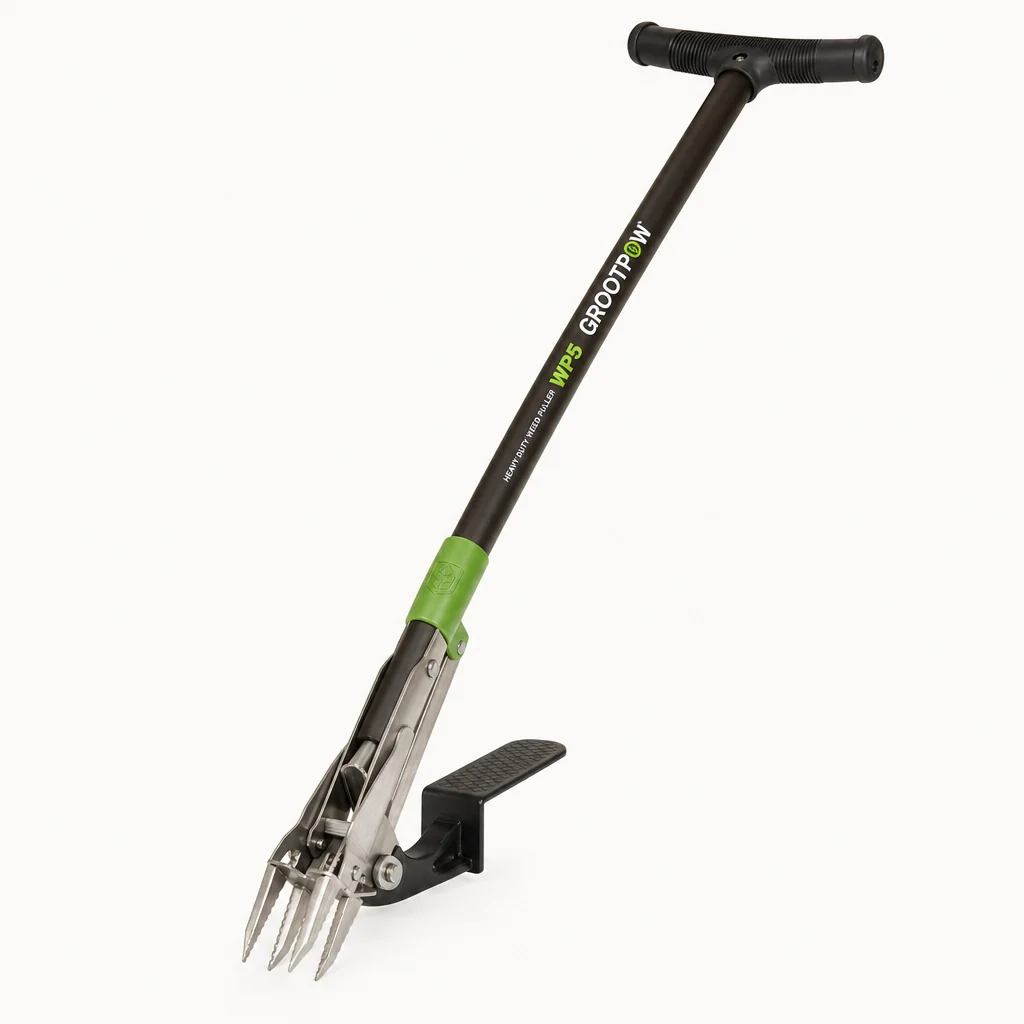
If your soil is the kind that turns to concrete in summer, the Grootpow WP5 deserves your attention. This is the tool built for exactly the conditions that defeat lighter weeders. It has a 40-inch handle, a cast-iron head described as nearly indestructible, and a three-claw design with wider prongs than most competitors — those broader claws grab more soil and root, giving a more secure purchase in difficult ground. The foot pedal is fibreglass-reinforced, and despite the robust build the overall weight remains manageable.
The headline is its soil performance. Where the Fiskars was only partially successful on dry compacted clay, the Grootpow WP5 genuinely excels in clay-heavy or compacted soils where other weeders struggle. If I gardened on heavy clay, this is the stand-up weeder I'd buy without hesitation. On soft, loose loam it's arguably overkill — a lighter tool would do the job with less effort — but for problem ground it's in a class of its own.
Walensee Weed Puller
The Walensee is the budget-friendly pick of the stand-up group. It has a 39-inch handle and a lightweight three-claw design, and it works well on softer soils. It's genuinely capable on the right terrain, and if you're weeding an area of loose, well-worked bed and don't want to spend a lot, it does the job. The main limitation I'd flag is that the foot peg is relatively small, which makes driving the claws down a slightly less comfortable and less powerful affair than on the Fiskars or Grootpow. For occasional use on easy soil, though, it's a sensible, affordable option.
| Model | Length | Claws | Head | Best Soil |
|---|---|---|---|---|
| Fiskars 4-Claw | 39" | 4 serrated steel | Stainless steel | Loose / post-rain |
| Fiskars 3-Claw | 39" | 3 serrated steel | Stainless steel | Firmer soils |
| Grampa's Weeder | 43–45" | 4 steel | Cast iron / steel | Moist, general |
| Grootpow WP5 | 40" | 3 wide-prong | Cast iron | Clay / compacted |
| Walensee | 39" | 3-claw | Steel | Soft soils |
Stand-Up Weeders: Pros
- Extract weeds entirely upright — no kneeling or bending
- Excellent on dandelions and tap-rooted weeds
- Use body weight and leverage, not grip strength
- Foot-pedal action drives claws deep in one step
- Lightweight aluminium models around 2.3–2.5 lb are easy to carry
Stand-Up Weeders: Cons
- Largely ineffective on fibrous, spreading roots
- Struggle in dry, compacted soil — taproots snap
- Too bulky for tight spaces between prized plants
- Budget models can have small, uncomfortable foot pegs
- Leave visible plugs of soil in a fine lawn
Compact Hand Weeders: Precision Where It Counts
Stand-up tools are wonderful in open ground, but the moment you're weeding a packed border, a container, a rockery or the narrow gap between two treasured perennials, they become a liability. This is where compact hand weeders earn their keep. They weigh a fraction of their stand-up cousins — hand tools typically weigh less than a pound, and the lightest models between six and twelve ounces — which considerably reduces user fatigue during extended weeding sessions. You'll be crouching or kneeling, so a kneeling pad is your friend, but the precision on offer is unmatched.
Fiskars Xact Extractor
The Xact Extractor is a specialist deep-root hand weeder, and it earned a BBC Gardeners' World Magazine Best Buy specifically for tackling stubborn, deep-rooted weeds. It has a long plastic handle, a lengthy stainless-steel head and a serrated edge that lets you drive down alongside a taproot and lever it free. The soft-grip handle is comfortable and doesn't slip even when your hands are damp and muddy, and it provides great leverage — that combination of a long head and a grippy handle is what lets it extract deep roots that a stubbier tool would simply break.
The Xact Extractor's award was specifically for stubborn, deep-rooted weeds — precisely the dandelion-type invaders that a stand-up claw handles in the open lawn but can't reach when they're nestled between plants. Think of it as the close-quarters specialist for the same job.
Niwaki Weeding Hoe
If the Xact Extractor is the precision extractor, the Niwaki weeding hoe is the precision slicer — and it too picked up a BBC Gardeners' World Magazine Best Buy, this time as best versatile hand weeder. It has a sharp, hooked carbon-steel blade that slices easily into the ground, letting you cut through weed roots just below the surface or hook out individual weeds with a flick. It's light and easy to use, comes in a handy bag with a protective sheath for the blade, and — a genuinely thoughtful touch you rarely see — it's available in both left- and right-handed versions.
That handedness matters more than you'd think with a hooked blade, because the cutting geometry only works properly when the hook faces the right way for your dominant hand. If you're left-handed and have spent years making do with awkward right-handed tools, the Niwaki is a small revelation. Carbon steel takes and holds a keen edge beautifully, though you'll want to keep it dry and lightly oiled to prevent rust — the protective sheath helps enormously there.
Two Award-Winners, Two Different Jobs
The Fiskars Xact Extractor won its Best Buy for deep-rooted extraction; the Niwaki hoe won for versatile slicing and general weeding. They're complementary rather than competing — many keen gardeners happily own both.
Featherweight Comfort
With hand tools weighing well under a pound — the lightest between 6 and 12 ounces — fatigue over a long session is dramatically lower than with a heavier tool. Your wrist and forearm will thank you after an hour of detailed border work.
Left- and Right-Handed Options
The Niwaki hoe's availability in both hand orientations is a genuine rarity in garden tools and a real quality-of-life improvement for left-handed gardeners.
Hand Weeders: Pros
- Unbeatable precision in tight spaces and containers
- Extremely light — often under 12 ounces — so low fatigue
- Xact Extractor: award-winning on deep-rooted weeds
- Niwaki hoe: award-winning versatility, sharp carbon steel
- Niwaki available for both left- and right-handers
Hand Weeders: Cons
- Require kneeling or crouching — not "pain-free" for backs
- Slow going over large areas
- Carbon steel blades need drying and oiling to avoid rust
- Not suited to open-lawn dandelion clearance at speed
Specialty Long-Handled Tools: Reach and Coverage
The third family sits between the other two in philosophy: long handles like the stand-up weeders for a bent-back-free posture, but blades and hoes rather than claws, so they slice and cover ground rather than extracting individual roots. These are the tools for keeping large areas on top of weeds and for reaching into the middle of deep borders.
LAWFYMORI Weed Puller
The most versatile of the specialty tools I've looked at is the LAWFYMORI, which has a 60-inch adjustable handle — noticeably longer than any of the stand-up claw weeders — and a clever dual-sided head combining a sharp triangle hoe on one side and a weeding rake on the other. The long stainless-steel handle is excellent for getting deep into flower beds without back pain, which is precisely the problem long-handled tools exist to solve. The dual functionality means you can chop and slice weeds with the triangle hoe, then flip the head to rake out the debris and loosen the surface — two jobs from one tool.
Other Long-Handled Designs
Beyond the LAWFYMORI, the specialty category includes a few other designs worth knowing about. There are stand-up weeders that pair a robust foot pedal with a bamboo handle, are adjustable for height and fold down for storage — a boon if your shed is already bursting at the seams. And there's the L-shaped blade weeder built specifically for tight spaces, mounted on a 55-inch handle so you can slide the angled blade under weeds in awkward corners while still standing upright. Each of these solves a specific problem, and the adjustability and folding features are exactly the kind of practical detail that makes a tool a keeper rather than something that migrates to the back of the shed.
Long-handled hoes and blades slice weeds rather than extracting whole roots. That's ideal for annual weeds and keeping large areas tidy, but for persistent taproots you'll still need a claw weeder or a hand extractor to remove the whole root.
Weight, Fatigue and How Much It Matters
It's tempting to dismiss a difference of a pound or two as trivial, but when you're carrying and swinging a tool for an hour or more, weight compounds into real fatigue. Let's look at the numbers across the categories, because they tell a clear story about matching tool weight to task.
A couple of things jump out. First, the stand-up claw weeders cluster in a fairly narrow band — the Garden Weasel WeedPopper at 2 pounds with its aluminium handle and stainless-steel head, the Fiskars 4-claw at 2.3 pounds, and the Fiskars Deluxe at around 2.5 pounds. These are all light enough that weight is barely a factor in normal use. Second, the leverage-style Landzie at 4 pounds is nearly double the Garden Weasel — that extra heft can be an advantage for driving through tough ground under its own weight, but it's noticeably more tiring to carry around a large garden.
At the other extreme, hand tools weigh less than a pound and usually no more than five or six pounds even for the heaviest specimens, with the truly lightweight models between six and twelve ounces. Those featherweight tools considerably reduce user fatigue during extended weeding tasks, which is exactly why they're the right choice for detailed, hours-long border work where you're making hundreds of small movements. The lesson: for open-ground extraction, a 2–2.5 lb stand-up tool is the sweet spot; for detailed close work, go as light as you can.
Match Weight to Task, Not Ego
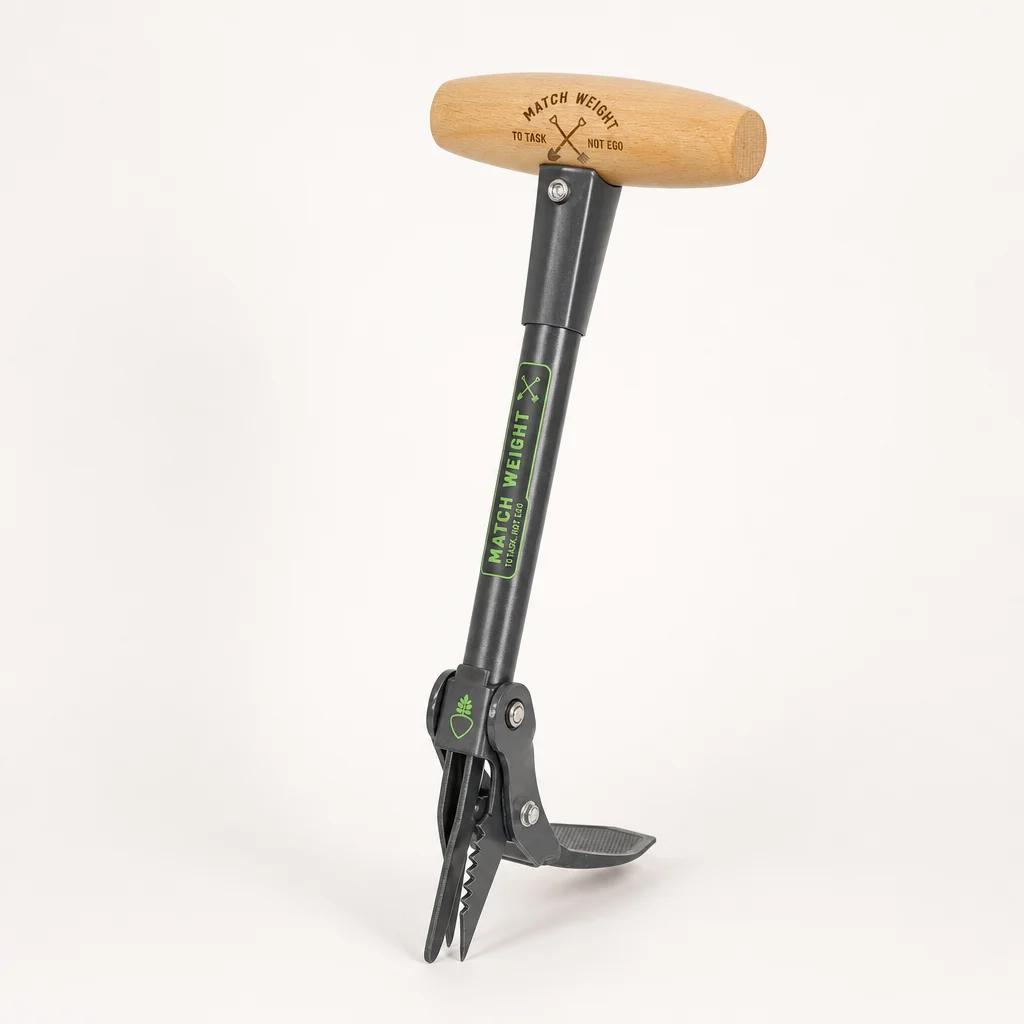
There's a temptation to buy the heaviest, most robust tool going, on the assumption that bigger equals better. But a 4-pound tool you dread picking up is worse than a 2-pound tool you'll happily use. Unless you specifically garden on clay that needs the mass, lighter almost always wins for enjoyment and endurance.
Matching the Tool to the Weed
This is the section I wish someone had sat me down and explained years ago, because it would have saved me a lot of wasted money. Different weeds have fundamentally different root systems, and that determines which tool will work. Get this right and weeding becomes genuinely satisfying; get it wrong and you'll be forever fighting the tool.
| Weed type | Root system | Best tool family | Top pick |
|---|---|---|---|
| Dandelions | Deep taproot | 4-claw stand-up | Fiskars 4-Claw / Grootpow WP5 |
| Taproot weeds in beds | Deep taproot | Hand extractor | Fiskars Xact Extractor |
| Crabgrass (soft soil) | Fibrous, spreading | 3-claw / hoe | Walensee (soft soil) |
| Crabgrass (general) | Fibrous, spreading | Hoe — not claws | Niwaki weeding hoe |
| Annual surface weeds | Shallow, fine | Long-handled hoe | LAWFYMORI triangle hoe |
The clearest rule is around taproots versus fibrous roots. Four-claw weeders are ideal for tap-rooted weeds, and both the Fiskars 4-Claw and the Grootpow WP5 excel on dandelions specifically — the four claws close around that single deep root and lever it out whole. Three-claw options like the Walensee work well on softer soils for crabgrass, where the roots aren't anchored too firmly. But here's the crucial caveat: stand-up claw weeders are largely ineffective on fibrous root systems such as crabgrass and other spreading weeds when the soil is anything but soft. Those weeds don't have a single root to grip; they have a dense, spreading mat, and a claw just tears through it leaving plenty behind to regrow.
For fibrous and spreading weeds in general, you want to slice rather than extract — which is exactly the Niwaki weeding hoe's forte, or the triangle hoe on the LAWFYMORI for larger areas. And for deep taproots that are growing in a packed border where a stand-up claw would damage neighbouring plants, the Fiskars Xact Extractor is the tool that lets you get the whole root out with surgical precision.
Soil Conditions: The Make-or-Break Factor
I've mentioned soil repeatedly, and that's deliberate, because in real-world testing it proved to be the single most decisive variable — more than the number of claws, more than handle length, more than brand. Let me lay out what actually happened in testing, because the numbers are instructive.
Moist Soil: The Ideal
In slightly moist soil the taproot extracts cleanly, coming out whole in one satisfying pull. The Fiskars performed at its best on looser, aerated soil the day after light rain. This is the condition every claw weeder is designed around.
Dry, Compacted Clay: The Enemy
In dry, compacted soil the taproot snaps rather than lifting. On dry compacted clay-based soil the Fiskars was only partially successful, managing weeds with small root systems but failing on larger ones.
The Clay Exception
The Grootpow WP5 was the standout in exactly these difficult conditions, excelling in clay-heavy or compacted soils where other weeders struggled — thanks to its wider prongs and near-indestructible cast-iron head.
So the practical playbook writes itself. If you can, weed the day after rain when the ground is soft and yielding — your success rate will soar regardless of which tool you own. If you garden on heavy clay and can't always wait for perfect conditions, invest in the Grootpow WP5, which is built precisely for ground that defeats lighter tools. And if you're stuck weeding dry, compacted soil with a lighter tool, water the area thoroughly an hour beforehand to soften it — a simple trick that transforms your results.
Testing was carried out across two soil types — dry compacted clay-based soil and looser aerated soil — with the same tools performing dramatically differently on each. It's the clearest possible illustration that your soil matters as much as your tool.
Head-to-Head: The Two Best-in-Class Claw Weeders
If you've read this far and simply want to know which stand-up weeder to buy, it comes down to your soil. For most gardens, the Fiskars 4-Claw is the all-rounder; for heavy clay, the Grootpow WP5 is the specialist. Here's how they stack up directly, with the Walensee included as the budget reference point.
| Feature | Fiskars 4-Claw | Grootpow WP5 | Walensee |
|---|---|---|---|
| Handle length | 39" | 40" | 39" |
| Claw count | 4 | 3 (wide prongs) | 3 |
| Head material | Stainless steel | Cast iron | Steel |
| Weight | ~2.3 lb | Manageable / robust | Lightweight |
| Viewing window | Yes | — | — |
| Easy-eject | Yes | — | — |
| Foot pedal | Reinforced, 30% stronger | Fibreglass-reinforced | Relatively small |
| Best on clay | Partial | Excellent | Soft soil only |
| Best on loose soil | Excellent | Excellent (overkill) | Very good |
The Fiskars wins on refinement — the viewing window and easy-eject mechanism are genuine daily conveniences, and the reinforced foot platform gives confidence. The Grootpow wins on brute capability in tough ground, with its wider prongs and cast-iron head shrugging off clay that leaves the Fiskars struggling. The Walensee wins on price and is perfectly good on soft soil, held back only by that small foot peg. There's no single "best" — there's a best for your particular patch of earth.
Our Overall Rating
Rating an entire category rather than a single product is unusual, so I've scored the field on the qualities that matter across all these tools: how comfortable they are to use, how well they extract, how they cope with difficult soil, how versatile they are across weed types, and how well-built they feel. This reflects the category at its best — with the right tool chosen for the right job.
The comfort score is deservedly high — the whole point of these tools is to spare your back and knees, and the stand-up claw weeders in particular achieve that beautifully. Extraction is strong, held back only by the physics of dry soil. The tough-soil score is the weakest across the field, dragged down by how much the lighter tools struggle in clay, though the Grootpow WP5 single-handedly lifts it. Versatility and build quality are both excellent, reflecting well-thought-out designs from Fiskars, the century-old durability of Grampa's Weeder, and the award-winning hand tools from Fiskars and Niwaki.
Who Should Buy What
The Lawn Dandelion Warrior
Buy the Fiskars 4-Claw. On loose or post-rain soil it extracts dandelions cleanly all day without you bending once. The viewing window and easy-eject seal the deal.
The Heavy-Clay Gardener
Buy the Grootpow WP5. Its wide prongs, cast-iron head and fibreglass-reinforced pedal excel in exactly the compacted, clay-heavy ground that defeats everything else.
The Taller Gardener
Buy Grampa's Weeder. The 45-inch bamboo handle keeps you upright, and the intuitive leverage action needs very little strength — a joy for taller or older gardeners.
The Border Perfectionist
Buy the Fiskars Xact Extractor. Award-winning on stubborn deep-rooted weeds, its long serrated head extracts taproots between prized plants without collateral damage.
The All-Rounder
Buy the Niwaki weeding hoe. Award-winning versatility, a keen carbon-steel blade, and left- or right-handed options make it the one hand tool to own if you own only one.
The Budget-Conscious
Buy the Walensee. On soft, well-worked soil it pulls weeds capably at a friendly price — just don't ask its small foot peg to tackle hard clay.
Frequently Asked Questions
The Verdict
Pain-Free Weeding Is Real — If You Match the Tool to the Job
After crouching, levering and stamping my way through this whole category, my conclusion is simple: there is no single best weeder, but there are clear best choices for specific situations. The stand-up claw weeders are the true back-savers, letting you extract deep taproots entirely upright, and for most gardens the Fiskars 4-Claw — with its viewing window, easy-eject mechanism and reinforced 30%-stronger foot platform — is the polished all-rounder to reach for.
If your soil is heavy clay, though, the Grootpow WP5's wider prongs and near-indestructible cast-iron head make it the specialist that succeeds where lighter tools snap taproots and give up. For taller gardeners, the century-old Grampa's Weeder and its 45-inch bamboo handle keep you gloriously upright. And when the work moves into the borders, the award-winning Fiskars Xact Extractor and Niwaki weeding hoe bring the precision that no stand-up tool can offer.
Above all, remember the one lesson that outranks every spec: weed when the soil is moist. Get that right, choose the tool that suits your ground and your weeds, and one of gardening's most dreaded chores becomes something you might — dare I say it — actually look forward to.